




Abstract
Sandwich structures with composite honeycomb core and skin have been mostly used for a variety of engineering applications. There are different man-made honeycomb structures with metal, polymer, and paper honeycomb cell geometry which provide minimum weight, least material content and minimal material cost. In this paper, the textile fiber-based 3 D woven honeycomb structure is engineered by using fabric geometrical parameters and mathematical expressions have been developed to calculate the repeat unit weight, fiber volume fraction (FVF) and specific weight of 3 D woven honeycomb structures. Five 3 D woven honeycomb fabric samples with different cell sizes were produced using model-based construction parameters on a customized rapier weaving machine. Fabric dimensional parameters were determined experimentally to validate the model value with actual results. A reasonably high agreement was observed between experimental and theoretical values. The model can be used as a tool to engineer woven honeycomb reinforcement architecture to produce lightweight structural composite materials.
Keywords
Introduction
Lightweight engineering is trying to find new solutions to make the product lighter but not weaker, at its best even stronger. One solution for lighter products is the usage of cellular structures, which include honeycombs. Manmade cellular materials are divided into stochastic structures and designed periodic structures, 2 D and 3 D shapes [1]. The cellular solids can also exhibit a low stiffness and strength behavior depending on their loading direction and this unique feature makes them ideal for cushioning and energy absorption applications [2]. With a low density and open pore structure, a cellular solid can be used to design stiff components, lightweight structures such as sandwich panels and large size portable structures [3]. In cellular solids, materials with structured cores are textile cores, corrugated cores and, honeycombs. Honeycomb cores are also used in aerospace due to their lightweight and high-performance properties. Unidirectional supports are given by corrugated core that is why they do not give strength in the direction perpendicular to corrugations [4]. Aramid and aluminum papers are used to manufacture honeycombs with inexpensive thermoplastic material to control cost and increase the applications beyond the aircraft industry [5]. Honeycomb has an open space of about 90–99 percent in its expanded form. Honeycomb cores for the sandwich panel are widely recognized for their mechanical performance and their economic advantages. The hollow spaces reduce weight but also ensure required strength, provided they are designed correctly. Composites made of the 3 D woven hollow structure are energy absorbent, superlight, strong as well as voluminous.
Honeycomb composites produced from different materials are used in variety of engineering applications primarily due to their excellent energy absorption behavior [6]. Sandwich panels with a honeycomb core are used as strength members of aircraft or satellites, which reduce structural weight effectively. Honeycomb structures are used in marine, automotive high-speed trains, mantle, industrial structure, thermal insulation or thermal management [7], packaging industry, especially in the space and aviation industry. Honeycomb structures can also be used in buffer design as energy absorber which will reduce accidents that occur in large vehicles which cause loss of life and property. In highway viaducts, these structures can also be used as road barriers to reduce accidents in sharp bends [8–10].
Honeycomb structures can be made by many methods like bonding up by glues, moulding and casting, resining and stiffening, and extrusion [11]. Mathematical modeling has been carried out by Chen et al. to create weave design and manufacture 3 D woven hollow fabrics of uneven surface [12,13] and flat or even surface [14]. There is an increase in interest in textile composites because of their attractive properties of light-weight and high energy absorption capability for a variety of applications. 3 D woven fabric gives an integrated structure, there will be no interlaminar separation or delamination and give higher mechanical properties like shear and tensile strengths. Honeycomb could be categorized as a spacer fabric, also called hollow structure, which gives better mechanical performance under bending stresses when the layers are connected with woven crosslinks rather than conventional pile yarns [15,16]. 3 D woven multilayer honeycomb preforms also provide lightweight integrated structure with no delamination and may replace metal honeycomb (aluminum, steel) as the composites of these structures will give high specific strength and stiffness [17].
Geometrical modeling of 3 D woven solid structures and hollow structures have been reported by several researchers to estimate fibre volume fraction and areal density from their respective unit cell [18–20]. The unit cell describes the whole reinforcing fabric. The unit repeat characteristics represent the entire composite behavior and it will remain constant which can be replicated in width and length direction to obtain a composite structure.
One of the major objectives of composite manufacturing from textile hollow structure preforms is to reduce the weight of the material with out compromising their mechanical performance. In case of hollow structures, the change in weave density, cell size and linear density of warp and weft yarns change the overall structural density. These structural changes directly influence the fibre volume fraction, repeat unit weight and specific weight of the preform and final composite structure. It is therefore important to understand the relationship between various fabric construction parameters and resulting dimensional properties of the fabric prior to weaving.In this paper, the geometrical modeling of a 3 D woven honeycomb structure is carried out to determine the repeat unit weight, fiber volume fraction (FVF) and specific weight to facilitate the weaver to decide all constructional details of the fabric before weaving. In 3 D weaving, honeycomb cell structures were changed by changing the number of picks. This model is then validated by comparing the predicted values of the model with experimental values.
Experimental procedure
Materials
Five 3D woven honeycomb fabrics have been produced with different cell structures from commercially available E- glass tow supplied by Owens Corning. The same yarn was used in both warp and weft direction. The mechanical and physical property of E-Glass tow is given in Table 1. Tensile properties of E-glass tow were determined on Instron Tensile Tester as per ASTM D 2256-02 standard.Tow linear density and fibre density were taken from the supplier’s brochure. Properties of E-Glass tow.
Methodology
Representation of 3 D woven honeycomb structure
The geometrical parameters of 3 D woven honeycomb fabric can be changed by changing the number of picks in the required section of the repeat unit of honeycomb fabric. Based on this idea, different parameters of the honeycomb fabric shown in Figure 1 can be changed are bonded wall length (lb), free wall length (lf) and the height of cell (h). Other parameters of a honeycomb cell are opening angle (θ), bonded wall thickness (tf), and free wall thickness (tb).

Unit honeycomb cell.
General coding format developed to denote the particular honeycomb structure is:

In the above, z, x, y are integers and z > 2, x > 1, y > 1.
According to format discussed above (5,7)P3L45 honeycomb structure stands for a structure comprising 5 picks in the free wall, 7 picks in the bonded wall, 3 layers in the bonded wall, and the opening angle is 45 degree. If the format is 5P4L60, then the honeycomb structure shows that structure has 5 picks in both free wall and bonded wall, 4 layers of bonded wall and the opening angle is 60 degrees. The schematic representation for 5P4L60 is shown in Figure 2. The weft yarn is represented by the straight line and curved lines show the warp yarns in the cross-section diagram.

Cross-section representation of honeycomb structure 5P4L60 sample.
Production of 3 D woven honeycomb fabric
In this study, all the 3 D woven honeycomb samples were prepared on a customized rigid rapier weaving machine. This machine is capable of running at a maximum weft insertion rate of 750 meters per minute with one meter reed width. The machine is installed with four beam arrangement with independent take-up and let-off mechanism. The machine has 24 heald shafts equipped with electronic dobby and a customized CAD system for weaving various designs to produce different variety of fabrics like 3 D multilayer solid structures, spacer fabrics, and 3 D honeycomb structure.
Weave design is the basic and primary element to start the weaving process. To prepare the samples of honeycomb fabric with varying cell geometry, each structure was made by different weave designs. The designs produced must be compatible with 2 D weaving system. To meet this requirement, all designs are prepared on the double cloth principle which has two distinct layers separate from each other. Both layers of honeycomb fabric then integrated at a particular point to produce a honeycomb structure. The interlacement of warp and weft in all the walls follow one up one down plain weave pattern.
To produce honeycomb fabric, warp yarns are taken from four beams. In this way, five samples were produced with different free wall and bonded wall-length keeping opening angle (60°) constant. The produced fabric samples for 5P4L60, 7P4L60, (5,3)P4L60, (5,7)P4L60 and(7,5)P4L60 are shown in Figure 3(a) to (e) respectively

3 D woven honeycomb fabric sample (a) 5P4L60 honeycomb (b) 7P4L60 honeycomb (c) (5,3)P4L60 honeycomb,(d) (5,7)P4L60 honeycomb and (e) (7,5)P4L60 honeycomb.
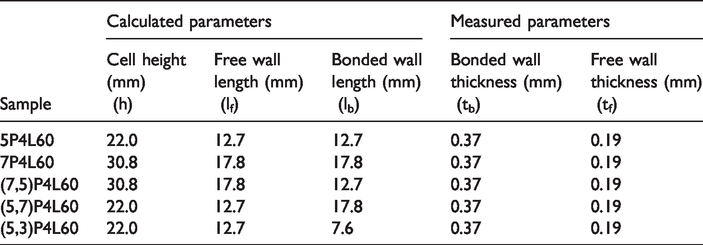
The actual ends and picks density is 3.94 per cm and nomial thread density is 4 picks per cm. The structural parameters of five 3 D woven honeycomb fabrics are given in Table 2. Some of the structural parameters were obtained through calculation and some were obtained experimentally. Bonded wall thickness (tb) and free wall thickness (tf) were measured by digital thickness tester as per ASTM D1777 standard.Other parameters such as free wall length (lf), bonded wall length (lb) and cell height (h) were calculated by equation (1) and equation (2) respectively.
Structural parameters for 3 D woven honeycomb fabric.
Similarly, for calculating height of cell(h) trigonometric relationship can be used by taking reference of Figure 1:
Modeling approach
The dimensions of the cell structure of honeycomb can be calculated by the length of each section in terms of the number of picks, and the angle of connecting fabric(s) layers. The individual section of the honeycomb fabric structure is composed of 2 D woven fabric. Cell structural parameters like free wall length, bonded wall length and cell height of the structure can be changed by changing the number of picks in free and bonded wall of the fabric, which changes the fabric volume and this change will correspond to repeat unit weight, FVF and specific weight of 3 D woven honeycomb fabric. The repeat unit of the honeycomb structure with different sections and layers is shown in Figure 4.

The repeat unit of the honeycomb structure.
The geometrical model is developed by using weft and warp spacing in all layers, their waviness, yarn linear densities and the structural parameters of the honeycomb repeat unit of the structure. For the calculation of several output parameters, the input parameters used in the model are listed below.
Input parameters
Output parameters
In one repeat unit, the total weight of warp was calculated by the following sequence of equations:
One warp length in qth section of pth layer
One warp yarn length in pth layer,
Total length in pth layer of warp yarns,
In each layer, the weight of warp is
In one repeat unit, the total weight of warp,
The total weight of weft in one repeat unit is calculated by the following sequence of equations:
Length of weft yarn in qth section of pth layer,
Weight of weft in qth section in pth layer,
Weight of weft yarn in qth section of the structure,
Total weight of weft in one repeat unit,
Total weight of one repeat unit,

Then with the use of structural parameters of the unit cell of the honeycomb structure, the volume of the unit hexagonal cell as shown in Figure 5 can be determined. Subsequently, the repeat unit weight, Fiber Volume Fraction (FVF) and specific weight can also be calculated.

The unit hexagonal cell of the honeycomb.
The volume of one hexagonal cell (Vh) = ½ lb h (no. of central triangles)H (13)

Calculation of the volume of repeat unit cell, FVF, and specific weight


However, if the fabric structure has different fiber materials in weft and warp, then the above equations can be generalized to calculate the FVF of such structures. These equations (3) to (12) can be used separately to calculate the weight of individual fiber components. The total volume or volume of the repeat unit is calculated by using equations (13) to (16). FVF of such different materials can be calculated by using the equation (19).
Where x = 1, 2, 3,…., k for different materials.
MATLAB (version R2019a) platform was used to calculate the total weight of weft and warp, specific weight and its FVF by using theoretical equations provided above. It was reported that, when the fabric is woven from multifilament glass tows [18] or polyester tows [19], the cross-section of tows take ellipsoidal shape. The crimp in the yarn is calculated using the standard formula [21] as “(Excess of the modular length over thread spacing)/(thread spacing)”. Hence, geometrical parameters can be predicted before the actual production of any honeycomb fabric.
Results and discussion
Comparison of predicted and experimental geometrical parameters
Five different fabric samples were produced to validate the model. The predicted and experimental repeat unit weight, FVF and specific weight for 3 D woven honeycomb structure are depicted in Figure 6(a) to (c) respectively. Error% in prediction was calculated from equation 20.

Measured and computed result for honeycomb fabric (a) Repeat unit weight (b) FVF (c) Specific weight.
The results show that the geometrical model gives a close approximation of the result, with a maximum error of 4%. Model is capable to predict the repeat unit weight, FVF and specific weight with prediction accuracy of more than 95%.
Prediction of repeat unit weight, FVF, and specific weight
The results of geometrical modeling for repeat unit weight, FVF, and specific weight are calculated for different number of picks in the wall. It may be observed that with the increase in the number of picks, the wall-length increases (both free wall length and bonded wall length) with the simultaneous increase of cell height. This is due to the obvious requirement of extra space occupied by the addition of picks in the wall. Here four values of picks namely 3, 5, 7 and 9 were taken in free and bonded wall length, these values are interchanged to form different types of samples that have different dimensions of wall length which can be changed by changing the number of picks. Then repeat unit weight, FVF and specific weight was calculated. The results are shown in Table 3.
The three different characteristics of fabric namely repeat unit weight, FVF and specific weight were calculated by geometrical modeling.
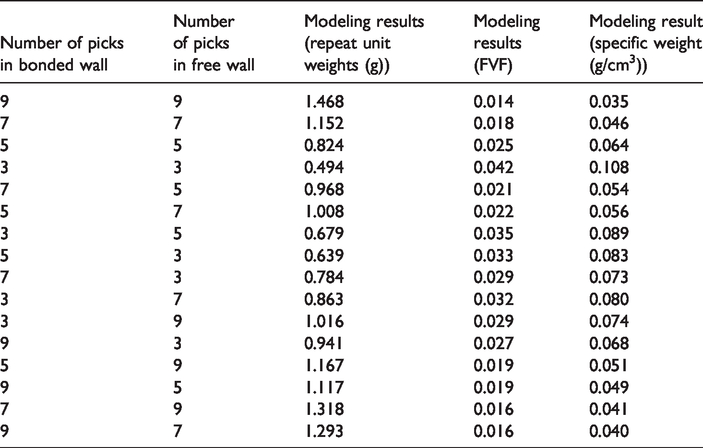
From the Figure 7(a) to (c), it may be concluded that with increase in the number of picks in both free wall and bonded wall of the honeycomb cell, repeat unit weight increases whereas fibre volume fraction and specific weight of the unit cell decrease. This may be attributed to the fact that extra weft in internal cell walls due to more number of picks increases the fabric weight. However, these extra picks increase the wall length and cell height in each section increase the overall volume of the fabric resulting in a decrease in fiber volume fraction and specific weight of the honeycomb structure.
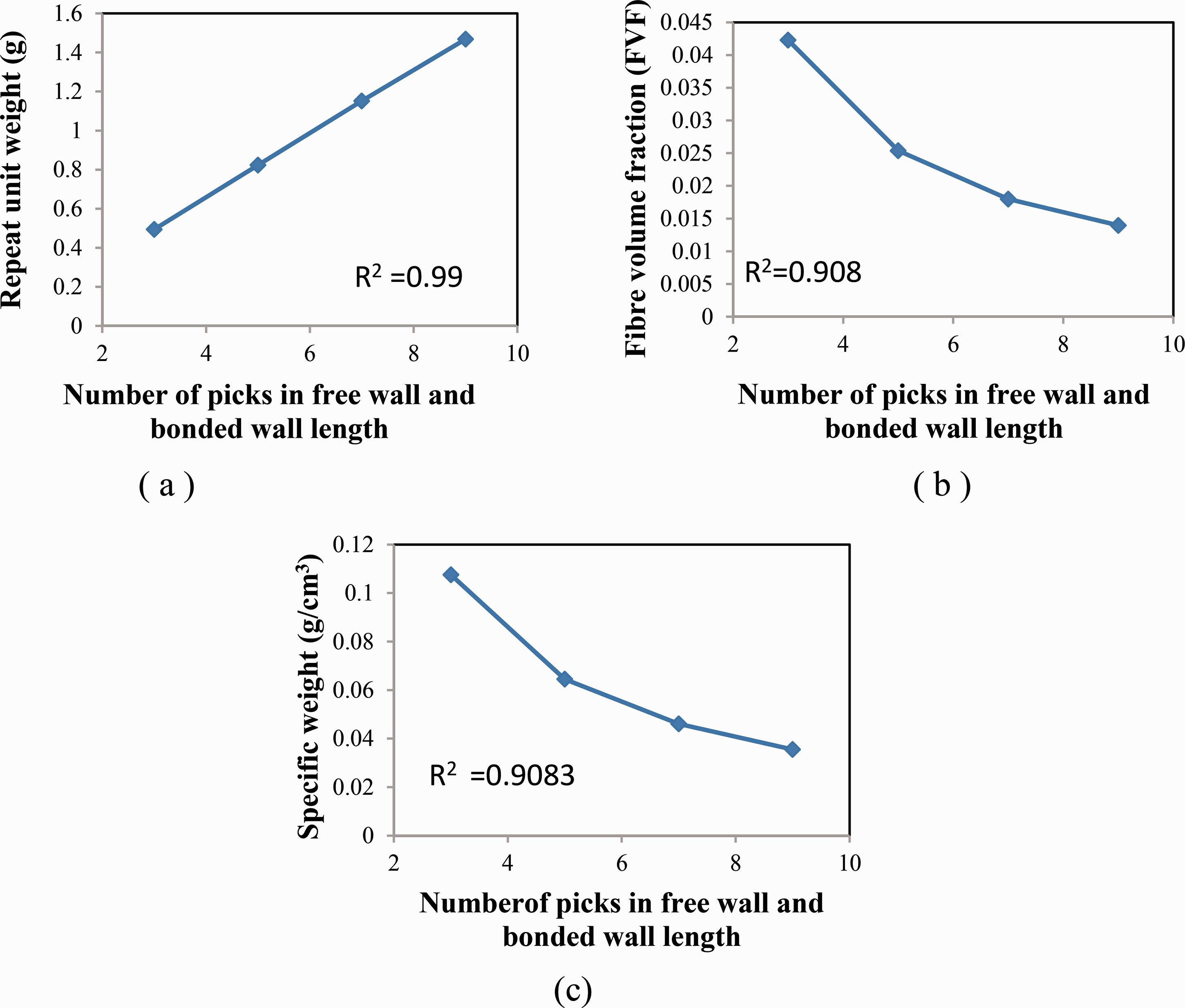
The predicted value for different value of wall length (a) Repeat unit weight (b) FVF (c) Specific weight.
In the second part of geometrical modeling the effect of number of picks in free wall and bonded wall are examined separately on repeat unit weight, FVF, and specific weight of the honeycomb cell. The influence of number of picks in free wall on repeat unit weight, FVF, and specific weight of honeycomb cell with constant picks in bonded wall is shown in Figure 8(a) to (c) respectively. Similarly the influence of number of picks in bonded wall on repeat unit weight, FVF, and specific weight of honeycomb cell with constant picks in free wall is demonstrated in Figure 9(a) to (c) respectively. It is clearly evident from these plots that the increase in number of picks increases repeat unit weight and decreases FVF and specific weight irrespective of the change in picks in free wall and bonded wall. The result also reveals that the relative increase in volume of unit cell is much higher than the relative increase in material weight because of extra picks in free wall and bonded wall.

The predicted value for different picks in free wall length with constant picks in bonded wall length (a) repeat unit weight (b) FVF (c) specific weight.
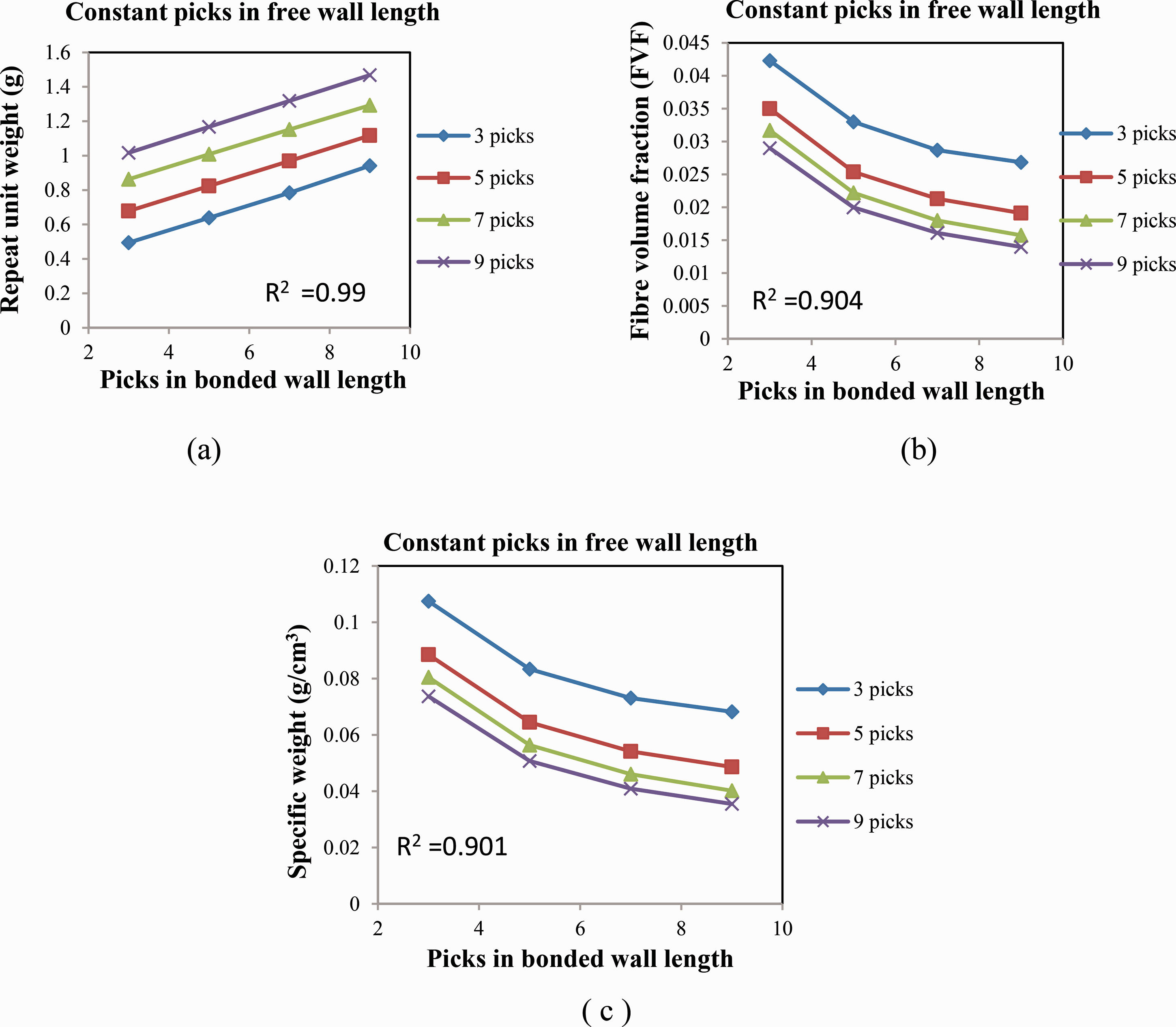
The predicted value for different picks in bonded wall length with constant picks in free wall length (a) repeat unit weight (b) FVF (c) specific weight.
Conclusions
Geometrical modeling of honeycomb fabric was carried out to predict the weight of a repeat unit, FVF and specific weight of 3 D woven honeycomb fabrics. This model considers the structural parameter of the cell, fabric constructional details of different sections and material properties. Dimensions of the structures were changed by changing the number of picks in free and bonded wall. The results show a good approximation of repeat unit weight, FVF and specific weight of honeycomb structures, the accuracy of the modeling result is greater than 95% in all honeycomb structures. It is concluded that with increase in the number of picks in both free wall and bonded wall, repeat unit weight increases whereas fibre volume fraction and specific weight of the honeycomb cell decrease. The result also reveals that the relative increase in volume of unit cell is much higher than the relative increase in material weight because of extra picks in free wall and bonded wall. The model is capable to estimate the constructional parameters of a 3 D woven honeycomb fabric that can be used to develop 3 D woven honeycomb composite with desired repeat unit weight, fiber volume fraction and specific weight.
Footnotes
Acknowledgements
The project team sincerely acknowledges the Ministry of Textiles, Government of India for sponsoring this project to Focus Incubation Centre of 3D Fabric and Structural Composite.
Declaration of conflicting interest
The author(s) declared no potential conflict of interest with respect to the research, author-ship, and/or publication of this article.
Funding
The author(s) received no financial support for the research, authorship, and/or publication of this article.
