




Abstract
A novel 3D braided material was found based on the traditional 3D orthogonal woven process. The mesostructure of novel 3D braided material is similar to the 3D orthogonal woven material, but only coincide in the Z-direction. The processing technique is easy to operate in automatic process. The representative volume unit has been proposed to establish geometric model. The fiber volume fraction of novel 3D braided material is analyzed and its value is higher than the traditional 3D orthogonal woven material ones. The experimental results show that the braided process of the imperfect orthogonal 3D braided material is rational and feasible.
Introduction
3D braided composites have great potential applications in aerospace and other high temperature-resistant structure, extending to the medical and sports and automotive industries, because it has a lot of advanced properties, such as its modulus and damage tolerance and fracture toughness are high [1, 2]. 3D orthogonal composites as a main branch of 3D braided composites have been widely used in the fields of aircraft, high performance vehicles, marine submarines and soil engineering due to their outstanding physical, mechanical and thermal properties [3–5]. To make 3D orthogonal composites widely applied, many researchers have spent great efforts on the understanding of the mechanical properties of its reinforced phase in the past [3–13].
Luo et al. [6] examined the transverse impact behaviors of 3D orthogonal hybrid woven composites and found that energy absorption of the composites increases with the impact velocity. Kuo et al. [7] found that the compressive failure behavior of 3D carbon/epoxy composites was influenced by the difference of the weaving process. Ji et al. [8] analyzed the damages of 3D orthogonal woven composites circular plate by Materials Test System and modified split Hopkinson bar apparatus. Rudov-Clark et al. [9] studied the tensile fatigue properties of a specific type of 3D orthogonal woven composites. Sun et al. [10] employed the method of finite element analysis and experiment to analyze the ballistic impact damages of 3D orthogonal woven composites. Buchanan et al. [11] presented an analytical model changing the weaving parameters and constituent material types to predict the elastic stiffness performance of orthogonal interlock-bound 3D woven composites. Li et al. [12] proposed an evaluation of 3D orthogonal woven composites elastic modulus by applying meshfree methods on the micromechanical model of the woven composites. Mahmood et al. [13] developed a generic stiffness model to predict the engineering elastic constants of hybrid composites. Jia et al. [14] analyzed the deformation and damage mechanisms of 3D orthogonal woven composites under three-point bending based on finite element analysis at micro/meso/macro-scale level.
Many researchers have made efforts to further investigate the mesostructure of 3D orthogonal woven composites. Jia et al. [15] investigated the ballistic penetration of conically cylindrical steel projectile into 3D orthogonal woven composite through finite element analyses and ballistic impact tests. Ghosh et al. [16] studied the influence of Z-fibers on 3D orthogonal woven composite architecture during high speed penetrative impact using a straightforward meso-scale model. Pazmino et al. [17] analyzed the effect of in-plane shear deformation on the composite reinforcement geometry by X-ray micro-computed tomography observations. Guo et al. [18, 19] analyzed the influence of 3D orthogonal woven fabric parameters on the fiber volume fraction and compared the test values and model ones of the fiber volume fraction.
3D orthogonal woven composites, which conquer the layering problems of the traditional two-dimensional laminated composites, greatly improved the performance along the thickness direction and other mechanical properties of the composites. The traditional 3D orthogonal woven process is more complex, and the processing efficiency is poor, which affects its high efficiency production and wide application.
An imperfect orthogonal 3D braided material is proposed to avoid the problem in this research work. The mesostructure of novel 3D braided material is similar to the 3D orthogonal woven material, but only coincide in the Z-direction. The yarns of the 3D orthogonal woven material are along the three directions in Cartesian coordinate system, whereas the yarns of the imperfect orthogonal 3D braided material only coincide in the Z-direction.
The internal structure of the material is analyzed, and the process of the novel 3D braided material is studied. The representative volume unit has been proposed to establish geometric model and analyze the performance of this material. On the basis of the geometric model, the geometric parameters of the material are discussed. The novel material is obtained by the novel braided process in laboratory.
Structure of novel 3D braided material
The novel braided material is based on the traditional 3D orthogonal woven process. The yarns in 3D orthogonal woven material are along the three directions of the coordinate system, whereas the yarns in novel 3D braided material only coincide in the Z-direction. The internal structure of the novel material is analyzed in detail in this section.
The inner yarns of novel 3D braided material are divided into three groups (Figure 1). Yarn ‘I’ and ‘II’ are alternately distributed in the vertical direction, and the yarn ‘III’ that is perpendicular to the horizontal plane shuttles back and forth in the diamond holes formed by yarn ‘I’ and ‘II’. The angle θ The yarns division of novel 3D braided material.
Novel braided process
The reinforced phase of 3D orthogonal woven composites is often manufactured by the traditional 3D orthogonal woven process which is faced with low production efficiency. A novel 3D braided material is found based on the traditional 3D orthogonal woven process, which corresponds to a novel 3D braided method. The cross movement rules of the yarns to meet the material geometry are to be discussed in this section.
The distribution of the carriers carrying the yarns is illustrated in Figure 3. Each symbol The carrier array of the novel braided process. represents a carrier, and the arrow points denote the direction of movement. The movement trajectory of the yarns does not change during the process, and all the carriers move once along the direction of the arrow to complete a braided cycle.

Step 1: The carriers carrying the yarns are distributed in its regular orbit, and the other end of the yarns is fixed on a plate (shown in Figures 3 and 4).
The position of two group yarns before braiding.
Step 2: The carriers in the same orbit move once along the direction of the arrow. After moving one-step, the two sets of yarns intercross in the space and form a group of diamond holes in the horizontal plane projection as shown in Figure 5.
The diamond holes in the horizontal plane projection.
Step 3: The yarns (group III) shuttle back and forth among the diamond holes. As shown in Figure 6, the movement trajectory of the yarns in the vertical direction is illustrated.
The movement trajectory of the yarns in the vertical direction.
Step 4: Repeat steps 2 and 3 at least circle times.
Each group yarn of novel 3D braided material is approximately straight in the novel material, only bending at the edge of the boundary. As these steps of motion continue, the yarns move throughout the diamond holes and form the novel braided material finally (as shown in Figure 7).
Theoretical model of novel 3D braided material.
The geometric model of novel 3D braided material
Due to the mesostructure of 3D braided composites with periodic characteristics, the analytic model is usually used to predict the mechanical properties of its reinforced phase [20]. According to the structure feature of novel 3D braided material, the representative volume unit, which is the smallest periodic structure, is proposed to produce the whole structure by translating its copies. To predict the mechanical properties of novel 3D braided material produced by novel braided process, a geometric model including representative volume unit has been presented in this study.
Basic assumptions
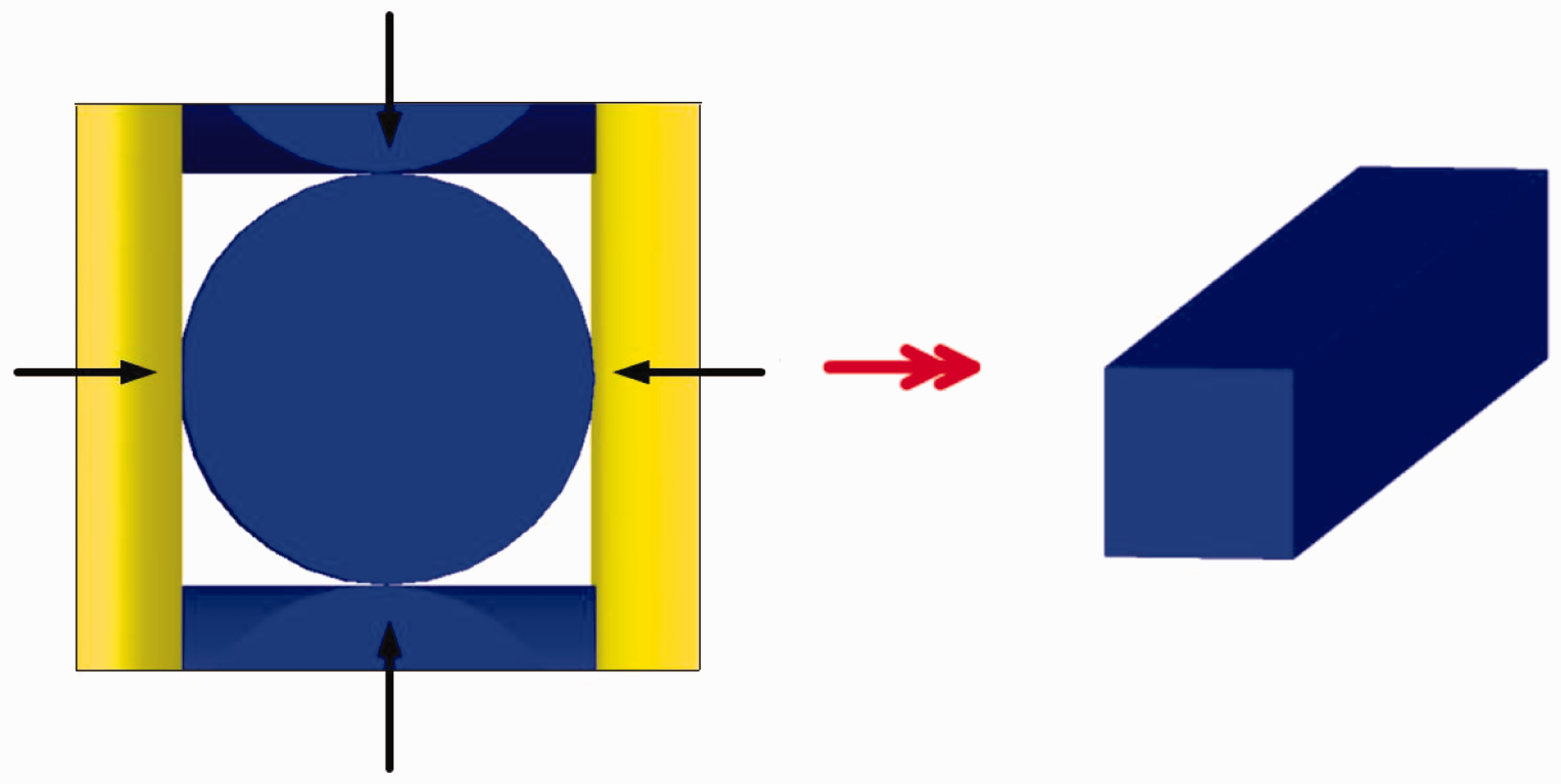
For considering the mutual squeezing of the yarn ‘I’ and ‘II’, the cross section of the yarns is assumed to be rectangle (Figure 8). As the squeezing condition of the yarn ‘III’ is different from the yarn ‘I’ and ‘II’, the cross section of the yarn ‘III’ is assumed to be diamond with the minimum angle θ (Figure 9). The yarn is flexible enough and produces a geometric deformation with the change of the braiding loads. The braided process is sufficiently stable, and the braided geometry is consistent within some range of the material. The influence of the surface structure can be ignored with the increase of the whole dimensions. The internal yarns of the braided material are straight, only bending at the corner. The diagram of the yarn ‘III’ bearing the lateral squeezing. The diagram of the yarn ‘I’ and ‘II’ bearing the lateral squeezing.

Structural parameters
As illustrated in Figure 10, the interior unit that is the smallest periodical unit is selected by considering the periodical distribution feature of novel 3D braided material. By analyzing the geometric relation of the interior braided yarns, the geometric model of novel 3D braided material is established and given in Figure 11. Figure 11(a) shows the topological relation of the main yarns in a parallelepiped unit with the width of a, the thickness of b, and the pitch height of h. As shown in Figure 11(b), θ is the angle formed by the yarn ‘I’ and ‘II’ in xoy plane.
The total volume of the unit and the length of the yarns. The representative volume unit. The relationship of simplify yarns in the given coordinate system.


As illustrated in Figures 10 and 11, the total volume of the unit can be obtained.

Let the front L1, L2, and L3 stand for the length of the yarn ‘I’, ‘II’, and ‘III’, respectively. According to the geometric relationship shown in Figure 11, the length of the yarns can be calculated as follow
The cross-sectional area of single yarns

In the representative volume unit (Figure 10), the yarn ‘I’ and ‘II’ are represented by quadrangular prism with a rectangular cross section, and the yarn ‘III’ is represented by quadrangular prism with a diamond cross section. As shown in Figure 10, let A1 and A2 stand for the cross sectional area of the yarn ‘I’ and ‘II’, respectively.

Let the front A3 stand for the cross sectional area of the yarn ‘III’. After analyzing the geometric relation of the parameters, it can be given as follows
The reduction coefficient

Due to the influence of yarn deformation on the geometry of the unit, a reduction coefficient λ of yarn section is introduced.


The font R represents the equivalent radius of the yarn. It is determined by the yarn linear density
The extent of λ is
The yarns volume and fiber volume of the braided material

The total volume Us of simplify yarns in Figure 10 is

The total volume of the original yarns is

The assemble factor ɛ of the yarns is proposed to predict the fiber volume fraction. The maximum value is [19]

The total volume of the fiber in the unit is
The fiber volume fraction of the novel braided material

The fiber volume fraction Vf can be deduced by formula (1), (10) and (11).

The fiber volume of the yarn without deformation is

When the cross-section of the braided yarn is circular, the fiber volume fraction of the novel braided material is the minimum. It can be deduced by formula (1), (2), (8) and (13).

The fiber volume fraction Vf
According to the above modeling strategy, the process was developed to calculate the parameters of the geometric model. The reduction coefficient λ and the assemble factor ɛ affect the fiber volume fraction. Under ultimate limit states, the fiber volume fraction Vf cannot achieve the maximum. According to the formula (14), the fiber volume fraction is the minimum because of its loose structure when the cross section of the braided yarns is circular. Compared to the value of the fiber volume fraction in [17, 18], its maximum of the traditional 3D orthogonal woven material is lower than the novel braided material ones. The novel braided material is still in theoretical research, which can only be predicted and analyzed qualitatively.
Experimental results and discussion
To verify the feasibility of the novel braided process, the following experiment was done on the basis of theoretical research. The sample is braided by 6 × 6 arrays. The distribution of the carriers is illustrated in Figure 3. As shown in Figure 5, the two sets of yarns intercross in the space and form a group of diamond holes in the horizontal plane projection after moving one step. The movement trajectory of the yarns in the vertical direction, which is different from Figure 6, is illustrated in Figure 12. The novel braided material can be obtained in the laboratory based on the definitive array of the yarns and motion method.
The movement trajectory of the yarns in the vertical direction.
Comparing the experimental results and simulation model of novel 3D braided material, it is clear that the geometry of the novel material is similar to the simulation model, and the yarn path is identical. As shown in Figure 13(a), the 3D shape of the novel 3D braided material is illustrated. The top view and left view are expressed in Figure 13(b) and (c), separately.
Experimental results and simulation model of novel 3D braided material.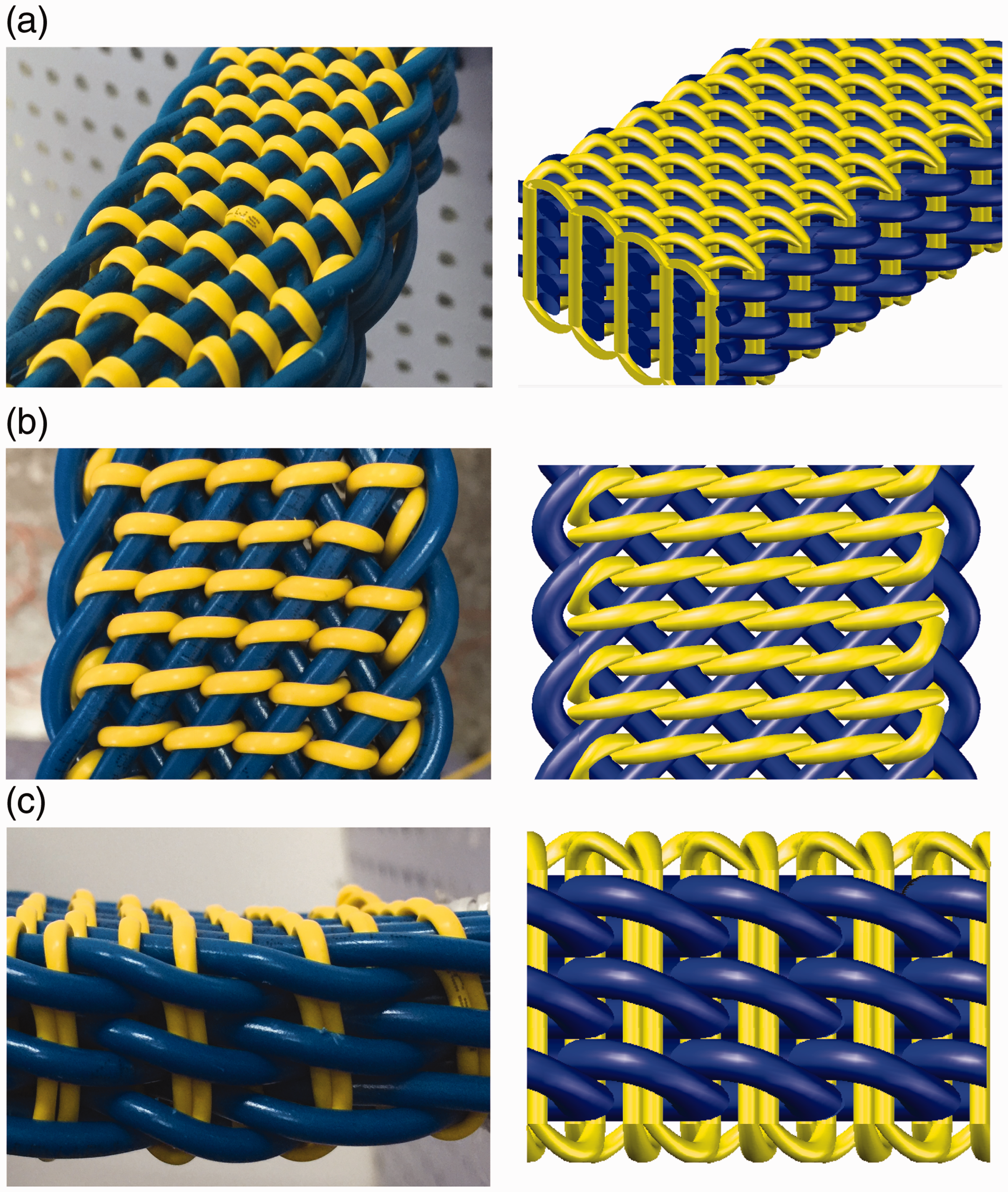
Conclusion
The mesostructure of novel 3D braided material produced by the novel braided process has been analyzed in detail. The movement rules of the yarns were analyzed, and the novel braided process was simple and easy to operate. The representative volume unit has been proposed to establish a geometric model. The fiber volume fraction of novel 3D braided material corresponding to the reduction coefficient of cross section and the assemble factor was obtained. The geometric parameters have been defined and compared with the traditional ones based on the geometric model. The performance of the novel braided material is better than the traditional 3D orthogonal woven material. The experimental results show that the process of the novel braided material is rational and feasible. The novel braided process is easy to operate in automatic process.
Z-direction view of novel 3D braided material.
Footnotes
Declaration of Conflicting Interests
The author(s) declared no potential conflicts of interest with respect to the research, authorship, and/or publication of this article.
Funding
The author(s) disclosed receipt of the following financial support for the research, authorship, and/or publication of this article: This project was supported by a grant from Foundation of Henan Educational Committee (Project serial number: 14A460012). This project was supported by a grant from the Education Department Jiangsu Province (Project serial number: BK2009002).