




Abstract
Aiming at the traditional single-needle electrospinning technology, a novel system for the efficient production of multi-production nanofibers through electrospinning is reported. The polymer solution is delivered to the liquid tank, and when the applied voltage exceeds a certain value, a plurality of nozzles is formed. In this paper, the electric field distribution of pinhole cylindrical spinneret structure is studied by simulating the electric field intensity with finite element software. The diameter and yield of the nanofibers were investigated by varying the center electrode voltage and the annular collector radius. The results show that the diameter and productivity of nanofibers are affected by the electric field intensity around the spinneret. Increasing the applied voltage and collecting distance has some significant effect on the diameter of nanofibers. The diameter of nanofibers increases with the concentration of the solution. The maximum yield of nanofibers is 3.1 g/h. It is noteworthy that this method not only greatly improves productivity but also significantly reduces the influence of solvent evaporation during electrospinning. This spinning method provides support for large-scale production of nanofibers in the future. This will be conducive to the further development of electrospinning, increase production, and more accurate control.
Introduction
The preparation of nanofibers from electrospun polymeric materials has received wide attention [1–3]. The main principle of the electrospinning process is to break the balance between surface tension and electricity, that is, the charged body forms a Taylor cone under a strong electric field, and when the electric power overcomes the surface tension, the charged jet is ejected from its tip [4]. Nanofibers have broad application prospects in tissue regeneration and drug delivery [5,6], energy storage [7], biosensors [8,9], composite materials [10,11], biomaterials, and wound dressings [12,13].
Because of its simple setup [5], large-scale production [14], size controllability [15], and easy combination with other materials [16], electrospinning is one of the most useful processes for manufacturing nanomaterials and hybridizing these materials with multi-functional nanoparticles [8,9]. But the traditional electrospinning technology only needs one needle to produce nanofibers, and its output can be ignored. Because the needle is easy to block, the control and maintenance are also very troublesome. Therefore, needle-free electrospinning has attracted wide attention because of its large-scale production capacity. For example, Liberec University of Czech Republic [17] first proposed a method of electrospinning rotating electrodes instead of needles, which produces large quantities of nanofibers. This method connects the high voltage power supply to the metal shaft immersed in the solution tank. Peng et al. [18] designed bubble models to control the morphology of fibers, especially nanoporous fibers. Wuhan [19] designed the annular spinneret and simulated the electric field. Therefore, there is still enough space to explore new needle-free electrospinning spinnerets, which can overcome shortcomings in a short time.
In this paper, a new type of multi-pinhole cylindrical spinneret is introduced to prepare high-throughput nanofibers. The effects of different voltage and receiving distance (distance from spray hole to the receiving plate) on the morphology of nanofibers were calculated by the finite element method. The properties of electrostatic spinning were studied, the distribution of electric field intensity was analyzed, and its mechanism was understood. It is concluded that the new spinneret has potential application prospect in the mass production of nanofibers.
Experimental
Electrospinning
The new cylindrical nozzle is a needle-free electrospinning method for nanofibers. The system mainly includes high voltage power supply, liquid tank (nozzle), annular collector, central electrode, and power device (piston), as shown in Figure 1. The new sprinkler looks like a hollow cylinder (radius 5.00 cm, height 10.00 cm, thickness 1.00 cm) with four holes of 1.68 mm in diameter in one row on the surface of the cylinder. In the center of the cylinder, there is a central electrode with an equal height radius of 10.00 cm. The central electrode is connected to a high voltage. The annular receiving board (10 cm thickness and 14.00 cm height) is grounded. In electrospinning, the power device drives the piston to flow the polymer solution out of the hole. The nanofibers were collected and spun on an annular metal plate covered with aluminum foil.

Schematics of the experimental setup.
Materials
Polyacrylonitrile (PAN, average molecular weight 75,000 g/mol) was obtained from Shanghai Chemical Fibers Institute. Dimethylformamide (DMF) was obtained from Sigma-Aldrich. Dissolve 1.21 g PAN in 5 ml DMF, heat the mixture at 50°C and stir for 12 h.
Electrospinning setup
PAN solution is stored in the liquid tank and flows out of the hole by moving the piston of the power unit. Figure 2(a) is a nanofiber membrane prepared by a cylindrical nozzle. The concentration of the solution is 10 wt%, the piston decreases at the speed of 1.2 mm/min, and the radius of the collecting plate is 18 cm. At the same time, the traditional single-needle device is compared with the annular spinneret device. Figure 2(b) is the physical schematic diagram of the conventional device of single needle spinneret. Figure 2(c) shows the size of the nanofiber membrane using a single needle spinneret. By calculation, the production efficiency of single needle spinneret is about 0.03 g/h.

(a) Nanofibers prepared by cylindrical nozzle. (b) Physical diagram of conventional single needle spinneret, spinning process parameters: solution concentration 10 wt%, applied voltage 20 kV, collection distance 15 cm, solution flow rate 0.5 ml/h. (c) Nanofiber membrane was prepared by a single-needle nozzle.
Characterizations and measurements
Scanning electron microscopy (Quanta-250, FEI) is used to characterize the morphology of nanofibers, and Image J software (NIH, USA) is used to calculate the diameter of nanofibers. The productivity of the nanofibers was analyzed by weighing the amount produced every 60 min of the spinning time. Based on COMSOL Multiphysics 5.0, the electric field distribution and electric field intensity in the whole working area were simulated by the finite element method. The central electrode voltage is set to change from 25 to 50 kV, and the ring collector (radius from 15 cm to 25 cm) is set to zero voltage, as shown in Figure 3. The grid and solution are automatically implemented by COMSOL Multiphysics 5.0 software. The electric field distribution and electric field intensity of the spinneret can be obtained. Adjust the clamping distance of the upper and lower collets of the universal testing machine to 40 mm, and the tensile speed to 5 mm/min, and test the tensile performance to get the stress–strain curve of the fiber membrane.

(a)Simulation model, (b)Schematic view of the model from different angles.
Results and discussion
Effect of voltage on fiber diameter and productivity
COMSOL Multiphysics is utilized to calculate the electric field distribution and electric potential distribution. Figure 4(a) shows the electric field distribution of 35 kV voltage when the central electrode is connected. The solution height is 5 cm, and the electric field distribution of the plane where the height is 2 cm is taken. The maximum electric field intensity can be calculated to be 9.99 × 10⁵ V/m, and the position can be judged as the central electrode surface. Figure 4(b) shows the structure and electric field distribution of the cylindrical part. We can see the hole of the solution injection. The solution between the central electrode and the inner wall of the cylinder shows a relatively low electric field strength. Figure 4(c) displays the distribution of electric field intensity along the symmetrical centerline. Four peaks can be seen along the horizontal coordinates. The first and fourth peaks are equal, and the second and third peaks are equal. The second and third peaks represent the electric field distribution on the surface of the central electrode. The first and fourth peaks represent the electric field intensity at the inner wall of the cylinder, which is 5.8 × 10⁵ V/m (the central electrode is 35 kV).
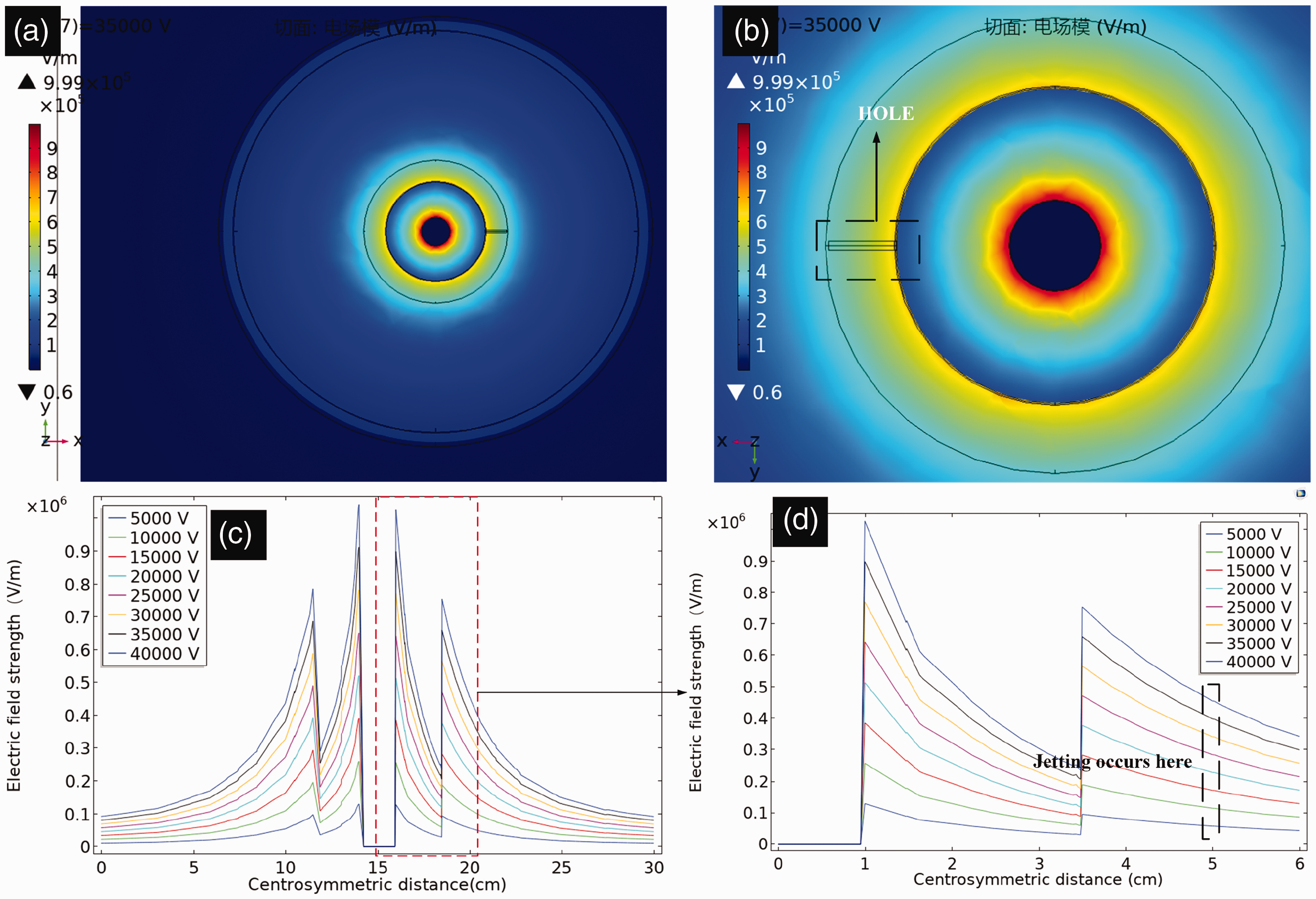
(a,b) The electric field distribution when the central electrode is connected to 35 kV. (c,d) The change of electric field intensity when the central electrode is connected from 5 kV to 40 kV.
We can also conclude that the size of the central electrode access voltage has an effect on the spray of the solution. As shown in Figure 4(d), the maximum electric field strength is
Figure 5 shows the effects of different voltages on the morphology, diameter, and yield of nanofibers. No beads were found on the nanofibers, and the morphology of nanofibers was normal. The diameter of nanofibers fluctuates obviously with the increase of applied voltage and tends to decrease between 20 kV and 40 kV. The reason is that the larger electric field forces make the nanofibers thinner. When the applied voltage is 40 kV, the diameter of nanofibers is 170.21 ± 26.65 nm. The diameter of nanofibers increases at the beginning and decreases when the applied voltage is 50 kV to 60 kV. When the applied voltage is more than 40 kV, the excessive electric field force may take away more polymer solution, resulting in an increase of nanofiber diameter. With the increase of applied voltage to 60 kV, the electric field force plays a more important role in the process of jet stretching than the solution viscosity, making the nanofibers thinner. As can be seen from the figure, the yield of nanofibers has been increasing with the increase of voltage from 40 kV to 60 kV. The explanation is that with the increase of applied voltage, more and more jets can be formed.

Distribution of electric field equipotential line under different voltage: (a) 20 kV, (b) 30 kV, (c) 40 kV, (d) 50 kV, (e) 60 kV. Insert image: scanning electron microscopy image of nanofibers. (f) The productivity and diameter of nanofibers with different applied voltages. Electrospinning process parameters: solution concentration of 10 wt%, collection distance of 10 cm. Scale = 5 µm.
Effect of radius of ring receiver plate on fiber diameter and productivity
Figure 6(a) shows the variation of electric field intensity and potential when the radius of the annular receiving plate is 15 cm. We have examined the reasons for the change of electric field intensity before, and here we mainly analyze the trend of electric potential change. It is easy to conclude that the potential from the central electrode to the receiving plate is reduced, and the decline rate is very large. There is a fluctuation at 11.5 cm and 18.5 cm (the potential at this point is 2400 V), which is obviously the inner wall of the liquid tank. By changing the radius of the annular metal, the electric field strength and potential values at different radius of the nozzle are calculated (see Figure 6(b)). The change of electric potential and electric field intensity shows the opposite tendency. Figure 6(c) shows the effect of the radius of the annular receiving plate on the diameter and productivity of nanofibers. With the radius increasing from 15 cm to 20 cm, the yield first increases and then decreases. When the radius is 18 cm, the yield reaches 3.1 g/h. When the diameter of nanofibers is about 200 nm and the radius is 16 cm, the overall radius of nanofibers is relatively fine (182 nm).

(a) Changes of electric field intensity and potential. (b) Effects of radius on electric field intensity and potential at nozzle. (c) Effects of radius on morphology of nanofibers.
Mechanical properties
Nanofiber films were prepared by electrospinning with a cylindrical nozzle, and their tensile properties were tested. The sample size is 1.5 cm and the web thickness is 0.91 mm. Figure 7 shows the stress–strain curve of the nanofiber membrane prepared under the condition of 40 kV central electrode, 10% PAN concentration, and 18 cm receiving distance. It can be seen from the figure that the obtained film has good mechanical properties. This is because nanofibers are more evenly distributed and have a smoother structure.

The stress–strain curve of the nanofibrous membranes.
Conclusions
In this study, we developed a new electrospinning technology, which can be used to produce nanofibers on a large scale. The results show that compared with the traditional single-needle electrospinning, this method has a higher nanofiber yield, and the electric field modulus around the cylindrical nozzle is calculated by the finite element method. The simulation results of COMSOL Multiphysics software show that the nozzle has a strong uniform electric field. The effects of central electrode voltage and collection distance on the morphology and yield of nanofibers were studied. With the increase of applied voltage, the diameter of nanofibers fluctuates obviously, and the radius of collecting plate has a similar trend. The maximum yield of nanofibers is 3.1 g/h. The mechanical properties of the nanofiber film were studied, and it was found that the film had good tensile properties. The electrospinning technology of the new cylinder nozzle will open up a new prospect for the production of nanowires under low voltage conditions and will further improve the production efficiency of nanowires.
Footnotes
Declaration of conflicting interests
The author(s) declared no potential conflicts of interest with respect to the research, authorship, and/or publication of this article.
Funding
The author(s) received no financial support for the research, authorship, and/or publication of this article.
