




Abstract
In this study, silane-modified polypyrrole (PPy) was coated onto cotton fabrics through a conventional “in situ polymerization” method. And by chlorination with NaClO solution, we obtained antimicrobial conductive PPy/Si–Cl–cotton fabrics. The PPy/Si–Cl–cotton fabrics were characterized by scanning electron microscopy, energy-dispersive spectroscopy, X-ray photoelectron spectroscopy, Fourier-transform infrared and thermogravimetric analysis. Also, the electrical conductivity property, antibacterial property, and ultraviolet light stability of the coated fabrics were tested. The PPy/Si–Cl–cotton fabrics showed antimicrobial and electrical conductivity properties when the chlorination time was up to 30 s. The chlorine content was 0.30 wt% and the resistance was 26.79 kΩ/cm. The PPy/Si–Cl–cotton fabrics (Cl+% 0.30) showed excellent antibacterial properties against 100% Staphylococcus aureus and 100% Escherichia coli O157:H7 were inactivated within 1 min of contact. Due to the proportional relationship of the electrical conductivity and chlorine content of the PPy/Si–Cl–cotton fabrics, the electrical conductivity of the PPy/Si–Cl–cotton fabrics can be used for monitoring the antimicrobial activity.
Introduction
Static electricity is a potentially harmful phenomenon of textile production and can become a big issue for textiles operation and cause industrial losses and endanger human life. To prevent electrostatics in textiles, it is necessary to provide anti-electrostatic clothing for workers and people. Therefore, wearable conductive materials are of great importance for the prevention. In addition, they are applied in wearable displays [1,2], medical clothing [3], facilities [4], and military equipments [5]. Wearable conductive textiles are primarily designed by integrating conductive fillers, such as conductive polymers [6,7], metal [8–10], and carbon-based materials [11–13] into soft-based templates.
The majority of traditional wearable conductive materials are made by coating conductive polymers onto fabrics. In 1977, Park Y et al. [14] used AsF5 and I2 to dope polyacetylene to endow it with electrical conductivity. Since then, the research of conductive polymeric materials has been developed rapidly. Many polymers, such as polyacetylene, polyaniline, polypyrrole (PPy), polythiophene, and polyindole, were found to possess conductive activities. Among conductive polymers, PPy is considered as one of the most useful conductive polymers due to its low cost, high electrical conductivity, and good chemical stability. It has been widely used for gas sensors and biosensors [15,16]. Cotton fabrics draw much attention in anti-electrostatic research and are widely used to make anti-electrostatic clothing due to its cheap cost, comfort, light weight, high porosity, large surface area, and good reactivity. Lu et al. [17] used cationic surfactant to enhance the electrical conductive property of PPy-coated cotton fabrics. Khajavi and Berendjchi [18] reported the formation of PPy films on pristine and precationized cotton samples using admicellar polymerization by increasing the adsorption of sodium dodecyl sulfate (SDS) on cotton fabric, enhancing the conductivity of these samples up to 49%. Nautiyal et al. [19] coated PPy onto carbon steel using electrochemical synthesis, and the coating showed great anti-corrosion and excellent biocidal properties.
However, cotton fabrics are good media and carriers for microbial growth, such as bacteria, fungi, and viruses, under suitable environment due to its hydrophilic property retaining moisture, oxygen, and nutrients [20]. Cotton fabric has strong hydrophilic property. Through surface modification of cotton fabric, its hydrophobicity can be improved [21–24]. It is important to produce PPy-coated cotton with antibacterial property. The simple way of making antibacterial PPy-coated fabrics is to add metal such as silver. However, high cost, poor softness, and fastness limit their industrial production. Based on the structure of PPy (Figure 1), PPy can be regarded as a polymeric N-halamine precursor since the N–H bonds on the rings of PPy could be transformed into N–Cl bonds upon chlorination. N-halamines are very effective biocides in inactivation of bacteria. N-halamines compounds contain N–X covalent bonds, formed by amine, amide, or imide group [25,26]. When N-halamines compounds are exposed to sodium hypochlorite (NaClO) solution, the N–H bonds are transformed into N–Cl, which have a good killing bacteria effect [27,28].

Repeating unit of polypyrrole.
In this study, silane-modified PPy was prepared and coated onto cotton fabrics by chemical oxidative polymerization. The morphology, elemental composition, electrical conductivity, and thermal property of the coated fabrics were investigated. The relationship between electrical conductivity and chlorine content of the PPy/Si–Cl–cotton fabrics was also explored. The PPy/Si–cotton fabrics after chlorination were evaluated for their biocidal efficacies against Staphylococcus aureus and Escherichia coli O157:H7.
Experiment
Materials
100% bleached cotton fabric was provided by Zhejiang Guandong Printing & Dyeing Company, Zhejiang. Pyrrole monomer (Py, 98%) was purchased from J&K Chemicals (Shanghai, China), and distilled under reduced pressure before use. 3-Amino-propyltriethoxysilane (C9H23NO3Si) (98%) was purchased from J&K Chemicals (Shanghai, China). Ammonium persulfate ((NH4)2S2O8, APS), hydrochloric acid (HCl), NaClO, and ethyl alcohol (CH3CH2OH) were from Sinopharm Chemical Reagent Co., Ltd, Shanghai. These chemicals were used without further purification and all solutions were prepared with deionized water.
Instruments
Scanning electron micrographs were obtained using a SU-1510 scanning electron microscope (SEM, Hitachi, Tokyo, Japan) at 5 kV accelerating voltage. The S-4800 energy-dispersive X-ray spectroscopy (EDS, Hitachi, Tokyo, Japan) was used to analyze the chemical compositions of samples. X-ray photoelectron spectroscopy (XPS) was performed on an ESCALAB 250Xi (Thermo Fisher, USA). The Fourier transform infrared (FTIR) spectra were recorded by a Nicolet Nexus 470 spectrometer (Nicolet Instrument Corporation, Madison, WI) in the optical range of 500–4000 cm−1 by averaging 32 scans at a resolution of 4 cm−1. The resistance of the coated fabrics was measured by SZT-2 A four-point probe tester (Thongchuang, Suzhou, China). UV-blocking property of the samples was measured using a YG (B) 912E UV spectrophotometer (Shimadzu Co., Ltd., China). Thermogravimetric analysis (TGA) was carried out using a TGA unit (TA Instruments, USA). A 5-mg sample was heated from 35°C to 600°C at a heating rate of 10°C min−1 under nitrogen atmosphere with 40 mL min−1 flow rate.
Preparation of PPy/Si–cotton fabrics
Cotton fabrics were treated with 0.5 wt% Na2CO3 for 30 min followed by rinsing with deionized water neutral pH and dried at 65°C. PPy was synthesized by a chemical oxidative polymerization method following the published protocol [29]. A total of 2 g of cotton fabrics were immersed in 150 mL of absolute ethyl alcohol solution contained 10 mL Py and 5 mL 3-aminopropyltriethoxysilane. Then, 3.3 g APS (solvent: 1 M HCl) was added dropwise into the above mixture with vigorous stirring. Deposition of PPy on cotton fabrics was carried out by in situ chemical oxidative polymerization on ice water bath (0–5°C) for 2 h under nitrogen atmosphere. After polymerization, the resulting fabrics were thoroughly washed with ethyl alcohol to remove residual 3-aminopropyltriethoxysilane. The fabrics were further washed with deionized water several times to remove unreacted Py and other impurities. The obtained PPy/Si-cotton fabrics were dried at 95°C for 1 h.
Chlorination and analytical titration
PPy/Si–cotton fabrics were immersed in 10 wt% NaClO solution at pH 7 for 15 s, 30 s, 60 s, 120 s, and 180 s. The chlorinated swatches were washed thoroughly with deionized water and dried at 45°C for 1 h to remove any free chlorine. The iodometric/thiosulfate titration procedures were employed to determine the chlorine content of PPy/Si–cotton fabrics after different chlorination times. The 0.001 N sodium thiosulfate solution was used to titrate chlorine contents in the chlorinated samples. The Cl+ (wt%) on the cotton swatches was calculated by equation (1)

UV light stability test
UV-protection factor (UPF) was determined according to the previous work [30] to evaluate the UV protection performance of PPy/Si–cotton fabrics. Samples were tested on both sides. The UVA, UVB, and UPF values of fabrics, respectively, were recorded. Three tests were performed for each sample and averaged. UPF was calculated according to the formula shown in equation (2)

Air permeability test
The air permeability of the samples was tested according to the previous work [31]. The samples were tested using a water vapor transmission tester (YG461E-III, Ningbo Textile Instrument Co. Ltd., China) with a test pressure of 100 Pa and area of 20 cm2.
Tensile strength test
The breaking strength of the coated samples was determined by using YG (B) 026 D-250 Electronic Fabric Strength Tester according to a work reported previously [32]. Five replicates (5 cm × 20 cm) were tested for each sample to obtain average results. The test was carried out in both warp and weft directions at ambient temperature.
Antimicrobial test
PPy/Si–cotton fabric swatches and PPy/Si–Cl–cotton fabric swatches were challenged with S. aureus (ATCC 6538) and E. coli O157:H7 (ATCC 43895) using a modified AATCC Test Method 100-2004. An aliquot of 25 μL bacterial suspension in pH 7 phosphate buffer was added to one swatch, and another identical swatch was placed on it. A sterile weight was placed on the top of the samples to ensure the contact between the bacterial suspension and the swatches. After contact time from 1 min to 30 min, each sample was transferred to a tube containing 5.0 mL of sterile 0.02 N sodium thiosulfate to remove all oxidative chlorine. A 10-fold serial dilution was applied to all quenched solutions with pH 7, 100 mM phosphate buffer, and each dilution was plated on Trypticase soy agar plates. The plates were incubated at 37°C for 24 h. The bacterial colonies were enumerated and recorded for biocidal efficacy analysis.
Results and discussion
Characterization of the PPy/Si–cotton fabrics by SEM, EDS, and FTIR
The surface morphologies of uncoated cotton fabrics and PPy/Si–cotton fabrics were observed by SEM and are shown in Figure 2. The surface of uncoated cotton fabric was smooth and relatively uniform, and no impurities appeared on the surface (Figure 2(a) and (b)). The PPy/Si–cotton presented relatively coarse surface covered with typically granular conductive polymers (Figure 2(c) to (e)). The agents were successfully coated on the surface of the cotton fabrics by comparing the appearances before and after coating. The coated cotton fabrics were covered with films. The formation of this film started with the hydrolysis of ethoxy groups in 3-aminopropyltriethoxysilane [33].
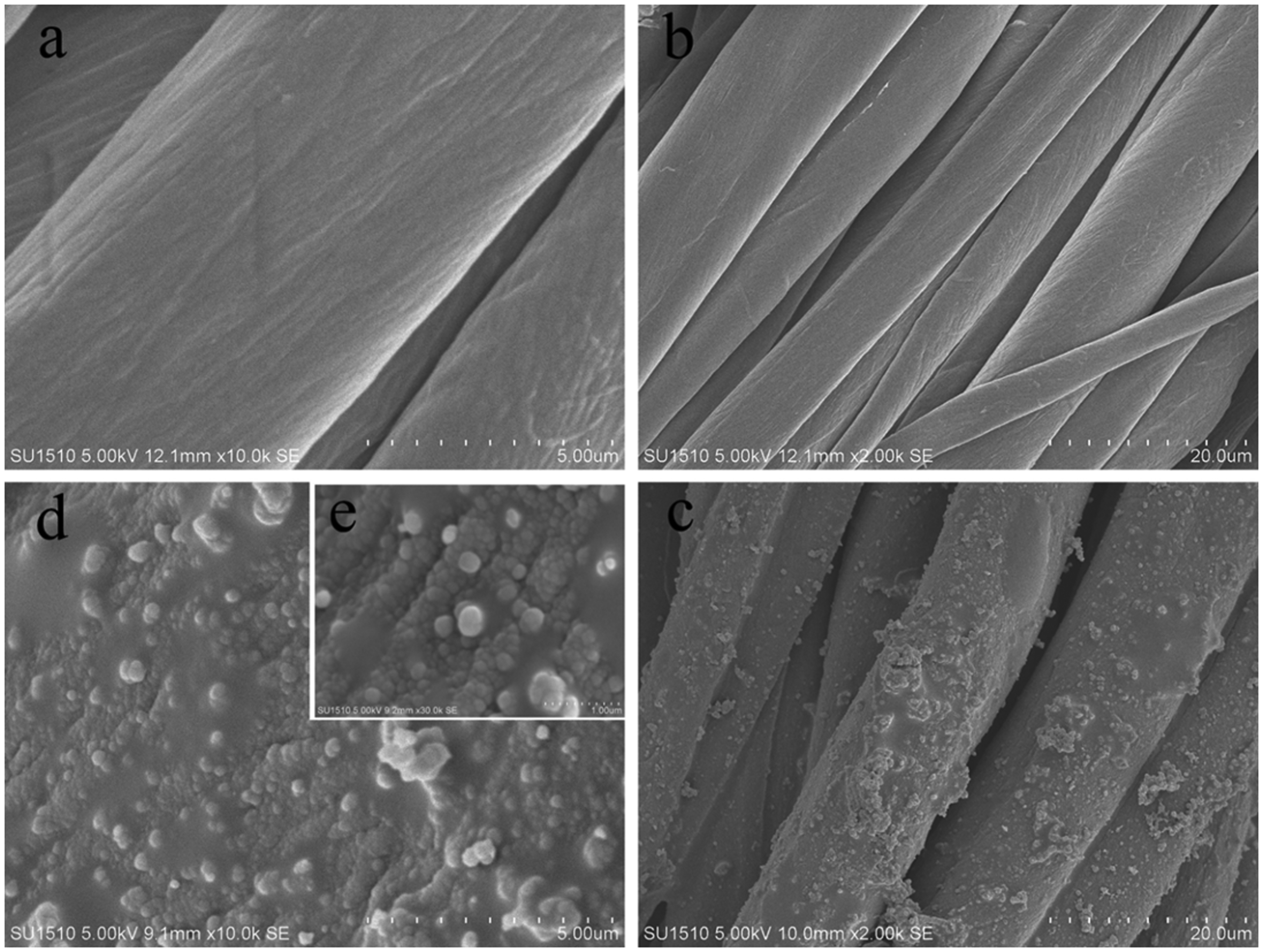
SEM images of uncoated cotton fabrics and PPy/Si-cotton fabrics: (a) uncoated cotton fabrics ×10 k, (b) uncoated cotton fabrics × 2 k, 2 k; (c) PPy/Si-cotton fabrics ×2 k, (d) PPy/Si-cotton fabrics × 10 k, (e) PPy/Si-cotton fabrics × 30 k.
To determine the chemical elements of PPy/Si–cotton and PPy/Si–Cl–cotton fabrics, the EDS elemental mappings are presented in Figure 3. The figure shows that PPy/Si–cotton fabric prepared with APS and HCl was mainly composed of six elements including carbon, nitrogen, oxygen, silicon, sulphur, and chlorine. The mass ratio of nitrogen to carbon of PPy/Si–cotton was lower than that of pure PPy. The presence of silicon was due to 3-aminopropyltriethoxysilane in the coating solution. In addition, the presence of chlorine confirmed the doping of hydrochloric acid into PPy coating. The presence of sulphur demonstrated that APS was an oxidizing agent in PPy/Si system. Compared between Figure 3(a) and (b), the weight percent of chlorine increased after chlorination.

EDS of PPy/Si-cotton fabrics (a), PPy/Si-Cl-cotton fabrics (b) and pure PPy (c).
In order to determine the elemental composition of the samples, XPS analysis was applied to characterize the chemical state of the samples. In Figure 4(A), binding energy of uncoated cotton, PPy/Si–cotton, and PPy/Si–Cl–cotton are shown. Compared with uncoated cotton, new peaks at binding energies of 400.7 eV, 200.8 eV, 151.9 eV, and 100.9 eV were observed, corresponding to N, Cl, S, and Si elements, respectively. After chlorination, the peak of chlorine at 200.78 eV could decompose into four contributions including 197.8, 200.2, 201.2, and 202.3 eV, attributing to Cl− 2p3/2, Cl− 2p1/2, N–Cl 2p3/2, and N–Cl 2p1/2, which revealed that N–H was successfully converted to a N–Cl bond [34].

XPS spectra (A), Cl 2p fitting spectra (B): (a) cotton fabrics; (b) PPy/Si–cotton fabrics; (c) PPy/Si–Cl–cotton fabrics.
Figure 5 shows the FTIR spectra of uncoated cotton fabrics and PPy/Si–cotton fabrics. In Figure 5(a), the peak at 3303 cm−1 is assigned to the characteristic broad band for the O–H group of cellulose and a peak around 2906 cm−1 can be attributed to the asymmetrically stretching vibration of C–H in the pyranoid ring, which corresponds to characteristic absorption peaks of cellulose [35]. Compared with pure cotton, a new peak at 3671 cm−1 in the PPy/Si–cotton fabrics is assigned to stretching vibration of –OH, which is presumably due to the adsorbed water molecules on 3-aminopropyltriethoxysilane films [33]. The additional peaks at 2981 cm−1 is related to –CH2 stretching vibrations, respectively. The band at 1454 cm−1 is assigned to five-membered ring stretching and the free C–N stretching vibration of Py rings [36,37]. The band at 1072 cm−1 is ascribed to Si–O between 3-aminopropyltriethoxysilane and cotton fabrics [38,39]. The peak at 778 cm−1 is attributed to N–H inplane deformation vibration which is attributed to the N–H bonds in PPy and 3-aminopropyltriethoxysilane [40]. All the peaks above confirmed the attachment of PPy/Si to cotton fabrics.

FTIR spectra of uncoated cotton fabrics (a) and PPy/Si–cotton fabrics (b).
Electrical conductivity of PPy/Si–Cl–cotton fabrics
Cotton fabrics are insulated without electrical conductivity, and became electrically conductive after coating with PPy/Si. The resistance of PPy/Si–cotton without chlorination was 0.86 kΩ/cm. After treatment with 10 wt% NaClO at different times, the chlorine contents and resistances of PPy/Si–Cl cotton were measured. As shown in Figure 6(a), it can be seen that the chlorine contents of cotton increased with the extension of chlorinated times, ranging from 0% to 0.81%. After chlorination, the hydrogen atom of the N–H bond was substituted by chlorine. The longer the chlorination time, the more N–H bonds are converted into N–Cl bonds. A chlorine value was about 0.2 wt% after 15 s chlorination, which was sufficient to inactivate bacteria according to previous studies [41]. Figure 6(b) shows resistance of PPy/Si–Cl–cotton with different chlorine content. The resistance of PPy/Si–Cl–cotton fabrics increased sharply with the increase of the chlorination time for [Cl] > 0.4%. Considering the chlorine content and electrical conductivity, chlorination time of 30 s was selected and used for the subsequent performance study, and the resistance of PPy/Si–Cl–cotton was 26.79 kΩ/cm. The antibacterial property of the coated cotton fabrics can be monitored through the resistance. It had been found that the chlorine content in the PPy/Si–Cl–cotton fabrics is negatively related to the electrical conductivity. Therefore, the chlorine content for determining the time of recharging chlorine of the PPy/Si–Cl–cotton fabrics can be used to monitor the electrical signals in order to keep its high antimicrobial efficacy and good electrical conductivity.

Chlorine content of PPy/Si–Cl–cotton with different chlorinated time (a) and resistance of PPy/Si–Cl–cotton with different chlorine content (b).
UV protection properties of PPy/Si–Cl–cotton fabrics
As the important features of textiles, UV protection factors (UPF) and air permeability of PPy/Si–cotton and PPy/Si–cotton fabrics with different chlorine contents are shown in Table 1. There was significant increase in the UPF value after coating with PPy/Si mainly due to the existence of PPy. The PPy/Si–cotton had an enhanced ability to absorb UV light and could effectively prevent the penetration of ultraviolet light. More PPy on the coated cotton fabric was detached from the cotton surface with the increase of chlorination time, leading to the decrease of UPF value. But the coated fabric still maintained good UV protection ability with all UPF values over 50. The air permeability of uncoated cotton fabrics was 149.93 mm/s. The air permeability was reduced to 72.47 mm/s after coated with PPy/Si, which was mainly due to the loading of PPy/Si on the surface of the cotton fabrics. After coating, the air permeability of cotton fabrics has been reduced by half, but it still has applicable air permeability [42,43]. Chlorination has little effect on air permeability of the coated cotton fabrics. Therefore, the prepared fabrics with good air permeability may have great potential for applications in textiles and wearable conductive materials.
UV protection properties and air permeability of the coated cotton fabrics.

Thermal analysis
TGA and DTG curves of uncoated cotton, PPy/Si–cotton, and PPy/Si–Cl–cotton are shown in Figure 7. The weight loss below 200°C (Figure 7(a)) was due to the removal of absorbed water [44]. In comparison, a lower weight loss temperature is observed for PPy/Si–coated cotton fabrics than that of untreated fabric due to doping acid accelerating decomposition of the composites. The presence of PPy and 3-aminopropyltriethoxysilane enhanced the thermal stability of cotton fabrics and increased the amount of char residues. Cotton fabrics displayed the onset of degradation (9% mass loss) at 310°C and reached 11% char yield of the mass at 600°C. The decomposition of PPy/Si–cotton and PPy/Si–Cl–cotton fabrics started at 263°C and 246°C and provided a higher char yield of 35% and 37% at 600°C, respectively. It can be seen in Figure 7(b) that the uncoated cotton fabrics had the fastest decomposition rate at 378°C. The PPy/Si–cotton and PPy/Si–Cl–cotton fabrics had maximum decomposition rate at 364°C and 368°C, respectively. The maximum decomposition rate of the coated cotton fabrics was lower than uncoated cotton fabrics. The results illustrated that the PPy/Si coatings might be able to advance the second decomposition stage of the coated cotton fabrics and cause the increase of char residue. In addition, there was nitrogen containing components in PPy, which formed a gas protective layer on the fabric surface. 3-Aminopropyltriethoxysilane coated on cotton produced siliceous char layer which acts as a barrier to heat, fuel, and oxygen transfer, protecting the underlying cotton fabrics from fire spread and prevented further oxidative degradation of cotton fabrics [45]. Compared with PPy/Si–cotton, PPy/Si–Cl–cotton had a decomposition started at 190°C and continued up to 270°C, which was close to the decomposition of the N–Cl bonds [46].

TGA (a) and DTG (b) curves for uncoated cotton, PPy/Si–cotton fabrics and PPy/Si–Cl–cotton fabrics (Cl+ wt% 0.30).
Tensile strength
In order to evaluate the effect of the coating and chlorination on the mechanical property of the coated cotton fabrics, the tensile strengths in warp and weft directions of uncoated cotton and coated cotton with and without chlorination were tested. Figure 8 shows that uncoated cotton fabric has an average breaking strength of 734 N in the warp and 325 N in the weft directions. After coating with PPy/Si, 27% and 16% of breaking strength was lost in the warp and weft directions, respectively, which might be due to the breaking of glycoside bonds in cellulose caused by the acidic polymerization reaction system. The chlorination treatment has a small effect on the breaking strength of the PPy/Si–Cl–cotton fabrics. The breaking strength after chlorination was almost the same as before chlorination in the warp direction, and 10.3% of breaking strength was lost after chlorination in the weft direction compared to PPy/Si–cotton fabrics.

Tensile strengths of uncoated and coated fabrics.
Antibacterial efficacy
The PPy/Si–cotton and PPy/Si–Cl–cotton fabrics were challenged with S. aureus (Gram positive) at 1.07 × 10⁶ CFU/sample and E. coli O157:H7 (Gram negative) at 1.47 × 10⁶ CFU/sample, with the biocidal efficacy data are presented in Table 2. As the control sample, unchlorinated PPy/Si–cotton showed small reductions for both bacteria, which were 0.84 log and 0.49 log reductions for S. aureus and E. coli O157:H7, respectively, after 30 min contact time due some the adhesion of bacteria onto the surface of cotton fabrics. The PPy/Si–Cl–cotton fabrics with 0.30% active chlorine could completely inactivate all inoculated S. aureus (6.03 log) and E. coli O157:H7 (6.17 log) after 1 min contact. The results show that PPy/Si–Cl–cotton fabrics have a great potential for using as antibacterial products in different applications. After chlorination, the hydrogens of the N–H bonds were substituted by chlorines, and PPy/Si–Cl transferred the active chlorines to the bacterial cells, kills them upon contact. After inactivating bacteria, the biocidal function could be lost since active chlorines were consumed. The lost chlorines could be regained with diluted bleach solution to reinstall the antibacterial function. It has been found that the chlorine content of the PPy/Si–Cl–cotton fabrics is negatively related to the electrical conductivity. Therefore, the electrical resistance of PPy/Si–Cl–cotton can be used as an indicator of the chlorine content for monitoring the antibacterial efficacy.
Antibacterial property against S. aureus and E. coli O157:H7.

aThe inoculum population was 1.07 × 10⁶ CFU/sample.
bThe inoculum population was 1.47 × 10⁶ CFU/sample.
Conclusions
The PPy/Si–cotton fabrics were successfully prepared by a chemical polymerization method and exhibited good electrical conductivity with the resistance of 0.86 kΩ/cm. After exposure to 10 wt% NaClO solution, the PPy/Si–Cl–cotton fabrics were endowed an antibacterial function. The PPy/Si–Cl–cotton fabrics (0.30% Cl+, wt%, 26.79 kΩ/cm resistance) showed excellent antibacterial efficacy against S. aureus and E. coli O157:H7, and were able to inactivate 100% inoculated S. aureus (6.03 log) and E coli O157:H7 (6.17 log) within 1 min of contact time. This reported method for preparing antimicrobial/conductive coatings on cotton fabrics is simple, green and highly effective. It has a great potential application of low-cost and high-performance multifunctional coatings in textiles to manufacture antielectrostatic clothing and wearable conductive materials.
Footnotes
Declaration of conflicting interests
The author(s) declared no potential conflicts of interest with respect to the research, authorship, and/or publication of this article.
Funding
The author(s) disclosed receipt of the following financial support for the research, authorship, and/or publication of this article: This study was supported by the research funds from the Project for Jiangsu Scientific and Technological Innovation Team, and the Fundamental Research Funds for the Central Universities (No. JUSRP51722B), the national first-class discipline program of Light Industry Technology and Engineering (LITE2018-2), and 111 Projects (B17021).
