




Abstract
This study aimed at developing a knitted fabric using conductive staple spun yarn composed of polypyrrole coated cotton fibers and characterizing its thermal, optical and electrical properties, hydrophobic behavior as well as mechanical stiffness as a factor of weight percentage in fabrics. FTIR spectra, TGA and SEM verify that the polypyrrole ((PPy) has been successfully coated on cotton fibres before and after washing. The results showed that the fabrics containing polypyrrole had lower transmission and reflection percentage as compared with fabric without polypyrrole for wavelengths ranging from 200 to 20000 nm. At the investigated weight percentages, the thermal properties, hydrophobicity and electrical conductivity were found to be increased significantly with increasing amount of polypyrrole coated cotton fibers in the fabric. The thermal conductivity of fabrics with PPy coated fibers were found to be increased around 30-40%. The higher value of electrical conductivity (0.73 µS cm−1) was obtained in course direction and static water contact angle of 138° for fabric with higher polypyrrole content. The stiffness of the fabrics with PPy was found to increase about 10–20% in both wale wise and course wise directions with increase of polypyrrole coated cotton fibers in fabrics.
Introduction
Over last few years, conductive textiles materials such as fibers, yarns and fabrics have received significant attention due to their extensive variety of applications [1,2]. The potential applications of conductive textile materials include thermal management, communication and data management fabrics, health monitoring apparel, fabrics with antimicrobial properties, functional and fashion clothing, static charge discharge and electromagnetic shielding materials [3–7]. Normally the conductive fibres are classified as fibers coated with conductive polymers or metal power, conductive natural fibres and metallic fibres [8]. Conductive polymers are desirable materials for fabricating light weight smart textiles without addition of any metals [9]. This class of polymers offers numerous applications due to their conducting, electrochemical and stimulus responsive properties. The conductive polymeric fibers can be produced either by electrochemical or chemical methods [10]. The electrochemical method produces functional polymeric filaments or fibers with conductive polymers using melt spinning technology, which the chemical method can be used to coat conventional fibers with any conductive polymers [11].
The most widely investigated conductive polymers for smart textiles are polypyrrole (PPy), polyaniline (PANI), polyacetylene (PA) and polythiophene (PTh). Among these conductive polymers, PPy is a good candidate due to its ease of preparation, high conductivity, non-toxicity, low cost and good stability [12,13]. Also, it has very high potential for light-to-heat conversion because of it shows a broadband solar absorption covering ultraviolet, visible and near-infrared (NIR) regions [14]. So it has ability to act as an outstanding photo-thermal agent and be a strong absorber of solar energy [15].
Photo-thermal conversion is one of the most promising future technologies for functional textile materials. These technologies could be useful for the fabrication of clothes for extreme environment conditions where clothes are naturally exposed to sunlight [16]. Photo-thermal properties of textile materials depend on a substantial amount of incident electromagnetic energy being absorbed and converted to heat, which can effectively improve the thermal insulation properties of fabric. So it is necessary that the optical and thermal properties of a textile material are considered to achieve an efficient photo-thermal conversion [17]. This photo-thermal conversion effect has wide range of applications in functional clothing such as sports and winter wear. The usage of conductive polymers especially PPy in photo-thermal conversion is well-known [18].
Among the various studies on PPy incorporated textile materials for advanced applications [19–22], some articles relevant to our work are reported here. Researchers have reported that fabric coated with PPy had excellent UV protection properties [23]. In another study, PPy on the cotton fabric surface provided excellent heat generation and antistatic properties [24]. Recently, antibacterial properties of PPy coated on cotton woven fabrics have been reported [25]. The electromagnetic shielding properties of polyester fabric coated with PPy have also been examined and it was found that it exhibits a good electromagnetic shielding index [26]. It was also found that PPy imported a good flameproof property to polyester because of its good chemical stability, and because it lowers the oxidative decomposition temperature of the polyester [27].
Most of the studies related to application of PPy on textile materials have been carried out using either a fabric or a yarn substrate. There is a lack of information available on use of PPy on fiber substrates especially on cotton fibres. Cotton has commonly been used as a substrate for the deposition of conducting polymers. In general chemical groups present in cotton allows fibes to absorb large amounts of water and other polar solvents. Due to flexibility, breathability, good process ability, availability among others is properties which make cotton the best choice for conductive polymer coating [28]. However it is very difficult to deposit PPy on synthetic fibers, especially polyester, because of its hydrophobic surface which will retard absorption of polymer. Hence in this research an attempt has been made to develop knitted fabrics using PPy coated cotton fibers.
The main aim of this paper is to study the thermal and optical performance of knitted fabrics produced using conductive staple yarn composed of PPy coated cotton fibers. Commercially available cotton fibres were procured for this study and coated with PPy. The spun yarn was developed with coated cotton fibres by using our laboratory staple fibre spinning line. Further the knitted single jersey fabrics were produced with and without PPy conductive yarn. The developed fabrics were tested and compared for their ultraviolet, visible and near and far infrared reflectance and transmittance; thermal properties. In addition, this work were investigated the electrical conductivity behavior and hydrophobicity and flexural rigidity of fabrics coated with PPy.
Experimental section
Materials
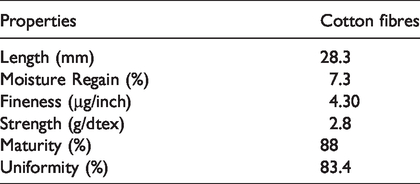
The selection of important material parameters such as fabric mass per unit area, yarn linear density, stitch length, twist factor were done after a survey of materials used in the made on knitting industries. The cleaned cotton fibres are obtained from spinning mill in India and their properties are given in Table 1. Physical characteristics of cotton fibers i.e. spun length, uniformity ratio, fineness, strength and trash were determined according to standard methods. 100% polyester ring spun yarn with 30/1 Ne (Linear Density) was procured from China. This yarn was developed using polyester staple fibres of 38 mm length & 1.2 denier, with tenacity of 25 cN/tex and 750 TPM (twist per meter).
Properties of cotton fibres.
Methods
Synthesis and coating of polypyrrole on cotton fibers
The chemicals for synthesis of PPy were purchased from Sigma-Aldrich and used as received. Dry cotton fibers (100 g) were mixed with DI water (8 L) and Iron (III) chloride hexahydrate (90.2 g, 0.33 mol), then a solution of pyrrole (9.6 ml, 0.14 mol) of pyrrole in ethanol/water mixture (4/1 v/v, (190 ml)) was added at room temperature. The mixture was stirred with a mechanical stirrer for 45 min. The resulting black fibers were collected by filtration, washed with water and then ethanol, then dried at 70°C for 5 h, giving 102.6 g of PPy coated cotton fibers (PPy content identified gravimetrically is as 2.5 wt%).
Development of ring spun yarn using PPy coated cotton fibers and uncoated cotton fibres
Ring spun yarns were developed using 100% Polypyrrole coated cotton fibers and uncoated cotton fibres. The fibres were processed with Mesdan Lab 337 A, a Laboratory carding machine. The coated cotton fibres of weight 10 grams for each web were manually opened and carded twice. After the second carding, the web was cut from the collection drum and rolled up to form sliver 1.2 meter length. The resultant sliver of linear density 6.6 ktex was sequentially drawn in a Mesdan-lab Mini Stirolab 3371 with drawing ratio of 4.45 that were spun to yarn of 30 s Ne which was a target linear density. The drawn sliver of 0.40 Ne was used to perform yarn spinning in Mesdan-lab Ring lab 3108 A. Twist is important parameters to be concerned during manufacturing of staple fibre yarns, because twist in the fine strand of fibres manages to hold the fibres together and impart the desired properties to the twisted yarns. In this work, Twist per unit length (TPM) was calculated using the relationship given below (1),
Other set process parameters of ring spinning machine are as follows; Spindle speed was 5400; Twist per meter was 750; break draft and total draft were 1.2 & 10. Twist contraction factor was assumed 5%.
Determination of yarn properties
The properties such as U% (irregularity), thin and thick places, and the amount of neps in PPy conductive yarn was tested using Uster tester 5 machine using ASTM D2256 standard [30]. The yarn was assessed in standard testing atmosphere of RH 65 ± 2% and 20 ± 2°C temperature and results are given in the Table 2.
Polypyrrole coated cotton fiber ring yarn properties.

Development of knitted fabrics
Single jersey fabric was knitted on a 24 gauge circular knitting machine. Customized 6 feeders of yarn were utilized to feed the machine and knitting cylinder diameter is 16 inch. Single jersey, plain weft knitted fabrics were produced for this research (Figure 1), with similar adjustment parameters namely cams settings, yarn feeding tension and fabric take down. Four different types of fabrics were produced and named as R1, R2 (reference fabrics without PPy) & S1, S2 (fabrics with 2 different weight percentage of PPy coated cotton fibers). S1 and S2 are composed of 16.7% and 33.3% yarn with PPy coated cotton fibres, former was developed with 5 feeders of polyester yarns and 1 feeder of PPy yarn and later with 4 feeders of polyester yarns and 2 feeders of PPy yarn respectively. For reference fabrics (R1 & R2) yarn with PPy coated cotton fibers was replaced with pure cotton yarn but knitting pattern was followed to compare. The knitting was carried out with same conditions for all fabrics and machine parameters.
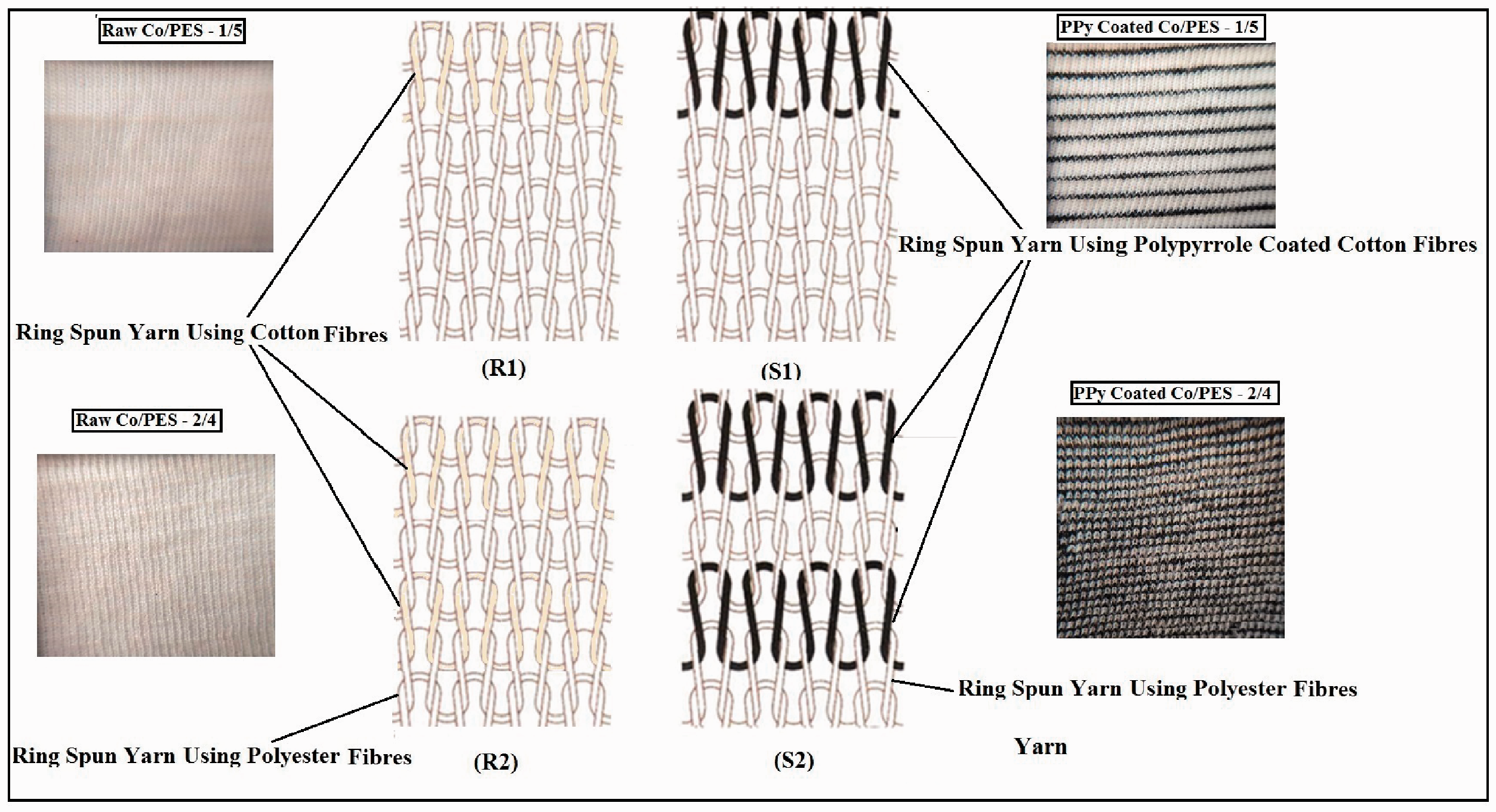
Structure of single jersey fabrics (R1) fabric without PPy (16.7% cotton yarn); (R2) fabric without PPy (33.3% cotton yarn); (S1) fabric with 16.7% PPy coated cotton yarn (S2) fabric with 33.3% PPy coated cotton yarn.
Determination of physical properties of fabrics
The physical properties of all fabrics were tested in a standard atmosphere according to standards. Course and wale density values per cm were taken into account for the study in accordance with Standard EN 14971 [31]. The yarn loop length was determined in accordance with Standard EN 14970 [31]. The mean mass per unit area (gsm) was determined in accordance with Standard EN 12127 [32]. Similarly the fabric thickness was measured according to ASTM D1777-96 standard [33]. The number of wales per cm and that of courses per cm were determined by taking ten measurements from different areas of each fabric. Afterwards mean values were calculated. The product of these means was used to determine the stitch density of fabrics. The fabric parameters are kept constant for all the samples and the results are given in the Table 3.
Fabric specifications.

Washing durability and thermal stability
To assess the durability of developed fabrics, samples of fabric with PPy were subjected to detergent washing and water washing cycles. Washing and drying were carried out with procedure 4 N in British standard BS EN ISO 6330:2012; Textiles—Domestic washing and drying procedures for textile testing [28], using a domestic front loading washing machine. The surface functional groups and the thermal stability of the fabric without and with PPy, and also washed fabrics with PPy (with/without detergent) were examined using Fourier transform infrared spectrometer (FTIR) (Frontier, PerkinElmer) and a thermogravimetric analyzer (TGA) (Q500, TA Instruments).
Determination of electrical resistivity and water contact angle
ESCORT 97 Multimeter was used to measure resistivity of the samples. Data Physics OCA 15 Pro was used to measure the values of contact angle.
Characterization of optical properties of fabrics
The transmittance, reflection and absorption of fabric samples for each band spectrum were determined using a UV–Vis–NIR spectrophotometer (Lambda 950, Perkin Elmer, USA) over the wavelengths from 200 to 2500 nm. The mid-infrared (MIR) spectral transmittance and diffuse reflectance of the fabrics were measured by a FTIR spectrometer (Nicolet iS-50, Thermo Scientific) over the wavelength range from 2500 to 16,000 nm.
Evaluation of thermal conductivity of fabrics
In order to evaluate the thermal transmission of a fabric in a shielded condition, a two-plate method is required, so the thermal conductivity of fabrics was measured using a DRX-II-RL apparatus (guarded heat flow meter method) as per ASTM E1530. In this non-convective mode, a top plate is used to cover the top surface of the sample to cut off the convection current with compressive load of 40 PSI (0.28Mpa) [34]. Thermal conductivity was calculated according to equation (2),
Q – Measured heat flow through the sample (W. m2)
d – Sample thickness (m)
A – Surface area of the sample (m2)
Characterization of thermal insulation of fabrics
Thermal insulation is an important aspect of fabric performance as far as both cold and warm conditions are concerned. To evaluate thermal transmission of fabrics exposed to ambient environment, single plate test was used. It takes place without any top plate. The test method covers the determination of the overall thermal insulation due to the combined action of conduction, convection, and radiation for dry specimens of textile fabrics. Thermal Resistance (Rct) was determined according to ASTM method D-1518 -14 [35]. This standard measures the heat transfer from hot plate at constant temperature through fabric layer on top it to cool atmosphere. The thermal resistances (Rct) of three samples of each of the fabrics (30 x 30 cm) was determined using a Thermetrics sweating guarded hotplate simulating a human’s heat production by metabolism and heat release by conduction, radiation, convection and evaporation. Obtained average Rct values need to be multiplied by 6.45 to convert more commonly used thermal insulation unit clo.
Fabric stiffness measurement
The fabrics stiffness test was performed using a Shirley stiffness tester in accordance with ASTM D 1388-96 [36]. The bending length of fabric samples with the dimensions of 25 × 200 mm, was measured after being subjected to standard atmospheric conditions. Flexural rigidity of specimens was calculated using following equation (3),
G – Flexural Rigidity (mg.cm)
M – Fabric mass per unit are (g.m−2)
C – Bending Length (mm)
Statistical analysis
The mean values and standard deviation for thermal conductivity and resistance were calculated and one-way analysis of variance (ANOVA) was carried to find the significant differences using Sigma Plot 14.0. The Bonferroni test was performed to identify statistically significant differences (95% confidence level) between the samples and pairwise comparisons.
Results and discussions
Scanning electron microscopy images were obtained using JEOL FESEM 6340 F to characterize surface morphologies of cotton fibres before and after PPy coating. The samples were coated with gold (20 nm thickness) using sputtering. The SEM pictures of both uncoated and PPy coated cotton fibres are shown in Figure 2. As shown, in Figure 2(a), the cotton fibres possess smooth and twisted surface. These twists are called convolutions, which give cotton fibre uneven surface and increase inter fibres interaction during yarn spinning. As shown in Figure 1(b), coated fiber surface became rough (Figure 2(b)) and a lot of small particles could be observed. This is due to cotton fibres immersed in the bath are coated with even and thin layer of adherent polymer, which is directly grown on the fibre surface by adsorption of pyrrole monomer and oxidant molecules during polymerization.

SEM pictures of Cotton Fibres (a) Uncoated (b) Coated with PPy.
Fabric with PPy has shown quite good stability during washing. We have 0.27% weight change of fabric with PPy after washing with no detergent, which is even lower than 0.51% of weight loss of reference fabric. When we used detergent, the weight losses of fabric with PPy and reference fabric were 0.21% and 0.43% accordingly.
FTIR spectra were collected to further verify the presence of PPy in the fabrics. As shown in Figure 3, peaks of fabric with PPy was overlapped the peaks of the reference. The typical absorption bands of polyester presented in both control and coated fabrics are the following: the sharp and intense peak at 1712 cm−1 is attributed to C–O stretching; the broad and strong bands at 1240 and 1091 cm−1 are due to C–O, C–O–C stretching and CH in-plane deformation, respectively; the sharp peak at 1018 cm−1 is associated to C–O–C asymmetric stretching, whereas the C-H out-of-plane deformation is responsible for the sharp peak at 723 cm−1. The spectrum related to the raw cotton fibres in fabrics showed strong absorption bands at 1159, 1107, 1055 and 1030 cm−1, as a result of the overlapping bands assigned to the functional groups of cellulose, such as the C–O, C–C and C–O–C stretching vibrations. The intensity of the peak was reduced in the spectra of the fabrics with PPy because of the interaction of PPy with CH2OH groups in the glucose units of cellulose in cotton fibres. In comparison to reference fabric, shoulder peak appear at 1043 cm−1 in the spectra of fabrics with PPy (Figure 3), this peak is attributed to the =C–H band vibration of PPy. It can be seen from spectral range that intensity of the hydroxyl peak (3315 cm−1) of the fabric with polypyrrole-coated cotton fibres was reduced, presumably because some of the hydroxyl groups of the cotton fibres were covered by PPy. The results confirm the presence of PPy in the fabrics before and after washing.

FTIR Spectra of Fabrics without and with PPy.
The peak intensity (I) were obtained by the Origin function Gadgets-Integrate, and the value of R value, crystallinity index (CI), were calculated according to literatures [37,38].
The R value and IR Crystallinity (CIIR) were found to show strong and linear relationships with the cellulose content in cotton as given in Table 4. From the results calculated, the trends in R value and CIIR are similar, in which the cellulose contents in the four samples are in descending order of: reference blank fabric, washed with detergent, before washed and washed without detergent.
Comparison of R value and CIIR and of all Fabrics.

The thermal stability of the fabrics was also investigated by measuring the weight change in the temperature range of 30–900°C under N2 atmosphere (Figure 4). It is noted that the 1st degradation peak of the reference fabric is the lowest (347.6°C), which indicates the improvement of thermal stability of fabric with PPy and the molecular interaction of PPy with the fibers. This is in agreement that demonstrated the thermal resistance and flame-proofing properties of PPy-coated fibers. All samples with PPy started to degrade later than fabric without PPy, which indicates that after washing we still have PPy on fabric.

TGA of Fabric without and with PPy.
Influence of polypyrrole on optical properties of fabrics
Figure 5 demonstrates transmission and reflection properties of studied fabrics in UV VIS-NIR and infrared spectral range. Polypyrrole exhibit good transparency in visible region and strong absorption in UV-NIR region, which motivates us to investigate their potential in fabrics for developing sports apparels. The samples with 0% of PPy fibers (R1 and R2) show the highest transmission at the plateau in between 550 – 1500 nm. The total transmission for the samples in the studied spectral range is shown in Table 4. The fabric with 16.7% PPy (S1) demonstrates the decrease in the total transmission in UV VIS NIR to 28.6% compared to the reference fabrics while having similar pattern of the spectra. The fabric with the highest PPy content exhibits the lowest value of total transmission (9.6%), since PPy can absorb efficiently NIR light and then convert it to heat. Same pattern is observed for the reflection spectra, with the highest values for the reference samples R1 and R2. The increase of PPy content leads to decrease in reflection, with the lowest value of total reflection of 19.4% for S2. The studies in MIR range of spectra have significant importance since human body irradiates IR waves in the range of 6000 – 14,000 nm. In the IR range shown in Figure 5, all the samples show very similar values of total transmission except S2, which value is lower (Table 5). All the samples have similar pattern and demonstrate very close values of total reflection in the IR range of the spectra.

Optical Properties of the studied fabrics. (a) Transmission in UV-Vis_NIR spectral region. (b) Reflection in UV-Vis_NIR spectral region. (c) Transmission in Infrared spectral region (d) Reflection in Infrared spectral region.
Total transmission and reflection of the studied fabrics in UV-VIS-NIR and IR spectral ranges.

Influence of polypyrrole on thermal conductivity and insulation
The thermal property of a textile fabric is dependent upon the amount of entrapped air in the fabric structure and ability of fibres to absorb and conduct heat. Thermal conductivity (k) is fundamental to determine the heat transfer through fabrics. There are three fundamental ways by which heat energy can be transferred through porous materials such as fabrics conduction, convection, and radiation. The amount of air layer in fabric decreases as the amount of fibre per unit area increases. The packing density of staple yarns varies widely depending on the fibre arrangement which greatly influences the thermal transmission behavior of textile fabrics.
Polypyrrole itself is a material with good thermal conductivity which would affect the thermal properties of fabrics incorporated using yarn composed of PPy coated cotton fibers. Consequently, the thermal conductivity in shielded condition and insulation under exposed to atmosphere of the fabrics with PPy and without PPy were tested. The mean values with SD for thermal conductivity and thermal insulation (clo) are given in Table 6.
Thermal properties of fabric samples.

It was observed that both thermal properties were tremendously increases with increases in the amount of PPy coated cotton fibers. The thermal conductivity k values of fabrics with PPy (0.2 & 0.23 W.m−1.K−1) significantly increased in comparison with fabric without PPy (0.16 & 0.15 W.m−1.K−1). This may be attributed to the fact that 2.5% of PPy present on the fibre surface may influence changes in the heat transfer. The increase in thermal conductivity of the fabric is because of the high thermal conductivity nature of the PPy filler. The increase in the volume fraction of the PPy increased the thermal conductivity of the fabrics. It can also be expected that the treatment of cotton fibers with PPy can cause changes of the fibre morphology results in changes in their thermal properties. And also pyrrole concentration is very crucial in the production of an economical thermal conducting fabric. Generally, a material which is having good electrical conductivity also possesses good thermal conductivity. This has been also found to be true in case of fabric with PPy coated fibers where its thermal conductivity can be enhanced by enhancing electrical conductivity.
The thermal insulation (clo) of fabrics with PPy exposed to environment are investigated and found to be increased as compared with reference fabrics. It is also observed between fabric samples with PPy, clo value decreases from 0.21 to 0.19 with increase in amount of PPy coated fibers (16.7 to 33.3%) in the fabric. To some extent addition of fibers coated with PPy can enhance heat absorption which actually increases thermal insulation of fabric, but further increase in amount of PPy leads to decrease in clo due to surface heat emission to environment.
Using ANOVA, both thermal conductivity and intrinsic thermal resistance values for fabrics were found significantly different (F = 300.2036 & p = 2.8533e-14) for Thermal conductivity; F = 147.695 & P = 7.1536e-12 for Thermal Resistance). The p-value corresponding to the F-statistic of one-way ANOVA is lower than 0.05, suggesting that the one or more treatments are significantly different. Fabrics produced without PPy fibers was selected as the control group in Bonferroni multiple comparisons analyzes. It was found that fabrics with PPy differed significantly from control fabrics at the 5% level of significance.
Water repellence
The tested fabrics with 0% PPy content (R1 and R2) absorb water, as well as the one with 16.7% PPy coated fibers (S1), showing hydrophilic properties. However, the fabric with 33.3% of PPy coated fibers (S2) demonstrates hydrophobic properties (high contact angle) due to the increased quantity of PPy at the surface of the fabric, which prevents water absorption. Since, neutral PPy has a rather low surface energy of approximately 32.1 mJ. m−2 [39], so the contact angle of a drop of water (6 µL) placed on this fabric was found to be 138°, which contains that the surface is hydrophobic. In general, polypyrrole coating on the surface of the cotton fibres increased the water contact angles by developing both nano and micro roughness on resulting produced fabrics. The water contact angle of fabrics with 33.3% PPy coated cotton fibres are shown in Figure 6.
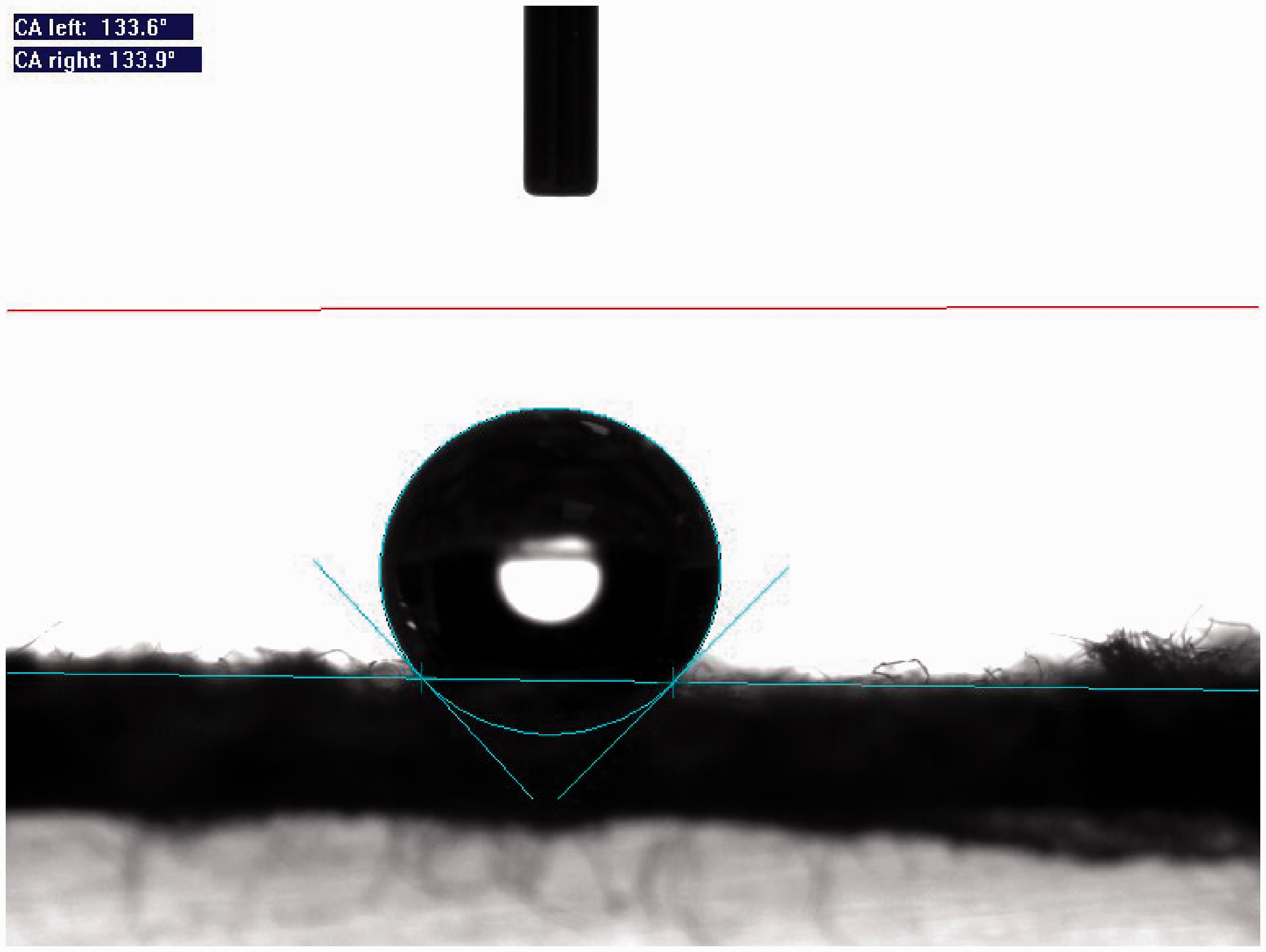
Water Contact Angle for the Fabric with 33.3% PPy.
Electric conductivity
The fabrics containing no fibers coated with PPy (R1 and R2) do not conduct electricity. The fabric with 16.7% PPy coated fibers (S1) conducts electricity when measured along the PPy coated fibers (conductivity 0.58 µS cm−1) and has no electrical conductivity when measured across the coated fibres. The sample with larger PPy content (33.3% PPy fibres, S2) shows higher value of electrical conductivity (0.73 µS cm−1) when measured along the coated fibres then when measured across them (0.05 µS cm−1). The electrical conductivity of fabrics with high amount of PPy coated fibers is increased due to structural difference between the two oxidizing agents and their interaction with pyrrole monomer during the chemical synthesis and their morphologies. Normally pyrrole monomer is oxidized by oxidation reduction reaction of Fe3+ – Fe2+ and subsequently loses its electron; two molecules in this form combine to form a dimer lacking two electrons. Afterwards the dimer recovers aromaticity by losing hydrogen. The pyrrole dimer forms PPy by repeating this process and obtains improved electrical conductivity through doping by Cl–.
Flexural rigidity
Both wale wise and course wise bending behavior of fabrics was studied to study the influence of PPy coated fibers on fabrics stiffness properties. The flexural rigidity of fabrics is the ratio of the small change in bending moment per unit width of the material to the corresponding small change in curvature and it is calculated. The results of both bending length and flexural rigidity are reported in the Figure 7 and Table 7.

Comparison of bending length of fabrics.
Flexural rigidity of fabrics.

The bending length in both sides (surface and back) of the fabrics has calculated for both directions (wale and course) of the fabric. Both wale and course directions, the highest bending length was recorded in surface side of fabric with 33.3% Polypyrrole coated cotton fibres (S2) and lowest value was observed in back side of reference fabric (R1). The Flexural rigidity was calculated and presented in the Table 7, the flexural rigidity in wale direction is higher than the flexural rigidity in course direction for all the fabrics. The flexural rigidity were 16.5% & 12.8% higher for the samples S1 and S2 respectively compared to the sample R1 and R2 in wale wise direction. Concerning flexural rigidity in course direction, fabrics with high PPy coated fibers have higher flexural rigidity than the reference fabrics.
Conclusion
In summary, the knitted fabrics were developed using yarn composed of polypyrrole (PPy) coated cotton fibres with different weight percentages, and fabrics thermal, electrical, optical and hydrophobic properties were studied and reported. The presences of PPy in the fabrics before and after washing were confirmed using FTIR spectra and TGA analysis. The SEM images showed that PPy particles were evenly coated on the cotton fibres. It is also observed that fabrics with PPy coated fibres lead to decrease in total transmission and reflection in UV VIS NIR spectral range as compared with fabrics without PPy coated fibres. Fabric with 33.3% PPy coated fibres has promising absorption capacity of around 70% in human body that irradiates IR range of 6000–14,000 nm. The thermal conductivity in shielded condition has been increased significantly increased with the increases in the amount of PPy coated fibres in fabrics. But, thermal insulation of fabric exposed to environment has been raised for fabric with 16.7% PPy coated cotton fibres and then clo decreased with further addition of PPy coated fibres. Further, the fabric with 33.3% of PPy coated fibers demonstrates hydrophobic properties due to the increased amount of PPy at the surface of the fabric, which prevents water absorption. Fabric with larger PPy content (33.3% PPy fibres) shows higher value of electrical conductivity (0.73 µS cm−1) when measured along the coated fibres then when measured across them (0.05 µS cm−1). The presence of yarn with PPy coated fibres as 1 or 2 courses in single jersey weft knitted fabrics leads to enhance the electrical conductivity in widthwise direction. Additionally, the fabric stiffness was increased about 12–16% with the addition of PPy in the fabrics. The findings of this study can be used to develop conductive spun yarn for the development of fabric with required heating characteristics and it can be applied in sports clothing.
Footnotes
Acknowledgement
The authors gratefully acknowledge technical support from the Sport & Fashion Management Pte Ltd, Singapore for this study.
Declaration of conflicting interests
The author(s) declared no potential conflicts of interest with respect to the research, authorship, and/or publication of this article.
Funding
The author(s) disclosed receipt of the following financial support for the research, authorship, and/or publication of this article: The authors gratefully acknowledge financial support from the Sport & Fashion Management Pte Ltd, Singapore for this study.
