




Abstract
The application of three-dimensional angle-interlock woven composites (3DAC) as structure components in aerospace field creates tremendous demands for mechanical properties. A new kind of 3DAC with bidirectional fabric structure was proposed in this paper. The tensile properties of 3DAC and 3D bidirectional angle-interlock composites (3DBAC) were conducted by quasi-static tensile tests. According to three-point bending method, the flexural properties of 3DAC and 3DBAC were experimentally tested. The load–displacement curves of specimens showed that 3DBAC presented the better stability due to the higher noncrimp rate. The stress–strain curves indicated that the tensile modulus of elasticity in 3DBAC was larger than 3DAC, and the flexural modulus of 3DBAC gained an advantage over 3DAC. Based on the mesostructure of fabrics, the failure characterizations of specimens were analyzed. Results showed that the yarns in 3DBAC bear the maximum load, and the tensile fracture was regular. Through the analysis of crack morphologies, it is found that 3DBAC exhibits better flexural properties. The results supply the theoretical support for the manufacturing of structural components in the field of lightweight design.
Keywords
Introduction
Three-dimensional angle-interlock woven composites (3DAC) as structural components are being applied increasingly to aerospace, defense, and civil industries owing to the benefits of excellent delamination resistance and mechanical properties. These properties determine its application in the complexity and variety of components, such as cylinder and flange, egg crate structures, and turbine rotors [1,2]. The outstanding properties depend upon the type of the fibrous reinforcements and their placement architecture in composites. The reinforcing phase of 3DAC is a bundle of fibers interlocked by warp and weft yarns in the thickness direction, leading to the anisotropic and orientation-dependence [3–5]. In practice, 3DAC components require high modulus and the same properties in warp and weft directions, which are affected by the proportion and geometrical structure of the yarn systems. Although 3DAC possess better mechanical properties, further study on the influence of fabric structure on the tensile properties and flexural properties will help researchers design and construct the high-performance components.
The effective elastic properties of 3DAC are related to the performance of fibers and matrix, as well as the meso-geometric structure of fabrics [6]. Much efforts have been contributed to investigate the meso-geometric structures, which affect the elastic properties of 3DAC. Whitney and Chou [7] developed a model for predicting the in-plane elastic properties of 3DAC. The results showed that fiber volume fraction was the key element affecting the in-plane elastic properties. Byun and Chou [3] identified the influence of structural parameters on the geometrical structure of 3D angle-interlock fabrics. It was found that the cross-sectional shape of warp/weft yarns and the distance between adjacent yarns were the key parameters affecting the elastic properties of 3DAC. Lapeyronnie et al. [8] established a model for predicting the in-plane elastic constants of 3DAC. The internal geometric structure and constituent properties of the composites was obtained, and the results were verified by experiments. Younes et al. [9] proposed a homogenization element model and optimized by considering the method of sequential quadratic programming approach. The elastic modulus and fiber volume fraction were predicted. Hallal et al. [10] considered the real structure of the yarns and proposed a mixed model using the three stages homogenization method. The elastic properties of 3DAC could be estimated.
Many researches have analyzed the factors affecting the mechanical properties of 3DAC. Tensile tests and numerical simulations were conducted to obtain its tensile properties and failure mechanism. Dong et al. [11] performed the tensile tests on 3DAC to review that the shape and layers of fabric impacted the tensile properties. The tensile strength in the warp direction was increased with the raising of yarn layers, but the tensile strength in the weft direction presented instability. Lu et al. [12] analyzed the stress–strain behavior and progressive damage process of 3DAC under uniaxial tension using two-step multiscale progressive damage analysis method. The relationship between the tensile strength and the loading direction was obtained, and the characteristic failure modes under different off-axis loading angles were discussed. Song et al. [13] proposed the nonlinear progressive damage analysis method to simulate the stress–strain behavior and damage characteristics of composites under uniaxial tension, and discussed the effects of tightening parameters and element thickness on the mechanical properties of woven composites. Liu et al. [14] investigated the damage behavior of 3DAC under uniaxial tension, and presented a multiscale progressive failure modeling scheme. The effective tensile elastic properties, failure strength, and damage evolution process of composites were predicted. Also, the flexural properties of 3DAC were investigated. Jin et al. [15] presented the comparison of quasi-static three-point bending behavior between the 3DAC and the 3D orthogonal woven composite. The results showed that the different structural fabrics affected the flexural properties of composites, and the existence of noncrimp yarns along the load-carrying direction played an important role in the bending loading conditions. Dai et al. [6] discussed the effect of weave architecture and binder position on the properties of the 3D woven composites, and the results showed that the mechanical properties of 3D woven composites was found to be affected by the distribution of resin-rich regions and the curvature of the load-carrying fibers. Zhang et al. [16] predicted the effect of off-axis angle on the bending properties of 3D carbon/epoxy woven composites. Bending experiments were carried out on specimens with different angles. The results showed that there existed obvious quasi-brittle behavior in the stress and deformation of coaxial (0° and 90°) specimens, but the stress and deformation of coaxial (30° and 45°) specimens had important ductile characteristics.
As structural components, the strength and modulus of 3DAC require higher demands, as well as the dimensional stability of fabrics. The mechanical properties in weft and warp directions are different. In order to obtain 3DAC with high modulus in orthogonal two-direction, one approach is to balance the mechanical properties in warp and weft directions by adjusting the volume ratio of warp and weft fibers in the fabrics. Jiao et al. [17] studied the effect of the volume ratio of warp and weft fibers on the mechanical properties of 3DAC. It was found that when the volume ratio was 1:0.5, the properties in warp and weft directions kept balanced. Another approach is to propose new 3D textile fabrics with different geometrical structures, and to analyze the feasibility of the process. Based on the symmetry group in crystallography, Ma et al. [18–20] deduced a series of 3D textile fabric structures, and made basic research on their processing and meso-geometric structure. The effective elastic constants of these deduced composites were analyzed by considering the structural parameters of fabrics.
In this paper, a new kind of three-dimensional bidirectional angle-interlock composites (3DBAC) is proposed based on the processing of fabrics in 3DAC. The specimens of 3DBAC and 3DAC are prepared by woven process and vacuum-assisted resin transfer molding (VARTM) technique. The quasi-static tensile tests and three-point bending tests are conducted. The extensometer is adopted to record the displacement changes in minute scope. Comparing the load–displacement curves and stress–strain curves of specimens, the tensile and flexural properties of 3DAC and 3DBAC are discussed. The failure characterizations of specimens are also analyzed according to the geometrical features of fabrics.
Experimental details
Materials and specimen preparation
3DBAC is different from the traditional 3DAC with regard to the geometrical structures and properties. The systems of warp and weft fiber tows owe the same curvature, so the yarn systems in the bidirectional angle-interlock fabrics are divided into x-directional yarns and y-directional yarns. As shown in Figure 1, the meso-structure of the bidirectional angle-interlock fabrics is quite different from the traditional ones. The two yarn systems are arranged alternately with a certain ratio of 1:1, and the fibers remain straight to the maximal degree. As shown in Figure 1(a), both the x-directional and y-directional yarns are the same so that the mechanical properties achieve consistency among two directions. The traditional 3DAC is displayed in Figure 1(b). The warp yarns remain curved, whereas the weft yarns keep straight. The specifications of 3D angle-interlock fabrics are displayed in Table 1.

Schematic of 3D angle-interlock fabrics: (a) 3D bidirectional angle-interlock fabrics; (b) 3D angle-interlock fabrics.
The specification of 3D angle-interlock fabrics.

3DBAC: three-dimensional bidirectional angle-interlock composites; 3DAC: three-dimensional angle-interlock woven composites.
The epoxy resin GE-7118A is mixed with curing agent GE-7114B with mass ratio of 10:3, thereafter saturating the preform sufficiently by VARTM technique. The materials considered in this paper are 3DAC and 3DBAC made of T700-12K carbon fibers. The mechanical property parameters of component materials are presented in Table 2. Figure 2 displays the photographs of the 3DBAC specimens. Cartesian coordinate system is adopted, and the view of 3D angle-interlock fabrics in z-direction is shown in Figure 2(a). The x-directional and y-directional yarns are arranged in 1 × 1. Figure 2(b) shows the cross-section of 3DBAC. The shape of tension specimens is cut to 3D dumbbell employing high-pressure water jet, and the shape of three-point bending specimens is adopted rectangular as shown in Figure 2(c) and (d). The overall size of the tensile specimen is 180 mm (length, L) × 20 mm (width, W), and the size of three-point bending specimen is 120 mm (length, l) × 12.5 mm (width, b). The tensile and bending specimens of 3DBAC were numbered to record the tests accurately. In order to compare the difference between 3DBAC and 3DAC, the component materials and curing process remain the same, as well as the size of the specimens and experimental methods. The thickness of 3DBAC and 3DAC are 2 mm and 3 mm, separately. Five effective experimental datum are selected to analysis the properties of each group of specimens.
Mechanical properties of component materials.


Photographs of the 3DBAC: (a) z-directional view; (b) cross section; (c) number the tensile specimens; (d) dimension of three-point bending specimen.
Quasi-static tensile tests
The elastic modulus is a sensitive and basic factor in affecting the structural components application of composites. According to the test standard GB/T 1447-2005, the quasi-static tension tests were conducted on EHF-UV100k1-040-0A system at a cross-head speed of 2 mm/min.
As shown in Figure 3(a), the tests were carried out at room temperature. To avoid the specimens slipping and stress concentration around clamps in the tensile tests, copper sheets were warped at the end of the specimens. It is ensured that the specimen center line coincides with the loading center line of the test machine. The extensometer was adopted to record the displacement changes in minute scope. Figure 3(b) shows the dimensions of tension specimens of 3DBAC and 3DAC. The values of length and width have been given, where L × W is 180 mm × 20 mm, and the values of the effective segments are expressed by the representative letter.

Quasi-static tensile tests: (a) the equipment; (b) the dimensions of tensile specimen.
Further, the tensile modulus of elasticity Et can be calculated by equation (1)
Quasi-static three-point bending tests
Three-dimensional woven composites present a complex stress state in flexural property tests, and the tensile, compressive, and shear stresses are conducted simultaneously in the loading specimen [21]. The three-point bending tests were conducted on the universal testing machine at room temperature, and the span-to-depth ratio was 16:1, as depicted in Figure 4. According to the test standard GB/T 3356-2014, the speed of indenter is adopted to be 2 mm/min. From equation (2), the flexural modulus can be calculated
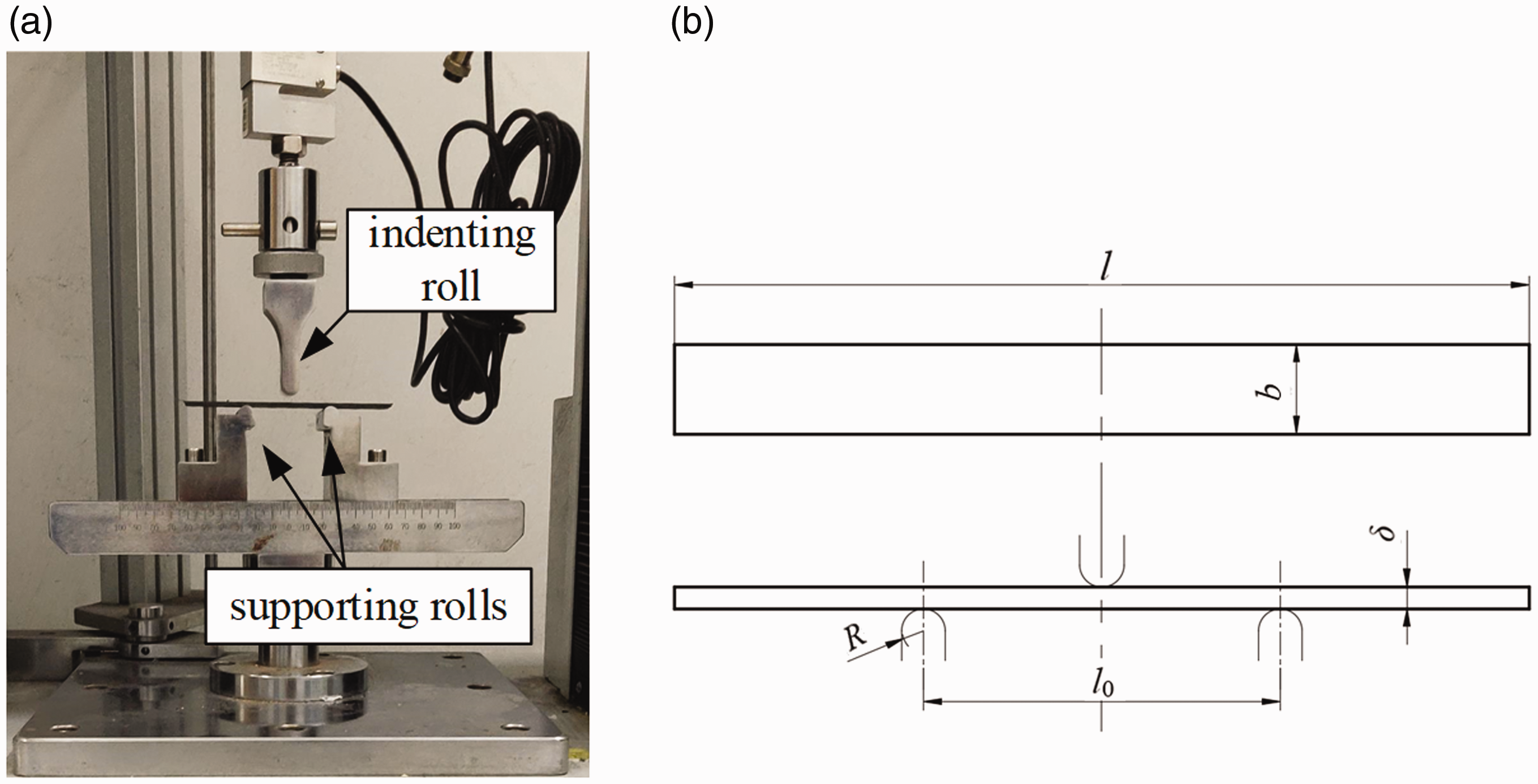
Three-point bending tests: (a) the equipment; (b) the dimensions and span of bending specimen.
The composite specimens were placed on two supporting rollers as shown in Figure 4(a) and the indenting roller was employed to provide the applied static loading. Figure 4(b) shows the dimensions of three-point bending specimen, and the three rollers have a radius of R = 3 mm, and the span between the two supporting rollers is l0 = 50 mm.
According to equations (1) and (2), the tensile modulus and flexural modulus of elasticity in each group can be deduced and the three valid digits are retained. The arithmetic average value of datum in each group is calculated according to equation (3), and the valid digits of statistical data are retained
Results and discussions
Quasi-static tensile properties
Figure 5 shows the tensile load–displacement curves of angle-interlock woven composites, whose effective size is 50 mm (length, L0) ×10 mm (width, b). The extensometer recorded the displacement changes. The result shows that the tensile curve of 3DBAC is smoother than the 3DAC ones. At the beginning of the test, the displacement increased linearly with the increase in load.

Tensile load–displacement curves of angle-interlock woven composites.
The slopes of the tensile load–displacement curves of 3DBAC decrease gradually before the load of 13.5 kN, and then the load decreased suddenly. With the increase in the load, the curves of 3DBAC showed better stationarity than 3DAC. The reason is that the structural features of the two fabrics match well. The results show that there exists better stability in fabrics in 3DBAC than that in 3DAC. The curve of 3DAC shows fluctuation at the load of about 5 kN, and the curve presented the serrated shape. The mechanism for this phenomenon is that the fiber in composites is presented with high crimp. The curvature of yarns is gradually decreased with the increase in the load, and this procedure is not smooth. Therefore, the load–displacement curves is smooth with the low crimp of fibers. Then, the load eventually reaches 13.5 kN, and then decreases suddenly. The peak loads of 3DBAC and 3DAC are similar, but the cross-sectional area of 3DBAC is smaller than the 3DAC ones. The maximum displacement of 3DAC is larger than 3DBAC. Therefore, the elongation of 3DBAC is lower than 3DAC.
The average datum of tensile modulus can be obtained according to equations (1) and (3), and the stress–strain curves and the elastic tensile modulus of 3DBAC and 3DAC are displayed in Figure 6. Each curve is the consequence of the quasi-static tension tests, as shown in Figure 6(a), and the slopes express the value of elastic modulus. The results show that the slope of the stress–strain curves of 3DBAC decreases slightly with the increase in strain, and its value reaches its maximum at the initial stage. The slope of the stress–strain curves of 3DAC increases slightly in the initial stage, and decreases gradually after reaching a certain degree, that is, the initial elastic modulus of 3DAC is not the largest. The reason being the internal fabric structure is unstable and the loading fibers fail to bear the maximum load in the initial stage. According to equation (3), the elastic tensile modulus of these two types of composites is displayed in Figure 6(b). The tensile modulus of 3DBAC is around 50 GPa and that of 3DAC is around 32 GPa. The error bar is introduced to illustrate the distribution range of modulus, and the dispersion ratio of 3DAC is higher than 3DAC. In conclusion, the tensile modulus Et value of 3DBAC is larger than that of 3DAC, and the tensile modulus of 3DBAC reaches its maximum in the initial stage. Therefore, 3DBAC has better stability and supplies the theoretic support for the manufacturing of structural components.

The stress–strain curves and elastic tensile modulus of 3DBAC and 3DAC.
Quasi-static flexural properties
As shown in Figure 7, the load–deflection curves of 3DBAC and 3DAC in quasi-static three-point bending tests are displayed. Both the curves can be divided into three distinct stages. In the first stage, the curves keep horizontal, and the displacement increases under relatively lower load. The reason being the specimens have not entered the stage of elastic deformation. The second stage is the initial elastic stage, and the load–deflection curves increased with the increase in the load. It can be found that the shape of 3DBAC presents the linear thought pattern, but not the shape of 3DAC. Originally, the shape of 3DAC is parabola but finally becomes a straight line, which is due to the curvature of fibers in fabrics. Before reaching the peak load, there occurred a sudden decrease in the load of both 3DBAC and 3DAC, and then the load increased until it reached a maximum value. In the third stage, the curves of specimens showed instability, and the curves exerted serrated shape. The load reduced directly after reaching the peak loads because of the instability of the angle-interlock fabrics. Finally, the specimens failed after these three stages.

The load–deflection curves of 3DBAC and 3DAC in three-point bending tests.
The stress–strain curves of 3DBAC and 3DAC in three-point bending tests are illustrated in Figure 8(a). The slopes of the curves are the flexural modulus of 3DBAC and 3DAC. The results show that the stress–strain curves of 3DBAC is growing in a straight line at the initial elastic stage. As shown in 3DAC, the slope is unstable when the strain is [0.006, 0.01]. It corresponds to the original of the second stages of 3DAC. As the strain increases, the slope of the curve eventually shows a stable value. In contrast, the slope of stress–strain curves of 3DBAC exhibits stability at the initial elastic stage. The reason being there is a difference in the fabric construction of 3DBAC and 3DAC, and the curvature of fibers in the fabric ultimately affects the properties. The results show that 3DBAC presents better flexural properties.
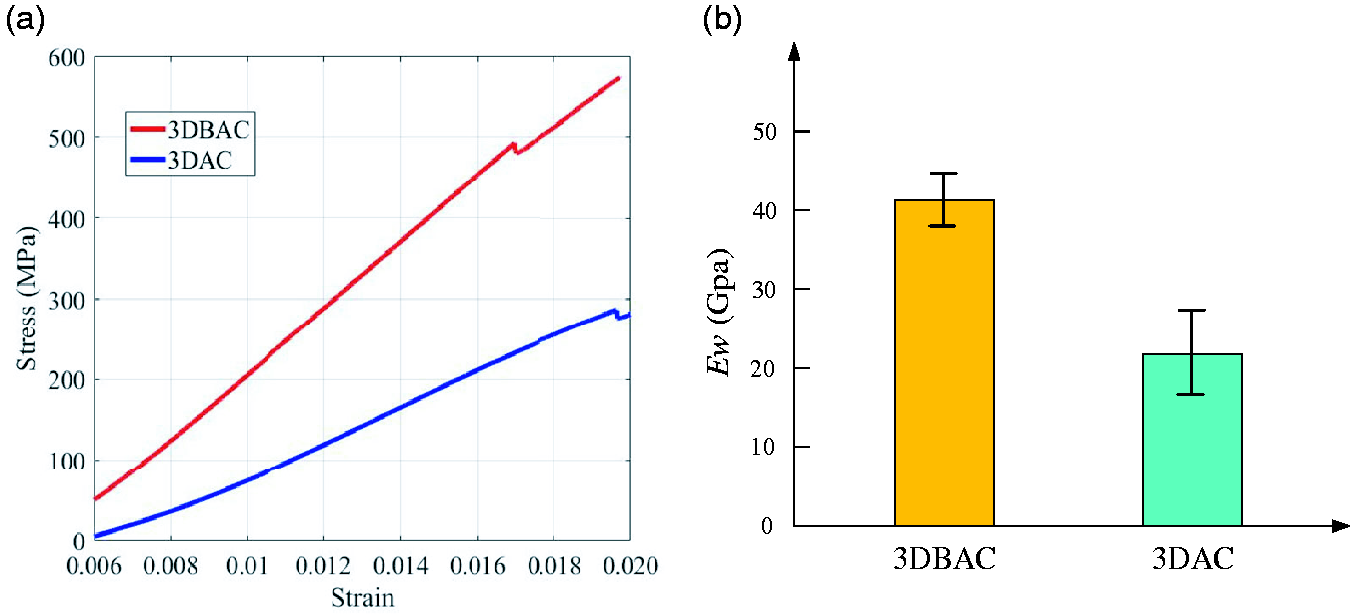
The stress–strain curves and flexural modulus of 3DBAC and 3DAC.
According to equations (2) and (3), the value of flexural modulus can be calculated. As shown in Figure 8(b), the flexural modulus of 3DBAC is approximately 41 GPa, and the error bar is also illustrated. Furthermore, the flexural modulus of 3DAC is obtained, and the average value is about 22 GPa. The error bar of 3DAC is displayed, but its dispersion ratio is higher than the 3DBAC ones. In conclusion, 3DBAC displays better flexural properties than 3DAC.
Failure characterization
The flexural modulus of 3DBAC and 3DAC are lower than the tensile modulus, and the flexural strength is higher than the tensile strength. The ultimate failure morphologies of 3DBAC and 3DAC specimens under quasi-static tensile loading are presented in Figures 9 and 10, separately. The results show that the matrix cracking, fiber breakages, and debonding are the main damage modes. The sequence number corresponds to the number of tensile specimens, and four typical fracture surfaces were displayed.

The tensile fracture morphologies of 3DBAC specimens.

The tensile fracture morphologies of 3DAC specimens.
Figure 9 shows four typical fracture surfaces of specimens by the optical microscope. The fracture mechanism of 3DBAC is brittle rupture, and matrix cracking and fiber breakages can be easily found on the fracture surface of the specimens. It could be found that specimens (1)–(4) show obvious fiber breakages and matrix cracking around the fracture surface can be observed. The fracture surface is vertical and specimens (1) and (2) indicated that the fiber breakages are the main failure modes. This illustrates that the yarns in 3DBAC carry majority of the load during the static tensile tests. These characterizations further proved that fabrics in 3DBAC exert important influence on tensile tests.
Meanwhile, four typical tensile fracture morphologies of 3DAC specimens are presented in Figure 10. The fracture surface of 3DAC is varied than 3DBAC, and fiber breakage and debonding are the main failure modes. The fiber breakages on the fracture surface are disorderly present. The results indicated that the waviness warp yarns carried the major loads during the static tensile loading. The debonding was relatively easier to occur at the stress concentration regions of yarn–resin interface, where the waviness warp yarns hold the maximum amplitude of wave. Taking the structural features of fabrics in 3DBAC and 3DAC into consideration, the phenomena summarized above should be identified as different dominant damage mechanisms. It can be obtained that the structural features of fabrics affect the tensile property. The yarns in the fabrics of 3DBAC have high noncrimp rate, so the yarns carry the major load. The curvatures of yarns influence the final properties.
The quasi-static three-point bending tests of 3DBAC and 3DAC specimens have been conducted. In order to obtain the flexural modulus, the specimens of 3DBAC and 3DAC are tested without the final fracture. Figures 11 and 12 show the breakage morphologies of specimens, where the cracks of 3DBAC are more visible. The sequence number corresponds to the number of bending specimens, and four typical breakage morphologies are displayed.

The breakage morphologies of 3DBAC after quasi-static three-point bending tests.
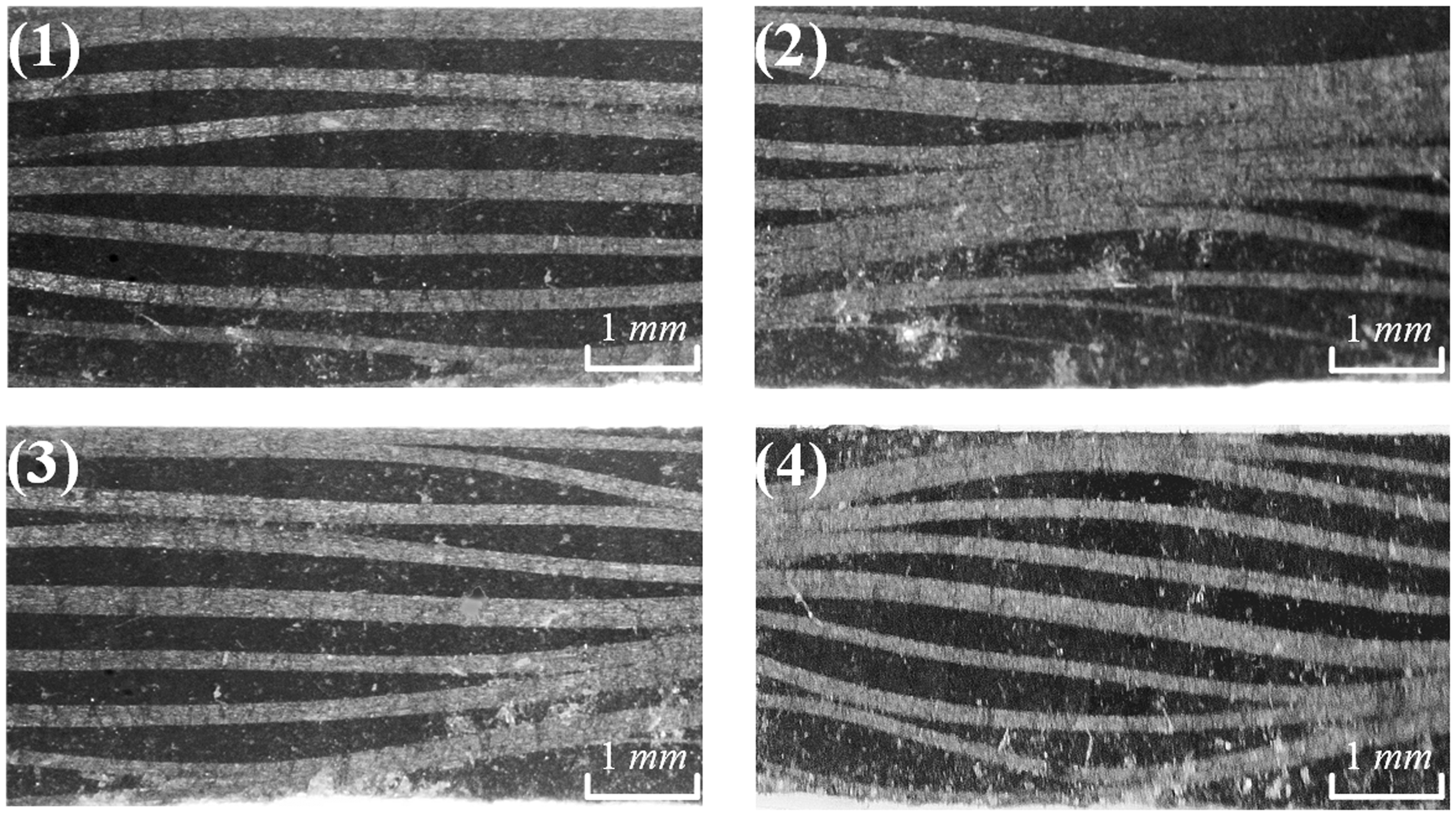
The breakage morphologies of 3DAC after quasi-static three-point bending tests.
As shown in Figure 11, the cracks begin to occur at the opposite surface after the load is applied on the specimens. With the increase in load, the cracks propagated along the thickness, where the final cracks are emphasized with red circle. It can be obviously observed in these four figures that the cracks do not occur through the thickness after failure. This is attributed to the structural features of angle-interlock fabrics, where the delamination resistance exists. This phenomenon indicates that the yarns in fabrics of specimens carry the major load. The existence of noncrimp yarns plays an important role in three-point bending tests. Moreover, the cracks of the specimens have high consistency. In contrast, the specimens of 3DAC have no clear cracks after failure.
As shown in Figure 12, the cracks in specimens of 3DAC are tiny, and the crack is at the initial period. During the three-point bending tests, the specimens make a brittle sound after reaching the maximum load and the resin cracking is the main failure mode. This indicates that the yarns in 3DAC cannot bear the main load because of the structural features of fabrics. In comparison to 3DAC, the structural features of 3DBAC exhibit better flexural properties.
Conclusion
In this study, a new kind of 3D angle-interlock fabrics was proposed to meet the application of structural components. The quasi-static tensile and three-point bending tests were conducted. The tensile and flexural properties have been discussed by comparing 3DBAC and 3DAC. Also, the stress–strain curves of 3DBAC and 3DAC were displayed. The failure characterizations of specimens were identified. The following conclusions are drawn: The yarns in the fabrics of 3DBAC have high noncrimp rate. It makes the yarns carry the load to a maximum extent. According to the tensile and three-point bending tests, the superiority of the structural fabrics in 3DBAC is verified. The curvature of yarns in composites can greatly affect the tensile and flexural properties. The stability of angle-interlock woven composites is largely determined by the fiber curvature. In the tensile tests, the load–displacement curves of 3DBAC presented the brittle properties, and the curves of 3DAC displayed the serrated shape before reaching the maximum load. The tensile modulus of composites was calculated, and the value of 3DBAC was higher than 3DAC. In quasi-static three-point bending tests, the load–deflection curves and stress–strain curves of 3DBAC and 3DAC were finally obtained. The flexural properties of 3DBAC gained an advantage over 3DAC. Both the failure characterizations of tensile and bending tests were analyzed. The results indicated that the structural features of fabrics in 3DBAC are better than 3DAC owing to the fabric structure of composites.
Overall, two kinds of 3D angle-interlock composites were investigated in this study. The tensile and three-point bending tests were conducted. The fundamental researches provide the theoretical support for the application of 3D composite materials in structural components. Further work is to describe the influence of the noncrimp rate in a quantitative way, and compare the fatigue properties of 3DBAC and 3DAC.
Footnotes
Declaration of conflicting interests
The author(s) declared no potential conflicts of interest with respect to the research, authorship, and/or publication of this article.
Funding
The author(s) received no financial support for the research, authorship, and/or publication of this article.
