




Abstract
This paper compares the ballistic impact damage behaviors between the three-dimensional angle-interlock woven fabric and its reinforced composite (three-dimensional angle interlock woven composite) under various ballistic strike velocities based on experimental and numerical finite element analysis. In experiments, the residual velocities of projectiles were recorded to compare their ballistic proof properties undergoing different impact loading conditions. Furthermore, the ultimate damage morphologies of both types of materials were also compared to deduce the specific ballistic impact performance and energy absorption mechanisms between the three-dimensional angle interlock woven fabric and three-dimensional angle interlock woven composite. It was found that the three-dimensional angle interlock woven composite has absorbed more energy than the three-dimensional angle interlock woven fabric under the “high” ballistic velocities (higher than 350 m/s). And it shows the opposite phenomena under the “low” ballistic velocities (lower than 350 m/s). In finite element analysis, the simplified finite element models were established for both materials to characterize the critical importance of resin matrix in transferring and dissipating the high velocity impact energy. Especially for three-dimensional angle interlock woven composite, the impact energy was transferred to the large area during a relatively short period of time, thereby resulting in an overall bearing capacity of the composite structure, therefore absorbed most of the impact energy, which was well applied to explain the experimental results.
Keywords
Introduction
In recent several decades, due to the significant mechanical advantages of light weight, high strength, easy to design, as well as the great energy dissipating and absorption performances, textile structural fabrics and their reinforced composites have been widely used in engineering field, such as aerospace, sports equipment, vehicle protection and ballistic-proof [1,2].
The 3D textile structural patterns include woven, braided and knitted fabrics, as
shown in Figure 1 [3–6]. The most
significant characteristic is that the fibers through thickness direction. Such
structural characteristic can greatly increase the inter-layer shear strength,
improve the structural stability and resist the de-lamination. 
Among them, three-dimensional angle interlock woven fabrics (3DAWF) and their reinforced composites (three-dimensional angle interlock woven composites, 3DAWC) have gained fast growing interest because of their higher interlayer strength along the thickness direction compared with other textile structural fabrics or composites, which is mainly owing to the weft yarns that are interlaced through the different layers of the warp yarns in the fabric architecture. Moreover, angle interlock is one kind of weaving technique in which weft yarns are placed at an angle to the thickness direction to hold the non-crimp warp yarns together for delamination resistance, such structural characteristic is very effective for dissipating the impact energy when subjected to the ballistic impact loading. Besides, the properly selections of the suitable fiber types and matrix materials for manufacturing the 3DAWF and 3DAWC may significantly strengthen their mechanical properties [7–14]. Therefore, both of the 3DAWF and 3DAWC have great potential in the ballistic-proof body armors design and manufacture [15–17]. In particular, such kind of structural feature will lead to higher ballistic impact energy absorption performance than the traditional multi-layered 2D plain woven fabric system. Chen and Yang [18,19] proposed a research on the ballistic impact performance of 3D angle-interlock fabrics, it was found that the angle-interlock fabric had shown a better ballistic impact resistance property than the conventional 2D plain woven fabric pattern ballistic armours.
The mechanical properties, such as tension, compression, bending, shearing and fatigue of the 3DAWF and 3DAWC have been studied by several researchers [20–28]. As for the ballistic impact behavior of the 3DAWF and 3DAWC, Cui et al. [29], Li et al. [30] and Luan et al. [31] employed three-dimensional (3-D) finite element models to analyze the damage mechanisms of 3DAWC subjected to ballistic impact loading. Good agreement between finite element analysis (FEA) and experimental was found in both researches. Tang et al. [32] studied the failure modes of the 3DAWC undergoing transverse impact loading. For the impact responses and ultimate damage mode, good agreement was found between FEA and experimental results. Jin et al. [33] studied the energy absorption characteristics and mechanisms of a layer-to-layer 3DAWC under different high velocity impact conditions. There were good agreements of the impact damage of the 3DAWF and the residual velocities of the projectile between finite element results and experimental results. The acceleration fluctuation record of the projectile and the stress wave propagation in the 3DAWF obtained from the simulation reveal the impact damage mechanisms of the 3DAWF. However, few research was reported on the comparisons of ballistic impact property between them so far.
In this paper, both experimental and numerical comparisons of the ballistic impact behaviors between the 3DAWF and 3DAWC under different ballistic impact velocities are presented. The residual velocities of the projectiles for both kinds of targets are given to compare their ballistic-proof performances. The ultimate ballistic impact damage morphologies of the 3DAWF and 3DAWC targets are also presented to illustrate the mechanism of energy absorption. In addition, the simplified finite element models are established to characterize the critical importance of resin matrix in transferring and dissipating the impact energy.
Experimental
3DAWF and 3DAWC
Figure 2 shows a sketch
diagram and tested specimen of the 3DAWF. It can be found that two adjacent
layers of warp yarns are held together by the weaving of the weft yarns. Such
type of fabric structural characteristic ensures high stiffness and high
strength to the entire material. In addition, this kind of fabric structure is
pretty effective for dissipating the high velocity impact energy. Herein,
Twaron® filament tows manufactured by Akzo Nobel were used for the weaving of
3DAWF. Table 1 lists
the specifications of the fabric. Sketch diagram of the 3DAWF and tested specimen. Specifications of the 3DAWF. 3DAWF: three-dimensional angle interlock woven fabrics.

As shown in Figure 3, the
vacuum assisted resin transfer molding (VARTM) technique is always used to
manufacture the textile structural composites. In this work, unsaturated
polyester resin was injected into the 3DAWF with VARTM technique to manufacture
the 3DAWC plate. The employed resin and curing agent were AROPOLTM INF 80501-50
polyester resin manufactured by Ashland Composite Polymers China and AKZO® M-50,
respectively. Their proportion was 100:1.5 by weight. The composite plate was
cut with high-pressure water jet to obtain the 3DAWC specimens as presented in
Figure 4. The size
of tested samples was 200 mm × 200 mm × 11 mm (length × width × thickness). And
the unit areal weight of specimen was 1.56 × 10⁴ g/m2. The
burn-off tests were used to measure the fibre volume fraction for the composite
specimens. The obtained fibre volume fraction for the composite specimens was
approximately 50%. Table
2 lists the mechanical parameters of materials. Textile structural composites manufacturing using VARTM technique:
(a) photo and (b) schematic diagram. The surface of tested 3DAWC specimen. Mechanical parameters of materials.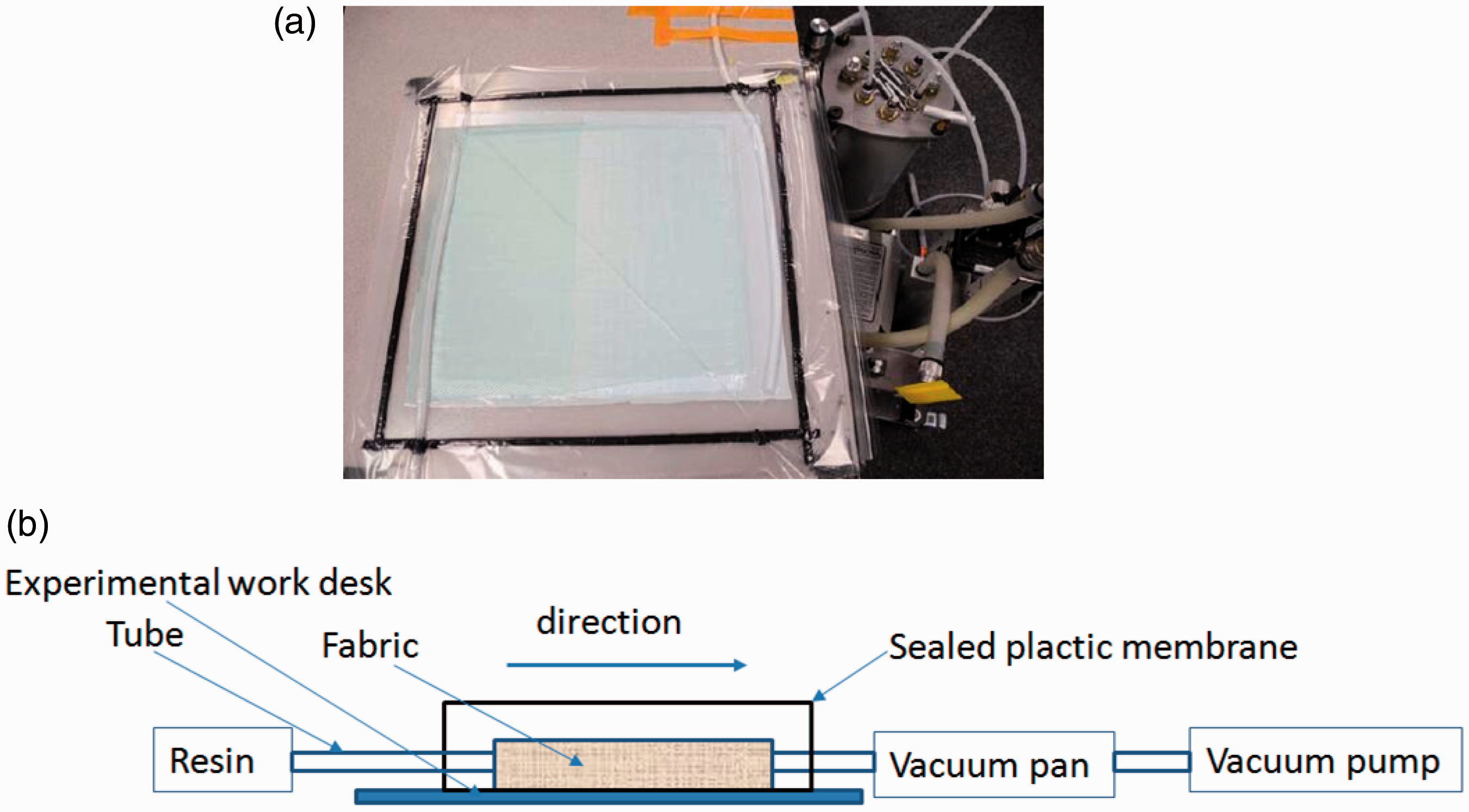


Ballistic impact tests
Ballistic impact tests were conducted at No. 53 Institute of China Ammunition Co.
Ltd. Tested specimens were clamped between two steel rings with inner diameter
of 12 cm. As shown in Figure
5, the steel projectiles with a copper jacket of Type 56 (China
Military Standard) were used for all the ballistic impact tests and the impact
points were designed at the center of the targets. The strike velocity of the
projectile was adjusted by changing the weight of gunpowder. The strike velocity
Vs and the residual velocity Vr of the projectile were measured by the
corresponding digital sensors. Parameters of the projectiles are listed in Table 3. The projectile and its dimensions [33]. Parameters of the projectiles. 3DAWF: three-dimensional angle interlock woven fabrics; 3DAWC:
three-dimensional angle interlock woven composites.
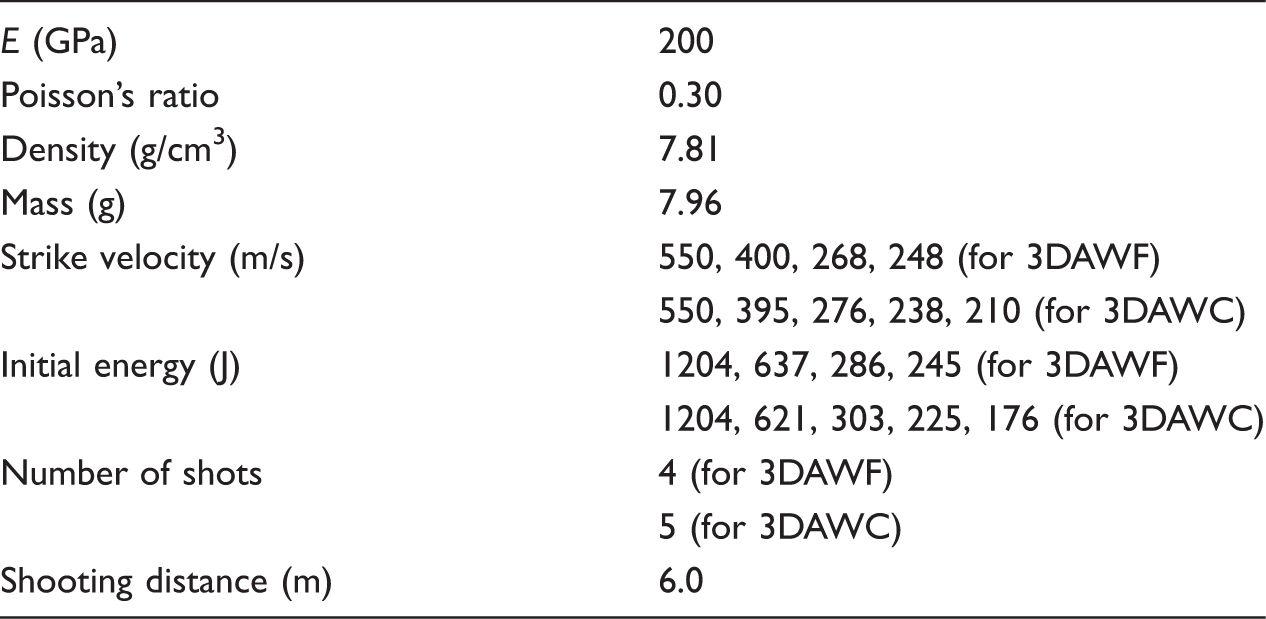
FEA
The simplified FEA was employed to study the critical importance of resin matrix in transferring and dissipating the ballistic impact energy in the 3DAWC structure. FEA was conducted using commercial finite element software (ABAQUS/ Explicit, Ver. 6.10).
(1) Geometrical model. As shown in Figure 6, the simplified ballistic impact
FEA models of the 3DAWF and 3DAWC were established. The spherical shaped steel
projectile was employed in FEA. The ballistic impact simplified FEA model of (a) 3DAWF and (b)
3DAWC.
(2) Interaction property. For the definition of materials contact, “SURFACE TO SURFACE CONTACT” was defined between the adjacent materials. The surface of projectile is the master surface and the surface of yarns and resin (for 3DAWC only) is the slave surface. The fraction coefficient between the resin and yarns was set to 0.2. And the fraction coefficient between the warp yarns and weft yarns was set to 0.3.
(3) Loading and boundary condition. The applied initial strike velocity of projectile was 300 m/s and the duration of the ballistic impact was 10 μs. The steel projectile was treated as a rigid body with no freedom of displacement or rotation, except the displacement along normal impact direction (−Y direction). For the fabric or composite target, two sides were fully fixed.
(4) Mesh. Coincidence of nodes technique was applied in mesh process. The element type was CPS4R Quad-dominated. Furthermore, the numbers of elements for 3DAWF and 3DAWC were 2114 and 3831, respectively.
(5) Failure criteria. In FEA, the maximum stress failure criteria were applied to dominate the failure of materials. When the stress reaches the maximum value of yarn or resin, the elements will be damaged and deleted.
Results and discussions
The residual velocities of projectiles and energy absorption
The residual velocities of projectiles after ballistic tests for both kinds of
targets are shown in Figure
7. It was found that the residual velocities of the projectiles in
the ballistic impact tests for the 3DAWC were lower than those for the 3DAWF at
the “high” impact velocities (higher than 350 m/s). In addition, as listed in
Table 4, it
presented that the 3DAWC had absorbed more impact energy (approximately 40 J)
than 3DAWF at the high velocity region. On the contrary, they were higher at the
“low” velocities (less than 350 m/s), which meant that the 3DAWF had absorbed
more impact energy (over 37 J) than 3DAWC at the low velocity region. In
particular, it was found that the projectiles were captured by the targets at
the ballistic velocities of 210 m/s and 248 m/s for the 3DAWC and 3DAWF,
respectively. Strike velocity vs. residual velocity of the projectiles. Energy absorption comparison between 3DAWF and 3DAWC. 3DAWF: three-dimensional angle interlock woven fabrics; 3DAWC:
three-dimensional angle interlock woven composites.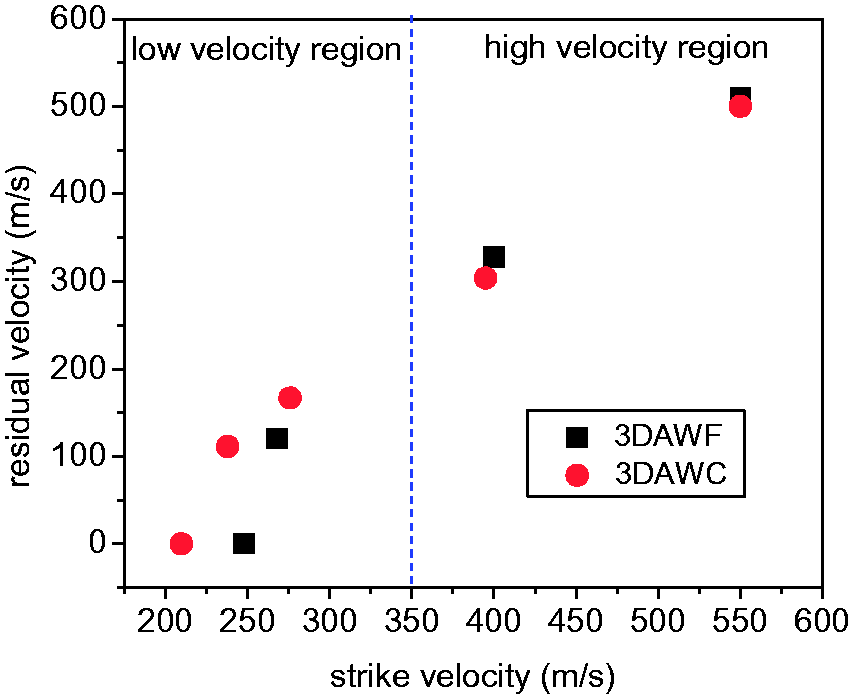

Based on the tested results above, it can be concluded that the 3DAWF has a more obvious advantage of bullet-proof undergoing the “low” ballistic impact velocities (lower than 350 m/s), as well as the 3DAWC has a more obvious advantage of bullet-proof when subjected to the “high” ballistic impact velocities (higher than 350 m/s). It is no doubt that such phenomenon is related to the material structure characteristics, which will be explained below.
Damage modes and energy absorption
For both impact cases, the residual velocity of the projectile was mainly
dominated by the deformation area or damage magnitude of the target, and in
particular, the different impact damage mechanisms between the fabric and
composite also should be taken into consideration. The 3DAWC has absorbed more
impact energy than the 3DAWF under the “high” ballistic velocities (higher than
350 m/s). It may be owing to the specific strain rate effect of the materials
subjected to high velocity impact [34], where the impact energy may
propagate to a large area of the target at a very high stress wave velocity
during a relative short period of time according to equation (1)
[35], the
calculated stress wave velocities in fiber tow and resin are 8700 m/s and
1638 m/s, respectively. This leads to the dissipation and absorption of a large
amount of impact energy. 
And the 3DAWC has absorbed less energy than the 3DAWF under the “low” ballistic
velocities (less than 350 m/s). The strain rate effect was no longer dominating
the energy absorption mechanism, where the deformation and damage of the target
played an important role owing to the “low” velocities provided more time for
the deformation or damage of the targets. Therefore, the 3DAWF has absorbed more
energy due to its larger area of deformation compared with the 3DAWC. Figure 8 presents the
comparisons of ultimate ballistic impact damage morphologies between the 3DAWF
and 3DAWC, which at the ballistic impact velocities of 248 m/s and 210 m/s
(captured status, i.e. the projectile was captured by the target), respectively.
In Figure 8, it can be
clearly found that the deformation area of 3DAWF was larger than that of 3DAWC,
where the deformation area of 3DAWF was larger than 19 mm (mainly for back
surface), and that of 3DAWC was approximately 16 mm. Ballistic impact damage morphology for the low velocity issues
(captured status). (a) 3DAWF (Vs = 248 m/s) and (b) 3DAWC
(Vs = 210 m/s).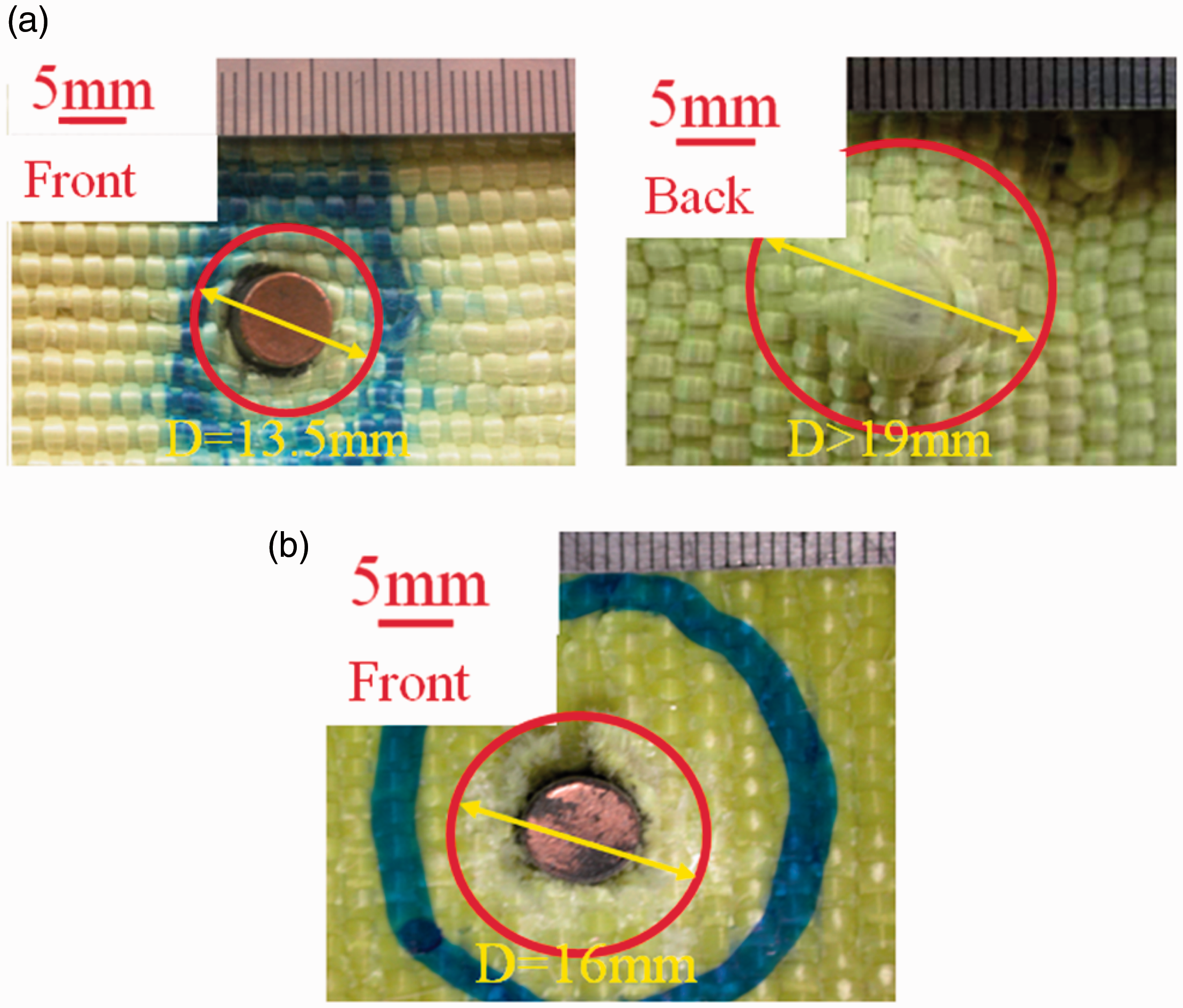
Damage evolution mechanisms
We summarize the ballistic impact damage evolution mechanisms of the 3DAWF and
3DAWC, as well as reveal the critical importance of resin matrix in transferring
and dissipating the high velocity impact energy. Figure 9 gives the impact damage
evolution process of both materials at different time steps by FEA. The ballistic impact damage evolution of 3DAWF (left) and 3DAWC
(right).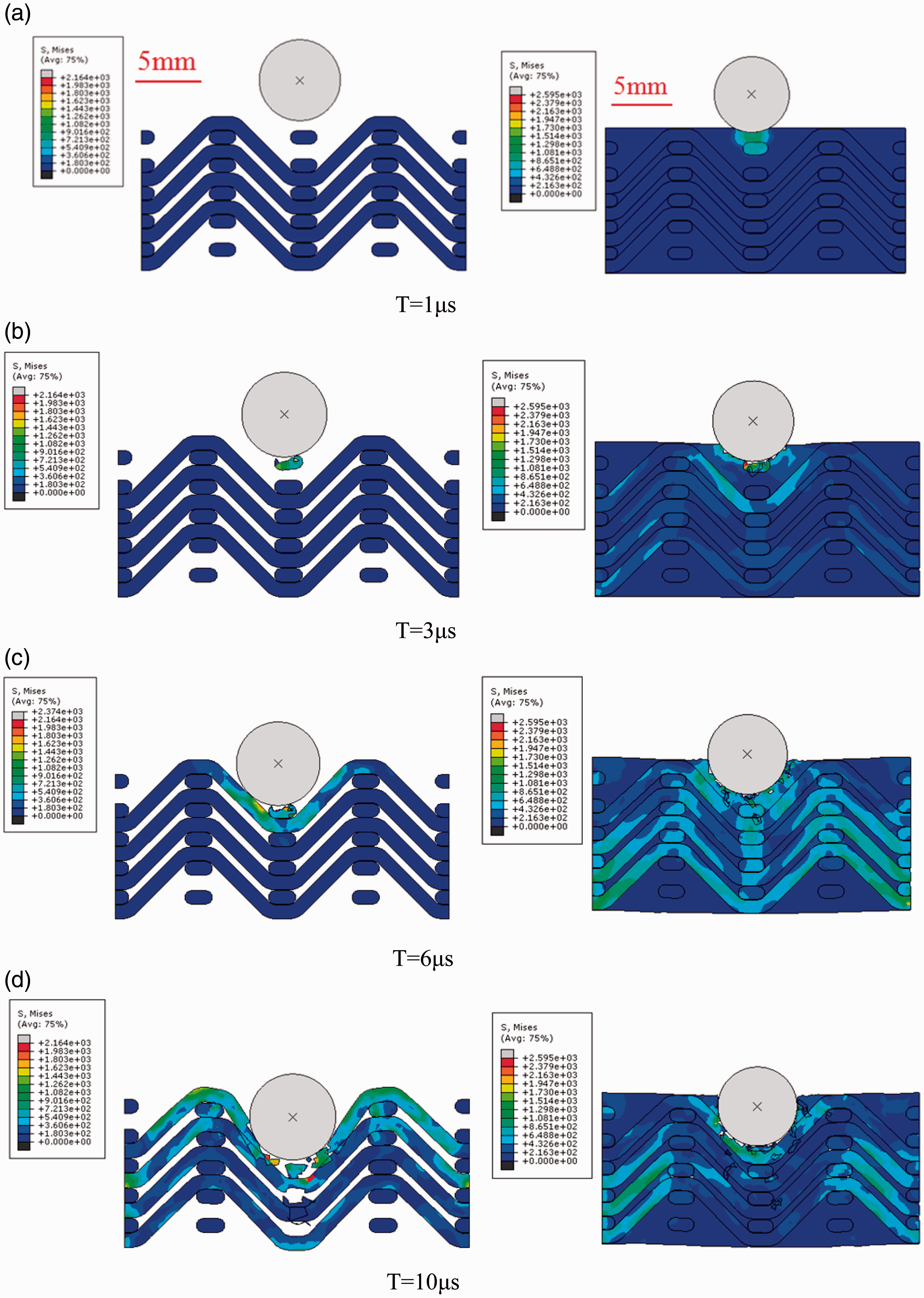
For the 3DAWF, it can be seen that the stress wave in fabric was mainly
propagated along warp and weft directions. Since there was no transfer of impact
energy by the resin matrix and only a small area of contact between the warp and
weft yarns, it took a relatively longer time to transfer the impact energy to
the larger area of the material by the stress wave. As presented in Figure 10, one node near
the bottom surface for the specific target was selected, it can be found that
the time for impact stress propagated to the node was over 7 μs for 3DAWF. But
for 3DAWC, the time for impact stress propagated to the node was approximately
1 μs only, which indicated the impact energy was transferred to the entire
fabric during a relatively longer period of time, which cannot be beneficial to
the impact energy absorbed by the fabric. Besides, it was found that the yarns’
breakage was the main impact damage mode. As the ballistic penetration process
goes on, the damage area developed rapidly until the ultimate generation of
ballistic hole. Stress vs. time curve of the selected node (a) node location (b)
stress vs. time curve.
As for the 3DAWC, it can be found that the impact damage started from the resin matrix crack and then breakage of yarns reinforcement. As the ballistic impact penetration process went on, the contact area between projectile and composite target became larger and simultaneously the damage of material developed rapidly. In particular, taking into account the impact energy propagates inside the structure was mainly in the form of stress wave, by comparing the stress wave propagation between the presented two types of materials, it can be clearly found that the critical importance of resin matrix in transferring and dissipating the impact energy. As described above, the impact energy was transferred to the large area of the composite during a relatively shorter period of time, thereby resulting in an overall bearing capacity of the composite structure, and therefore absorbed most of the impact energy. In addition, stress wave in resin matrix was mainly propagated along yarns’ direction.
Conclusions
The comparisons of ballistic impact properties between the 3DAWF and 3DAWC were
studied in this paper. The ballistic impact tests under various strike velocities of
projectiles were conducted to measure the residual velocities of the projectiles and
obtain the impact damage morphologies of both kinds of targets. The different energy
absorption mechanisms between them were also presented. The following conclusions
have been obtained: It was found that the 3DAWC has absorbed more energy than the 3DAWF under
the “high” ballistic velocities (higher than 350 m/s) which may mainly
be due to the strain rate effect of the materials, where the impact
energy may propagate to a large area of the target at a very high stress
wave velocity during a relatively short period of time. And for the
opposite phenomena under the “low” ballistic velocities (less than
350 m/s), the important role of the deformation area and damage of the
target should be taken into consideration. In this case, the strain rate
effect was no longer dominating the energy absorption mechanism, where
the deformation and damage of the target played an important role owing
to the “low” velocities provided more impact time. Therefore, the 3DAWF
has absorbed more energy due to its larger area of deformation compared
with the 3DAWC. The critical importance of resin matrix in transferring and dissipating
the impact energy was also summarized. In FEA, the simplified finite
element models were established for both materials to characterize the
critical importance of resin matrix in transferring and dissipating the
high velocity impact energy. Especially for 3DAWC, the impact energy was
transferred to the large area during a relatively short period of time,
thereby resulting in an overall bearing capacity of the composite
structure, therefore absorbed most of the impact energy, which was well
applied to explain the experimental results.
Footnotes
Declaration of conflicting interests
The author(s) declared no potential conflicts of interest with respect to the research, authorship, and/or publication of this article.
Funding
The author(s) disclosed receipt of the following financial support for the research, authorship, and/or publication of this article: The authors acknowledge the financial support from the China Postdoctoral Science Foundation (2017T100325, 2016M591767), the Fundamental Research Funds for the Central Universities (JUSRP51625B), the Natural Science Foundation of China (11502163), the Open Project Program of Jiangsu R&D Center of the Ecological Textile Engineering & Technology, Yancheng Polytechnic College (YGKF-201711), and the Open Project Program of Hubei Key Laboratory of Advanced Textile Materials & Application, Wuhan Textile University (Fzxcl2017001, Fzxcl2017013).