




Abstract
In this work, the sound absorption properties of warp knitted spacer fabrics enhanced with nanofiber were studied. The angle of connecting yarns at two different spacing was considered as knit structure variable. Also, the effect of layering on the sound absorption performance was studied. Besides that, the effect of polyacrylonitrile nanofiber enhancement on sound absorption coefficient of such structures were considered. The polyacrylonitrile nanofibers were manufactured by a single-nozzle electrospinning device using a rotating cylindrical collector. The main variable for the nanofiber enhancement was its deposition amount on the front surface of spacer fabrics. The sound absorption coefficient was measured by using the method of impedance tube. For this purpose, the samples were prepared according to the requirements, and the tests were performed at the frequency range of 500–6000 Hz on single-layer and multi-layer samples. The results showed that increasing the spacing and the angle of connecting yarns will enhance the sound absorption coefficients of samples through increasing their areal mass, thickness and porosity. Moreover, layering will significantly affect the sound absorption performance of samples. Furthermore, nanofiber enhancement increased the absorption of sound at all frequencies.
Keywords
Introduction
Nowadays, noise pollution in industrial countries is considered as one of the environmental issues that have been addressed in large cities, the interior design of residential and commercial buildings and industrial machinery. A report released by the World Health Organization (WHO) indicates that noise pollution from traffic leads to more than a million deaths per year. Noise can cause problems for human health, such as blood pressure and hearing loss [1]. Therefore, it is very important to control the noise pollution.
Among various methods for controlling the noise pollution, the use of porous materials for sound absorption is increasingly used in various industries. The acoustic energy in the porous material is capable of entering into the material, and due to the friction between the material and the air flow the energy is wasted as temperature, and sound absorption occurs [2–4]. Among porous materials, the sound absorption properties of fibrous structures have been studied by researchers [5,6]. These structures have many applications in building and automotive industries [7–10]. The fibrous structures are in the form of woven [11–13], knitted [14,15], nonwoven [16–21] and their composites [22–25] are increasingly used for sound absorption due to their light weight and low cost.
Spacer warp knitted structures have received particular importance among other structures due to their specific features, especially high capacity of air trap. A spacer fabric is a double-faced fabric knitted on a double needle bar machine. Warp knitted spacer fabrics consist of two surfaces usually with different knit structures joining each other by connecting yarns which passes between them. The knit structure of each surface, the space between the two surfaces and the angle of the connecting yarns will affect the whole fabric’s areal mass, thickness and porosity which all have significant influence on the sound absorption performance of such structures. Spacer warp knitting fabrics have a better ability to reduce acoustic energy due to their porous nature, large and double-faced structures compared to common fabrics. Due to the collision of the acoustic wave with the surface of the porous nature of the structure and the connecting yarns between the two surfaces, its energy will be decreased due to abrasion friction. This phenomenon converts the sound wave energy into heat, and sound absorption occurs. It was shown that thickness is an important factor in controlling the sound absorbance behavior of spacer warp knitted fabrics. A small change in the thickness causes a great effect on the air channel circulation of such structures which is effective in sound absorbing properties [26–29]. Moreover, the effect of fabric layering has been the subject of some researches. The results showed that by layering of fabrics, the sound absorption coefficient (SAC) can be improved [30,31].
The fibers under 1 µm with a high specific surface area significantly increase the absorption of sound waves. Nanofibers can be manufactured by electrospinning which have so many applications [32]. Accordingly, nanofibers have recently been investigated by many researchers for acoustic applications [33–37]. It was shown that good sound absorption properties can be achieved by adding polyacrylonitrile (PAN) nanofiber to the polyurethane foam structure. The use of nanofibers can improve the SAC at medium and low frequencies due to the greater friction of the fiber with air and sound waves.
In the current work, the SAC of warp knitted spacer fabric was investigated based on its some main structural parameters, and simultaneously the effect of nanofibers enhancement was considered. Moreover, the effect of layering on the sound absorption performance was also considered in this work. Therefore, the interaction of various parameters on the sound absorption performance of such structures is considered in this work. The knit structure was changed by changing the angle of connecting yarns between two surfaces of structure. Moreover, the fabrics were designed to be produced in two different spacing distances. Therefore, the main variables for the knit structure were considered to be the spacing of the fabrics and the angle of connecting yarns. Besides that, the main variable for the nanofiber enhancement was its deposition amount on the front surface of spacer fabrics.
Experimental
Materials
Warp knitted spacer fabrics
Warp knitted spacer fabrics were manufactured by double needle bar Raschel machines gauge 22 equipped with 6 guide bars (GB). The knit structure of surfaces was identical for all samples, but the angle of connecting yarns varied upon different amounts of underlap movement of their guide bars. The samples were designed to be produced in two different spaces between the two surfaces. Therefore, the distances of 4.5 mm and 7.5 mm were considered for machine setting. These two spacing were chosen because of the technological point of view which made it possible to see the effect of thickness of such structures at conventional range of spacing as well as the available industrial possibilities in this project for manufacturing such samples. A picture of such structure is shown in Figure 1.
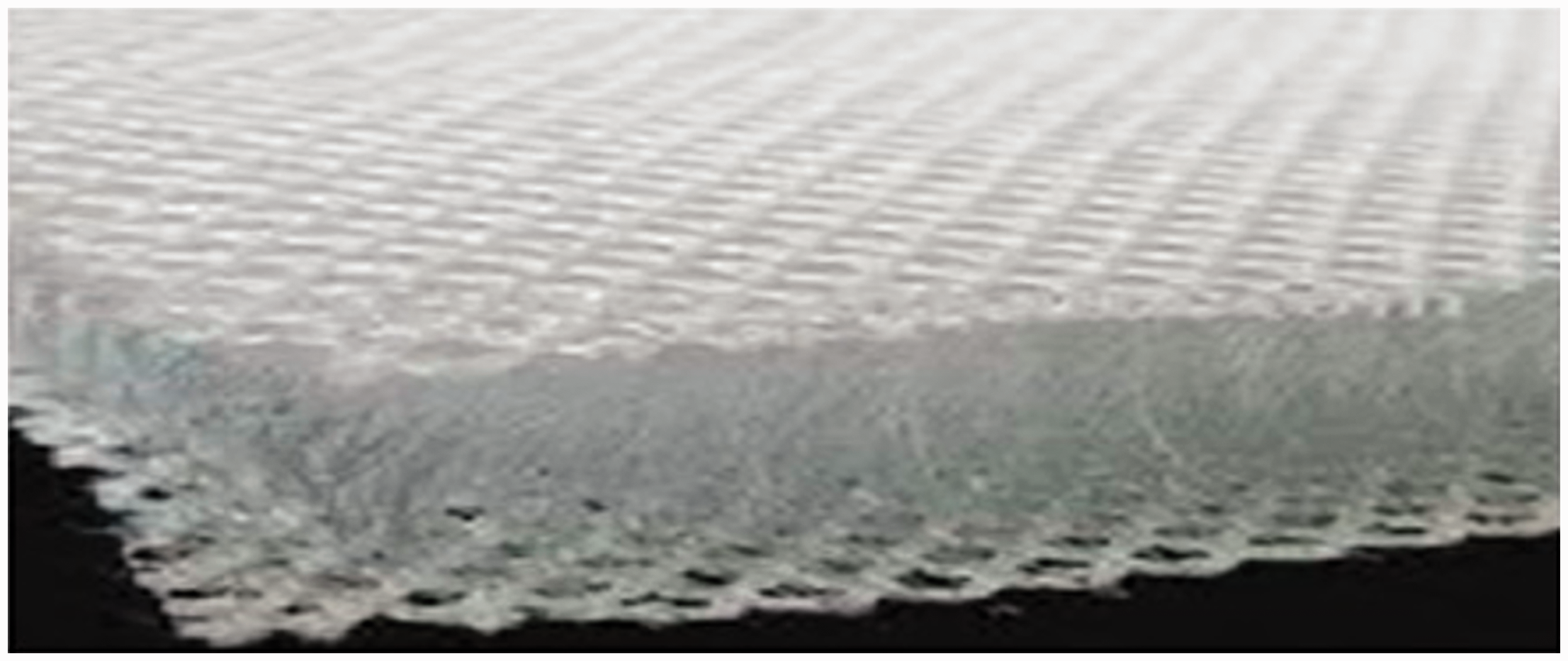
Warp knitted spacer fabric.
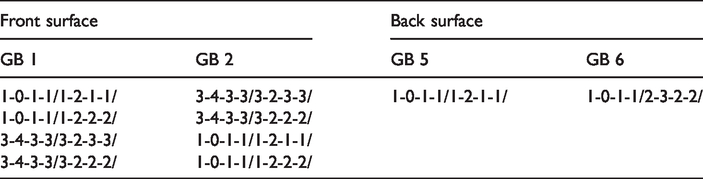
All the fabrics were produced with polyester yarn of 75 deniers for the surfaces and 30 denier monofilament polyester fibers for the connecting yarns. The simple knit structure was designed for the back surface, and open-hole structure was designed for the front surface in all produced fabrics. The knit structure of surfaces is shown in Figure 2.

The knit structure of fabric surfaces; (a) front surface (b) back surface.
The chain notations of guide-bars 1,2,5,6 for the knitting of surfaces are illustrated in Table 1. Also, the chain notations for the underlap movement of guide bars for the connecting yarns are shown in Table 2.
Chain notations for surfaces knit structure of all samples.
Chain notation for connecting yarns underlap movement.

The angle of connecting yarns between the two surfaces is shown in Figure 3. This angle was changed by underlap movement of the related guide bars.

Connecting yarns between two surfaces.
Therefore, the notations A2 and A3 were used for the samples with 4.5 mm spacing and the notations B2 and B3 were used for the samples with 7.5 mm spacing. The numbers 2 and 3 refer to the underlap movement of connecting yarns in each case. The parameters for the knit structure of all samples are presented in Table 3.
The knit structure parameters of warp knitted spacer fabrics.

WPC: wale per centimeter; CPC: course per centimeter.
In Table 3, WPC and CPC refer to the density of the structure.
Polymer solution
PAN polymer with molecular weight (Mw) of 1000 g/mol was dissolved in N, N-dimethylformamide. By using a magnetic stirrer for 24 h under laboratory conditions (
Methods
Dry relaxation was conducted on all the manufactured fabrics at a temperature of
Areal mass
The areal mass of fabrics was measured by using a digital scale with an accuracy of two decimals according to ASTM 3776.
Thickness
Thickness was measured by SDL thickness measuring device with an accuracy of two decimals under the pressure of 20 (gf/cm3) according to ASTM 1777.
Porosity
Porosity is one of the most important physical properties, which influences the sound absorption performance of materials. Several empirical and theoretical methods can be used to estimate the porosity of textile structures [37–40]. It was shown elsewhere [41,42] that there is a very good agreement between the results of experimental and theoretical methods. Therefore, theoretical method has been used in this work. In theoretical approach, porosity (P) is defined as the ratio of void volume (
On the other hand, the total volume can be obtained through equation (2).

The amount of yarn density (
Finally, the percentage of porosity was calculated through equation (5).
The physical specifications of warp knitted spacer fabrics are presented in Table 4. The thickness of all samples is higher than the machine setting for spacing due to the retention of connection yarns after fabrics production. Also, the porosity amounts of all samples are higher than 90% which is promising for sound absorption performance.
The physical specifications of warp knitted spacer fabrics.

Nanofiber enhancement
A horizontal single-nozzle electorspinning setup (Figure 4) equipped with a cylindrical collector was used to produce nanofiber. A needle of gauge 22 was used, and its tip distance to the collector was set to 18 cm. The feeding rate of 0.45 ml/h and the applied voltage of 20 KV were adjusted. A cylindrical rotating collector with rotating speed of 40 r/min was used for the collector which enables the production of an even layer of randomly oriented nanofiber.

Electrospinning setup.
To prepare a spacer warp knitted fabric with a nanofiber coating, a PAN solution was directly spun on the front surface of the knitted fabric to prevent the problem of handling and lamination of the nanofiber layer on the surface of fabrics. Due to the results which will be discussed later, the sample B3 was selected to be incorporated with nanofibers. For this purpose, the fabric was prepared in an appropriate dimension (210 × 290 mm) to be wrapped around the collector. The electrospinning was performed in 15, 30, 60 and 120 min to obtain different amounts of nanofiber deposition on the fabrics. To calculate the amount of nanofiber deposition, the weight of samples before and after electrospinning was measured precisely. The results are shown in Table 5.
Electrospinning time and nanofiber deposition amounts.

Scanning electron microscope (SEM) was used to characterize surface morphology and internal morphology of nanofibers. The results are shown in Figure 5.

SEM image of PAN nanofiber layer of sample B3n1.
Sound absorption coefficient
The SAC was measured by the two-microphone impedance tube method. A schematic representation of an impedance tube setup is shown in Figure 6. In this method, the sound waves directly encounter the intended object and the absorption coefficient is calculated according to ASTM 1050. The microphone close to the audio source is used to measure the input waves, and the second microphone is used to measure the reflected waves. To determine the SAC of the samples at each frequency, the waves recorded by both microphones are analyzed by VA-Lab IMP software. To calculate the SAC, samples with the same size as the diameter of the impedance tube (100 mm for the frequency range of 63–1600 Hz and 30 mm for the frequency range of 800–6300 HZ) were prepared. The front surface of spacer warp knitted fabrics enhanced with nanofiber layer was placed in front of the audio source as is illustrated in Figure 6. The average of three times measuring was considered as the SAC of each sample to obtain more accurate results.
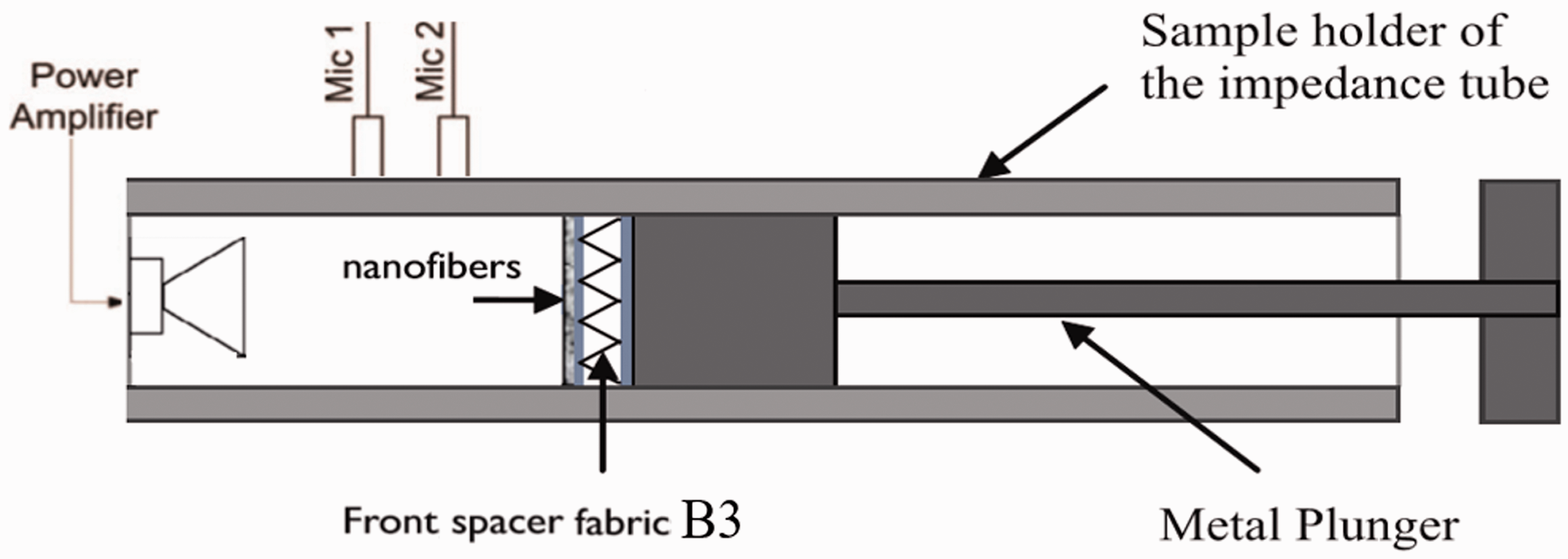
Two-microphone impedance tube setup.
Results and discussion
The results for the SAC of all samples are presented in the frequency range of 500–6000 Hz. It was found that the SACs of all samples are increased in higher frequencies. It should be noted here that in the frequency of around 4000 Hz, the SACs are decreased which seems to be due to the phenomenon of resonance (unification of collided sound frequency with the natural frequency of the object). In the following discussion, some symbols are used the meanings of which are summarized in Table 6.
Meaning of symbols.

Effect of spacing
The effects of spacing on the sound absorption performance of samples are shown in Figure 7 for the samples A2L1&B2L1 and in Figure 8 for the samples A3L1&B3L1. The notation “L1” refers to the results in single layer mode of experiments. In these samples, all the structural parameters except spacing were similar. The effect of spacing is represented in two figures for more clarification of interactions between various parameters.

The effect of spacing on the sound absorption coefficient of A2L1 and B2L1.

The effect of spacing on the sound absorption coefficient of A3L1 and B3L1.
As can be found, applying higher amount of spacing for the fabrics will result in almost 50% higher amount of SAC at all frequencies. This is due to the higher amount of areal mass, thickness and porosity in the case of samples with spacing of 7.5 (samples B) which is presented in Table 4. The decrease of sound absorption at the frequency of around 4000 occurred for both cases.
Effect of connecting yarn angle
The effects of connecting yarn angle on the sound absorption performance of samples are shown in Figure 9 for the samples A2L1&A3L1 and in Figure 10 for the samples B2L1&B3L1. In these samples, all the structural parameters except the angle of connecting yarns through different amount of their underlap movement were similar.
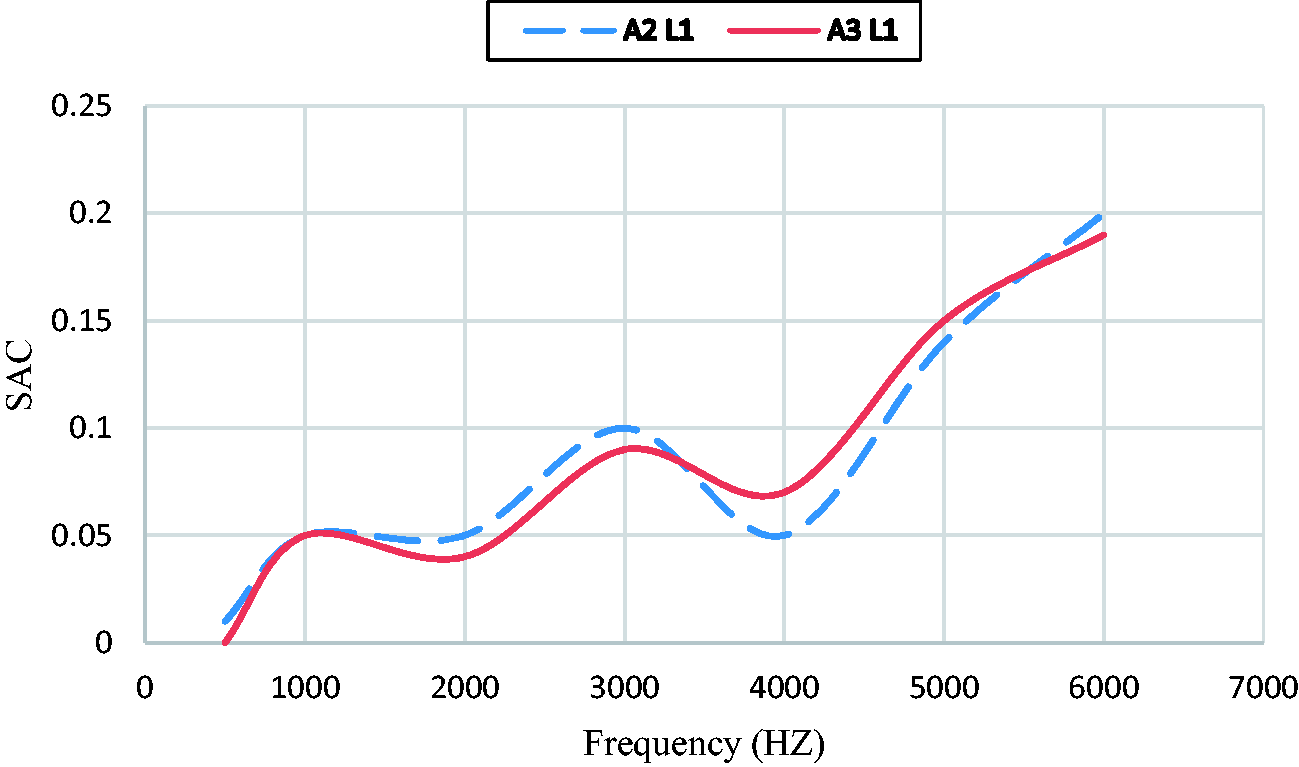
The effect of connecting yarn angle on the sound absorption coefficient of A2L1 and A3L1.
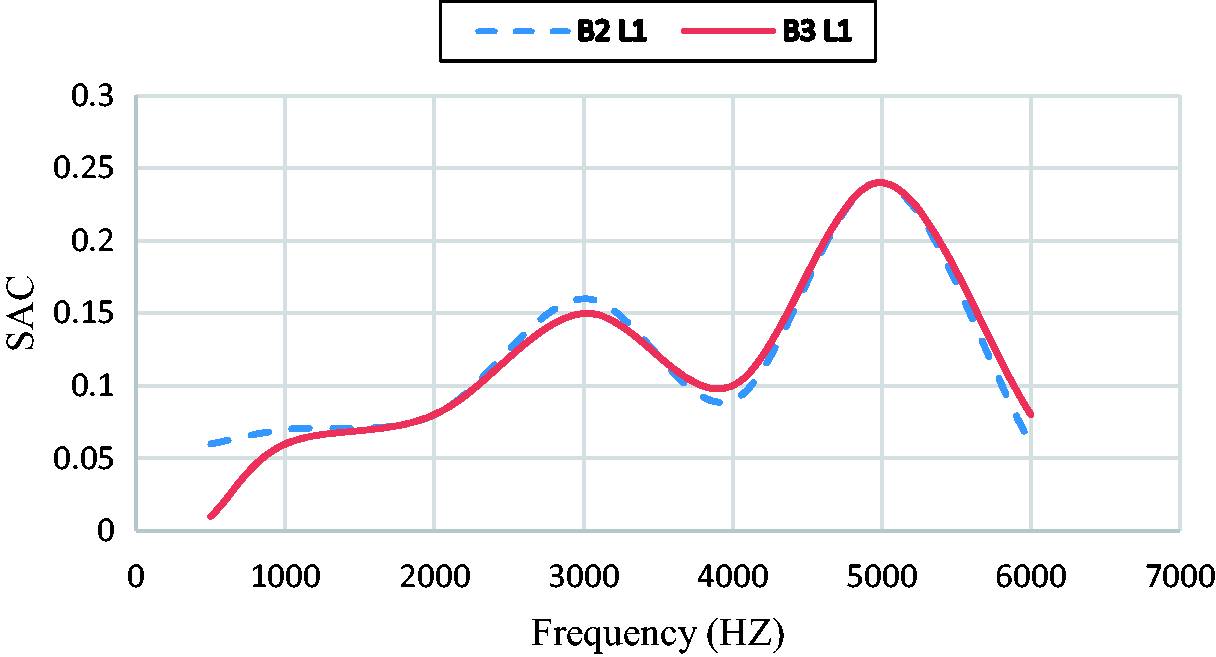
The effect of connecting yarn angle on the sound absorption coefficient of B2L1 and B3L1.
As can be found through both figures, changing the underlap amount of connecting yarns (and consequently declining amount of their angle) has no significant influence on the SAC of samples. In fact, increasing the underlap movement of connecting yarns will decrease the average thickness and porosity and increase the average amount of samples areal mass as is presented in Table 4. In fact, the thickness and porosity will not change significantly by changing the angle of connecting yarns, while the areal mass will change. It can be concluded here that the effect of thickness and porosity is more significant than the effect of areal mass on the sound absorption performance. This effect was confirmed by layering the samples. Moreover, it can be found that in the case of applying samples A, the SAC is increasing after the frequency of 4000 Hz, but in the case of samples B, it is decreasing again after the frequency of 5000 Hz.
Effect of layering
The effects of layering on the SAC of samples are shown in Figure 11 for samples A and in Figure 12 for samples B. For the purpose of layering, three single layer fabrics were stacked in the impedance tube.
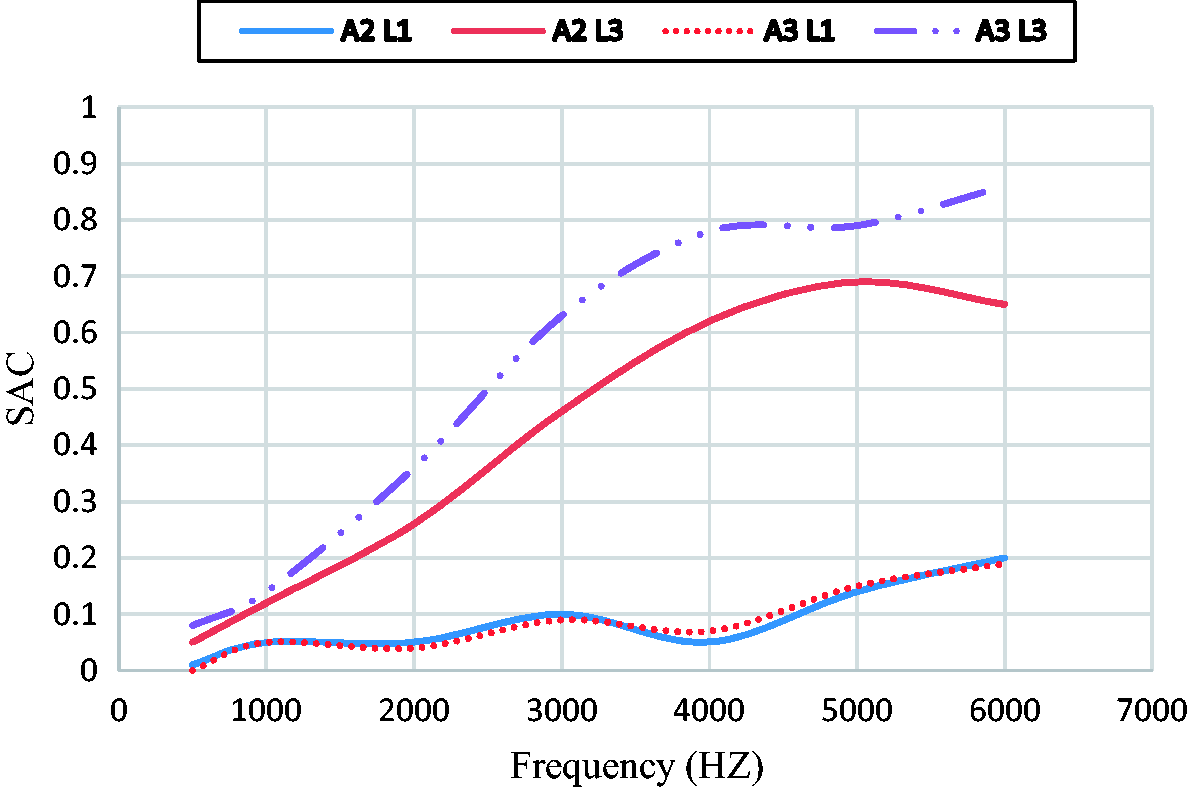
The effect of layering on the sound absorption coefficient of samples A.

The effect of layering on the sound absorption coefficient of samples B.
It can be found that by having three layers, the thickness of the samples is increased, and the sound waves must pass more distance to the get through the sample. Therefore, the possibility of sound waves colliding with the structure of the fabric is increased, and a greater amount of sound energy is lost due to friction and heat generation, which increases the possibility of sound absorption in the samples. For better understanding of what is happening for the sound absorption performance of all samples influenced by various amounts of knit structural parameters, the results are shown in Figure 13 for single layer mode and in Figure 14 for three layer mode.

The effect of knit structure on the sound absorption coefficient of single layer samples.

The effect of knit structure on the sound absorption coefficient of three layer samples.
As can be found through Figure 13, the sample B3L1 has the best performance for sound absorption in comparison with other samples in single layer mode. Although its performance at frequency around 4000 Hz is not well, it is still better than others. On the other hand, the results in Figure 14 represent the significant effect of thickness and tortuosity on sound absorption performance. As can be found, the challenge of sound absorption decreases at the frequency of 4000 Hz since the effect of resonance does not exist. But the main problem here is the thickness and areal mass penalty which is not ideal for many applications. Therefore, there is a need for increasing the performance of sound absorption without such penalties. For this purpose, the effect of nanofiber enhancement on sample B3L1 was considered in this work.
Effect of nanofiber enhancement
The effect of PAN nanofibers enhancement on the SAC of samples is shown in Figure 15. The samples B3L1 was selected to be incorporated with various amount of nanofiber deposition.

The effect of nanofiber enhancement on the sound absorption coefficient of samples B3L1.
As can be found through this figure, the SACs of all samples are increased by nanofiber enhancement at all frequencies. This seems to be mainly due to the increase of the specific surface area which increases the possibility of sound waves collision with the structure and consequently results in decreasing of sound wave energy due to friction and ultimately an increase in the sound absorption performance. Considering the deposition amount of nanofiber which is presented in Table 5, it can be concluded that a small amount of nanofiber enhancement significantly affects the sound absorption performance. Furthermore, by increasing the amount of nanofiber deposition, the SAC will decrease which seems to be due to the closure of the surface pores of the knitted fabrics and the reduction of the porosity. This result is promising because the best results are achieved in the case of lower amount of the nanofiber consumption.
Moreover, the results showed that nanofiber enhancement leads to change in the resonance frequency of the structure, as there is no significant reduction of the sound absorption performance at the frequencies around 4000 Hz for sample B3n1. Figure 16 shows the changing trend of the SAC of samples at frequency of 4000 Hz based on the deposition amount of nanofibers.

Sound absorption coefficient of samples enhanced with various amounts of nanofiber deposition at frequency of 4000 Hz.
Conclusion
It is concluded that samples with larger amount of spacing have better SAC at all frequencies. It was shown that applying higher amount of spacing for the fabrics will result in almost 50% higher amount of SAC at all frequencies. Moreover, changing the angle of connecting yarns has no significant influence on the SAC of samples. Furthermore, it was concluded that the effect of thickness and porosity is more significant than the effect of areal mass on the sound absorption performance. In case of applying three layers of fabrics, the possibility of sound absorption increases significantly. The main problem here is the thickness and areal mass penalty which is not ideal for many applications. By applying nanofiber enhancement, the SACs of all samples were increased at all frequencies. The enhancement of nanofiber leads to better performance of sound absorption without thickness and areal mass penalty.
Footnotes
Acknowledgements
The authors would like to thank the Azin-Khodro Co. for conducting some experiments and Forozan-Baft Co. for providing the warp knitted spacer fabrics.
Declaration of conflicting interests
The author(s) declared no potential conflicts of interest with respect to the research, authorship, and/or publication of this article.
Funding
The author(s) received no financial support for the research, authorship, and/or publication of this article.
