




Abstract
This article presents research on spacer knitted fabrics (3D) and typical upholstery materials, as vibro-insulation inserts that can be used in workplace seating. The tests were carried out on a specially constructed laboratory stand that allowed excitation of general vibrations in the low frequency range. Each sample was placed between the sensor and the vibration actuator and vibrated in the range from 1 to 100 Hz. Seven spacer knitted fabrics with different physical and mechanical parameters and three upholstery materials were tested to check their vibro-insulation properties. The presented study showed the importance and impact of technological parameters such as thickness, areal density, stiffness, and compression module on the damping properties of spacer knitted fabrics. The research showed that all materials are characterized by vibro-insulating properties in the low frequency range. To assess the damping quality, a dimensionless SEAT (Seat Effective Amplitude Transmissibility) index was proposed, defined as the ratio of the weighted vibration acceleration determined at the station (without damping inserts) to the weighted vibration acceleration determined at the station with the use of knitted damping inserts. The work also carried out a comparative analysis of the SEAT coefficient with the physico-mechanical parameters of the studied materials, with the use of the Spearman’s rank correlation coefficient. That coefficient is used to describe the correlation of two factors characterizing the tested samples, which may influence the SEAT attenuation coefficient, e.g., surface mass on attenuation. The best and optimal vibro-insulation properties in the low frequency vibration range (f1 = 10 Hz and f2 = 40 Hz) characterized by a high protection factor (SEAT >1.5) was for the prototype of spacer knitted fabric coded W5. The thickness of W5 spacer fabric is half the size of reference foam material coded F1. The tests may have a practical application in promoting distance fabrics as a material that absorbs adverse vibrations to protect the human body.
Keywords
Introduction
The negative effect of vibrations on the human body depends on the location where the vibrations are penetrating the body. For this reason, mechanical vibrations were divided into vibrations acting on the human body through the upper limbs (local vibrations) and vibrations that penetrate the human body through legs, pelvis, back, or sides (general vibrations) [1]. Exposure at work to general vibrations has an impact in particular to the skeletal system and human internal organs. In the skeletal system, lesions mainly arise in the lumbar region of the spine. Unfavorable changes in internal organs, occurring as a result of general vibrations, are mainly the result of stimulation of individual organs to resonance vibrations which may lead to organ dysfunctions, and in extreme cases, to the mechanical disruption of organs. The most frequently observed organ dysfunctions are the digestive system, the vestibular and cochlear organs, organs of the chest, and reproductive organs in women. In addition to the possibility of damage to internal organs, general vibrations can cause a number of other non-specific physiological and psychophysical reactions such as visual acuity disorders, increased motor and visual reaction times, fatigue, and coordination disorders. In particular, this study focuses on isolating general vibrations for workers such as drivers, tractor drivers, engineers and operators of all types of construction, mining, road and agricultural vehicles and machines on which work is carried out in a sitting position. In these work stations, vibrations from the seats are transferred to the body of the worker through the pelvis, back, and sides. Professional exposure to general vibrations also applies to employees who operate machines and stationary devices in a standing position or in various workshops. In such situations, vibrations penetrate into the worker’s body through his feet from the vibrating ground on which the workstation is located, and the effect of these vibrations is similar to those of the vibrations transmitted from the seats [1]. The vibrations which the driver is subjected to while driving causes decreased comfort, the formation of muscle and joint pains, impaired processes of perception, which consequently causes danger to the traffic safety [2,3]. The main source of vibrations in cars are vibrations caused by the drive system and vibrations transmitted by the suspension system from bumpy roads, through rolling wheels, to the driver’s and passenger’s seat [4,5]. The function of the seats is to minimize harmful vibrations and maximize driving comfort [2]. It is particularly important that the seats minimize vibration energy, in particular dangerous frequency ranges. Vertical vibrations in the frequency range from 4 to 8 Hz are resonances that affect internal human organs [2,6].
The human body feels the oscillation of elastic bodies with frequencies lower than 20 Hz, as vibrations, and vibrations with frequencies above 20 Hz—simultaneously as vibrations and sounds. The phenomenon of resonance has a very significant influence on the biological effect of vibrations.
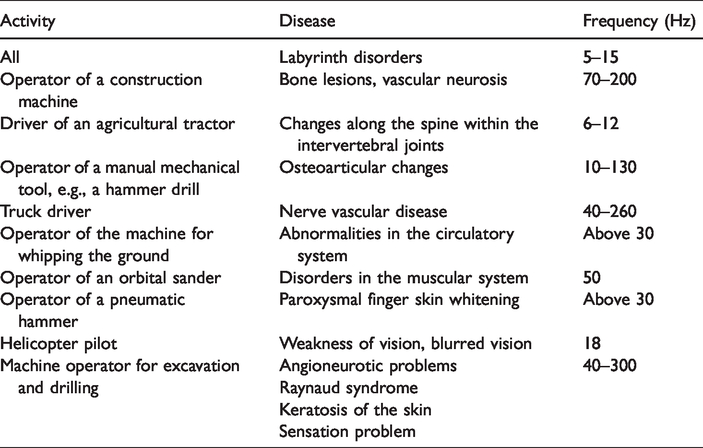
The vibration value from 20 Hz to below 250 Hz negatively affects the nervous system. If the exposure to vibrations is continued, this can lead to a reduction in the efficiency and quality of work performed, sometimes even making it impossible. The human exposed to vibration can cause mechanical injuries to occur in individual organs or parts of the body (damage to the elastic connections of organs), Table 1. When the ability to suppress vibrations by organs, muscles, and other tissues occurs; peritoneal fluid, air, and gases within the organs is insufficient to dampen the resonance vibrations of the internal organs resulting in mechanical injury. Long exposure to mechanical vibrations leads to irreversible changes in various organs and systems. These changes are called vibrational disease. Symptoms of the disease are individual, usually associated with the specificity of the profession.
Unfavorable functional changes lead to a decrease in the efficiency and quality of the work, and sometimes they make it impossible [3,7].
The type of vibrational disease and the frequency of vibrations.
Scientists are working on new ways to eliminate vibrations as this is a very serious issue [8]. This is not only a matter of respecting working conditions but also to apply new preventive methods. Minimization of vibration can be obtained by the use of technical means such as leveling or eliminating collision forces, modification of the vibration spectrum, changes in the system parameters, vibration eliminators: damping covers (pastes, paints), expansion joints, anti-vibration materials (rubber, resilient, and other), manner of foundation vibration sources, adjustment of rigidity of machine structures, and proper placement of vibration source.
In this work, the authors focus on vibration eliminators. New types of materials have been proposed and tested that could be used as vibration isolators – vibration damping inserts. Different variants of spacer knitted fabrics were tested. Knitted fabrics differed in surface area, thickness, bending stiffness, and air permeability. These parameters determine vibration absorption and damping properties. Traditional upholstery materials consisting of polyurethane (PU) foam of various thicknesses, with an outer layer of knit fabric, were compared.
Materials and testing methods
The research was focused on the following: testing and comparing the research material samples (distance knitted fabrics and spongy fabrics for upholstery materials) in terms of their vibro-insulation properties in the low frequency range (1–100 Hz) with the use of a dimensionless SEAT coefficient. Research into the impact of physico-mechanical parameters on the SEAT vibro-insulation coefficient in the low frequency range. Selection of the most optimal distance knitted fabric, in relation to the best damping characteristics for selected frequencies.
Environment simulation using a research stand
A stand designed to excite general vibrations in the low frequency range under laboratory conditions was constructed for testing and is presented in Figure 1. The stand consists of a 20 MHz function generator with a 50 W power output JC5620P (3), an electromagnetic actuator (exciter) (2) placed on an aluminum rail. In addition, the stand includes mechanical vibrations meter type SV 106 (1) with SVANT type SV150 vibration transducer from SVANTEK (1A). On the rail, there is also an aluminum barrier with adjustable distance to the work piece, used to attach the samples (4). Vibration waveforms were also recorded using a computerized recording set consisting of an oscilloscope, USB Pico 3406 D MSO PP936 and a PC computer with dedicated software (5).

Laboratory scheme of the overall vibration excitation of the low frequency range.
To determine the value of vibration acceleration with the use of a sensor (1A), three repetitions were made and the test lasted 30 min for each sample. The tests were carried out in the low frequency range, i.e., from 1 to 100 Hz, with 10 Hz steps. The test results were automatically recorded with the use of the meter (1) and measuring set (5).
Characteristics of prototype distance knitted fabrics
In the research, spacer knitted fabrics were used as vibro-insulation inserts that could be used in seats. These inserts would be subjected to general vibrations. A spacer knitted fabric is also called 3D or distance knitted fabric of the mesh type. It is a knitted or a double knit structure with a significant thickness determined by the distance between the outer layers of the knitted fabric Figure 2(a).
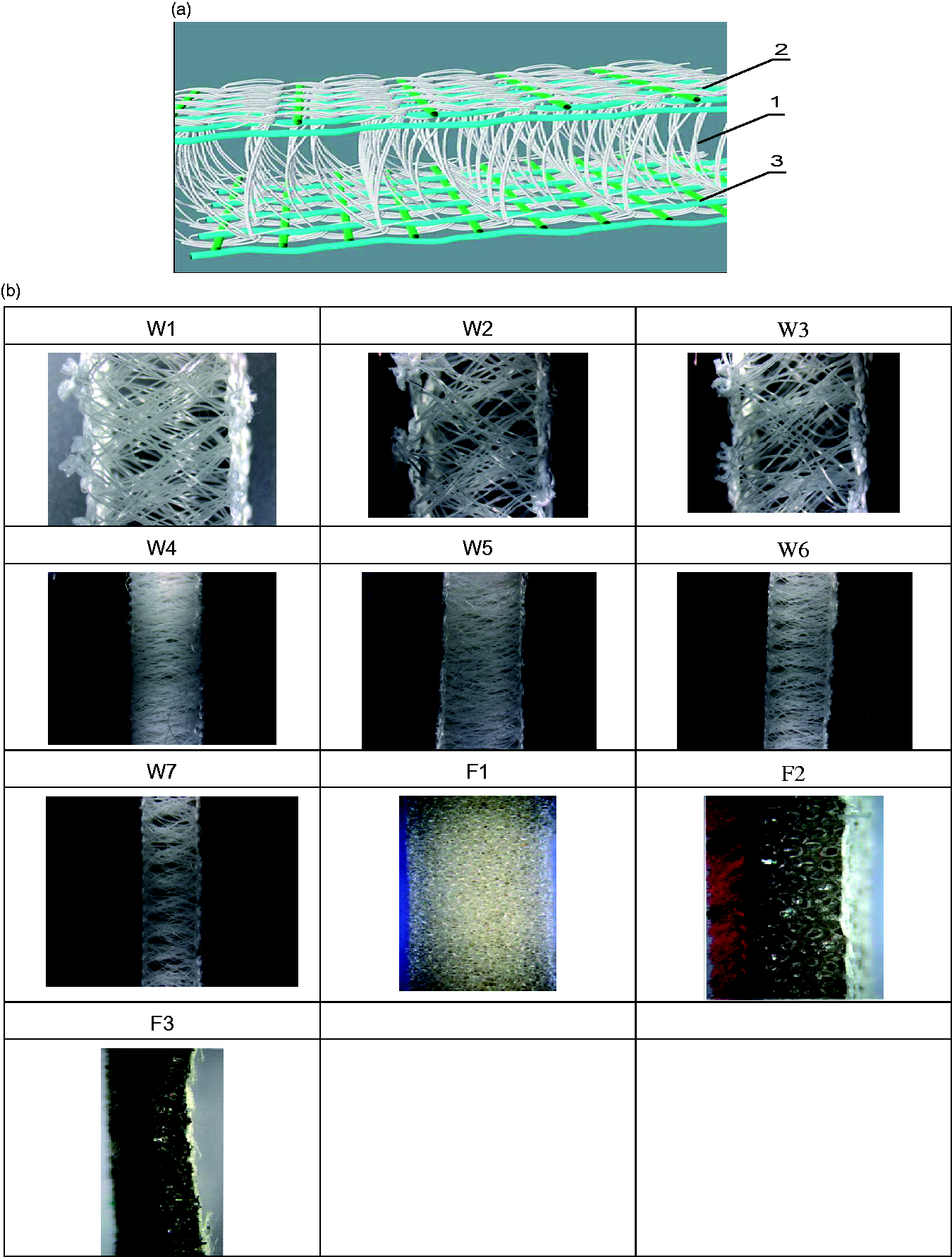
(a) Scheme of an exemplary spacer knit structure; 1—connectors; 2 and 3—outer layers of distance knitted fabric. (b) All variants of tested materials, cross-section photos.
This type of knitted fabric is modern and ensures high air permeability and minimal absorption of water and moisture. Due to their advantages, distance knitted fabrics are gaining popularity in many applications [6–10]. They are commonly used as a replacement for a sponge inside products such as mattresses, sofas, cushions, and car seats [11,12]. Spacers with a layered structure are being formed in a single knitting process without any additional joining. They consist of two separate outer layers connected by rows of spacers of monofilaments [13,14]. Upholstery materials (foam with outer fabric – Figure 2(b); F1, F2, F3) in the tests performed a comparative function; therefore, the linear mass of yarns of the outer material layer was not analyzed, but only the basic physical and mechanical properties [15,16]. Materials of this type are currently used in the upholstery of seats.
The physical and mechanical parameters of distance fabrics that were tested are presented in Table 2.
Physical and mechanical parameters of distance knitted fabrics.

The thickness parameter was measured in accordance with PN-EN ISO 5084: 2008 (determination of the thickness of textile products) [17]. The test sample was placed between the two reference surfaces exerting a specific pressure, and the distance between them was measured using an optical thickness gauge. The measurement results were determined in accordance with the standard, with an accuracy of 0.01 mm. The coefficient of variation was calculated as 0.1%. The area density was determined based on standard PN-P-04613:1997 (textiles: knitted and yarn—determination of linear and area density) [18]. Ten samples were tested for each variant of the knitted fabric. The measurement was made on the scale with an accuracy of 0.01 g. The compression stiffness was measured using the Chinese standard FZ/T01051.2-1998 [19]. The tests were carried out on an Instron Universal Testing Machine. The diameter of tested samples was 106 mm. The compression process was carried with a head speed v = 10 mm/min. Compression was carried out in three consecutive hysteresis loops for 25%, 50%, and 75% of the maximum forces. The linear mass of component yarns for spacer knitted fabrics is presented in Table 3.
The linear mass of component yarns of spacer knitted fabrics.

Results and discussion
For the evaluation of the quality of the damping spacer knitted materials, the method of total assessment (effective weighted value of vibration acceleration in a certain time interval) for steady-state vibrations was applied. Seat Effective Amplitude Transmissibility (SEAT) was calculated using formula (1) [20].
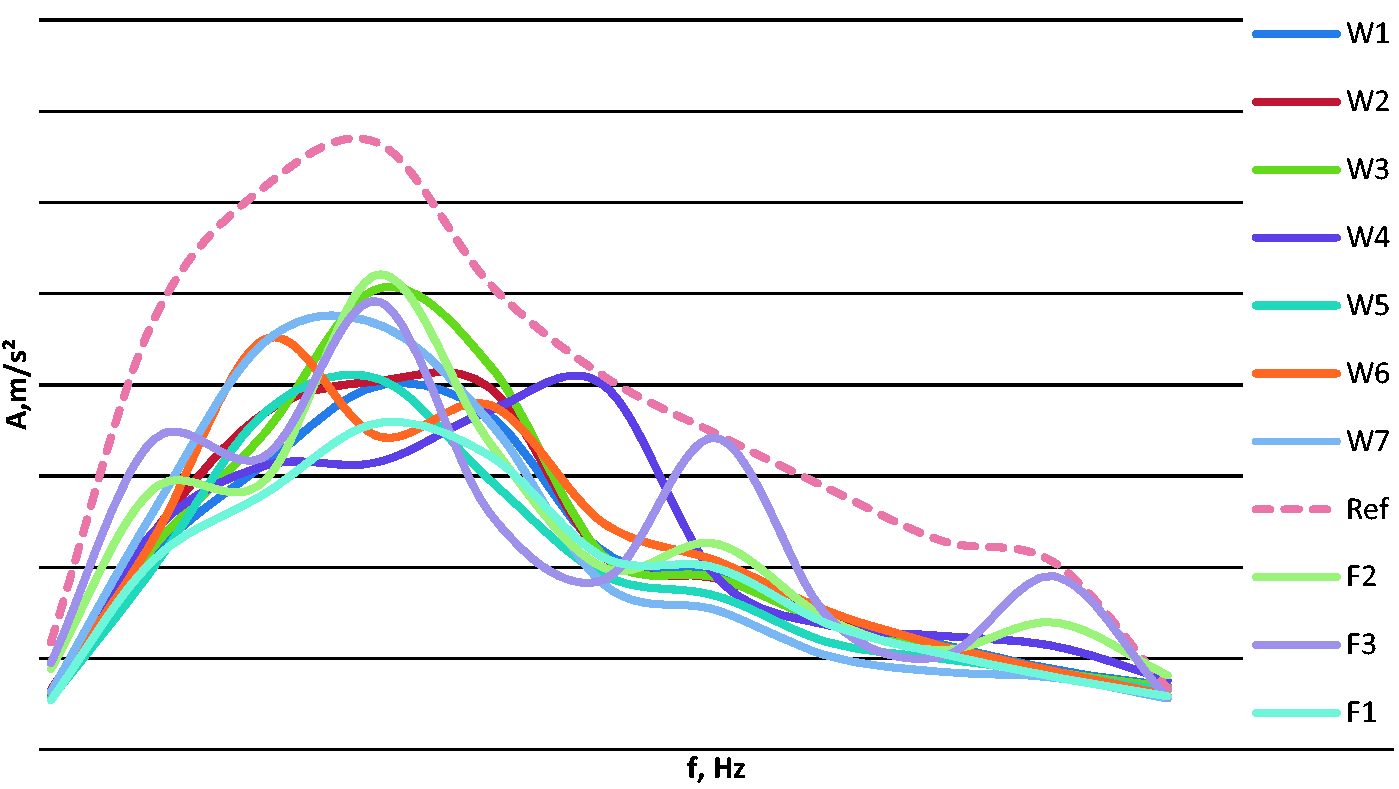
Characteristics of the effective weighted value of vibration acceleration for the tested materials.
A protection efficiency index equal to one (SEAT = 1) would mean that the protection does not limit vibration transmission in general, so there is no impact. The protection efficiency index (SEAT < 1) less than one would mean that the applied protection of vibrations strengthens the transmission. Whereas the SEAT > 1 indicator means that the applied protection (spacer fabrics) limits the transmission of vibrations and therefore reduces them. Therefore, it is desirable that the value of the SEAT coefficient is as high as possible. The effective value of weighted vibration acceleration results of the tested materials is presented in Figure 3 and calculated coefficient SEAT is presented in Figure 4.

Characteristics of the SEAT damping protection effectiveness coefficient for the tested materials.
In Figure 4, all materials were characterized by vibro-insulation properties in the low frequency range up to 100 Hz. The worst vibro-insulating properties among knitted fabrics were marked with W4. SEAT was equal to 1 for a 50 Hz frequency. However, for the upholstery materials, the worst performing material was F2 at f = 90 Hz where SEAT coefficient was less than one. From an application point of view, it is necessary to choose those materials that have the best damping properties in the frequency range that is responsible for causing disease in workers, for example truck drivers. Two frequencies 10 and 40 Hz were selected for comparison. At 10 Hz, the maximum value of acceleration (peak) tolerated by humans is 2.5 m/s2 for a period of 18 s. The analysis of the characteristics in Figure 3 showed that all materials provided adequate protection in this range of frequency. It is necessary to choose materials that have the best damping properties and therefore they should be analyzed to determine which physical parameters affect the damping.
Figure 5 shows how the material thickness affects the vibration damping properties with SEAT coefficient for frequency of 10 Hz. Taking into account the sample marked with the symbol W5, 8 mm thickness was the best, the second was the W1 sample with a thickness of 17 mm, and the third was the reference sample F1 with the largest thickness of 20 mm.

Analysis of the SEAT coefficient as a function of material thickness (d) for one selected frequency f = 10 Hz.
Analyzing the results of the SEAT coefficient for 40 Hz (in Figure 6), the best vibro-isolating properties were for F1, W5, and W7 materials.

Analysis of the SEAT coefficient as a function of material thickness (d) for one selected frequency f = 40 Hz.
The relationship between stiffness modulus and the SEAT index is evident. As the stiffness modulus increases for this frequency, the SEAT index decreases. The exception is the W7 sample, where the modulus of elasticity is high. This may be the effect of resonance vibrations, i.e., unknown self vibration of the W7 sample with 40 Hz set vibrations.
Detailed results of SEAT comparison for selected frequency for textile materials are presented in Table 4. This analysis was carried out for the stiffness compression module and surface weight of samples. For low frequencies, the low-modulus materials have the best vibro-isolation properties, as in the case of thicknesses, these are samples W5, W1, and F.
Comparing SEAT coefficient for two selected frequencies (10 Hz, 40 Hz) for the best three tested textile materials.

SEAT: Seat Effective Amplitude Transmissibility.
Calculated Spearman’s ratios (rs) for 10 Hz and 40 Hz.

SEAT: Seat Effective Amplitude Transmissibility.
The comparison of SEAT coefficient results was made with the use of the Spearman’s correlation coefficient which is used to describe the correlation strength of two traits if the features are quantitative, but their number is small. It assumes summation of the effects of all three factors characterizing the tested samples (thickness, stiffness modulus, surface weight), which can have an influence on the vibro-insulation coefficient SEAT. Co-operation between them was omitted.
Ranks were assigned for each comparative sample of materials for the two selected frequencies (10 Hz and 40 Hz). For these two variants, an independent rank was made. The observed values of a given variable were ordered in ascending order, giving them successive ranks, i.e., the number of the next statistical observation according to the value of one of the variables [18]. Samples were grouped for SEAT attenuation coefficient, sample thickness, stiffness modulus, and surface area. The rs coefficient was calculated from the following formula difference in paired ranks number of cases
When analyzing the rS coefficient for n = 10 observations for each of the considered cases and the significance coefficient α = 0.7, we obtain a critical value of the coefficient
Conclusions and discussion
We can conclude that there is dependence for the frequency of 10 Hz, the SEAT vibro-insulation coefficient from the thickness and from the surface mass of fabrics, while there is no correlation between the SEAT vibro-insulation coefficient and the bending stiffness module.
For the second considered frequency of 40 Hz, there is no correlation between each of the SEAT vibro-insulation coefficient and the bending stiffness module and sample thickness. However, there is a relationship between the SEAT and the surface mass of fabric.
The best and optimal vibro-insulation properties in the low frequency vibration range (f1 = 10 Hz and f2 = 40 Hz) characterized by a high protection factor (SEAT > 1.5) was for the prototype W5 fabric and F1 reference foam material. The thickness of W5 (d = 8 mm) spacer fabric is half the size of F1 (largest thickness d = 20 mm).
This study illustrates the importance and impact of technological parameters of distance knitted fabrics on the design of products with specific physical properties. Thanks to this approach, producers can choose the right kind of distance knitted fabrics for the indicated applications, e.g., in car child seats, thus increasing the safety of the user. Spearman’s rank correlation coefficients show what technical parameters of distance knitted fabrics affect the vibro-isolation properties in strictly defined ranges of vibration frequency.
On the basis of the tests carried out on vibroisolation properties, in the low frequency range from 1 to 100 Hz, for spacer knitted fabrics and typical materials intended for covering car seats as reference materials, the following conclusions can be drawn:
All samples of distance knitted fabrics and reference foam samples have vibration isolation capabilities in the range of the studied frequencies.
As an indicator of the vibroisolation quality assessment, a dimensionless SEAT effectiveness index was proposed. It determines the ratio of the weighted vibration acceleration determined at the laboratory stand (without damping inserts) to the weighted vibration acceleration value determined at the laboratory stand with the use of the spacer knitted damping inserts.
In the case of spacer knitted fabrics, this ability results from their spatial structure, which is made of a top layer connected with fixed stiffness joints with a lower layer. The connectors act as spacers and as flat springs role with linear characteristics (dependence of the elastic force on the spring deflection from the equilibrium position).
In the case of foams, the vibro-insulating abilities result from their porous structure, high elasticity, energy consumption, and elasticity.
The statistical analysis of the effects of the physical and mechanical parameters of the spacer fabrics on the SEAT vibro-insulation coefficient shows that there is a relationship between each for the two considered frequencies (10 and 40 Hz) of the SEAT coefficient and the surface mass. For the first frequency, there is also a correlation between the SEAT vibro-insulation coefficient and the bending stiffness module.
In summation, it can be concluded that spacer knitted fabrics can be a viable alternative to typical sponges covered with upholstery fabrics. Their unquestionable advantage is the fact that at a much lower thickness, they have sufficiently good vibration dampening properties at low frequencies that can negatively affect the human body. Thanks to this approach, producers can design textiles, optimizing their structures, for specific OSH applications. Such knits are used primarily in automotive applications for seat pads or in the production of mattresses.
Footnotes
Declaration of conflicting interests
The author(s) declared no potential conflicts of interest with respect to the research, authorship, and/or publication of this article.
Funding
The author(s) received no financial support for the research, authorship, and/or publication of this article.