




Abstract
This study presents methods for measuring thermal insulation of military clothing assemblies used in various climatic regions of the world, with the exception of polar regions. With the use of FOX 314 and thermal manikin, the thermal insulation of the fabrics (military materials) was ascertained at simulating real climatic conditions of cold, arid, temperate and tropical zones according to European standard EN 60721-2-1: 2014. The aim of this study was to compare the values of thermal insulation of the duty of military clothing ascertained by two methods and to evaluate the reliability of methods and instruments used. The measured results show that the measurement methods used are different in terms of method and measurement conditions, the results of the thermal insulation and the resulting choice of military clothing in the type of climate. The functionality and suitability of the use of military clothing sets were verified in real climatic conditions, provided that the optimal thermal comfort of the wearer was achieved.
Introduction
The clothing system of military clothing consists of several layers of individual military clothing. The main objective of clothing layering is to achieve synergy during transport of heat and humidity in individual clothing layers and to avoid occurrence of unpleasant feelings under the conditions of hotness, cold or humidity. If one of the clothing layers chosen incorrectly, a non-functional layer ensues and then the whole system does not function. Long-lasting state of user’s discomfort, e.g. a soldier who feels uncomfortable, has negative effect not only on user’s performance while executing tasks but also due to hypothermia or hyperthermia of organism, the user’s health be endangered.
Švecová et al. [1] found that the decisive utility property inevitable for reaching good comfort of the user while wearing military clothing under various climatic conditions is particularly low water vapour resistance of clothing (Ret) and, with regard to ambient conditions, sufficient insulation of clothing during given activity of the user. Particularly in the areas where increased emphasis is in thermal insulation properties of clothing such as the areas of temperate and cold zones, good thermal insulation capacities of clothing are, besides low vapour resistance of clothing, important requirements for clothing. Another requirement for clothing is resistance to external weather adverse effects, particularly water waterproofness, i.e. resistance to pressure water. Assuming that layers of clothing are selected properly, lower number of clothing textile layers means achieving better vapour permeability through clothing, i.e. lower vapour resistance (Ret). The other way around, higher number of clothing layers leads to better thermal insulation property of clothing. However, with higher number of clothing of layers, the vapour permeability worsens and there is a risk of dew point origination. Vapour condensation in inner layers of clothing or directly on barrier layer of clothing subsequently causes further worsening of vapour permeability and overall decrease in user’s comfort.
We comprehensively assess comfort of the clothing product depending on the reaction of human organism, climatic environment, and clothing system, which the surveyed person is wearing. The climatic conditions in which the military unit is located greatly affect the properties, durability and maintenance of not only military clothing but also other military techniques. Sukac et al. [2] in their work have dealt with the impact of climatic conditions, temperature and relative air humidity on the occurrence of material corrosion with consequent influence on the military unit economics. Other research projects investigating the influence of temperature on military material were presented in the literature [3, 4]. The properties of military clothing significantly affect the properties of the materials from which they are made. Material surface modification such as sublimation print applied onto layered sports textiles can significantly change their functionality and properties, which were so significantly emphasized at production. Lizák et al. [5] measured the thermal conductivity of the membrane fabrics before and after the sublimation printing application. Results of the measurements imply that the value of thermal conductivity increases proportionally with rising temperature of the sublimation process, and there is a linear dependence of thermal conductivity and material thickness.
Kwon and Choi [6] dealt in their study with the relationship between the microclimate temperature and clothing insulation under comfortable environmental conditions. Humans maintain heat balance through a heat exchange that occurs between their bodies and the surrounding thermal environment. This mechanism maintains thermal balance between conduction, convection, radiation, evaporation and heat production. Ashrae [7] states that there are six primary factors that directly affect thermal comfort that can be grouped in two categories: personal factors – because they are characteristics of the occupants – and environmental factors, which are conditions of the thermal environment. The former are metabolic rate and clothing level, the latter are air temperature, mean radiant temperature, air speed, and humidity. Even if all these factors may vary with time, standards usually refer to a steady state to study thermal comfort, just allowing limited temperature variations.
Li et al. [8] noted that the thermal and moisture behaviour of the microclimate of textiles is crucial in determining the physiological comfort of apparel. Based on sensing, temperature controlling and wireless communicating technology, a specially designed tester has been developed in their study to evaluate the thermal and moisture behaviour of the surface of textiles in moving status. This tester provides the platform to evaluate the thermal and moisture behaviour of textiles. It enables users to conduct a dynamic analysis on the temperature and humidity together with the thermal and moisture transport behaviour of the surface of fabric in moving condition. Development of this tester opens the door of investigation on the microclimate of textiles in real-time service and eventually benefits the understanding of the sensation comfort and wellbeing of apparel wearers.
The relationship between environmental temperature and clothing insulation across a year has been studied by Kwon and Choi [9]. The aim of this study was to determine the actual daily clothing insulation on sedentary human subjects across the seasons. Thirteen females and seven males participated in experiments from January to December in a thermal chamber. The clothing insulation (clo) required by these participants had a significant relationship with air temperature: insulation was reduced as air temperature increased. Other studies of the relationship between environmental temperature and wearing clothing insulation were present in the literature [10–12].
Standard EN ISO 15831 [13] defines thermal insulation clo of clothing as temperature difference between the wearer’s skin surface and ambient atmosphere divided by the resulting dry heat flow per unit area in the direction of the temperature gradient where the dry heat flow consists of conductive, convective and radiant components. Švecová et al. [1] thought thermal insulation clo as dimensionless quantity which reaches depending on the type of clothing, various values and under common conditions it typically ranks between the values of 0–2 [–]. The value of 1 clo represents thermal balance at ambient temperature of 21°C. For example, the value of 0 clo is stated for naked body, 0.6 clo for summer clothing, 2 clo for skiing equipment, 3 clo for light polar equipment, and 4 clo for hard polar equipment. Required values of clothing insulation clo for achieving the thermal balance and feeling of comfort depends not only on ambient conditions but also on occurrence of humidity, physical activity, i.e. production of heat and other conditions.
The results of the research by Havenith et al. [14] extended an extensive database of isolation values for non-Western clothing, which should be a valuable addition to the ASHRAE Standard 55-2013, ISO 7730-2005 and ISO Standard 9920-2009 [7,15,16]. Oliveira et al. [17] presented the research results of the thermal insulation of clothing ensembles, both in static conditions and considering the effect of body movements. Three calculating methods by Havenith were used to deduce the total thermal insulation, namely the global, the serial and the parallel method. The results were presented and discussed for the basic, the effective and the total clothing insulations. The results showed that the dynamic thermal insulation values are always lower than the corresponding static ones.
Standard EN ISO 15831 [13] describes the requirements for the thermal manikin and the test method used to measure thermal insulation of all clothing to the user in practical use in a relatively quiet environment, the user either stands or moves. This thermal insulation can be next to other parameters used to determine the physiological effect of the garment on users in specific environments or activities. Santee et al. [18] examined differences between the parallel and serial methods for the calculation of clothing insulation using a thermal manikin and demonstrated the differences in the insulation values calculated using these two methods. The parallel method was based on the condition of a uniform surface temperature of the manikin, whereas the serial method was based on the condition of a uniform heat flux over the manikin. Thus, a method for the calculation of clothing insulation is dependent on the operating mode of the manikins. Only the parallel method should be used when manikins are operated in UST mode, and only the serial method should be used when manikins are operated in UHF mode. The serial method and the parallel method should not be used normally at the same time.
The aim of the article is to compare the results of the thermal insulation values of the eighth military clothing sets found in two surveys because of the need to know the use of suitable garments in a particular climatic area while maintaining the optimum comfort of the user of military garments. The first round of study according to ISO 8301 was carried between 2016 and 2017 in the laboratory of physiological comfort of the Technical University of Liberec. The thermal conductivity of fabrics for military clothing sets were ascertained using FOX 314 apparatus. According to the producer, FOX instruments utilize a steady-state technique for the determination of thermal conductivity. The Heat Flow meter method, designed specifically for insulating materials, is defined by international standards ASTM C518, ISO 8301, and DIN EN 12667. This cost-effective and practical method is widely recognized and preferred by industry professionals throughout the world for its speed, simplicity, and accuracy. The experiment was proposed to verify ascertained material properties and assumption for achieving optimum comfort of military clothing in simulation under real climatic conditions at various areas of the world. Assessment of clothing should focus on the important thermophysiological properties of clothing, i.e. thermal insulation and water vapour resistance. Eighth military clothing sets, which were the most commonly used types of the textile sandwiches in military clothing production, were selected to perform the study in the specific climatic conditions. The second experiment was conducted in 2017 in the climatic chamber of the Brno University Technology. The thermal insulation values of selected military clothing sets from the first research on the Newton thermal mannequin were determined according to EN ISO 15831. The study to deduce the connection between the thermal properties of fabrics and thermal properties of military clothing has never been performed using FOX 314 apparatus and thermal manikin under proposed conditions.
Methods and materials
Two methods of measurement were chosen to evaluate the thermal insulation of military clothing. The thermal manikin measurement method is based on EN ISO 15831, which describes the requirements of the thermal manikin and the test procedure used to measure the thermal insulation of a clothing ensemble, as it becomes effective for the wearer in practical use in a relatively calm environment, with the wearer either standing or moving. The components of the clothing ensemble to be tested are placed on the manikin in the same arrangement as in practical use. The manikin is heated internally to a constant skin temperature of 34.0 ± 0.2°C uniformly throughout the body. It is located in the air conditioning chamber, where the air temperature is defined and the air speed and humidity can be adjusted. The dry heat flow, directed from the surface of the manikin’s skin to clothing to the ambient air, is measured after reaching equilibrium conditions. From the heat flow relating to the body surface of the unclothed dummy, the thermal insulation of the garment can be calculated with respect to the difference between the skin surface temperature of the dummy and the ambient air. According to ISO 15831, the measurements could be made with a stationary or moving manikin; however, in this study, only stationary insulation measurements were made [13].
The FOX 314 method for measuring heat flow is defined by the international standards ASTM C518 and ISO 8301. They define the use of the instrument in equilibrium by means of flat plates and the calculation of the heat transfer properties of the sample [19]. The FOX 314 is an accurate and easy-to-use device for measuring thermal conductivity according to the standards listed, and it works stand-alone or in PC-controlled configurations. The WinTherm software package is a user-friendly tool for setting experimental parameters, monitoring real-time test results, storing and analyzing data. A 305 × 305 mm fabric sample is placed between the two temperature-controlled plates. The plates create a user-defined temperature difference (ΔT) in the sample. The sample thickness (L) is adjusted to match the thickness of the compressed samples or the actual sample size. The FOX range contains four optical encoders, one in each corner to ensure maximum accuracy. The resulting heat flux (Q/A) from the steady-state heat transfer through the sample is measured by two thin film heat flux sensors covering a large area of the upper and lower samples. This technology provides sensitive and accurate measurement of heat flow. The average heat flux is used to calculate the thermal conductivity (λ) and the thermal resistance (R), according to the Fourier law.
The FOX 314 apparatus was used to calculate the thermal conductivity and the thermal resistance upon known values of the heat flux according to ISO 8301. The temperature range and the measuring time of the instruments are different. The FOX 314 has a temperature range of −20°C to 75°C and an average measurement time of 2 h. Thermal mannequin ranges from −20°C to 50°C with an average measurement time of 3 h. The advantages of the FOX 314 are the possibility of setting the required temperature above 25°C according to real climatic conditions and the measurement time less than 1 h. However, the use of the FOX is limited by a number of factors related to calibration and limitation of sample thickness. The main advantages of the measurement on the thermal mannequin are non-destructive measurement of clothing, the most accurate approximation of the thermal behavior of the human body, the repeatability of the measurement and the elimination of subjective effects on the measurement relative to the location in the air conditioning chamber. In contrast to the garment measurements with the thermal manikin, it is possible to measure fabric samples by the FOX apparatus. Methods for statistical processing of the resulting values are given in the section ‘Statistical analyses’.
Materials
Testing samples of new military clothing that are used under field conditions by Czech Army (hereinafter AČR) were used for the experiments. Table 1 presents an overview of military clothing that was used and its material composition, and Table 2 shows the used combinations of measured garments (sandwiches) divided according to the type of climate.
Overview of used military clothing and their material composition.

PTFE: polytetrafluoroethylene; ECWCS: Extended Cold Weather Clothing System.
Type and combination of military garments used for measuring textiles sandwich divided according to type of climate.

ECWCS: Extended Cold Weather Clothing System.
Thermal insulation measurement on FOX 314
First experimental measurement allowed to verify functionality and suitability of military clothing used in various areas of the world by objective measurement in simulation of real climatic conditions. All measurements were carried out in compliance with ČSN EN ISO 139 (8000056) under standard conditions for testing of textiles at the temperature of 20°C and 65% relative humidity. Thermal conductivity of the material represents capability of the material to conduct heat under given conditions. Heat resistance is the capability of the material to resist the heat transmission. A good thermal insulation material has low thermal conductivity and high heat resistance. According to the possible deployment of the AČR troops in all regions of the world, except for Arctic regions, four climatic types were operated in accordance with ČSN EN 60721-2-1 [20]. The standard sets of climate types are characterized by temperature and humidity. Table 3 presents the input values of the simulation environment for the measurement using FOX 314 according to the type of selected climate.
Input values of environment simulation for measurement using FOX 314 according to the type of selected climate.

Figure 1 shows the device FOX 314 that is used for measuring the thermal conductivity of the samples of sandwich materials. Temperature of lower board of the FOX device simulated temperature of human skin and temperature of upper board simulated temperature of the environment according to selected climate.

Machine FOX 314.
When measuring the heat flux with FOX 314 apparatus, the fabric thickness should be known. The thickness of composed textile sandwiches t (mm) were ascertained using digital thickness gauge SDL MO34A according to ČSN EN ISO 5084 (800844) – determination of thickness of textiles and textile products. Contact pressure was set at 70 Pa in accordance with the standard. After that, the thermal conductivity λ [W/(m⋅K)] and thermal resistance R [(m2⋅K)/W] of the selected textile sandwiches were calculated according to the equations presented in Table 4.
Formulas for calculation of thermal resistance R.
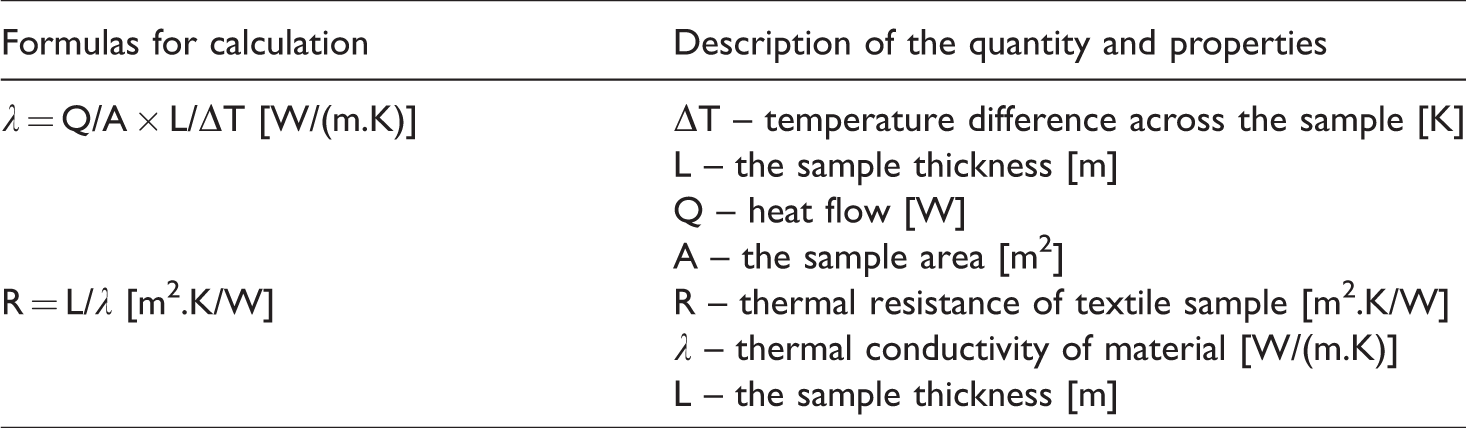
The resulting thermal resistance value of textile sandwiches was afterwards expressed by clo unit, where 1 clo equals to 0.155 m2⋅K/W. Water vapour resistance (Ret) (m2⋅Pa/W) was measured using Sweating Guarded Hotplate (hereinafter SGHP) according to ISO 11092 [21]. In order to achieve good user comfort while wearing military clothing under different climatic conditions, a particularly low water vapor resistance (Ret) and sufficient isolation of clothing during user’s activity due to the surrounding conditions are required.
Thermal insulation measurement on thermal manikin
Thermal insulation (It) was measured according to EN ISO 15831 standard [13] on 34-zone thermal manikin Newton (Thermetrics, USA). Manikin was placed in upright posture with hands down and airflow to its front (Figure 2) in the climatic chamber at Brno University of Technology, Czech Republic. All parameters were set and controlled according to the standard [13]. Average air velocity for all tests reached 0.46 ± 0.06 m/s, measured 1.1 m above floor level and 0.6 m in front of the manikin. Relative humidity was controlled at 49 ± 10% and sensor for its measurement was placed on the same location as air velocity. Minimal requested difference of 14°C between manikin surface temperature and ambient temperature was secured. All manikin zones were controlled at 34°C and average of ambient temperature was 14.1 ± 0.1°C (average value of two sensors – 0.1 m and 1.1 m above floor level). As our thermal manikin has no walking stand and only dry mode is available, neither resultant thermal insulation (Itr) nor evaporative resistance (Ret) was measured. Total thermal insulation (It) was calculated using parallel model for eight clothing ensembles.

Example of thermal insulation measurement of the thickest clothing ensemble on thermal manikin with placement of the sensors measuring all needed parameters.
Statistical analyses
Statistical analysis was performed to compare two different methods: one used to study the thermal resistance of the textile sandwiches (ISO 8301) and the other used to measure the thermal insulation of the overall clothing ensembles (ISO 15831). The results of the experiment were statistically processed by Microsoft Excel. Statistical dependence analysis, regression analysis, was used to estimate the linear dependence of the parameters of the line of two quantitative variables. The significance test was performed using a correlation coefficient. The least squares method and the approximation of the data by a line and polynomial of the second degree were used. In addition, a paired t test was used to compare two different measurement methods that were applied to the same research objects, in our case, the same military garments. The results of the statistical analysis are presented in Table 5 and the graphs are shown in Figures 4 and 5.
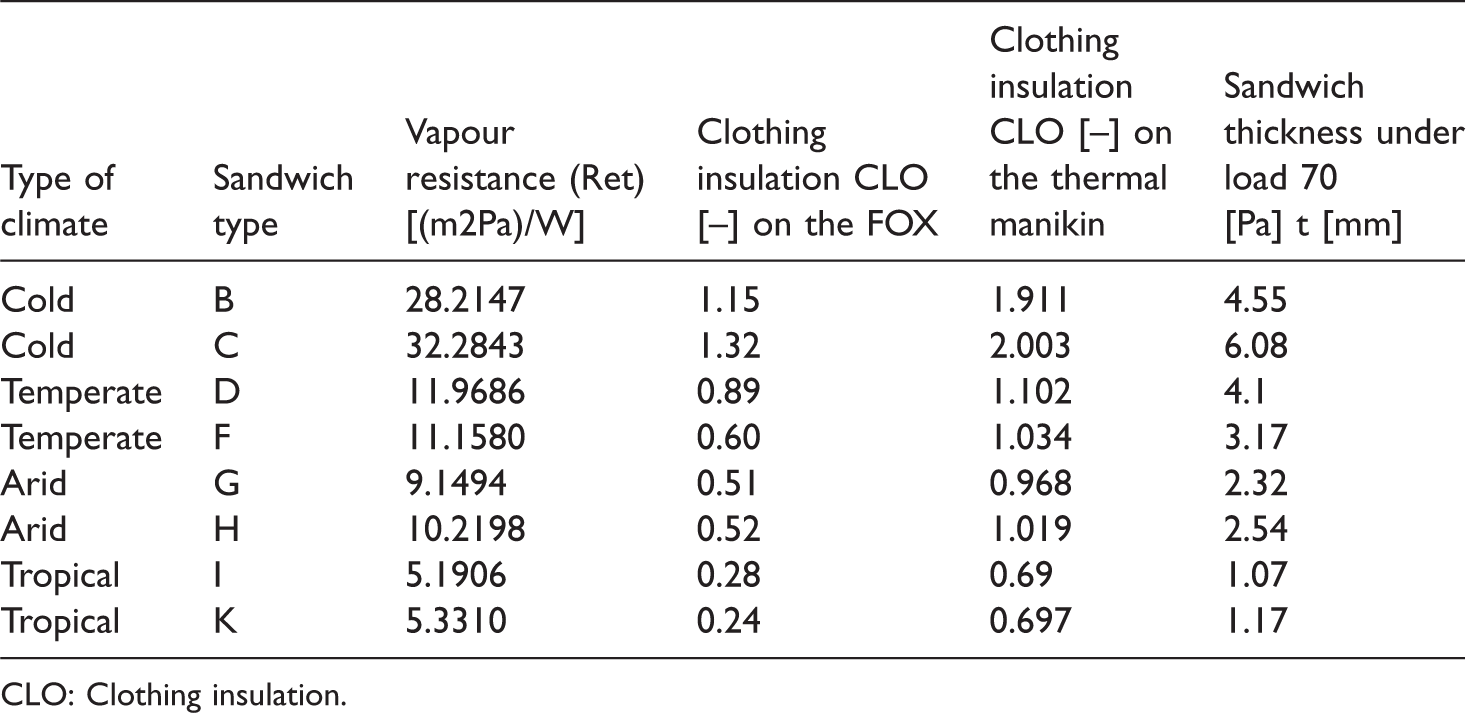
The most suitable types of the textile sandwiches of clothing according to thermal insulation CLO [−] and vapour resistance (Ret) [(m2Pa)/W].
CLO: Clothing insulation.
Results and discussion
On the basis of the measured thermal resistance values for the selected textile sandwich samples, used to produce the military ensembles, the dimensionless quantity of clothing isolation was calculated. To achieve good user comfort while wearing military clothing under various climatic conditions, the particularly low water vapour resistance (Ret) of fabrics is of utmost importance to achieve the satisfactory value of the clothing thermal insulation for the proposed climatic conditions. According to this criterion, the eight most suitable sets of military clothing for individual climatic areas were selected for measurements using FOX. The aforementioned assemblies were subsequently measured on a thermal mannequin. The measured values of the total thermal insulation of the assemblies were calculated according to a parallel calculation. Table 5 shows the water vapor resistance of ensembles, the thermal insulation of the FOX measurement and the thermal manikin as well as the thickness of the ensembles used.
Figure 3 shows the recommended sandwiches of military clothing for specific types of climate.

Sandwiches of military clothing for the type of climate: (a) sandwich type B – cold type of climate, (b) sandwich type D – temperate type of climate, (c) sandwich type G – arid type of climate, and (d) sandwich type I – tropical type of climate.
According to the well-known knowledge in the field of physiological comfort, the resulting values of the experiment and the average annual extremes of daily average temperature values, the following sets of military garments can be recommended for individual climate zones. For the tropical band, I (Light Thermo 2012/Summer Uniform 95), G (Light Thermo 2012/Hard Thermo 2012/Summer Uniform 95), D (Light Thermo 2012/Hard Thermo 2012/Thermo Jacket 2010); for the cold zone set B (Light Thermo 2012, Hard Thermo 2012/Thermo Jacket 2010/ECWCS 2012), which has a relatively low thermal insulation, which is due to its low thickness of only 4.55 mm. Selection of suitable (optimal) parameters, i.e. the ratio of utility properties ‘Ret’ and ‘CLO’, is very individual and it depends on other conditions such as planned application of clothing and period for using clothing and so each of the types of sandwiches mentioned herein has its alternative stated in Table 5 allowing suitable selection of clothing according to specific requirements and preferences. Figure 4 shows a graph comparing the thermal insulation results of the measurements obtained using FOX and thermal models.
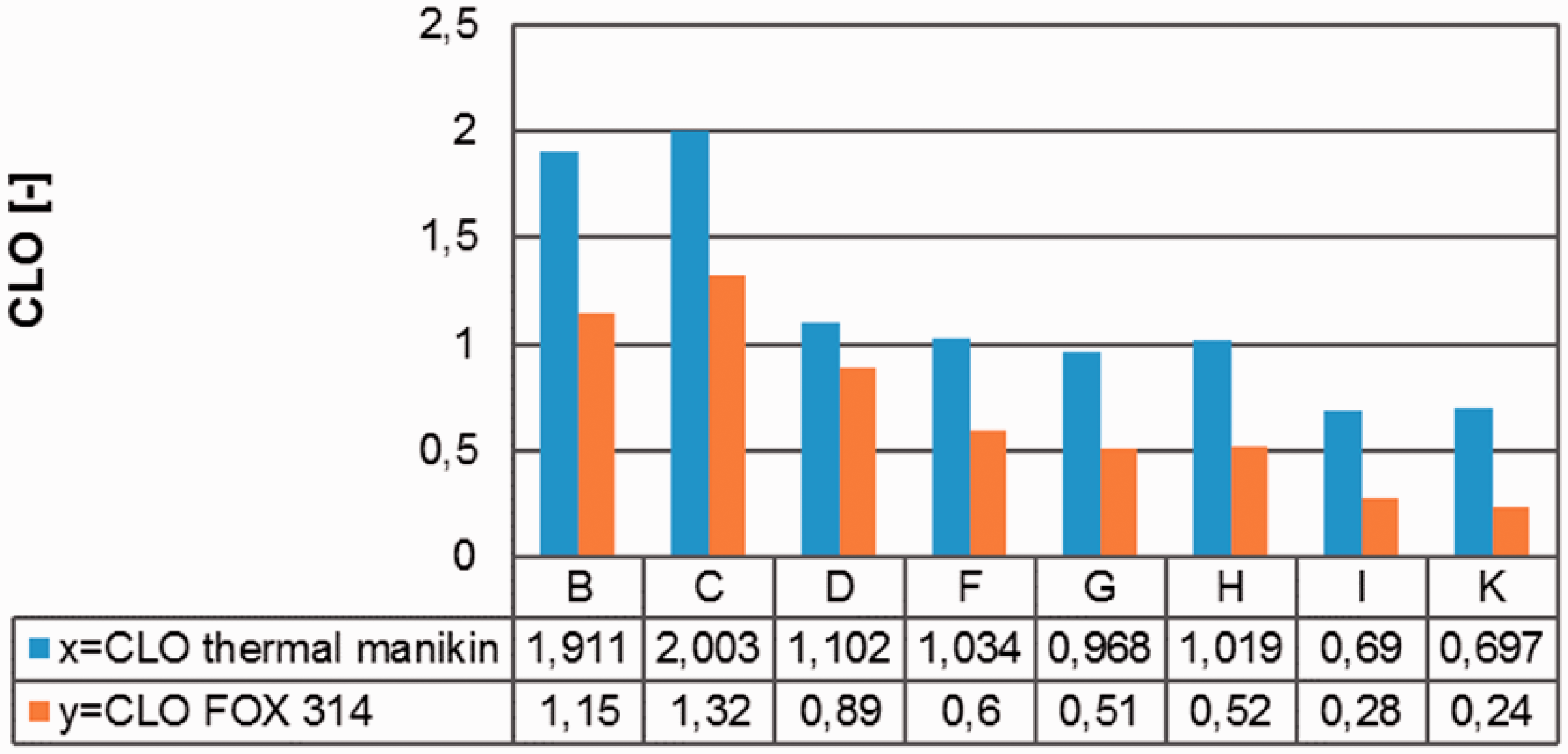
Graph of comparison of thermal insulation results from measuring on the FOX and on the thermal manikin.
The static dependency analysis of two measurement methods was performed. Usually, a new method or a less common (in our case FOX) comparison is made with a reference method that is commonly used (thermal manikin). The linear dependence of thermal insulation duty [–] was observed. The values of the independent variable x – duty (thermal manikin) and the dependent variable y – duty (FOX), regression coefficient b and constant a were substituted for the regression line equation. The regression analysis answers the question of what the dependence between two variables looks like. A linear regression model y = a + bx was used. The resulting equation of the regression line was found to be y = 0.7492x − 0.1938. In the least square method, the sum of square differences is determined as the fit criterion. The determination coefficient R2 is always positive and takes values from 0 to 1. In our case, R2 = 0.919585. The coefficient of determination is the square of the coefficient of linear correlation, and its value measures the magnitude of the linear relationship between x and y, regardless of which quantity is dependent and which quantity is independent, this coefficient obtained from both regression is the same. Figure 5 is a graph of the approximation of the thermal insulation by customs.

Approximation of thermal insulation values by straight line.
To determine the significance of a model that determines whether, based on the data obtained from the selection, we can believe that the model is significant in the core set, a correlation hypothesis test was performed. H0: R = 0, the thermal insulation values obtained using thermal mannequin are not linearly dependent compared to the FOX. H1: R ≠ 0, the thermal insulation values obtained using thermal manikin are linearly dependent compared to the FOX. Test criterion t = | R | √n−2/−1−R2. The test characteristic t is compared with tkrit (0.975; n−2), if t is larger than the student's quantile tkrit, H0 is rejected. In the table of critical values of Student's distribution for six degrees of freedom (8 − 2 = 6) and the probability of 99.95%, the critical value is tkrit (0.9995; n−2). The test characteristic t = 8.284 is larger than the quantile of Student's distribution tkrit (0.9995; n−2) = 5.959; therefore, H0 = R = 0 is rejected. The value lies in the critical domain, the null hypothesis was rejected and the linear dependence between the variables was demonstrated xa y. Thus, with a probability of 99.95%, R ≠ 0, R = 0.9589 and thus the total sum of squares of deviations succeeded in explaining 91.9585% of the sum of the squares of deviations by fitting the regression function. The correlation coefficient is significant. Figure 5 is a graph of the approximation of the thermal insulation by customs.
Due to the small range of random sampling, the Shapiro–Wilk test p = 0.725 was used, so we do not reject the null hypothesis that data come from the normal distribution at a significance level of 0.05.
A paired t test was used to compare two different measurement methods that were applied to the same object. By calculating the mean and the standard deviation of the differences in the results of the two measurement methods, we obtained mz = 0.48925 and sz = 0.168904. Therefore, the standard error of the difference SE (mz) = sz/√n = 0.168904/2.82842 = 0.05972.
Testing statistics t0 = mz/SE (mz) = 0.48925/0.05972 = 8.192 with seven degrees of freedom.
Based on the null and alternative hypothesis, the critical domain or W = (−∞, − t1-α/2(n−1)⟩ ∪ ⟨ t1 − α/2(n−1), ∞) = (−∞;−2.365⟩∪⟨2.365; ∞). The p value of 0.4782 was calculated with STATISTICA. Since t0 ∈ W (p <0.05), we reject the null hypothesis of zero difference of mean values between the thermal insulation results obtained by both methods that the difference between the results of two methods is different from zero at a significance level of 0.05. The relationship between values is linear, but there are significant differences between values. Figure 4 shows that the values from the thermal manikin are higher than from the FOX. The smallest difference of 19% is for the value of sandwich D and the largest difference of 65% is for sandwich K.
The confidence interval for the mean difference is mz ± t1 − α/2 (n−1) × sz/√n where t1 − α/2 (n − 1) is a 97.5% quantile t-distribution at n − 1 degrees of freedom. 0.48925 ± (2.655 × 0.05972) = 0.48925 ± 0.14123 = (0.35; 0.63). It can be said that at 95%, the actual mean is somewhere between a little less than 0.4 and a slightly greater than 0.6.
It used 3 s criterion to exclude gross errors. Criterion treats all values which do not lie within an interval as a gross error. An interval is determined by three times the sample standard deviation which do not lie within an interval xi ∉ (x̄−3*σn−1; x̄ + 3*σn−1). The interval x1 ∉ (−0.3; 2.7) for thermal manikin and x2 ∉ (−0.5; 1.9) for FOX. Possible existence of a gross measurement error was excluded. Then, the mean quadratic error of the arithmetic mean σx̄ was calculated. The probability p was chosen, and the Student’s coefficient tp,n 2.37 was determined. The extreme errors of the arithmetic mean σx̄ × tp,n were calculated and the result of both methods was written in the form X = (x̄ ± tp,n *σx̄) [–]. The result of the measurement on the thermal manikin is CLO1 = (1.2 ± 0.4) [–]. The FOX measurement result is CLO2 = (0.7 ± 0.3) [–].
Conclusion
The article dealt with the evaluation of thermal insulation of the eight sets of military clothes in the simulation of real climatic conditions in selected climatic regions of the world. Two methods of measurement were chosen to ascertain the thermal insulation properties of the military clothing. The thermal manikin measurement method was based on EN ISO 15831 and FOX 314 was based on ISO 8301: 1991. The results of the measurement of military clothing sets were statistically processed, and a comparison of the mentioned measurement methods was made. The measured results which were listed in the previous section show that the measurement methods used are different in terms of method and measurement conditions, the results of the thermal insulation and the resulting choice of military clothing in the type of climate. The calculated differences between the results are statistically significant and are high. The definite difference of the two developed testers (FOX 314 and thermal manikin) is the setting option of the input values of the simulation environment for the measurement using FOX 314 according to the type of selected climate in compliance with ČSN EN 60721-2-1. The comparison of the resulting values of thermal insulation of the eighth military garment sets by two methods confirmed their suitability for use in real climatic conditions in tropical, arid, mild and partly in cold climate. The thermal insulation properties of the measured sandwiches are sufficient in the tropical (10 to 40°C), the arid (0 to 45°C) and the temperate (−15 to 40°C) types of climate. In the cold type of climate (−25 to 30°C), it is advisable to add a winter jacket and trousers to the military clothing, which would be part of the B sandwich, which would then meet the criteria for the cold type of climate, i.e. 2–3 clo. These findings of the research are evaluated by the authors as a source of important information for future studies and serves not only to optimize the system of clothing security for soldiers but also to further improve the quality of materials for the production and introduction of new military clothing. Based on the evaluation of the experiment, appropriate models of correct layering of military clothing will be created and the methodology of correct system of layering of military clothing will be designed depending on climatic conditions in selected areas of the world, correct maintenance of military clothing and their use in practice. Furthermore, the development of a new military garment in a cold climate composed of a warm jacket and trousers is being considered.
Footnotes
Declaration of Conflicting Interests
The author(s) declared no potential conflicts of interest with respect to the research, authorship, and/or publication of this article.
Funding
The author(s) disclosed receipt of the following financial support for the research, authorship, and/or publication of this article: The presented research was financed from the project of specific research at the University of Defense in Brno in the period 2015–2018 under the name Interoperability outfitting material in military operations.