




Abstract
This paper presents a study investigating the effect of differing textile substrates on the performance of multilayer, aqueous fabric supercapacitors. Three widely available textiles, cotton, polyester-cotton and silk were chosen, and all underwent the same activated carbon deposition process to form electrodes. An automated spray coating was implemented to precisely control the loading of the carbon, and to enable a uniform coating. A vacuum impregnation technique was utilized to increase the wettability of the electrodes and improve the absorption of the aqueous electrolyte. The multilayer supercapacitors showed excellent electrochemical and mechanical stability, with the choice of textile substrate found to have a profound effect on the performance. The silk-based supercapacitor was found to have a gravimetric capacitance of 20.2 F.g−1 (56.6 mF.cm−2) at a carbon loading ratio of 15.7 %wt. The polyester-cotton supercapacitor, however, was found to have a superior areal capacitance of 118 mF.cm−2 at a carbon loading ratio of 14.1 %wt. This work will be used to select future substrates and carbon loading levels for real-world e-textiles.
Introduction
Electronic textiles (e-textiles) add functionality to traditional fabrics through the integration of electronics into the structure, making interaction with the user and/or the environment possible. The power delivery for these devices is a considerable challenge, with lightweight and flexible energy storage technologies (ESTs) being a favored solution [1–3]. Of these ESTs, textile supercapacitors have favorable characteristics of high energy and power densities, fast charge-discharge rates and long-term cycling stability [4,5]. These characteristics are due to the storage mechanism within supercapacitors. Unlike a battery, the charge is stored at the electrode-electrolyte boundary (electrical double layer [6]) allowing for much faster reversibility.
To date, supercapacitors have been demonstrated with a plethora of textiles as the electrode substrate, produced via printing or coating techniques [7–9]. Promising electrode materials include carbon nanotubes [10], graphene [11], activated carbon fibers [12] and conducting polymers [13] with gravimetric capacitances in excess of 200 F.g−1 [14] while still maintaining good mechanical and cycling stability. However, such materials increase the production cost and introduce complicated fabrication processes, hindering the large-scale manufacture of textile supercapacitors [15,16]. The use of pre-woven natural or natural/synthetic mixed textiles as the substrate (as opposed to synthetic fiber devices [17]) is seen to produce more comfortable, simpler and scalable devices via coating or printing techniques. Though synthetic fiber supercapacitors offer promising performance characteristics [18] the production methodology is prohibitively complicated for adoption by the textile industry.
This work presents a performance comparison study of supercapacitors with different textile electrodes. These electrodes are prepared via a simple and scalable spray coating technique, with three common types of natural and natural/synthetic mixed textiles being investigated. The fabrics used (cotton, polyester cotton and silk) are typically used within the clothing industry and have been selected to provide a range of characteristics such as thickness, weave pattern, fiber properties. Differing amounts of electrode material were deposited onto the textile to investigate optimal loading levels for each textile. The electrode materials presented are a low-cost blend of activated carbon and carbon black in a liquid binder solution. The supercapacitor devices constructed with aqueous electrolyte were electrochemically tested in a Swagelok test cell via galvanostatic cycling (GCD), cyclic voltammetry (CV) and electrochemical impedance spectroscopy (EIS).
Experimental
The supercapacitor electrodes were fabricated via a spray coating technique, with the carbon ink being sprayed directly onto the textile substrate, Figure 1. In this work, three different woven textile have been chosen for the electrode substrate; cotton (denoted as C), polyester-cotton (denoted as PC) and silk (denoted as S). The carbon ink contains activated carbon (YP-80F from Kuraray Chemical Co, > 99% purity, particle size range of 5 to 20 µm, effective surface area of 2100 m2.g−1), conductive additive (Shawinigan Black with a mean particle size of 42 nm and an effective surface area of 75 m2.g−1), and 0.4 %wt of ethylene-vinyl acetate binder and 1,2,4-Trichlorobenzene as the ink solvent. In the spray coating process, the carbon vapor was spray coated onto both sides of the unmasked sections of the textile substrate, as shown in Figure 1. The carbon vapor penetrates the textile sample and adheres to the yarns uniformly. The amount of carbon material that adheres to the yarns and the depth of vapor penetration can be controlled by the duration of the spray coating and substrate type. The duration of the spray was tightly controlled through the implementation of a motor-driven belt system, with each electrode passing through the carbon spray arc for 0.4 s. The samples with a spray coating time greater than 0.4 s were made by repeating the process multiple times. After the spray coating process, a circular shaped, conductive and porous carbon electrode was formed on the textile sample. Each electrode has an area of 0.785 cm2 and its textile substrate specifications and surface resistivity are given in Table 1. The electrodes are denoted by its textile type and spray coating time (e.g. cotton with a 1.6 s spray coating time is denoted as C 1.6 s) with their loading levels noted in Table 2. There are differences seen in the surface resistivity due to the variation across the carbon surface. This is due to the different textile structure and how the carbon adheres to the textile. The silk is seen to have the least variation due to its more uniform structure. Resistivity measurements should therefore only be used as an indicative measurement.
(a) Schematic of the multilayer layer textile supercapacitor fabrication process; (b) photographs of the final cotton (left), silk (middle) and polyester-cotton (right) electrodes. (The scale bar is 5 mm). Textile substrate characteristics and electrode resistivities. Carbon loading masses and levels for each electrode.


The assembled supercapacitor cell is shown in Figure 1(a); two electrodes were cut off from the spray coated textile sample (Figure 1(b)) and processed with vacuum impregnation9 with 1 M Li2SO4 aqueous electrolyte for 20 min. These electrodes were then sandwiched with a separator paper (class GF/F from Whatman) and compressed by spring-loaded metal current collectors (grade 303 stainless steel) housed within a Swagelok PFA tube fitting.
The electrochemical performance of the symmetrical supercapacitor based on different textile electrodes was obtained using a VMP2 potentiostat/galvanostat (Biologic, France). CV plots were generated at scan rates from 25 to 200 mV.s−1, and at voltages varying between ± 0.8 V. Galvanostatic charge-discharge (GCD) cycles were also performed at constant currents ranging from 0.5 A.g−1 of active material up to 2.5 A.g−1, with a peak voltage of 0.8 V. Finally, EIS measurements were carried out at frequencies varying from 20 mHz to 20 kHz with a peak to peak amplitude of 10 mV.
The capacitance (C) of the mutilayer textile supercapacitor was calculated from the corresponding GCD results using equation (1)

Results and discussion
The carbon loading for each substrate and spray duration can be seen in Table 2, with the differences in carbon adherence to the three textile substrates seen in Figure 2. The areal capacitance, energy and power density of the multilayer layer supercapacitors with textile electrodes made with polyester-cotton (PC), silk (S) and cotton (C) are shown in Table 3, with all of the results calculated from GCD tests. The areal capacitance and energy density of the supercapacitors made with polyester-cotton electrodes increases with increased carbon material loaded onto the textiles. The areal capacitance and energy density of the device made with silk electrodes initially increases as carbon loading increases. However, when the carbon:fabric ratio increased from 15.7 %wt to 33 %wt, its areal capacitance decreased from 56.6 mF.cm−2 (5.03 μWh.cm−2) to 34.4 mF.cm−2 (3.06 μWh.cm−2). A similar relationship appears in the supercapacitor made with the cotton electrode when its carbon:fabric ratio increased from 5.21% to 9.01%, and its areal capacitance decreased from 21.5 mF.cm−2 (1.9 μWh.cm−2) to 14.9 mF.cm−2 (1.32 μWh.cm−2). This performance decline is not immediately intuitive but can be attributed to the stacking of the carbon particles, with increasing levels of carbon stacking upon themselves and not dispersing into the natural fabrics. This has the effect of inhibiting the total surface area of electrode-electrolyte boundary and thus reducing the overall capacitance. The areal power density of all devices increases as the loading of carbon increases. The highest areal capacitance of the device made with polyester-cotton electrodes (111.8 mF.cm−2) was approximately double that of the device made with silk electrodes (56.6 mF.cm−2). However, from Table 1 the thickness of the silk is six times smaller than the polyester-cotton substrate, making the volumetric capacitance of the silk devices three times higher than the device with polyester-cotton electrodes. This highlights that silk is an appropriate fabric substrate for multilayer fabric supercapacitor in applications where volume/space is more of a concern than price point.
SEM photographs of the spray coated electrodes based on polyester-cotton (a), cotton (b) and silk (c), the scale bars are 50 µm. Areal capacitance, energy and power density of the multilayer supercapacitors with different textile and active materials. Note: Long spray-time results for cotton are not included due to poor adherence of carbon to the substrate above a spraying time of 3.2 s. All measurements undertaken at 0.1 A.g−1 of carbon material on the textile electrodes.
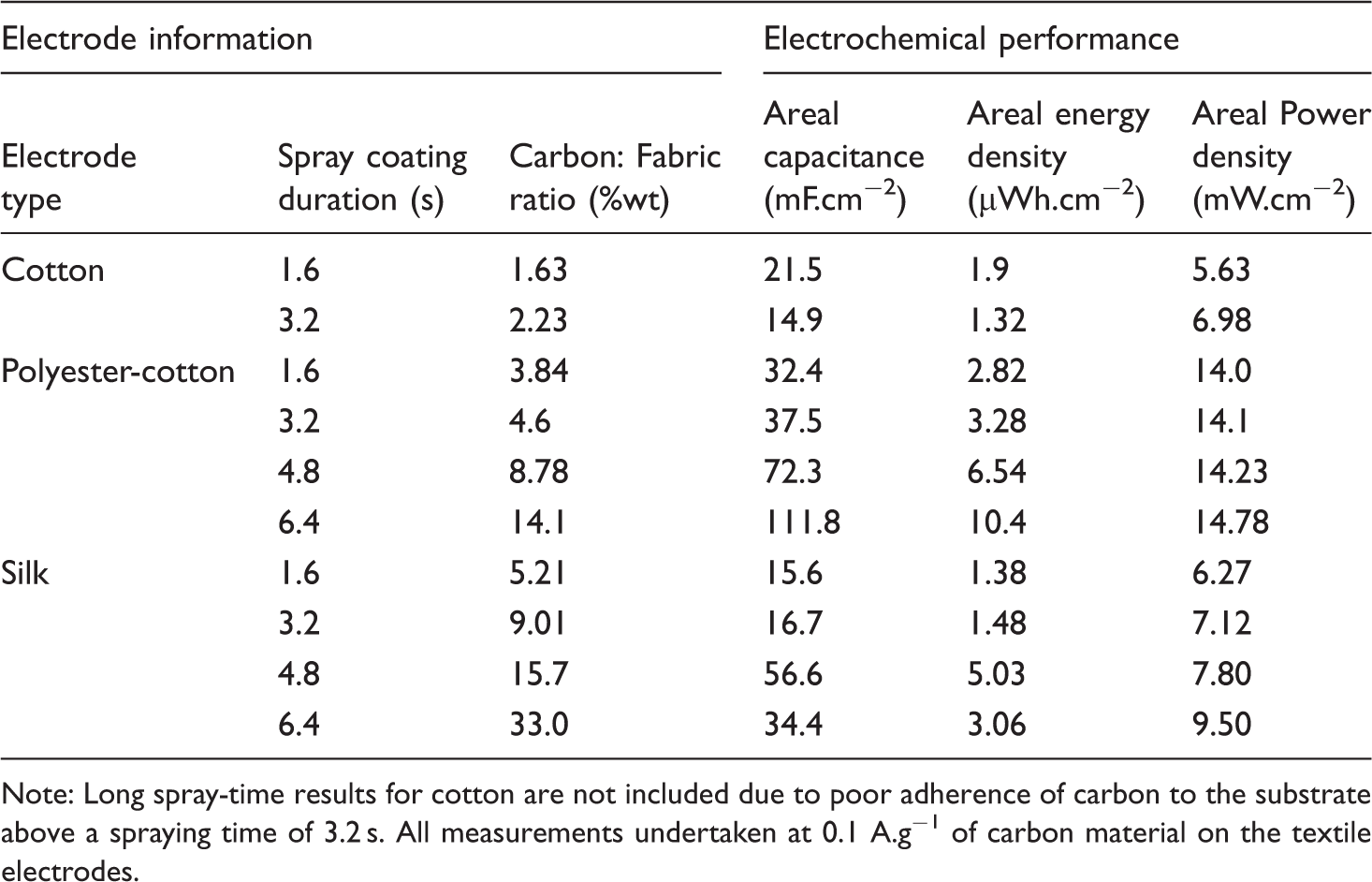
Gravimetric capacitance, energy and power density of the multilayer layer supercapacitors with different textile and active materials.

Note: All measurements undertaken at 0.1 A.g−1.
The root cause of this agglomeration (or stacking) of the carbon within the electrode is not, however, fully understood. Due to the performance of the polyester-cotton samples continuing to improve with loading, it is clear that it is not purely a phenomena of the carbon-binder ink but must also factor in the weave and/or the material of the fiber. Further investigation within this area must be undertaken to fully understand this phenomena.
Further electrochemical testing was performed on the polyester-cotton samples as these exhibited the most uniform performance across all loading levels. Figure 3 shows CV (a) and EIS (b) plots of these polyester-cotton samples. The CV plots shows the current response of the devices throughout the testing potential window. The area enclosed by the traces is proportional to the capacitance of each device. As can be seen, as the loading level increases, the shape of the plot becomes more diamond-like. This indicates that though the increased carbon levels do not significantly degrade the capacitance behavior, it does have a negative effect on the intrinsic ESR. This result is replicated in the EIS plot with the low frequency region (<10 Hz) showing considerable variation. Though the overall ESR obtained from the EIS plot does not show much variability (2.48–4.1 Ω), this is calculated in the high frequency region where the trace meets the x-axis in the first instance and not in the low frequency region where the device would be truly operated. This is an important detail for real-world device manufacturers and must be considered during the design phase.
Electrochemical performance of the multilayer supercapacitor using polyester cotton electrodes for different coating duration (1.6 s, 3.2 s, 4.8 s, 6.4 s): (a) CV plots between ± 0.8 V at scan rates of 25 mV.s−1 (b) Nyquist plots between 20 mHz to 200 kHz.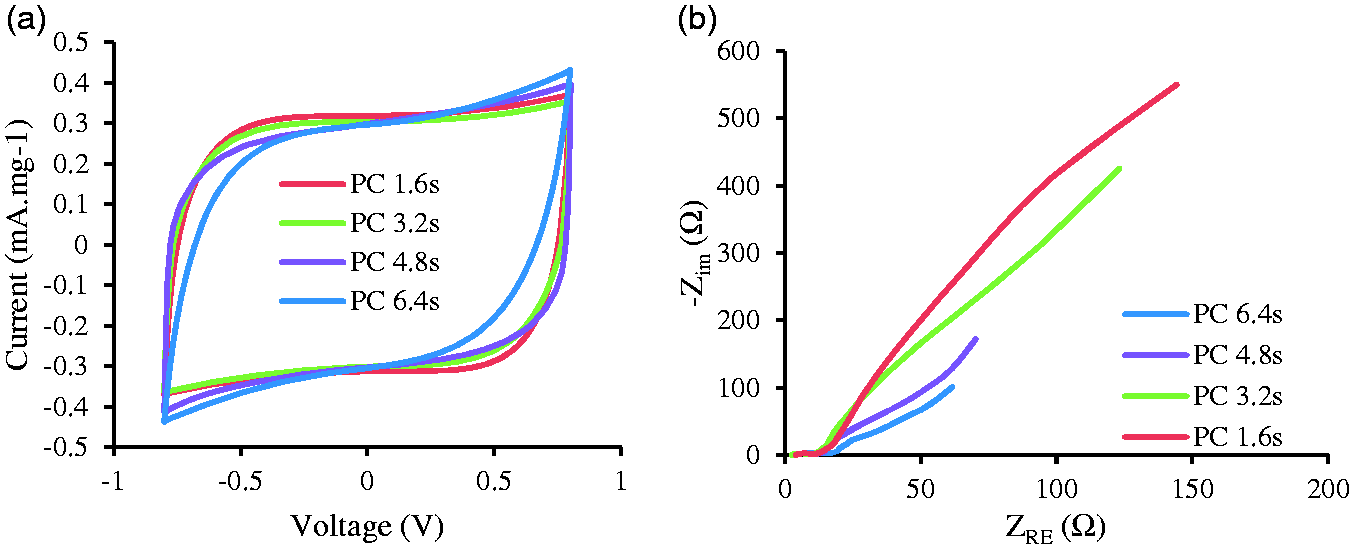
Finally, a thorough comparison of the different textile substrates can be seen in Figure 4. As in Figure 3 the polyester-cotton sample has been singled out for further analysis due to its performance. Figure 4(a) demonstrates that regardless of textile type, this production method produced electrochemically stable supercapacitors. Within the potential window (−0.8 V) no redox reactions or chemical breakdown were observed. The silk and polyester-cotton devices show highly rectangular traces, with the only difference being the overall magnitude of the current. Cotton, on the other hand, displayed a more spindle-like trace, though still an EDLC response as no extra peaks were observed. This spindle-like shape is indicative of a more resistive (ohmic and diffusion) device and is attributed to the distribution of carbon within the cotton substrate. Although the cotton does not directly affect the electrochemical performance of the device, the structure of the textile and/or the fundamental nature of the fibers alters the distribution of the deposited carbon resulting in reduced electrochemical performance. With further investigation, it will be possible to elucidate the cause, allowing for improved manufacturing steps to make the spray deposition method universal to all fabric types This notion of an inferior carbon structure forming within the cotton substrate is supported by Figure 4(b) where the capacitance performance drops off the most with increasing scan-rate, in total a 57.4% decrease between 25 and 200 mV.s−1. The silk retained the most capacitance (89.9%) over the scan-rates and this is understood to be due to improved wettability of the substrate allowing easy ion transport at the boundary. In comparison to published data [19–21] this is a very promising performance, highlighting the stability of this configuration of textile supercapacitor. Figure 4(d) shows the Ragone plots for the polyester-cotton samples derived from GC testing between 0.55 and 2.8 A.g−1 (1–5 mA.cm−2) as seen in Figure 4(c). It shows the energy density of the multilayer polyester-cotton textile supercapacitor (with electrode PC 1.6 s) increases from 0.33 µWh.cm−2 (0.16 Wh.kg−1) to 2.8 µWh cm−2 (1.37 W.g−1) while the power density remains above 14 mW.cm−2 (6.7 W.g−1) for all test current densities. Figure 4(e) shows the CV plots of the supercapacitor before and after bending the polyester-cotton electrodes (PC 1.6 s) around a diameter of 3.2 mm. The shape of CV plots did not change significantly throughout bending experiment with its capacitance decreasing by 5% after 200 cycles of bending, comparable to similar devices seen in the literature [22,23]. As shown in Figure 4(f), the capacitance of the supercapacitor made with PC 1.6 s electrodes reduced by 5.2% over 15,000 cycles at 200 mV.s−1. The GC test results of the device before and after the cycling stability test are shown in Figure 4(g), and both plots demonstrated a triangular shape indicating good capacitive behavior. These results show excellent device stability, and show that the adhesion between carbon/binder and the polyester-cotton yarns is very good. The combination of spray coating process and this carbon ink has managed to create a stable, porous and conductive network in the textile, forming an effective double-layer interface.
Electrochemical performance of the multilayer textile supercapacitor: (a) CV test results between ± 0.8 V at scan rate of 25 mV.s−1 for supercapacitor with silk (S 1.6 s), polyester-cotton (PC 1.6 s) and cotton (C 1.6 s) electrodes; (b) capacitance variation at different CV test scan rate for supercapacitor with S 1.6 s, PC 1.6 s and C 1.6 s electrodes; (c) GC plots at different current densities for device with PC 1.6 s; (d) GC derived Ragone plot of the polyester-cotton supercapacitor at increasing current densities between (0.55–2.8 A.g−1/ 1–5 mA.cm−2) tested between 0–0.8 V; (e) CV test of the device before and after bending (200 cycles); (f) CV derived stability test over 15,000 cycles; (g) GC test results at cycle 1 and cycle 15,000 with current density of 0.5 A.g−1.
Conclusion
A group of multilayer supercapacitors have been produced using spray-coated textile electrodes. The supercapacitor with silk electrodes (type S 4.8 s) demonstrated excellent performance with a gravimetric capacitance of 20.2 F.g−1 (56.6 mF.cm−2). However, the supercapacitor based on polyester-cotton electrodes (type PC 6.4 s) achieved the highest areal capacitance, energy density and power density (15.4 F.g−1, 118 mF.cm−2, 10.4 μWh.cm −2 and 14.78 mW.cm−2). The supercapacitor with spray-coated polyester-cotton electrodes exhibited excellent cycling stability with only a 5.2% capacitance decrease over 15,000 cycles. In addition, bending the textile electrode did not significantly affect the electrochemical performance of the device, with the capacitance of the device reducing by just 5% after cyclically bending 200 times.
This work has demonstrated the electrochemical performance of multilayer supercapacitors with three different textile electrodes and four different levels of carbon material. Textile substrates with different properties (material, thickness and weave structure) are seen to influence the weight and uniformity of carbon material that can be introduced into the fabric substrates. The choice of textile substrate also has a profound influence on the electrochemical performance of the carbon electrodes, with the carbon textile demonstrating the worst performance of the three. This work has demonstrated these influences and can act as a reference to inform future design considerations for flexible E-textile supercapacitors. Future work will include encapsulating the fabric supercapacitor to achieve a practical device that can withstand the rigors of use (such as washing) and investigating the weave/material/ink interaction to understand the effect of carbon agglomeration for different textiles.
Footnotes
Authors' note
All data supporting this study are openly available from the University of Southampton repository at 10.5258/SOTON/D0784.
Declaration of conflicting interests
The author(s) declared no potential conflicts of interest with respect to the research, authorship, and/or publication of this article.
Funding
The author(s) disclosed receipt of the following financial support for the research, authorship, and/or publication of this article: The authors thank the EPSRC for supporting this research with grant references EP/1005323/1 and EP/L016818/1.