




Abstract
Flexible solid-state yarn supercapacitors were fabricated using commercial carbon fiber and activated carbon fiber. Two methods of yarn construction were studied. One was twisting carbon fiber and activated carbon fiber together (plied yarn), and the other was wrapping activated carbon fiber on carbon fiber (wrapped yarn). Electrochemical measurements in terms of cyclic voltammetry (CV), galvanostatic charge/discharge (GC) and electrical impedance spectroscopy (EIS) were conducted. The result revealed that the cord-yarn structure performed better than the core-spun yarn structure, by showing a specific length capacitance of 82 mF cm−1 at 2 mVs−1. It also exhibited a high specific length energy density of 20.4 μW h cm−1 at a power density of 60 μW cm−1. There was little capacitance reduction when the cord-yarn supercapacitor was bent or crumpled, showing an excellent mechanical flexibility.
Keywords
Introduction
Using textile materials for energy storage is increasingly appealing manufacturers and consumers owing to the rapid development of lightweight and flexible wearable electronic devices [1–4]. Yarn-based supercapacitors, which are capable of providing high power density, longer cycle durability, and fast rate of charge–discharge than their counterparts, have attracted a tremendous attention from research communities and industries [5–8]. Moreover, a good compatibility with traditional textile products makes yarn supercapacitors a novel textile material for wearable energy-storage devices. Therefore, in recent years, great efforts have been made to develop new electrode materials with high capacitive performance and excellent electrical conductivity, such as carbon nanomaterials [9,10] and conducting polymers [11,12].
However, these academic achievements have not yet been translated into industrial successes due to the high cost of nanomaterials or complicated fabricating process. Zhai et al. fabricated all-carbon solid-state yarn supercapacitors using commercial activated carbon as electrode material [13], which is cheap and has high surface area. Nevertheless, the effective incorporation of activated carbon into wearable fibers was a challenge for textile process. Activated carbon fiber (ACF), as another type of highly porous carbon material, has a natural advantage of fibrous form compared to activated carbon. It can be easily handled to form a woven or nonwoven cloth. In addition, metal wire or metal-coated plastic was usually used as a current collector for fiber-based supercapacitors [14–16]. In spite of reducing the equivalent series resistance (ESR) and improving the mechanical properties of fiber-based supercapacitors, the metal wire or plastic wire has nothing to do with a direct increase of capability for energy storage except for a considerable weight and stiffness increase of the whole energy device. In contrast, carbon fiber (CF), which also has excellent electrical and mechanical properties, can be used as an alternative to plastic or mental wires, to achieve desired wearability for supercapacitor devices.
In this study, we showed that flexible all-carbon yarn supercapacitors could be fabricated using ACFs and CFs, both of which were commercially available. Two types of yarn structure were produced by twisting and wrapping ACFs and CFs. The loading mass of ACFs on CFs was carefully selected to make the yarn supercapacitors present both high specific gravimetric capacitance and specific length capacitance.
Materials and methods
Preparation of yarn supercapacitors
As shown in Figure 1(b), arayon-based ACF staple yarn with 12 cm length and 38 texfineness was obtained by unweaving a rayon-based ACF woven fabric (1200 m2 g−1, 0.7 cm3 g−1). No further information is available regarding the ACF pore size, pore distribution, and electrical conductivity. The CF filament yarn was a commercial-grade T-300 PAN-based carbon fiber (tow size 3 K, linear density 198 tex, single filament diameter 7.0 µm). Tensile strength and modulus of the CF filament yarn were 3.75 GPa and 231 GPa, respectively. The electrical conductivity of CF yarn was 556 s cm−1. The CF yarn was used as it was received, without any treatment. Used ACF mass in a plied yarn varied in 16, 24, and 32 mg.
Cord-yarn supercapacitor structure: (a) constructed with wrapped yarn; (b) constructed with plied yarn.
Then, the hybrid carbon yarns were twisted tightly using a yarn twist tester in a Z-twist direction (anti-clockwise turn) and coated with a thin layer of PVA-H3PO4 gel as electrolyte. When the gel solidified, the yarn electrode with a plied-yarn structure was obtained. Two pieces of plied-yarn electrodes with the same length were twisted together by using a handheld yarn spinner in an S-twist direction (clockwise turn) to form a cord yarn. The final length of the twisted 2-ply cord yarn was maintained at about 10 cm. Then, the cord yarn was coated with a thin layer of PVA-H3PO4 gel and dried in air till the polymer gel solidified. The as-prepared yarn supercapacitor was denoted as YarnS-tm, where S represented S-twist; t represented twisting for plying ACF and CF yarns; and m represented the mass of ACFs (16, 24, 32 mg). For the preparation of gel electrolyte, 5 g of PVA was dissolved in 50 ml of deionized water. The mixture was then heated to 90℃ under continuous stirring until the solution became transparent. Then 5 g of H3PO4 was added into the mixture with stirring to make the homogeneous PVA-H3PO4 gel.
To construct a wrapped yarn, a bundle of CF filaments was first twisted tightly using the yarn twist tester in a Z twist direction. Then 16 mg of ACF staple yarns (12 cm) were wrapped around the CFs (Figure 1(a)), forming a complex yarn structure with a yarn width around 2 mm. After wrapping, the complex yarn was coated with a thin layer of PVA-H3PO4 gel and dried to obtain a wrapped-yarn electrode. In accordance with the same operation procedure, two wrapped-yarn electrodes of the same length were twisted in S-direction to form a cord-yarn supercapacitor. The final length of the supercapacitor was about 6 cm and it was denoted as YarnS-w16, where S represents S-direction; w represents the wrapped-yarn electrode; and 16 indicates the mass of ACFs.
Electrochemical Measurements
Evaluation of capacitive properties of the cord-yarn supercapacitors included cyclic voltammetry (CV), galvanostatic charge/discharge (GC) and electrical impedance spectroscopy (EIS, 0.01 Hz to 100 kHz).Electrochemical measurements were performed using a potentiostatinstrument MetrohmAutolab PGSTAT 128 N. Capacitance retention was tested using an instrument of Arbin BT-2000.
The capacitance of the cord-yarn supercapacitors (C) was calculated from the corresponding CV and GC curves according to the formula
Results and discussion
Effect of ACF mass used in yarn
In order to determine the optimal mass of ACFs for configuring the all-carbon cord yarns, the cord-yarn supercapacitor samples YarnS-t16, YarnS-t24, and YarnS-t32 were compared in terms of electrochemical performance. Their typical CV behaviors at the scan rate of 2 mV s−1 are shown in Figure 2(a). As the mass of ACFs is increased, the enclosed area of CV curves which is indicative of total capacitance is becoming larger. However, the shape of CV curves is changed from a rectangular-like shape to a spindle-like shape, indicating worse capacitive behavior. Figure 2(b) shows a dependence of the mass of ACFs on the specific length capacitance and specific gravimetric capacitance. Calculated from their CV curves, the specific length capacitance of the cord-yarn supercapacitor composed of the plied yarns increases from 67, 82 to 100 mF cm−1 when the mass of ACFs increases from 16, 24 to 32 mg, on the contrary to a decrease of the specific gravimetric capacitance from 74, 66 to 62 F g−1.With a given length of the cord-yarn supercapacitor, the increase in the mass of ACFs meant the increase in the total electrode thickness. This could result in a reduction of capacitive efficiency for energy storage because of an increase of internal electric resistance. In other words, although increasing the mass of ACFs could obtain a high specific length capacitance, the overall capacitive behavior may perform poorly. Thus, the following study was focused on YarnS-t24, which provided almost equally high specific gravimetric capacitance (66 F g−1) and specific length capacitance (82 mF cm−1).
Electrochemical performance of the cord-yarn supercapacitor samples YarnS-t16, YarnS-t24, YarnS-t32. (a) CV curves at 2 mV s−1; (b) a dependence of the specific length capacitance and specific gravimetric capacitance on the mass of ACFs.
Electrochemical properties and flexibility of yarn supercapacitors
The electrochemical properties of YarnS-t24 were further determined by CV, GC and EIS. Figure 3(a) shows the CV curves of YarnS-t24 at 2–20 mV s−1, which became spindle-shaped and had a larger enclosed area at high scan rate. According to Figure 3(b), the GC curves of YarnS-t24 reveal two electrochemical features. First, the potential increase rate in charge cycle and potential drop rate in discharge cycle tend to be dramatic symmetrically with the increase of current density, indicating its high resistance to ion transport. Second, at the set potential level, the charge/discharge time is greatly extended for the low current density loads, suggesting that the best capacitive performance of YarnS-t24 is associated with the lowest current density load of 25 mA·g−1. This is consistent with the rate performance result of YarnS-t24 (Figure 3(c)).This poor rate capability was attributed to the low electrical conductivity of ACFs and high resistance of ion transport in the polymer gel electrolyte. Using conductive nanomaterials such as graphene and carbon nanotubes may improve the rate capability but could increase production cost as well. Nevertheless, our work was to develop yarn supercapacitors from low cost and commercially available carbon materials using the most economical and simple fabrication ways. The specific length capacitance of YarnS-t24 was still much higher than that of yarn supercapacitors in recently reported research, such as hybrid carbon yarns loaded with activated carbon (46.8 mF cm−1 at 2 mV s−1) [13] and graphene-oxidized yarns with MnO2 nanosheets/polypyrrole thin film (31 mF cm−1 at 11 mA cm−3) [17].
Electrochemical performance of YarnS-t24. (a) YarnS-t24 CV curves at different scan rates; (b) YarnS-t24 GC curves at different current density; (c) YarnS-t24 specific length capacitance and specific gravimetric capacitance at different scan rate and current density; (d) comparison of the Ragone plot of YarnS-t24 with those of some representative yarn supercapacitors; (e) YarnS-t24 EIS results from 0.01 to 100 kHz; (f) YarnS-t24 cycle performance at a 50 mA g−1.
The specific length energy density of YarnS-t24 was 20.4 μW h cm−1 at a power density of 60 μW cm−1. As seen from Figure 3(d), the length energy density was inversely proportional to the power density. It retained 2.2 μW h cm−1 at a power density of 480 μW cm−1. The length energy density of this device was much higher than that of many recently reported yarn supercapacitors, including carbon fiber/activated carbon yarns with 6.5 μW h cm−1 at 27.5 μW cm−1 [13], carbon nanotube/MnO2/polymer fiber with 0.7 μW h cm−1 at 19.3 μW cm−1 [18] and carbon fiber/polyaniline with 1.4 μW h cm−1 at 1.3 μW cm−1 [5].
Figure 3(e) shows the Nyquist plots of YarnS-t24 from the EIS measurement over the frequency range of 0.01 to 100 kHz. Equivalent series resistance (ESR) of YarnS-t24 was 1.1 Ω cm−1, which was far less than that of reported carbon fiber/activated carbon yarns (4.9 Ω cm−1) [13]. The charge transfer resistance at high frequencies presented a semicircle characteristic, which can be ascribed to the diffusion of ions through the gel electrolyte into small micropores of ACFs. Figure 3(f) shows the cycling performance of YarnS-t24 for 5000 charge–discharge cycles at 50 mA g−1. It exhibited a good cycling stability with 89% capacitance retention after 5000 cycles.
It is crucial to test the flexibility of this device compared to its electrochemical performance for wearable and other flexible applications. The flexibility of YarnS-t24 was tested by measuring the capacitance stability under different bending deformation as shown in Figure 4(a). Only very little capacitive decay was observed when the device was bent and recovered. Even when severely crumpled, it retained 90.6% of the initial specific capacitance and was able to recover some reduced capacitance after being flattened. As seen from the insert plot in Figure 4(a), a 94.8% retention rate was observed after 1000 bending (360°) cycles. Figure 4(b) shows the yarn supercapacitors connected in series to power an LED indicator and it can last for about 7 min, indicating great potential for smart textile applications.
(a) Capacitance retention of YarnS-t24 under different mechanical deformation conditions. The inset is capacitance retention after 1000 bending (360°) cycles; (b) photograph of three supercapacitors connected in series to power an LED bulb.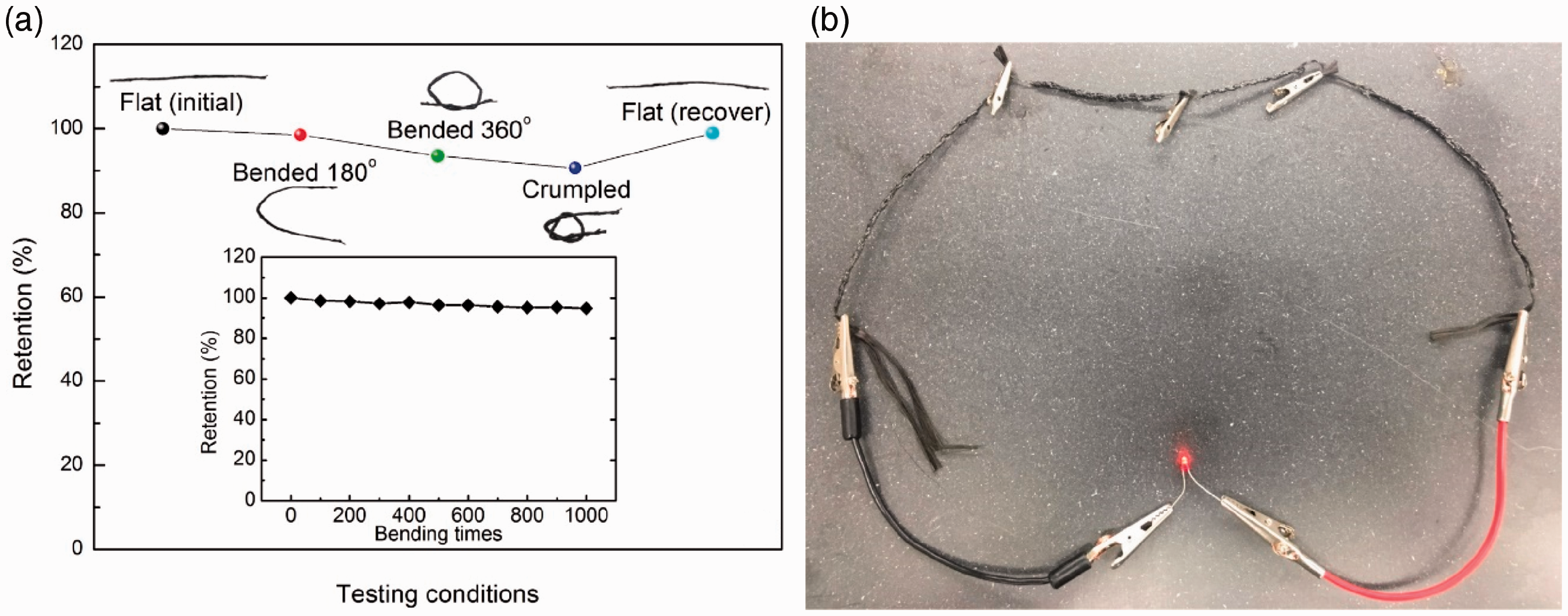
Effect of yarn fabrication methods
The difference between YarnS-t24 and YarnS-w24 resulted from the different yarn fabrication methods. The former was fabricated by twisting the CF/ACF yarns for the ply-yarn construction, while the latter was made by wrapping ACFs on twisted CFs for the wrapped-yarn structure. Figure 5(a) shows the CV curves of YarnS-w24 at different scan rates (2 − 20 mV s−1). No matter what rate was used, the CV curves were always spindle shaped. Moreover, the loop area was even smaller at the high scan rate. Calculated from the CV curves, the specific length capacitance of YarnS-w24 at 2 mV s−1 was 20 mF cm−1, which was far lower than that of YarnS-t24. The ESR of YarnS-w24 was 2.2 Ω cm−1(Figure 5(b)), higher than that of YarnS-t24. The relatively poor electrochemical performance of YarnS-w24 illustrated that wrapping ACFs on CFs was not an ideal way for fabricating high performance yarn supercapacitors, although the purpose of wrapping was to increase the contact area between ACFs and CFs. This was because the wrapped ACFs had a bulkier structure that would limit electron transfer significantly due to the enlarged distance between the ACFs and the current collectors (CFs). As a result, the ESR of YarnS-w24 was increased.
CV curves of YarnS-w24 at different scan rates (a); EIS results of YarnS-w24 from 0.01 to 100 kHz (b).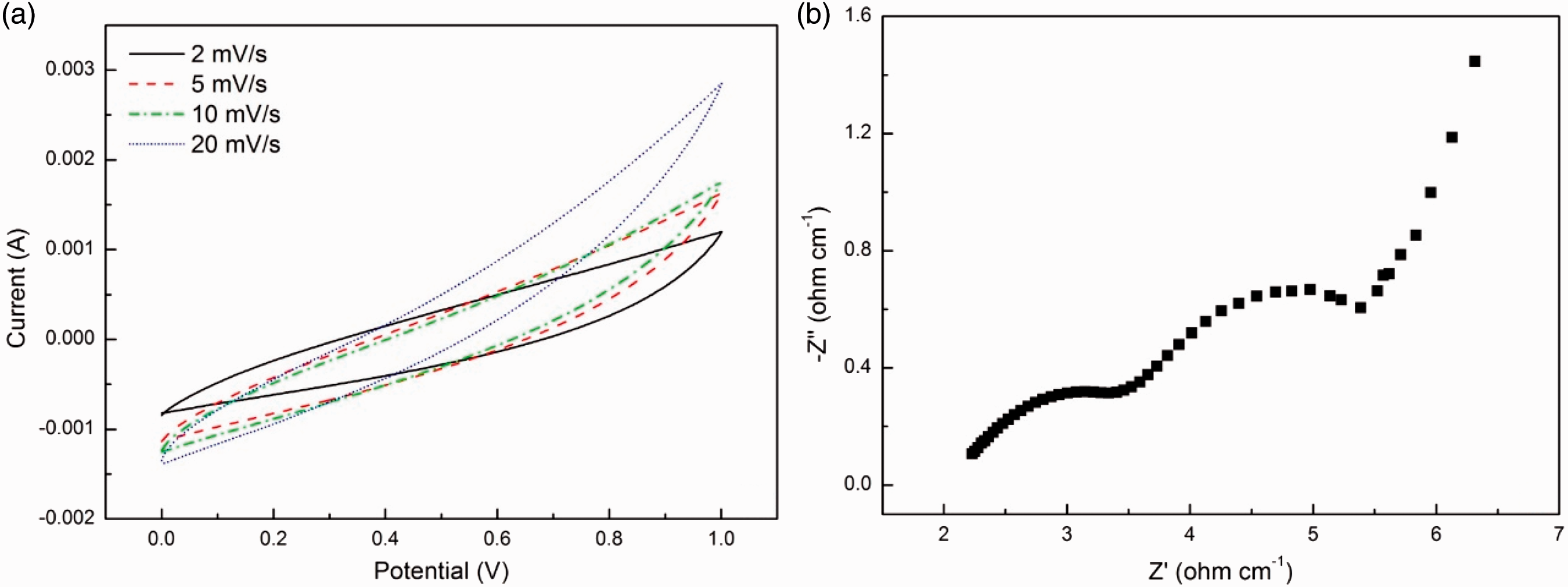
Conclusion
Commercial carbon fiber and activated carbon fiber yarns were used to fabricate flexible all-carbon solid-state yarn supercapacitors with PVA/H3PO4 polymer gel as solid electrolyte. During the fabrication process, two different yarn construction ways between carbon fibers and activated carbon fibers were used. Wrapping activated carbon fiber yarn on carbon fiber filament was proved an inefficient method compared with the twisting method. The 10 cm long yarn supercapacitor with 24 mg ACF twisted with CF showed a specific length capacitance of 82 mF cm−1 at 2 mVs−1. When the power density was 60 μW cm−1, the specific length energy density of this yarn supercapacitor was as high as 20.4 μW h cm−1. In the case of being bent or crumpled, the yarn supercapacitor had little capacitance reduction, showing excellent mechanical flexibility.
Footnotes
Acknowledgements
Gratitude is to the China ScholarshipCouncil for sponsoringYuxiangHuang's visiting research.
Declaration of Conflicting Interests
The author(s) declared no potential conflicts of interest with respect to the research, authorship, and/or publication of this article.
Funding
The author(s) received no financial support for the research, authorship, and/or publication of this article.