




Abstract
In this study, the nanofiber mat of silk fibroin and gelatin was fabricated by electrospinning process. As biological properties of the electrospun mat are bound up with the diameter of nanofibers, the group method of data handling along with the response surface methodology were adopted in order to explore the dependency of the diameter on the variables such as blend ratio, solution concentration, and electric field. The average absolute relative deviations were calculated as 4.62% and 5.86% for the group method of data handling and response surface methodology models, respectively. Moreover, being less prone to error and exhibiting greater accuracy to predict the actual trend of diameter in comparison with the response surface methodology, the group method of data handling model was applied to predict the porosity of silk fibroin/gelatin nanofiber mat. The average absolute relative deviations were 0.71% with a high regression coefficient of R2 = 0.99. This suggests that the group method of data handling model can fairly model the electrospinning process of the silk fibroin/gelatin nanofiber mat.
Introduction
In recent years, tissue engineering has witnessed tremendous progress to assemble the functional constructs which can regenerate and repair the injured tissues and organs [1,2]. Porous scaffolds play a critical role in tissue engineering due to their unique properties such as proper cell attachment, controllable in vivo degradation rates, suitable stiffness and strength for handling [2–6]. Several methods have been employed for the fabrication of the nanofibrous scaffolds, such as self-assembly, phase separation, template-synthesis, centrifugal spinning, pressurized gyration, and electrospinning [4]. In the selection of the biomaterial scaffolds, electrospun nanofibers have potential application in many tissues, because they can mimic the mechanical anisotropy of fibrous tissues and the biological function of native extracellular matrix (ECM) [5,6]. Moreover, the electrospun scaffold has a high surface-to-volume ratio and also the micro-pores which provide a proper surface for cell attachment and growth [7]. These properties highlight the importance of electrospinning for biomedical applications like drug delivery systems, wound dressings, medical implants, and so on [2]. In the electrospinning process, under the electric field, electrostatic force overcomes the surface tension of the polymeric solution and creates a charged and continues jet of the solution. The charged jet moves towards the collector and dries with the evaporation of the solvent, thus leading to the formation of micro- and nanofiber of polymer (Figure 1(a)) [8]. The morphology and diameter of nanofibers have a major effect on the properties of scaffold [9]. Christopherson et al. demonstrated that the fiber diameter of electrospun polyethersulfone (PES) mat significantly influenced the neural stem cells proliferation and differentiation. The results showed that as the fiber diameter decreased, the higher degree of proliferation and cell spreading were observed [10]. Hodgkinson et al. studied the cell behavior on the Bombyx mori silk fibroin (BMSF) electrospun scaffold. The BMSF scaffolds with a diameter approximately ∼250 nm supported cell proliferation significantly more than the microfibers with diameters ∼1 μm, and also nanofibrous scaffolds provided an effective template for migratory keratinocytes during re-epithelialization [11]. Moreover, the porosity of scaffold is one of the significant parameters in the electrospinning process, which controls the cell behaviors. Less porous structures lack the appropriate interaction between the cell and fibers, whereas for highly porous structures, the interaction and accommodation of cells within fibers are fulfilled from the different directions [12]. Since the diameter and porosity of nanofibers mats can influence the physical, mechanical, and biological properties, then the modeling of electrospinning process may serve as a useful guide to obtain the uniform structure at various combinations of variables.
Schematic of: (a) electrospinning process and proposed the GMDH model for prediction of: (b) diameter and (c) porosity of SF/G nanofiber mat. GMDH: group method of data handling.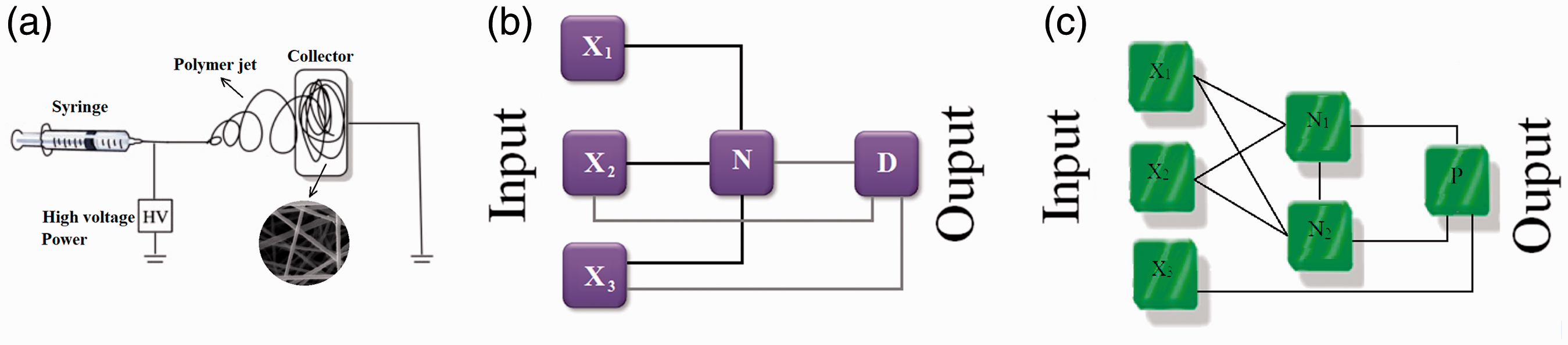
Silk has been well known in the textile industry for its unique mechanical properties [13]. Silk fibroin (SF) is a fibrous protein which is extracted mainly from the silkworm cocoons and spiders. Recently, special attention has been paid to SF because of its biocompatibility, biodegradability, and appropriate mechanical properties [14]. SF has been studied as a biomaterial for applications such as drug delivery, wound dressing, and tissue engineering scaffolds [15]. However, low mass loss rate and hydrophilicity of SF are considered as its main drawbacks. Gelatin (G) is a low-cost natural biopolymer, featuring the same biological characteristics as collagen. Moreover, G has arginine glycine aspartate (RGD) sequences which provide cell attachment sites [16]. In our previous study, we observed that G increased the bulk hydrophilicity, cell attachment, and mass loss rate of SF. Thus, SF/G nanofiber mat can have an immense potential in tissue engineering application [17].
Response surface methodology (RSM) is a common tool based on statistical and mathematical techniques. It is frequently adopted for process optimization of the variables which lead to the optimum response [12–14]. Park et al. used the RSM method to model and optimize the electrospinning parameters for polyvinylacetate (PVAc) nanofibers. The results indicated that concentrations and voltage played an important role in the diameter [18,19]. Moreover, Yördem et al. utilized the RSM model for prediction of the diameter of polyacrylonitrile (PAN) nanofiber mats. The RSM predictions showed that there is a negative correlation between the diameter and variation coefficient for the diameter of nanofibers [20]. Another efficient way to model the different kinds of systems and dependencies is the artificial neural network (ANN) approach. Generally, the ANN model includes powerful empirical mathematical tools for handling complicated relations between the input and output parameters in the data set. Although ANN approach has a good performance for modeling the different processes, however, its mathematical structure is complex. To address this issue, the group method of data handling (GMDH) is regarded. The GMDH model is the polynomial neural networks benefiting from both the simple mathematical structure and accuracy. Atashrouz et al. used the GMDH model for prediction of the water activities in the glycol-polyethylene glycol (PEG) solution. The GMDH approach with an explicit general correlation function, accurately extrapolated the activities of water in the polymeric solution [21]. In the other study, the GMDH model was developed to determine the thermal conductivity of pure ionic liquids. The average absolute relative deviation (AARD%) for all studied systems was 1.81%, which was a satisfactory degree of accuracy for the proposed model [22]. In our previous study which has been reported elsewhere [23], two mathematical models based on the ANN and GMDH were adopted for prediction of the diameter of SF nanofiber mat. The results showed that the GMDH model was more appropriate for modeling the diameter and the ANN model cannot be able to predict the actual trend of diameter with variations of the electrospinning parameters.
In the present study, the validity of the GMDH and RSM models in the prediction of the electrospun nanofibers of SF/G mat is compared. To the best of our knowledge, this is the first report on applying these models to predict the diameter and porosity of binary blend polymer scaffold. In this regard, three input parameters, i.e. blend ratio, solution concentration, and electric field were selected. Both the diameter of nanofibers and porosity as two important scaffolds characteristic were considered as the output parameters.
Experimental methods
Materials
Silkworm cocoons were prepared from the University of Guilan (Rasht, Iran). Formic acid (98%), type B gelatin, ethanol (99.9%), sodium carbonate (Na2CO3), and lithium bromide (LiBr) were purchased from Merck (Germany).
Preparation of SF
Firstly, silkworm cocoons were boiled for 45 min in an aqueous solution of 0.02 M Na2CO3, and then were rinsed for several times with distilled water. After drying, the degummed SF fibers were dissolved in 9.3 M LiBr at 60℃ for 4 h and dialyzed in a dialysis membrane against distilled water for three days by changing water several times. Finally, the SF solution was poured into a Petri dish and dried at room temperature for 24 h [17].
Electrospinning
The SF/G blended solution with various ratios was prepared by dissolving SF and G in the formic acid. Firstly, SF was dissolved in formic acid at 25℃ for 24 h. Then, a determined content of G was added to SF solution and the magnetic stirring was continued for 4 h at 45℃. The solution was filled into a 5 mL plastic syringe and electrospun for 12 h. The feed rate and speed of collector rotation were selected at 0.3 (cc/h) and 1500 (r/min), respectively. The blend ratio, solution centration, and electric field were selected in the range of 0–100 (%), 8–12 (%), and 1.5–2.5 (kV/cm), respectively.
Scanning electron microscopy
The morphological observation of the electrospun nanofibrous mats was performed with a scanning electron microscope (AIS2100, South Korea). In the SEM images, the diameters of nanofibers were determined by ImageJ software and the results were given as the average diameter ± standard deviation (SD).
Viscosity
The viscosity of SF/G blend solutions was measured using a Brookfield viscometer (Model LVDVE 230). The temperature of the solution was controlled at 27℃. Each test was performed three times (n = 3).
Porosity
The porosity of the SF/G electrospun nanofibers mats was measured by the liquid displacement method [24]. Ethanol was used as the displacement liquid. SF nanofibrous mat was immersed in a known volume (V1) of ethanol for 30 min. The total volume of ethanol after impregnation into the mats was recorded as V2. The residual ethanol volume was recorded as V3. Each test was performed three times for the samples (n = 3). The porosity was calculated according to the equation below

Cell behavior study
Mouse fibroblast L-929 cells were supplied by national cell bank of Iran, Pasteur Institute of Iran, according to the same procedures in the literature [17–25]. Firstly, the cells were cultured using RPMI 1640 medium supplemented by 10 v/v% fetal bovine serum (FBS) and 1 v/v% penicillin–streptomycin. Then, cells were detached from the flasks using 0.25 trypsin EDTA and 50 µl cell suspension and seeded onto the SF/G nanofiber mats (10 × 10 mm2) for 3 h in the incubator. Finally, after the removal of the culture medium, the SF/G mats were rinsed twice with the phosphate-buffered saline (PBS) and then, the cells were fixed with 4% GTA solution. In order to observe the cell attachment and morphology by SEM, the fixed cells were dehydrated in graded ethanol solutions and sputter coated with gold.
Mathematical model
GMDH
When applied to solve a specified problem, the GMDH algorithm combines variables, concurrently, to establish a polynomial expression [23]. The most proper configuration of polynomials with the highest accuracy is recognized by the algorithm. The GMDH system is in the form of the following series


RSM
Taking advantage of a low-order polynomial in most cases, the RSM model is able to approximate the numerical or physical experimental data. The brief descriptions of the procedure are given as follows:
Identification of variables ζ1, ζ2, ζ3, … for η (response). Calculation of corresponding coded variables X1, X2, X3, … with the following equation
Determination of the experimental model by multiple regression analysis to obtain the theoretical response (η), which was calculated according to the equation below
A response surface illustrates the response and the variables correlation in order to (i) investigate the mutual impacts of the parameters; (ii) determine an optimum parameter combination; and (iii) predict the experimental results for other parameter combinations. For this research, blend ratio, solution concentration, and electric field are three variables involved in the RSM model. The experimental model from the general equation becomes (k=3):



Statistical functions
All the experiments were repeated at least three times and the average of the results was expressed as mean ± SD. Statistical calculations were conducted with a statistical significance level of p < 0.05. In order to evaluate the proposed models in this study, some statistical functions including AARD%, mean absolute deviation (MAD%), mean square deviation (MSD), and regression coefficient (R2) were considered as shown below



The Pearson correlation coefficient (r) was used to estimate the influence of each parameter on the diameter of nanofibers. The higher value of this factor indicates the greater effect of the input parameter on the output. The r value is defined by the following equation

Results and discussion
The solution viscosity plotted against gelatin content is presented in Figure 2. The viscosity of the SF/G solution increased from 243 ± 19 cP in a pure SF solution to 358 ± 7 cP for the SF/G with 30 wt.% of the gelatin (p-value < 0.05). This upward trend can be attributed to the more molecular interactions, such as hydrogen bonding formation between –NH and –OH groups in the polypeptides chains [17,26].
Viscosity of the SF/G blend solutions.
In order to examine the diameter and porosity of nanofiber mat, the effects of blend ratio, solution concentration, and electric field on them were evaluated. The Design-Expert software delivered 16 experiment sets for the three mentioned parameters. The details of experimental design and electrospinning conditions are reported in Table 1. The SEM images of electrospun nanofibers are given in Figure 3. It can be observed that the electrospun mats are smooth and bead-less (except for some beads in Figure 3(2) and (4) that represent 8% pure SF solution concentration). Experimental findings have shown that to have bead-less nanofibers scaffold, a minimum concentration or viscosity is needed [3]. Generally, in lower values of the solution viscosity, some beads can be formed in the nanofibers. A gradual change in the configuration of beads from spherical to cylindrical shape occurs with an increase in the solution viscosity. When the solution concentration is ∼2.5 times greater than the entanglement concentration of polymer chains, smooth and bead-free nanofibers will be obtained [27]. Accordingly, it can be inferred that for the concentrations below 8%, the required entanglement between the polymer chains does not exist and some beads are formed along the fibers.
SEM images of the SF nanofibrous mats from experimental runs 1–16. (Feed rate = 0.3 cc/h, speed of collector rotation = 1500 r/min, blend ratio = 0–30%, solution centration = 8–12%, and electric field = 1.5–2.5 kV/cm) (Scale bar represents 5 μm in all figures). Characteristic of different samples.

Modeling of the diameter of nanofiber
As mentioned earlier, the diameter of nanofibers mats is an effective parameter which determines different properties of the electrospun scaffolds. Wang et al. studied the effect of the diameter of Tussah silk fibroin (TSF) nanofiber mats on the neuronal differentiation of human embryonic stem cells. The cell viability, neuronal differentiation, and neurite outgrowth on 400 nm diameters were significantly greater than that on 800 nm nanofiber diameter [9]. Moreover, Kumbar et al. [28] showed that the tensile modulus and mechanical properties of electrospun poly (lactic acid-co-glycolic acid) (PLAGA) were sensitive to the nanofiber diameters. Other studies showed that the diameter has an important effect on conductivity [29], hydrophilicity [30], and filtration behavior [31]. Therefore, it is very important to develop a model for estimating the diameter of electrospun nanofibers before starting the electrospinning process. There are several studies that used the ANN model for predicting the diameter of nanofiber [24,25]. In our previous study, the results showed that the GMDH model had a better ability to predict the trend of the diameter with electrospinning parameters variations, in comparison with the ANN model [23]. After finding the optimized GMDH model, an explicit analytical model representing relevant relationships between input and output variables is obtained. While in the case of the ANN model, the relationships between input and output variables are obtained as a weights and biases matrix which should be used to build the model with software. It should be noted that the ANNs models are generally more flexible than the GMDHs models, and it is better to use ANNs for highly non-linear systems. In this purpose of the study, in comparison with the ANN model, the GMDH models are more appropriate for modeling the electrospinning processes.
The GMDH and RSM models were developed based on the experimental data and are presented in Table 2. For modeling with the GMDH method, the experimental data are divided into two sections: randomly, 80% of experimental data were designated for training the model and the rest 20% were considered for the model testing (the number of hidden layers is one as shown in Figure 1(b)). As well as, in the RSM model, the results were fitted with a quadratic polynomial equation. Figure 4 illustrates the estimated data by the RSM and GMDH models as the experimental data. As can be seen, the data points are close to the diagonal line demonstrating a reasonable conformity between the estimated results from the models and the experimental data. It can be concluded that both models have good performance to predict the diameter of SF/G nanofiber mat.
Comparison between the estimated data by: (a) RSM and (b) GMDH models and the experimental data. GMDH: group method of data handling; RSM: response surface methodology. The mathematical relations of the GMDH and RSM models for prediction of the diameter of SF/G nanofiber mat. Note: GMDH: group method of data handling; RSM: response surface methodology.

Comparison between the errors of the GMDH and RSM models.

GMDH: group method of data handling; RSM: response surface methodology.
Apart from having good accuracy, both models should be examined for their physical response to a change in the input parameters. The effect of blend ratio on the nanofiber diameter and the predictions of the GMDH and RSM models are presented in Figure 5. As can be seen, increasing the G content leads to a rise in the diameter of SF/G nanofiber mat (p-value < 0.05). Since, as mentioned before, the solution viscosity was enhanced with an increase in the G content (Figure 2). This intensifies the entanglement of polymer chains, which results in a greater polymer solution resistance to being stretched by the electrostatic force and, ultimately, larger diameter is formed on the collector. Figure 5 indicates a noticeable difference between the experimental data and the values predicted by the RSM model and for the G content above 30 wt.%, RSM-estimated data showed a downward trend. The results demonstrate that RSM is unable to predict the upward trend of the diameter. In contrast, the GMDH model exhibits higher accuracy than RSM and the GMDH-estimated results are close to the experimental data, following a linear relationship between the nanofiber diameter and G content.
The effect of G content variations on the diameter of nanofibers and the prediction of the RSM and GMDH models (concentration = 10% and electric field = 2 kV/cm). GMDH: group method of data handling; RSM: response surface methodology.
Figure 6 shows the nanofiber diameter at different solution concentration. As described elsewhere, the viscoelastic force and entanglements of the polymer chains are enhanced with increasing the concentration of polymeric solution [13]. Therefore, charged polymer jet shows more resistance when being stretched by the electrical charges and leading to a larger diameter [14]. As can be seen in Figure 6, the diameter was enhanced with an increase in the solution concentration (p-value < 0.05). The GMDH- and RSM-estimated results showed different slope trend in comparison with the downward trend of experimental data. Nevertheless, the estimated data from the GMDH model showed more fitting with the experimental data in this concentration range (10–13%). It should be noted that the experimental errors are not negligible. Moreover, the objective function of the GMDH model is based on minimizing the output error and in some rare cases, the trend is not predicted correctly. However, this issue is not problematic for the current research study, and the error still remains low if the GMDH model is used for interpolation between the parameters.
The effect of solution concentration variations on the diameter of nanofibers and the prediction of the RSM and GMDH models (G content = 20 wt.% and electric field = 1.5 kV/cm). GMDH: group method of data handling; RSM: response surface methodology.
The effect of electric field on the diameter of nanofiber is represented in Figure 7. The applied electric field is one of the most important parameters in the electrospinning process due to its direct influence on the dynamics of the fluid flow. Moreover, as the voltage has an influence on the acceleration and stretching of the electrospinning jet, it will have an influence on the fiber. However, some studies concluded that the voltage has a less significant effect on the morphology and nanofiber diameter than the other parameters [32–36]. As seen in Figure 7, increasing the electric field leads to a significant decrease in the diameter (p-value < 0.05). It can be explained that in the higher voltage, electrostatic force dominates more against the surface tension of the polymer solution. Therefore, the charged polymer jet is stretched more under electric field and lower diameters are formed on the collector. As can be seen, the GMDH model has a good ability to predict the decreasing trend of diameter. In contrast, in the electric field more than 2 kV/cm, the RSM model showed an upward trend and failed to predict accurately the trend of diameter. Regarding the obtained results, the GMDH model offers superior advantages over the RSM model. Therefore, the GMDH model was selected for modeling of the porosity of SF/G nanofiber mat.
The effect of electric field variations on the diameter of nanofibers and the prediction of the RSM and GMDH models (G content = 20 wt.% and concentration = 12%). GMDH: group method of data handling; RSM: response surface methodology.
Modeling of the porosity
Low cell infiltration into the packed structure of electrospun scaffolds limits their application in the tissue engineering [37]. It is known that the porosity of scaffold serves a key role in controlling the cell behavior and could have significant impact on the different cells ingrowth, migration, adhesion, and proliferation [38]. The effects of the porosity on the cellular activities in micro- and nanofiber electrospun scaffold are summarized in Figure 8.
Schematic of the cellular activities in the micro- and nanofibers electrospun scaffold.
The behavior of the L-929 fibroblast cells in contact with the SF/G nanofiber mat is illustrated in Figure 9. As can be seen, the cells were successfully spread out and attached on the surfaces of samples. It has been reported in the literatures that the negative charges of cell membranes have an affinity to interact with the arginine in the carboxy-terminal of SF [39]. Also, the suitability of the SF nanofiber mat for attachment of keratinocytes and mesenchymal stem cells has been reported [40]. Moreover, it is well known that the arginine glycine aspartate (RGD) sequences of G provide cell attachment sites [41]. In Figure 9, the SF/G (90/10) nanofiber mat with 82% porosity shows somewhat better cell spreading and cell–cell interaction (as shown by green arrows) than the nanofiber mat with 63% porosity. By and large, it can be said that with an increase in the porosity, connection sites for the receivers on the cells' surface became more abundant and, as a result, the attachment and spreading of the cells were improved. Previous studies, also, have reported that porosity has a significant effect on cell behavior. Danilevicius et al. [42] demonstrated that cells adhered strongly onto the polylactic acid (PLA) scaffolds when the porosity value increased from 82 to 90%. Moreover, Takahashi and Tabata [43] concluded that the differentiation and attachment of mesenchymal stem cell (MSC) were influenced by the porosity of the polyethylene terephthalate (PET) scaffolds and the proliferation of MSC was enhanced with increasing the porosity. Therefore, developing a model is crucial for the precise estimation and fine controlling of the porosity of polymeric nanofiber mat.
SEM images of the cultured L-929 fibroblast cells on the electrospun mats: (a) SF/G (90/10) with 82% porosity and (b) SF/G (70/30) with 63% porosity (scale bars = 50 µm).
The mathematical relation of the GMDH model for prediction of the porosity of SF/G mats.

Note:
GMDH: group method of data handling.
The values of porosity estimated by the GMDH model, together with the corresponding experimental data, are presented in Figure 10(a). As can be observed, the data points keep close to the diagonal line, which shows an agreeable consistency between the GMDH-estimated data and experimental data. In addition to its accuracy in fitting the train data set, it is entirely suitable for the prediction of the porosity by the required parameters without recourse to experimental testing. This can be clearly understood in Figure 10(b) to (d). As indicated by Figure 10(b), by keeping all the parameters constant, according to the prediction of the GMDH model, an increase in the blend ratio led to a decline in the porosity (p-value < 0.05). This trend is in agreement with the experimental observations. A similar trend was predicted for the polymer solution concentration (Figure 10(c)) as well as the electric field (Figure 10(d)).
(a) Comparison between the estimated data by the GMDH model and the experimental data, and the effect of variations: (b) G content (concentration = 10% and electric field = 2 kV/cm), (c) solution concentration (G content = 30 wt.% and electric field = 1.5 kV/cm), and (d) electric field (G content = 30 wt.% and concentration = 8%) on the porosity of SF/G electrospun mats and the prediction of the GMDH model. GMDH: group method of data handling.
Conclusions
The SF/G nanofiber mat was fabricated by electrospinning process. The effects of different parameters (blend ratio, solution concentration, and electric field) on the diameter and porosity of nanofibers mat were investigated. For instance, with increasing the gelatin content from 0 to 30%, the nanofiber diameter was changed from 182.25 ± 23 nm to 443.69 ± 36 nm. Two mathematical models based on the GMDH and RSM were adopted to predict the diameter of SF/G nanofiber mat. While both developed models demonstrated good accuracy (the AARD% are 4.62% and 5.86% for the GMDH and RSM models, respectively), the results suggested that the GMDH model took precedence over the RSM with regard to their performance. As a result, it can be concluded that the GMDH model is more reliable for the estimation of the porosity. The calculated value of AARD%, i.e. 0.71%, implies that the GMDH model possesses a remarkable accuracy and can fairly model the porosity of nanofiber mat.
Footnotes
Declaration of conflicting interests
The author(s) declared no potential conflicts of interest with respect to the research, authorship, and/or publication of this article.
Funding
The author(s) disclosed receipt of the following financial support for the research, authorship, and/or publication of this article: This project was supported by Amirkabir University of Technology (Tehran Polytechnic), Grant No. 95.