



Abstract
Electromagnetic radiation is becoming increasingly serious around our living environment, which seriously endangers people's health and interferes with the operation of electronic equipment. The research and development of anti-electromagnetic radiation fabric have drawn more and more attention. However, the influencing rules and mechanisms of conductive fiber content, fabric tightness, warp–weft density, conductive yarn arrangement, weave type, and electromagnetic wave frequency on fabric electromagnetic shielding effectiveness have not been clarified. Therefore, in this study, a series of fabrics containing stainless steel fibers were produced. Meanwhile, the influencing rules of various factors on electromagnetic shielding effectiveness and the quantitative relationship between some factors and electromagnetic shielding effectiveness were discussed. The results showed that all factors had different degrees of influence on electromagnetic shielding effectiveness, and the relationship between electromagnetic shielding effectiveness and electromagnetic wave frequency could be approximately expressed as:
Keywords
Introduction
With the development of electronic industry, people's life is flooded with a large number of electromagnetic waves, which endangers human health and interferes with the operation of electronic equipment, thus leading to the increasing demand for radiation-proof functional textiles. Recent research papers on electromagnetic shielding effectiveness (EMSE) mainly focus on technology of electromagnetic shielding (EMS) materials [1–5], influencing factors [6–12], or calculation [12–16]. The blended metal fabric-EMS has so many advantages in price, technology maturity, EMS performance, and wear ability that it has become one of the most widely used EMS fabrics [7]. In order to better develop and evaluate the blended EMSE fabric, researchers have explained some effects of fabric parameters on EMSE from different aspects and revealed some influencing mechanisms.
In terms of conductive material content, most of studies believed that the EMSE increased with the increase of conductive material content [7–9,13]. However, Safarova et al. [13] suggested that the cover factor of fabric decreased with an increase in the portion of metal fiber in yarn, and the reason was that the fineness of yarn declined with increasing portion of the conductive component. This finding is interesting and can provide a reference for the study of the relationship between shielding effectiveness (SE) and conductive material content.
In the aspect of warp–weft density, most of the results were that the EMSE increased with an increase in the warp–weft density [12,17,18]. Unfortunately, although most researchers attributed the trend to changes in pores and conductive material content, there was little quantitative analysis. Moreover, the design of yarn spacing in some experimental samples was too large, which was different from the fabric parameters in actual production.
In terms of conductive yarn arrangement, literature [19] showed that the EMSE of the fabric containing conductive fibers in one direction was lower than that of fabric containing conductive fibers in both directions because two-way conductive network could not be formed, while the mechanism was not further analyzed.
As to weave type, it is generally believed that weave type had an influence on EMSE. Literature [20] also showed that the EMSE performance was significantly affected by the average float length, the weave interlacing coefficient, and the arrangement of yarn floats. However, opinions on influencing rules and interpretation were inconsistent. Some researchers thought that the twill weave fabric had better shielding efficiency than the plain weave fabric and analyzed different influencing mechanisms respectively. For example, literature [11] indicated that less interlacing points of twill tissue led to tighter fabric and less pores. However, the explanation contradicted the view in literature [21] that the floating length of twill weave was longer than that of plain weave, leading to higher porosity. Erdumlu and Saricam [22] suggested that EMSE characteristics of plain and twill weave fabric were the same, combining factors such as interlacing points, porosity, and thickness. In contrast, some studies showed that the EMSE of plain weave fabric was superior to twill weave fabric and given different analyses. Rajendrakumar and Thilagavathi [17] believed that this was due to the high interweaving times of warp and weft yarns which resulted in low surface impedance of the fabric. Krishnasamy et al. [23] pointed out that this was caused by the fact that plain weave fabrics had more interlacing points and higher yarn flattening than twill and satin fabrics, which meant higher coverage.
There are also different views on the frequency of electromagnetic waves. Most researchers believed that the EMSE showed a decreasing trend as the frequency of electromagnetic wave increased [15,22,24]; however, the analyses of mechanism were inconsistent. Erdumlu and Saricam [22] believed that the wavelength was so short at high frequency that the incident wave could penetrate through the gap. Liu et al. [24] pointed out that this should be attributed to changes in conductivity and permeability caused by the frequency of the electromagnetic wave.
All in all, there are still some problems in influencing rules and mechanisms of various factors on EMSE. For example, few samples were designed in the experiment, and the warp–weft density in some studies were different from that in actual production. On the other hand, views on influencing rules and mechanism analyses of electromagnetic wave frequency, weave type, and conductive fiber content on EMSE were inconsistent as well as influence mechanisms of warp–weft density and the arrangement of conductive yarns on EMSE were not thorough.
The objective of the study is to investigate the effects of various factors on EMSE and quantitative relationships between some factors and EMSE based on the weaving of 27 pieces of experimental fabrics. Besides, the influencing mechanisms of various factors on the EMSE also will be analyzed in combination with the EMSE mechanism and fabric microstructure and macrostructure, so as to provide a reference for the establishment of EMS fabric model and enterprise production.
Materials and method
In this study, two kinds of stainless steel/cotton/polyester blended yarns (manufactured by Wuxi Best Metal Fiber Factory) were selected. The contents of stainless steel (SS) fiber in the yarn are 25% and 30%, respectively. The yarn density was 3 × 21s. Five groups of fabrics were designed on the principle of keeping other parameters consistent when studying a certain parameter. Experimental fabrics were constructed on an semi-automatic rapier loom (SGA598, China). Figure 1 is the flow chart of preparation process of fabrics. Parameters of five groups of experimental fabrics are shown in Tables 1 to 5. In the table, SSFCPUA is SS fiber content per unit area. Fabric tightness is also called cover factor of fabrics, which can be calculated by the ratio between the projected area of the yarn and the area of the fabric.
The flow chart of preparation process of fabrics. SS: stainless steel. Parameters of fabrics with different content of SS fibers. SS: stainless steel; SSFCPUA: SS fiber content per unit area. Parameters of fabrics with different tightness and same warp density. SSFCPUA: stainless steel fiber content per unit area. Parameters of fabrics with the same tightness and different warp–weft density. SSFCPUA: stainless steel fiber content per unit area. Parameters of fabrics with different arrangement of SS blended yarn. SS: stainless steel; SSFCPUA: SS fiber content per unit area. Parameters of fabrics with different weave type. SSFCPUA: stainless steel fiber content per unit area. Surface resistivity (

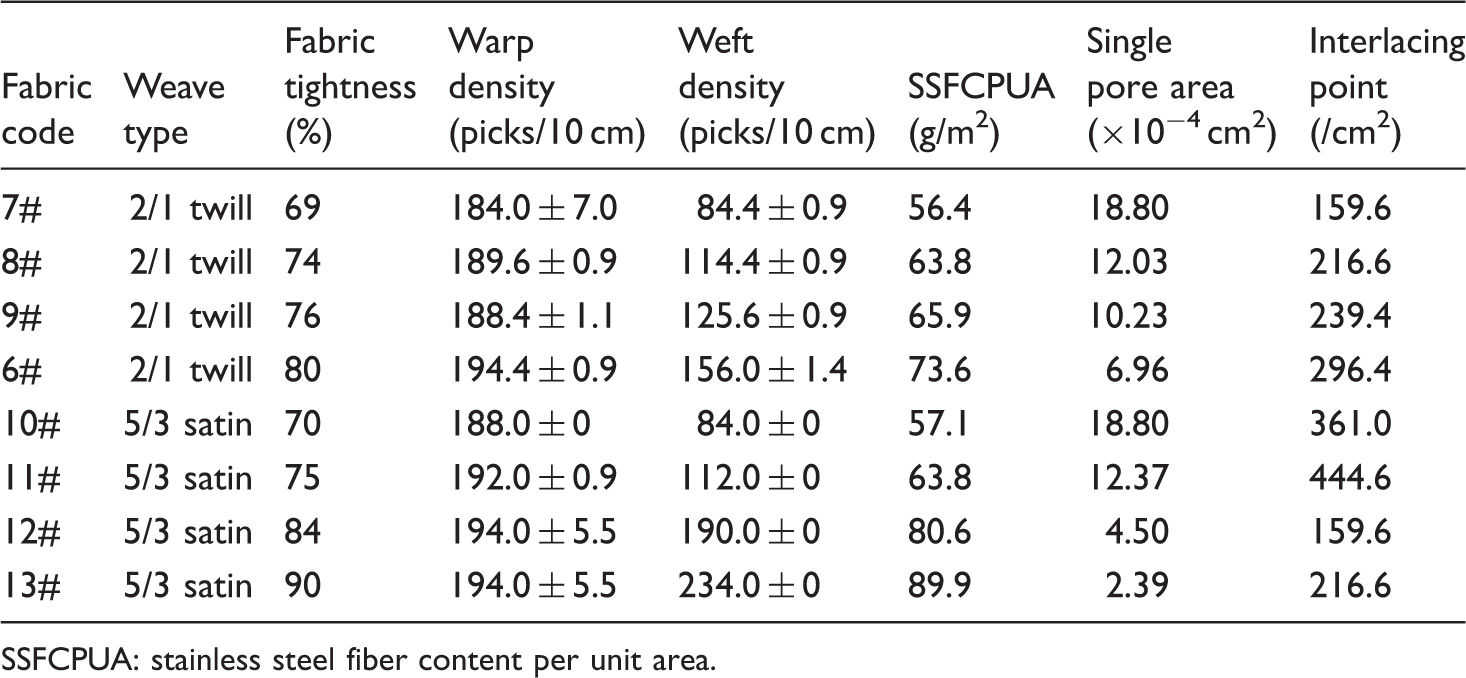
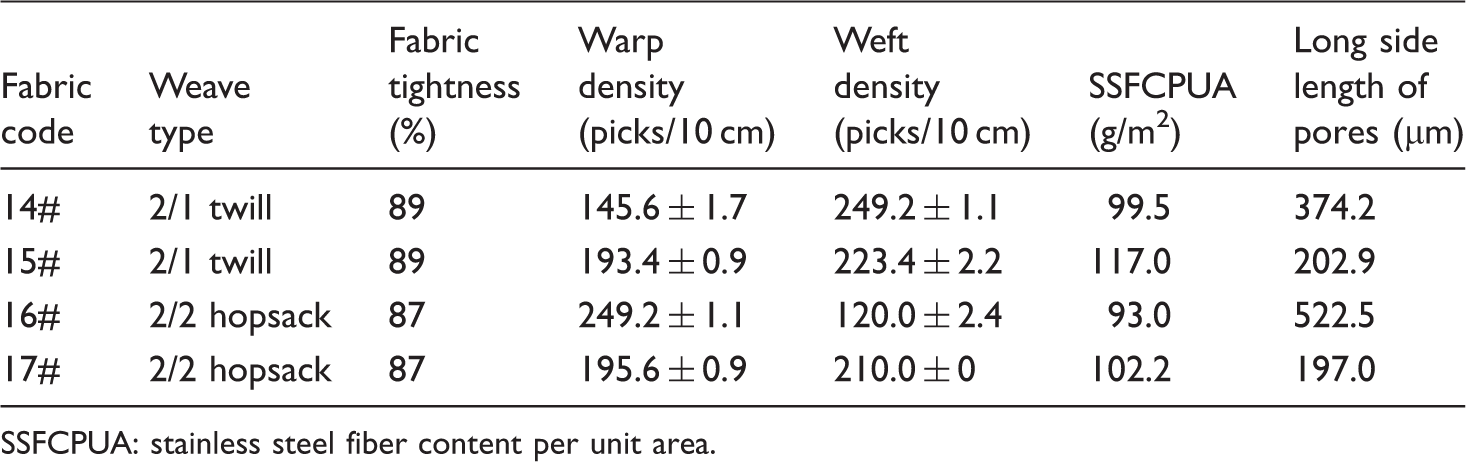


The measured values of the warp and weft density were slightly different from designed values, which was an unavoidable error in the experiment process. Considering the overall consistency of the results, other structural parameters were assumed to be consistent in the follow-up study of a certain factor. For example, the warp density values in Table 2 were regarded as 190 picks/10 cm to calculate other fabric parameters.
The surface resistivity (
The EMSE was measured using a shielding effectiveness test apparatus (DR-S02,China) which use the coaxial transmission line method for planar materials to determine EMSE of the fabric as per ASTM 4935-2010 standards. The experimental frequency range is 10–3000 MHz, which is the range of emission frequency of common radiation sources in daily life.
Results and discussion
In the beginning of the whole research work, control experiments were carried out using polyester/cotton blended fabrics. The EMSE values of fabrics were close to 0 dB, which indicated that the nonconductive background materials in the experiment do not have any impact on shielding properties.
Effect of SS fiber content on EMSE and mechanism analysis
Figure 2 presents the EMSE comparison of fabrics with different contents of SS fibers, all the results show that fabrics containing 30% SS fibers have higher EMSE values than that containing 25% SS fibers. The EMSE difference is between 0 and 5 dB.
The EMSE of fabrics with different SS fiber content: (a) the fabric tightness is 72%, (b) the fabric tightness is 76%, and (c) the fabric tightness is 80%. EMSE: electromagnetic shielding effectiveness.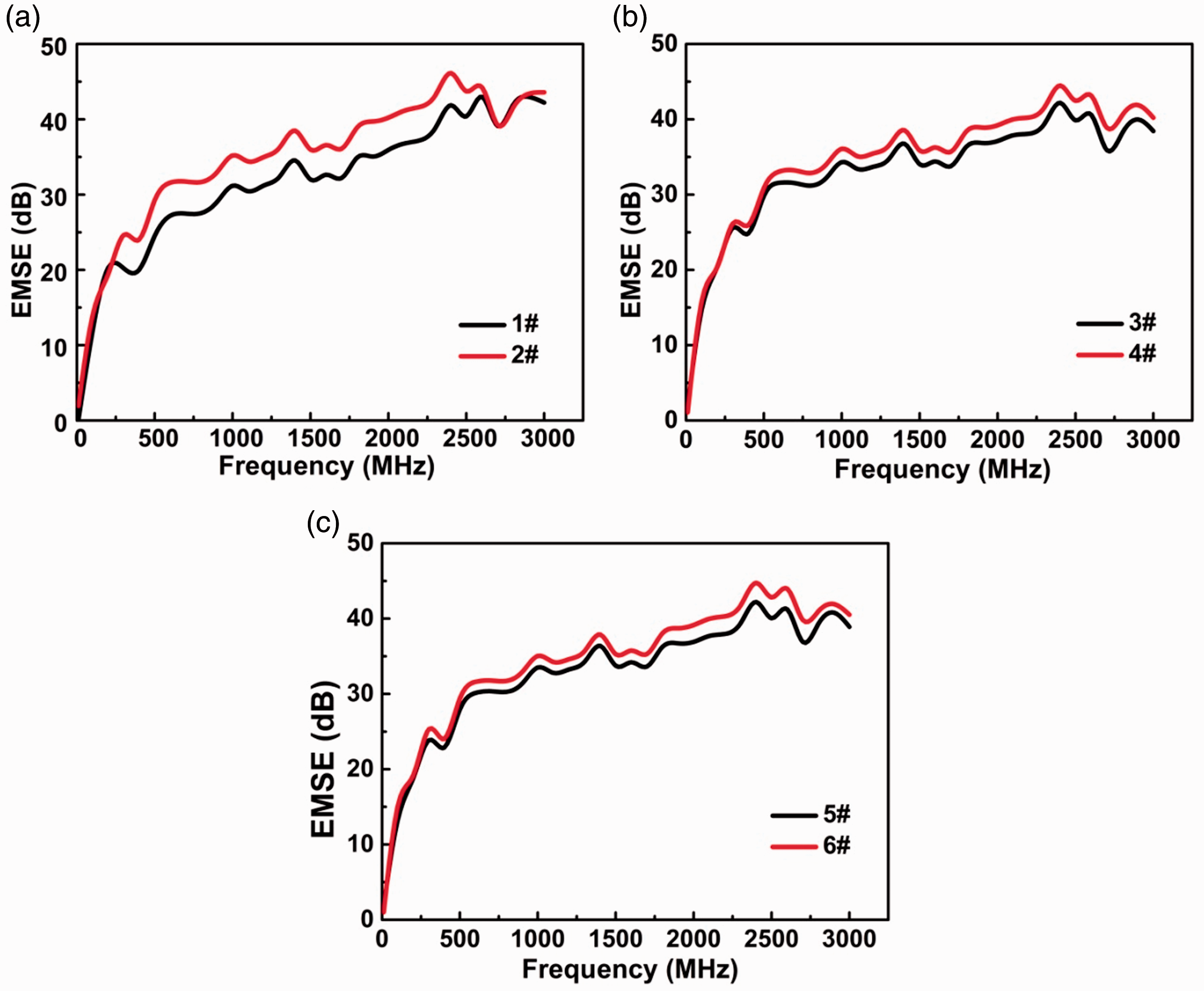
The result can be explained by EMS mechanism of ideal shielding materials. Usually, the propagation process of electromagnetic wave in fabric includes the attenuation through fabric and the leakage through holes. As shown in Figure 3, three attenuation processes determine the attenuation of electromagnetic wave: absorption loss (A), reflection attenuation (R), and multiple attenuation (B). The values of The process of electromagnetic wave attenuation in fabric.


The increase of
It is also observed from Figure 2 that the EMSE differences between fabric samples in Figure 2(a) are obvious compared to that in Figure 2(b) or (c), which indicates that when the tightness increases to a certain value, the effect of SS fiber content on EMSE becomes weak. The reason may be that the influence of SS fiber content on porosity and conductivity becomes weak.
Effect of tightness and warp–weft density on EMSE and mechanism analysis
In order to research the effect of tightness on shielding efficiency, the EMSE values of fabrics with different tightness (same warp density, different weft density) were compared. Figure 4(a) and (b) presents two sets of results that fabrics with higher tightness have higher EMSE in the frequency range of 10–2400 MHz, while there is no significant difference in the frequency range of 2400–3000 MHz.
The EMSE values of fabrics with different tightness. EMSE: electromagnetic shielding effectiveness.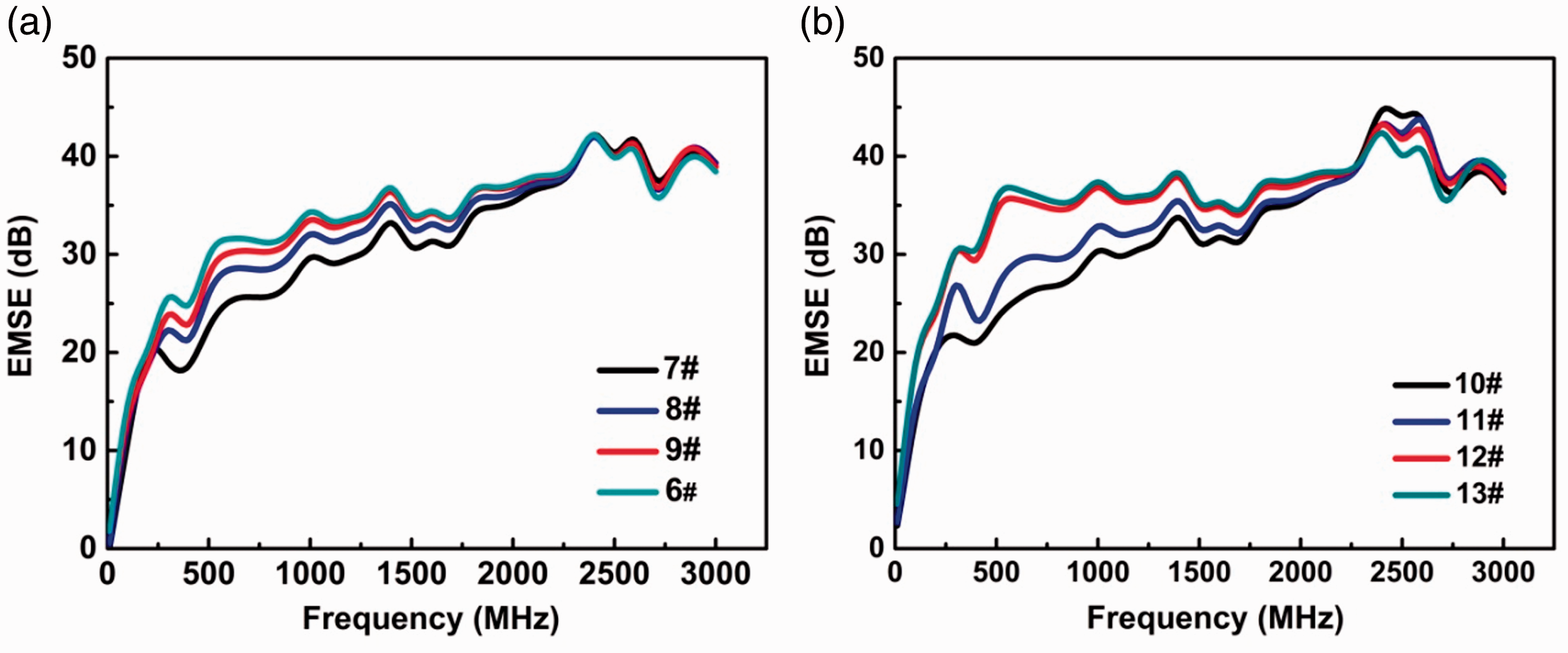
To study the effect of fabric tightness variation on EMSE, fabric surface structure, SSFCPUA, single pore area, and interlacing points were taken for analysis, as shown in Figures 5 and 6. Figure 5 shows the surface structure of fabrics with different tightness. Obviously, the structure of higher tightness fabric is tight, and it is difficult to observe obvious pores, which is confirmed by the linear decreasing relation between tightness and single pore area in Figure 6(a) and the linear increasing relation between tightness and interlacing point in Figure 6(b). In addition, Figure 6(a) shows a positive correlation between fabric tightness and SSFCPUA. Specifically, the higher the tightness is, the more the SSFCPUA is. On the whole, high-tightness fabrics are characterized by more compact structure, smaller pores, and higher SSFCPUA, leading to severe attenuation and less transmission to electromagnetic wave according to the EMS mechanism. As a consequence, the increase of fabric tightness, which is caused by the increase of weft density, leads to a positive correlation relationship between fabric tightness and EMSE.
Surface structures of fabrics with different tightness: (a) the fabric tightness is 70% and (b) the fabric tightness is 90%. Relationship between fabric tightness and fabric intrinsic parameters: (a) single pore area and SSFCPUA, (b) interlacing point. SSFCPUA: stainless steel fiber content per unit area.

Nevertheless, the results in Figure 4 show that EMSE of fabrics (6# and 13#) with high tightness is not the best at higher frequency. Meanwhile, when the tightness increases to a certain value, the effect of tightness on the EMSE becomes less obvious. The reason is that as the fabric tightness continues to increase, changes of pores become less obvious, which further leads to a small difference in the leakage of electromagnetic waves from pores at high frequencies.
Figure 7 shows the EMSE of fabrics with the same tightness and different warp–weft density at different frequency. It can be seen from the figure that fabrics (15# and 17#) with smaller difference values between the warp and weft density have higher EMSE. In order to explore the result, SSFCPUA and the long edge of pore were studied, as shown in Figure 8. Obviously, the smaller the difference values between the warp and weft density is, the higher the content of SSFCPUA is, and the smaller the long side of the pore is. Usually, higher SSFCPUA will lead to higher EMSE.
The EMSE of fabrics with different warp–weft density. EMSE: electromagnetic shielding effectiveness. Parameter comparison of fabrics with different warp–weft density. SSFCPUA: stainless steel fiber content per unit area.

On the other hand, the long side length of pore is also a reason for the increase of EMSE. Schulz et al. [25] and Perumalraj et al. [26] suggested that the more practical calculation formula that can be used to calculate the SE of perforated metal plate and metal mesh is as follows

The 

It is not difficult to see from equations (5) to (7) that the long side length of pore is closely related to the SE, which is also applicable to EMS fabrics. Specifically, the decrease of the difference values between the warp and weft density leads to the decrease of long side length of the pores, which further result in the increase of
Effect of SS blended yarns arrangement on EMSE and mechanism analysis
The EMSE values of fabrics with SS blended yarns arranged in one direction and both directions are given in Figure 9. It can be seen that EMSE values are significantly affected by the arrangement of SS blended yarns. Specifically, in the range of 200–3000 MHz, the EMSE values of fabrics (18#–20#) with SS blended yarns arranged only in one direction are much lower than that of fabrics (21#) with SS blended yarns arranged in both directions and even close to zero at some frequency point.
The EMSE of fabrics with different SS blended yarn arrangement. EMSE: electromagnetic shielding effectiveness.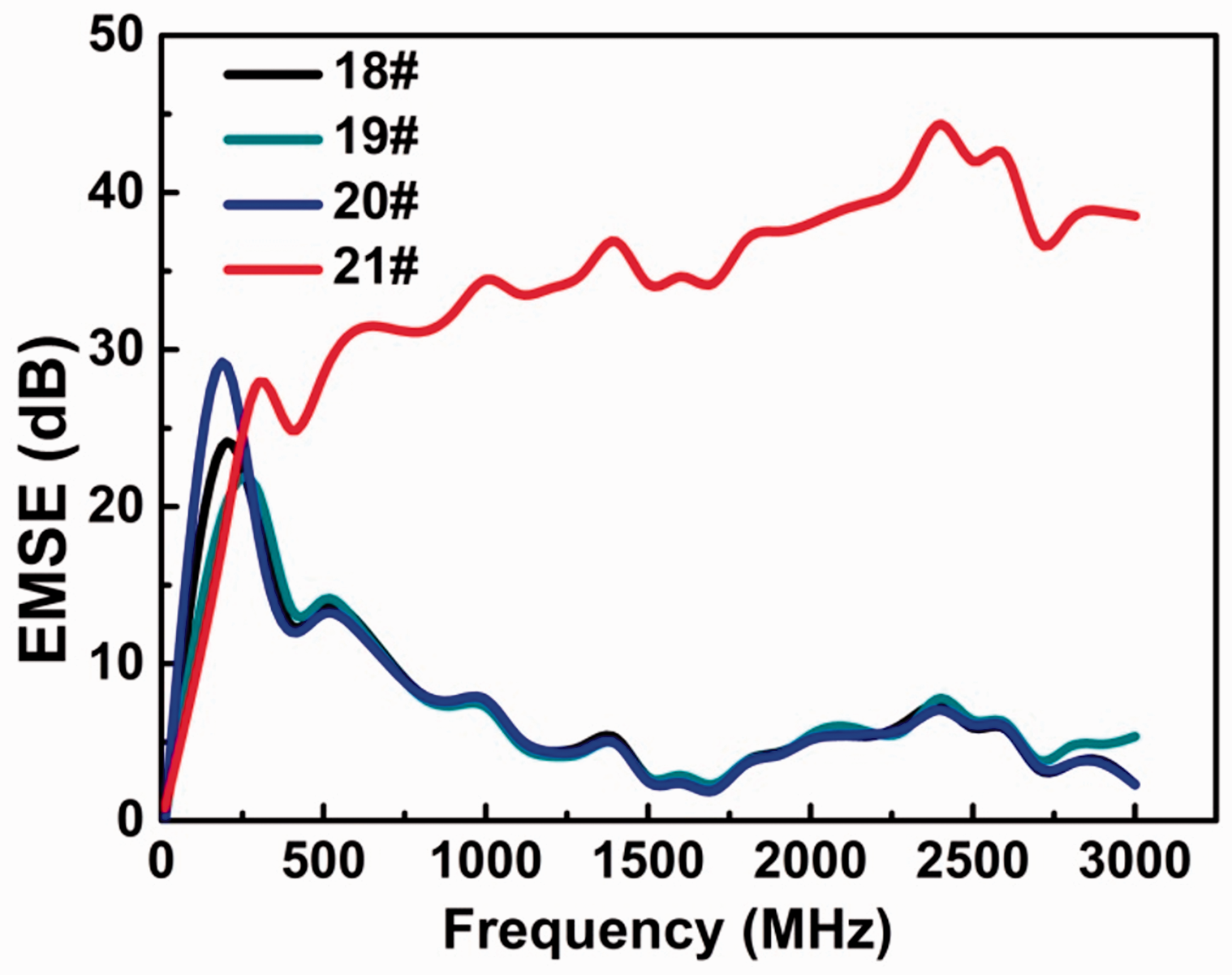
The result is mainly due to changes in pores. Figure 10(a) shows the surface structure of 20# fabric, Figure 10(b) shows a schematic cross section of the fabric when the ordinary purple yarn is deemed to be nonexistent. Obviously, although the fabric has a high tightness, there is a larger gap (diagonal area in Figure 10(b)) between the SS blended yarns due to the existence of flexural wave, as shown in Figure 10(b). In addition, since there are no interlacing points in the fabric, the diagonal area can be seen as a slit. In the case of the same area, the leakage of the slit is more serious than that of the pore and more serious as the frequency increases, thereby further causing the EMSE to decrease as the frequency increases and far lower than that of fabrics with SS yarns arranged in both directions.
The surface structure (a) and schematic cross section (b) of 20# fabric.
At the same time, Figure 9 also shows that there is no significant EMSE difference between fabrics 18#, 19#, and 20#, which indicates that the weave type has no significant influence on the EMSE of fabrics with SS blended yarns arranged in one direction. This is mainly due to the fact that when the ordinary yarns are considered to be absent, fabric structures are almost the same.
Effect of weave type on EMSE and mechanism analysis
Figure 11(a) to (c) shows the EMSE comparison between plain weave and twill weave fabrics in each experimental group, respectively. The result of Figure 11(a) shows that the EMSE of plain weave fabric is higher than that of twill fabric, and the maximum difference is about 4 dB. This is mainly because the plain fabric is tighter compared with the twill fabric due to the shorter float and more interlacing points. Tighter fabric means the contact pressure between yarns increases, which results in better electrical conductivity. Besides, coverage area is another reason. The tighter fabric also indicates yarn flattening degree and diameter coefficient. That is to say, in the case of the same fabric density, the actual coverage area of plain weave is higher than that of twill.
The EMSE of different weave types: (a) the fabric tightness is 77%, (b) the fabric tightness is 89%, and (c) the fabric tightness is 99%. EMSE: electromagnetic shielding effectiveness.
On the other hand, both the results in Figure 11(b) and (c) show that weaving type has no significant effect on EMSE due to the fact that when the tightness is high, the weave type has little effect on the covering area and conductivity of the fabric.
Effect of electromagnetic wave frequency on EMSE and mechanism analysis
Figure 12 shows EMSE values of all fabrics (except fabrics with SS blended yarn in one direction) at different frequencies, and the maximum difference between EMSE values is about 40 dB. Obviously, electromagnetic wave frequency has a significant influence on EMSE. In the frequency range of 10–2400 MHz, the trend lines of different fabrics are similar and generally show an increasing trend with the increase of frequency.
The EMSE of all fabrics at different frequency. EMSE: electromagnetic shielding effectiveness.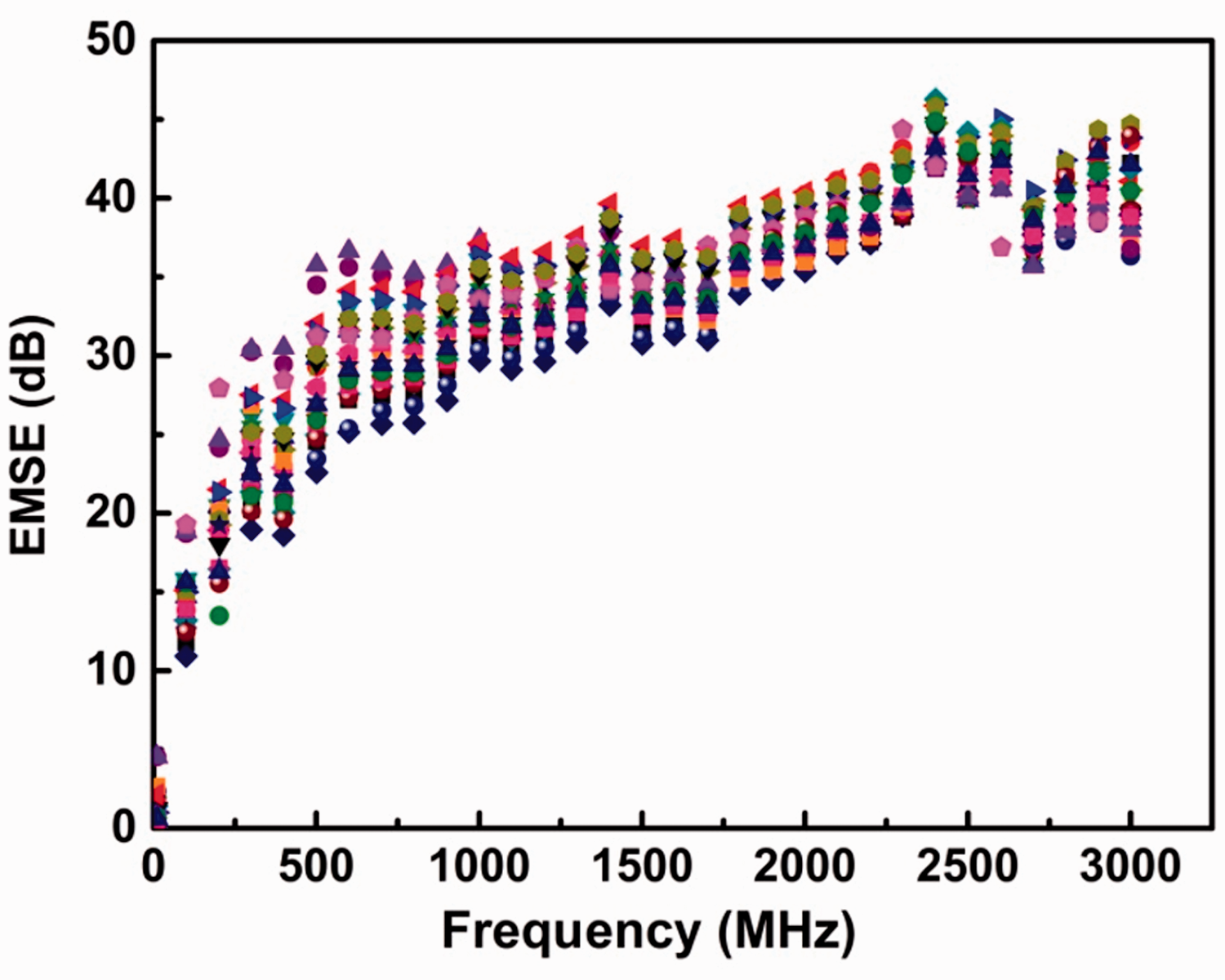
The trend can be explained by EMS mechanism. According to equations (2) and (3), with the increase of electromagnetic wave frequency, the reflection attenuation of electromagnetic wave decreases, while the absorption attenuation of electromagnetic wave increases. For the fabrics of this study, the increase of absorption attenuation is more significant than the decrease of reflection attenuation in above frequency range, which further leads to an increase in EMSE.
In order to study the quantitative relationship between frequency and EMSE, two fabrics were arbitrarily selected and Origin 9.0 was used to simulate the relationship between EMSE and frequency of the two fabrics. The simulation results show that both the regression equations conform to the equation The relationship between frequency and EMSE of any two fabrics. EMSE: electromagnetic shielding effectiveness.
Conclusion
Due to changes in conductivity and permeability, the EMSE values of fabrics containing 30% SS fibers are higher than that of fabrics containing 25% SS fibers. Moreover, because of the influence of pore parameters, the higher the fabric tightness, the smaller the EMSE difference caused by the content of SS fibers.
For fabrics with the same warp density and different tightness, the tightness is linearly dependent on pore parameters, SSFCPUA and interlacing points per unit area, so there is a positive relationship between tightness and EMSE within a certain degree of tightness. However, the higher the tightness is, the less obvious the advantage of EMSE is. For fabric with the same tightness and different warp–weft density, the fabric with smaller difference between warp density and weft density shows better EMS performance.
In the frequency range of 200–3000 MHz, the EMSE of fabric with SS blended yarns arranged only in one direction is much lower than that of fabric with SS blended yarns in both warp and weft directions and even close to zero at some frequency point. This is because narrow slits formed between SS yarns lead to a serious leakage of electromagnetic wave, when SS yarns arranged only in one direction.
The EMSE of plain weave fabric is better than twill weave fabric within a certain frequency range owing to the influence of fabric tightness and coverage area. However, there is no significant difference in EMSE values at relatively high frequency and tightness.
The effect of electromagnetic wave frequency on EMSE is significant. In the frequency range of 10–2400 MHz, the frequency and EMSE are in positive relation which can be approximately expressed as follows:
Footnotes
Declaration of conflicting interests
The author(s) declared no potential conflicts of interest with respect to the research, authorship, and/or publication of this article.
Funding
The author(s) disclosed receipt of the following financial support for the research, authorship, and/or publication of this article: This research was supported by the National Natural Science Foundation of China (Grant Number 61671489 and 61771500).