




Abstract
To ensure the thermal comfort during high physical activity, clothes must have good thermoregulation properties. Textiles containing ceramic additives, which are able to absorb and emit back the thermal energy from the human body, can be used to improve the thermal properties of the fabric. The aim of the research was to investigate the thermal and moisture management properties of different, three-layer knitted fabrics containing fibers impregnated with infrared-emitting ceramic particles. The thermal efficiency of the manufactured knits was characterised by the dynamics of accumulated/released heat generated by infrared rays and expressed as achieved steady-state surface temperature while and after the heating. Thermal resistance and liquid moisture management properties were investigated during the research as well. The elemental analysis of different pure bio-ceramic additives in yarns, used for development of knitted fabrics, was determined by X-ray fluorescence spectroscopy analysis. It was determined that heat accumulation is directly related to the calculated quantity of bio-ceramic additives in the knits. The obvious correlation between accumulated/released heat, thermal resistance, and the quantity of bio-ceramic additives in all investigated knitted structures was also investigated. Taking into account all the results obtained during the study of the thermoregulation properties, the optimal knitted structure, which could be comfortable for wearing next to the skin in cold weather, was selected.
Introduction
The most important functional purpose of the knitted fabrics, used for the high physical activity products and worn next to the skin, is to ensure wearing comfort by creating and maintaining a constant and pleasant microclimate on the skin surface independently from the environmental conditions. Thermophysiological comfort helps the body to retain heat balance while having rest or at various levels of physical activities. The thermoisolating properties of the fabric depend on the nature and structure of the fibers as well as on the amount of air content among the fibers and the ability to transport the moisture from the body to the outer layers of the clothing. In high physical activity, the thermoisolating fabrics have to be constantly dry [1–4].
Tao et al. [5] recorded FTIR (far infrared) spectra by Fourier transform infrared spectrometer in attenuated total reflection (A) mode from 400 to 4000 cm−1 for the polyamide (PA)-knitted fabrics made of circular fibers (common fabric) and triangular fibers (far infrared (FIR) fabric). It is noted that the overall absorption of the FIR fabric was significantly higher than that of the common fabric, the wavelength of 6–14 µm. In addition to identify the indirect assess of FTIR, the intuitive evaluation of infrared (IR) imaging with FLIR system was also applied. It revealed that the emissivity and absorptivity have the same variation trends under the equilibrium state, and thus the FIR fabric presented a relatively high temperature (38.27℃) in the thermal image.
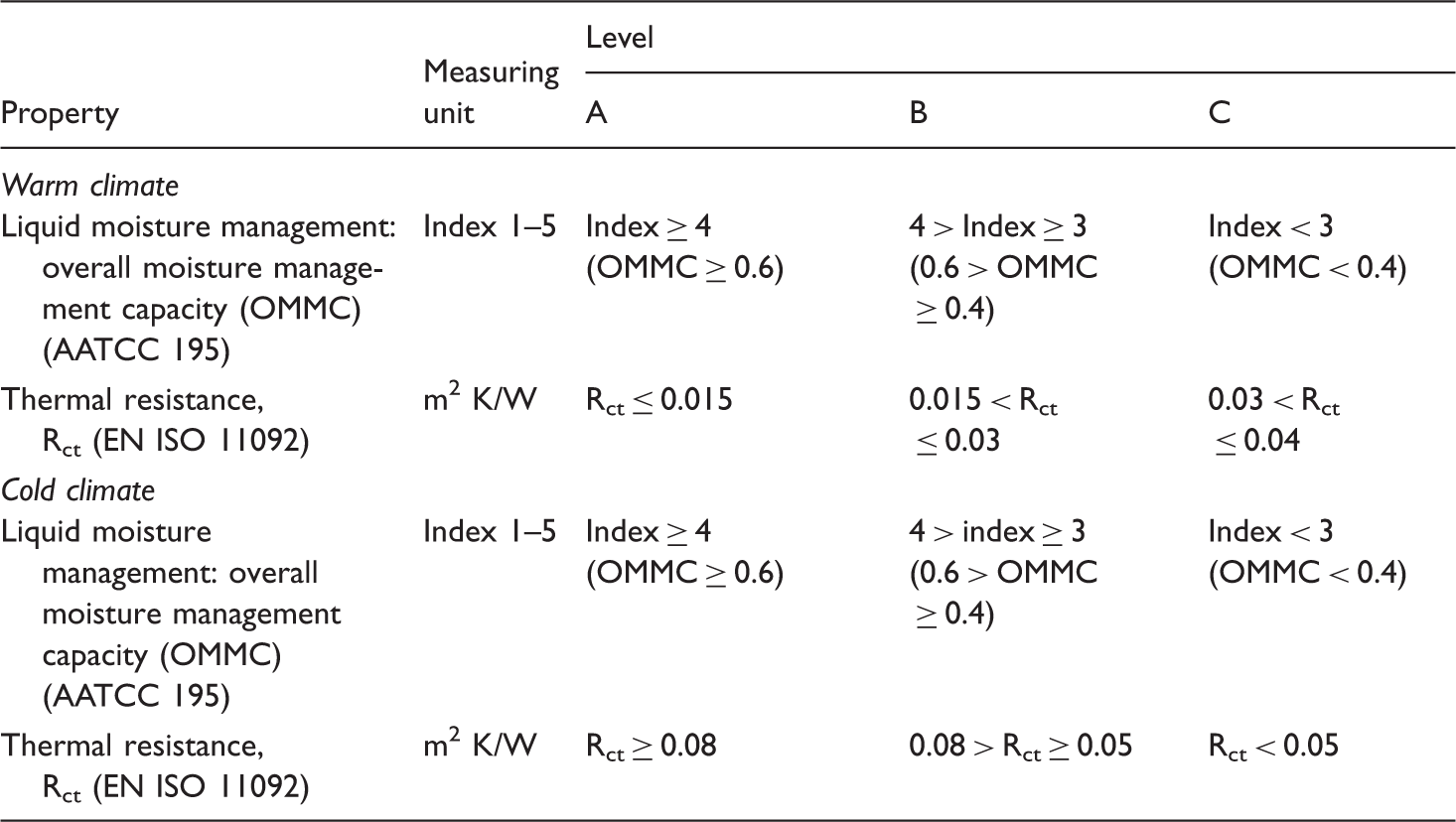
Levels of performance for materials contacting with the skin [6].
As it is already known, liquid moisture management and thermal properties of knitted fabrics are affected by the properties of the fiber and yarns, structure of the fabric, and the applied treatment [1–4]. Thermoregulating properties of textile knits can be further improved by providing them with some interactive functions; the increased self thermoregulation effect is created by the active response of the fabric to the changes of environmental or human skin's temperature. Fabrics with increased thermal efficiency are obtained by using special fibers with incorporated bio-ceramic additives that store IR radiation or by introducing these additives on the surface of the fabric by chemical modification applying different methods [7–9]. Such actively responsive smart fabrics have the ability to absorb and emit thermal energy. Clothing with better thermoregulatory properties is widely used for health, medicine, and sports (muscle warming during exercise) [10–15].
Materials used in Nanobionic® clothes, based on polyurethane (PU) loaded with mineral oxides (bio-ceramics) and coated on a microfiber, were studied by Voutetakis et al. [16]. The radiance of all prepared samples in IR wavelength (from 4 to 14 µm) with a spectrometer connected with an MCT/A detector was measured. The results have showed that all Nanobionic® samples had very high emissivity: between 95 and 99%, that is very near the emissivity of a standard black body at the same temperature.
Bio-ceramic is a mixture of non-toxic volcanic rocks compatible with the human body. Thermoreactive bio-ceramic additives—magnesium, zirconium and iron oxides, silicon carbide, germanium compounds, etc.—usually in the form of micro and nano-particles and acting on the principle of accumulation/release of IR radiation, are introduced in fabrics for the improvement of the thermoregulatory properties [17–19].
The influence of bio-ceramic additives, introduced into the structure of the material, for the thermal efficiency is based on their ability to absorb FIR rays from the human body as well as to retain and to radiate those rays back to the body, which results in a progressively increasing FIR radiation and determined intelligent behavior of these substances.
The most important part in creating the human heat is the FIR IR spectrum, namely, electromagnetic waves of 6–15 µm length. They have a unique positive effect for the human body, since it is approximately equivalent to the radiation of the human body itself (about 10 µm). For this reason, any external radiation of such wavelengths is accepted by the human body as its own. According to the literature source [20], FIR radiation (3–100 µm) is characterized by biological activity, and in the narrower range of 3–12 µm, it is also used for therapeutic purposes.
It has been determined that in the IR spectrum, only 8–12 µm FIR radiation emitted by heat can be received and delivered to the human body [21]. Penetrating deep into the body, the FIR rays from the light energy turn into warmth and make a unique positive effect to the body [22,23]. This effect is especially important for the stage of warm-up exercises for active people engaged in sports activities, which increases the efficiency of muscle work and reduces the possibility of injuries [14].
In Anderson et al. [24], authors used FTIR spectroscopy to assess the spectral optical properties of knitted textiles with different quantity of ceramic-bearing polymeric fibers. It was concluded that increased ceramic content in the knits results in decreased reflection and transmission of IR energy and increased absorption. Especially it was noticeable at wavelengths shorter than 6 µm. The authors stated that such modified textiles are able to absorb incoming radiation from the sun in the near-IR region and emit IR energy at longer wavelengths.
In order to improve the thermophysiological properties of textile materials, researchers [19,21] used the lamination method, where FIR additives were incorporated into breathable hydrophilic PU films and then coated on a surface of textile.
Kubiliene et al. [9] studied thermoregulatory process of ceramic-containing knits. Ceramic additives were applied on the surface of PET-knitted fabrics by screen printing and impregnation. They kept specimens in an oven with constant temperature, then placed on a cold surface and periodically, with a thermal imaging camera InfraCam, and recorded the decrease of temperature. Authors concluded that the highest heat accumulation was received in screen-printed fabric with continuous coating and the lowest in PET fabric knitted from yarns containing bio-ceramics. Therefore, the advantage of textile fabrics, from fibers, impregnated with FIR emitting ceramic particles, in comparison with coated FIR materials, is that they have permanent heat accumulation/release properties. Ceramic pores can be blocked by dirt and sweat, but repeated washing can damage the ceramic layers and limit their functions. The greatest limitation of current FIR textile products and technologies is the amount of FIR-active material that can be incorporated into the fiber and the level of FIR that can therefore be directed back to the body [25].
Despite a variety of different heat generation measuring methods, the standardised method was not detected. However, test methods used for the evaluation of the performance of FIR textile can be divided into [26]:
1. FIR characteristics:
a) FIR spectral emissivity—determined with IR spectrophotometer and standard black body; b) Re-radiation characteristics—measured with 45° parallel radiation equipment; 2. Temperature characteristics:
a) Skin temperature—obtained with thermo graph, thermal imager.
The aim of this research is to investigate the main thermoregulation properties of different three-layer ceramic-containing knitted fabrics and to select the optimal one, with improved thermal efficiency, knitted structure, to be primarily worn next to the skin.
Materials and methods
The following yarns with FIR-containing bio-ceramic additives have been selected for the design and development of knitted fabrics with high thermal efficiency:
19.7 tex polyethylenterephtalate (PET) spun yarns Resistex® Bioceramic (manufacturer—Tecnofilati S.r.l., Italy); 29.4 tex PET spun yarns Mirawave® (manufacturer of fibers with bioceramic additives—HUVIS, Korea; producer of yarns—Predilnica Litija d.o.o., Slovenia); 7.8 × 2 tex PA 6.6 textured microfiber filament yarns Nilit® Innergy (manufacturer—Nilit Ltd., Israel).
The control fabric, from regular PET fibers of 20 tex (manufacturer of fibers—PT Asia Pacific Fibers Tbk., Indonesia; producer of yarns—PT Kewalram Indonesia, Indonesia), was produced for comparison of heat accumulation/release data with results of other fabrics.
For the manufacturing of knits, 7.8/34f polybutilentereftalate (PBT) textured yarns (manufacturer of fibers and yarns—ANTEX, Spain) and 20 tex viscose (CV) spun yarns (manufacturer—Aditya Birla Group, India) were used as well.
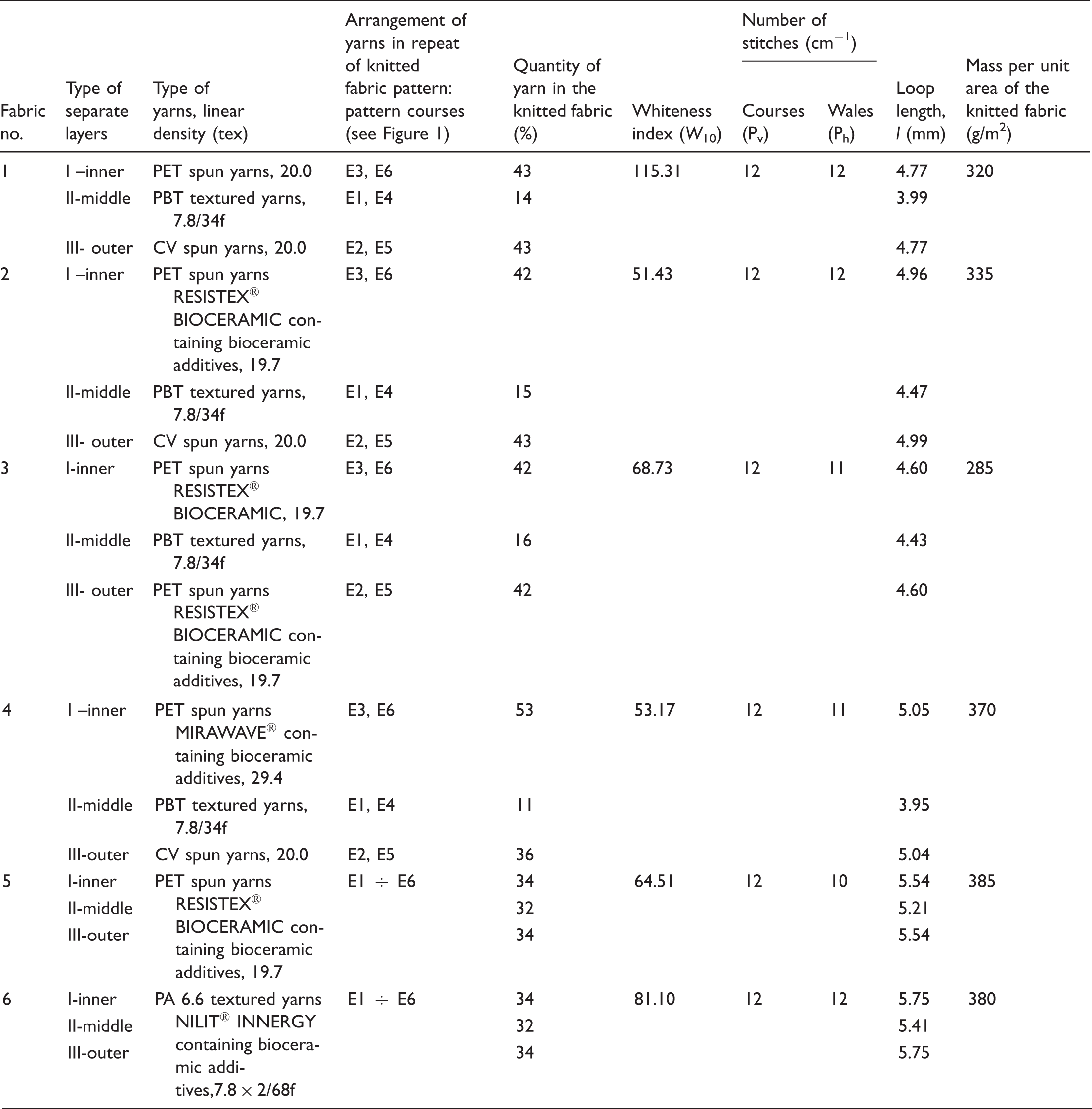
Three-layered fabrics, used in the research, were knitted in a combined pattern on the circular interlock knitting machine of gauge 20E. The structure of knits is presented in Figure 1. After knitting fabrics were washed according to standard EN ISO 6330, using washing procedure 4M (mild wash, at temperature 40℃) with anionic active preparation centrifuged and dried in a free state. The mass per unit area of knitted fabrics was determined according to standard EN 12127, and the number of stitches per unit length and unit area were calculated according to EN 14971 standard. Loop length was determined according to standard EN 14970. As the thermal absorption of textile materials depends on the intensity of the colour, the index of whiteness of the knits was determined according to the standard EN ISO 105-J02. The assessment was done with spectrophotometer Spectraflash SF 450 (Datacolor AG, Switzerland), with measuring diapason 360–700 nm and a light source D65/10°. The main parameters of knitted fabrics are presented in Table 2.
The combined pattern of the investigated three layer weft-knitted fabrics. The main characteristics of knitted fabrics.
The evaluation of the thermal effect generated by materials with bio-ceramic particles, acting on the IR radiation principle, is based on the original methodology for estimating the heat accumulation/release ability with changing ambient temperature. The specimen is placed on a flat-surface plate from polystyrene foam with a face side to an intensive source of heat energy (IR emitting lamp: power 250 W, λ = 0.5–3 µm; distance between the specimen and the heat source was 25 cm; room temperature 20 ± 0.5℃). When the lamp was switched on, the thermal image of the specimen was captured on the screen every 15 s for 4 min (240 s) by the thermal camera Infra CamTM (FLIR® Systems, Sweden; the spectral range of EM waves 7.5–13 µm, emission factor 0.95). When the lamp was turned off and the specimen started to cool down, the thermal image of the specimen was continued to capture every 15 s for 4 min (240 s) on the thermovision display as well.
Flir Reporter 9.0 software was used to process the received data. Five measurements were made on the hottest area of each specimen, and average point temperature of the specimen was calculated. The variation coefficients of temperature values did not exceed 5%. The general view of the equipment used is shown in Figure 2.
General (a) and schematic (b) view of the thermal imaging of IR simulation testing equipment: (1) IR irradiation source lamp (250 W, 240 V, λ = 500–3000 nm), (2) specimen of knitted fabric structure, (3) thermal insulating expanded polystyrene (EPS) plate, (4) thermal imaging camera Infra Cam™ with special software.
Identification of quantitative composition of IR radiant ceramic particles containing matrices in PET and PA 6.6 fiber was performed applying XRF spectroscopy. The elemental analysis of pure bio-ceramic additives was carried out by Bruker X-ray S8 Tiger WD spectrometer: Rh tube was used, anode voltage Ua—60 kV, and current strength (I)—130 mA. The measurement was performed using He atmosphere according to the SPECTRA Plus QUANT EXPRESS method.
The morphological investigation of knitted fabrics with incorporated ceramic particles was carried out with scanning electron microscopy (SEM) Helios Nanolab 650 (“FEI,” Holland).
Thermal resistance was measured under steady-state conditions using hot plate method according to standard EN ISO 11092, where the temperature of a hot plate was 35℃, and air temperature in the camera was 20℃ (standard atmospheric conditions—65% R.H and 20℃).
Moisture management parameters of manufactured fabrics were determined according to AATCC 195 standard. Testing and conditioning of specimens was carried out in standard atmospheric conditions. Five specimens with dimensions of 8 × 8 cm were prepared for each type of fabric, and an arithmetic value was presented as a result. The coefficients of variation values of the tested parameters did not exceed 6%.
For the determination of moisture transport capabilities of liquid in all directions and distribution properties of knitted samples, a Moisture Management Test (MMT) device, model M290 (“SDL Atlas,” USA) was used (see Figure 3). The tested material was placed between two horizontal electric sensors. In this study, the inner layer of the knitted fabric, which is in direct contact with the human skin during wearing, is always the top surface (facing the top sensor) when the sample is tested.
Moisture management tester, model M290, SDL Atlas: (a) view of a device and (b) schematic view of equipment during testing [27].
According to AATCC Test Method 195, the indices are graded and converted from value to grade based on a five-grade scale. According to the grading (see Table 3), fabrics are divided into:
waterproof; water-repellent; slow absorbing and slow drying; fast absorbing and slow drying; fast absorbing and quick drying; readily water permeable; Grading of indices (AATCC 195) according MMT.

Results and discussion
In the present study, it was attempted to investigate thermal and moisture management properties of the different knitted fabrics and according to a complex assessment of all thermoregulation characteristics to select the optimal structure for the fabric contacting with the skin. Moreover, the dependences of the thermoregulation parameters on the calculated content of main bio-ceramic additives in knitted fabric structures were investigated.
It is generally known that dark colour textile absorbs all the light and heat radiation, while the white reflects the IR radiation and remains cooler than the dark ones. In order to evaluate the whiteness of the fabrics, the whiteness index was determined for all the fabrics. It was revealed that the control fabric was the whitest of all tested fabrics (W10 = 115). The fabric No. 6 had a whiteness index of 81 (see Table 2). The colour of other knitted fabrics was very similar, W10 varied between 51 and 68.
XRF element analysis of bio-ceramic additives.

The results of XRF showed that PET RESISTEX® BIOCERAMIC yarns had the largest quantity of bio-ceramic additives, and the biggest part of it was composed of titanium and zinc particles (see Table 4). Zinc particles were also detected in other tested yarns, but in smaller amounts, while titanium was found only in this one. The quantity of other bio-ceramic additives in RESISTEX® BIOCERAMIC yarns composed less than 1%. The content of bio-ceramic particles in PET MIRAWAVE® and PA 6.6 NILIT® INNERGY was very similar, and the total amount of additives was approximately the same—about 1%. The main bio-ceramics, identified in both types of yarns, were silicon and stibium (see Table 4).
The calculated quantity of main bio-ceramic additives found in knitted fabric structures.

The data presented in Table 5 show the distribution of total mass of the main bio-ceramic additives calculated in 1 m2 of the knitted fabric. As it was expected, the results have showed that the biggest quantity of bioceramic additives was in fabric No. 5 (20.5 g/m2), because it was manufactured from RESISTEX® BIOCERAMIC yarns—with the biggest amount of ceramics. The smallest amount of ceramics was found in fabric No. 4—less than 2 g/m2. In later investigations, it was determined that the quantity of ceramics in the fabric is very important for the thermal properties. Thermal efficiency evaluation data of the manufactured knitted fabrics, obtained by using an IR light emitting 250 W lamp and a thermal camera for visualizing the distribution of the intensity of the IR radiation, are shown in Figures 4 and 5. Thermograms with measured highest temperatures of the knitted fabrics, recorded with thermal imaging camera, are presented in Figure 6.
Dynamic curves of accumulated/released heat, generated by IR rays, in knitted fabrics (before and after IR irradiation by exposure with 250 W IR lamp). Rate of heat absorption of knitted fabrics (by exposure with 250 W IR lamp) and heat retention after irradiation (by cooling). Thermograms with measured temperatures of all investigated knitted fabrics, recorded with thermal imaging camera (IR exposure time t = 240 s).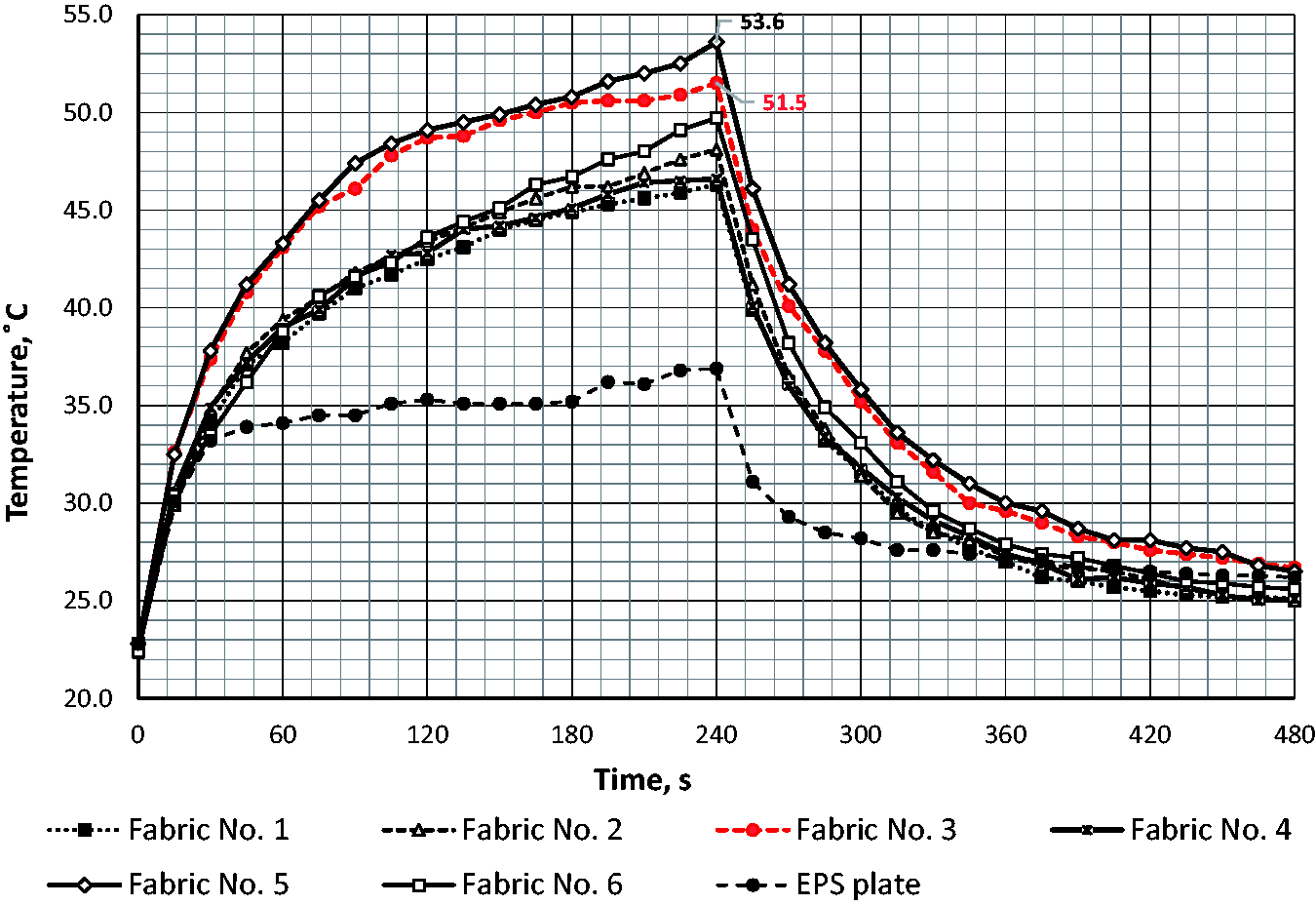
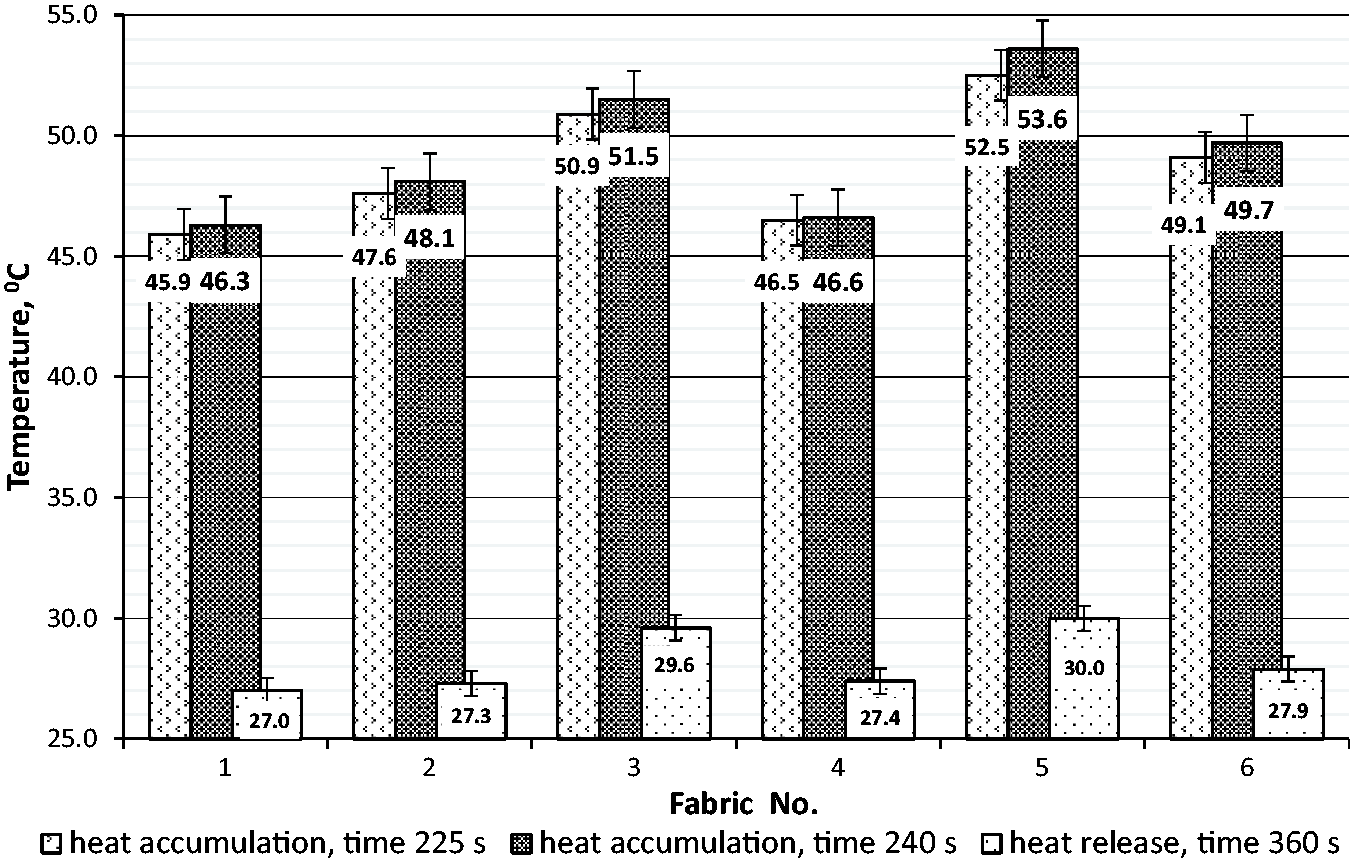

After comparing the warming temperatures of the knitted fabrics with ceramic additives inserted in the inner layer of the fabric No. 2 and No. 4 (48.1 and 46.6℃, respectively) with the analogous control fabric (without bio-ceramic additives) No. 1 (warming temperature 46.3℃), it can be stated that better heat accumulation/release abilities were distinguished in fabric No. 2—manufactured using Resistex® Bioceramic yarns (see Figures 4 to 6). Meanwhile, the Mirawave® yarns, which formed the inner layer of fabric No. 4 with a similar structure, did not significantly increase the thermal effect. All these tests have revealed that IR radiation penetrability energy transmission to heat occurred purely from light energy. The research also showed that the dynamics of the accumulated/released heat of the knitted fabrics depends not only on the amount of ceramic additives in the inner layer contacting directly with the skin. Mainly, it depends on the total quantity of ceramic additives in the fabric. The highest IR rays absorbing and retaining values (warming temperature 53.6℃) were determined in fabric No. 5, in which all three layers were composed from Resistex® Bioceramic yarns. The highest quantity of bio-ceramic additives—20.521% (see Table 4), was determined in this fabric. The main prevailing elements incorporated into the fiber were: Ti, Zn, Zr, Si, Fe, and Ca. The thermal behavior of the tested knitted fabrics with bio-ceramic additives may be explained according to Kirchhoff's law; emissivity and absorptivity have the same variation trend under the thermal equilibrium state. Following it, the fabrics with bio-ceramic additives under IR radiation displayed relatively high temperature values (see Figure 6). Similar conclusions were made by Tao et al. [5].
The thermal behavior and optical properties of fabrics with added ceramics were investigated by Anderson et al. [24]. They state that optical properties in the near IR wavelengths are of interest due to the interactions with radiation for hotter sources. The fabrics-containing ceramic additives have distinguished decreased reflectance and transmittance and increased absorptance, if compared to the control fabric without ceramics. It was also determined that the impact of quantity of the ceramic particles is more significant in the near IR range than in the mid IR.
A general view with a morphological SEM of PET spun yarn RESISTEX® BIOCERAMIC, fabric No. 5 is shown in Figure 7. These yarns have an illustrative character because of the biggest quantity of bio-ceramics in it. The microscopical images of yarns (Mirawave® and Nilit® Innergy) were found very similar to the presented one, but as the quantity of ceramic particles in yarns was lower, the separate photos were not presented. Different magnification imagery show bumps and irregularities on the surface of the PET fibers that can be attributed to particles of polymer dispersed ceramic additives.
SEM micrographs of knitted fabric No. 5, original magnification: (a) 2000×; and (b) 20,000×.
The results of accumulated heat and retention induced by IR stimulation in ceramic-containing knitted fabrics are also presented in Figures 8 and 9. The linear dependencies of quantity of bioceramic additives to accumulated heat and heat retention temperatures were determined after analysis of received research results. The coefficients of determination (R2) were 0.8679 and 0.8144, respectively (see Figures 8 and 9). The dependences between quantities of incorporated bio-ceramic additives and achieved temperature values, before and after IR stimulation, showed very strong positive correlation (correlation coefficients 0.9316 and 0.9024, respectively).
Relationship between quantity of bio-ceramic additives and accumulated heat (IR exposure time 240 s). Relationship between quantity of bio-ceramics additives and heat retention (time 360 s).

The measurements of thermal resistance (Rct) determined in all investigated ceramic-containing knitted fabrics according to the standard EN ISO 11092 are presented in Figure 10.
Thermal resistance of knitted fabric with different content and quantity of bio-ceramics additives.
As it is shown in Figure 10, the thermal resistance of investigated fabrics varied from 0.041 to 0.068 m2K/W. Therefore, while classifying thermoregulatory properties, according to the standard CEN/TR 16422 (see Table 1), it was determined that fabrics, manufactured for this research, are suitable to use in cold weather. Ceramic-containing knitted fabrics, which are in contact with the skin, according to Rct parameters, correspond to B (good) and C (medium) performance levels of the classification.
The best thermal resistance was characterized in knitted fabrics No. 3 and 5, which also had the highest IR rays absorbing and retaining capabilities (see Figures 4 and 5).
The analysis of the research results showed that thermal resistance depends on the calculated quantity of bio-ceramic additives in different knitted structures. Figure 11 displays the existing strong positive linear correlation between quantity of bio-ceramic additives and thermal resistance. The coefficient of this dependence (R2) is 0.8144, and correlation coefficient is 0.9024.
Relationship between quantity of bio-ceramics additives and thermal resistance.
Average values and levels of moisture management indices of ceramic-containing knitted fabric structures.
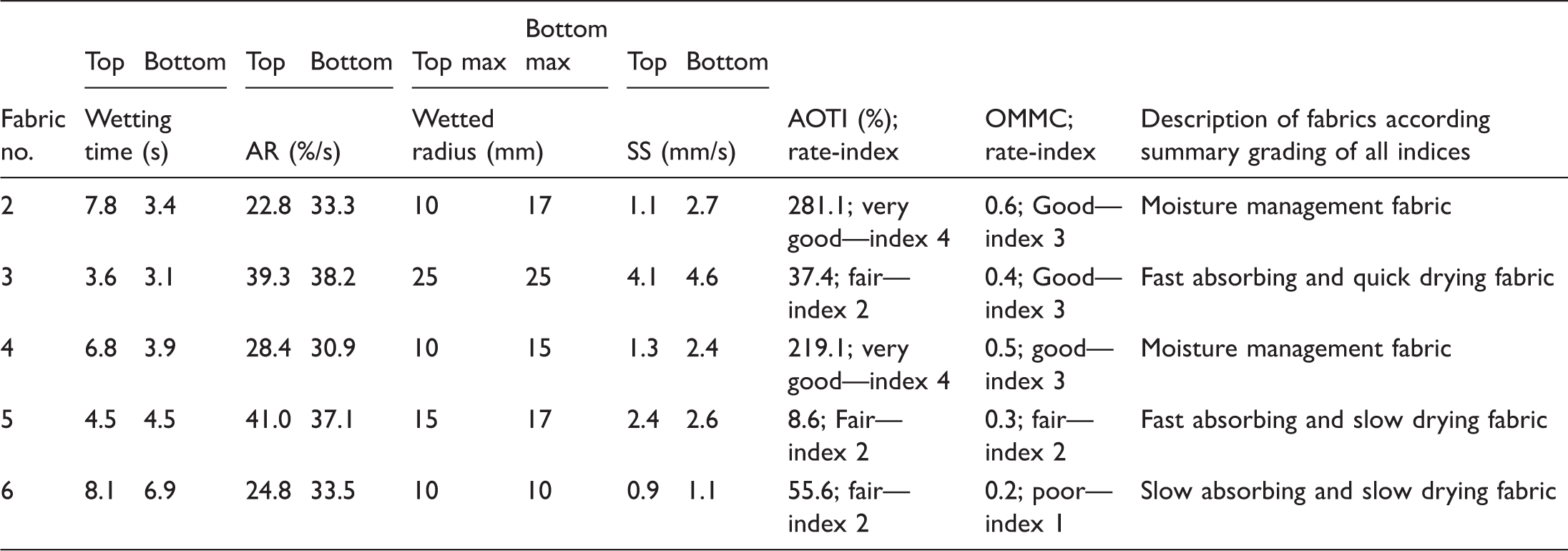
Summary of the main thermoregulatory properties of fabrics with incorporated ceramic additives.

According to the data presented in Table 7, it can be concluded that for intensive physical activity, the optimal solution would be to use knitted fabric No. 3, with OMMC value of 0.4254. The calculated quantity of bio-ceramic additives in this fabric was 12.76 g/m2 (see Table 5). The liquid moisture management capacity of this fabric can as well be graded as “good.” It can be qualified as “Fast absorbing and quick drying” fabric; when IR rays lamp is involved, it warms up till 51.5℃. The typical measuring curves of water content via time and an image of water spread in the fabric No. 3, derived from MMT 290 tester, are presented in Figure 12. According to the recommendations of the standard CEN/TR 16422 (see Table 1 for OMMC (index 3)) and the thermal resistance value (Rct = 0.066 m2K/W), the knitted fabric No. 3 corresponds to B (good) classification level, suitable for cold weather conditions.
Measuring curves of water content versus time (a) and diagram of water spread in the fabric No. 3 (back side of fabric is on the left and marked as “TOP (Inner)”; face side of fabric is on the right and marked as “BOTTOM (Outer)”).
Conclusions
The main thermoregulation properties of different structure ceramic-containing knitted fabrics were analyzed. The values of whiteness index, measured in tested fabrics, allowed comparing the results of thermal properties, because the W10 was very similar in knits with bio-ceramic additives. Examinations of dynamic curves of IR rays of accumulated/released heat of fabrics before and after IR irradiation have showed that heat accumulation is directly related to the quantity of bio-ceramic additives and composition in different knitting structures. The dynamic thermal IR rays absorbing/releasing capabilities of knitted fabrics depend not only on the amount of bio-ceramic additives in the inner layer, which is directly contacting the skin, but also on the total quantity of ceramic additives present in the fabric. The highest thermal efficiency values (maximum heating temperature—53.6℃) was determined in knitted fabric No. 5 in which all three layers were composed of PET spun yarns with incorporated bio-ceramic additives, and the total quantity of ceramic particles was the biggest. The main prevailing bio-ceramic elements were Ti, Zn, Zr, Si, Fe, and Ca. Also, the strong positive correlations between accumulated/released heat also thermal resistances with the quantity of bio-ceramic additives in all investigated knits were determined. With increased quantity of bioceramic additives in the fabrics, temperature parameters of accumulated/released heat and values of thermal resistance had increased as well. This is because bio-ceramic additives in knits absorb heat when exposed by IR rays and release it when the IR source is turned off. The IR radiation penetrability energy transmission on heat occurred purely from light energy.
The analysis of the results showed that thermal resistance as well as heat accumulation/release properties depend on the calculated quantity of bio-ceramic additives in different knitted structures. Fabrics No. 3 and 5, with the highest content of bio-ceramic additives, also had the highest thermal resistance values. The best moisture management results were obtained for fabrics No. 2 and 4 (OMMC values 0.6 and 0.5, respectively), where hydrophilic CV spun yarns were interlaced in the outer layer of fabric. To conclude, bio-ceramic additives did not have any or no obvious influence on the moisture management properties of the investigated fabrics. Nevertheless, according to all the characteristics of the main thermoregulatory properties of ceramic-containing knitted fabrics, it was determined that the optimal solution for high physical activity clothing wearied next to the skin is to use “Fast absorbing and quick drying” knitted fabric No. 3, which under the exposure of the IR irradiation achieved heating temperature 51.5℃. In reference to the standard CEN/TR 16422, according to the OMMC index and thermal resistance values, this knitted fabric corresponds to B (good) performance level of skin contacting materials to be worn in cold weather.
Footnotes
Declaration of conflicting interests
The author(s) declared no potential conflicts of interest with respect to the research, authorship, and/or publication of this article.
Funding
The author(s) disclosed receipt of the following financial support for the research, authorship, and/or publication of this article: The research has been supported by a grant (No. TEC-04/2015) from the Research Council of Lithuania.