




Abstract
There are several types of sound absorptive materials, such as natural and synthetic fibers, acoustic mineral wool, acoustic polyester panels, acoustic foam, cotton batts, that reduce the acoustic energy of a sound wave as the wave passes through. In this work, the use of nonwoven materials made of cotton, polyester, and polypropylene fibers for the development of sound absorptive nonwoven materials has been investigated. Samples of different materials (cotton, cotton/polyester blend, polyester fibers needle punched, and polypropylene melt blown nonwoven) and multilayer structures were tested on the designed impedance tube. Acoustic absorption properties of the fiber assemblies were studied in the frequency region of 100–1500 Hz. The values of sound absorption coefficient for different samples indicated that polypropylene microfiber melt blown nonwoven sample displayed a good sound absorption behavior in the entire frequency range. The use of multilayer samples improves the sound absorption coefficient with the condition that one of the layers is a thin melt blown nonwoven layer. The formation of nonwoven absorbent material consisted of hybrid layers, significantly reduces the resultant average sound absorption coefficient, especially when the upper layer is made from finer fibers of melt blown nonwoven of low air permeability value, and in this case the improvement reaches 50%. The use of melt blown layers of fine fibers values of noise reduction coefficient may reach 0.8. The multilayer nonwoven sound absorber design should take into consideration specific noise reduction coefficient values, not the absolute ones, particularly when the weight of the absorber is playing a decisive role.
Introduction
There has been a constant increase in the human-made noise level due to the growth of the transportation vehicles, highways noise, airports in most of the cities, etc. America's cities acoustical monitoring illustrates map which indicates that the magnitude noise levels average is 50–60 dB [1]. In the industrial areas, the sound level upsurges to 90 dB which can lead to health problems. The improvement is very desirable for reducing noise in the daily life through decreasing the noise emission at the source and increasing the noise damping. The sound propagation of new sound absorbent materials has been widely investigated and found to be directly influenced by the material elastic parameters [2,3]. The fabric is a complicated structure, because the sonic wave will propagate differently than in the case of solid isotropic material, besides the creep effect [4]. Many parameters have been introduced to describe the physics of sound propagation of textile materials, and often each parameter requires a different model. The fibrous structures are of wide range of the variables, either in fibers type or method of their manufacturing and application. Several varieties of fibers are used for the manufacturing of textile noise absorbers. The textile fibers may be used in traditional fabric form or nonwoven, and in random form, as a mat. Sound absorbent material may consist of a single layer or multilayers, made of the same fibers or hybrid fibers, depending on the end use. In some cases, fiber waste appears to be a good source for a sound absorber. Nonwovens possess an excellent sound absorption at the medium and high frequency [5–7].
The sound absorbing materials convert sound energy to the thermal energy when the sound wave strikes the fibers assembly. It was revealed, that the fibrous materials have a good affinity to absorb the sound energy. The porous material can reduce the acoustic energy of a sound wave as the wave passes through its pores that have various shapes and sizes [8–12]. The ability of a material to resist the flow of sound energy through its structure (sound insulation) is largely determined by its mass. Heavy materials stop more noise passing through than the light materials. For any impermeable material, there will be an increase in its noise stopping ability of approximately 6 dB for every doubling of mass per unit area [13]. The density of a material is often a significant factor governing its sound absorption qualities. The investigation of fabric density indicated that the increase in sample's areal density causes an increase in sound absorption at medium and high-frequency regions due to the increase in the number of fibers per unit area. As a result, the energy loss of sound waves increases because of the growth of surface friction, which leads to the enhancement in sound absorption performance [14,15]. However, the increase of material density does not always give the appropriate solution; there is the quest of the designs of the light fibrous structures with high sound absorption coefficient using natural or synthetic fibers, in fiber form or as the particles. For instance, the application of Hemp particles in the concrete affects the sound coefficient of material [16] due to the increase of the concrete porosity.
Several researchers investigated the effect of the pores shape and size, tortuosity airflow resistance, and the type of a material on the sound absorption. The pore size and pore shape are main parameters that affect the sound absorption. The pore diameter depends on the fiber's diameter and the distribution of the fibers in each layer as well as fibers orientation. The presence of pore surface will increase the sound absorption coefficient of a material, depending on the pore's diameter and distribution. The sound absorption coefficient increases with an increase in the number of pore openings in the unit area or with a decrease in the diameter of the pore openings [17,18]. The maximum absorption coefficient of the material is generally proportional to the pore area [19]. When the resonance occurs, and the diameter of the hole is large, the maximum sound absorption is increased, while there is only a slight change in the resonant frequency. When the sound wave incidence angle is increased, the sound absorption becomes larger at the resonant frequency [20]. The application of a thin layer of nanofibrous membranes on a polypropylene nonwoven improved the acoustical performance of the composite for the whole frequency range. The reason for the improvement may be attributed to the confined vibration of nanofibrous membranes on the traditional materials, resulting in more energy dispersion of the sound waves [21]. Therefore, the incorporation of nanofiber layers in nonwoven materials can improve both sound absorption and sound transmission loss simultaneously, especially in medium and lower frequencies, which are difficult to detect in the conventional materials. Nanofibrous membranes have the advantage that they can improve the acoustic insulation performance of products by increasing their sound absorption coefficient at a reduced thickness and decreased weight [22,23]. For this reason, these sound absorption materials are effective at low frequencies. For low-frequency sound absorption, the energy of sonic waves is absorbed by a thin nanofibrous layer in accordance with the principle of membrane resonance. The acoustical damping property of the resultant composites, combining the nanofibrous membranes with traditional acoustical materials (perforated panel, foam and fiber), can be greatly enhanced, especially in the low and medium frequency range, demonstrating that the nanofibrous membrane, PAN nanofibrous membrane, designates a promising candidate for the noise reduction. [24–26]. Kapok fiber can be used as a desirable template material, due to its natural microtube structure. Kapok fiber is composed of two major layers with differing microfibrillar orientations [27]. The outer layer is composed of cellulose microfibrils oriented transversely to the fiber axis, whereas the inner layer is composed of fibrils oriented nearly parallel to the fiber axis. In recent years, kapok fiber has received increasing attention as special structure beneficial for sound absorption since it increases the chance of friction between sound waves and fibers, showing an excellent acoustical damping performance. The sound absorption coefficients of kapok fibrous assemblies are significantly affected by the bulk density, thickness, and arrangement of kapok fibers, but less dependent on the fiber length [6,27–31].
Although an extended number of papers are published, sound absorption property of nonwovens still needs to be improved, and more precise model to explain the acoustic absorbing behavior of nonwovens is still to be developed.
The major purpose of this study is to explore the relationship between fiber properties, air permeability, pore diameter of the nonwoven fabrics and the coefficient of sound absorption when using a composite structure of nanofibers mat and nonwoven fabric.
Materials and methods
Preparation of nonwoven
The melt blown nonwovens were processed on the setup at the Nonwoven Research laboratory at the University of Tennessee (UTNRL), Knoxville, TN, USA, as shown in Figure 1.
Melt blown setup.
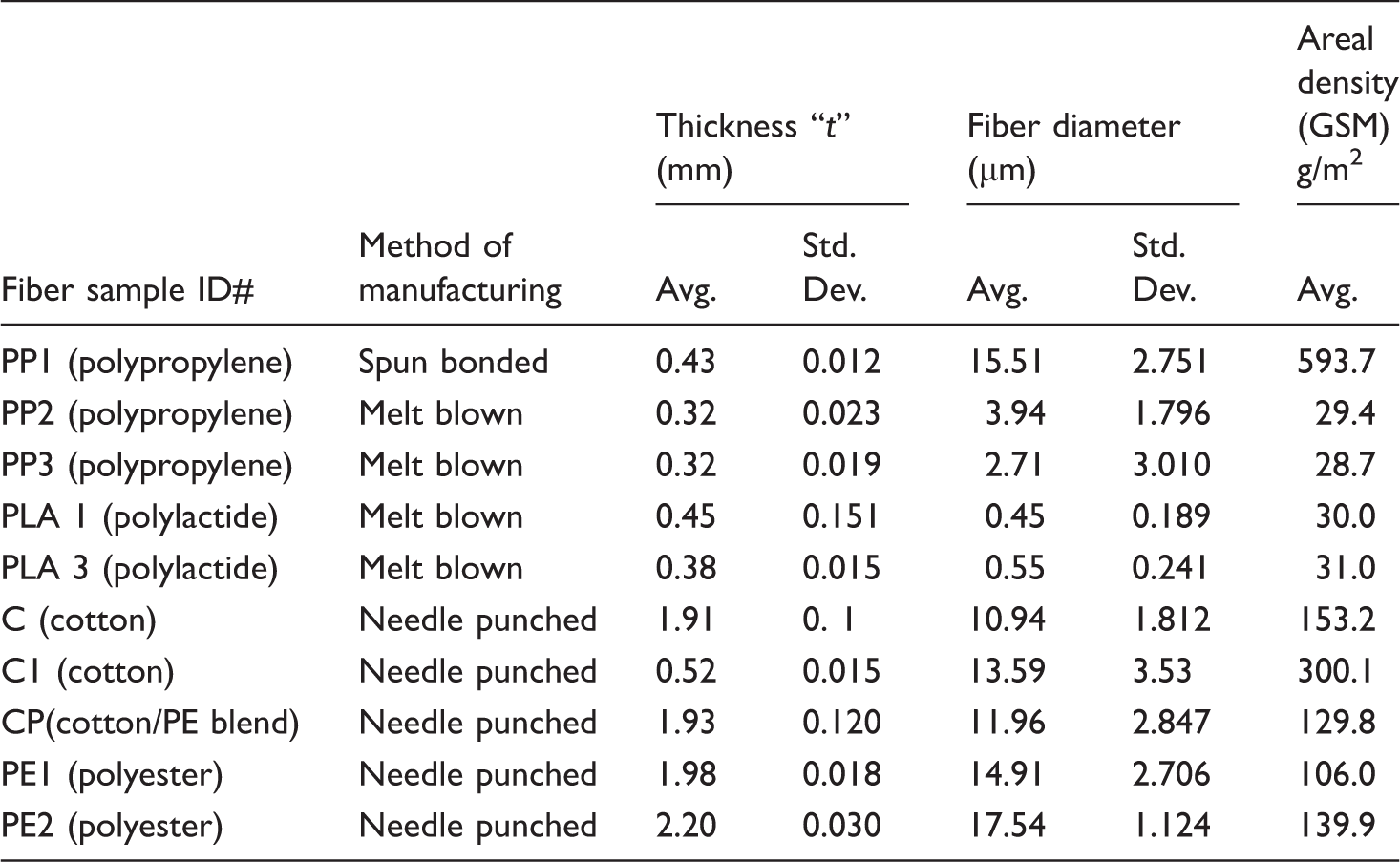
Sample specifications.
Physical characteristics
Thickness of the nonwoven composite (t) was determined using thickness gauge according to ASTM D 5736 standard.
Weight per unit area of a nonwoven fabric was determined according to ASTM D 3776-96.

Air permeability
One of the fibrous structure properties, that affects its sound absorption coefficient, is its air permeability which is generally understood as the transmission of air through a material. Air passes through the textile, through inter-yarn and inter-fiber spaces (pores). Air permeability is one of the properties that defines the internal structure of the material and depends on the amount and size of pores, that enable air to pass through the textile. The measurement of the air permeability is the rate of air flow passing perpendicularly through a known area under a prescribed air pressure differential between the two surfaces of a textile material. Air permeability was measured according to ASTM D73796 with area specimen of 38 cm2 and under the constant pressure of 125 Pa. TEXTEST FX3330 air permeability tester was used and an average of five measurements is recorded for each sample. The results are expressed in SI units as cm3/s/cm2.
Mean pore diameter
The testing apparatus of the samples mean pore diameter is Capillary Flow Analyzer CFP-1100-A (PMI Company, USA). The standard of measurement is ASTM F316-03. Galwick with a surface tension of 16 dynes/cm was used as a wetting agent. The measurements of mean pore diameter were made at the University of Tennessee Nonwovens Research laboratory (UTNR), the University of Tennessee, Knoxville, TN, USA. The data obtained, mean flow pore pressure (mfpp), mean flow pore diameter (mfpd), bubble point pressure (bpp) and bubble point pore diameter (bppd) were reported.
Sound absorption characteristics
Measuring device
Four Mic method impedance tube setup for acoustic absorption and transmission loss was built at UTNRL, Knoxville, TN, USA. Figure 2 shows the photo of the setup.
Impedance tube setup for acoustic absorption and transmission loss.
The experimental setup for determining the sound transmission loss using the four-microphone method consists of noise generator connected to a loudspeaker for the generation of plane waves at different frequencies. The tube is fitted with four PCB Piezotronics Microphones type 130E20 mounted on the tube along its length. ICP preamplifier and repolarization, and these microphones can be powered by simple, constant-current signal conditioners. The tube dimensions and microphone position were as recommended by Brüel and Kjær TL tube Type 4206T. Tube diameter was 100 mm for the frequency ranges assumed to be from 100 Hz to 1.6 kHz. The procedure of the tests was carried out according to ASTM E2611-17.
The material, whose acoustical properties are to be determined, is placed at holder perpendicular to the axis of the tube so that there are two microphones on either side of the sample. The four microphones are individually connected to DTQ, dynamic signal acquisition USB. The output of the microphone pre-amplifiers is collected on a laptop and analyzed using Quick DAQ software. The frequency values such as (100–1600 Hz) were selected. After generating the required frequency using the waveform generator, the microphones probes attached to Impedance tube measured the output pressure to calculate the material absorption coefficient at each sound frequency “α”.
Results and discussion
The relationship of the nonwoven structure and the pore size
The pore size diameter distribution in the nonwoven web and the pore shape, which are usually irregular in both shape size and continuity through the web thickness, interconnective pore or closed pore [32], depends on the method of manufacturing the web, fiber properties, and crimp. There are several parameters that influence the sound absorption of textile nonwoven material [28–32]. The analysis of the factors affecting the sound absorption of the nonwoven structures is summarized [3,4,31,32] and presented in Figure 3.
Factors affecting the nonwoven sound absorption coefficients.
Results of the different samples analyzed on capillary flow porometer-PMI.

Figure 4 demonstrates the relationship of the air permeability and the parameters of the pores in the structures versus mfpd and maximum pore diameter (bppd).
The relationship between air permeability and mean flow pore diameter (mfpd) and maximum pore diameter (bppd).
Regardless of the different systems used for the manufacturing the nonwoven or the type of fiber material, the increase of mean pore diameter and the maximum pore diameter are linearly correlated with fiber diameter as given in Figure 5. This may be because the fiber diameter affects the interaction between the fiber physical properties and the method of nonwoven fabric formation consequently, the formation of pores and their diameter and distribution. It was revealed that [33] the stochastic structure results in a pore size distribution which has the mean pore size and is directly proportional to fiber size and inversely proportional to the fiber volume fraction.
Mean flow pore diameter (mfpd) and maximum pore diameter (bppd) versus fiber diameter.
The results of measuring the air permeability of all the samples indicated that it is linearly related to the square of the fiber diameter, as illustrated in Figure 6.
The air permeability versus square of fiber diameter (d2).
Analyses of the nonwoven fabric air permeability
Effect of the number of nonwoven layers on the air permeability
Fabric porosity concurrently governs both air permeability and sound absorption of a fibrous structure [34]. Air permeability is, generally, understood as the transmission of air through a material. Air passes through the textile, through inter-yarn and pores. Air permeability depends on the amount and size of pores, which enable air to pass through the textile. To evaluate the different combinations of hybrid structures to be used as sound absorption, it is more appropriate to measure their air permeability to express their internal pore structure without the distortion. The measured results of the air permeability for the different samples of single and multilayers of the nonwovens, C, cotton; CP, cotton/polyester blend; PE1, polyester; PE2, polyester 2; PP1, polypropylene 1; PP2, polypropylene 2, PP3, polypropylene 3, are shown in Figure 7. This demonstrates the effect of multilayers on the value of the air permeability, which is inversely proportional to the number of layers [34]. The effect of layering of the samples on their air permeability depends on the structure of each sample. The melt blown samples show higher rate of the air permeability decreases as the number of layers increased. Thus, the hybrid materials will behave differently depending on the fibrous structure of the different layers.
Effect of multilayer on air permeability.
Effect of the hybrid layers of nonwoven on the air permeability
Figure 8 illustrates the effect of different samples combinations (C-PE1 – one layer of cotton and second layer of PE1, C-PE2 – one layer of cotton and second layer of PE2, C-PP1 – one layer of cotton and second layer of PP1, C-PP2 – one layer of cotton and second layer of PP2, C-PP2 – one layer of cotton and second layer of PP3), indicating that the air permeability reduces sharply when adding a thin layer of melt blown nonwoven on the surface of cotton needle punched nonwoven. Morphology and pore structure of PP melt blown nonwovens can be ascribed to the fact that pore sizes are closely related to fiber diameter [35,36]. The high porosity indicates that air flow would choose to pass through the media in a shorter and unblocked path by obeying the minimal resistance principle [37]. Generally, the air permeability of the combination of the two layers reduces significantly, and the resultant air permeability is less than the minimum one.
Two layers of different materials.
Air permeability of the nonwoven samples.

The needle punched nonwoven has higher air permeability due to the method of their manufacture which allows the presence of pores passing through the entire thickness of the fabric while meltblow nanofiber fabric has random arrangement of the pores. The description of a porous structure by porosity is limited to a certain extent since it depends on the volume of the pore not their size diameter distribution. Air permeability has mostly been related to the actual porosity, but samples of the same measured porosity do not always have exactly the same air permeability. Subsequently, air permeability should be regarded as the preferred criterion in determination of acoustic performance of nonwoven fabrics.
Mechanism of sound absorption of nonwoven structures
When sound enters porous materials, owing to sound pressure, air molecules oscillate in the interstices of the porous material with the frequency of the exciting sound wave. This oscillation results in frictional losses. A change in the flow direction of sound waves, together with expansion and contraction phenomenon of flow through irregular pores, results in a loss of momentum. The porous nonwoven material is a space structure of fibers of different length that contains cavities, channels or interstices so that sound waves can enter through them. Open pores have a continuous channel of communication with the external surface of the fiber structure, influencing the absorption of sound, such as the needle hole in needle punched nonwoven. Closed pores are substantially less efficient in absorbing sound energy [19,21]. Another category of pores is blind, which are opened from one end only. The increase in the number of fiber layers in the nonwoven structure will lead to change in the percentage of the different types of pores. This explains the variations in the air permeability of the multilayer samples as illustrated in Figure 8. The sound absorption coefficient of the material depends on the degree of the air molecules at the surface of the material and within the pores [30]. The sound wave forces the air molecules to vibrate and, in doing so, lose some of their original energy. In fibrous materials, much of the energy can also be absorbed by scattering from the fibers and by the vibration caused by the individual fibers. The fibers of the material rub together under the influence of the sound waves [39]. Figure 9 shows the pores shapes and sizes in the nonwoven fabric. The spaces between the pores, the pore size, the flexibility of the fibers, their orientation with respect to the direction of the sound wave and its resonance frequency will affect the absorbed energy.
Pore distribution in nonwoven.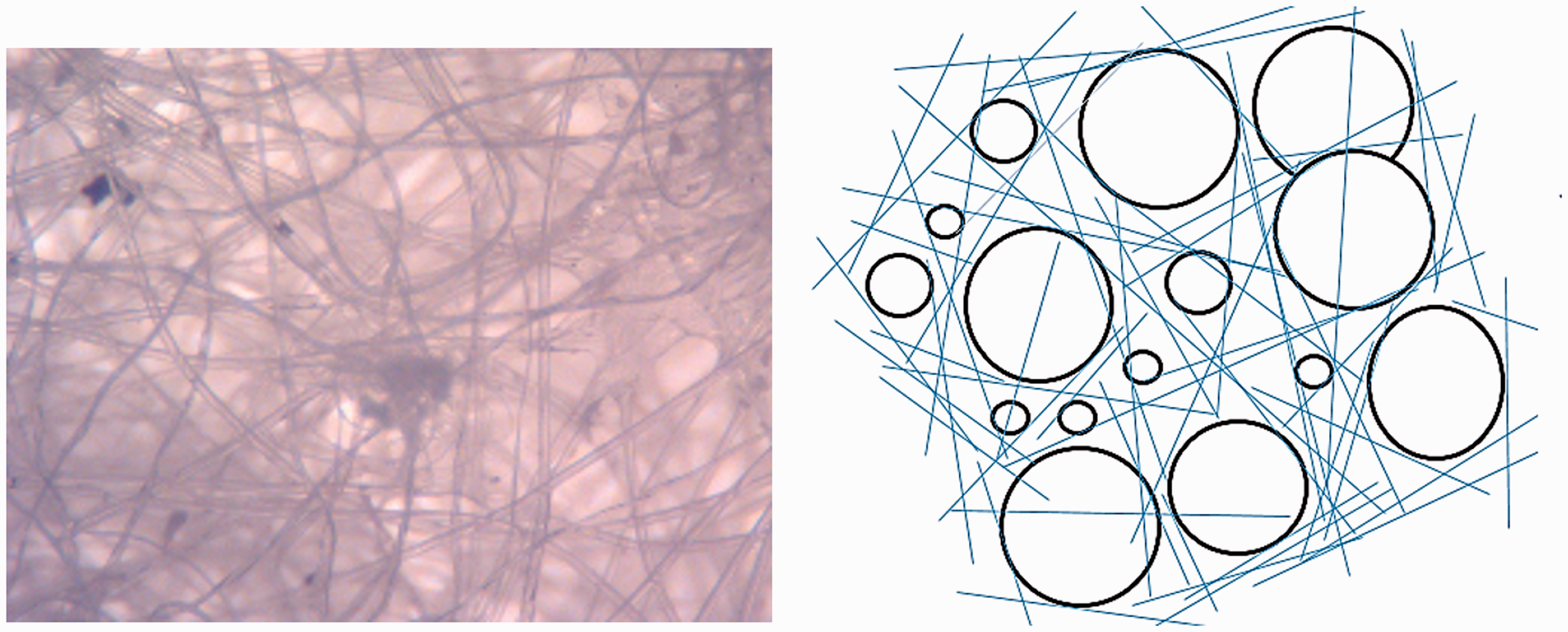
The network of the fibers may be modeled as shown in Figure 9. The pores are of different sizes in the form of holes with the fibers crossing them at different levels on their lengths; these fibers will be forced to vibrate due to the sound wave. Thus, the pore diameter will depend on the fiber diameter and the distribution of the fibers in each layer as well as fiber orientation. The presence of pores on the surface will increase the sound absorption coefficient of material depending on the pore diameter and their distribution [16]. The maximum sound absorption coefficient of the material is proportional to the area of the pore [40]. The relationships between the different parameters are codependent. The inherent properties of the fibers cannot be changed without affecting the other parameters that influence the sound coefficient of absorption of the material.
To obtain multilayer structures with diversified properties, four variants of needle punched nonwovens from cotton and cotton/polyester (60/40) fibers blends and two 100% polyester and two melt blown polypropylene nonwoven were prepared.
The characteristic impedance and propagation constant, which describe the acoustical properties of porous materials, are governed by the flow resistance of the material [40–42]. One of the most important qualities that influences the sound absorbing characteristics of a nonwoven material is the specific flow resistance per unit thickness of the material. The porous material should have enough pores on the surface of the material for the sound to pass through and get dampened [34]. From the above analysis, it can be concluded that due to the interaction between the material and fibrous structure of the nonwoven, the value of the air permeability can be taken as the fibrous structure parameter that correlated with both the material porosity and thus coefficient of sound absorption.
Influence of number of nonwoven layers on coefficient of sound absorption
Figure 10(a) to (f) illustrates examples of the sound absorption coefficient values of different nonwoven samples as a function of frequency in the case of using single layer or multi-layer samples.
Absorption coefficient of nonwoven samples as a function of sound frequency. (a) Cotton, (b) Cotton/polyster blend, (c) PE1 (d) PE2, (e) PP1 and (f) PP2.
In almost the entire frequency range, the material absorption coefficient first increases to the maximum at lower frequencies and then fluctuates at higher frequencies, which shows a similar sound absorbing property to porous sound-absorbing materials. The absorption coefficient frequency dependencies are very similar. Also, it indicates that the absorption coefficient of the fiber assemblies increases sharply with the sound frequency at low-frequency range, reaching a maximum at some moderate frequency. The maximum of the absorption coefficient of these nonwovens is about 0.95 at sound frequency of 1500 Hz, when using multilayers of nonwoven. The melt blown nonwoven gives highest value of sound absorption coefficient than the other samples. This is due to the finer fiber diameter used. For all the four fiber types, the effect of number of layers on the sound absorption property is nearly the same as the effect of increasing thickness of materials, and the melt blown samples are still superior.
It can be revealed from Figure 10(a) to (f), when the number of the layers increased up to two layers, it improves the values of the coefficient of sound absorption at lower values of frequency up to 500 Hz, and the addition of one more layer to the multi-layers structures insignificantly advances the coefficient of sound absorption. Moreover, the thickness of the layers in the multilayer structures plays a little influence on the sound absorption at the higher frequencies [43,44].
Influence of number of layers on the specific NRC
With the increase in number of layers in the structure, the compactness of the layers will affect the value of noise reduction coefficient (NRC), hence the material thickness has the greatest impact on the material's sound absorbing [44]. The NRC was determined using the following formula:

An NRC is an average rating of how much sound an acoustic product can absorb and is a scalar representation of the amount of sound energy absorbed upon striking a surface. The thickness and density of a product are two factors in calculating an NRC. The introduction of the specific NRC will help to differentiate between the different sound absorption structures, especially when the weight of the absorber is critical hence, transmission loss is a function of mass of the absorption material and the sound frequency. The samples used have a different areal density. The specific value of NRC can be obtained by dividing it by the sample's areal density and used for comparison of the sound absorption of the different samples.
Figure 11 illustrates comparison of different samples, indicating that the increase in the number of layers does not improve the values of the specific NRC for different samples, this may be because of the interference between the pore size and its distribution through the used multilayer structure of the same materials. The best results of the specific NRC are related to the Polypropylene samples PP1 and PP2.
Comparison of the specific NRC for the different multilayer samples. C2: cotton; C2/P: cotton polyester blend; PE1: polyester; PE2: polyester 2; PP1: polypropylene 1; PP2: polypropylene 2.
The relationship between NRC of different tested samples as a function of their air permeability is demonstrated in Figure 12. It is recommended to use for sound absorption material the low permeability fabrics in composition with two layers of nonwoven, one of them of high NRC, which is better than one layer with the increased material areal density. The melt blown nonwoven gives the best performance when related to the specific NRC. The high air permeability of the sound absorber offers the possibility for sound wave to strike in the pores of the acoustical material; the sound wave causes the fibers of the absorbing material to vibrate.
NRC versus air permeability.
The value of NRC for the different hybrid structures as a function of their air permeability is illustrated in Figure 12, which shows a good correlation. The nonwoven with low values of mfpd and maximum pore diameter (bppd) denotes the best sound performance. When designing multilayer nonwoven sound absorber, attention should be paid to the specific NRC values, not the absolute ones, especially when the weight of the absorber plays a decisive role.
The air permeability of the melt blown web can be controlled during manufacturing and through the thermal pressing. The microfibers were produced at different melt blowing air pressures and calendared to reduce the pore size of the membrane by varying the calendaring temperature, pressure, and time while the fiber diameter is same [45]. Melt blown nanofiber layer can improve the acoustic insulation properties because its open structure and the fine fibers increase the air permeability. Samples of air permeability less than 125 cm3/s/cm2 give an accepted value of NRC up to 0.60.
Conclusion
In this research work, it was attempted to investigate the relationship between the air permeability and the pore size as well as the effect of the number of layers in the multilayer structures, made of the same material, or hybrid multilayer structures, made from a nonwoven, on the coefficient of sound absorption. As observed from this work, the coefficient of sound absorption of the multilayer structures increases with an increase in the number of layers of up to two; however, when the number of layers in the structure is increased to three, this characteristic is not significantly improved. Sound absorber design should take into consideration specific NRC values, and not only the absolute ones. It is recommended to use the sound absorber composed of two layers of nonwoven, one of them of high NRC. The melt blown nonwoven fabrics proved to have better absorption of the sound due to their fine fibers and closer structure. The use of melt blown layers of fine fibers allows to reach values of NRC up to 0.8. Hybrid materials, obtained by introducing melt blown nonwoven, have sound absorption performance significantly improved, up to 50%, compared to cotton needle punched samples. The multilayer of nonwoven fabrics with dissimilar pore structure is recommended to achieve the required value of specific NRC.
Footnotes
Declaration of conflicting interests
The author(s) declared no potential conflicts of interest with respect to the research, authorship, and/or publication of this article.
Funding
The author(s) received no financial support for the research, authorship, and/or publication of this article.