




Abstract
In this paper, a ‘mesoscale spring model’ was generated to predict the tensile modulus of warp-knitted fabric-reinforced composites. A previously developed geometrical model was used for generating a mechanical model as a set of series and parallel springs. For this purpose, the unit cell of straight line model was discretized into different segments. Each segment was modelled as a spring with definite constant based on the alignment of yarns in the segment. Warp-knitted fabrics (Queen's Cord) were used as reinforcement of composites. In order to validate the presented model, samples of composites were produced using hand layup method. Tensile tests were carried out on the prepared samples. The comparison between theoretical and experimental elastic modulus showed a reasonable agreement between experimental and theoretical data. Also, the comparison between the results of different models and experimental data showed that the results of spring model are closer to the experimental results than that of Krenchel's model. It can be concluded that the spring model can predict adequately the elastic modulus of composites.
Introduction
It is well known that the elastic modulus of constituent elements, i.e. reinforcement and matrix, has main role on the tensile properties of composites. The rule of mixture (ROM) is defined to predict tensile properties of composites based on mechanical properties of fibres and matrix. In order to use the conventional ROM, we need to assume that the fibres are unidirectionally aligned and the stresses are uniformly distributed. In the fabric-reinforced composites, the yarns follow different path due to fabric formation process. It means that the conventional form of ROM cannot predict adequately the elastic modulus of fabric-reinforced composites. Many attempts have been made to modify the ROM. Krenchel [1] initiated the modification of ROM in fibre-reinforced composites. Based on the Krenchel's method, an efficient factor should be multiplied to Young's modulus of fibres in the ROM to predict the Young's modulus of composite. Yang et al. [2] proposed a ‘Fibre Inclination Model’ which treats the unit cell of a composite as an assemblage of inclined unidirectional lamina. This model can be used to analyse any 3D structural textile composites. Tang and Postle [3,4] studied the mechanics of 3D braided structures for composite materials, and they generated a model to predict the elastic modulus considering fabric structure and fibre volume fraction. You et al. [5] modified the ROM to predict the tensile strength of GFRP rebar based on test results and found a 5% improvement in accuracy of the tensile strength prediction. Ramakrishna et al. [6] proposed a coefficient for the modulus of fibres in term of proportion and the orientation of fibre bundle in the plain weft-knitted fabrics. Gommers et al. [7] defined a coefficient as length-weighted average of the fibre segments in the loop of warp-knitted fabrics. Virk et al. [8] proposed a fibre area correction factor to modify the ROM and generated a micromechanical model for the prediction of the tensile modulus of natural fibre-reinforced polymer matrix composites. Considering the noncircular cross-section of natural fibres, a new ROM was defined to provide a sensible estimate for the experimentally measured elastic modulus of the composite by Cullen et al. [9]
The spring model has received attention of researchers to simulate the elastic properties of different materials and structures. Zhao et al. [10] proposed a 3D distinct lattice spring model for elasticity and dynamic failure. Tsai et al. [11] presented a parallelogram spring model for predicting the effective elastic modulus of 2D braided structure composites. Huwan et al. [12] generated a spatial spring model to predict the elastic moduli of 3D braided structures based on parallelogram spring model. Okabe et al. [13] predicted the tensile strength of unidirectional CFRP composites using spring element model and found good agreement between theoretical and experimental tensile strength.
In this study, a new approach is presented to predict the elastic modulus of fabric-reinforced composite based on assemblage of series and parallel springs in mesoscale. For this purpose the unit cell of composites is discretized into segment which contains a straight part of yarns. Each segment is modelled as a spring, and finally the adjacent segments are assembled.
Theoretical background
The main parameter in the prediction of elastic moduli of fabric-reinforced composites is the yarns' (fibres) alignment in the structure of fabric. Since the yarns are located in different directions due to the fabric formation process, the prediction of tensile behaviour of fabric-reinforced composites encounters with problems. The way to avoid this difficulty is to discretize the unit cell of composites into individual segments so that in each segment yarns have only one direction. Then, the segments are modelled by spring constant, and the unit cell is configured as assemblage of series and parallel springs.
In this paper, the straight-line model generated for warp-knitted fabrics is used as reinforcement of composite. [14] Figure 1 shows the different parts of front and back bar loops. As shown in this figure, the unit cell of front and back bar loops is comprised of straight-line sections.
Straight-line model for Queen's Cord warp-knitted fabrics. (a) Front bar loop and (b) back bar loop [14].
In order to use classical laminate theory, it is necessary to know the length and angle of yarns in each segment. In our previous research [14], the geometrical parameters of front and back bar loops were calculated as follows:

Where


Where


Theoretical model
The unit cells are discretized into six segments which have been indicated by five coloured solid boxes for different parts of loop and one dashed-dotted box for underlap, as shown in Figure 2. The small white boxes which are supposed to be filled with matrix are ignored. Each segment contains a straight part of yarn. Therefore, the segments are considered as inclined unidirectional lamina which can be modelled by springs.
Discretization of unit cell in mesoscale: (a) front bar loop and (b) back bar loop.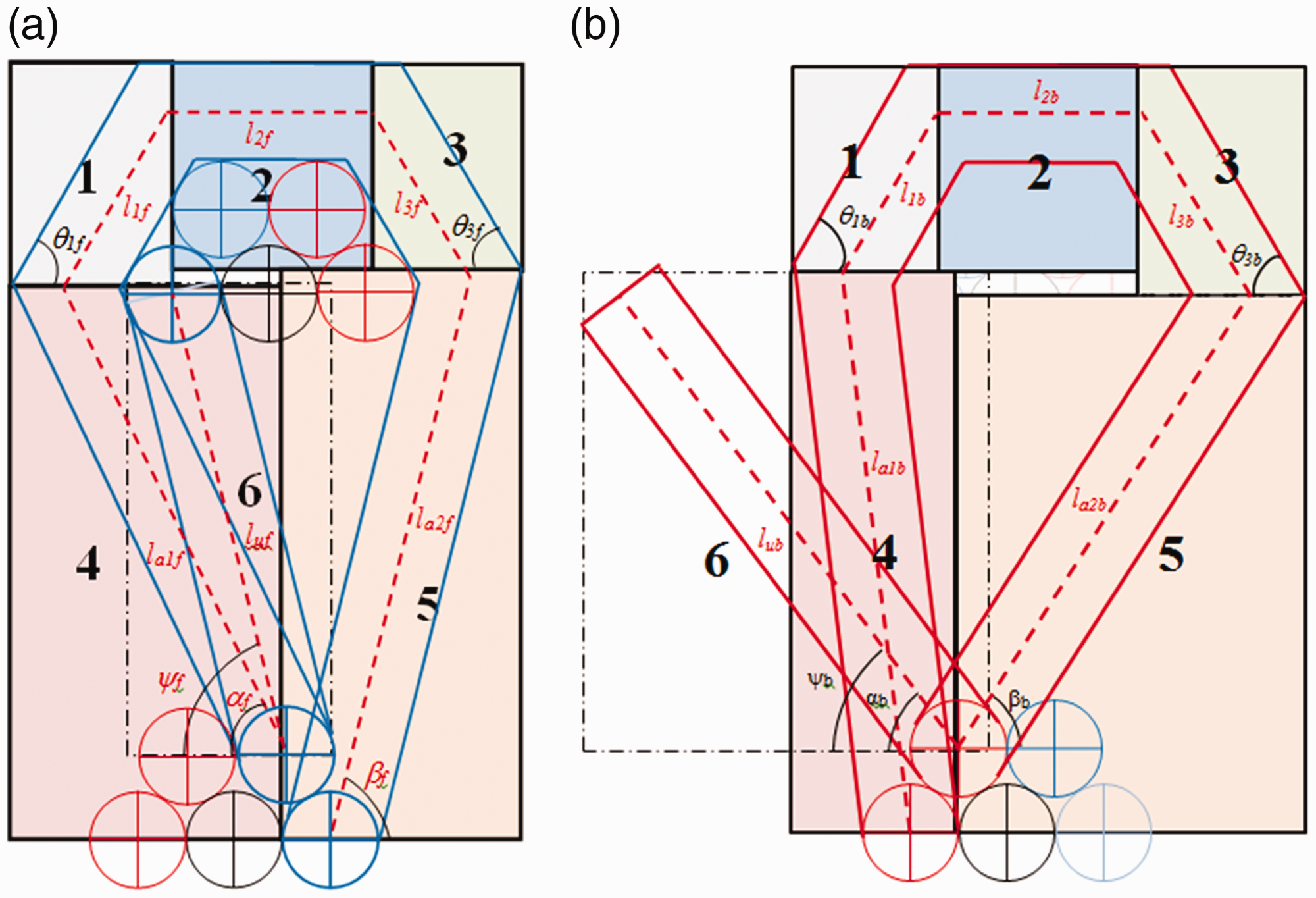
Suppose that a typical segment of composite is subjected to load A segment of composite: (a) areas of components and (b) force component on the yarn.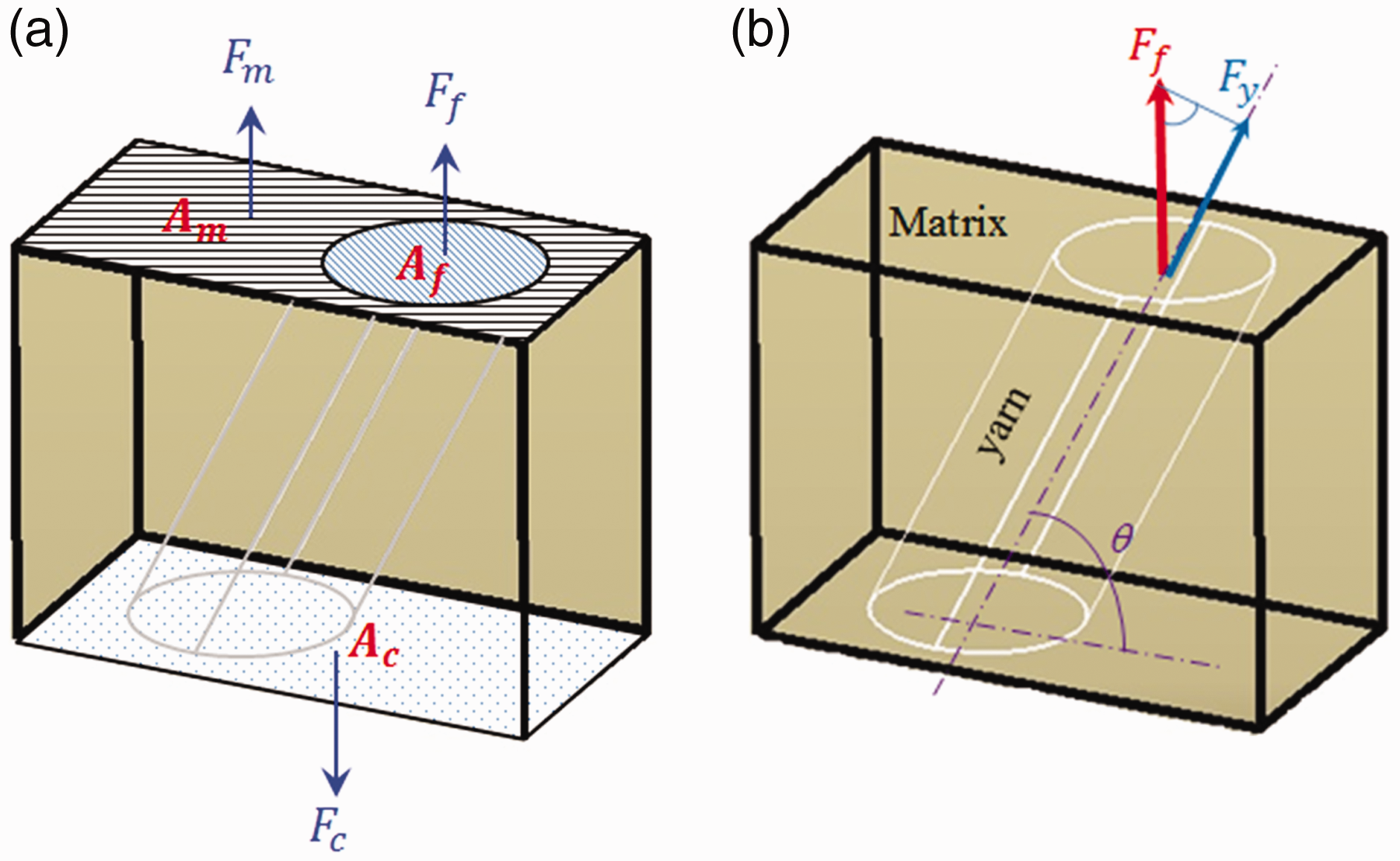
It is well known that

Referring to Figure 3, the line of action of the force

Substituting equation (11) into equation (10)

Considering the uniform distributed stresses on the elements and equation (12), we can write

Based on Hooke's law

Suppose that the segment has been elongated as much as h. Hence, according to Figure 4, we can write
Elongation of segment.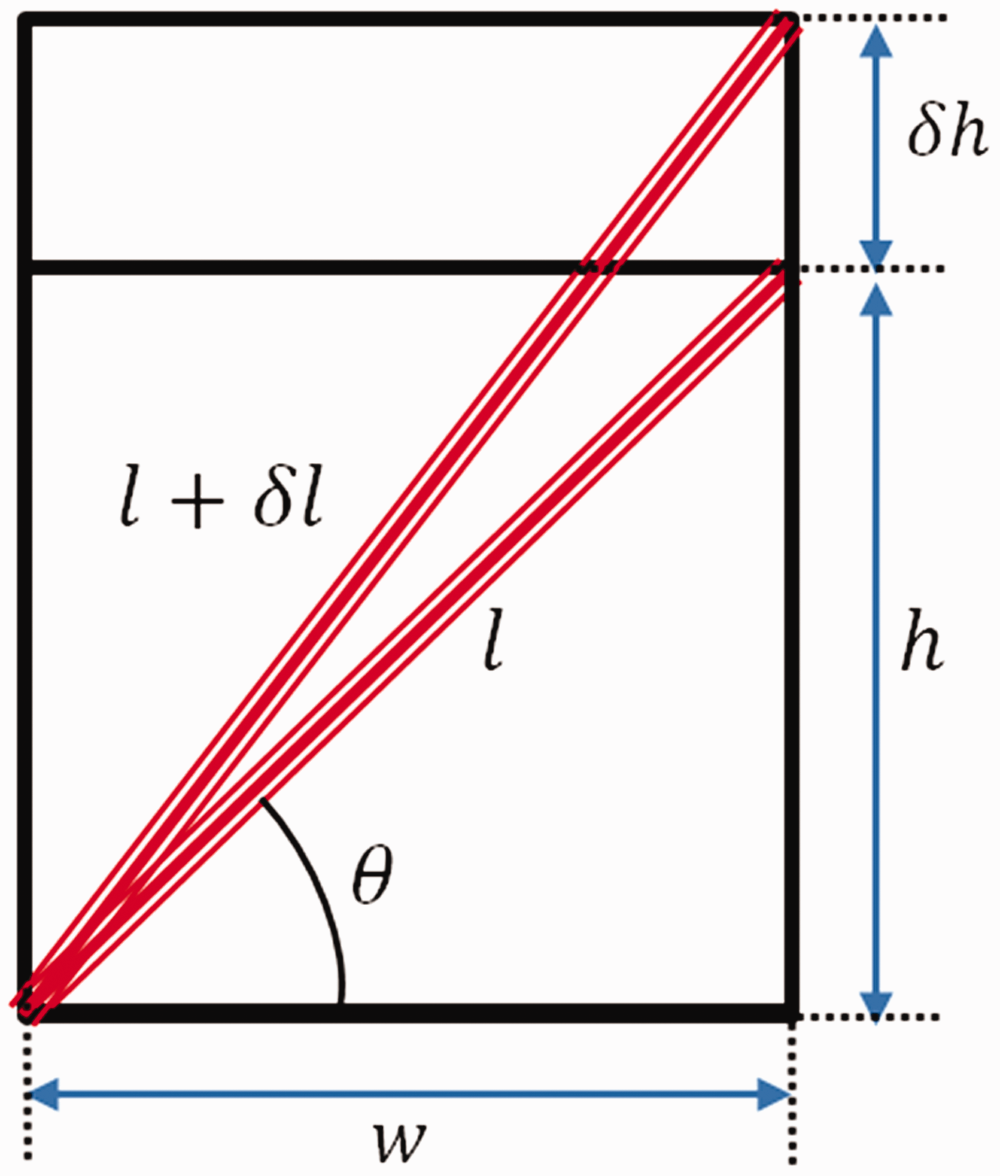

In other words

Neglecting second-order terms in

Dividing two sides of equation (17) to

Referring to Figure 4, equation (18) becomes

By simplifying, equation (19) reduces to

Substituting equation (20) into equation (14) and treating that

Integrating equation (21) over length of yarn

Hence

Dividing equation (23) to

In general, the elastic modulus of different segments is calculated as below

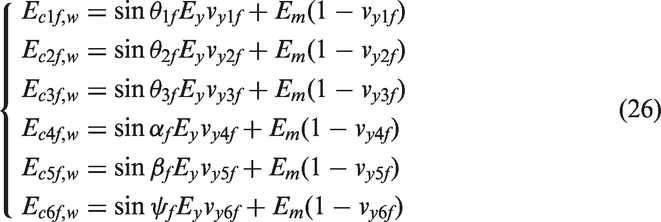
Referring to Figure 2 and using geometrical parameters of the unit cells in wale and course directions, the elastic modulus of each segment is obtained (in the following equations, the subscripts c and w are devoted to the course and wale directions and subscripts f and b are devoted to the front and back bar loops, respectively):

In order to model the defined segments, springs with different lengths and constants are considered (Figure 5). Suppose that the load Modelling the segments by springs with different lengths and constants in wale direction.

Substituting the values of

Applying the Hooke's law

Hence, the constant of spring is obtained as below

As shown in Figure 5, the springs 1, 2 and 3 related to segments 1, 2 and 3 are parallel in the wale direction, so the equivalent constant would be

Also, the springs 4, 5 and 6 related to segments 4, 5 and 6 are parallel. Therefore

Equivalent springs with constant

Since the front and back bar unit cells are parallel, the equivalent constant would be equal to

In general, the elastic behaviour of the unit cell in the wale direction is modelled by a spring with constant of

Similarly, the elastic modulus of each segment in course direction is obtained:


Figure 6 shows that the springs 1, 2 and 3 are series, so the equivalent constant would be
Modelling the segments by springs with different lengths and constants in course direction. Stress–strain diagram of CQ3h samples: (a) course direction and (b) wale direction.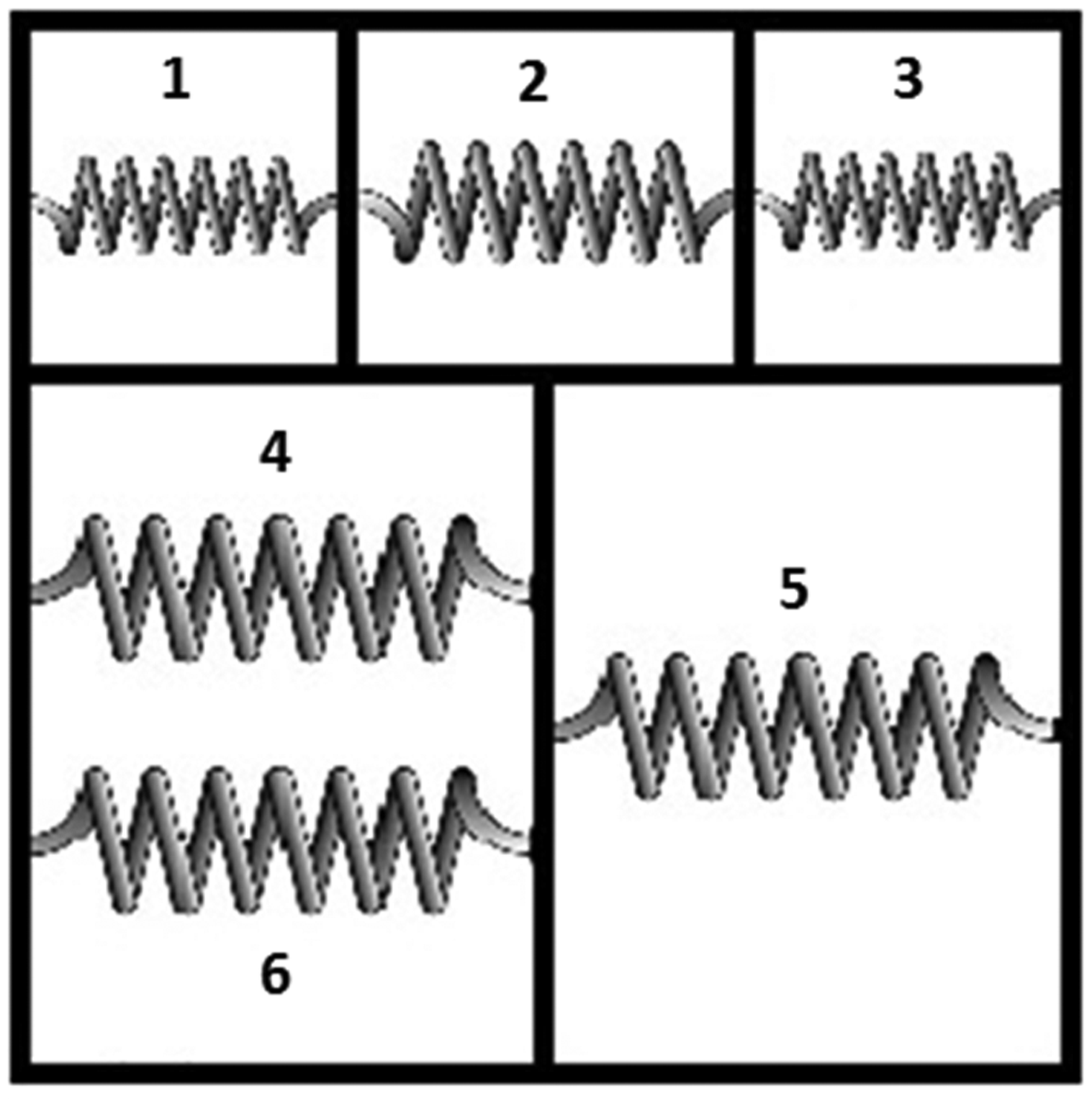


Also, the springs 4 and 6 related to segments 4 and 6 are parallel. Therefore

Equivalent springs with constant

As shown in Figure 6, the equivalent springs with constants

Since the front and back bar unit cells are parallel, the equivalent constant for unit cell is equal to

In other words

Consequently, the elastic behaviour of the unit cell in the course direction is modelled by a spring with constant of

Verification of the model
Details of polyester Queen's Cord fabrics.

The details of polyester fibres and epoxy resin are listed in Table 2.
The epoxy resin model ML506 and hardener HA-11 were used to produce composites by hand layup method. The tensile test was carried out on the prepared samples in both course and wale directions using the INSTRON (model: 5566) tensile tester with jaw speed of 2 mm/min, gauge length of 170 mm and width of 25 mm according to ASTM D3093-76. Stress–strain diagram of CQ3h sample is presented in Figure 7 as an example. The stress–strain diagrams of other samples are presented in Figures 10 to 17 of Appendix 1. The elastic modulus of samples was measured by INSTRON in the range of strain of 0.3–1.2%.
Details of constituent of composites.

The results of tensile test on the composites in wale direction.

The results of tensile test on the composites in course direction.

Geometrical parameter of front bar loop. a

aThe lengths and angles are issued in terms of mm and rad, respectively.
Geometrical parameter of back bar loop. a
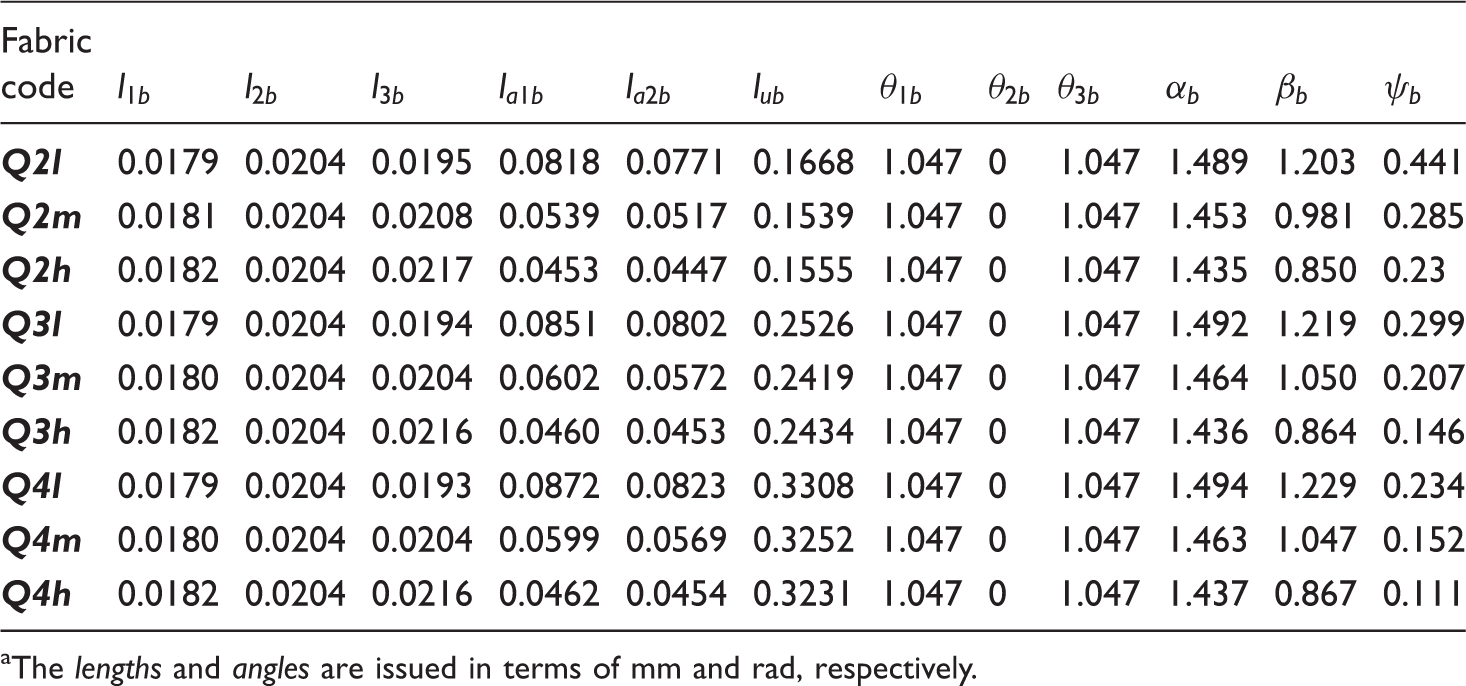
aThe lengths and angles are issued in terms of mm and rad, respectively.
Elastic modulus of front bar segments in course direction. a
The elastic modulus and constant of springs are issued in terms of MPa and N/cm, respectively.
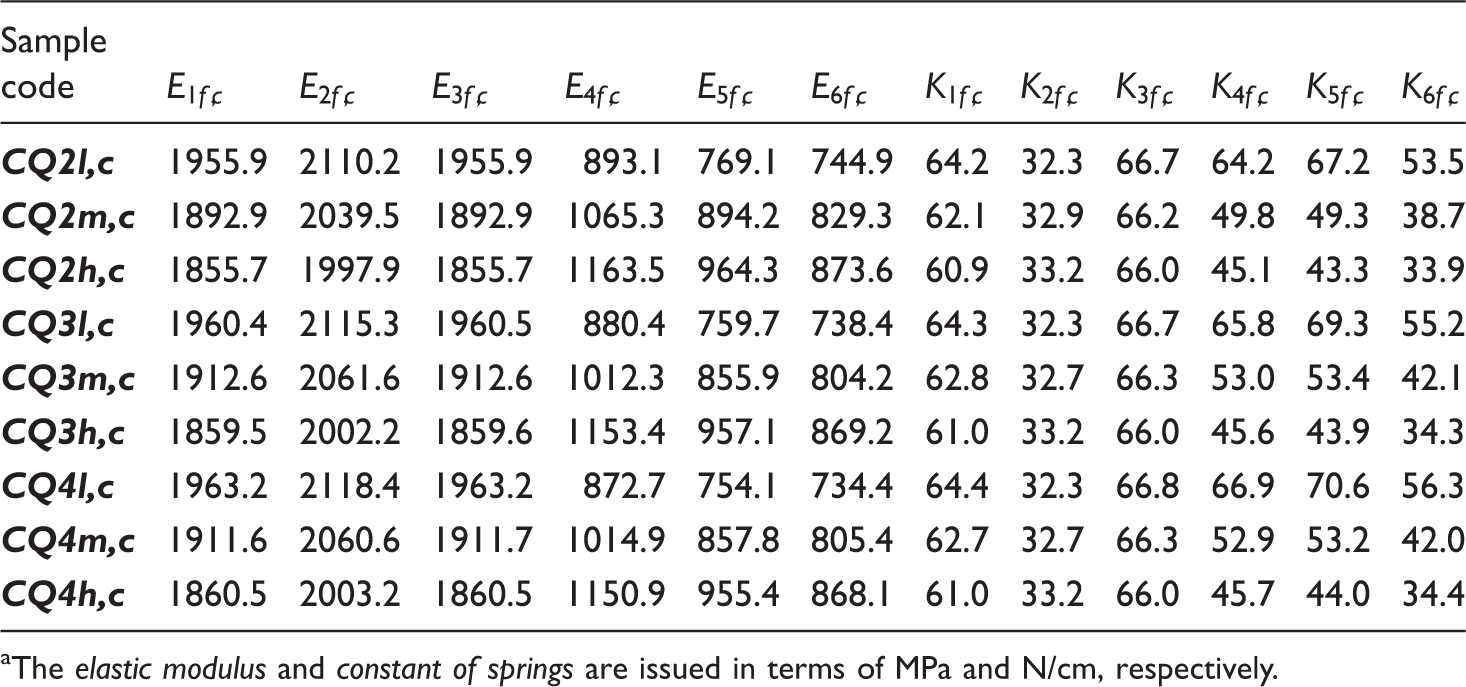
Elastic modulus of back bar segments in course direction. a

The elastic modulus and constant of springs are issued in terms of MPa and N/cm, respectively.
Equivalent constants and stiffness modulus of composites in course direction.

Elastic modulus of front bar segments in wale direction. a

The elastic modulus and constant of springs are issued in terms of MPa and N/cm, respectively.
Elastic modulus of back bar segments in wale direction. a

The elastic modulus and constant of springs are issued in terms of MPa and N/cm, respectively.
Equivalent constants and stiffness modulus of composites in wale direction.

Modification of the model
As can be seen in Figure 8, real photos of loop alignment in the structure of warp-knitted fabrics show a deviation about 32 ° from the vertical alignment, while the loops have been considered straight for generating the model. It is well known that this deviation leads to change the portion of fibres in the wale and course direction. Hence, the portion of fibres in the wale direction decreases, while in the course direction increases. In other words, the skewness of loops leads to increase the elastic modulus in the course direction and decrease that in the wale direction. The difference between theoretical and experimental results can be attributed to this phenomenon. Therefore, the results of the model should be projected to the vertical and horizontal axes. A correction factor is defined as cosine of the angle of the deviation, so that the results of the elastic modulus in the wale direction are multiplied by cosine of the deviation angle, while the elastic modulus in the course direction is divided to cosine of the deviation angle
Real photos of loop deviation: (a) front bar and (b) back bar.


Comparison between experimental and theoretical stiffness modulus of composites.

In order to evaluate the accuracy of the Spring model, it was compared with other modified ROM. Since the Krenchel's model is the first developed model to predict the elastic modulus of composites, it was considered as modified form of ROM. The experimental elastic modulus of different samples was compared with results of both Spring and Krenchel models. As shown in Figure 9(a), in all cases the results of the Spring model are closer to the experimental results than that of Krenchel's model. Also, except from CQ2m sample, the theoretical and experimental results have increasing trend in course direction from low to high density. It is well known that density of samples increases by increasing the CPC on a knitting machine. When CPC of a sample increases, the angle of back bar underlap (ψ
b
) decreases, which leads to increase the straight portion of yarn in the course direction. Therefore, the elastic modulus of samples increases in course direction.
Comparison between results of theoretical models and experimental data: (a) course direction and (b) wale direction.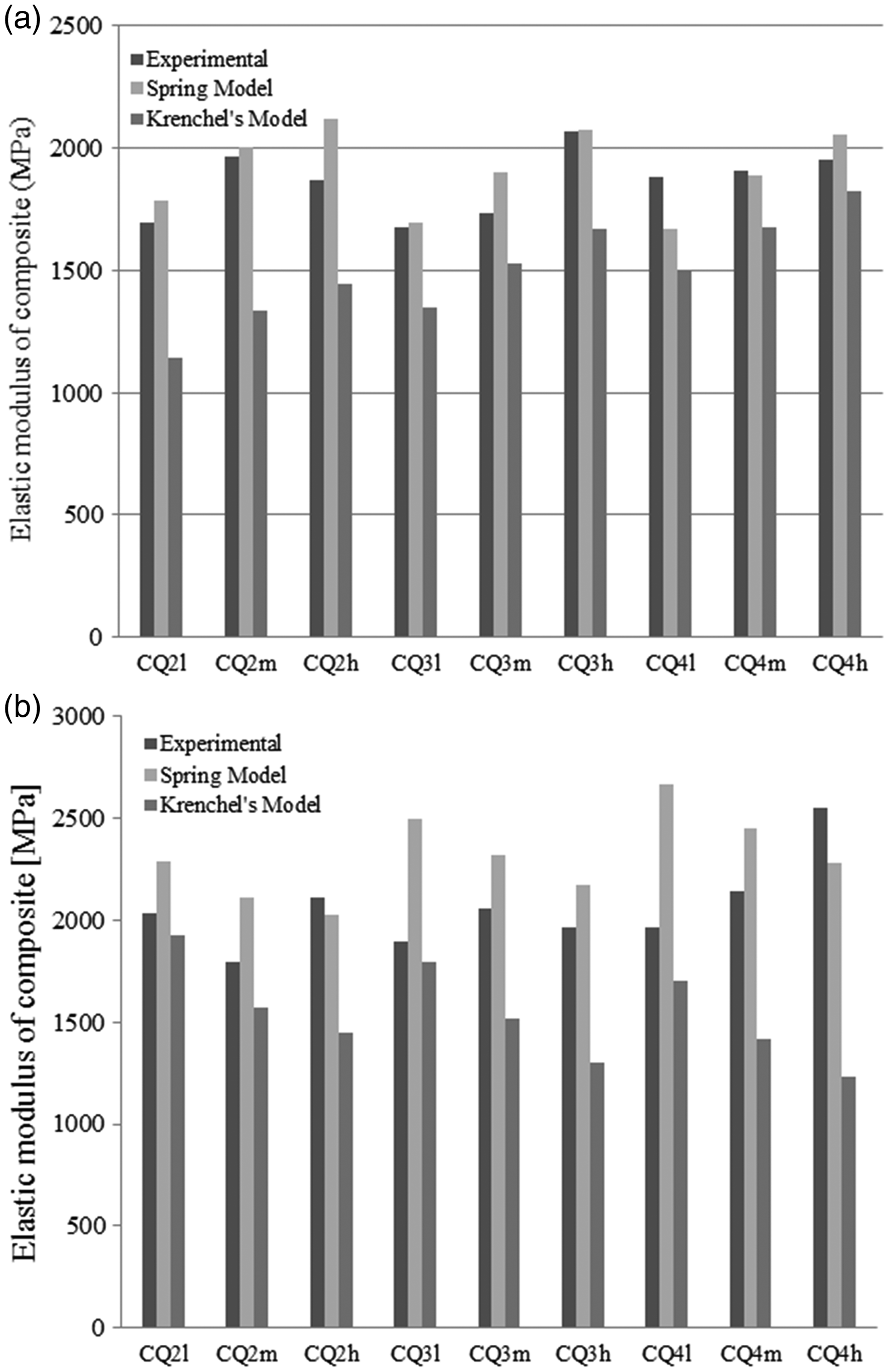
Figure 9(b) shows the comparison between theoretical and experimental results in the wale direction. As pointed out, the enhancement of density leads to reduction of
Conclusion
The basic form of the ROM is applicable for fibre-reinforced composites in which the fibres are assumed unidirectional and the stress distribution is uniform. In fabric-reinforced composites, yarns (fibres) follow different path due to fabric formation process. Therefore, the modified form of the ROM is suitable to predict the elastic modulus of fabric-reinforced composites. In order to modify the ROM, the curved path of the yarns (fibres) was considered as straight path. A straight-line model proposed for the unit cell of Queen's Cord warp-knitted fabrics was used and discretized to unidirectional segments. A ‘Mesoscale Spring Model’ was generated to predict the elastic modulus of warp-knitted fabric-reinforced composites by considering the unit cell of fabric. A modification was made on the proposed model based on the deviation angle of loops from vertical alignment. A good correlation was found between theoretical and experimental results. Also, the results of the proposed model are closer to the experimental results than that of Krenchel's model.
Footnotes
Declaration of conflicting interests
The author(s) declared no potential conflicts of interest with respect to the research, authorship, and/or publication of this article.
Funding
The author(s) received no financial support for the research, authorship, and/or publication of this article.