




Abstract
In this work, the tensile property retention characteristics of high-performance glass and carbon rovings in warp-knitted reinforced fabrics and cement-based composites used in structural applications were investigated. Three types of warp-knitted fabrics, with differing stitch patterns, and cement-based composites were produced. The tensile strength retention and Young’s modulus retention of the roving in these fabrics and their influence on the properties of cement-based composites were compared on the basis of the stitch type. Samples of warp-knitted fabrics composed of glass fibres and carbon fibres exhibit retention of 76–87% and 65–87.6%, respectively, of the initial strength of the rovings. The highest Young’s modulus retention (∼80%) occurs in the case of the fabric sample composed of glass rovings. The retention of the Young’s modulus in the fabric samples composed of carbon rovings was 37–60%. In addition, the translation of strength from the roving to the fabric and retention of the Young’s modulus in the carbon rovings decreased with increasing strength and modulus, respectively, of the original roving. On the basis of the data presented, we provided guidelines for the possible application of the developed fabrics. As conclusion, it is possible to reduce the cost of the raw materials by using fabrics whose original rovings have low tensile strength and Young’s modulus, but high retention properties.
Keywords
Introduction
Experimental measurements of the tensile property changes of warp-knitted fabrics with various types of stitches were recently reported [1]. The study shows that, owing to its flatness or compactness, the cross-sectional shape of the roving in the fabric has the greatest effect on the transfer of mechanical loads. The present study is an extension of that work. As such, the property utilisation of high-performance rovings in warp-knitted fabrics and the reinforcement efficiency of warp-knitted fabrics in cement-based composites were investigated. Determination of the relationship between the properties of the rovings and the fabrics as well as between the fabrics and the composites is essential; in other words, the mechanisms governing the functioning of these systems can be understood through this determination.
The use of textile materials for reinforcement of composites is motivated by the possibility of wide-scale implementation and the development of entirely new types of products. High-performance textiles are typically used to reinforce polymer composites [2]. In the last two decades, textiles have also been widely used to reinforce cement composites; in these composites, textile-reinforcing fabrics are combined with the cement matrix. These reinforcements are corrosion-resistant and unlike steel, can be used without the application of a coating. Therefore, thin and light components can be developed in a straightforward manner. The combination of textile reinforcement and the concrete matrix has led to the development of a new type of structural material referred to as textile-reinforced concrete (TRC) [3, 4]. The use of high-performance textile fabrics as reinforcements in concrete provides new possibilities for the manufacture of concrete parts. In fact, TRC is used in many applications, including concrete architectural elements and load-bearing structural members [5–7]. This type of concrete is an excellent building material from the viewpoint of sustainability, disaster control, and retrofitting of existing structures. Textile applications are used extensively in the construction of buildings and structures. However, these applications are used mainly for non-load-bearing functions, such as protection grids, isolation, etc. Textiles are rarely used for the reinforcement of structural elements in building construction. These innovative materials can be used in the construction of unique buildings. However, limited knowledge of the properties of these materials and structures has stymied their use in wide-scale construction. A detailed study of the properties of various textile materials is required for optimal use of these materials in the reinforcement of building structures.
Textile reinforcement structures obtained by applying different high-strength rovings and the subsequent development of appropriate textile structures have a significant impact on the load-bearing capacity properties of building elements. Textile fabrics, i.e. a reinforcing structure composed of continuous filament yarns or rovings have attracted considerable attention [8–10]. Accordingly, the development of appropriate textile structures has been extensively investigated [11–15] in recent years. These studies have focused mainly on improving the mechanical performance of reinforced fabrics and hence the load-bearing capacity of structural elements composed of textile-reinforced concrete.
Woven fabrics including mesh-like and open structures have typically been used for composite reinforcement. However, unlike warp-knitted structures, woven structures are susceptible to yarn crimp, which results in deterioration of the mechanical properties [11]; knitted structures, in fact, provide better fixation of the reinforced yarns, thereby leading to higher deformation resistance in all loading directions. Owing to the flexibility of the knitting process, various warp-knitted structures have been employed for concrete reinforcement. Most studies on TRCs have focused, correspondingly, on the use of warp-knitted fabrics for reinforcement [16–18].
The structure of warp-knitted fabrics is determined by constituent features such as structural elements (yarns), their relative positioning, and the knitting pattern. In these fabrics, directly oriented high-strength yarns or rovings are inserted in the machine in the warp and transverse weft directions [19]. The reinforced yarns are then combined by the knitting yarn. The mechanical properties of warp-knitted fabrics depend on the fabric structure. Alkali-resistant (AR) materials such as AR-glass and carbon are typically used as warp-knitted two-dimensional (2D) textile reinforcement structures for the production of loaded concrete structural elements [20]. These reinforcements are embedded in fine-grained concrete as a means of absorbing the applied external tensile forces. The bonding between the concrete and the fibre is mainly determined by the form locking of the grid. In addition, the filaments of AR-glass and carbon typically have diameters of 14–30 µm and 7 µm, respectively. The concrete contacts the outer filaments only and does not penetrate the roving. In the case of fibre-reinforced polymers, special fibre sizings, with respect to the polymer, are used. In the case of textile reinforcements for concrete, the wettability is applicable to various types of concrete [21]. The construction of the reinforcement structure, from the viewpoint of design and pattern of the warp-knitting, depends on the respective application and manufacturing process. Warp-knitted fabrics with optimum tensile properties can be developed by using various patterns, without significantly changing the textile production process, increasing the cost of production or reducing the strength of the composite.
In fact, multiple filaments within a single roving and improved load-bearing capacity of the concrete elements can be realised by using innovative open-yarn structures such as spread and commingled yarns [22]. These structures enable excellent transfer of load through the yarn, owing to low interfilament friction and large yarn contact length. Similar results can be achieved by using various types of stitches during the processing of conventional high-performance rovings in warp-knitted fabrics. In previous work [1], we compared the tensile properties of warp-knitted fabrics that have different types of stitches, and found that the stitch type has a significant effect on these properties. These properties are influenced mainly by the cross-sectional shape of the roving in the fabric; the shape affects the transfer of mechanical load owing to its flatness or compactness. Janetzko et al. [23] reported similar behaviour in the case of glass fibre cement composites. For example, fabrics that had tricot stitches had a higher tensile strength than fabrics with other types of stitches, owing to the greater contact length of the roving cross section in the concrete.
The effectiveness of the reinforcement and load-bearing capacity of TRC is determined by the type, diameter, volume fraction and orientation of the fibre. In addition, the use of straight inlay rovings should prevent damage to brittle rovings, owing to the absence of bending forces encountered, for example, during knitting. The rovings are kept straight during the production process, thereby preventing damage; rovings may be damaged when bent in loops. However, straight rovings may be punctured by needles, and therefore damaged, when these rovings are integrated into the fabric. The knitting action has significant influence on the retention properties from the viewpoint of damage to the brittle rovings during textile processing. Therefore, the use of the roving properties in the fabric depends on the stitching pattern and the knitting action.
In this work, the dependence of the properties of warp-knitted fabrics and cement composites on the properties of the original high-strength roving is investigated. An understanding of these dependences is essential for resolving various problems associated with the production of this type of reinforcing material. These problems result mainly from the brittleness of the original high-strength rovings that are easily damaged during textile processing. Therefore, knowledge of the roving-property utilisation in mechanical properties of the fabrics and composites affected by the tensile strength and Young’s modulus of the roving as well as process parameters is essential.
Experimental
Manufacture of the fabric samples
Experimental data.

Fabrics used for the reinforcement of concrete have a planar structure that consists of a geometrical mesh whose shape facilitates penetration of the cement into the structure. The structures developed in this study are shown in Figure 1. As the figure shows, the reinforcing fabric consists of rectangular mesh cells. The size and shape of cells may vary, although 8 mm rectangular cells are typically used, as the case of this study. Three basic types of stitch, tricot, cord, and pillar stitches were used in this work. These stitches are commonly used in the warp-knitting process for the manufacture of technical fabrics [24]. The first two belong to the same group and differ only in the length of the underlap, which encompasses either one or two yarns (Figure 1(a) and (b)). The third stitch type, i.e. pillar, is characterised by a vertical arrangement of the underlaps. This knitting yarn can only be connected along the vertical axis of the roving (Figure 1(c)). As Figure 1 shows, the stitch type in the warp-knitted fabrics exerts a strong influence on both the geometry of the yarn and the structure of the fabric. The structure of a given yarn changes significantly when the stitch type is changed.
Structures of warp-knitted fabrics with tricot 1×1 lap (a), cord 2×1 lap (b), and pillar stitches (c).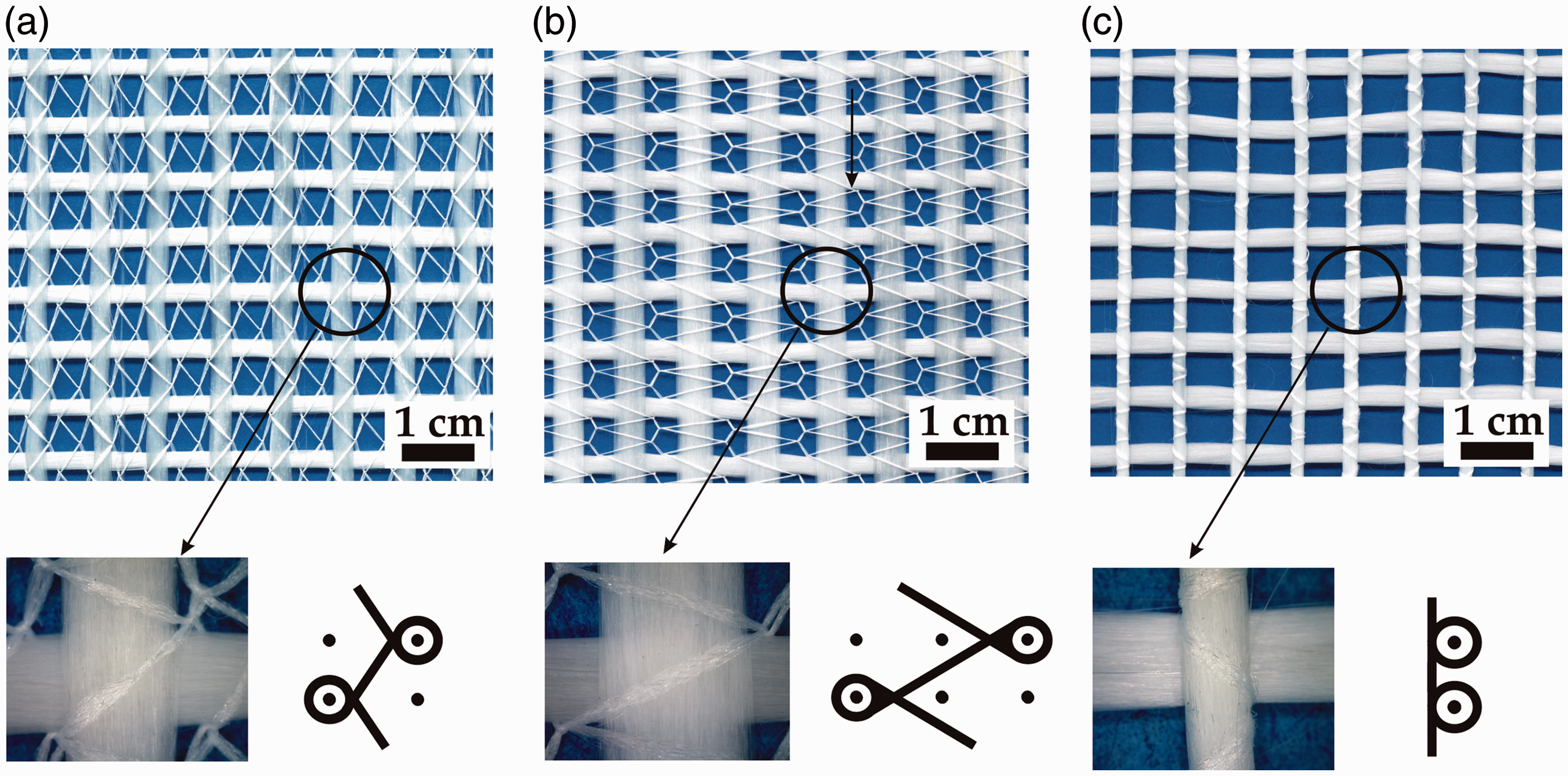
Manufacture of the concrete samples
The constituents of fine-grained concrete (kg/m3).

Tensile testing
The tensile properties of the rovings and warp-knitted fabrics were investigated by using a Zwick universal testing machine (model Z100). The free ends of the roving and fabric specimens were embedded in epoxy resin in order to prevent damage to the brittle rovings. Details of the test method and specimen geometry are provided elsewhere [25]. Rovings having a gauge length of 125 mm were tested to failure at a loading rate of 10 mm/min. Moreover, the warp-knitted fabrics were tested in the warp or machine direction, and their tensile properties were obtained with a 100 mm sample base and clamp movement of 10 mm/min. The tests were performed in accordance with ISO 13934-1.
The tensile strength was determined as the maximum applied force divided by the initial cross-sectional area of the specimen, and was calculated using equation (1) for the rovings and equation (2) for the fabrics [1].


The Young’s modulus was defined as the slope of the linear region of the stress–strain curve, for strains ranging from 0.25% to 0.5%.
Flexural testing of the concrete samples
Samples of cement composites were subjected to a four-point bending test. The flexural tests were performed on 30 × 60 × 180 mm specimens (these dimensions correspond to thickness, width and length) in a Zwick Z100 testing machine at a clear span of 60 mm. The specimens were tested at a constant loading rate of 1 mm/min in a standard climate at 20℃ and 65% RH.
Results and discussion
Tensile properties of the roving and fabric samples
Knowledge of the retention properties of fabrics and their constituent high-performance roving is essential for the selection of the most appropriate raw material, i.e. the material that exhibits maximum utilisation properties. Figure 2 shows the tensile strength of the rovings and the warp-knitted fabrics developed in this study; the column bars indicate the average tensile strength at a confidence interval of 95%. The strength of the fabrics is evaluated on the basis of roving and stitch type. In addition, the strength of each constituent roving is shown as a horizontal dashed line above the columns corresponding to the fabrics. This figure reveals the tensile strength utilisation of the original roving in a reinforcing fabric. The Young’s moduli of the roving and fabric samples are plotted in a similar manner (Figure 3). As the histograms show, the Young's moduli of the original rovings and the reinforcing fabrics vary significantly.
Tensile strength of the roving and fabric samples [1]. Young’s modulus of the roving and fabric samples [1].
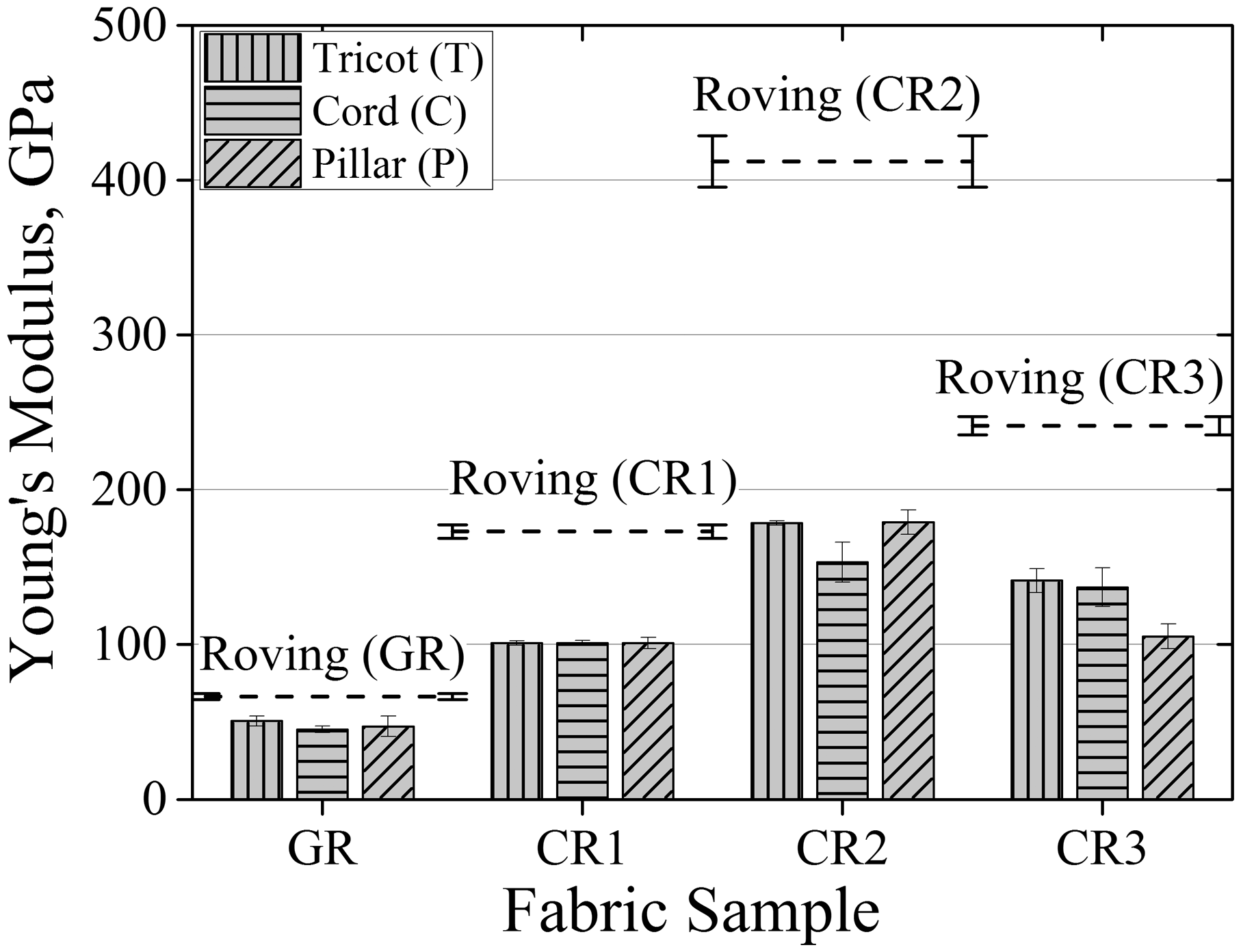
These rovings are interesting from an experimental viewpoint owing to the marked difference between their properties and (possibly) behaviour during the processing of the fabric. The use of the rovings in applications also depends on the processing parameters. Moreover, as Figures 2 and 3 show, the tensile properties vary significantly. These properties vary with the type of stitch used during fabric construction. In addition, the loss of strength results from damage to the roving during knitting and tightening of the knitting yarn around the rovings. The tricot (T) stitch leads to better tensile characteristics than the cord (C) and pillar (P) stitches; the pillar stitch results, in general, in the lowest tensile strength. In this case, the pillar stitch that has a round roving shape has the lowest tensile strength, owing to the high interfilament friction [1]. The value of the Young’s modulus is also influenced by the type of roving and the stitch pattern, whereas the tensile strength is relatively independent of these factors.
Fabric variables
The efficiency of textile reinforcement depends on the use of the properties of the original multi-characteristic rovings. The retention factor constitutes one of the main characteristics that determine the suitability of a fabric for use as reinforcement. This factor is calculated as the ratio of the strength or modulus values determined for certain process parameters, and the corresponding value of the original roving. This characteristic, i.e. the tensile strength retention (TSR), is defined as the ratio of the tensile strength of the original roving to the tensile strength of the fabric composed of these rovings [26, 27]. The TSR is calculated as follows

Similarly, the Young’s modulus retention (YMR) is determined from

The results obtained from equations (3) and (4) to determine the retention properties of the developed warp-knitted fabrics are shown in Figures 4 and 5, respectively. These properties vary significantly with the roving and knitting pattern. The glass roving (GR) exhibited excellent property retention, as evidenced by values of 86%, 87% and 76% (Figure 4) in samples that have tricot, pillar and cord stitches, respectively. However, the Young’s modulus of these fabrics was substantially reduced (Figure 5) with variations in the stitch pattern. This is evidenced by retention values of only 76%, 71% and 68% for samples with tricot, pillar and cord stitches, respectively.
Effect of the stitch pattern on the TSR and YMR. Effect of the stitch pattern on the YMR.
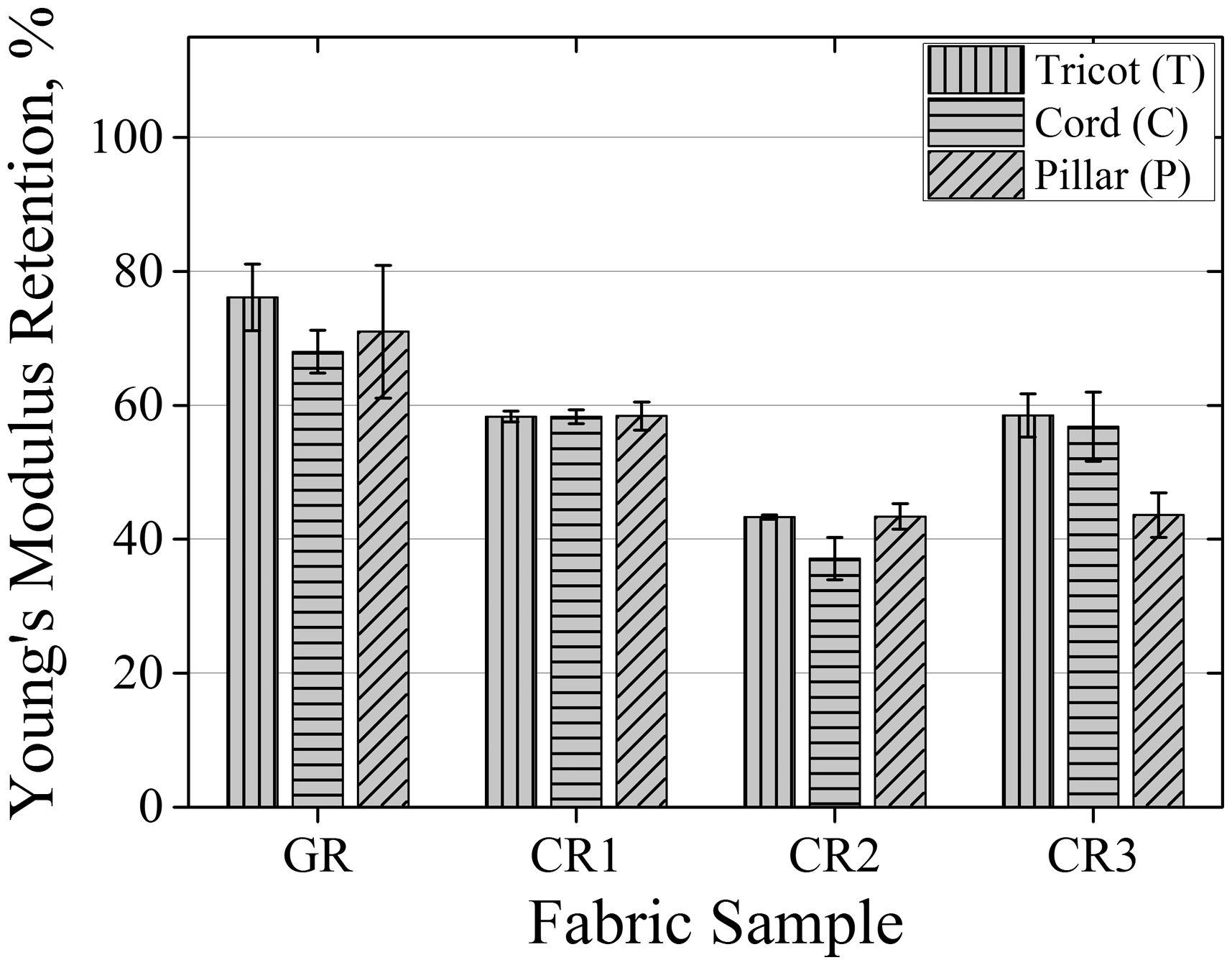
The highest TSR values, 87.6%, 80.9% and 69.1%, were obtained in the case of sample CR1, for rovings with tricot, cord and pillar stitches, respectively. Sample CR3 with tricot and cord stitches also exhibited excellent strength retention (>80%). Furthermore, for all three stitch types, the lowest TSR (65–76%) was obtained for sample CR2 and the highest YMR (∼60%) occurred in the case of CR1. In the case of sample CR3, the YMR was 56–58% for fabrics with tricot and cord stitches, respectively, and only 43.6% for the sample with the pillar stitch. Sample CR2 exhibited the lowest YMR (37.1–43.4%) for all three types of stitch. This is attributed to the fact that CR2 has the highest stiffness of all the carbon rovings. Therefore, this sample is extremely brittle and hence has only mediocre properties after textile processing.
The aforementioned analysis confirms that the TSR and YMR both depend significantly on the properties of the original roving. Samples of warp-knitted fabrics composed of glass fibres and carbon fibres CR1 exhibit retention of 70–80% and >80%, respectively, of the initial strength of the rovings. These samples exhibit, in general, minimal loss of strength during textile processing. In contrast to the TSR obtained after processing the roving into a warp-knitted fabric, the rovings have low YMR. The modulus of elasticity of all the samples decreased significantly after processing. The highest YMR (∼80%) occurs in the case of the fabric sample composed of glass rovings. A maximum value of 60% is obtained for sample CR1 that consists of carbon rovings. The YMR exhibits little or no dependence on the stitch pattern. In fact, samples with CR1 and CR3 have almost the same YMR, except for the sample with the pillar stitch. Moreover, sample CR2 that was fabricated from the roving with the highest Young’s modulus experienced a significant (i.e. 60 %) loss of strength.
The relationship between the tensile strength and the Young’s modulus of the rovings and the corresponding fabric properties are shown in Figure 6(a) and (b), respectively. In these plots, the strength and modulus of the rovings are shown on the y-axes, and the properties of the fabrics are shown on the x-axes. The dashed line drawn at an angle of 45° corresponds to complete translation of the roving properties to the fabrics. Ideally, all points should be located as close as possible to this line. The glass roving exhibits the highest retention (87%) of strength, irrespective of the type of stitches. All carbon samples lie below the line and the translation of strength from the roving to the fabric decreases with increasing strength of the (carbon) roving (Figure 6(a)). This also holds true for the Young’s modulus (Figure 6(b)). Therefore, the glass roving exhibits the highest level of property retention. The retention of the Young’s modulus in the carbon rovings decreased with increasing Young’s modulus of the original constituent roving. The decrease in the translation of properties results from the brittleness of these rovings. In other words, with increasing stiffness of the rovings, the filament is partially destroyed during straining, which in turn has a significant influence on the Young’s modulus.
Roving utilisation properties in the fabrics: (a) tensile strength and (b) Young’s modulus.
The effectiveness of the reinforcement warp-knitted fabrics in cement composites
The utilisation of the properties of the original rovings can be assessed by evaluating the reinforcement of cement composites. As such, the results of four-point bending tests of warp-knitted fabric-reinforced cement composites with various stitch patterns and roving types are shown in Figure 7. The figure shows that the original roving and stitch pattern have a significant effect on the flexural properties of the cement composites. In fact, the trends observed here are very similar to those observed for the fabrics (Figure 6). The maximum flexural strength of the samples with tricot and cord stitches is higher than those of the samples with pillar stitches. In the case of the concrete sample reinforced with the glass roving and carbon roving CR3, the samples with tricot, cord, and pillar stitches have maximum, intermediate, and minimum flexural strengths, respectively. The samples of concrete reinforced with carbon rovings CR1 and CR2 that have cord stitches have slightly higher flexural strengths than their counterparts that have tricot stitches. The sample geometry has, in general, an impact on the strength. Cord and tricot stitches belong to the same group (Figure 1) of stitches that have a flattened roving cross section. This cross section provides maximum load transfer and better bonding to the surface owing to a larger contact length, compared to that of pillar stitches [1]. Therefore, samples with cord and tricot stitches have slightly higher flexural strengths than samples with pillar stitches, which are attached to round rovings that provide an inadequate transfer of forces.
Maximum flexural strength of the concrete samples.
The strength of the concrete samples differs less than that of the fabric samples. This variation in strength constitutes (possibly) a key factor in the selection of an initial reinforcing material. Therefore, the feasibility of a particular type of roving was determined by evaluating the dependence of the flexural strength of the concrete samples on the tensile strength and Young’s modulus of the roving; these plots are shown in Figure 8(a) and (b), respectively. The concrete samples exhibit similar dependences to those observed (Figure 6(a) and (b)) for the fabric samples. The inclined dashed line shows the roving property utilisation of the concrete. The properties of the rovings lying above this line were better utilised than those of the rovings lying below the line. With a flexural strength of 7.5 MPa, the sample consisting of concrete and reinforced glass roving exhibits relatively good strength utilisation in the composite. The flexural strength of the samples reinforced with the carbon roving exhibits a similar trend to that of the strength of the reinforcing fabrics. The sample consisting of CR3 has the highest strength (up to 10.03 MPa in the case of cord stitch) and the strength decreases thereafter, even with increasing strength of the original roving. This decrease, as in the case of the reinforcing fabric, may have resulted from damage to the filaments of the roving during processing into the warp-knitted fabric. Similar behaviour was observed (Figure 8(b)) in the case of the Young’s modulus of the roving, i.e. the modulus reaches a maximum in the case of sample CR3 and decreases thereafter. In addition, owing to its high stiffness, sample CR2 exhibits the poorest utilisation properties of all the carbon-reinforced cement composites.
Roving utilisation properties in the fabric-reinforced cement composite: (a) tensile strength and (b) Young’s modulus.
A polynomial function was fitted to the data in order to determine the optimum strength and Young’s modulus of the rovings. The correlation between the tensile strength of the roving and the flexural strength of the concrete was well described by a second-order polynomial. In fact, the flexural strength increases initially with increasing tensile strength and decreases thereafter. The first derivative test can be applied to the polynomial function in order to determine the maximum value. The maximum value of the flexural strength corresponds to the optimum tensile strength or Young’s modulus of the original roving.
Optimal properties of the roving in the concrete.

The aforementioned results indicate that the composite samples exhibit smaller variations in flexural strength than the rovings with different strength characteristics. In fact, Figure 8 shows that the samples fabricated from glass rovings have comparable flexural strength to those fabricated from carbon rovings. Values of 7.2 MPa and 6.9 MPa for samples with tricot and cord stitches, respectively, confirm that the glass roving exhibits good utilisation of the strength properties. In other words, on average, two-thirds of the maximum flexural strength (10.18 MPa for sample with tricot stitch) is utilised. Among the carbon rovings, CR2 and CR3 exhibit the lowest and highest, respectively, utilisation of properties.
Statistical analysis
The effect of the roving parameters and the stitch type on the flexural properties of the cement composites was revealed via statistical analyses. These analyses were performed by using two-way ANOVA (analysis of variance) at a significance level of 0.05. Tukey HSD post hoc test was applied to determine which specific groups were significantly different from others.
Two-way ANOVA test results.

Tukey HSD post hoc test results.

Note: The same letter indicates that the difference of the means is not significantly different at the 0.05 level.
Practical application of the obtained results
The tensile characteristics of fabrics are fundamental to their selection for the reinforcement of composite materials. Manufacturers typically base selections on the guideline that the higher the strength of the reinforcing roving or fabric, the higher the strength of the composite material. However, this is not always the case. The aforementioned results revealed that, in some cases, the tensile characteristic of the original roving constitutes only a minor factor in the selection of the rovings. For example, the flexural strength of a composite sample reinforced with the glass roving was two-thirds of the maximum flexural strength achieved among all of the samples. This roving has, however, the minimum tensile strength and Young’s modulus, and is relatively low cost compared with the carbon rovings. In fact, the tensile strength of the glass roving is two and ∼2.4 times lower than the strength of carbon rovings CR1 and CR2, respectively. The corresponding Young’s modulus is several times lower than those of the carbon rovings.
The critical tensile characteristics of the rovings constitute another factor in the selection of the original material. Consider structures where significant weight and cost reduction are unimportant. The results indicate that in this case, the tensile strength constitutes the key factor in the selection of carbon rovings. The sample reinforced with carbon roving CR1 exhibited high-strength characteristics, although the tensile strength and Young’s modulus were lower than those of CR2 and CR3. Conversely, the samples reinforced with carbon roving CR2 had maximum strength and Young’s modulus but minimum flexural strength of the concrete samples reinforced with carbon roving samples. These result mainly from the brittleness of the carbon fibres and difficulty associated with textile processing. Therefore, we introduce the concept of the so-called critical high-strength properties of textile yarns. These properties correspond to the case where a certain level of yarn stiffness is not further improved when the yarn is processed into composites. The critical tensile strength and Young's modulus of the rovings used in this work are 1700–1870 MPa and 250–280 GPa, respectively (Table 3). These values constitute the maximum values at which the rovings can be reliably applied. The results of this work are applicable to fabrics developed with warp-knitting technology; these fabrics dominate the market of reinforcing textiles. The application of these rovings may be more economically feasible when compared with carbon rovings. In fact, the same reinforcing effect as that obtained with the use of carbon, can be achieved by using a significantly (i.e. an order of magnitude) smaller amount of glass fibres.
Conclusions
The influence of relevant fabric parameters, such as the knitting pattern, and the concreting manufacturing technique, on the tensile properties of the fabrics was described in this paper. The effect of the roving type was also investigated. Rovings with a wide range of tensile strength and Young’s modulus values were examined.
The experimental results revealed that the type of reinforced roving as well as the stitch patterns of the warp knits have a significant impact on the tensile properties of fabrics and cement-based composites. In general, fabrics with tricot stitches exhibit better strength characteristics than their counterparts that have cord and pillar stitches. The high-strength characteristics of the rovings have various effects on the properties of reinforced fabrics and cement-based composites. Furthermore, the loss of tensile strength resulted from needle punctures of, and hence damage to, the roving during the knitting process. The cheapest and most popular roving for concrete reinforcement is the AR-glass roving, which yields satisfactory results in terms of strength efficiency. Carbon rovings also constitute effective concrete reinforcements. However, owing to a loss of tensile strength, rovings with higher tensile strength and Young’s modulus exhibited lower reinforcement efficiency than their counterparts that have lower strengths and moduli.
Therefore, the roving type and stitch pattern have similar effects on the properties of the fabrics, depending on the magnitude of the strength and Young’s modulus of the original roving. Similar relationships were obtained when various rovings were analysed on the basis of stitch type, i.e. the tensile characteristics are determined by the fabric pattern and the properties of their constituent rovings. Moreover, optimal properties, as a function of the stitch pattern, were determined via statistical analysis conducted by using two-way ANOVA. The results showed that the stitch type and roving type have a pronounced effect on the properties, at a significance level of 0.05.
Footnotes
Declaration of Conflicting Interests
The author(s) declared no potential conflicts of interest with respect to the research, authorship, and/or publication of this article.
Funding
The author(s) received no financial support for the research, authorship, and/or publication of this article.