




Abstract
Auxetic materials are under great attention of researchers due to their excellent mechanical response under certain conditions. Previous works have been carried out in knitted or uni-stretch woven fabrics. In the present study, three-dimensional (3D) woven structures were produced and the effect of float length of ground weave and binding yarn on auxeticity of the fabric was investigated. Eight different 3D orthogonal woven structures/reinforcements were produced on rapier dobby loom by changing the float length in ground weave and binding yarns. Hand layup technique was used for composite fabrication, while green epoxy resin was used as a matrix. For investigating the auxeticity, 3D reinforcement samples were subjected to tensile loading and change in their thickness was measured. The results showed that 3D woven reinforcements with equal and maximum float length of ground weave and binding yarn showed greater auxetic behavior, because both weaves support each other and room for opening of structure increases. As the difference between the float length of ground weave and binding yarns increases, the auxeticity of reinforcement decreases because the ground weave and binding yarn cancel out the effect of each other. Moreover, the impact energy absorption of the developed composites was found to increase with the increase in float length, justifying that the structures are auxetic in nature.
Keywords
Introduction
The three-dimensional (3D) weaving involves interlacing of three yarns, i.e. the warp yarn and two weft yarns (ground yarn and binding yarn). Dual directional shedding systems are used in this technique, as the warp yarns are interlaced with two set of weft yarns. 3D weaving is the interlacing of a grid-like multiple layer warp sheet with the sets of ground yarn and binding yarn [1]. Nevertheless, the 3D woven fabrics can also be produced using conventional 2D weaving process, and can be either warp interlock or weft interlock [2]. Some of the most common examples of these 3D fabrics include terry fabrics, spacer fabrics, multilayer woven fabrics and shell fabrics [3]. 3D preforms have been developed to minimize the out-of-plane damage caused by 2D structures. These reinforcements aim to attain a balance between the in-plane and out of plane properties of woven fabric [4]. Especially for structural applications, 3D reinforcement should be recommended [5].
Auxetic materials tend to become thicker when stretched axially and vice versa. This occurs due to their hinge like structures, which become flexible when stretched. Auxetic structures show negative Poisson's ratio [6]. Auxetic textiles can be produced either by inherently auxetic fibers, helical auxetic yarn (HAY) or auxetic textile structures [7]. The auxetic materials have better energy absorption and resistance under the compressive loads than conventional materials [8]. This property, in combination with shear resistance, indentation resistance and fracture toughness, makes the auextic materials an attractive choice for applications such as automobile, aerospace, defence, sensors, and protection [9]. The auxetic materials can also serve effectively as filtration media. Material with different particle sizes can be filtered with the same filter using auxetic behavior. Auxetic material can be used for artificial blood vessel as wall thickness increases when the pulse of blood flows through it due to auxeticity [9]. Auxetic material or structure is also used in smart bandages impregnated with healing agents. When the bandage is applied on the swollen wound, it opens up to release the healing agent. When the wound heals and swelling decreases, the bandage pores will close, restricting the release of healing agent [8]. The synclastic curvature of auxetic materials makes it easier to produce curved surfaces that conform to the human body shape easily. Auxetic spacer fabrics are used as replacement of foam pads, as foam have low air permeability. It can be used in sports clothing for making knee pads, elbow pads, helmets and other applications. Auxetic yarns are used to make blast curtains due their good impact and indentation resistance [10].
Composites are fabricated by mixing two or more different materials to develop a new material that has better mechanical properties than its constituents, when used alone. Composite materials offer many advantages, e.g. less weight, higher strength, higher stiffness and toughness. There are various types of preforms used in composites. Woven fabrics are preferred for their structural stability. Composites are reinforced by stacking woven fabric layers over one another. But there are chances of delamination failure during performance. So, 3D woven reinforcements are used to overcome deficiencies of stacked reinforcements [11]. 3D woven preforms show better out-of-plane and interlaminar failure resistance [12]. Yi and Ding employed conventional shuttle loom for fabricating 3D preforms for composites [13]. Wambu and Anandjiwala also worked to reduce the occurrence of delamination as well as improving out of plane impact properties by through the thickness reinforcement [14]. Auxetic reinforcements are used in composites to enhance the energy absorption/impact resistance of the composite material [15]. In case of impact, the material bears a high force acting on it for a short interval of time. The high velocity impact has greater effect as compared to a low velocity impact for a long period of time [16]. During impact, the phenomenon of energy dissipation in composite and metal is totally different from each other. In case of low or intermediate impact energy, metals absorb energy through elastic and plastic deformation. If the load-carrying capability of metal is small, some permanent structural deformation (perforation) may occur, and its load-bearing ability will decrease [16]. Whereas the energy absorption in composite materials creates large areas of fracture, resulting in reduction of strength and stiffness [16]. In fiber-reinforced composites, impact resistance and load bearing capacity are greatly affected by fiber properties. The ability of a fiber ability to store energy elastically is the basic factor in determining the impact resistance of a composites in case of low velocity impact. The composite materials are robust if fiber diameter is large and offer higher strains to failure in case of fibers having small diameter. Various methods to fabricate auxetic composites have been found in the literature. The methods include (a) angle ply method, in which negative Poisson's ratio through thickness is achieved by arranging laminates in a certain sequence [17], (b) composites developed using impregnating DHY yarns with polymeric resin [18], (c) auxetic fabrics impregnated with polymeric resin [19], and (d) auxetic nanocomposites [20]. Jiang used unidirectional carbon prepreg sheets impregnated with epoxy resin to fabricate auxetic composites. Auxetic effect was achieved by stacking of sheets in the form of symmetrical laminates, with the ply sequence of ±θ with respect to the reference direction where θ = 0, 10, 15, 20, 25, 30 and 40°. Twenty-four fiber layers were used to produce these composites. The composite laminates exhibited NPR for θ values in the range between 15° and 30°, according to the theoretical prediction. Miller produced auxetic composites using DHY's impregnated with silicon rubber gel. DHY was produced using UHMWPE wrap yarns and polyurethane core material with different Young's modulus using an approximate wrap angle of 70° [21]. The recent study on auxetic composites was conducted by Steffens et al. [19]. In this study, high performance fibers such as Para aramid and ultra-high-molecular-weight polyethylene (Spectra) were used to develop auxetic structures with the help of weft knitting technology. These knitted reinforcements were impregnated with polymeric resins (epoxy and unsaturated polyester resins based on iso-phthalic acid) to produce auxetic composites. High performance fibers exhibited excellent impact resistance and energy absorption values, making them suitable for advanced technical applications [19]. Sugun and Sandeep used orthogonal weaving technique to fabricate integrally woven “T” stiffeners based on pleat formation concept. Carbon tows were woven on a customized automatic take-up rapier weaving machine. Dobby shedding mechanism with multi-beam warp let-off was used [22]. In a recent research conducted by Ma et al., comparison of ballistic impact damage was studied between 3D angle-interlock woven fabric and its reinforced composite. Experimental and numerical modeling was done to investigate their impact resistance under various ballistic strike velocities. Results concluded that the 3D woven composite has absorbed more impact energy than the 3D woven fabric under the high velocity impact ( < 350 m/s). And it showed the opposite trend under the “low” velocity impact (>350 m/s) [23].
Previous work is available on the auxetic behavior of 2D knitted or uni-stretch woven fabric structures. In our previous work, 3D woven auxetic composites with improved impact energy absorption were produced using orthogonal technique [24]. The current research is based on the same technique and focuses on development of novel 3D orthogonal auxetic structures with improved auxeticity. The effect of float length of binding yarn and ground weave on auxeticity of the structures was analyzed. Also, these 3D woven structures were fabricated into their corresponding composites which offer superior impact resistance properties. For their high energy absorption, good impact and indentation resistance, Auxetic woven fabric composites can be used in automobile industries, protective clothing (sports clothing and helmets) and blast proof curtains.
Material and methods
Construction of woven fabric samples.

Mechanical properties of cotton and jute yarns.

Design of experiment of 3D woven reinforcements.


Weft wise cross section of 3D orthogonal multilayer reinforcements (Texgen).
Cross-sectional image of real fabric is given in Figure 2.
Cross-sectional image of fabric in reinforcement form.
Specifications of green epoxy resin.

Testing was done at two levels, i.e. first at reinforcement level and second at composite level. In the first level, auxeticity of reinforcement was measured. All samples were subjected to a tensile load using Universal Testing Machine (Allroundline Z100, Zwick/Roell, Germany). The thickness of specimen, before and after tensile loading was measured using digital thickness tester according to standard test method ASTM D1777, and transversal strain was calculated. The values of axial and transversal strain were then used to calculate the Poisson's ratio using equation (1).
Interlocking pattern of binding yarn before and after tensile load. (a) Before axial load. (b) Aefore axial load.

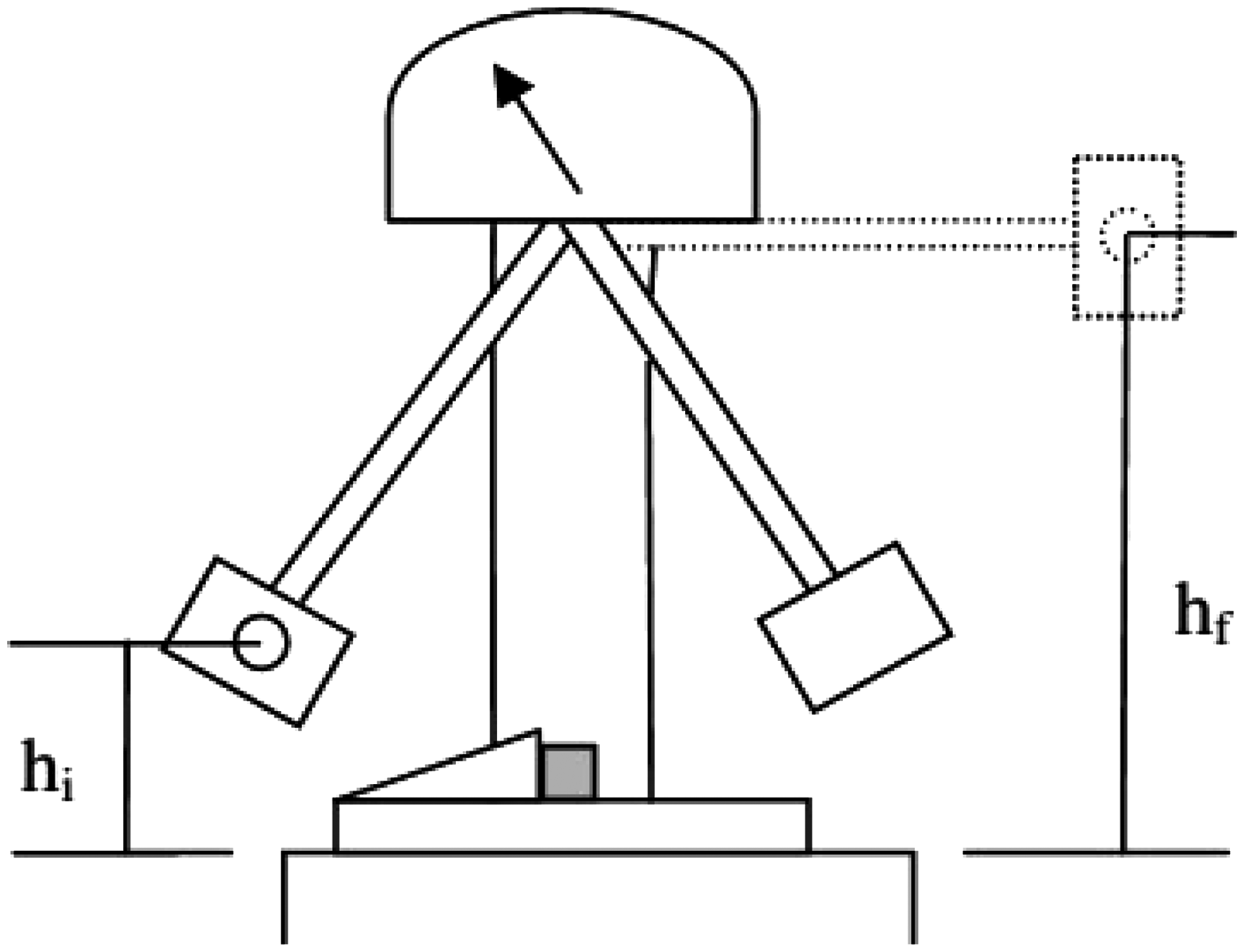
In the second step, the energy absorption of these composites is under impact loading. The impact testing was performed according to the standard test method ISO-179. In this method, a rectangular shaped (10 mm × 80 mm × thickness) composite sample is placed between two fixed supports of the tester. A pendulum of known weight positioned to a known height is then allowed to fall freely. When pendulum strikes the specimen, it exerts an impact load on the specimen and breaks the specimen, rising to a specific height. This difference between the initial and the final height is measured to calculate the amount of energy lost in fracturing the specimen. The total energy in fracturing the specimen can be determined by using the following equation
Schematic diagram of Charpy impact testing.
Results and discussion
Reinforcement auxetic behavior
Results of axial and transversal strains and Poisson's ratio of 3D woven reinforcements.

From the results given in Table 5, we can relate transversal strain with Poisson's ratio. It is observed that the transversal strain and Poisson's ratio have a direct relation with each other. More the increase in thickness, higher is the value of negative Poisson's ratio and vice versa. The results of negative Poisson's ratio showed that thickness of fabric is increasing due to the increase in length of specimen in warp direction. All the 3D woven reinforcements (except sample no 6) were found to be auxetic in nature, with maximum auxeticity exhibited by S4. The initial thickness (without any load) and final thickness (at 15.38% axial strain) of reinforcement are shown in Figure 5.
Thickness of samples before and after tensile loading.
It was observed that only a single sample S6 has shown positive Poisson's ratio that depicts that it is not auxetic.
Figure 6 shows the combined effect between transversal strain percentage and Poisson's ratio of all specimens. The behavior of float lengths of ground weave and binding yarn has been explained. S4 has showed maximum auxetic behavior. It has maximum float length in ground weave and binding yarn as shown in Figure 2 (S4). In combination both have supported each other and produced maximum auxeticity. The increase in fabric thickness was due to interlocking pattern of binding yarn. S3 & S7 have showed almost the same behavior, slightly lesser than S4. They both have a float length of 4/2 in binding yarn but have different ground weaves. Reduction in float length of binding yarn reduced the auxetic behavior. S1 and S8 were similar in terms of auxeticity. They both have the same length of binding yarn. S8 has greater length in ground weave, but lesser float in binding yarn has limited its auxeticity. It can be concluded that, float length of ground weave and binding yarn interact with each other to give rise to auxeticity. To exhibit auxetic behavior, the float length of binding yarn should be equal or near to the float length of ground weave. Also, the difference between the float length of ground and binding yarn needs to be less. If there is greater difference between the two, then there will be very less or negligible auxetic behavior.
Strain versus Poisson's ratio of 3D woven reinforcements.
S5 and S6 have same ground weave but different binding yarn float. S5 has equal number of yarns on both sides of binding yarn creating a balanced architecture that provides flexibility to behave as auxetic material. Whereas in S6 there is an unbalanced architecture and a tight ground weave, due to which yarn buckling occurs when tensile load is applied and no increase in thickness is observed (Figure 7). It can be concluded that, to exhibit auxetic behavior, there must be some flexibility in the structure which is not present in case of S6. Ground weave has limited the flexibility of binding yarn. That is the reason it has showed positive Poisson's ratio.
Comparing the auxetic behavior of S5 and S6. (a) S5. (b) S6.
Impact properties (for composites)
Different failure mechanisms (complete break & hinge break) were observed during impact testing. There are various factors that contribute to impact resistance of woven fabrics. One of the major contributing factors is woven architecture of fabric, which significantly affects the energy dissipation values. Energy dissipates in the form of kinetic energy, strain energy and friction energy. This difference in failure mechanisms was due to the difference in architecture of 3D woven fabrics. Cross-sectional view of composite before impact, hinge break and after impact is given in Figure 8.
Cross-sectional view of composite breaking behavior against impact: (a) composite before impact; (b) hinge break; and (c) complete break.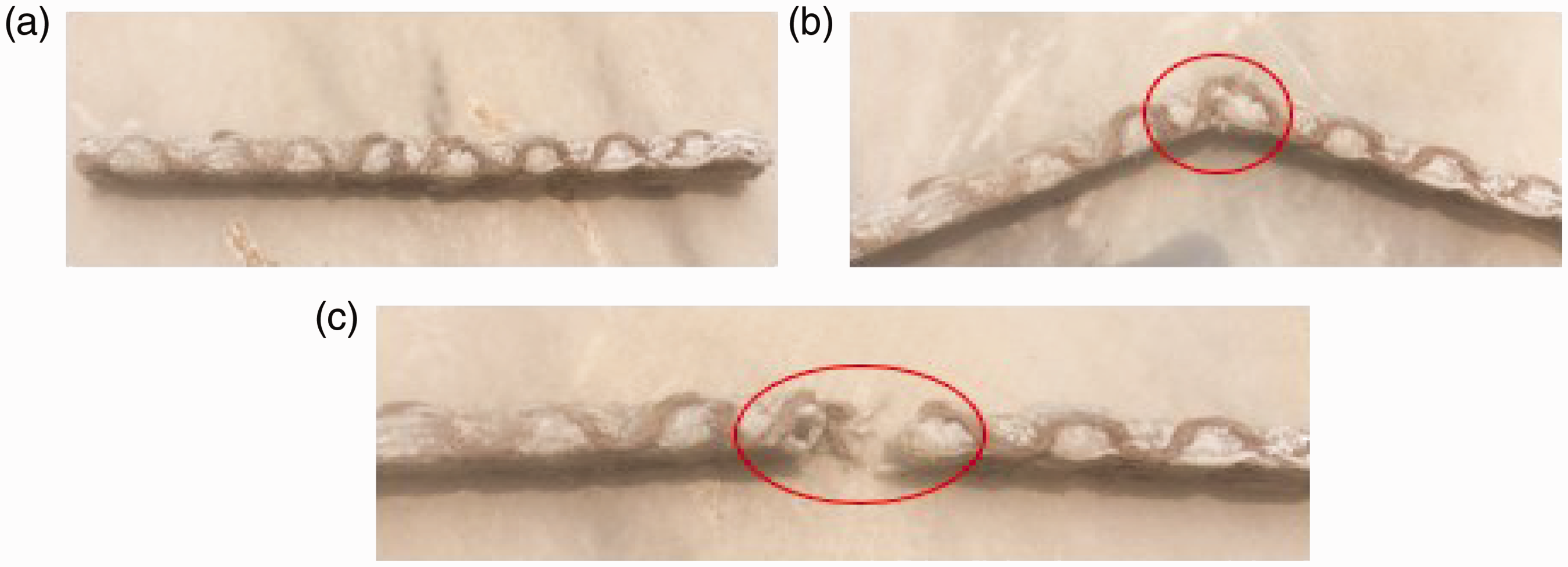
Impact energy absorption values of composites.

3D woven auxetic reinforcement was used in these composites. Impact strength of these composites is calculated by equation (3).

Impact strength of composites is given in Figure 9.
Impact strength of 3D woven composites.
It was observed from the results that energy absorption of composites varies with the variation of architecture of 3D woven reinforcement (different float length of ground weave and binding yarn). Trend line shows that impact strength increases as float length both in ground weave and binding yarn increases. Samples having greater float lengths both in ground weave and binding yarn absorbed more energy. This is due to the lesser number of intersection points. The specimen having more number of intersection points absorbed least amount of impact energy whereas specimen with higher float length absorbed higher impact energy due to flexible structure. As we know, intersection points has direct relation with compactness of structure [24]. Under the Charpy impact test, the energy dissipation values of the auxetic composites were greater as compared to the non-auxetic composite (S6). In auxetic reinforcement, there is always a room for hinges in the structure to expand. When auxetic materials are subjected to impact energy, more energy is dissipated due to flexible nature of structure. S6 has absorbed least amount of energy and showed brittle behavior due to rigid reinforcement as shown in Table 6. The rigidity in non-auxetic reinforcement (S6) structure is due to the excessive intersection points in ground weave.
Conclusions
In this research, the effect of float length of ground weave and binding yarn on auxeticity of 3D multilayer orthogonal through thickness fabrics (reinforcements) has been investigated. Results showed that float length of ground weave and binding yarn have a direct effect on Poisson's ratio. Float length of binding yarn in coordination with ground weave affects the auxeticity in such a manner that, with the increase in float length, the auxetic affect also increased. Specimen with combination of maximum float length in ground weave and in binding yarn exhibited maximum auxeticity. It is clear from the results that due to higher float length, there is greater room for hinges in structure to expand and produce auxetic effect. The float length of ground weave and binding yarn should be equal or near to each other for improved auxeticity. When they both were increased at equal interval, it exhibited greater auxeticity and when there was greater float difference between the two, it exhibited very little or negligible auxetic behavior. As energy absorption is concerned, composites having greater float length, both in ground and binding yarn showed better energy absorption values. As the float length is increased, the room for energy dissipation also increases due to mobility of yarns within the structure, while in shorter float lengths there would be higher number of interlacement points, creating a compact structure, which results in failure of structure when subjected to low velocity impact. Breaking behavior of auxetic composite is ductile. So, these auxetic composites have better impact resistance and energy absorption as compared to the non-auxetic composites. In conclusion, the impact strength of composites was improved by using 3D woven auxetic reinforcements. As indicated by the testing results, the impact properties of these composites have improved, therefore these composites may find their use in protective clothing (sports clothing and helmets), blast proof Curtains, and impact applications, e.g. automobiles, structural applications, etc.
Footnotes
Declaration of conflicting interests
The author(s) declared no potential conflicts of interest with respect to the research, authorship, and/or publication of this article.
Funding
The author(s) disclosed receipt of the following financial support for the research, authorship, and/or publication of this article: This work is supported by Higher Education Commission of Pakistan under the project NRPU 6072.