




Abstract
The results of acoustics tests of different structure woven fabrics are presented. The researches were performed in the aeroacoustic anechoic chamber. Ten fabrics were tested (four of them with honeycomb 3D design) to check their acoustic properties. The tests were conducted inside lower and medium acoustical frequency zones. The presented studies showed that all fabrics with honeycomb weaves had much less attenuation than other fabrics, mostly due to less dense structures at higher thicknesses and more open internal structures. Having analyzed the obtained results, some comments are shown and possibilities of using such woven structures are proposed.
Keywords
Introduction
The problem of noise is one of the fundamental issues that have a very significant impact on the comfort and safety of people [1]. Currently, noise is a common occurrence in the human environment. It is presented in all types of human environment and has adverse effects on human health, including hindering rest and regeneration. It reduces the efficiency of human work and also increases the likelihood of accidents at work. Long-term exposure to noise on the human body is also accompanied by deterioration of hearing or, in extreme cases, total deafness [2].
In modern times there are innumerable sources of noise. Machinery and equipment are the main sources of noise not only at workstations but also inside residential buildings and while using many utilities. Other sources like road traffic of noise are also common.
The well-being of people in a given place is closely related to the quality of the acoustic environment. For example, rooms with bad acoustic environments produce unpleasant sensations. If there are several people talking at the same time, the noise level is increasing and the speech understanding is hindered. The cognitive abilities of people in such places decrease significantly. Optimal acoustic environment plays a major role in dealing with it [3–5].
In order to improve the acoustic quality of the human environment, wide ranges of systems and materials are used. They mostly contribute to:
Reducing unwanted noise at a source; Managing the noise levels, for example by using different kinds of sound barriers; Interacting with noise, for example by using active noise controls.
The problem is complex because it depends on many factors, depending on the environmental conditions (for example room conditions and facilities) and, among others, the noise frequency ranges. This is the reason for using combinations of different methods to solve such problems.
Fibrous materials have been widely used in noise reduction due to their porous structures [6]. Researchers are still developing new materials that can absorb sound energy. They comprise experimental studies on acoustic properties improvements of rigid polyurethane closed-cell foams, by incorporating various quantities of textile wastes into the matrix. Obtained composite materials have better sound absorption properties when compared to rigid polyurethane foams. The noise reduction coefficient of the composite material with 40% textile waste and 60% rigid polyurethane foam is twice as high as the 100% rigid polyurethane material [7]. Various fibrous materials including inorganic and metallic fibers, synthetic fibers, natural fibers, and nanofibrous membranes for noise reduction are reviewed. The tailored cross-sections of synthetic fibers such as circle, hollow, and triangle are beneficial to improve acoustic absorption properties [6]. The use of material wastes, coming from the fibers of fluffs, when manufacturing the sound absorber products, can help to combat two different kinds of problems: the disposal of this kind of waste and the noise control [8].
Resistive screens or perforated plates are widely used upstream of porous materials. The upstream resistive layer can control the sound absorption of the porous multilayer material, while nullifying the acoustic properties of downstream layer. This upstream layer may be detrimental to sound absorption of porous multilayer materials. Any experimental validation on a porous multilayer, controlled by a woven textile, supports these findings. The sound absorption of a material with poor sound absorption can be enhanced with a conveniently designed resistive layer [9].
The main aim of this paper is to present the acoustic transmission losses of 10 different structures of woven fabrics and to investigate the influence of weaving on the acoustic attenuation of the fabrics under the presented tests. The patterns of weaves and their structures influence mechanical properties. The internal structures give different effects, for example of abrasion resistance and air permeability, deformability and complex shape forming including shearing properties [10–13]. It is interesting how the structures of fabrics influence acoustic attenuation and this is what this paper is focused on.
Subject of the study
Specification of the tested woven fabrics.

Parameters of the tested woven fabrics.

Description of the experiment
The individual fabrics were subjected to sound absorption tests in the aeroacoustic anechoic chamber in the Laboratory of Aeroacoustics of the Institute of Turbomachinery (Lodz University of Technology) to achieve free-field anechoic environment. Additional/further details about its acoustic characteristics and modernizations can be found in earlier papers [14–16].
The experiment included testing every fabric attached to a specially prepared frame (Figure 1, pos. 2) with fixing needles. The dimensions of the samples of each fabric were 150 cm × 150 cm (Figure 1, pos. 4).
Test rig: 1 – microphones, 2 – frame, 3 – sound source, 4 – fabric under test.
The tests were conducted inside lower and medium acoustical frequency zones (critical zones) since they include speech frequencies. The sound absorbing properties of the textiles are much better for higher acoustic frequencies [17–19].
All tests were performed using a directional sound source (Figure 1, pos. 3) powered by an amplifier (frequency response from 5 Hz to 60 kHz ± 1 dB). The frequencies were set up with a sinusoidal signal generator and in every case the signal profiles were checked with an oscilloscope. The signal amplitude was set up as 300 mV and further amplified before going to the sound source. Before the presented tests, the measurement system was checked without any fabrics. Three half-inch microphones with built-in preamplifiers (Figure 1, pos. 1; sensitivity 50 mV, frequency range from 3.15 Hz to 40 kHz with polarization 200 V) were used after having been calibrated. Two of them were in front of the sound source and the values of the sound at the distance of 1 m (0.1 m behind the frame plane, Figure 1, pos. 2) were measured. They were placed symmetrically at the height of the main axis of the sound source. The distance between them was 0.100 cm in the horizontal plane. The third microphone (for measuring the reference of the sound level during all tests) was aside the frame at the distance of 0.100 m, also at the height of the sound source main axis (Figure 1, position of microphone 3). The axis of the third microphone was directed at the center of the sound source output plane. According to standards, for all acoustic measurements the reference acoustic pressure level p0 was 20 μPa.
For every individual measurement case, the sample time window was t = 10 s and the sampling frequency fs was setup as 50 kHz using the multi-channel data acquisition system (1.5 million of data in every measuring case). After analog-to-digital conversion the data were sent to the computer by Ethernet connection for recording and further analysis (more details are in [20,21]). The method of gathering and treatment of the test data is described in earlier tests [22,23]. According to the producer of the acoustic test system, the measurement inaccuracies were not higher than 0.3 dB [14,18].
Before the main tests, the measuring system was checked without any fabric. The values of sound levels were measured for the chosen frequency range. These reference results are presented in Figure 2. During that part of the presented research, it was checked that, according to standards, the sound generating and measurement systems had flat characteristics (±3 dB) in the whole tested frequency range (Figure 2). As it can be seen the results from microphones 1 and 2 were almost identical, from statistical point of view they are not significant and within the inaccuracy range. Later, these results were treated as the reference base for comparisons of sound pressure levels. According to standards, for every fabric the octave frequencies were used, i.e. 63 Hz, 125 Hz, 250 Hz, 500 Hz, and 2 kHz.
Reference sound levels of the microphones: L1 and L2 – behind the plane of the frame; L3 – aside of the frame (for reference purposes).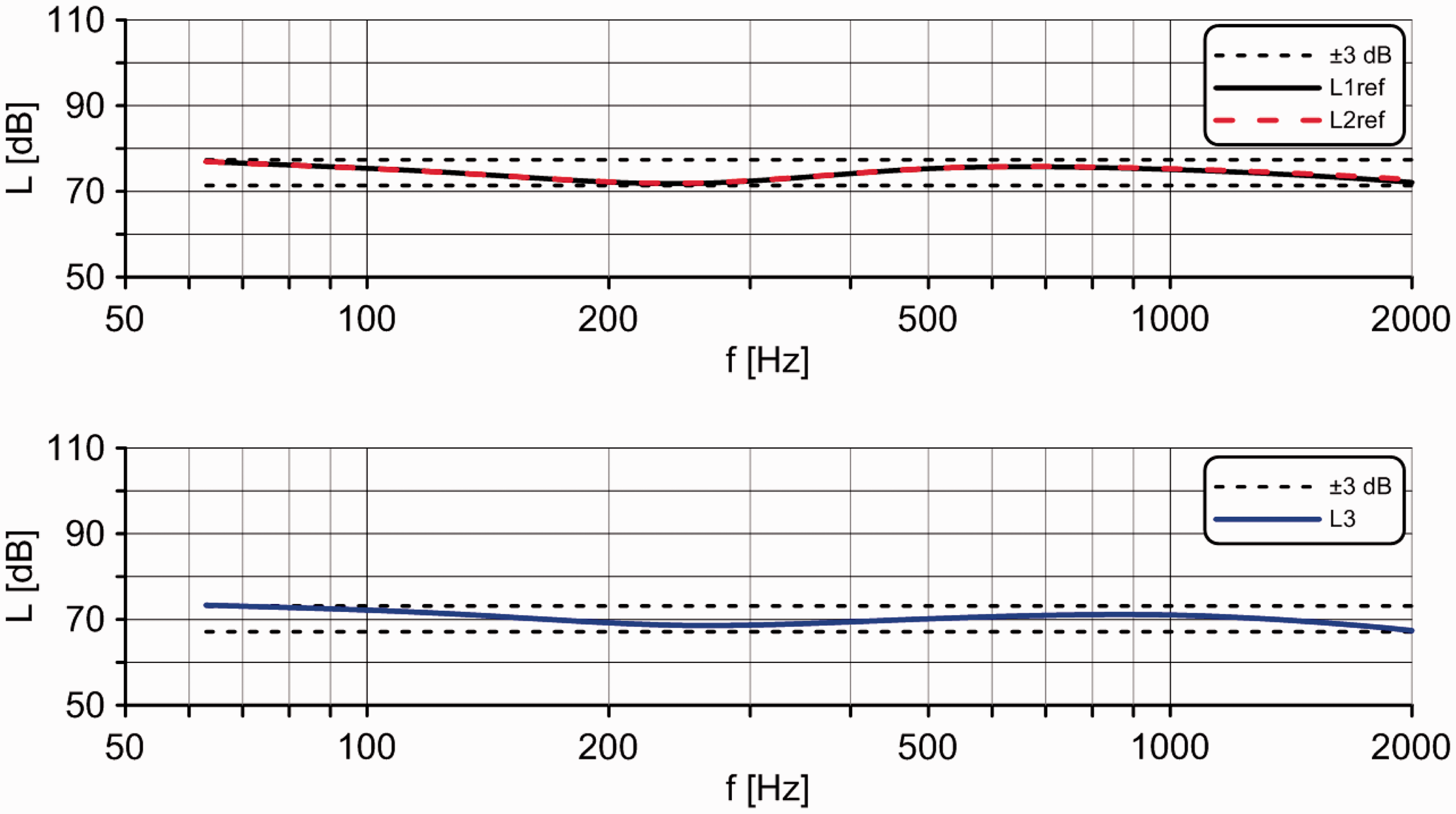
Results and discussion
The results of the presented acoustic measurements are shown in Figures 3, 4, and 5. They are grouped according to the type of the fabric: Figure 3 for A (double cloth with acrylic weft), B (back weft weaves with acrylic weft), and C (canvas weaves with acrylic weft); Figure 4 for D (honeycomb weaves 30/30 with cotton weft), E (honeycomb weaves 15/15 with acrylic weft), F (honeycomb weaves 30/30 with acrylic weft), and G (honeycomb weaves 30/30 with Trevira weft); Figure 5 for H (plain weave with acrylic weft), I (satin weaves 1/9 with acrylic weft), and J (twill weaves 1/3 with acrylic weft). As it can be seen, similar results were obtained in every presented group; anyway, for the honeycomb fabrics (D, E, F, and G) much better results had been expected due to their three-dimensional structures and greater values of their thickness. However, flat sound absorption characteristics in these cases can be used in some usage in everyday life, architecture, sound systems, etc.
Sound pressure level drop of the following fabrics: A – double cloth with acrylic weft, B – back weft weaves with acrylic weft, and C – canvas weaves with acrylic weft. Sound pressure level drop of the fabrics with the honeycomb weaves: D – honeycomb weaves 30/30 with cotton weft, E – honeycomb weaves 15/15 with acrylic weft, F – honeycomb weaves 30/30 with acrylic weft, and G – honeycomb weaves 30/30 with Trevira weft. Sound pressure level drop of the following fabrics: H – plain weave with acrylic weft, I – satin weaves 1/9 with acrylic weft, and J – twill weaves 1/3 with acrylic weft.
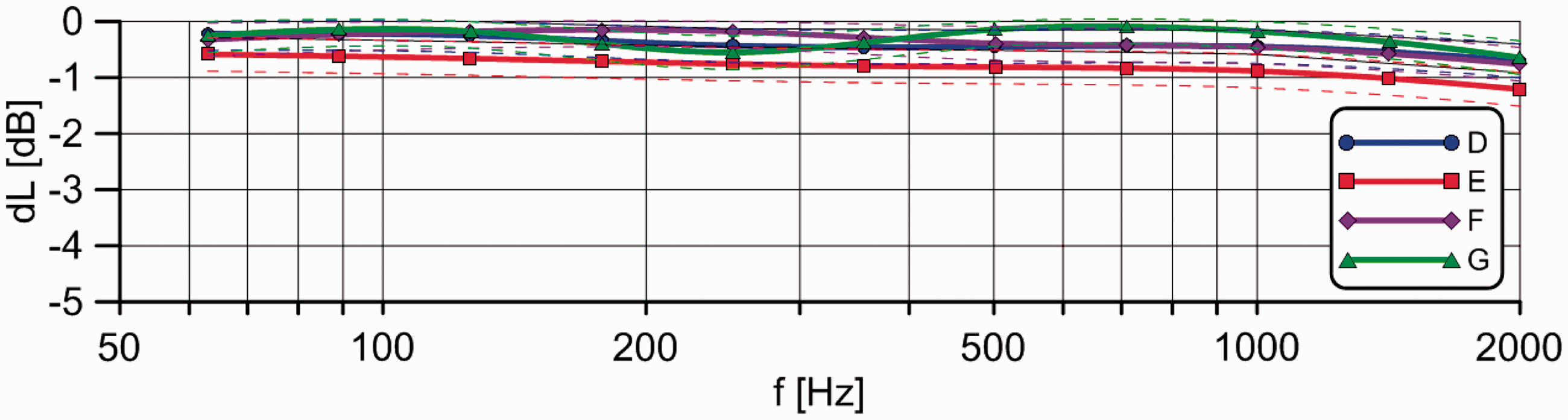

This type of fabrics can be considered as three-dimensional since the thickness is much higher when compared with other fabrics. In this case, the porosity is higher and the sound transfer is easer due to open spaces between yarns. To analyze how raw material can influence on the acoustic attenuation additionally fabric D (with cotton weft) and fabric G (with Trevita weft but basing on the same pattern as fabric F) had been produced.Smoother Trevira and cotton wefts did not close the air pores so the fabrics D and G practically did not absorb the sound. Comparison of fabric E (honeycomb weaves 15/15 with acrylic weft) and fabric F (honeycomb weaves 30/30 with acrylic weft) showed that Fabric E had better acoustic attenuation. The pattern of this fabric was smaller; its structure was denser so sound had more difficulty to pass through the fabric.
In Figure 3, it can be seen that the double-cloth weave has the best acoustic attenuation. The density of the weft is very high and its internal structure is very compact, so the fabric has higher acoustic attenuation. The structure of canvas weave gives small pore sizes in the middle of its pattern hence the transfer of sound was easier. Some intriguing results can be seen in Figure 5 with the comparison of well-known weaves: plain, satin, and twill. These flat fabrics showed quite decent results when compared to others with different weaves.
The comparison of overall (i.e. for the whole tested sound frequency range) sound pressure level drops of all fabrics’ configurations are shown in Figures 6 and 7. The cases D and D1 were for the same fabric but examined in different configurations. For the first case (D), the fabric was hooked and slightly strengthened on needles around the perimeter of the frame, as other fabrics. For the second case (D1), it was hung freely on the upper part of the frame, i.e. without any material tension. The purpose of this test was to check whether the fixing method may have any effect on the fabric sound absorption. From the obtained results it appeared that the method of hanging on the frame in the case of the fabric D (honeycomb weave 30/30 with cotton thread) did not significantly influence the test results (Figure 7).
Comparison of overall sound pressure level drops of all fabrics configurations. Influence of the method of fabric hanging: D: the fabric slightly strengthened on needles around the perimeter of the frame; D1: the fabric hung freely on the upper part of the frame.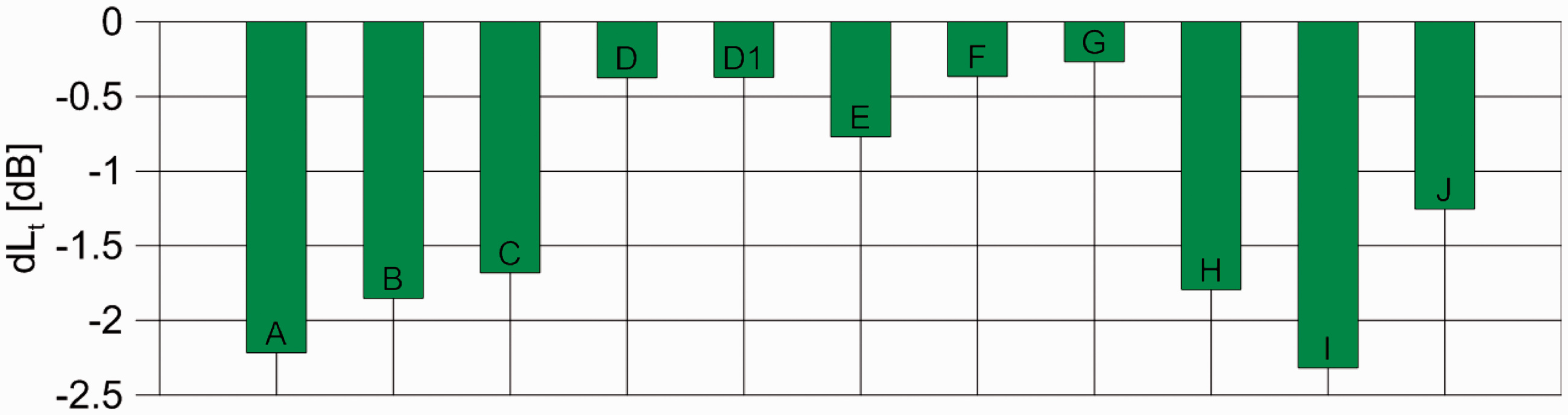
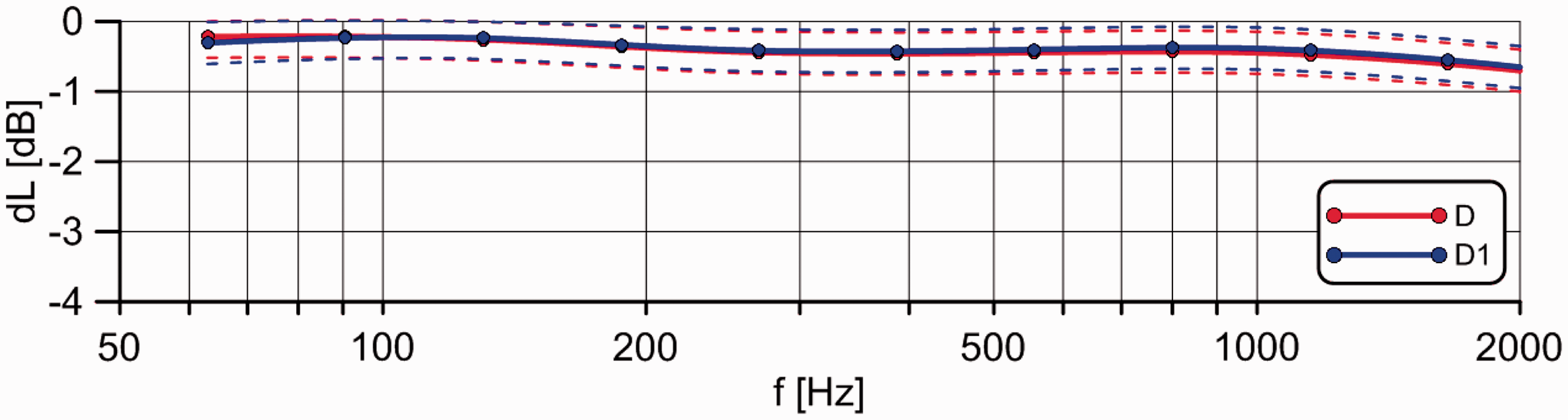
The results for the fabrics with the honeycomb weaves (i.e. with the greater thicknesses and three-dimensional structures, and which had been expected to show better absorbing possibilities than the classical fabrics) were different from the expectations due to their low sound absorption possibilities (Figure 6).
The comparison of only the honeycomb weaves shows that smaller patterns (fabric E, 15 by 15 yarns) gave better results of overall absorption in the tested sound frequency range. The acrylic yarn used for weft (fabric F) characterizes with better acoustic attenuation when compared to the cotton (fabric D) and Trevira (fabric G) ones. This phenomenon could be explained by the fact that the acrylic yarn has hairy surface. In this case, the free area between yarns in the structure of a fabric is smaller due to the overhanging fibers from the surface of the yarns. Having optically analyzed these fabrics, it was found that the results can be also explained by presence of many emptier inside spaces (i.e. more open structures) and a lot of small area “holes” allowing an easier pass of acoustic waves through them, so it was observed that the thickness did not play an important role if the structure too was opened (Figure 8(a)). Satin weaves present denser structure (Figure 8(b)).
Structures of chosen fabrics: (a) honeycomb weaves (fabric F); (b) satin weave (fabric I).
In order to perform a more detailed analysis, the obtained results were also grouped by the fabrics parameters as shown in Figure 9. Since the measurements were performed for every individual frequency of the emitted sound, the overall acoustic pressure drops were calculated by integration of the results based on the frequency domain [3]. It was found that optically “denser” fabrics (I - satin, A - double cloth, and B - back weft weaves (B) have the highest acoustic attenuation possibilities (Figure 3). The structures of these high-density fabrics are more closed when being compared to the woven fabrics. The plain weave (H) has quite high acoustic attenuation just because free areas between yarns are closed by overhanging fibers from the surface of the yarns.
Comparison of overall sound pressure level drops vs. fabric parameters: the warp density, the weaving density, mass per unit area, and the thickness.
In contrast to the expectations of spatial fabrics, they are characterized by some low sound absorption. Nevertheless, as it was expected, sound absorbing properties of weaves are better at higher frequencies. Thickness is not the primary criterion for the contemporary fabric. Areal density of a fabric was also found to be of importance.
Design of a structure of fabrics influences the density of the warp. All fabrics were made on the same loom with constant density 30 warp/cm but internal stresses changed it as it is shown in Table 2. These changes also influenced the areal density. Higher density of yarns influenced higher areal density and consequently higher acoustic attenuation (Figure 9). The tests showed that thickness did not positively influence acoustic attenuation. The most important for sound absorption was found to be the areal density together with the density of yarns.
Summary and conclusions
As it was expected, all tested fabrics have low sound absorbing properties at low frequencies. The presented studies also showed that all fabrics with honeycomb weaves have much less attenuation than other fabrics. Low attenuation of these fabrics is likely due to their similarity to fabrics with less number of threads per centimeter, resulting in less dense structures at higher thicknesses. Other woven fabrics are more compact and much thinner, what results in good sound absorbing properties. The research proved that the best absorbing properties were in the cases of satin, double cloth, and back weft weaves.
It was also found that the method of fixing fabric D (cases D and D1) had no effect on sound absorption; however, just one case (i.e. without complicated folding) was effectively tested.
As the material gets thicker, the study did not show any significant increase of sound absorption at low frequencies that are the most difficult to be absorbed. However, at higher frequencies thickness also had an insignificant effect on sound absorption. It can be concluded then that if there is air space inside and behind a fabric, sound absorption possibilities move through the frequency range. Similar results were obtained by other researchers using different testing methods (inside a reverberation room) for cases of coated and uncoated textiles [24].
The proposed honeycomb fabrics can be used in combination with other acoustic adaptations, such as partially blocking and transmitting the sound to a deeper sound damping installations that, due to different reasons, must be otherwise hidden. They can also be used, for example, as covers for voice or loudspeakers systems. The honeycomb fabrics could protect the loudspeaker against the wind or different weather conditions without negatively affecting the good quality of the sound. In such cases, modern printing techniques allow creating interesting artistic decorative motifs, for example in concert halls, where acoustic performance is critical, and fabric’s job is not only to absorb sound itself but also to allow other acoustic sound adaptations behind the fabric to absorb sound in more predictive manner. In such cases the main task of a fabric is not to hinder or reflect the sound but to control the hall or room environment and act as additional finishing protective layer [9]. More tests are planned to perform further researches, among others, also including boundary layers of fabrics, i.e. in close proximity to the surface structures of a fabric, similar to other studies [23].
The presented results can be useful also for interior designers and architects as the experiments were performed for the first time on such materials and compared next to standard fabrics.
The study helped to identify the best samples of woven fabrics with different weaves in terms of sound absorption. Moreover, the tests allowed determining what parameters of the fabric are affected on insulation or sound permeability. The presented researches showed one of the ways to design the most optimal weaves of woven fabrics, in this case from the point of view of acoustic attenuation. To obtain more detailed information about the discussed phenomena, further researches of modern fabrics with different patterns are to be performed.
Footnotes
Declaration of conflicting interests
The author(s) declared no potential conflicts of interest with respect to the research, authorship, and/or publication of this article.
Funding
The author(s) received no financial support for the research, authorship, and/or publication of this article.