



Abstract
This study explores and discusses the structure of two-dimensional (2D) jacquard woven fabric and its weave pattern. The aim of the study is to propose a methodology focused on the definition of threads interlacing in the 2D jacquard woven fabric and thereby determine the interlacing weave factor. The interlacing weave factor is known from dobby fabrics where many contributions have been made to express the interlacing of threads in the weave repeat. These are mainly purely experimental approaches. The calculation of the weave factor of jacquard fabrics has not yet been published. The proposed methodology defines the jacquard fabric pattern and its threads interlacing comprehensively based on the interlacing structural cells (SCs). The weave factor expressed on the basis of SCs describes the jacquard pattern comprehensively from the perspective of the combination of weaves forming the resulting pattern of the jacquard fabric. The proposed methodology can analyze SCs based on both the absolute frequency and the relative frequency related to the entire weave of the jacquard fabric pattern. From a practical point of view, the weave factor defines the degree of floatation in the weave. The weave factor is used to recalculate the thread density of plain weave to the thread density of non-plain weaves or pattern. The cohesion of the fabric depends on the interlacing and density of the threads. In fabric construction, the rule applies: when the floatation increases, the thread density must increase. In practice, the proposed weave factor is used to calculate the thread density in a jacquard fabric with combination of non-plain weaves.
Introduction
The jacquard woven fabric is a fabric where the color image is transferred to the woven fabric structure by interlacing of the threads.1–3 2D jacquard woven fabric is defined by one warp and one weft system. Individual image colored areas are transferred to the structure by combination of two or more weaves, where the number of colors determines the number of weaves. In this case, the interlacing of threads in jacquard fabrics is related to the complexity of the image. There is no image in electronic form that could not be transferred to the woven fabric. The image parameters (raster, pixel, pixel density, image color, image shape – the shape of the curves and areas in the image) are compatible with the fabric parameters (raster = warp and weft system, pixel = binding point, pixel density is the number of threads in the warp and weft, image colors = threads colors, image shape – the shape of the curves and areas in the image = individual warp threads control by the jacquard mechanism, area = width and length of the pattern). The interlacing of individual weaves and the repetition of weaves is given by the arrangement of the entire image in the area of the fabric.4–6 In terms of the arrangement of the pattern with respect to the fabric width it is possible to divide into (a) one pattern repeat per fabric width – in this case the width of the jacquard pattern repeat is equal to the width of the jacquard woven fabric, and (b) pattern repetition per fabric width – in this case the width of the jacquard pattern repeat is smaller than fabric width, and the pattern repeat is repeated regularly several times across the width of the fabric according to the composition of the fabric and the possibility of arranging the lifting cords of the jacquard shed mechanism. 7 The warp threads are individually controlled by the hooks and lifting cord of jacquard shed mechanism of the weaving machine. The number of hooks determines the number of differently interlaced warp threads in the patterns.
In jacquard fabrics, the planar and spatial geometry from the point of view of interlacing is defined by the combination of weaves located in the areas of the input image. The individual combination of weaves for preparation of patter in jacquard are based on the weaves used in the construction of dobby fabrics. The basic description and definition of weave varies along with the perspectives of different authors.8–14
Generally, a weave is defined as a method of the interlacing of threads, with emphasis given to patterning. The basic division of weaves according to these authors is based on basic weave groups, weaves derived from basic weaves, randomly arranged weaves, patterned weaves, and other criteria.8,13 Other authors such as have also been conducting research into thread interlacing in woven fabrics, defining the structural arrangements of binding points in basic weave patterns and selected derived weaves.15–23
No contribution is focused on the interlacing weave factor of jacquard fabric patterns. The proposed methodology defines the jacquard fabric pattern and its threads interlacing comprehensively based on the interlacing structural cells (SCs). The SCs define the mutual interlacing connection between two adjacent warp and two adjacent weft threads. SCs appear to be a tool for identifying and analyzing interlacing threads of a pattern in jacquard fabrics. The weave factor expressed on the basis of SCs describes the jacquard pattern comprehensively from the perspective of the combination of weaves forming the resulting pattern of the jacquard fabric. The study presents a comparison with the weaves of dobby fabrics. In addition to the weave factor of jacquard fabric, the proposed methodology can analyze SCs based on both the absolute frequency of individual SCs and the relative frequency related to the entire weave of the jacquard fabric pattern.
Methodology for definition of structural interlacing cells for jacquard 2D woven fabric
No contribution has been published in the past on the analysis and identification of the interlacing of the structure in jacquard woven fabric patterns from the perspective of its planar and spatial geometry. The literature search shows that the focus of the contributions is in relation to the motif of jacquard fabric, the processing of the motif and the esthetic aspect of jacquard fabric as a work of art.1,24–27 The first basic element of a fabric is a binding point – warp or weft. The second important element from the perspective of interlacing identification is the SC. The binding point describes the warp and weft threads from the position of the face of the woven fabric. The SC defines the mutual interlacing connection between two adjacent warp and weft threads. The size of the SC is 2 × 2 threads (two adjacent warp threads and two adjacent weft threads). From the perspective of the structure and geometry of woven fabrics, it is true that the fabric as a cohesive system is given by the mutual force interaction between the threads of the warp and weft system, which arises from the mutual crossing of these threads. In floatation, the basic element of the fabric – the binding point – can also be defined, but the floatation position of the warp and weft binding point does not create a force interaction, the mutual cohesion of the thread systems in the fabric is zero. From the perspective of the definition of structural cells (SCs) in the mutual interlacing between two adjacent warp and weft threads, there are only four SCs it is possible to identify in the weave/pattern with marking SC1–SC4. The calculation of geometric relationships in SCs uses the Pythagorean theorem with a linear description of the shape of the binding wave. The linear model15,21,27,28 is sufficient to describe the length of the binding wave thread. The definition of the structure of individual cells SC1–SC4 shows Figure 1–5. Figure 1 shows presentation of structure of the SC1, including schematic drawing of SC1 in the pattern grid. The schematic drawing of SC1 in the pattern grid can be in face-side or back-side form, see Figure 1(b). The SC1 creates full crossing of two adjacent warp threads and two adjacent weft threads in the longitudinal and transverse directions. This is a cell with a double-sided effect. The SC1 is a symmetrical cell containing only crossing points in both the longitudinal and transverse directions of the woven fabric, see Figure 1. The structural cell creates the most cohesive bond of threads in the fabric based on the mutual force between the warp and weft threads.

The structure of SC1: (a) planar and cross-section presentation and (b) schematic representation of face-side and back-side of SC1, including color presentation of SC1.

The structure of SC2: (a) planar and cross-section presentation and (b) schematic representation of face-side and back-side of SC2, including color presentation of SC2.

The structure of SC3(→): (a) planar and cross-section presentation and (b) schematic representation of face-side and back-side of SC3(→), including color presentation of SC3(→).
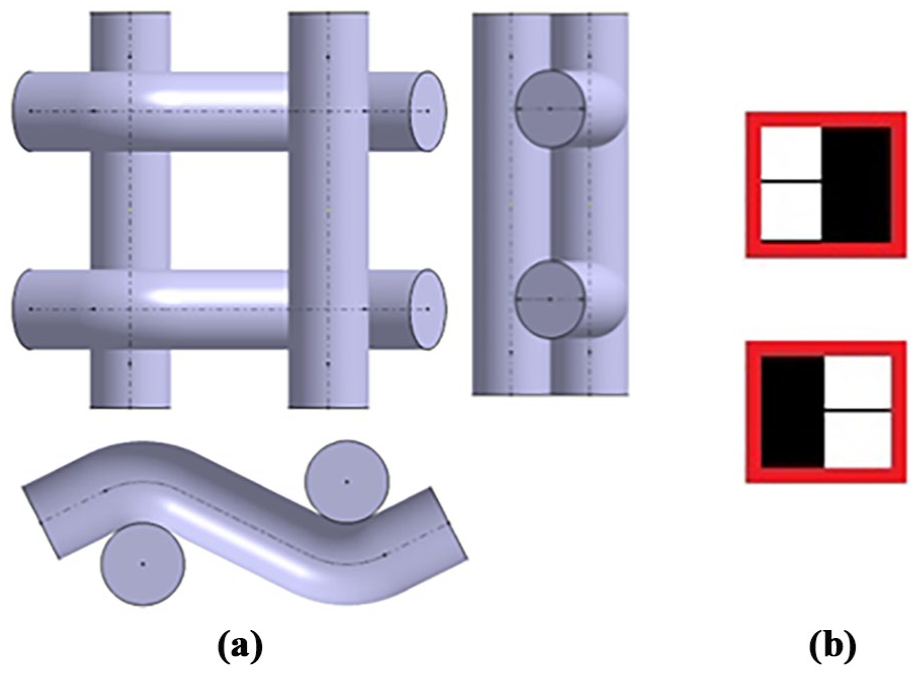
The structure of SC3(↑): (a) planar and cross-section presentation and (b) schematic representation of face-side and back-side of SC3(↑), including color presentation of SC3(↑).

The structure of SC4: (a) planar and cross-section presentation and (b) schematic representation of face-side and back-side of SC4, including color presentation of SC4.
The SC1 limit dimension in the geometry of a square balanced woven fabric with a limit threads arrangement is given by the limit spacing of the warp A(SC1) and limit spacing of weft threads B(SC1). The limit spacing it is possible to recalculate by equation (1). The calculation of geometric relationships in SCs uses the Pythagorean theorem with a linear description of the shape of the binding wave.27,28 The mean thread diameter dmean is given by equation (2) where d1,2 are diameter of warp and weft threads (note: warp and weft thread diameter is equal for square balanced woven fabric).


Figure 2 shows presentation of structure of the SC2, including schematic drawing of SC2 in the pattern grid. SC2 creates a partial crossing of two adjacent warp threads and two adjacent weft threads in the longitudinal and transverse directions. This is a cell where the position of the threads can create a warp or weft effect, not a double-sided effect as SC1, see Figure 2(b). Face-side and back-side of fabric given by schematic representation of SC2 shows Figure 2(b). The SC2 is a symmetrical cell containing only a partial crossing of the threads in the cell area with respect to both the longitudinal and transverse directions of the fabric, see Figure 2(a). The SC2 does not create the most cohesive bond of threads in the fabric compared to the SC1. Due to the floatation position of one thread in the cell, see Figure 2(a), the mutual force interactions between the warp and weft threads at a given location of the binding cell are zero.
The SC2 limit dimension in the geometry of a square balanced woven fabric with a limit threads arrangement is given by the limit spacing of the warp A(SC2) and limit spacing of weft threads B(SC2). The limit spacing it is possible to recalculate by equations (3) and (4). The equations expressed the average limit spacing of the limit threads arrangement in the weave repeat with number of warp n1 and weft n2 threads. The calculation of geometric relationships in SCs uses the Pythagorean theorem with a linear description of the shape of the binding wave.27,28 The weave repeat is generally defined on the basis of the crossing – transition sections of the warp pp1 and weft pp2 threads as well as the float sections.


Figures 3 and 4 show presentation of structure of the SC3 with division into the SC3(→) and the SC3(↑), including schematic drawing of SC3 in the pattern grid. The SC3 creates a partial crossing of two adjacent warp threads and two adjacent weft threads in the weave in the longitudinal or transverse direction. This is a cell with a two-sided effect. Face-side and back-side of fabric given by schematic representation of SC3 shows Figures 3(b) and 4(b). This is a directional cell: transverse SC3(→) and longitudinal the SC3(↑). The SC3 is the only asymmetric SC in fabric pattern. In SC3, two adjacent threads in one direction have a mutual bond in full cross, and two adjacent threads in the other direction are fully floated, see Figures 3 and 4. The calculation of geometric relationships in SCs uses the Pythagorean theorem with a linear description of the shape of the binding wave.27,28 The force bonds in the interlacing create only one direction of the threads, in the other, based on full floatation, the force bonds are zero. SC3 does not independently create a cohesive bond of the threads in the woven fabric. SC3 is characteristic for pattern of the rep weave derived from the basic plain weave.
The SC3 in case of SC3(→) the limit dimension in the geometry of a square balanced woven fabric with a limit threads arrangement is given by the limit spacing of the warp A(SC3(→)) and limit spacing of weft threads B(SC3(→)). The calculation of geometric relationships in SCs uses the Pythagorean theorem with a linear description of the shape of the binding wave.27,28 The limit spacing it is possible to recalculate by the equations (5) and (6).


The SC3 in case of SC3(↑) the limit dimension in the geometry of a square balanced woven fabric with a limit threads arrangement is given by the limit spacing of the warp A(SC3(↑)) and limit spacing of weft threads B(SC3(↑)). The limit spacing it is possible to recalculate by the equations (7) and (8) (note: warp and weft thread diameter is equal for square balanced woven fabric).


Figure 5 shows presentation of structure of the SC4, including schematic drawing of SC4 in the pattern grid. The SC4 creates full floatation of two adjacent warp threads and two adjacent weft threads in the longitudinal and transverse directions. This is a cell where the position of the threads can create a warp or weft effect. Face-side and back-side of fabric given by schematic representation of SC4 shows Figure 5(b). The SC4 is a symmetrical cell containing fully floating interlacing in both the longitudinal and transverse directions of the fabric, see Figure 5. The calculation of geometric relationships in SCs uses the Pythagorean theorem with a linear description of the shape of the binding wave.27,28 The SC4 creates a non-cohesive interlacing of the threads in the woven fabric, based on the fact that the mutual force between the warp and weft threads is zero at the point of floatation.
The SC4 the limit dimension in the geometry of a square balanced woven fabric with a limit threads arrangement is given by the limit spacing of the warp A(SC4) and limit spacing of weft threads B(SC4). The calculation of geometric relationships in SCs uses the Pythagorean theorem with a linear description of the shape of the binding wave.27,28 The limit spacing it is possible to recalculate by the equations (9) and (10) (note: warp and weft thread diameter is equal for square balanced woven fabric).


The interlacing weave factor (given by equations (11) and (12)) can be expressed based on the ratio of threads spacing in plain weave and non-plain weaves (non-plain are expressed based on the sum of the limit spacings A(SC1–SC4) and B(SC1–SC4) and relative frequencies of SC1–SC4).


The degree of interlacing (weave factor) represents the degree of loosening of the threads in the weave in relation to the float. The theory for recalculation of weave factor it is possible to compare with basic theory given by Brierley. 15 The Brierley theory used for recalculation of weave factor the research approach.16–18 The research approach in the above contributions is purely experimental and it is possible to use for dobby weaves only, not for jacquard pattern identification and description.
The distribution of individual interlacing SCs in both dobby and jacquard woven fabric repeat may be evaluated with respect to the absolute frequency of occurrence of SC1–SC4 related to the entire weave repeat area. The relative frequency of occurrence RF(SC1–SC4) of individual interlacing SCs in a weave repeat area is defined according to relations (13).

SCs are evaluated not only within the jacquard weave pattern, but also in the continuity of the pattern, which means evaluating the last and first threads in the repeat pattern. The total number of interlacing SCs in a weave repeat area is determined by n1 × n2. Based on the four cells SC1–SC4 listed and described above, it is possible to identify the interlacing of all weaves in 2D dobby and jacquard woven fabrics. The absolute frequency of cells can be expressed form weaves repeat. The expression of absolute frequency is possible numerically or graphically using a matrix. The matrix, see Figures 6–8 it is possible to create for presentation of SCs. The size of the matrix corresponds to the size of the pattern repeat n1; n2, where n1 is the number of warp threads and n2 is the number of weft threads. The number of warp threads in a weave repeat determines the number of rows while the number of weft threads in the repeat determines the number of columns. The entire number of interlacing SCs in a weave repeat area is determined by the product of n1 × n2.

Identification and definition of SCs in plain weave including matrix notation of plain weave in woven fabric (note: blue squares represent SC1).

Identification and definition of SCs in twill weave with repeat n1 = 5, n2 = 5 (T1/4 (Z)) including matrix notation of twill 5 in woven fabric (note: blue squares represent SC1, orange squares represent SC2, violet squares represent SC4).

Definition of sateen weave with repeat n1 = 5, n2 = 5 (S1/4 (2)) including matrix notation of sateen 5 in woven fabric (note: orange squares represent SC2, violet squares represent SC4).
The expression of the absolute frequency of SCs in jacquard fabrics is included in the ProTkaTEx software. 28 The software was modified from the perspective of calculating the construction parameters of jacquard fabrics presented in this study. Modified and newly added algorithm identifying weave factor in a jacquard pattern was created in the new module of ProTkaTex software. For clarity and simplicity, the identification SC1–SC4 in the pattern is presented for basic weaves. An example of basic weaves is presented in Figures 6–8 – plain P1/1, twill T 1/4 (Z), and satin S 1/4 (2).
Figure 6 shows presentation of structure of plain weave including matrix notation. Plain weave repeat is n1 = 2, n2 = 2 than the matrix of SCs for plain weave in woven fabric is 2 × 2, and then total number of SCs in repeat is 4 (given from n1 × n2). Based on identification of mutual interlacing connection between two adjacent warp and weft threads in the longitudinal and transverse directions it is possible to identify only SC1 in weave repeat, see Figure 6. The absolute frequency of SC1 = 4. The relative frequency of cells according to relations (13) is RF(SC1) = 1, and RF(SC2) = 0, and RF(SC3) = 0, and RF(SC4) = 0. The interlacing weave factor = 1.
Figure 7 shows presentation of structure of twill weave with repeat n1 = 5, n2 = 5 (T1/4 (Z)) including matrix notation. Presented twill weave repeat is n1 = 5, n2 = 5 than the matrix of SCs for this twill weave in woven fabric is 5 × 5, and then total number of cells in weave repeat is 25 (given from n1 × n2). Based on identification of mutual interlacing connection between two adjacent warp and weft threads in the longitudinal and transverse directions it is possible to identify the cells: SC1, and SC2, and SC4 weave repeat, see Figure 6. The absolute frequency of SC1–SC4 in weave repeat is: SC1 = 5, and SC2 = 10, and SC4 = 10, note: the sum of absolute frequency of SC1–SC4 must be equal to the total number of cells of weave repeat. The relative frequency of cells according to relations (13) is RF(SC1) = 0.2, and RF(SC2) = 0.4, and RF(SC3) = 0, and RF(SC4) = 0.4. The interlacing weave factor according to relations (11) is 1.371 (note: square plain weave fabric, equations (11) and (12) are identical).
Figure 8 shows presentation of structure of satin weave with repeat n1 = 5, n2 = 5 (S1/4 (2)) including matrix notation. Presented satin weave repeat is n1 = 5, n2 = 5 than the matrix of SCs for this satin weave in woven fabric is 5 × 5, and then total number of cells in weave repeat is 25 (given from n1 × n2). Based on identification of mutual interlacing connection between two adjacent warp and weft threads in the longitudinal and transverse directions it is possible to identify the cells: SC2, and SC4 weave repeat, see Figure 8. The Absolute frequency of SC1–SC4 in weave repeat is: SC1 = 0, and SC2 = 20, and SC4 = 5, note: the sum of absolute frequency of SC1–SC4 must be equal to the total number of cells of weave repeat. The relative frequency of cells according to relations (13) is RF(SC1) = 0, and RF(SC2) = 0.8, and RF(SC3) = 0, and RF(SC4) = 0.2. The interlacing weave factor according to relations (11) is 1.403 (note: square plain weave fabric, equations (11) and (12) are identical).
Figure 9 shows presentation of structure of derived plain weaves – hopsack weave with repeat n1 = 4, n2 = 4 including matrix notation. This is a weaves category where SC3(↑) and SC3(→) can be demonstrated. Presented hopsack weave repeat is n1 = 4, n2 = 4 than the matrix of SCs for this hopsack weave in woven fabric is 4 × 74, and then total number of cells in weave repeat is 16 (given from n1 × n2). Based on identification of mutual interlacing connection between two adjacent warp and weft threads in the longitudinal and transverse directions it is possible to identify the cells: SC1, and SC3(↑), and SC3(→), and SC4 weave repeat, see Figure 9. The Absolute frequency of SC1–SC4 in weave repeat is: SC1 = 4, and SC2 = 0, and SC3(↑) = 4 and SC3(→) = 4, and SC4 = 4, note: the sum of absolute frequency of SC1–SC4 must be equal to the total number of cells of weave repeat. The relative frequency of cells according to relations (13) is RF(SC1) = 0.25, and RF(SC2) = 0, and RF(SC3(↑)) = 0.25, and RF(SC3(→)) = 0.25, and RF(SC4) = 0.25. The interlacing weave factor according to relations (11) is 1.268 (note: square weave fabric, equations (11) and (12) are identical).

Definition of hopsack weave with repeat n1 = 4, n2 = 4 including matrix notation of hopsack 4 in woven fabric (note: blue squares represent SC1, red squares represent SC3(↑), green squares represent SC3(→), violet squares represent SC4).
Comparison of weave factor of basic weaves given by SCs theory and Brierley theory 15 is presented in Table 1. Plain weave in both theories has the weave factor equal 1. Theoretical calculation of the weave factor using SCs confirmed the expression of the weave factor based on the Brierley theory given by purely experimental measurements of a set of samples.
Comparison of weave factor of basic weaves.

There is no comparison of the weave factor from other authors,16–18 because other authors base their work on Brierley’s theory, which they modify. The correction weave factor according to Brierley theory expresses the relaxation of the interlacing of the threads of the fabric in a float weave in comparison with a plain weave, for which is equal to 1. The interlacing exponent expresses the degree of approximation of the threads in non-plain weaves at the point of floatation of the threads in the fabric. It is determined empirically from a set of fabrics, where the weave exponent of twill is 0.39, of atlas is 0.42, and of derived plain weave is 0.45. With increasing float, the value of the degree of interlacing increases, which leads to a higher value of densities for non-plain weaves. For the degree of interlacing of float weaves, a relationship based on the size of the repeat weave and the number of yarn transitions in the repeat weave applies. The theory does not state the limit state of the interlacing factor for fabric constructions. However, this maximum state is defined. The maximum relaxation of the interlacing for both the warp and weft directions is equal to the square root of three, which follows from the planar geometry of the arrangement of the threads in the plane of the fabric.
From the point of view of woven fabric density, the woven fabric with satin weave is due to the combination of SC2 and SC4 creates the possibility of achieving higher thread densities. This is different in twill weave which are given by combination of SC1, SC2, and SC4. As stated above, the SC1 creates full crossing of two adjacent warp threads and two adjacent weft threads in the longitudinal and transverse directions, and this cell limits the achievement of higher thread densities in the woven fabrics. SC2 presents a partial crossing between two adjacent warp threads and between two adjacent weft threads. This SC2 uses partial crossing and partial floatation. From the point of view of fabric cohesion, it is a looser cell than SC1 due to the presence of a floatation section (flotation = threads lie next to each other). SC3 is a doubling of two adjacent warp threads and two adjacent weft threads. This cell is characteristic for interlacing of derived basic weaves hopsak and rip, and other derived twill and satin weaves. Basic weaves do not have this SC3. SC4 is a fully floatation cell, where two adjacent warp and two adjacent weft threads lie next to each other without crossing.
Results and discussion
The jacquard fabric and its pattern are defined by a combination of weaves, see the detail of the jacquard weave pattern in Figure 10. The combination of weaves inserted into the image creates the final fabric structure. To define the structure of the jacquard fabric, it is not enough to know the behavior of individual separated weaves, but it is necessary to evaluate the fabric from the perspective of the combination of weaves, and their distribution in the pattern. As with dobby fabrics, it is possible to identify SCs based on the interconnection of two adjacent warp and two adjacent weft threads. The weave patterns of jacquard fabrics used in the present study are shown in Figure 10. In this case, Brierley’s theory or other theories cannot be used for comparison, because these theories are derived only for basic weaves and selected derived dobby weaves for jacquard fabrics.

Combination of the weaves (S1/7(3); T2/2(Z), S7/1(5)) in the detail of jacquard weave pattern.
From the perspective of thread interlacing, whether for dobby or jacquard fabric, general laws apply, structural cells in which the mutual interlacing of a pair of adjacent warp and weft threads is defined by the crossing of the threads, at the point of crossing there is a mutual force interaction between the threads of the warp and weft system, which ensures the resulting cohesion of the fabric. In structural cells of interlacing, in which the mutual interlacing of a pair of adjacent warp and weft threads is defined only by the floatation of the threads, there is no mutual force interaction between the threads of the warp and weft system, which reduces the resulting cohesion of the fabric. The aim of the study is to design a model structure of a jacquard fabric, which will allow predicting selected fabric properties in a steady state for a possible assessment of its suitability from the point of view of its application even before its actual production. The designed model structure of a jacquard fabric expressed on the basis of SCs was used in the development of the ProTkaTex software. 28 The software is compatible with commercial CAD systems used in fabric production in the operation of preparing the weave pattern of the jacquard fabrics. The pattern generated from the CAD system in file format “.bmp,” see Figure 11.
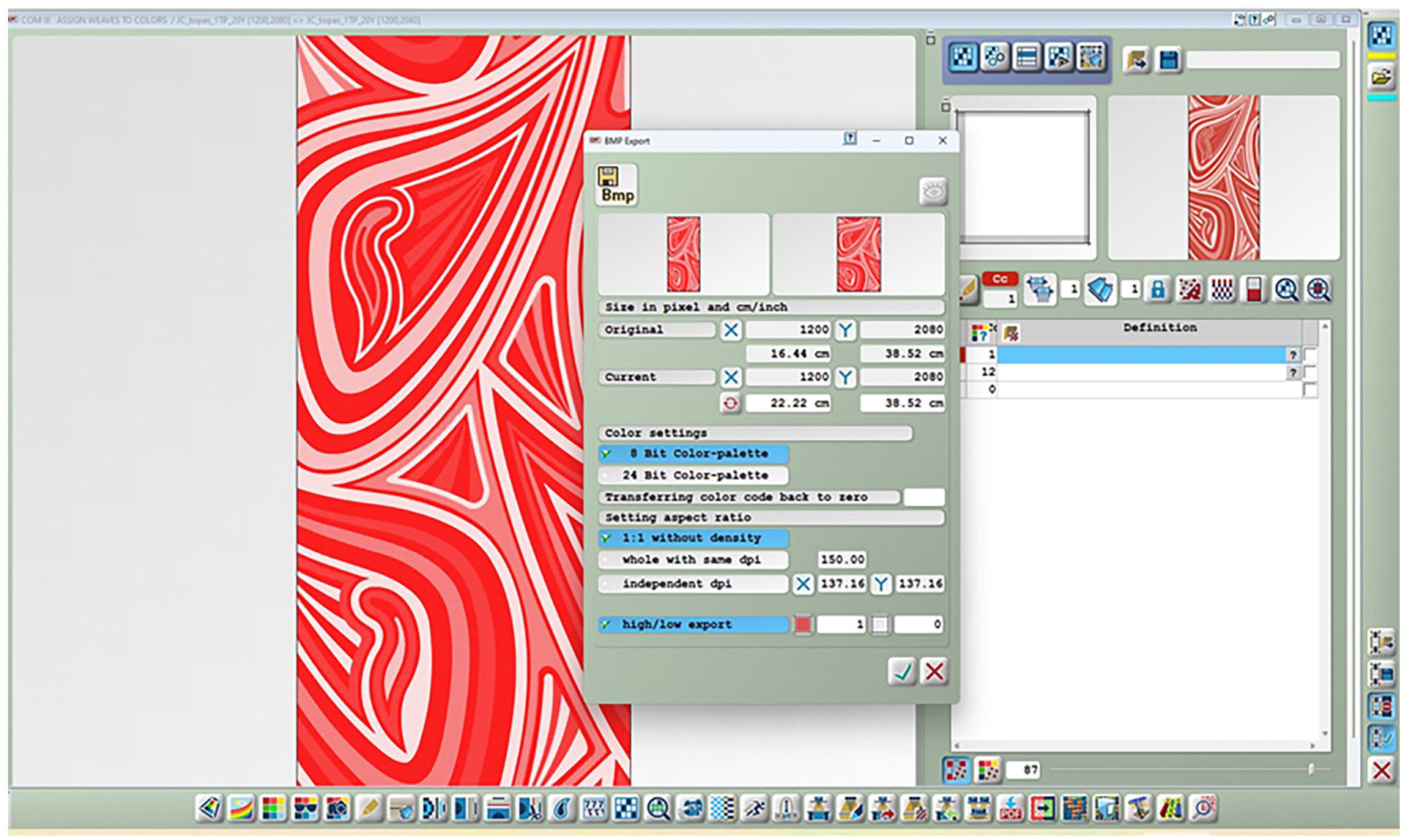
Jacquard weave pattern generated from the CAD/EAT.
The file format “.bmp” of jacquard weave pattern is subsequently processed in the ProTkaTex software. By running the calculation in the ProTkaTex software, the SCs of the Jacquard pattern are generated in the form of: absolute frequency SC1–SC4 and relative frequency SC1–SC4, including the weave factor.
As part of the study, the jacquard fabric patterns shown in Figure 12 were analyzed. These are 2D jacquard fabrics that are defined by different input images and different weave combinations. Neither the CAD system nor the ProTkaTex software has any restrictions in terms of images or weave combinations.
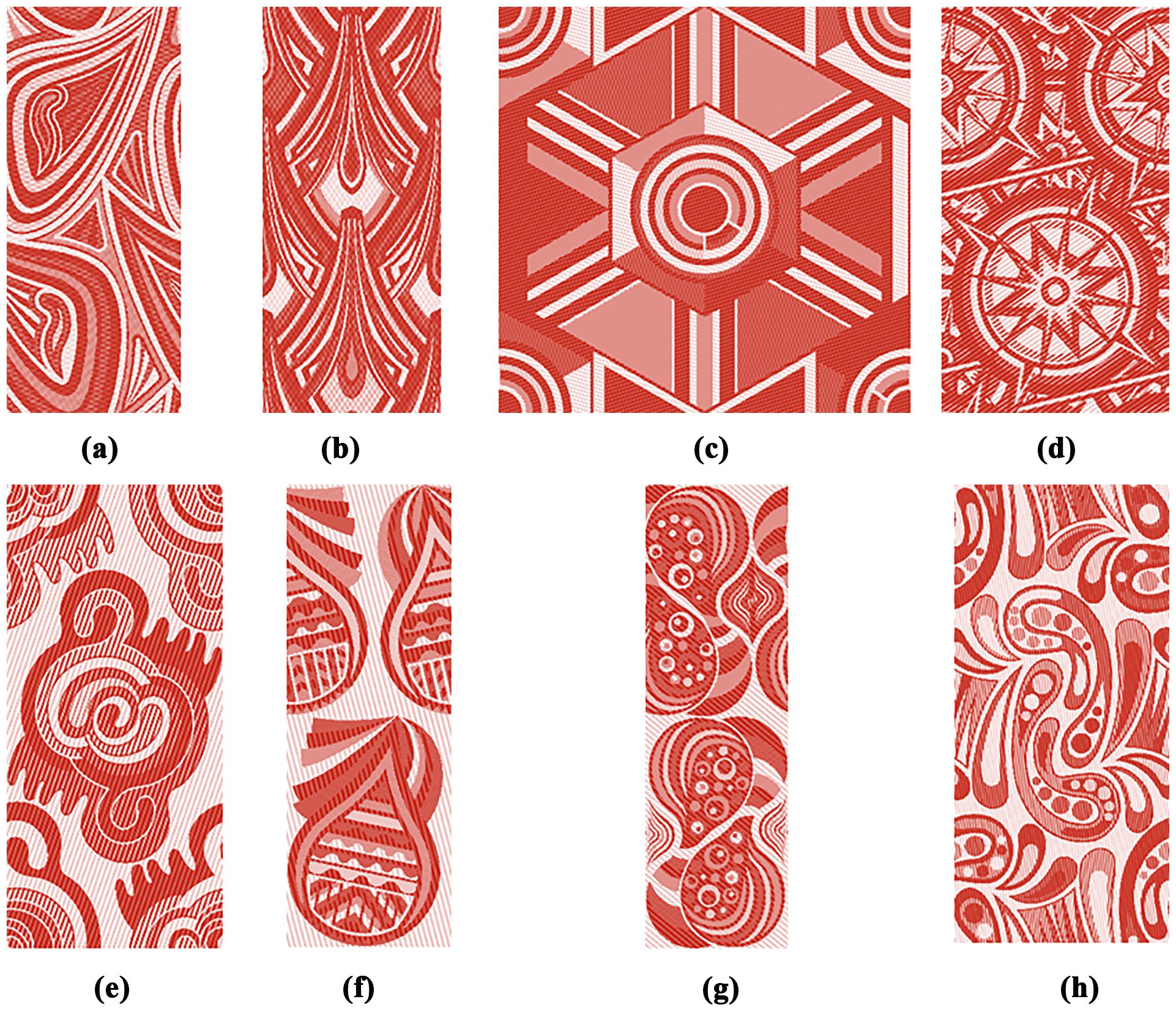
Analyzed weave patterns of jacquard fabrics with repeat given by n1/n2: (a) 1200/2080, (b) 1200/2040, (c) 1200/880, (d) 1200/1600, (e) 1200/2080, (f) 1320/3000, (g) 1200/3160, and (h) 1320/2280.
The expressions of the absolute frequency of individual SC1–SC4 for the analyzed patterns of jacquard fabrics are shown in Figure 13. The algorithm created according to the methodology presented in this study evaluated SCs of all pairs of adjacent warp and pairs of adjacent weft threads in the area of the pattern given by n1 × n2. The color marking of individual SC1–SC4 is the same as that given in the methodology of the presented basic weaves, see Figures 6–8. The jacquard fabric patterns formed by a combination of weaves of defined areas of the input image are formed by all cells SC1–SC4.
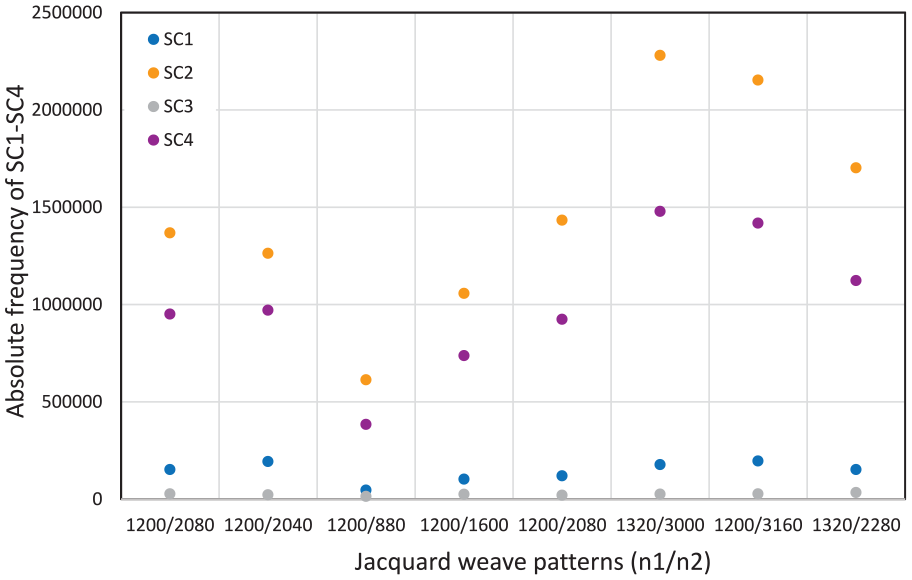
Absolute frequency of individual SC1–SC4 for the analyzed patterns of jacquard fabrics.
In the contours of the pattern at the transition of weaves, the mutual weave of two adjacent warp and two adjacent weft threads can be formed by all SC1–SC4. From the absolute frequency of SC1–SC4, a small number of SC3 is evident. This is because these cells are formed in the contours of the pattern at the transition of weaves. The fact that satin weave is used in most jacquard patterns also shows a low number of SC1.
For comparison, the Figure 14 shows the absolute frequency of SC1–SC4 for the basic weaves of satin and twill weaves with a weave repeats (n1/n2) from 5/5 to 12/12. As can be seen from the description of the basic weaves for Figures 6–8, basic satin weaves are characterized by the fact that they do not contain SC1. The absolute frequency of SC1 is equal zero. The weave consists only from SC2 and SC4. Twill weaves, on the other hand, are basic weaves that are composed of both SC1 and SC2 and SC4. SC3 is not present in basic weaves, it is characteristic of derivatives of the plain weave – rep and hopsack. The jacquard patterns also used a derived twill weave T2/2(Z), where absolute frequency of SCs is: SC1 = 0, and SC2 = 16, and SC3(→) = 0, and SC3(↑) and SC4 = 0. The relative frequency of cells of T2/2(Z) according to relations (13) is RF(SC1) = 0, and RF(SC2) = 1, and RF(SC3(↑)) = 0, and RF(SC3(→)) = 0, and RF(SC4) = 0. The interlacing weave factor according to relations (11) is 1.271.

Absolute frequency of individual SC1–SC4 for basic weaves.
The relative frequency of individual RF(SC1–SC4) of the analyzed patterns of jacquard fabrics is subsequently expressed according to equation (13). The relative frequency RF(SC1–SC4) of individual analyzed patterns is presented in Figure 15.
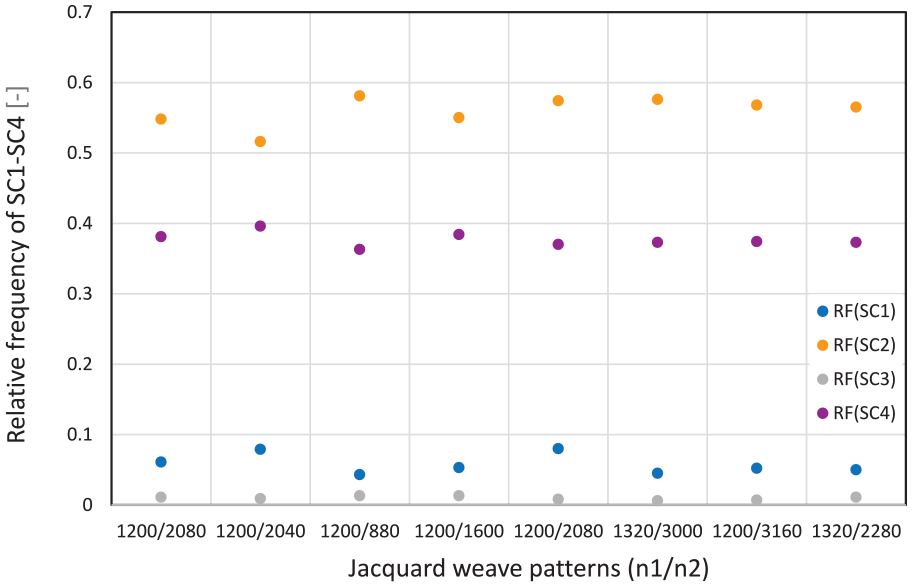
Relative frequency of individual SC1–SC4 for the analyzed patterns of jacquard fabrics.
The negligible ratio of SC3 is also evident in the relative frequencies of RF(SC1–SC4). SC2 and SC4 are essential for the above types of patterns. For comparison, the Figure 16 shows the relative frequency RF(SC1–SC4) of the basic weaves of satin and twill weaves with a weave repeats (n1/n2) from (5/5) to (12/12).
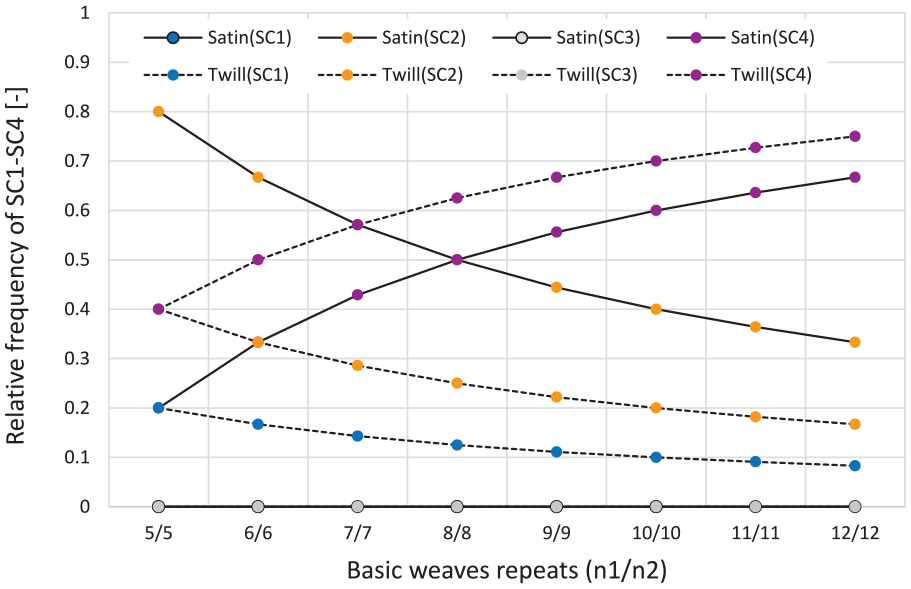
Relative frequency of individual SC1–SC4 for basic weaves – twill and satin weaves.
By comparing of the relative frequency RF(SC1–SC4) of individual jacquard fabrics with the relative frequency RF(SC1–SC4) of the basic weaves, the values of the jacquard patterns are closest to the satin weave with repeat 7/7 with a minimum of the SC1 and the SC3.
Weave factor (WF) of analyzed jacquard fabrics patterns recalculated based on SC theory is presented in Table 2. For comparison, the table shows the WF values of the basic satin and twill weaves. As mentioned above, the weave factor of satin weaves is higher than twill weaves. This is due to the absence of the SC1 in the woven fabric. In relation to the possible recalculation of threads density for satin weave, it is possible to achieve higher densities for satin compared to other basic weaves such as twill and plain. Jacquard fabric patterns are shown in Figure 11 and evaluated in Table 2. In this case, the recalculation of the weave factor according to Brierley’s theory cannot be used, because this theory is used only for basic weaves and selected derived weaves of dobby fabrics.
WF of analyzed patterns of jacquard fabrics with pattern repeat n1/n2, and twill and satin weave repeats.
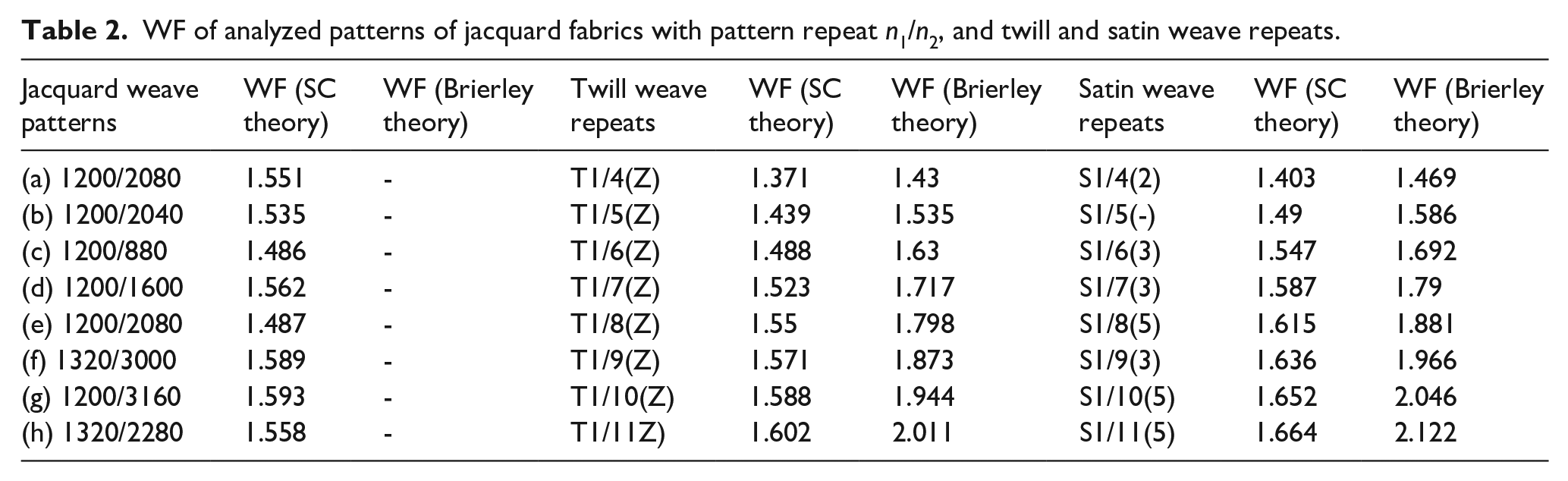
During the processing of the jacquard pattern, the adjustment of the contours in the transition points of the pattern allows the adjustment of the size of the float, which is created by the transition of one weave to another. The interlacing of the pattern at the point of transition of the pattern areas can be increasing, depending on the sizes of the areas of the color input image. General rules apply during processing of the input image for jacquard fabrics: at the point of pattern transition it is allowed, in terms of patterning jacquard fabrics with maximum float length of thread by 1–2 binding points more compared to the weave that is adjacent to the transition place. From Table 2 it is clear that the values of the weave factor of jacquard patterns range from 1.486 to 1.589, which corresponds to the weave factor of the seven to eight repeat satin weave with which jacquard patterns work.
Conclusion
This study explores and discusses the structure of two-dimensional (2D) jacquard woven fabric and its weave pattern. The aim of the study is to propose a methodology focused on the definition of threads interlacing in the 2D jacquard woven fabric and thereby determine the interlacing weave factor. The interlacing weave factor is known from dobby fabrics where many contributions have been made to express the interlacing of threads in the weave repeat. These are mainly purely experimental approaches. No contribution is focused on the interlacing weave factor of jacquard fabric patterns. The proposed methodology defines the jacquard fabric pattern and its interlacing of threads comprehensively based on the interlacing structural cells (SCs). The SCs define the mutual interlacing connection between two adjacent warp and two adjacent weft threads. The size of the SC is 2 × 2 threads (two adjacent warp threads and two adjacent weft threads). From the perspective of the structure and geometry of woven fabrics, it is true that the woven fabric as a cohesive system is given by the mutual force interaction between the threads of the warp and weft system, which arises from the mutual crossing of these threads. SCs appear to be a tool for identifying and analyzing interlacing threads of a pattern in jacquard fabrics. The weave factor expressed on the basis of SCs describes the jacquard pattern comprehensively from the perspective of the combination of weaves forming the resulting pattern of the jacquard fabric. The study presents a comparison with the weaves of dobby fabrics. In addition to the weave factor, the proposed methodology can analyze SCs based on both the absolute frequency of individual SCs and the relative frequency related to the entire weave of the jacquard fabric pattern. Modified and newly added algorithm identifying weave factor in a jacquard pattern was created in the new module of ProTkaTex software. Based on the weave factor, fabric designers are able to express the thread density. The input yarn for the warp and weft system, together with the thread interlacing (weave factor) and thread density, creates the fabric construction parameters. Based on the fabric construction parameters, the production process for a given woven fabric can be compiled. From a practical point of view, the weave factor defines the degree of floatation in the weave. The weave factor is used to recalculate the thread density of plain weave to the thread density of non-plain weave or patterns. The cohesion of the fabric depends on the interlacing and density of the threads. In fabric construction, the rule applies: when the floatation increases, the thread density must increase. In practice, the proposed weave factor is used to calculate the thread density in a jacquard fabric with combination of non-plain weaves. Weave factor is in this case a tool that will help weavers express the density of threads when developing new fabrics. They do not have to experimentally derive design parameters from woven fabric samples after weaving. It will help new, inexperienced weavers to increase the efficiency of their work and save on the experiments they still use today. It will save time and money. There will be less experimental work for the development of jacquard fabrics.
Footnotes

Funding
The author(s) disclosed receipt of the following financial support for the research, authorship, and/or publication of this article: This work was supported by the Ministry of Education, Youth, and Sports of the Czech Republic and the European Union—European Structural and Investment Funds in the Frames of Operational Program Research, Development and Education—Project Hybrid Materials for Hierarchical Structures [HyHi, Reg. No. CZ.02.1.01/0.0/0.0/16_019/0000843].
Declaration of conflicting interests
The author(s) declared no potential conflicts of interest with respect to the research, authorship, and/or publication of this article.
Data availability statement
Data will be made available on request.