




Abstract
In the present work, a new phenomenal model is proposed for modeling and simulating tearing mechanical properties on an airship envelope fabric. The greatest advantage of the phenomenal model is that such model is capable of calculating the tearing strength of a plain weave fabric by simply uniaxial tearing tests rather than the expensive and complex pressurized cylinder tests. The geometric progression technique is employed to calculate the stress distribution on the crack tip. The stress transfer coefficient Q is derived to be 0.9656. Three types of SEN (single-edge-notched) specimens were researched by the uniaxial tearing tensile tests. The effects of specimen width and the crack length ratio on the tearing strength of the airship envelope fabric are studied thoroughly. A good agreement between such model and experimental data is obtained, and the deviation is lower than 5%. Meanwhile, compared with the new phenomenal model and the Thiele’s formula, this new phenomenal model is verified to be more accurate while calculating the tearing strength of a plain weaving airship envelope fabric in the uniaxial tearing tensile load.
Keywords
Introduction
There has been an increasing interest in stratospheric airship [1] as an alternative to traditional air vehicles for telecommunication and science observation. As one of a significant structural part in an airship, it is major developments in membrane materials [2–4] that have been uniquely responsible for advances in airship design. In the real engineering application, the initial crack or defect expansion of the envelope material easily causes the whole airship to tear and damage quickly under the stratosphere environment. Therefore, an improved fundamental understanding of the fracture mechanism and tearing mechanical properties in envelope fabric is needed to provide a rational basis for the designers of airships.
In recent decades, many efforts [5–15] have been made to investigate the tearing behaviors of fabrics by experimental studies or theoretical analysis. In general, the uniaxial, biaxial, multi-axial tensile tearing tests and pressurized cylinder tests are the most commonly applied approaches. For instance, Wang et al. [5] investigated the effects of the load ratio, the initial crack length, and the crack orientation on the tearing mechanical properties of an envelope material under uniaxial and biaxial tensile condition. It is concluded that oriented crack can be represented by non-oriented crack with crack equivalent length under biaxial condition. Chen et al. [6] proposed a new tearing strength criterion which combined the Tsai–hill criterion and the off-axial constitutive relationship for shear modulus of orthotropic materials. Their conclusions can be applied to similar laminated fabrics. Bigaud et al. [13] experimentally (in uniaxial and biaxial tensile tearing tests) analyzed the fracture strength of polyester fabrics coated with Polyvinyl chloride (PVC), two different failure modes were distinguished depending on the initial crack length. Luo and Hu [14] found the presence of the initial cracks result in the reduction of the tearing mechanical performance; the effect magnitude depends on the initial crack length and crack orientation under multi-axial tensile loads. Shoji [11] carried out a biaxial tensile test and a pressurized cylinder test to find the critical stress which initiated the tear propagation. To consider the stress field near the crack, they proposed an empirical formula. In their study, the stress distribution in the crack tip was presumed to be exponential. However, during the derivative process, the specimen scale was considered to be infinite, which is not appropriate for the biaxial specimens. Liu et al. [15] conducted a single-edge-notched film experiment to analyze the tearing strength characteristics of Kevlar-plain woven fabric. They also proposed a physical model to calculate the initial crack on such fabric. The arithmetic progression of load distribution is assumed for the fibers in the crack tip. However, the crack tip length, a parameter in their formula, is hardly to be measured accurately. Therefore, it will lead to a large error for calculating tearing strength of a plain woven fabric. From all the papers above mentioned, rarely researchers reported or studied the specimen width effect on the critical tearing stress of an airship envelope fabric. When conducting the pressurized cylinder tests, researchers did not consider the specimen scale effect was reasonable. That is due to the physical dimension of a pressurized cylinder is roughly 4 m length [11], the maximum initial crack length during testing was around 300 mm. Hence, the crack length ratio (ρ = the initial crack length/the specimen width) was too small, so that can be ignored. But for the uniaxial, biaxial, and multi-axial tearing tensile tests, researchers would like to set the specimen widths as constant values. Few researchers have considered the specimen width influence on the critical tearing stress of a fabric. However, the relationship between the critical tearing stress and the specimen width for a plain weave fabric is not a simple concept of magnification.
In this paper, the influences of the specimen width and the crack length ratio on the tearing strength of an airship envelope fabric are investigated by carefully designed uniaxial tensile experiments. Three types of specimen width are included during fabrication. Based on those experimental results, a new phenomenal model is proposed. Comparison of the experimental data and the phenomenal model results shows that, in general, the model faithfully represents the mechanical response of the airship envelope material. In the end, comparison between the new phenomenal model and the Thiele’s empirical theory is made to verify the new phenomenal model’s accuracy.
Tearing strength experiment
Material
Figure 1 shows the structure of the new envelope fabric. The laminate was designed to consist of three layers: Tedlar, Ethylene Vinyl Alcohol Polymer, and Vectran. The polyurethane was applied as the adhesion between the structure layers.
The structure of the new envelope fabric. (a) The internal structure of the new envelope fabric and (b) The macroscopic structure of the new envelope fabric.
Specification of the envelope fabric.

Experimental program
Tearing mechanical properties of the airship envelope material were measured by tensile tests in the Space Structure Research Center, Shanghai Jiaotong University. A strength-testing machine called UTM4000 electronic universal testing machine was applied, see Figure 2(a). Specimens were fabricated by cutting the laminate by 300 × b mm. To analyze the scale effect on specimens during loading, three kinds of width size, b, were manufactured for all specimens. In this paper, the warp fiber bundles were aligned with the load axis, and a specific number of warp yarns were cut off in the initial crack region, see Figure 2(b).
Experimental set-up: (a) UTM4000 electronic universal testing machine and (b) Specimen dimensions.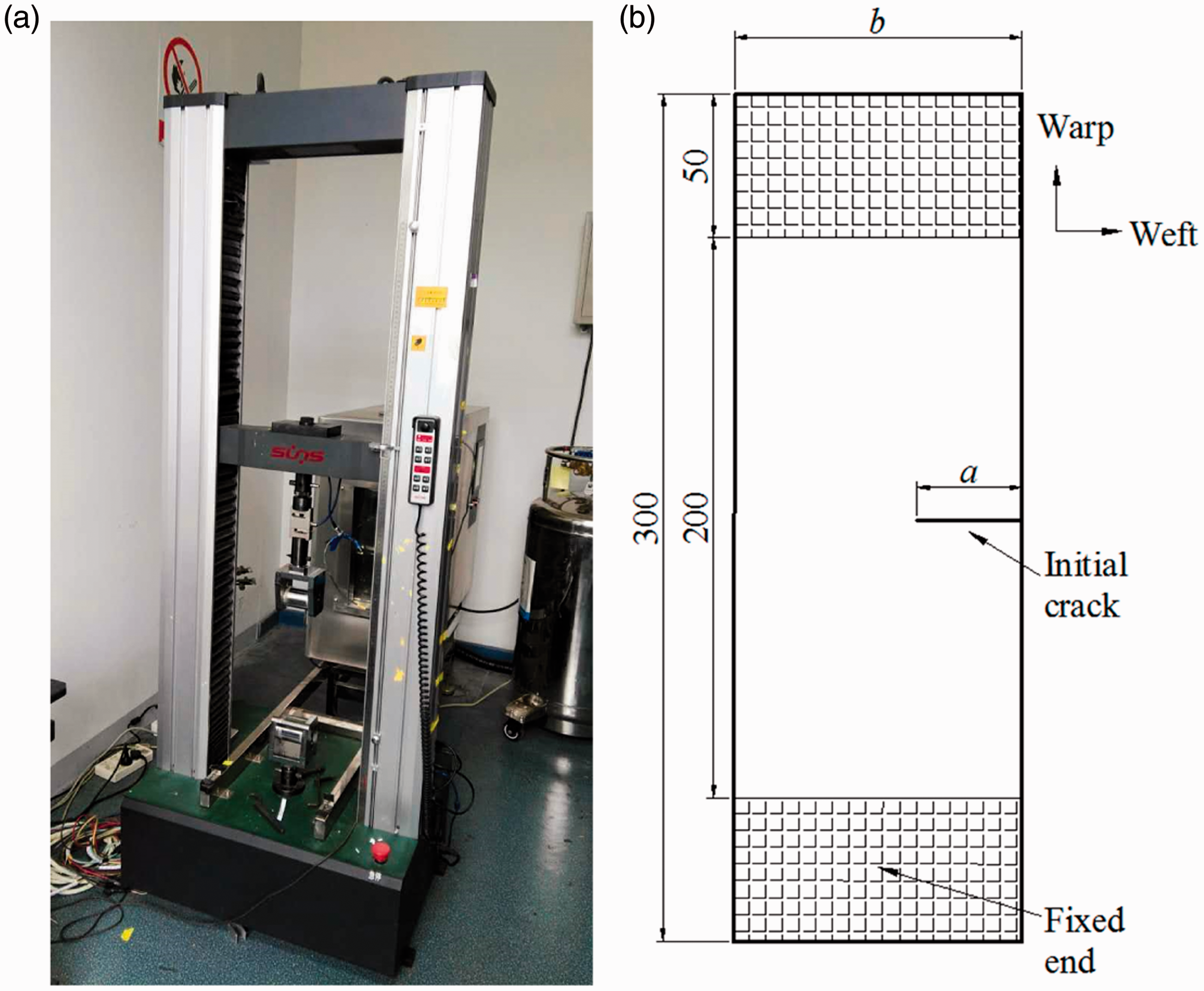
It is commonly known that each fiber bundle is composed of various number of filaments to meet specific strength requirement. Hence, it would be inevitable to cut a portion of one fiber bundle for some fabrics if the initial crack was introduced by the unit of centimeter. For instance, 9 × 9 fiber bundles per centimeter are laid for the new envelope fabric. There would be 13.5 number of fiber bundles to cut if the initial crack length was set to be 1.5 cm. In such case, the performance of the fiber bundle could be complex and hardly to analyze the mechanical properties of such fabric. In this paper, therefore, all specimens were cut by counting the number of fiber bundles. The corresponding dimension, a, of the crack was transformed by a simple calculation. For each width b case, three different cutting fiber bundle amounts (5 bundles, 10 bundles, 15 bundles) were prepared to measure tearing properties of single-edge-notched film, see Figure 3.
Specification of specimens with different widths.
Specification of the specimens.

Additionally, to investigate the correlation of crack tip fiber yarns and the fabric critical tearing strength, the breaking strength of single fiber bundle was also tested by UTM4000, see Figure 4. Aluminium sheets were also attached on such fiber bundle during loading. The load correlated to the displacement data of the single fiber bundle was recorded.
Crack propagation test of single fiber bundle.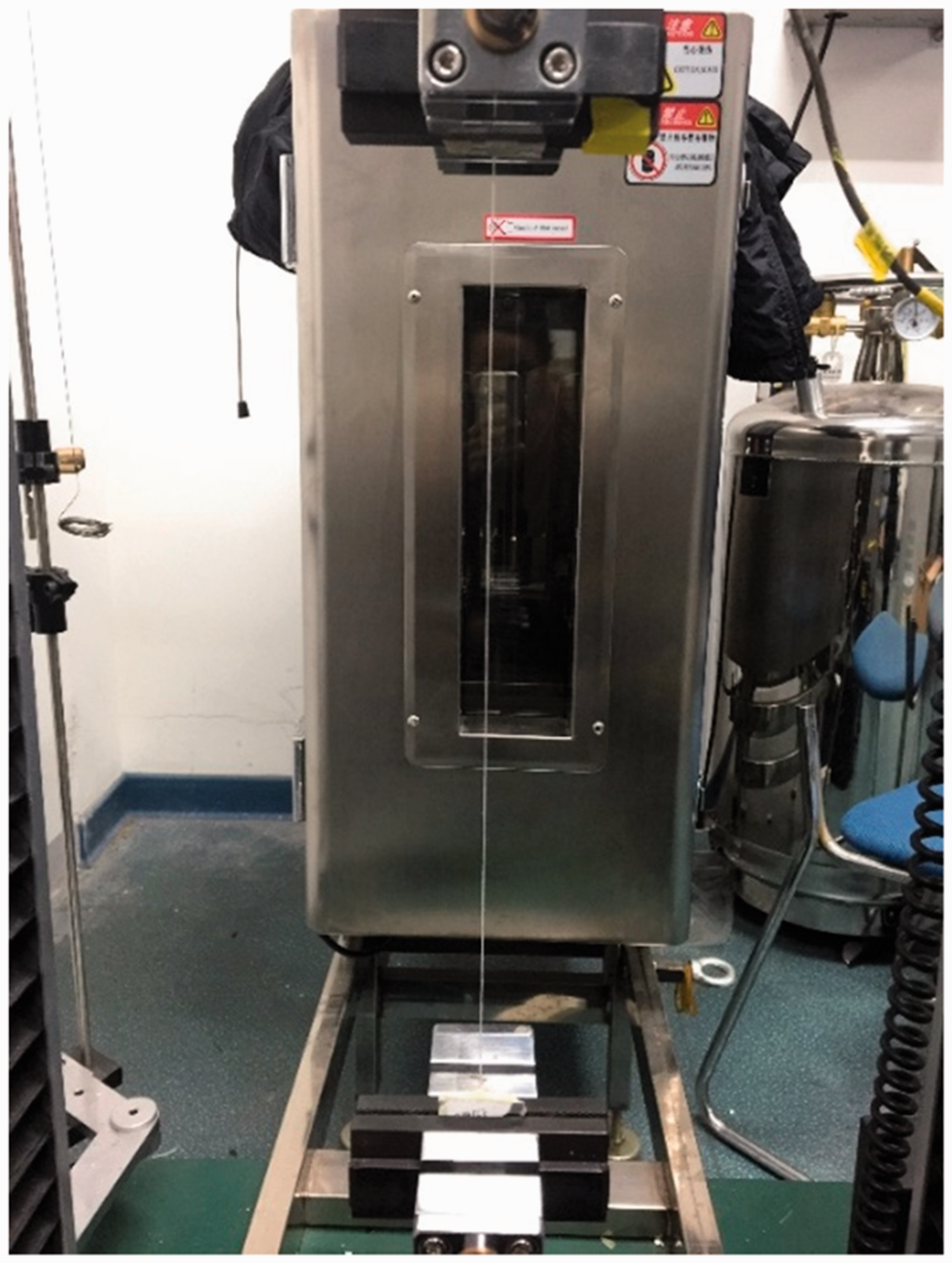
According to the ISO 139-2005 standard, a climatic room temperature of 20 ± 2℃ and a relative humidity of 65 ± 4% were ensured during testing. Aluminium sheets were attached on both sides of a specimen grip to prevent slipping during loading. Meanwhile, the 3 M glue was selected as the adhesive for its favorable viscosity and high sheering strength. It is noteworthy that stress unit of such fiber was kN/m considering the thickness of such envelope fabric is extremely thin. In other words, the stress of such airship envelope was derived from that to value of the tensile load divided the specimen width. Meanwhile, one fiber bundle was confirmed by the ratio of the relevant external load to one fiber bundle width of such fabric. The calculation method for one fiber bundle width is specifically related in equations (10) and (11).
Tearing strength model
To investigate the relationship between the tearing stress and the mechanical characteristic of the new envelope fabric, a new phenomenal model is proposed. In this paper, four assumptions were made:
The tensile stresses from the helium barrier and thermal bonding layers are much smaller than that of the Vectran fiber layers. Hence, the tensile stresses from protective layers are ignored. When the first warp yarn near the crack tip broken, the envelope fabric is treated to be damaged. The maximum force of one fiber bundle is treated as that of the first warp yarn near the crack tip undertook when it came to be broken. The corresponding tearing stress is defined as critical tearing stress of the envelope fabric. The incremental stresses of warp yarns in the crack tip are treated as geometric progression. Specifically, they are treated as decreased progressively. A constant Q is introduced to consider the possible viscosity of the yarns.
Hence, the phenomenal model of the tearing strength is developed and simplified as shown in Figure 5.
SEN geometric physical model.
As can be seen from Figure 5, m is defined as the number of initial cutting fiber bundles, and the number of the residual bundles is defined as n.
In this paper, the tearing propagation was partitioned in two reasons. For one thing, the vertical displacement which parallel to the loading direction was due to the warp yarns adjoined the initial crack pulled out gradually as the force increasing. For another, the tearing propagation which parallel to the initial crack direction was because of the weft yarns near the crack tip slip out of the warp yarns. In this regard, as the external load increasing, the first warp fiber bundle at the crack tip extended and undertook much more stress. Then, the second warp fiber bundle continued to be elongated and then the third one, and so on. A Del-zone (a triangle stress shape zone) would be formed as the warp fibers near the crack tip extending gradually, see Figure 6.
Graphical representation of tearing propagation on the Del-zone.
As can be seen from Figure 6, when the first warp fiber bundle in the Del-zone reached to its maximum tensile stress, it would be fractured. Then, the rest of the warp yarns in the Del-zone inherited and reassigned the stress of the damaged fiber, simultaneously. Additionally, the second warp fiber bundle replaced the first yarn bundle in the new crack tip and continued to be elongated by the increasing external tensile load. Hence, a new Del-zone formed and a new cycle started as the loading tension increasing.
According to the Saint Venant principle, the effect of stress concentration in the crack tip will disappear in warp fiber bundles which are far away from the Del-zone. Such fiber bundles are called the stable fibers. For such warp fibers, the weft yarns are hardly to transfer the shear stress between the adjacent warp fibers. Hence, the load and elongations of such warp fibers are the same as that of the clamped region, see Figure 7.
Composition of tearing stress in the Del-zone fiber bundles.
In this paper, the stress in the stable region is defined as σe, which means the equivalent stress of the fibers on the clamped region. Therefore, the tensile stress of each fiber bundle in the Del-zone consists of two parts. One part is the equivalent stress, σe, which applied uniformly on each fiber bundle of a specimen if there is no initial crack. The other part is an incremental stress, σi, which considered as the redistribution stress of the initial cutting fiber bundles, see Figure 7.
In this paper, the incremental stress of the fiber bundle in the Del-zone is treated as geometric progression. The incremental stress of the first warp fiber bundle is defined as σ1. Therefore, the incremental stress of the i-th fiber bundle is

Hence, the total stress of the i-th fiber bundle is written as

The total strength of a specimen with an initial crack would be written as

Meanwhile, the external force can be express as

Hence, the force equilibrium equation for the specimen during loading is as follows

Then, equations (1) and (2) into equation (5), thus

When the first warp fiber bundle reached to its maximum tearing stress σu, according to equation (2), the stress of that fiber becomes

According to the assumption 3, when the first warp fiber bundle in the crack tip broken partially or totally, the external load value is regard as the tearing strength of the specimen. Therefore, the critical tearing stress σcr corresponding to specimen with specific cutting fibers would be as follows

Equations (6) and (8) into equation (7), thus

Obviously, from equation (9), if there is no initial crack introduced to a specimen (m = 0), then, the critical tearing tensile stress of specimen is equal to the stress when one fiber bundle of specimen reached to its maximum tearing stress(

Then, substitute both into equation (9), the corresponding formula by the millimeter or centimeter unit can be solved.
In this paper, the m and n index are introduced to consider the specimen’s width effect, the Q is introduced to consider the transmit ratio of incremental stress. Therefore, such empirical formula is a true prediction model because all of its parameters have physical meaning and can be determined by the fundamental experimental data of tearing tensile tests.
Results and discussion
Experimental results
Failure mode
Figure 8 shows the experimental results of the three types of specimens with various initial cutting fiber bundles and the fracture model of one fiber bundle. In this regard, Figure 8(a) shows the elongation of warp fibers increased gradually as the tensile load increased. It is observed that the Del-zone progressively generated as the warp fiber bundles slip out of the weft fibers yarns one by one in the crack tip. Figure 8(b) manifests the tearing failure mode of the fabric under uniaxial tensile condition, i.e. the crack propagates along vertical to the loading direction. Figure 8(c) demonstrates the fracture failure of one fiber bundle.
Tearing propagation process. (a) The Del-zone in the crack tip, (b) crack propagation phenomenon, and (c) One fiber break.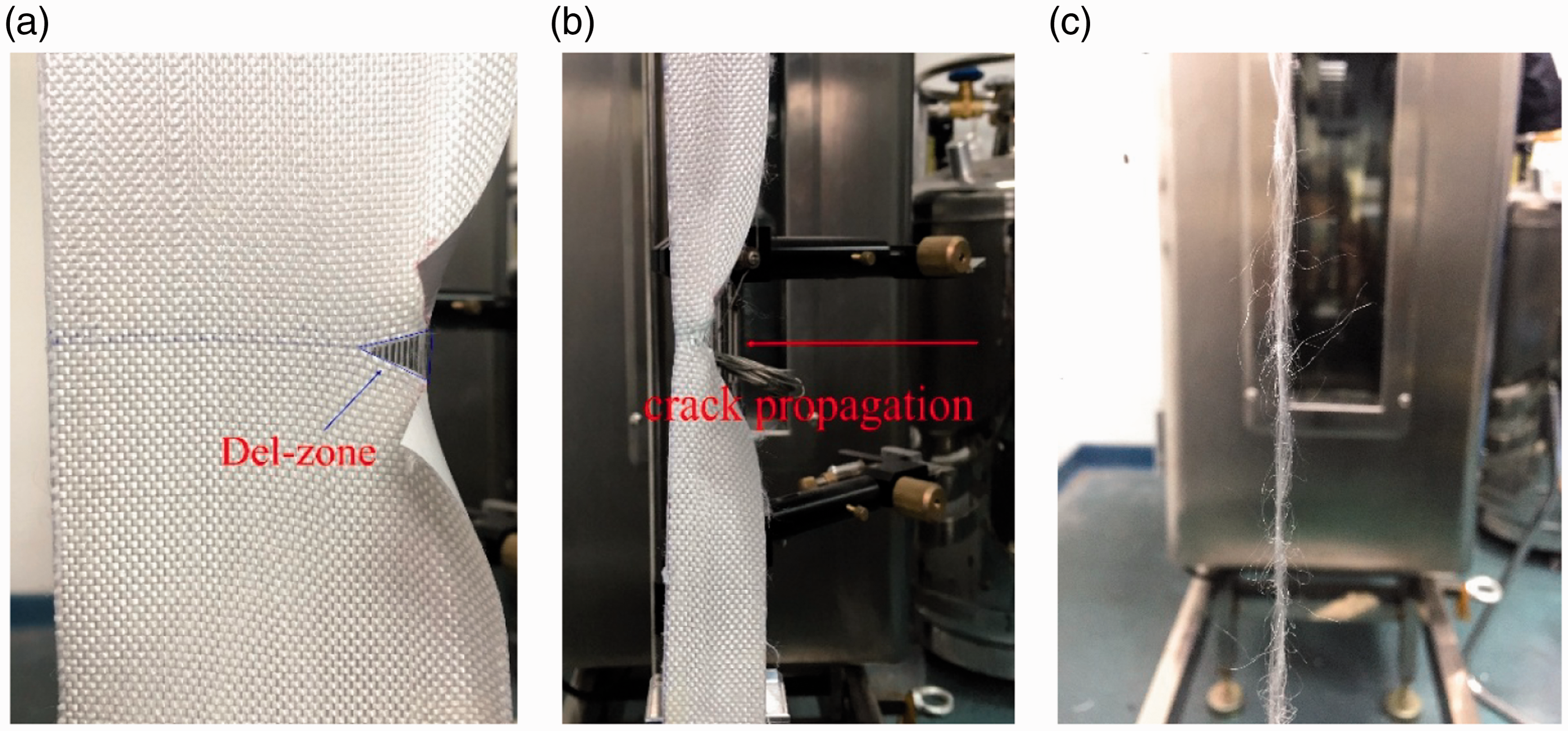
Considering the inevitable stress concentration in the adjacent of the crack tip, the first warp yarn bundle bears more tensile load than fiber bundles far away from the crack tip. Hence, the first warp fiber will reach to its maximum tensile load earlier than other warp fibers, see Figure 8(b). Based on the experimental observation, when the first warp fiber bundle ruptured, a vibration of the tensile load would occurred with a sharp snap. The bearing load proportion of the first warp fiber bundle would transfer to the residual fiber bundles in the adjacent crack tip, simultaneously. Assumption 1 derives from the above-mentioned consideration. After the redistribution of tensile loads in the crack tip finished, the second warp fiber bundle in the crack tip came to replace the status of the previous first warp yarn. With the external tensile load increasing, a new Del-zone formed. Another interesting phenomenon is also detected from the experimental observation, which is that the geometry of the formed Del-zone is approximate to a triangle shape, and the Del-zone span of the above-mentioned specimens is nearly the same.
However, according to the observation of the extensive experimental process, the fiber bundles of the envelope fabric are easily to be ruptured in the following Del-zones, which mean the fiber bundles have reached to their maximum tensile load in when the first Del-zone generated. In the end, the ultimate tensile strength value of each specimen is close to that of the external load when specimen’s first warp fiber bundle ruptured. Hence, it is reasonable to define the external load value, when the first warp fiber in the crack tip ruptured, as the tear load for such fabric with a specific crack length.
Influence of cutting fiber numbers
To reveal the crack fiber bundle number influence on single-edge-notched (SEN) tearing tensile stress of such envelope, the elongation curves of S-25 are plotted as an example, see Figure 9.
The stress-time curves of SEN S-25.
From the experimental observation, it is found that the maximum stress supported by specimen falls down with an increasing number of cutting bundles, see Figure 9. For instance, the maximum stress value of a specimen with five fiber bundles cut previously is almost twice as much as that of a specimen cut 15 (which corresponds to three-fifth of the sample’s width) fiber bundles initially. Hence, the relationship between the tearing tensile stress and the number of cutting fibers is nonlinear.
Additionally, as can be seen from the Figure 9, the specimens will reach to their maximum tearing tensile stresses soon after the first Del-zone occurred with a saw tooth style. In other words, the maximum tearing tensile strength is almost identical as that of the external loading value when the first fiber ruptured. Therefore, analyzing the formation of the first Del-zone is of most important. And the stress value when the first yarn ruptured is defined as the critical stress of the fabric with specific crack. The critical stress of each specimen is highlighted in green arrow in case of misread.
Influence of specimen dimension
To clarify the specimen dimension influence on such fabric, the elongation curves of specimens with identical cutting fiber bundles are plotted. In this paper, a group of specimens with five bundles initially cut are shown as an example, see Figure 10.
Dimension influence of the SEN specimens (five initial cutting fiber bundles).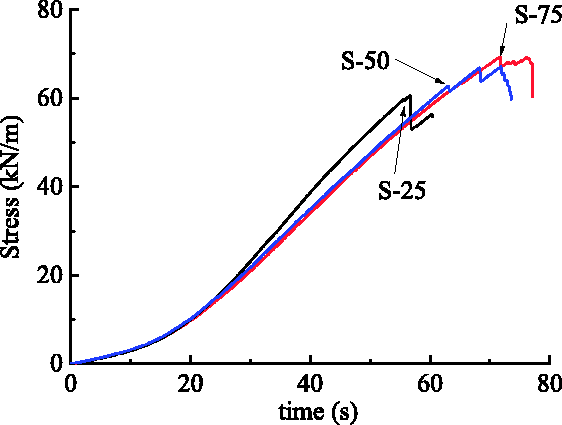
As can be seen from Figure 10, the stress corresponding to time-response curves of such fabric is almost identical at the primary loading stage. That is due to the collaboration between the protective layers (the helium barrier and thermal bonding layers) and the bearing layer. However, the slopes of the curves changed to be imparity as the external load increasing. Such phenomenon is due to the protective layers retreated from bearing tensile load gradually and the Vectran fibers turn out to be the unique bearing layer. According to the previous studies [4], the ultimate tensile stress values of the coated and un-coated fabric show tiny difference, which means the Vectran fiber is a relatively light-weight fibrous material with ultra-high strength comparing the other two isotropic function film layers.
Meanwhile, it is obvious that a saw tooth style generated as the fiber bundles ruptured one by one in the crack tip until the final failure. The camera photos confirmed that the tearing tensile stress increased discontinuous after the first fiber bundle ruptured. Therefore, the assumption 3, the number of incremental tensile stress of the warp fiber bundles in the Del-zone changed in a geometric progression, is validated.
Additionally, the failure stresses of specimens decrease as the specimen’s width reducing, see Figure 10. Hence, it is of significance to consider the dimension influence while analyzing the tearing mechanical properties of fabric. In this study, the global failure of such fabric occurred quickly after the first fiber bundle in the crack tip ruptured. According to the specification of FAA-P-8110-2 [16], Airship Design Criteria, the tear would not propagate under the limit load condition considering the safety operation of an airship. Hence, it is of importance to extract a limiting value to the force for which the crack started propagating, leading more or less quickly to the specimen’s global failure. Such force is described as the ‘critical force’ when the first warp fiber bundle ruptured. The corresponding critical stress is calculated by dividing the specimen width.
To make a clear specification on the specimen width influence, all the critical tearing stresses of specimens are gathered and plotted as Figure 11.
Specimen width effect on the critical cutting fibers.
From Figure 11, apparently, when the number of cutting fiber is a constant, the testing critical tearing stresses for various specimen widths are different. For instance, when 10 fiber bundles are cut initially, the average critical tearing stresses of S-25, S-50, and S-75 are around 41.85, 52.57, and 55.30 kN/m, respectively. What is more, the specimens with 25 fiber bundles own a larger decrease amplitude than that of the specimens with 50 fiber bundles and specimens with 75 fiber bundles. That is due to the crack length ratios, ρ, of such three kinds of specimen width are various.
Influence of crack length ratio
From the above analysis, it is obvious that the tearing tensile strength of envelope fabric is influenced not only by the crack length but also the fabricated specimen dimension. Hence, the crack length ratio, ρ, of influence on such envelope fabric is studied below, the critical stresses of all specimens are plotted in Figure 12.
The crack length ratio’s influence on the critical tearing stress of the envelope.
Obviously, from Figure 12, as for the envelope fabric, the crack length ratios, ρ, indicate high nonlinear influence on the critical stresses. In this paper, the specimens of S-25-5, S-50-10, and S-75-15 own identical crack length ratio, i.e. ρ = 0.2. However, the average critical stresses of such specimens are around 59.8, 52.57, and 52.46 kN/m, respectively. Hence, the relationship between the tearing stress and the initial crack should not be simply considered as the tearing stress and the crack length. The specimen width, d, also represents a high important status on the tearing mechanical properties of envelope fabrics. Hence, the stress transformation from one fiber to another in the Del-zone should be considered in a microscopical way thoroughly.
Verification
Below is the procedure to obtain the Q of such envelope fabric. First, the equation (9) was rewritten as

Then, natural logarithm of equation (10) was taken

Assuming the above equation as

Then

And then

Substituting all testing data into equation (14), the constant Q is obtained to be 0.9656, according to a trial and error process.
Then, substitute the value of Q into equation (9), the relevant fitting lines of specimens with various widths are obtained and plotted as Figure 13.
Comparison of testing data and fitting lines for all specimens.
From Figure 13, apparently, the critical stresses of specimens with identical cutting fibers are decreasing as the specimens’ width reduces. Meanwhile, the decreasing tendency of critical stress is increasing as the initial crack length ratio (m/(m + n)) extending. It is observed from Figure 13 that all the fitting lines match the relevant testing data very well. It is observed from Figure 10, the fitting line-S-25, which manifests the tearing strength of specimens with 25 fiber bundles, accurately predict the tearing strength would become zero if all the fibers were cut initially. However, the specimens with 50 or 75 fiber bundles still can sustain external load. Hence, this model subtly considered the crack length ratio effect. Considering the experimental test deviation, the critical tearing strength of the envelope fabric with various initial cracks can be calculated by the new phenomenal model.
To verify the accurate of the new phenomenal model, the Thiele’s formula [17], which was proposed by Mr. Thiele derived from Dr. Topping’s work [18]. Mr. Thiele performed a test on two full size airship envelopes with diameters near 9400 mm. A good correlation between critical tearing strength and the initial crack length was got. In their research, the specimen scale effect was not considered due to the crack size is too tiny comparing with the huge size airship envelope structure. Hence, the crack can be treated as loaded with an infinite boundary.
The Thiele’s empirical theory is shown as follows

Then, the critical tearing tensile stress of a fabric is

For a flat specimen, the above equation simplified as follows


Tearing strength comparison between experimental data and the empirical models.

As can be seen from Table 3, there is a highly coherence between the new phenomenal calculation data and the experimental results. The highest deviation is only 4.83%, which is a tiny disparity that can be ignored for engineering application. However, the highest deviations of the Thiele’s theory are up to 40.39%. Only when specimens own 75 fiber bundles, the deviation of the Thiele’s theory is close to the testing data. That is due to the Thiele’s theory did not consider the specimen dimension. In other words, the Thiele’s theory is more suitable for the infinite flat specimens. The crack length ratio for specimens with 75 fiber bundles is lower than that of the specimens with 25 or 50 fiber bundles. The largest deviation between the empirical value and the experimental value for Thiele’s formula emerged in S-25-15, see Table 3. That is due to the crack length ratio is up to 0.6, hence, the specimen dimension effect should not be ignored.
The above-mentioned analysis indicates that the new phenomenal model can be faithfully represents the mechanical response of the new envelope fabric if the testing specimen is limited. Below are the studies on the condition that the specimen dimension is infinite.
As can be seen from equation (9), if the residual fiber bundle number is infinite, then the specimen can be treated as an infinite plate. Considering the coefficient of force transfer, Q is a constant lower than 1, hence, equation (9) is simplified as

Then, substitute the value of Q into equation (10), the tearing stress of an infinite flat for such new envelope fabric would be as follows

Then, the phenomenal model and the Thiele’s theory formula are plotted in one figure as well as the uniaxial tearing tensile test data, see Figure 14.
Tearing strength comparison between the phenomenal model and the Thiele’s theory when the specimen width is infinite.
Obviously, both empirical curves manifest the critical stress will decrease as the number of cutting fiber bundles increase. When the specimen width came to be infinite, which is close to a real airship condition, the critical stress of phenomenal model results is close to that of the Thiele’s theory. That is to say, the new empirical model can be expanded to the pressurized cylinder tests. But according to Table 3, the Thiele’s theory is not appropriate during uniaxial tearing test. As can be seen from Figure 14, the critical stress of an airship fabric calculated by the Thiele’s theory will tend to be infinity when the initial cutting number tends to be zero, which manifests again that the Thiele’s theory is invalid in the uniaxial tearing tests. But as for the new phenomenal model, the highest deviation between the experimental data and the phenomenal model results is only 4.83%.
In general, Comparisons of the experimental and empirical model results indicate the model faithfully represents the mechanical response of fabrics. The most advantage of the phenomenal model is that such model is capable of calculating the tearing strength of a plain weaving fabric by simply uniaxial tearing tests rather than the expensive and complex pressurized cylinder tests. The precision of the model response verifies the soundness of the assumptions made in the modeling process. The model predicts realistically the true mechanical characteristics of the behavior of such new airship envelope.
Conclusion
In this study, the tearing mechanical characteristics are tested and analyzed for a new airship envelope material. The specimen dimension effects on the tearing stress under uniaxial tensile load for airship envelope fabric are researched thoroughly for the first time. Based on the experimental study and numerical analysis, the following concluding remarks can be drawn:
According to the observation of experimental phenomena, the crack of the new airship envelope fabric propagates along vertical to the loading direction. Meanwhile, the failure mode of the fabric is transient break with a saw tooth style in the Del-zone as the wrap fiber bundles in the crack tip break one by one. The tearing tests indicate that the testing tearing stress is different when testing specimen width changed. It is also found that the tearing strength of such envelope fabric with smaller specimen width decreases much greater than that of the specimen owning larger width during the initial cutting fiber number increasing. A new phenomenal model for estimating the tearing strength of the airship envelope fabric has been proposed. In such new model, the incremental stresses of warp yarns in the crack tip are defined as geometric progression. A force transmission coefficient, Q = 0.9656, is introduced. Such new phenomenal model is validated to calculate the tearing stress of an envelope fabric with a plain weaving process. Tearing strength comparison between the new phenomenal model and the experimental results indicates the highest deviation of the new model is only 4.83%. Meanwhile, the tearing strength comparison between the new phenomenal model and the Thiele’s formula results indicates the new phenomenal model is also appropriate to simulate the tearing strength of a real airship envelope fabric. The greatest advantage of the phenomenal model is that such model is capable of calculating the tearing strength of a plain weaving fabric by simply uniaxial tearing tests rather than the expensive and complex pressurized cylinder tests.
Footnotes
Acknowledgements
Authors gratefully acknowledge the 46th Research Institute, 6th Academy of China Aerospace Science & Industry for their assistance with material provided. Authors also gratefully acknowledge the New United Group Ltd for their assistance with tearing tests.
Declaration of conflicting interests
The author(s) declared no potential conflicts of interest with respect to the research, authorship, and/or publication of this article.
Funding
The author(s) disclosed receipt of the following financial support for the research, authorship, and/or publication of this article: This research was supported by the National High Technology Research and Development Program of China (2016YFB1200200).