




Abstract
Live working shielding clothing must be worn when working under the high-pressure environment. High voltage and electromagnetic waves are shielded by conducting principle, so as to reduce the harm to human body. At present, the relationship between the point to point resistance and the structure of clothing is not clear in the production and research of shielding clothing, its design, production, and test lack of theoretical guidance. In this paper, the electrical conductivity of the clothing is studied by measuring the point to point resistance of shielding clothing. The suitable method of measuring point to point resistance is designed, and test platform is build by U610E's digital multimeter and homemade special electrode and other equipment. The representative points are selected from the main latitude lines of clothing and the parts of contacting electrified equipment when wearing clothes, then measure the resistance value between different points. Through the analysis of the experimental results it can be found that, on the basis of good connection, the farther the distance between two points, the smaller the resistance value and the better the connectivity; the resistance value of the points that frequently contact with electrified equipment is significantly smaller than others; about the same distance of two points, if there is structure line in the middle, the resistance value is large; the structural complexity is proportional to the resistance value. It is concluded that the point to point resistance of shielding garment is related to the parts of contacting with electrified equipment during operation, the complexity of structure, and other relevant factors. In the design and production, we should focus on reducing the resistance value between the most distal of clothing, the parts of contacting electrification equipment and limbs, in order to increase its connectivity; the structural design of clothing should be simplified.
Keywords
Introduction
Nowadays, live working is widely adopted in the electric power departments, in this way, the repair points can be inspected and repaired without affecting the operation of the power grid [1]. When live working is being conducted, the staff will be directly exposed to high-voltage live equipment. At this time, there will be dangerous currents flowing through the human body, and the body will also be subjected to high-voltage electromagnetic wave radiation. This will directly endanger personal safety.
In order to ensure the personal safety of the staff and the safety of power operation, besides adopting some technological and managing measures, it is also necessary to provide the corresponding safety protective clothing for high-voltage live working personnel [2–6]. Live working shielding clothing is the protective clothing that must be worn when working under the high-pressure environment, which has the function of shielding, voltage-sharing, and shunt. With the continuous development of society, the demand for live working shielding clothing in the electric power industry has also gradually improved, so it is necessary to study the related performance of shielding clothing with live operation.
At present, the research on live working shielding clothing mainly focuses on the development and improvement of garment materials and conductive fibers in fabric. Özdemir, Erdumlu and others developed high performance conductive fabrics according to different methods of yarn mixing and fabric weaving [7–10]. In order to meet the requirements of high resistivity and high conductivity, the double-layer structure is chosen in paper. In the test of yarn and fabric, the samples coated with carbon fibers have good electrical properties [11]. It is found that different degrees of wear and exposed area affect the electrical conductivity of the garment in an electric field. At the same time, the test was carried out in combination with the paints containing carbon nanotubes (CNTs). The effect of working conditions on workers can be reduced by choosing comfortable and durable clothing and coating [12]. The stainless steel core yarn was selected as a conductive yarn to produce conductive fabrics, the twill and some diced woven fabrics with different metal densities were measured. It was found that, when the fabric samples were positioned that the weft yarns were vertical to the antenna polarization, the effectiveness of fabric samples woven increased in accordance with the steel core yarn density in high frequency range [13,14]. Liu and coworkers explored the influence of fabric density and content of metal fiber in fabrics on the conductivity and shielding effectiveness of fabric [15,16]. Suzhou Power Supply Bureau, Suzhou Institute of Textile Science and other units worked together to produce the blended fabric that was twisted by soft copper and cotton yarn through the transverse mode. Then, a kind of live working shielding clothing was designed and its conductive fiber is copper wire. The disadvantages of the longitudinal conductivity that are worse than the transverse conductivity of overall clothing were overcome. At the same time, the power supply bureau in East China area had successfully developed a chemical silver plated shield suit. Jiang et al. selected tussah silk and stainless steel fiber blended yarn as the raw materials of warp and weft, then the shielding fabric was made with a plain weave method, it has the advantages of strong flame retardant performance, corrosion resistance, soft handle, comfortable wearing, and long service life. How to carry out live work under the condition of high temperature in the process of transportation of live equipment was analyzed and researched by Chengke Sun, Jun Xing, and others. By adjusting the types of blended fibers, adding a certain amount of tussah silk, thus changing the thermal contractibility of yarn. A new type of thermal insulation shielding clothing was designed. And the indexes were tested and evaluated synthetically; this kind of heat insulation shielding clothing is confirmed to be suitable for 110 kV to 500 VK transmission line. The key points of the development of aramid fiber blended shielding clothing fabric were discussed by Xiao; a new type of shielding clothing fabrics was developed with aramid 1313 fiber, flame retardant viscose fiber, stainless steel short fiber blended yarn and metal filament yarn, etc. [17–19].
The study of the electrical conductivity of clothing is relatively few; many of them usually only measured the surface resistance of the shielding clothing. However, the conductive performance is an important basis to evaluate the shielding effectiveness of live working shielding clothing. The research on the electrical conductivity of live working shielding clothing can provide reference for the related scientific research and the improvement of performance, which is conducive to the further development and testing of the shielding clothing. Therefore, it is of great significance to study the conductive property of live working shielding clothing.
In this paper, the electrical conductivity of the clothing is studied by measuring the point to point resistance of the live working shielding clothing. At present, the relationship between point to point resistance and clothing structure is not clear, and there is lack of theoretical guidance of further design, production, and testing of live working shielding clothing. The appropriate resistance measurement scheme is designed to measure the point to point resistance. According to the analysis of the resistance value between different two points of shielding clothing, the distribution law of the resistance value, the relationship between the resistance value and the clothing structure, and the influencing factors are obtained. The new information and design scheme are added to the research of live working shielding clothing.
Experimental
Theoretical analysis
It is very dangerous to work under the high-pressure environment; the formula of danger rate of live operation can be calculated according to different voltage parameters, the equation as follows [20]


From the above equation, we can see that the higher the voltage, the higher the risk rate. At this time, the good electrical conductivity of live working shielding clothing is required to withstand higher voltage to protect the human body.
In the high voltage electric field, when the voltage is loaded, there will be electric currents flowing through the body. The magnitude of the current is as follows [21]

In equation (3), Zt is the total impedance of the human body, including skin impedance and internal impedance. Human impedance varies from person to person, generally calculated by 1000 Ω.
The current flowing through the body can cause harm to the human body. When wearing the protective clothing, the smaller the resistance of the protective clothing, the greater the shunt current, the more secure the body. The size of the resistance of the protective clothing represents the electrical conductivity of the garment.
Therefore, this paper studies the conductive performance of live working shielding clothing, and it has very important practical significance to test and analyze the point to point resistance of clothing.
On the basis of the existing methods of measuring the resistance value of live working shielding clothing, the experimental scheme is designed and improved according to the reference and standard, to measure the resistance value between two points in the live working shielding clothing. As far as possible to reduce the lead wire and circuit error, the appropriate and accurate instruments and test electrodes are selected. The material, the quality, and the size of the test electrode are clearly defined, and the position of the resistance test point of the shielding clothing is determined.
Experimental equipment
UNI-T U610E’s digital multimeter: the universal meter is a measuring instrument with multifunctional and multi range, which is mainly used for measuring voltage, current, and resistance value. This multimeter is more accurate than the general resistance measuring instrument for resistance measurement. It has a display with four and a half digital, and the range can be switched automatically. Two copper electrodes with wiring terminal: they are special test electrode of point to point resistance.
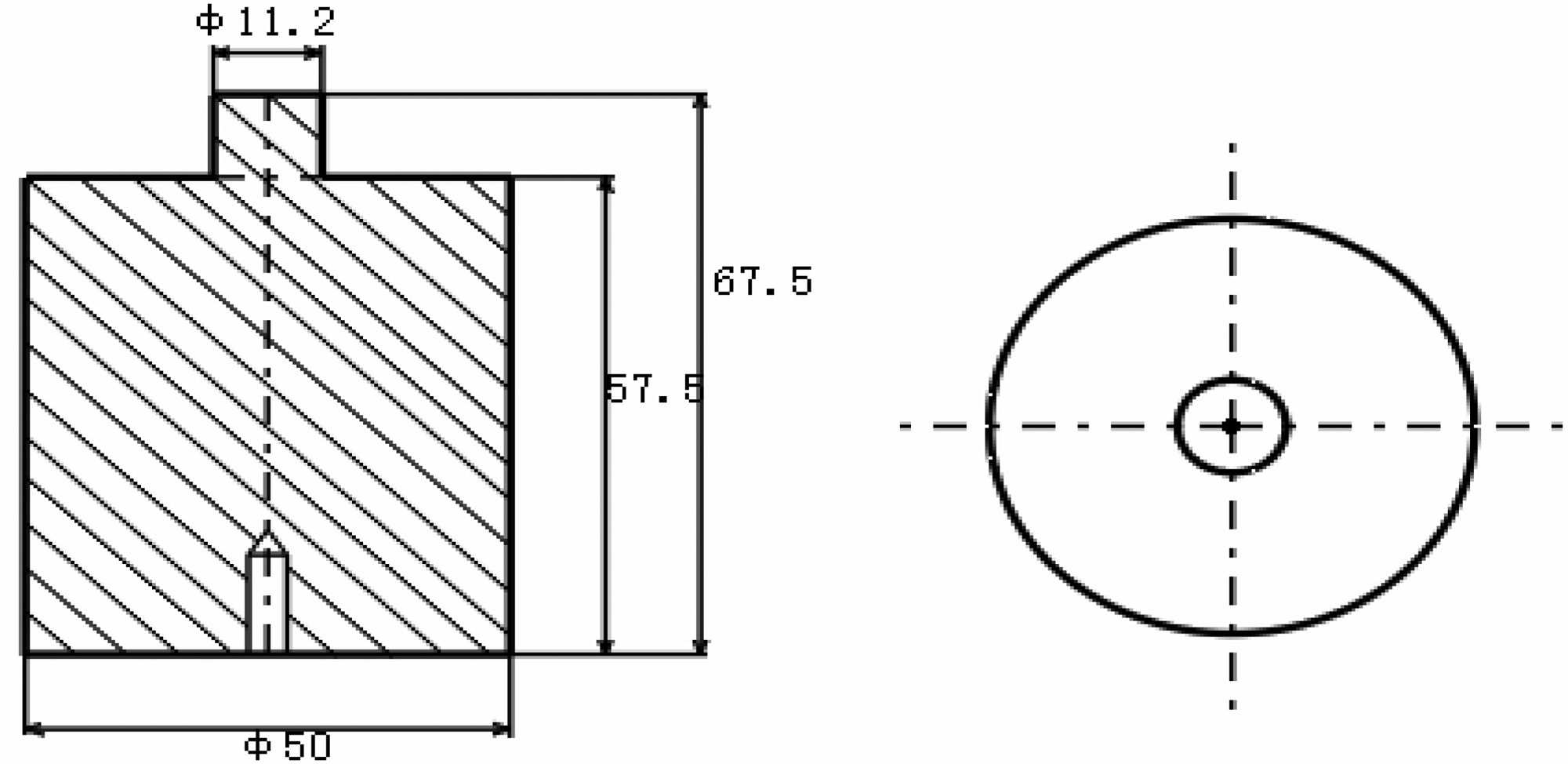
The red copper is selected as the material of electrode column, because of its good electrical conductivity and plasticity. According to the national standard and the relevant literature, 1 kg of sample is used to determine the quality of each electrode, the contact surface area of the bottom surface and the garment is 1 cm2 [22]. Schematic diagram of electrode parts is shown in Figure 1 (unit: mm) (copper density: 8.9 × 10³ kg/m3).
Copper wiring column: the diameter of wiring column and the threaded hole of electrode are matched. Wireway. Structure diagram of test electrode.
The physical diagram of the experimental equipment is illustrated in Figure 2.
Practicality picture.
Experimental content
Select the live working shielding clothing in accordance with the standard. The information about materials of clothing is shown below. The raw material of the garment is the blend fabric, which is made of stainless steel fiber and tussah silk. The number of the twist yarn made of stainless steel fiber and tussah silk is 18 in warp and weft direction per centimeter. The material of clothing is plain weave fabric. A point to point resistance test platform is built by using the above experimental equipment (Figure 3). Then the test points are determined, the resistance values between the two points are measured, and the relevant data are recorded (unit: Ω). In this paper, the key point of this paper is to design an appropriate point to point resistance measurement scheme, and to analyze its conductive properties by measuring the point to point resistance of live working shielding clothing. It can be referred for the further development and test by researching on conductive property of live working shielding clothing.
Experimental test method.
Resistance test point.

Figures 4 and 5 are the schematic diagram of test point on clothing.
Schematic diagram of test point on clothing. Schematic diagram of test point on gloves and socks.

In order to make a specific mark on the measuring point of garment, the corresponding area is cut out in the center of label according to the contact area in the bottom surface of electrode column. Then the label is attached to the location of test point. This method not only can reduce the numerical error caused by the deviation of the measuring point in the test process, but also ensure the cleanliness of the garment, and does no harm to the clothing.
Experimental procedure
Measuring the resistance value of the most remote points on a single piece of clothing. The main clothing pieces are coat, trousers, gloves, and socks. The location of the test includes: the top of hat and coat hem; left and right trousers mouth; finger tip and glove shunt line; tip of sock and sock shunt line; and other most remote two points in a single piece of shielding clothing. Measuring the resistance value of the most remote points on whole set of clothing. First, the components of the shielding clothing are connected and checked to ensure good connection between the components, and then the resistance value between the most remote points is measured. The parts of the test shall include: between the two gloves; between the two socks; between the each glove and each sock; between the top of hat and socks. The purpose of the above resistance test project is to check the resistance value of the complete set of shielding clothing. On the basis of good connection of live working shielding clothing, the resistance value between the different points on the garment parts and the foot is measured. Measurement of resistance value at different points in a single piece of shielding clothing. Data record: the distribution law of point to point resistance value of shielding clothing, the relationship between the structure of clothing and resistance are obtained through data processing and analyzing. Five measurements were taken between the two test points and then calculate the average value as the final resistance value.
In order to avoid the short connection between shielding clothing at the time of experiment, a layer of insulating plastic film is put inside the clothes. At the same time, attention need to be paid to the minimum distance between the test point and the seams, and the connection line is 3 cm in length.
Analysis of the errors on the experiment
Fluff is found on clothing surface, which is because the clothes are often touched during the experiment. And the dust in the air adheres to the surface of shielding clothing. These phenomena can cause the discontinuity of contact between the test electrode and the fabric [23]. Thus, the contact resistance is generated, and the measured data will have a certain error. That is, the measurement data also include the other resistance

In equation (4), R represents the measured value of the resistance, R1 is the actual point to point resistance value, R2 is the contact resistance value, and R3 is the resistance value of the electrode. (In this experiment, the electrode resistance is relatively small, so it can be ignored.) There is a certain error in the measured data.
At the same time in the test, the temperature and humidity of the surrounding environment, the insulation performance of the measuring table, the error of the experimental equipment, the electromagnetic environment around the experimental equipment, and other factors all can change the resistance value of the shielding clothing [24], thereby affecting the measurement data of point to point resistance.
Therefore, in the experiment, we should try to ensure the smoothness of shielding clothing and the consistency of the surrounding environment, reduce the number of handling of clothing. Finally, the experimental data should be measured in a continuous time.
Results and analysis
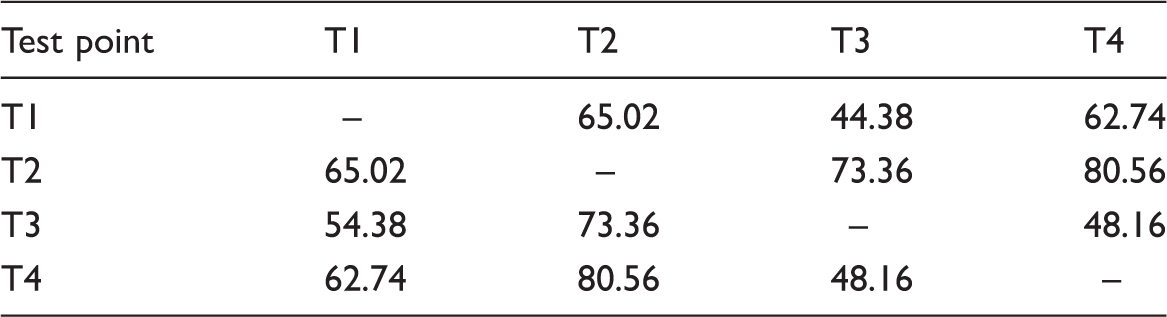
The point to point resistance values of live working shielding clothing are processed, and the average number of recorded five sets of data is the final data. The selected measuring points are numbered in sequence, and the sequence number is shown in Table 1.
Analysis of the resistance value of the whole set of clothing
When wearing the shielding clothing for live work, the hands are the main parts contacting with the electrified equipment. And the current of each part in the garment will eventually flow out through the part of foot. Therefore, this paper focuses on analysis of the resistance value of the test point to the foot and hand, and the relevant laws.
Under the condition of good connection of shielding clothing, the four points on the two socks and the four points on the two gloves are used as reference points. The shielding clothing is made of homogeneous conductor material and fiber material. But it has obvious differences in the structure of the front and the back, the left and the right of the clothing. The position and frequency of contacting with live equipment are also different. Therefore, the front and rear sides, the left and right sides of clothing were analyzed and compared separately.
The four points on the socks are taken as the reference points, and the resistance values between the points inside the front of garment and the reference point are shown in Figures 6 and 7.
The resistance value between the left of the front of garment and the socks. The resistance value between the right of the front of garment and the socks.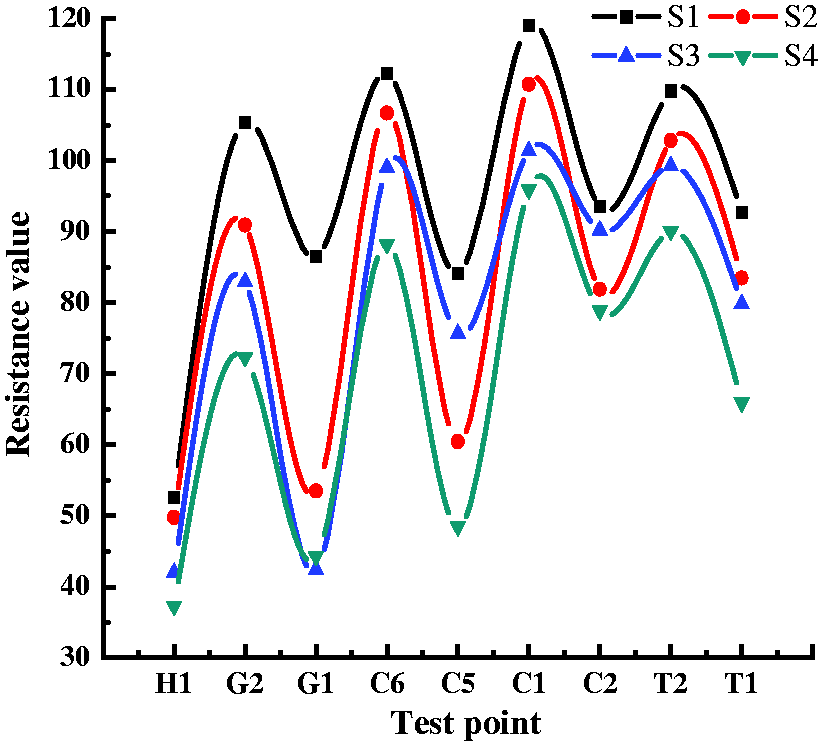

Through the observation and analysis of graphics, the resistance value between the test point and the heel of socks is less than the resistance value between the test point and the tip of the socks. When people standing for working, the heel bears more weight than the tiptoe. Therefore, the smaller the resistance between the test point and the heel of socks the more the conducive to flow out effectively of the electric current. It can be seen at the same time that the vertex of the hat is the farthest from the reference points, but the resistance value is the least. This is, about the overall shielding clothing, the farther the distance, the better the conductivity. In the high-pressure environment, the live working shielding clothing protects the human body through the shunt, the smaller the resistance between the two ends of shielding clothing, the greater the shunt current. Therefore, it can be learned that the point to point resistance value of live working shielding clothing is not proportional to the distance, the farther distance between two points, the better the connectivity and transmission performance.
The four points on the gloves are taken as the reference points, and the resistance values between the points inside the front of garment and the reference point are shown in Figures 8 and 9.
The resistance value between the left of the front of garment and the gloves. The resistance value between the right of the front of garment and the gloves.

It can be seen from the above figures that the resistance value of the points on shoulder and knee to the reference points is less than other points. Mainly because of these parts are often exposed to electrified equipment. the smaller the resistance, the more the conducive to the rapid transmission of current.
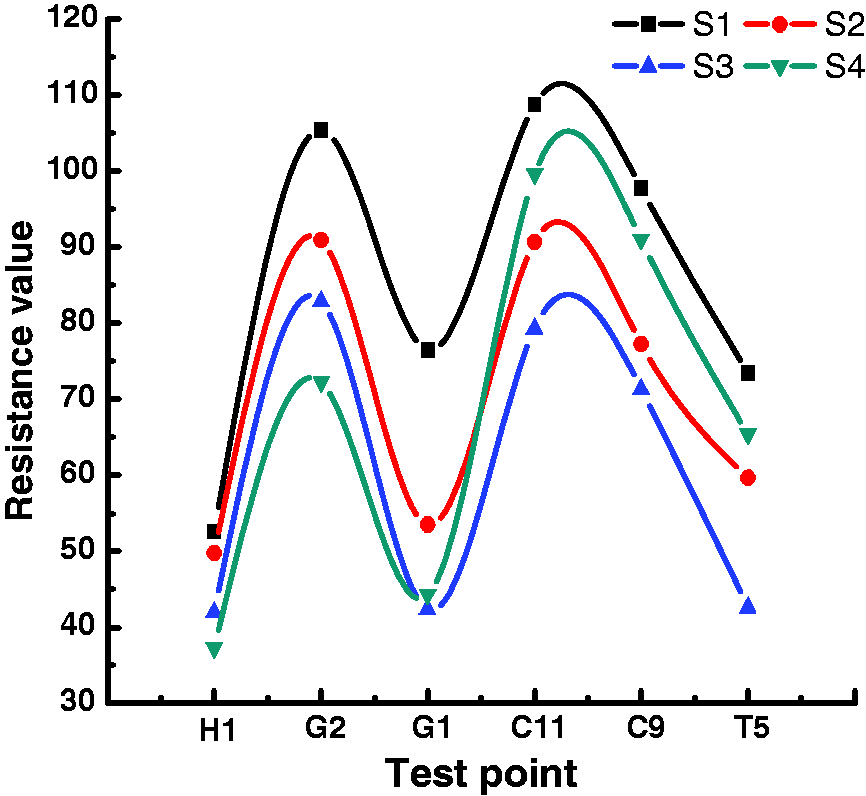
The four points on the socks are taken as the reference points, and the resistance values between the points inside the back of garment and the reference point are shown in Figures 10 and 11.
The resistance value between the left of the back of garment and the socks. The resistance value between the right of the back of garment and the socks.
The four points on the gloves are taken as the reference points, and the resistance values between the points inside the back of garment and the reference point are shown in Figures 12 and 13.
The resistance value between the left of the back of garment and the gloves. The resistance value between the right of the back of garment and the gloves.

From the above picture it can also be seen that the resistance of the most distal part of the garment and the resistance of the parts of contacting with electrified equipment frequently are minimal.
Analysis of the resistance value of the single piece of clothing
Point to point resistance of the front of a single piece of garment.

Point to point resistance of the back of a single piece of garment.

Point to point resistance of the trousers.
Conclusion
In this paper, the test method of point to point resistance is improved, the test electrodes are made, and the test platform is built to measure the point to point resistance. Through the analysis of the experimental data, the conductive properties of the live working shielding clothing are studied.
According to the measurement and analysis of the point to point resistance between the different points of the shielding clothing the following conclusions can be obtained: (1) on the basis of good connection, the farther the distance between two points, the smaller the resistance value and the better connectivity; (2) the resistance value of the points that frequently contact with electrified equipment is significantly smaller than others; (3) in the single piece of clothing, the size of the point to point resistance value is proportional to the distance; (4) given the same distance, if there is structure line in the middle of two points, the resistance value is large; (5) the structural complexity is positively associated with resistance value.
It is concluded that the electrical conductivity of live working shielding garment is related to the parts in clothing of contacting with electrified equipment during the operation, the complexity of structure, and other relevant factors. In the design and production, we should focus on reducing the resistance value between the most distal of clothing, the parts of contacting electrification equipment, and the feet, in order to increase its connectivity; the structural design of clothing should be simplified.
With the rapid development of the world's electric power industry, high-voltage live working technology is developing towards a deeper level in all countries. Subsequently, the requirements for the performance of live working shielding clothing are also increasing day by day. The deeper exploration and practice of the shielding clothing is the urgent need of the society and the industry. At the same time, the research on the live working shielding clothing will also promote the development of the industry.
Footnotes
Declaration of Conflicting Interests
The author(s) declared no potential conflicts of interest with respect to the research, authorship, and/or publication of this article.
Funding
The author(s) disclosed receipt of the following financial support for the research, authorship, and/or publication of this article: This research was supported by the National Natural Science Foundation of China [Grant Number 61771500, 61671489]; Henan Provincial Natural Science Foundation of China [Grant Number 162300410340].