




Abstract
Corduroy fabrics have been widely used in interior decoration currently. This work mainly investigated the acoustical properties of corduroy fabrics in relation to air permeability and airflow resistance. Five specimens with similar surface density and different wale width are used. The results indicated that corduroy fabrics with thicker wale width exhibited higher air permeability and lower airflow resistance. Furthermore, the increased width of wale is beneficial to improve the acoustic absorption of corduroy fabric. Two models based on air permeability and airflow resistance are taken to characterize the acoustical behavior. It has been indicated that Pieren model could well predict the acoustic absorption coefficient of corduroy fabric, and the difference of acoustic absorption is due to the varied air permeability and airflow resistance resulting from the different wale width.
Introduction
Textiles are widely used materials for noise reduction applications, including room acoustics, industrial noise, transportation noise, studio acoustics, etc. [1–3]. Compared with fiber felts and nonwovens, the acoustic absorption properties of woven fabrics are relatively poor due to the thinner thickness. However, the appearance of woven fabric is artistically pleasing and has been generally used for indoor and automobile decorations [4]. The acoustic absorption phenomena of woven fabrics have been studied for a long time. The acoustic wave attenuation mechanism could be mainly attributed to the internal viscothermal dissipative effects, the flow distortion effects, resonant effects, and bending vibration of the fabric [5].
In order to study the acoustic absorption properties of woven structures, some empirical-based works have been done. For instance, it has been found that pile surface, fabric-backing conditions, and various factors determine the total permeability, which would contribute more significantly to sound absorption [6, 7]. Shoshani and Rosenhouse [8] have studied the relationship between the sound absorption coefficient and structural parameters of woven fabrics. The results stated that cover factor has the most significant effect on absorption coefficient, which is particularly emphasized in the curves corresponding to the frequencies ranging from 2000 to 4000 Hz. Recently, Soltani and Zerrebini [9] reported that sound absorption properties of various woven fabric including plain, 2/1 twill, 3/1 twill, 2/2 twill, rib and satin fabrics would be decreased in the named order. The results also revealed that both fabric porosity and surface specific weight have substantial influence on acoustic absorption. Woven fabrics with lower weft yarn twist would absorb acoustic energy more efficiently, and air permeability can be taken as a criterion of sound absorption behavior [10]. Furthermore, a theoretical model for the acoustical behavior of thin woven fabrics backed with air gap space is presented by Pieren [11]. The method is described by airflow resistance and specific surface weight, thus predict the acoustic absorption coefficient. It has been reported that airflow resistance is a reproducible parameter of porous materials, and acoustic absorption coefficient can be predicted by flow resistance [12, 13]. For fibrous materials, air permeability is an easily measured parameter and could be used to evaluate acoustic absorption properties.
Corduroy fabric has enjoyed interest due to its applications extended to home furnishing, such as curtains and carpets, etc. The structure of corduroy fabric consists of two sets of filling yarns and warp yarns. The warp yarns should be strong enough and high evenness to subject the high forces in weaving. The first set is configured with the warp yarns, which is the so-called ground fabric, thus provide the integrity of the structure. The second set of filling yarns forms the floats, and the cutting of the pile is normally done after weaving on a specific machine fitted with circular knives and followed brushing [14, 15]. Considering the special structure and cut pile filling of corduroy fabric, it has potential to improve the acoustic absorption properties. The raised rib on the surface of corduroy fabric is similar with nonwoven, and the ground fabric is woven structure. Therefore, corduroy fabric could be seen as multilayer acoustic absorber consisting of woven and nonwoven fabrics. This compound structure is benefit to the attenuation of acoustic waves. However, to the best of the author’s knowledge, the acoustical analysis of corduroy fabric has not been reported.
In the present paper, we have first analyzed the sound absorption properties of corduroy fabrics. The acoustic absorption coefficient of five corduroy fabrics with similar surface density and different wale width has been measured and compared. Two parameters including air permeability and airflow resistance which affected the acoustic absorption are discussed. In addition, the difference of acoustic absorption curves of five tested corduroy fabrics has been explained. And wale width was taken as a parameter to evaluate the acoustic properties, which could predict acoustic absorption coefficients intuitively. For this purpose, we use two methods such as empirical-based vibration absorption model and geometry-based Pieren model to characterize the acoustic absorption coefficients. The predicted values are compared with the test data; it has been indicated that the Pieren model could well characterize the acoustic absorption of corduroy fabric at normal incidence.
Materials and methods
Physical properties of corduroy fabrics in this study.

Currently, impedance tube has been widely taken to measure the acoustic absorption coefficient of porous materials. In this study, SW-260 double-microphones standing wave tube was used to analyze the acoustical characteristic of corduroy fabrics. The schematic illustration of acoustic absorption measurement is shown in Figure 1. The equipment consists of a loudspeaker, a digital frequency analysis system, an impedance tube, a power amplifier, two precision sound level microphones, etc. The test process was based on the method of ASTM E 1050 (Standing Test Method for Impedance and Absorption of Acoustic Properties Using a Tube, Two Microphones and a Digital Frequency Analysis System) [18]. Circular test samples with a diameter of 35 and 80 mm were used to measure the absorption properties at high- and mid-low frequency, respectively. Incident acoustic signals propagate as plane waves in the impedance tube, where incident and reflected wave signals are picked up and analyzed. The coefficient of normal acoustic absorption was calculated by the VA-lab system using computer. In the present work, the test was repeated three times and the average values were reported. The optical images of measured five corduroy fabrics are shown in Figure 2. It could be seen from Figure 2(a) and (b) that the width of stripes is gradually increased for C-1 to C-5 fabrics in sequence. In Figure 2(c), the ground fabric could be observed for C-3, C-4, and C-5 specimens, while the ground structure was totally covered by the surface pile filling of C-1 and C-2 fabrics.
Schematic illustration of acoustic absorption measurement system with different back cavity. Corduroy fabrics in this study: (a) circular specimens used in the acoustic absorption test, (b) photographs to display the stripes morphology of corduroy fabrics, and (c) optical images with the magnification of 30 times.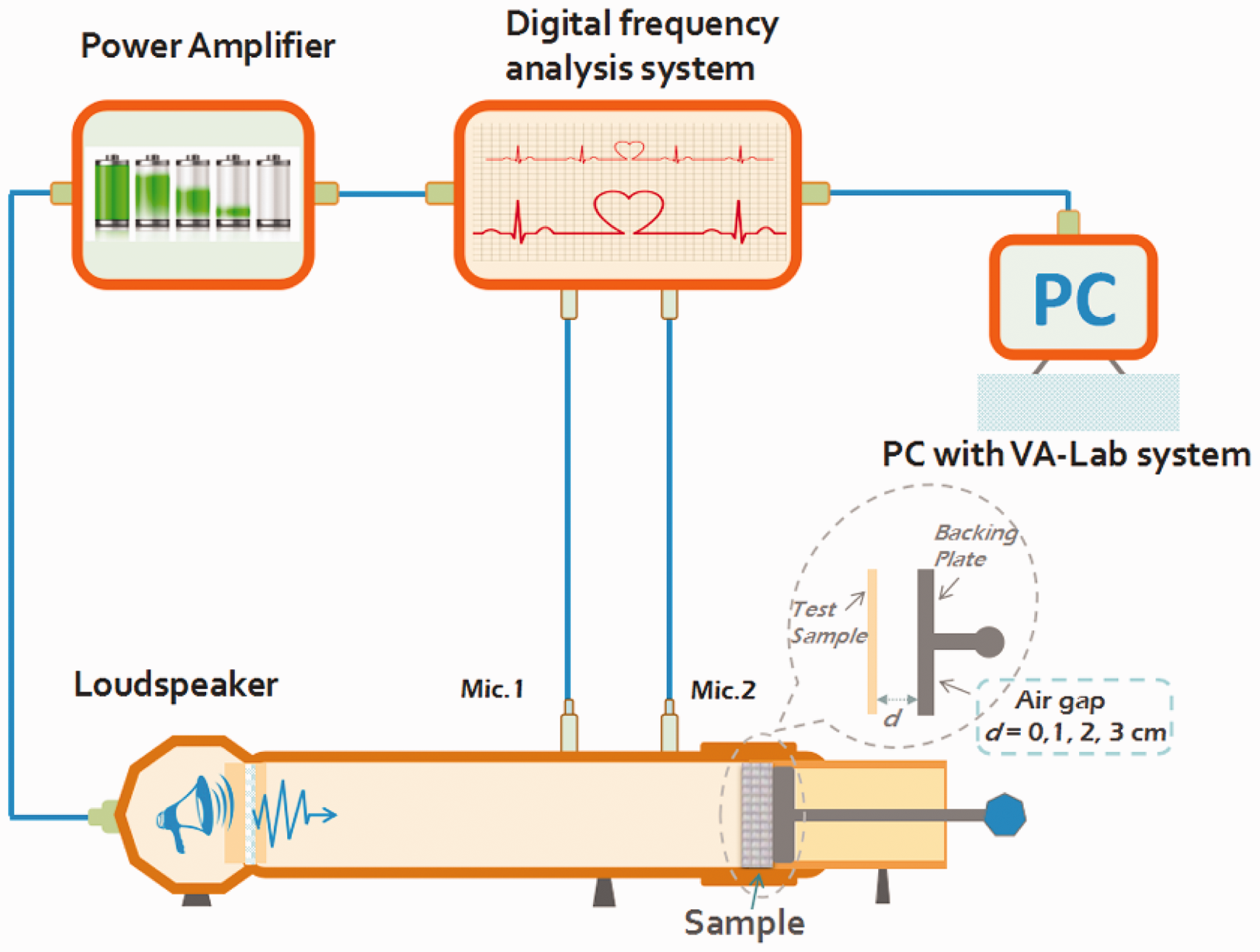

Theoretical basis and models
Generally, fibrous materials are classified as thin sheet fabric and bulk fiber assemblies according to the thickness compared with acoustic wavelength. The thickness of sheet fabric is much smaller than the wavelength, while the thickness of bulk fiber assemblies is equal or larger than wavelength. The acoustic wave attenuation in bulk fiber assemblies is mainly controlled by viscous and thermal effects, and solid density, etc. However, the acoustic absorption properties of sheet fabrics are determined by the viscous effects and surface area density [19]. In this section, two reported methods including vibration absorption model and Pieren model related to the acoustic absorption of thin fabric are described.
Vibration absorption model
The schematic illustration of sound absorption structure with air gap is shown in Figure 3. It has been found that the acoustical behavior of thin fabric could be described by a simple parameter of air gap distance D. The model is based on the maximal acoustic absorption coefficient at the odd number multiplication of 1/4 wavelength and the minimal acoustic absorption coefficient at the integer number multiplication of 1/4 wavelength [8, 20]. Therefore, the absorption coefficient is assumed to be positively proportional to the wave amplitude in impedance tube. Y is the amplitude maximum and ω is angular frequency. The wave vibration equation is as follows
Illustration of sound absorption structure with air gap.

The expression of acoustic absorption coefficient can be shown as follows


It has been reported that the theoretical tendency is completely identical with the measured values when A equals to 1. The value range of α is 0–1. Air permeability is an important parameter which determines the acoustical behavior. The relationship between acoustic absorption coefficient and air permeability has been investigated [10, 22]. It has been stated that acoustic absorption properties were strongly affected by air permeability. Furthermore, an empirical formula was obtained as follows [21]
Equivalent electrical circuit of corduroy fabric sound absorption model.


Pieren model with air gap
The acoustical absorption behavior of thin fabric could be described by equivalent circuit method, as shown in Figure 4. In this analogy process, various physical elements are represented by equivalent electrical elements. Therefore, the ratio of sound pressure and sound velocity yields an acoustic impedance [23, 24]. The airflow resistance Rs is taken to describe the acoustical energy loss inside the thin fabric, which is mainly attributed to the viscous friction effects. Zm is represented by an inductor with inductance m, which is the surface mass density (kg/m2), and Zm = jωm. The velocity of acoustic wave and fabric has to be summed up, which corresponding to the parallel connection of impedance Rs and ZM, as follows

The impedance of back air gap at normal incidence could be described as follows


According to the calculated surface impedance ZT, the normal acoustic absorption coefficient could be characterized as follows

Results and discussion
Acoustic absorption coefficient of corduroy fabrics

Average acoustic absorption coefficient of five corduroy fabrics with different back air gap.

It could be seen that all corduroy fabrics showed poor sound absorption properties without air gap. The presence of back air gap can obviously increase the acoustic absorption coefficients. In addition, as shown in Figure 5, both C-4 and C-5 have relatively good acoustic absorption properties at high-frequency range when the air gap distance is 1 and 2 cm. With the air gap increased to 3 cm, the acoustic absorption peak moved to lower frequency. However, for C-1, C-2, and C-3 samples, the maximized acoustic absorption coefficient was observed at low frequency, as listed in Tables 3 to 5. It should be pointed out that Δf is the frequency range of coefficient higher than 0.5, which is taken to describe the effective absorption frequencies. Air gap plays an important role in the acoustic absorption behavior of sheet fibrous materials. Both average and peak acoustic absorption coefficients are affected by the presence of air gap. The acoustic impedance of air is determined by the thickness of air gap behind the fabric, and the frequency-dependent acoustic wave transmission path is also limited by the cavity length. Therefore, the different distance of air gap will cause the different absorption coefficients.
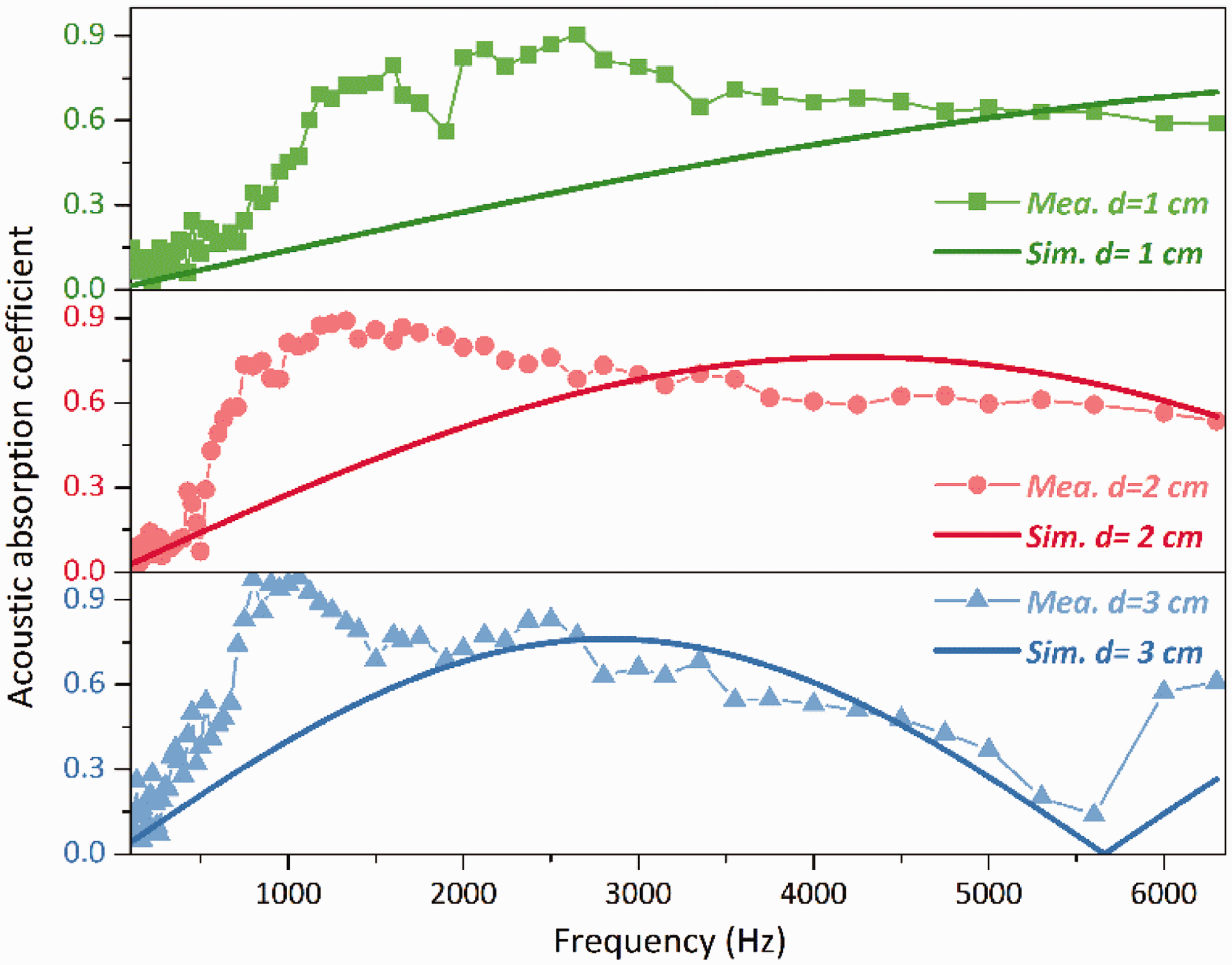
Measured and simulated acoustic absorption coefficient of corduroy fabrics with vibration absorption model. Detailed acoustic absorption properties of corduroy fabrics with different 1 cm air gap. Detailed acoustic absorption properties of corduroy fabrics with different 2 cm air gap. Detailed acoustic absorption properties of corduroy fabrics with different 3 cm air gap.


The octave frequency range of coefficient higher than 0.5 for five corduroy fabrics was calculated based on the formula of f2/f1 = 2 m , where m is the octave frequency range (Δf), f1 and f2 are the start and terminated frequency peak of coefficient higher than 0.5. The results indicated that C-3, C-4, and C-5 fabrics have octave frequency range higher than 2 with 1 cm air gap. Especially, the octave frequency range increased to approximately 3 when the air gap is 2 or 3 cm. It should be noted that C-1 and C-2 have at least two separated octave frequency range resulted by the serve fluctuation of absorption curves at low- and middle-frequency range. Therefore, it can be stated that a wider width of the wale can improve the acoustic absorption properties. To further study the difference of five corduroy fabrics, two simulation methods characterized the acoustical behavior in the following sections.
Predicted results based on vibration absorption model
Vibration absorption model was used to describe the acoustical behavior of corduroy fabrics. Figure 5 shows the measured and predicted acoustic absorption coefficients for corduroy fabrics with air gap. The difference of four kinds of curves is mainly due to the different distance of air gap. Based on the acoustic absorption theory of fibrous materials, acoustic absorption curves and coefficients are determined by the distance of air gap. Vibration model could roughly describe the trend of acoustic absorption properties when the air gap is 2 and 3 cm. As for five samples with 1 cm air gap, the prediction curve could not well describe the acoustic characteristics. However, the acoustic absorption properties of C-4 and C-5 specimens could be simulated with certain deviation. Hence, vibration absorption model is ineffective in predicting the acoustic absorption coefficient of corduroy fabrics. To compare the prediction accuracy of established models, the error rate was calculated by the following equation (11). The results of different fabrics were shown in Figure 6.
Error rate between measured and simulated acoustic absorption coefficient of corduroy fabrics with vibration absorption model.

In order to confirm the effects of air permeability on sound absorption, a revised vibration absorption model has been established by considering the air permeability of fabric, as shown in equations (4) and (5). Figures 7 to 11 compared the simulated and measured values of acoustic absorption. The predicted error rate of five corduroy fabrics is shown in Figure 12. The results indicated that the deviations of C-1 and C-2 are smaller than C-3, C-4, and C-5 samples. However, Figures 7 and 8 demonstrate that the predicted curves did not describe the tendency of measured values adequately. Similarly, with the vibration absorption model without considering the air permeability, a revised model could better characterize the acoustical behavior of corduroy fabrics with thicker wale width. The reason could be attributed to the applicability of vibration absorption model, where acoustic absorption coefficient is affected by the air permeability of fabric [21]. Therefore, in the next section, we have simulated the acoustic absorption properties of five corduroy fabrics with geometrical structure based on the Pieren model.
Measured and simulated acoustic absorption coefficient of C-1 corduroy fabric with vibration absorption model considering air permeability. Measured and simulated acoustic absorption coefficient of C-2 corduroy fabric with vibration absorption model considering air permeability. Measured and simulated acoustic absorption coefficient of C-3 corduroy fabric with vibration absorption model considering air permeability. Measured and simulated acoustic absorption coefficient of C-4 corduroy fabric with vibration absorption model considering air permeability. Measured and simulated acoustic absorption coefficient of C-5 corduroy fabric with vibration absorption model considering air permeability. Error rate between measured and simulated acoustic absorption coefficient of corduroy fabrics with vibration absorption model considering air permeability.



Predicted results based on Pieren model
The geometry-based Pieren model involves surface area mass density, air gap distance, and airflow resistance. Specifically, this model is described by a set of formulas including equations (6) to (9). In this section, the measured and predicted results of five corduroy fabrics are shown in Figures 13 to 17. Generally, the measured and predicted curves agree better than the vibration absorption model, and the error rate can be seen in Figure 18. However, it is similar to the vibration absorption model in that the prediction deviation of thick wale corduroy fabric is higher than fine wale corduroy fabric. The results could be attributed to the enhanced resonance effects of fabrics with low air permeability. Therefore, the fabrics gradually exhibited the acoustical characteristics similar to synthetic films [25]. In detail, the airflow resistance values of the five corduroy fabrics in this study are significantly higher than that of Pieren’s work. For example, the airflow resistance of C-1 and C-2 sample was 1986 and 2038 Pa s/m, respectively, which is much higher than the values reported by Pieren [11]. C-4 and C-5 have relatively low airflow resistance and high air permeability, therefore, the model of Pieren could better characterize the acoustical behavior. The intrinsic characteristics of five corduroy fabrics can be indirectly described by airflow resistance, thus making the difference in acoustic absorption. It can be stated that the acoustic absorption properties of corduroy fabrics can be well characterized according to the parameters of surface mass density, airflow resistance, and air permeability.
Measured and simulated acoustic absorption coefficient of C-1 corduroy fabric with Pieren model. Measured and simulated acoustic absorption coefficient of C-2 corduroy fabric with Pieren model. Measured and simulated acoustic absorption coefficient of C-3 corduroy fabric with Pieren model. Measured and simulated acoustic absorption coefficient of C-4 corduroy fabric with Pieren model. Measured and simulated acoustic absorption coefficient of C-5 corduroy fabric with Pieren model. Error rate between measured and simulated acoustic absorption coefficient of corduroy fabrics with Pieren model.


In this study, the vibration model is based on the maximal acoustic absorption coefficient at the odd number multiplication of 1/4 wavelength and the minimal acoustic absorption coefficient at the integer number multiplication of 1/4 wavelength. A modified empirical formula is established by considering the role of air permeability of thin fabric, as shown in equations (4) and (5). Therefore, in Figure 6, the error rate of C-1 and C-2 is conspicuously different from that of C-3, C-4, and C-5. The reasons could be attributed to the difference of air permeability and airflow resistance. For C-1 and C-2, the air permeability is relatively low; therefore the acoustic behavior is similar with membrane materials. It can be observed from Figure 5 that the sound absorption bandwidth of C-1 and C-2 very is narrow. C-4 and C-5 have the obvious characteristics of porous materials, and vibration model is based on the porous mechanism. Therefore, the error rate of C-1 and C-2 is higher than that of C-3, C-4, and C-5. In Pieren model, various physical elements are represented by equivalent electrical elements, and the ratio of sound pressure and sound velocity yields an acoustic impedance. The calculation process of Pieren model is shown in equations (6) to (9). The simulation of Pieren model is based on the surface mass density of corduroy fabrics. In the present study, all the five fabrics have the similar surface mass density. Therefore, Pieren model could predict the acoustic absorption coefficient more accurately than vibration model. The results are shown in Figure 12.
Conclusion
Corduroy fabric has bright promise for noise reduction applications. The acoustical characteristics of five corduroy fabrics were measured at frequencies from 100 to 6300 Hz. The acoustic absorption with 1, 2, and 3 cm air gap distance has been compared and analyzed. In summary, we could draw the following conclusions. First, it has been found that corduroy fabrics have great potential in noise reduction applications, and thick wale width is benefit to increase acoustic absorption properties. Second, both air permeability and airflow resistance can determine the acoustical behavior of corduroy fabric. The acoustic absorption of corduroy fabric is gradually increased with the increase of air permeability. Third, Pieren model could better predict the acoustic absorption coefficient of corduroy fabric than vibration absorption model. The acoustic absorption properties of corduroy fabrics with different wale widths could be estimated according to airflow resistance.
Footnotes
Declaration of Conflicting Interests
The author(s) declared no potential conflicts of interest with respect to the research, authorship, and/or publication of this article.
Funding
The author(s) disclosed receipt of the following financial support for the research, authorship, and/or publication of this article: This research was supported by the Fundamental Research Funds for the Central Universities (CUSF-DH-D-2017001).