




Abstract
A comprehensive analysis carried out on the mechanical and free vibration properties of woven natural fiber polymer composites is presented. Jute fabric with three different weave types (plain, basket and herringbone) and intra-ply woven jute-banana fabrics are considered for investigation of the effect of weave type of a fabric and its stacking sequence on mechanical, dynamic mechanical and free vibration properties. Enhancement of the properties is found with the number of layers of fabric and better properties obtained for four layers. Uniform stress distribution along warp and weft direction of fabric with basket weave type lead to better properties compared to other weave types for four-layered composites. Intra-ply hybridization of jute-banana also enhances the mechanical properties but slightly less than the jute-basket fabric composite. The investigations on effect of layer sequence of fabrics revealed improvement in mechanical properties. Layered composite with relatively strong intra-ply fabric as the facing layer and relatively weak jute plain fabrics as the core layer has higher tensile and flexural properties. Experimental modal analysis carried out on beam-like composite laminates reveal that natural frequencies and associated modal damping factor are significantly influenced by stacking sequence and weave type of a fabric. The density of the composite calculated based on Archimedes principle matches well with the theoretical values.
Keywords
Introduction
In recent years, natural fiber has been chosen as a good alternate material due to several advantages associated with natural fibers such as use of plant waste, environmental friendly, high strength to weight ratio, requirement of less energy to fabricate their composites makes them as an alternative material to conventional materials and synthetic fiber-reinforced polymer composites in several applications where load-sharing requirement of the structural component is vital [1,2]. In most of the cases, the natural fiber-based composite material can be successfully implemented for low and medium load application while in high load application, it has restrictions. In most of the cases, natural fiber-based composite material has tensile and flexural strength less than 100 MPa. This makes them not suitable with high load application. In general, natural fiber-based composite material can find use in home-based application (telephone stand), structural application (door) and packing application. Natural fiber along with synthetic fiber can be used in automobile industry. This helps reducing the weight of the final product such as outer body, door, etc. The adoption of natural fiber in the polymer composite, especially in automobile industry, increases the fuel efficiency. Lightweight natural fiber composite structure decreases the fuel consumption [3–5]. A few researchers proved that natural fiber composite can be successfully used to replace the synthetic fiber composite with equivalent properties for low and medium load application [6,7].
The tremendous developments in the textile field such as weave type, braiding and knitting technologies have triggered improvements in the properties of composite material [8,9]. Several researchers have made analysis of natural fiber reinforcement in woven form in the polymer matrix and reported that woven fabric composite enhances the properties of composite material compared to composite with intimately mixed fibers [10,11]. Sapuan and Maleque [12] used woven banana fabric-reinforced composite for low load application to develop the telephone stand. Bledzki et al. [13] compared the mechanical properties of woven flax and jute composite. Their results revealed woven flax composite increases the mechanical properties of composite material compared to jute composite. Goutianos et al. [14] found that the properties of woven composite depend entirely on the nature of yarn twist. They report that yarns with low twist transferring minimum stress under loading as a result of the low strength of woven fabric. Pothan et al. [15] have compared the mechanical properties of plain, twill and matt woven sisal composite. They found enhancement of the mechanical properties of the composite material compared to twill and plain woven composite through matt type woven sisal composite. This arises as a result of poor stress transfer of plain and twill woven fabric which is the result of lower fiber volume percentage in the polymer matrix. Rajesh and Jeyaraj [16] have done analysis of the dynamic mechanical properties of different woven composites for banana and jute composite. They found the nature of weaving pattern having influence on the dynamic properties of composite material. They have also extended the analysis to intra-ply woven banana/jute hybrid composite by changing banana and jute yarns in the warp and weft directions. They found the orientation of fiber influence on the dynamic properties of composite material. The results reveal composite with relatively stronger jute fiber yarn along the warp direction has a higher storage modulus (3.5 E+09 Pa) compared to relatively weak banana yarn in the warp direction (2 E+09 Pa).
Several researchers have performed the analysis of the layering effect of natural fiber composite on mechanical, dynamic mechanical and free vibration properties and concluded that the number of sequential layers influences the properties of composite material. Jawaid et al. [17] analyzed the tensile properties of tri-layer oil-palm jute woven composite and showed that jute layer, when kept as skin layer, improves the tensile property of composite material by 48% compared to pure oil-palm composite. Bennet et al. [18] analyzed the stacking sequence effect of coconut sheath/sansevieria cylindrica polyester composite and found that coconut sheath/sansevieria cylindrica/coconut sheath composite enhances the natural frequency. Santulli et al. [19] have analyzed the mechanical behavior of jute cloth/wool felts hybrid composite using the intercalated and sandwich method and found composite with sandwich method increasing the mechanical properties of composite material. Ramesh et al. [20] have analyzed the mechanical properties of sisal/jute/glass reinforced polyester composite. They found the incorporation of sisal and jute in glass composite increases the mechanical properties of the composite material.
Natural fiber composite with improved mechanical properties can be used to replace structures made of metals and synthetic fiber-based composites in low and medium load applications. The major drawback associated with natural fiber composite is their short and random orientation form of reinforcement in the matrix which reduces the mechanical properties due to their amorphous nature. A few researchers have demonstrated a significant improvement in the mechanical properties of natural fiber composite through their reinforcement in woven form.
However, exploration still remains to be done by way of detailed investigation on the influence of the nature of the weaving type of the fabric, the number of layers and stacking sequence of fabrics with different weaving type on the mechanical properties of a polymer composite. In the same way, it is very important to analyze the effect of intra-ply hybridization of two different natural fibers in a woven fabric on the mechanical behavior of the composite. The focus of this work is on the mechanical, dynamic mechanical and free vibration behavior of different woven fabric (plain, basket and herringbone) composites made of jute yarn and intra-ply hybrid composite made of jute and banana yarns.
Experimental details
Woven fabric and polymer preparation
Plain, basket, herringbone and intra-ply hybrid fabrics are considered in the present study for the investigation of the effect of weave type and its layering sequence on the mechanical, dynamic mechanical and free vibration characteristics. The different types of fabrics considered are plain jute, basket jute, herringbone jute and banana–jute intra-ply basket fabrics as shown in Figure 1. All the fabrics are prepared with a thickness between 0.8 mm to 0.9 mm. These fabrics are woven using a power loom to obtain the stiff woven fabrics and also to minimize the gap between the yarns.
Different woven fabrics. (a) jute plain, (b) jute basket, (c) jute herringbone and (d) intra-ply.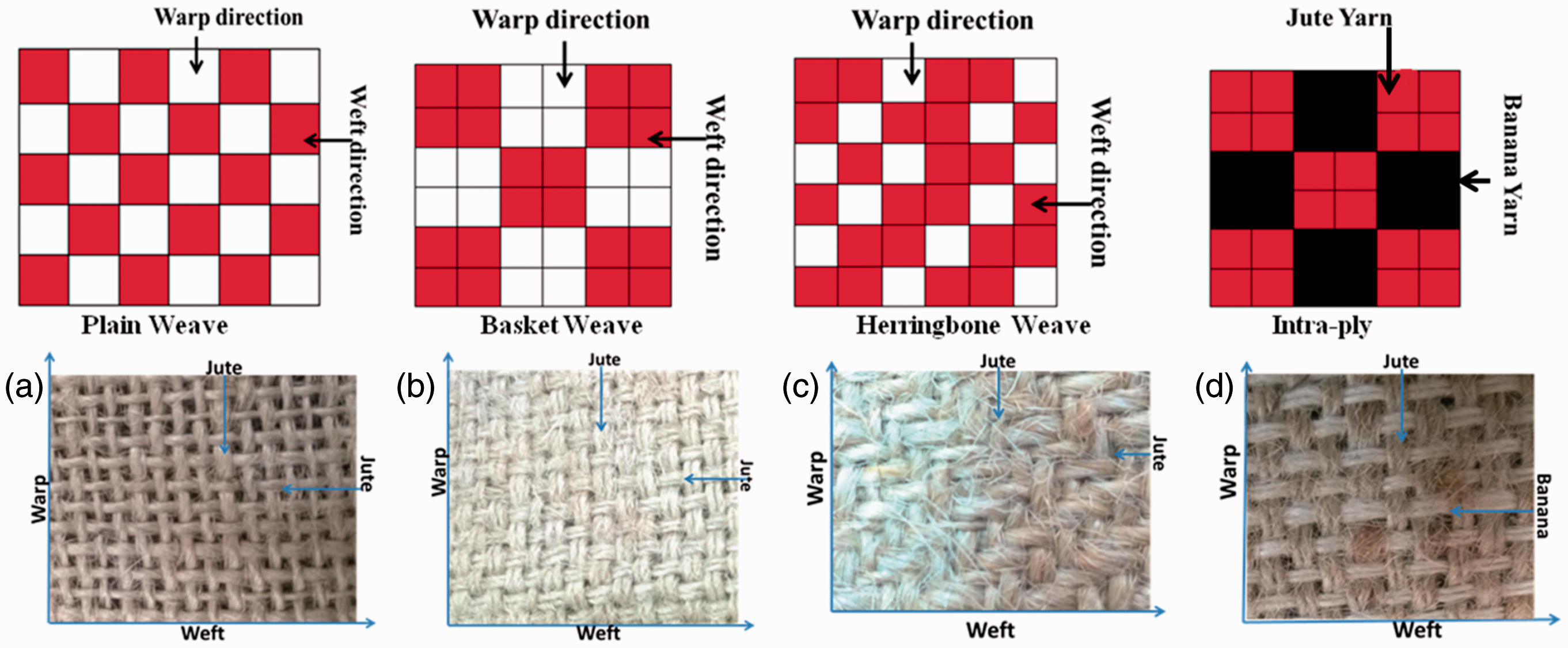
In this work, unsaturated isophthalic polyester resin is used as a matrix material while methyl ethyl ketone peroxide (MEKP) and cobalt naphthenate are used as a catalyst and as an accelerator, respectively. Initially, one weight percentage of MEKP and cobalt naphthenate are taken and mixed uniformly with the unsaturated isophthalic polyester in the ratio of 1:1:10 by weight.
Based on the investigation of the effect of the number of layers of woven fabric on mechanical properties, it is decided to perform the layering sequence study on the four-layered sandwich composites. The different types of sandwich composites investigated are IPPI, IPI, BPPB, BPB, IPPB, PIIP and IBaBaI. Here, the extreme letters indicate the fabric associated with the bottom and top skin layers and the remaining alphabets indicate the core layers. Similarly, I indicates banana-jute intra-ply fabric, H indicates herringbone jute fabric, P indicates plain jute fabric, B indicates basket jute fabric and Ba indicates basket type banana fabrics.
Fabrication of composites
Composite laminate with different fabrics are prepared with the help of a compression moulding machine. For this purpose, a mould of size 250 mm × 250 mm × 4 mm has been prepared using stainless steel material. Initially, a sufficient amount of resin is poured inside the mould cavity. This is followed by placing multiple layers of woven fabrics over the poured resin. This is followed by the use of a roller for removing voids present in the composite. The natural fiber fabrics are wet in the matrix material and subsequently placed inside the mould. This wetting process increases the adhesion between fiber and matrix more than what is possible in the normal laying process. The remaining amount of matrix material is poured over the layer and the mould is covered by a plate. It is then compressed by 150 kgf/cm2 pressure for 1 h with 80℃ curing temperature to obtain the uniform composite laminate. After the curing, the composite laminate is removed from the mould and sized according to ASTM standards for tensile, flexural and impact test, respectively. Figure 2 shows the experimental setup used in the study to prepare the composite laminate.
Experimental setup used in the study.
Testing standards
In this study, tensile test for the woven composite specimen is carried out as per ASTM D-638 with a testing speed of 5 mm/min. For that dog-bone shaped specimen with dimension of 165 mm length, 19 mm width and 57 mm gauge length are prepared. ASTM D-790 is followed to find the flexural strength of composite specimen through three-point bending test with a testing speed of 1.7 mm/min. For that composite specimens are sized into 127 mm × 12.7 mm × 4 mm. Impact strength of composite is found using Izod test without notch. Impact specimens are prepared as per ASTM standard D-256 with dimension of 63.7 mm ×12.7 mm × 3 mm. Dynamic mechanical analysis is done using double cantilever system SEIKODMAI-DMSC 6100 at a frequency of 1 Hz in atmospheric condition in a nitrogen environment for a temperature range of 0℃ to 200℃ at 2℃/min to determine the storage modulus, loss modulus and loss factor of various composite specimens.
Results and discussion
As the first steps, a separate study has been carried out to find the number of layers of fabric which gives better mechanical properties of the composite. This has been done for all the fabrics through variation in the number of layers of fabric from one through four. The total number of layers of fabric has been restricted to four considering the thickness limitations of the test specimen according to the standards. Followed by this, the investigation of a four-layered sandwich has been done for different sequences of fabric layers. Apart from mechanical strength behavior, dynamic mechanical and experimental modal analyses are also performed.
Density measurement
Influence of weaving pattern architecture, number of layers, stacking sequence on density of the composites.

Mechanical properties
Influence of weaving pattern architecture, number of layers, stacking sequence on mechanical properties.

Fiber volume fraction of different composites.

The strength of fiber reinforced composite depends on the fiber strength, amount of fiber, fiber length and weave type. Also the strength of composite dependent, stress transfer between fiber and matrix. It is evident from the results shown in Table 3 that amount of fiber in the composite influences the effective stress transfer. The composites with low fiber content are not able to transfer much load which leads to the failure of composite very early. However the composites with high fiber content are able to transfer much load hence has higher strength.
Table 2, clearly, shows a significant increase in the tensile properties with increase in the number of layers. Composites with four-layered basket type woven jute fabric are seen giving higher tensile properties compared to other fabric composites. The synergy effect of both high strength jute fiber and better load transfer between the basket weaving style woven fabric and matrix is the factor that improves the properties of composites. In the case of basket type woven fabric composite, higher resistance has been provided by the fabric against tensile loading as a result of the nature of arrangement of fiber yarns. Hence, additional load is required for breaking the composite material. Herringbone woven fabric composite has higher tensile properties compared to plain fabric composite but less than basket fabric composite. Further investigation has been done on jute-banana intra-ply hybrid woven fabric composite for tensile behavior and the results are compared with the individual jute basket fabric composite. The comparison shows intra-ply hybridization of banana and jute fibers yarns in basket type woven fabric resulting in better tensile properties compared to individual jute fiber fabric composites. Figure 3 shows the influence of the number of layers and the different types of woven fabrics on mechanical properties of the composite. Figure 3(a) reveals four-layered composite exhibiting better resistance against tensile loading than the other layered composites. Figure 3(b) brings out the fact of composite with basket weaving pattern providing more resistance against deformation and carries more load than other woven fabric composites. The basket weave type of woven fabric provides more restriction against the stretching of yarns in warp and weft direction thereby reducing the displacement of basket woven fabric composite. Another observation from Figure 3(b) is the failure of jute plain woven fabric composite earlier under low load with large deformation. This is the result of tightening effect between yarns in the warp and weft direction.
Load vs. displacement diagram for woven composite under tensile load. (a) Influence of number layer and (b) influence of weaving pattern.
Indication from Table 2 is hybridization and stacking sequence of different woven fabrics influencing the tensile properties of the composite. Many researchers have proved that the stacking sequence of composite increases the mechanical properties of composite material [17,21,22]. They have suggested high strength fiber as skin layer and less strength fiber as core layer improves the mechanical properties. In a sandwich composite, the skin layers provide a higher resistance against deformation, while the core layer distributes the load uniformly. This is reflected in the results reported in Table 2. The layered sandwich composite has hybrid banana-jute intra-ply fabric as the skin layer, and plain jute fabric as the core layer (IPPI) has better tensile properties compared to the other layered composite sandwiches. Similarly, the layered composite BPPB has better tensile properties in comparison with other composites but less than IPPI composite due to the influence of basket jute skin layer. The poor tensile characteristics seen in three-layered BPB and IPI composite indicate the influence of core thickness. The higher core thickness associated with the four-layered BPPB and IPPI enhances the tensile properties of the layered sandwich composite. The four-layered sandwich composite PIIP has better tensile properties than IPPB but less than those of the four-layered IPPI and BPPB composite. This is the result of a non-uniform stress transfer behavior of intra-ply and basket-jute fabrics. Again sandwiching banana fabrics between the banana-jute intra-ply fabrics has also influenced in better tensile properties of the IBaBaI composite but less than those in IPPI and BPPB composites.
In the case of IPPI sandwich composites, hybridization of banana and jute natural fiber yarn in the warp and weft direction gives low deformation which increases the strength of the composite material. The stretching nature of fiber strands in the fabrics break at different times is independent, and individual breaking nature of fiber stands influences the tensile properties of sandwich composite material.
Stacking sequence has a considerable influence on the flexural properties of different types of jute and jute-banana intra-ply woven fabric polyester composites as shown in Table 2. The significantly higher flexural strength in the IPPI-layered sandwich composite compared to all other layered composites is clear from Table 2. The IPPB sandwich composite has poor flexural strength compared to four-layered IPPI and three layered BPB and IPI sandwich composites. This indicates the enhancement of flexural strength arising out of a stiff layer of banana-jute intra-ply fabric. The lowest flexural strength of IBaBaI sandwich composite indicates that the flexural strength of a sandwich composite is not only influenced by nature of skin layer fabric but also influenced by the nature of core fabric. The weak banana fabric layers reduce the flexural strength of IBaBaI sandwich significantly.
In the case of IPPI, composite banana-jute intra-ply fabric is used as a skin layer which carries more load than other composites due to the nature of basket weaving and fiber count of jute and banana in the intra-ply fabric. The flexural strength of woven composite depends on fiber orientation, fiber strength, fiber–matrix interfacial bonding and fiber count [23,24]. Apart from this, weave type plays an important role in improving the properties of a composite material. The results lead to the observation that, during flexural loading, none of the specimen breaks completely at maximum load. This arises as an effect of weave type and continuous long fiber yarns which influence the flexural properties of sandwich composites [25]. The conclusion from this result is that flexural strength of sandwich composite material depends on the extreme outer layer strength which defines the flexural values of composite material.
Variations in impact strength with the layering sequence of different fabrics of the sandwich composite are detailed in Table 2. Similar to the tensile and flexural strengths, the impact strength of the four-layered basket jute fabric composite is higher than all other composites. Intra-ply hybrid fabric also yields better impact strength but less than that of basket jute fabric for the four-layered composite. The results of four-layered composites also indicate both the weave types of a fabric and material of the fiber yarn influencing the impact strength of the woven fabric composites. This is evident from the higher impact strength of basket jute fabric composite.
Impact strength of the layered fabric sandwich composite is enhanced whenever the facing layer is highly stiff compared to the core. This has been a clear observation for IPPB, IPPI and IBaBaI-layered composite sandwiches. In the case of IPPB sandwich composite, a combination of jute-banana intra-ply fabric and jute fabric as skin layers produces higher toughness and, in turn, withstands higher strain rates. Table 2 helps observation of poor impact strength for the three-layered sandwich composites such as BPB and IPI due to less core thickness associated with them.
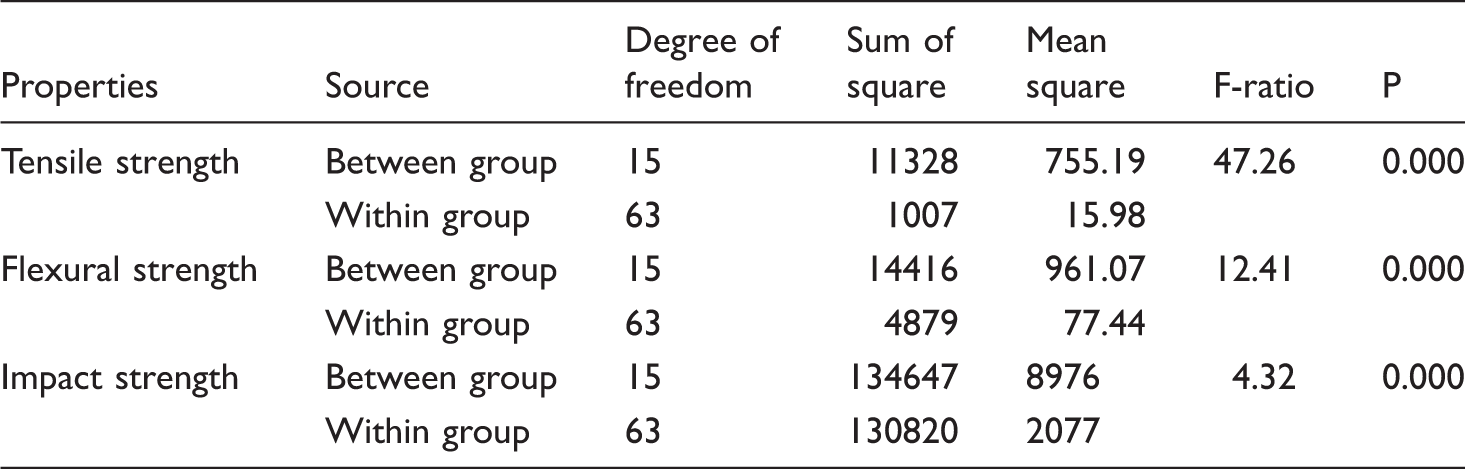
ANOVA test for mechanical properties of different woven composite.
Surface morphology study
Scanning electron microscope (SEM) is used for analyzing the tensile, flexural and impact fractured specimen for understanding the fiber–matrix adhesion and matrix damage due to loading. Figure 4(a) and (b) shows the SEM image of the fractured surface of four-layered and two-layered plain jute fabric composite, respectively, under tensile load. Figure 4(a) and (b) reveals the result of the poor stress transfer to matrix as a severe damage on matrix surface also. Figure 4(b) also indicates fiber pullout due to poor adhesion for the two-layered composite, but in the case of four-layered jute plain composite, it is not found. From this, it can be concluded that the addition of more number of layers in the polymer composite increases the rigidity of material. This resists the fiber pullout as a result of small extensibility of four-layer composite under tensile load.
Microstructure of fractured surface of the composite. (a) Four-layer plain composite under tensile load, (b) two-layer plain composite under tensile load, (c) PIIP composite under flexural load, (d) four-layer intra-ply composite under tensile load, (e) four-layer jute basket composite under impact loading and (f) IPPI composite under impact loading.
Figure 4(c) shows the microstructure of PIIP composite under flexural load, indicating the severe damage near the fiber yarn in the matrix. It is due to poor stress transfer from outer weak layer to middle layer in the composite material. This causes severe damage in the matrix and allows the crack from fiber yarn to matrix material. No cracks are found in the case of four-layer intra-ply composite’s matrix. This is due to uniform stress transfer. A similar observation has been found in four-layer jute basket and IPPI composites under an impact load. This is shown in Figure 4(d) and (e). Figure 4(e) reveals that there is no crack and fiber pullout due to sudden impact loading. As a result of better fiber–matrix adhesion, it resists the crack propagation in the matrix as well as fiber pullout. Same observation has been found in IPPI composite under impact loading. Figure 4(f) shows that there is no crack in the matrix between outer intra-ply and middle jute plain woven fabrics. This is due to higher modulus of banana-jute intra-ply woven fabric. Hence, it resists the suddenly applied load and transfers the load. As a result, severe damage in the matrix material between the two layers is avoided.
Dynamic mechanical analysis
The influence of stacking sequence of fabrics with different weave types on dynamic mechanical properties such as storage modulus, loss modulus and loss factor of the composite is significant as seen in Figure 5. Figure 5(a) shows four-layer jute and jute-banana intra-ply composites having higher storage modulus value in both the glassy and rubbery regions than herringbone composite. Figure 5(a) also indicates increase in the storage modulus for four-layer composite in the order herringbone < basket < intra-ply fabrics. Storage modulus variation reveals weave type and fiber orientation in warp and weft direction having significant effects on the results. In the case of jute-banana intra-ply composite, the orientation of jute fiber in the warp direction and combination of both the fibers enhances the storage modulus, while the sandwich composites (BPPB, IPPI, PIIP) show lower storage modulus than the individual four-layer composite which arises as a result of variations in modulus of composite material. It is also evident from the mechanical properties of composite material shown in Table 2. The individual four-layer composite has a higher flexural modulus compared to sandwich composite. This increases the rigidity of composite material. In case of sandwich composites, the storage modulus variation is not significant in both the regions. Figure 5(b) shows the influence of different stacking sequences on loss modulus of the composite. This is similar to the storage modulus variation. It can be observed from Figure 5(b) that intra-ply composite has a higher loss modulus than other composites because the enhancement of frictional resistance of the composite increases the energy dissipation in the form of heat. In the case of the basket and the herringbone composites, much variation in loss modulus is not seen as it is the case for the sandwich composites also. In intra-ply hybrid fabric composite, combination of jute and banana fibers increases the frictional resistance. In the case of basket and herringbone fabric composite, only jute fiber influences frictional resistance. In the case of sandwich composite, frictional resistance of the composite may be less due to presence of two different woven fabrics in the composite layer upon layer.
Influence of stacking sequence of fabrics on (a) storage modulus, (b) loss modulus, (c) damping factor and (d) Cole-Cole plot.
Variation in the loss factor with respect to different layered composites is shown in Figure 5(c). Figure 5(c) reveals the variation of loss factor of the composite for a different stacking sequence of the fabric as not significant. In general, the four layers of fabric reinforcement improve the stiffness of the layered composite while reducing the level of interaction between fiber to matrix and fiber to fiber which results in poor material loss factor.
Peak height and glass transition temperature of different woven composites.

Figure 5(d) shows the cole–cole behavior of composite material which reveals the homogeneous behavior of composite material in semi-circular form. In the composite material, the addition of fiber/filler in the polymer matrix changes the material behavior from homogeneous into heterogeneous reflecting an imperfect semi-circle in cole–cole plot.
Theoretical modelling
Several theories have been developed for the analysis of the different parameters such as the reinforcing effect and the volume percentage of fiber on mechanical properties of a composite material. Einstein [26] formulated the equation for analysis of the mechanical properties of composite material considering the reinforcing effect as given as

Another relation given by Guth [27] is

Several researchers have used the rule of mixture equation for predicting the tan δ or damping factor values of composite material to a certain extent [28,29].

When reinforced materials are rigid, the first term of the above equation can be eliminated, and the equation can be rewritten as

In the above expressions, subscripts c, m, and f indicate composite, matrix and fiber, respectively. Further equation (4) can be rewritten by introducing the stiffness parameter. Addition of stiffness term in the equation is based on the addition of fiber in the matrix which offers the stiffness of the composite material.

Figure 6 shows the comparison of experimental storage modulus of different woven composites at 40℃ with Einstein and Guth theories. The results reveal the correlation of experimental value of different composites is in correlation with the Einstein equation rather than with Guth equation while damping factor experimental values, not matched well with theoretical values as the type of wove fabric influences the results.
Comparison of experimental values with theoretical values for (a) storage modulus and (b) damping factor.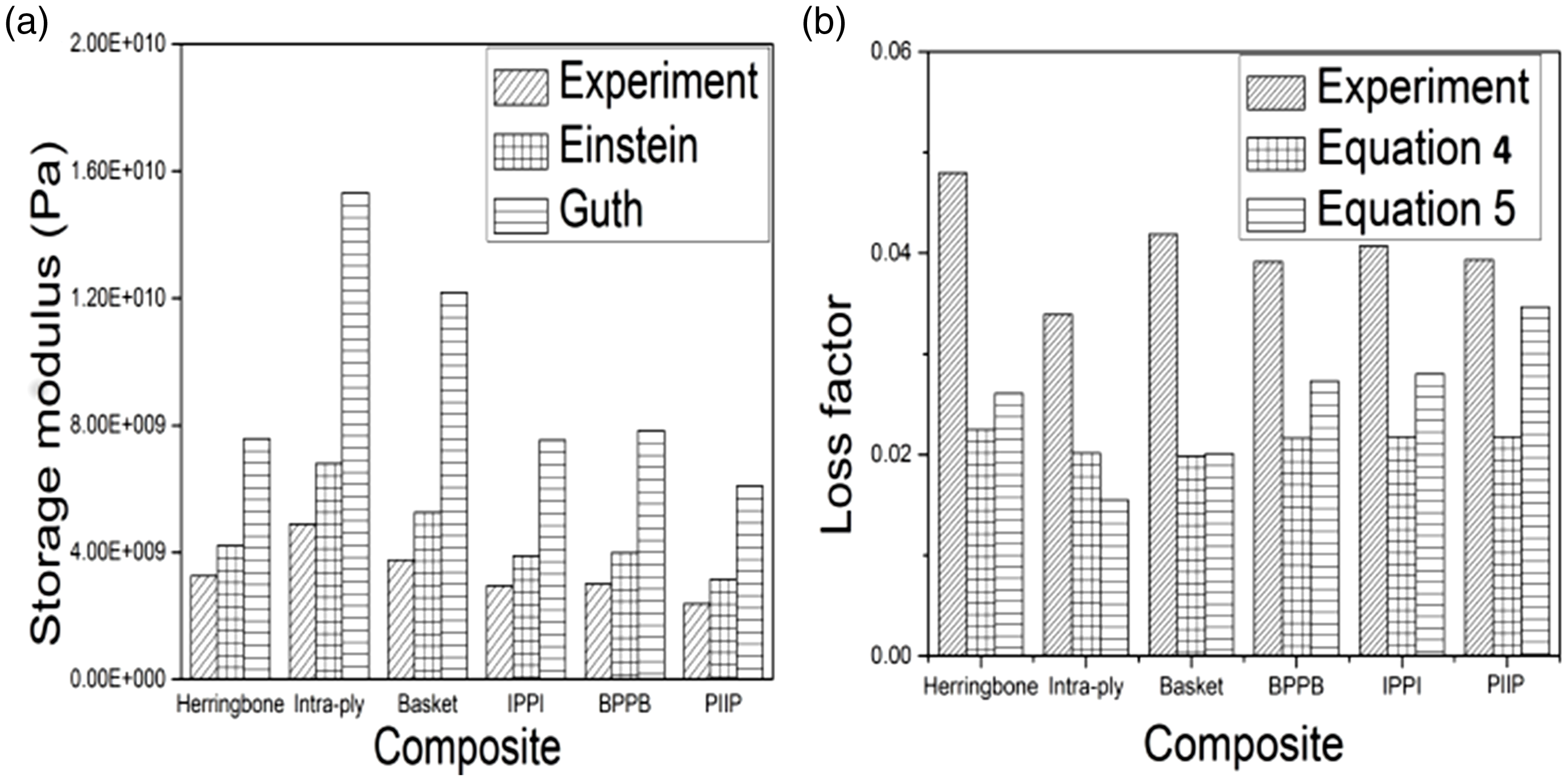
Free vibration analysis

Influence of weaving pattern architecture, number of layers, stacking sequence on free vibration characteristics under fixed-free condition.

Influence of weaving pattern architecture, number of layers, stacking sequence on free vibration characteristics under fixed-fixed condition.

The observation from the results is that the composite with three- and four-layered woven fabric reinforcement has higher a natural frequency compared to single- and double-layered composites which indicates that the addition of layers in the matrix increases the structural stiffness of composite material. Similarly, single- and double-layer composites have better damping factor of the composite laminate due to a large volume of matrix material in the composite and higher interaction between fiber–matrix. Even though three-layer composite increases the natural frequency of composite compared to single and double layer, the four-layer composite shows a significant increase in the natural frequency due to higher amount of fiber loading as seen in Tables 6 and 7.
In the case of four-layer composites, basket type woven jute fabric and jute-banana intra-ply woven fabric composites provide a higher natural frequency compared to jute plain woven fabric and jute herringbone fabric composites. Structural arrangements of yarns in the warp and weft direction in the woven fabric account for this. This is explained in the section on mechanical properties. The effect of stacking sequence of fabrics with different weave types influences the natural frequencies and modal damping of the sandwich composites. However, the natural frequencies of the sandwich composites are less than those of the four-layered composites such as jute basket and jute-banana intra-ply fabric composites. This can be attributed to the higher flexural modulus of the four-layered composites than the sandwich composites. In sandwich composite, IPPI and BPPB composite shows low damping factor which indicates better bonding between fiber–matrix as well as uniform stress distribution due to presence of two weak woven fabrics.
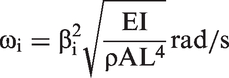
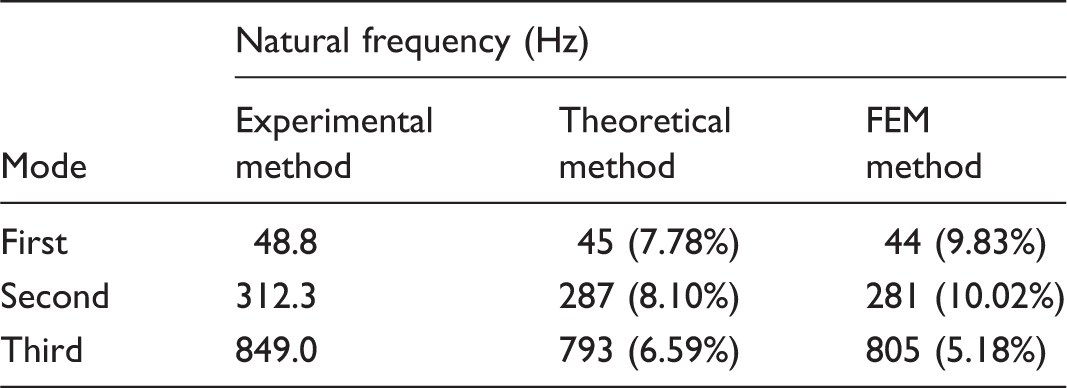
Comparison of experimental natural frequencies with theoretical and numerical results for IPPI sandwich composite.
Conclusion
Influence of woven fabric reinforcement with different weave types and their stacking sequence on mechanical, dynamic mechanical and free vibration behavior has been investigated. The results revealed that jute woven basket composite has better mechanical, dynamic mechanical and free vibration characteristics than plain and herringbone woven fabric composites. Further jute-banana intra-ply basket type woven fabric composite results have been compared with jute basket woven composite. It is found that the intra-ply composite gives better properties compared to composites with jute woven fabric. The combined effect of jute and banana fibers enhances the properties of the composite material. It is also found that the four-layered composites give better properties. The density of composites calculated using the Archimedes principle revealed the absence of any porosity and fabrication damages in the composite. Further, sandwich composites are prepared using different combinations of strong woven fabrics and weak woven fabrics as skin and core material, respectively. Enhancement of the properties of composite as a result of effective stress transfer from matrix to fiber due to strong fiber–matrix interface are shown for IPPI composite, while PIIP (plain-intra-ply-intra-ply-plain) composite decreases the properties of composite material due to poor stress transfer from outer layer to middle layer. It is also observed that IPPI composite gives better properties than IPI composite due to better stress transfer and modulus value.
Footnotes
Acknowledgement
The authors wish to thank Material Characterization Lab, Department of Mechanical Engineering, NITK, Surathkal for allowing us to carry out tensile and flexural tests.
Declaration of Conflicting Interests
The author(s) declared no potential conflicts of interest with respect to the research, authorship, and/or publication of this article.
Funding
The author(s) disclosed receipt of the following financial support for the research, authorship, and/or publication of this article: This study was funded by SERB-Department of Science and Technology, India. (SR/FTP/ETA-64/2012).