




Abstract
Compression stockings, which constitute one of the most important groups of compression garments, are engineered to regulate blood flow in venous systems in order to use in many medical fields such as supporting muscles and preventing edema. In the present study, it was aimed to analyze the effects of production parameters such as tightness, elastane yarn feeding tension and elastane yarn counts on pressure behavior of compression stockings, which are commonly used to adjust pressure values. The results of the statistical analysis indicated that the tested parameters had significant effects on pressure characteristics of compression stockings. Moreover, multiple regression analysis was used to investigate the relationship between the fabric parameters and pressure values. The analysis exhibited the strong impact of thickness and traversal elasticity on pressure characteristics. All parameters have positive impacts except traversal elasticity.
Introduction
Compression therapy is one of the basic treatment methods used for diseases of venous, arterial, and lymphatic systems [1]. The objective of compression therapy is to oppose the hydrostatic forces of venous hypertension. The application of adequate compression reduces the diameter of major veins, which increases blood flow velocity. Compression therapy helps to restore a functional calf pump unit [1,2]. A variety of compression devices is available such as compression stockings, elastic, and inelastic bandages, orthotic pressure devices, and compression pumps [3].
Compression garments have a special function, which apply a certain pressure to the body mainly for medical, sports, and body shaping [4]. Most medical compression garments are individually designed and manufactured for a particular part of the body, such as stockings, gloves, sleeves, face masks, and body suits [5]. The circumference of a compression garment have to be smaller than the body size in order to achieve the compression effect arising from stretching [6,7].
Compression stockings, which constitute one of the most important groups of compression garments, are engineered to regulate blood flow in the venous system in order to be used in many medical fields such as supporting muscles and preventing edema. Compression therapy with compression stockings is an adjuvant treatment to surgery, especially diseases caused by venous system disorder [8,9]. Compression stockings apply graduated pressure to the different areas of legs. The application of maximum pressure value is on the ankle and minimum pressure value is on the groin. This pressure difference helps returning of blood from the venous system to the heart. Compression stockings are commonly used for the critical venous diseases such as varicose veins, chronical venous insufficiency, venous ulcer, deep vein thrombosis, lymphedema, and lipidema. Thus, the determination and development of their pressure characteristics are important for medical performance.
The first study of temporary pressure on legs by stockings was carried out in 17th century [10]. Approximately 150 years later a clinical study [11] was published in 1949. The results indicated that using elastic stockings increased venous blood flow. Orbach [12] discovered efficiency of graduated effect on elastic compression stockings between 1958 and 1960. In light of these studies, Goldman et al. developed compression stockings which applied max pressure value at the ankle [13].
Nowadays the studies on compression stockings still continue and researches usually focus on the effects of raw material characteristics, fabric constructions or manufacturing factors on pressure characteristics. Chattopadhyay et al. [14] have investigated the effect of inlay yarn on the pressure characteristics of knitted circular stretch fabrics. Spandex yarns have been fed at five different levels of pre-tension (2cN-6cN). They defined a reduction factor (Rf) and according to the results the pressure values were almost similar for each fabric samples that produced by different pre-tensions. However, when they were mounted on measurement cylinders with different diameters, the pressure generation of samples varied from 18 to 40 mm Hg. Maleki et al. [15] have observed the pressure behavior of tubular knitted fabrics (plain and interlock) with various stitch lengths (0.22, 0.25, 0.29 and 0.32 cm) after a long period of time. The pressure reduction of the fabrics was analyzed after 48 h at the different strain percent (10%, 20% and 25%). The test results indicated that there was a significant decline in pressure values when the stitch length increased. Higher pressure reduction occurred in plain fabric samples with the lowest stitch length and this situation was opposite for interlock structures. Özbayraktar and Kavuşturan [16] have determined the effects of body (40–70 denier) and inlay yarn (169–253 denier) counts and inlay yarn amount on the extensibility and the bursting strength of knitted compression stockings. The results showed that when the course number of inlay yarns at knit structure increased, there was a significant decrease in course way extensibility values of compression stockings. The bursting strength values were increased by the fabric tightness at the ankle part. Based on the results inlay yarn was the most effective factor on course way extensibility. Maklewska et al. [17] have presented a procedure for designing compressive garments with a pre-set value of unit pressure exerted on human body. The procedure was based on a developed dependency which considered the Laplace Law and on the garment’s mechanical characteristics in form of a nonlinear function of force vs. elongation. According to the results of force and relative elongation, a relationship was determined with a correlation coefficient R = 0.98. The Laplace Law and the relationship between force and relative elongation were used for developing a new equation to predict the pressure values of a knitted fabric bond. The test results of the equation on new manufactured stockings indicated that there was a close affinity between estimated and measured pressure values. Leung et al. [18] have developed an equation for predicting pressure of garments (single layer and laminated fabrics). The equation was consisted based on the Laplace Law and the relationship between Young modulus and elongation. The correlation between Young modulus and elongation was determined by analyzing the elongation behavior of samples. The results indicated that using the equation for predicting pressure values of single layer fabrics created a 34.6% deviation from actual test results. Meanwhile, the laminated fabrics created a 2.89% deviation from actual results.
In this study, it was aimed to analyze the effects of production parameters such as tightness, elastane yarn feeding tension, and elastane yarn counts on pressure behavior of compression stockings, which are commonly used to adjust pressure values. Apart from the previous studies, the samples of this study were knitted as stocking forms by the most common manufacturing parameters and the pressure tests were measured on a device which determines the gradient pressure profile of stockings to reveal the real production conditions. However other researchers usually used regular circular knitting machines for producing samples and some pressure sensors on a cylindrical tube for measurements, so these situations caused to determine limited effects of parameters on real usage conditions.
Furthermore, the fabric properties which present the multiple effects of production parameters were used for regression analysis in order to define pressure characteristic in detail. For example, the elastane yarn count directly affects pressure value, whereas it changes the fabric thickness as well and creates a secondary effect on pressure property. So by using thickness values in regression analysis, it is possible to investigate multiple effects of yarn count.
Materials and methods
Materials
Twenty-seven types of compression stockings were produced using 40/40 denier covered polyamide-elastane as ground yarn and three different elastane yarn count as in-lay yarn (285 dtex, 470 dtex and 570 dtex) in three different fabric tightness: 15 cpc, 16 cpc and 17 cpc (cpc: course per cm), by three different elastane feeding tension: 2 cN, 2.5 cN and 3 cN. Stockings were knitted on a compression stocking knitting machine made by Harry Lucas-Elha with a cylinder diameter of 3.25 in, 28 fine, two systems and 321 needles. Schematic diagram of knitted structures is given in Figure 1, where ground yarns are illustrated as white and in-lay yarns as black.
Schematic diagram of knitted structures.
Pressure tests
Pressure profiles of stockings, which were defined as the percentage distribution of pressure values that are exerted from the ankle to the thigh, were tested on Salzmann Group MST MK IV Medical Compression Stocking Tester (Figure 2) by the direct measurement method.
MST MK IV Medical Compression Tester and measurement zone.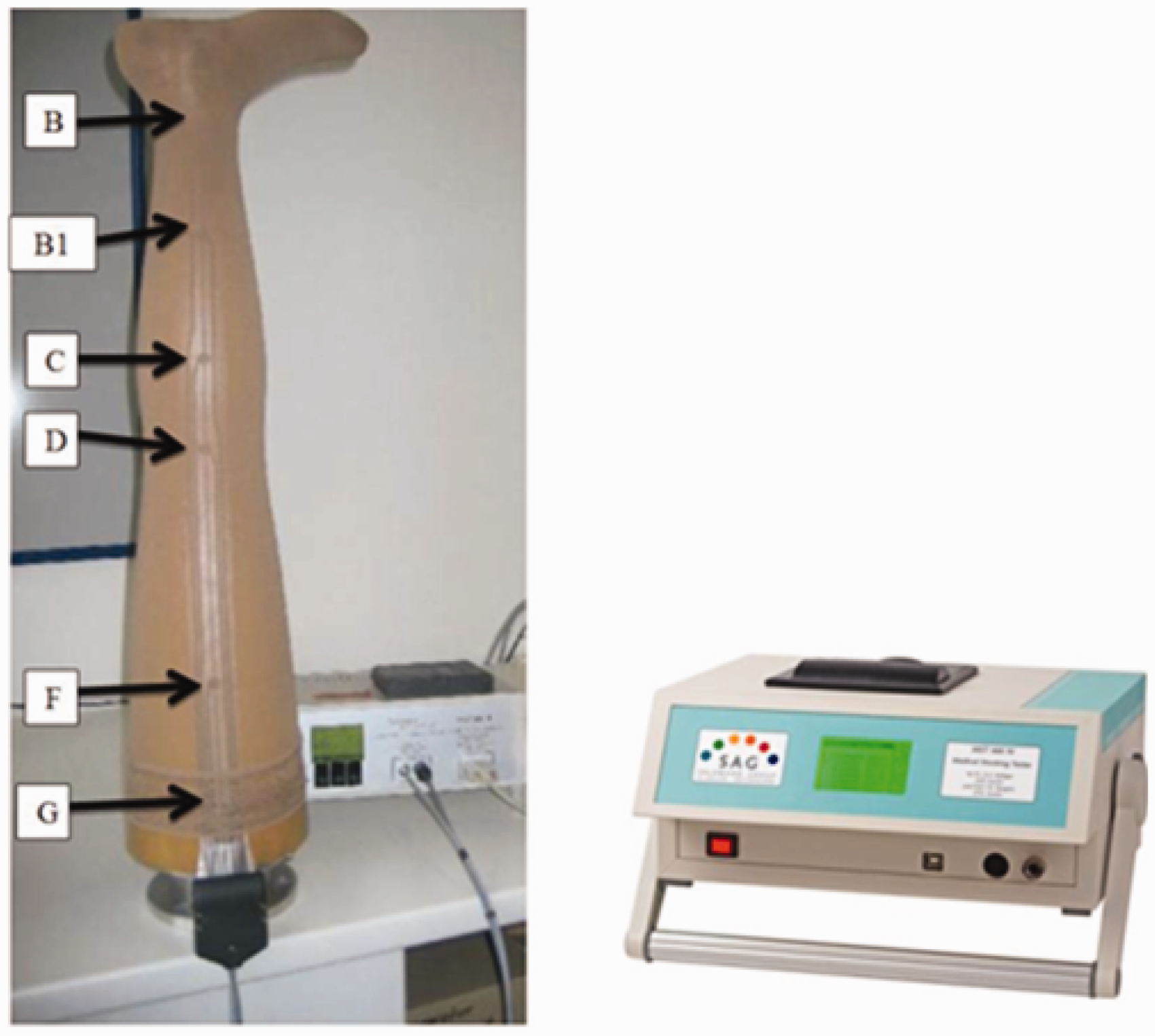
Each sample was tested according to CEN 15831 in standard laboratory conditions (20 ± 2℃ and 65 ± 4% relative humidity). The same wooden dummy leg was used for all pressure measurements and each test was repeated four times.
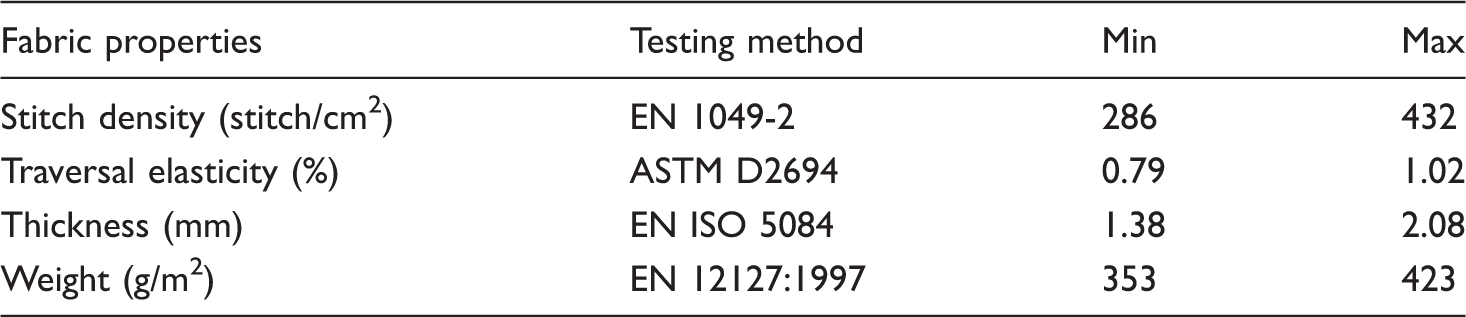
Other fabric properties
Testing methods and the range of fabric parameters.
Statistical evaluation
The evaluation of test results was carried out in two stages:
Investigation of production parameter effect on pressure values; Multiple regression analysis for describing the relationship between fabric properties and pressure values.
In the first stage, analysis of variance (ANOVA) tests were done using SPSS software to determine the statistical importance of variations by applying Tamhane’s T2 analysis method. In order to deduce whether the production parameters were significant or not, p values were examined according to the significant level of α = 0.05. The statistical analysis was performed by the ankle pressures which have the highest pressure values along the leg.
In the second stage, the multiple regression analysis was used for investigating the relationships between fabric parameters and pressure values for this is the optimal method to describe the quantitative relationships between different parameters. Herein, the fabric parameters were chosen as independent variables and used to predict the pressure values at the ankle part. The statistical analysis showed that there was a nearly linear relationship between fabric parameters and pressure values. The forward stepwise method was selected to perform multiple regression analysis by using SPSS software.
Results and discussion
Effects of production parameters on pressure values
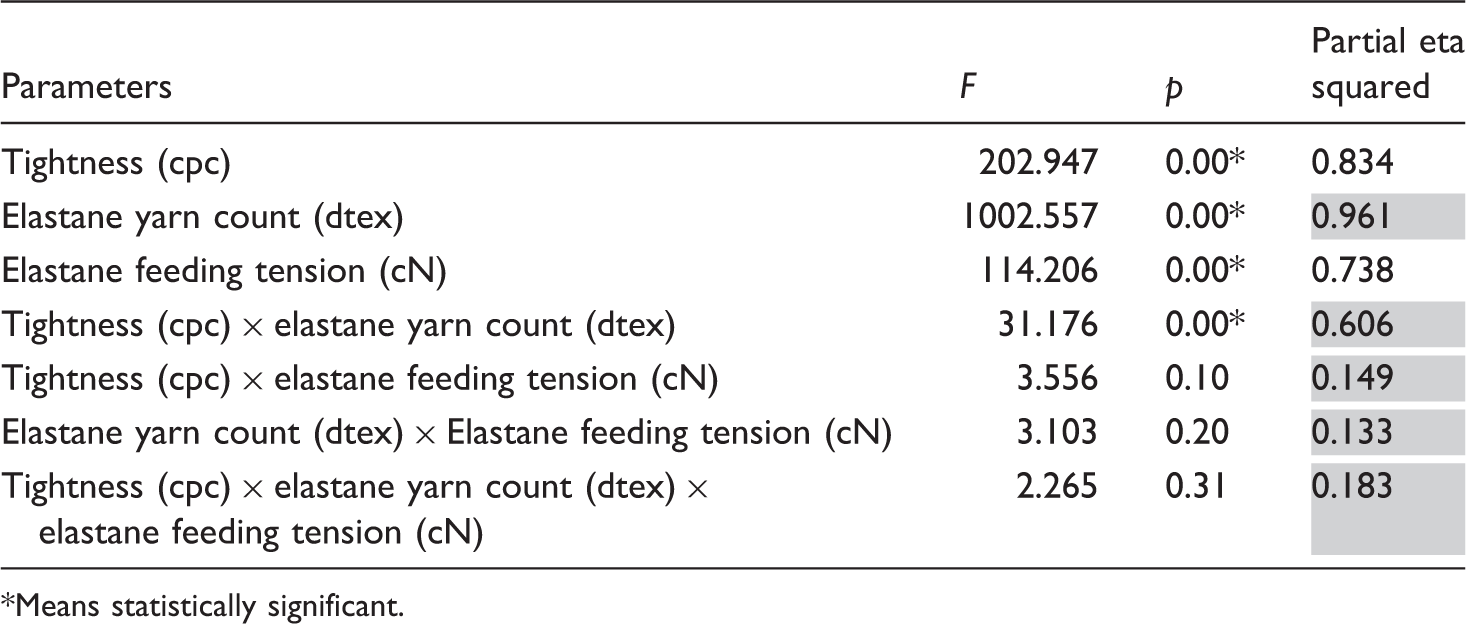
Effects of tightness, feeding tension, and yarn count parameters on pressure values.
*Means statistically significant.
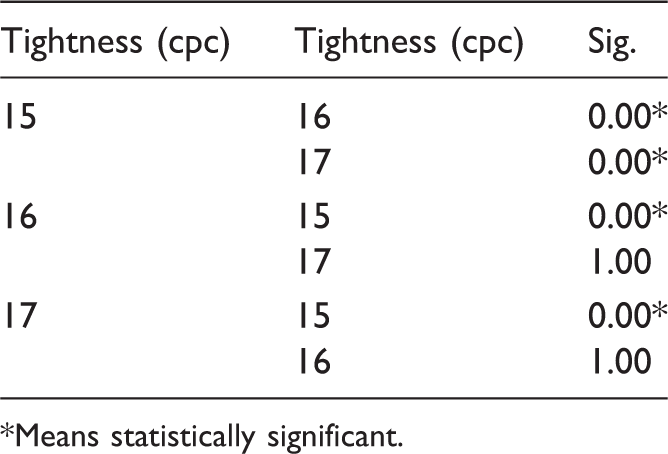
Statistical evaluation of tightness values.
*Means statistically significant.
Statistical evaluation of elastane yarn count.

*Means statistically significant.
As the statistical data in Table 2 indicate that elastane yarn count is the most effective parameter on pressure values (partial eta squared = 0.961). Also, there is not any strong interaction between parameters except tightness × elastane yarn counts.
The loosest structure (cpc = 15) provides the lowest pressure value, whereas the other structures have statistically similar results as shown in Figure 3 and Table 3. Increase in tightness factor caused higher stitch density which creates higher force at unit area (P = F/A; where P is pressure, F is the normal force and A is the pressure area).
Average values of pressure results for different tightness levels, elastane yarn counts, and elastane feeding tensions.
Figure 3 illustrates that finer yarn count (285 dtex elastane) exhibited the lowest pressure. Besides, the stockings produced by 470 and 570 dtex elastane yarns have higher and statistically similar pressure levels (Table 4). This result can be explained by higher transversal force provided by coarser yarns.
Statistical evaluation of elastane feeding tension.

*Means statistically significant as a parameter.
Multiple regression analysis
Within this part, it was aimed to investigate the relationship between fabric properties and pressure values by multiple linear regression analysis (see Appendix 1 for experimental results). Compression effect consists of not only production parameters but also fabric properties to obtain a regular pressure profile. Therefore, during the regression analysis, stitch density, traversal elasticity, thickness, and weight selected as independent variables which can also present the multiple effects of production parameters on pressure values.

ANOVA results of regression analysis.

Regression analysis results.

The results stated that the derived equation has a good regression coefficient (R2 = 0.801, Table 7).
The correlation analysis also revealed that there is a high correlation coefficient between experimental and predicted values particularly for higher pressure values (Figure 4 and 5). This can be explained by the rigid fabric structure of high pressure samples that leads to balanced thickness and elasticity characteristics.
Correlation between the experimental and predicted value. Comparison of experimental and predicted pressure values.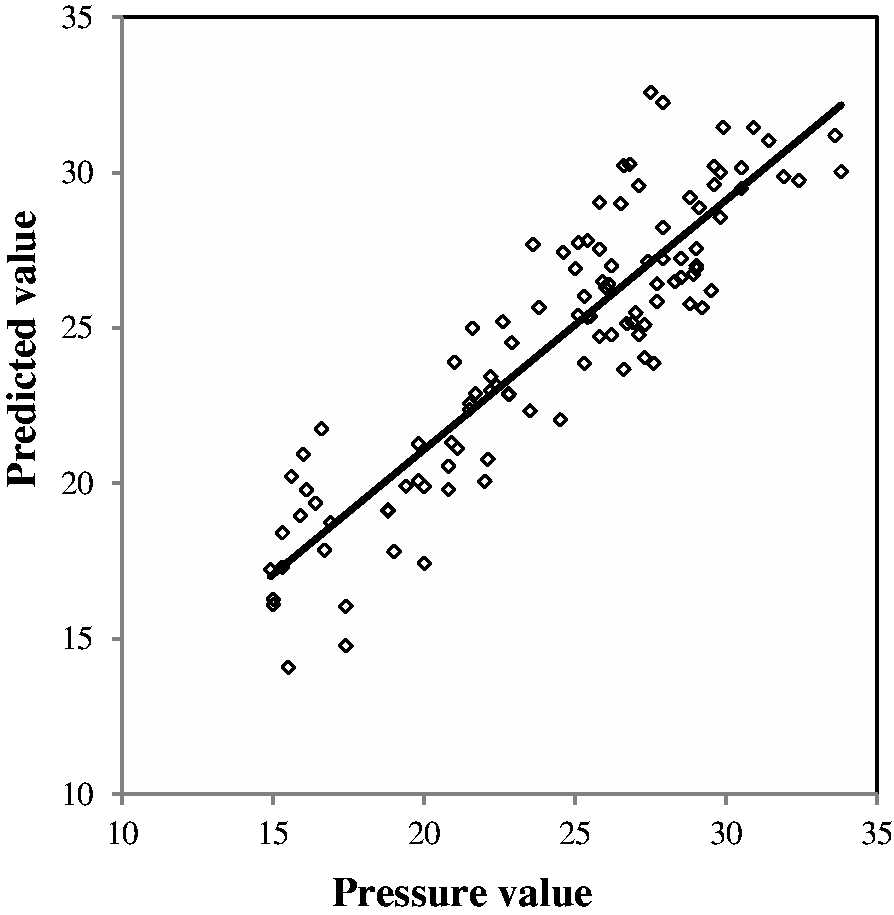

The analysis exhibited strong impact of thickness with the importance of 0.381 and traversal elasticity with the importance of 0.339, while weak impact of stitch density and weight on pressure characteristics. Except traversal elasticity all parameters have positive impacts.
As a conclusion, the statistical analyses proved that compression effect is directly related to elastane yarn count (Table 2) and fabric properties (Table 7). As mentioned before, the circumference of a compression garment has to be smaller than the body size in order to achieve the compression effect arising from stretching. During stocking application, this stretch generates force while trying to return the relaxed situation and this resilience force constitutes pressure on a particular area. That is why the elasticity of stockings is the most important property for compression effect and elastane yarns play an important role in creating of elasticity and resilience force.
According to the regression analysis, the thickness has the strongest positive effect among other fabric properties. This can be explained by elastane yarn count as coarser elastane yarn count causes higher thickness. The results of ANOVA analysis indicated that increasing elastane yarn count provides more pressure (Table 4). Also, stitch density and weight properties of stockings have positive effects on pressure. The fabric becomes more compact with increasing stitch density and weight, and much force is needed to stretch stockings. This situation causes more resilience effect and more pressure is created on unit area. On the other hand, the regression results showed that traversal elasticity has the strongest negative effect on pressure values. More elastic fabrics can be stretched by only a less force. Thus, these fabric structures fail to create high pressure values. In addition, they are more successful in absorbing force than rigid structures.
The optimal pressure level is the most critical factor for the successful treatment of vein disorders [19–22]. Pressure values of compression stocking are directly related production parameters, particularly elastane yarn count. These parameters affect not only pressure characteristics but also other fabric parameters such as thermal comfort properties. Increasing of tightness and feeding tension factors enhance stitch density and thickness of stockings (Appendix 1) and the compact fabric structures cause lower permeability properties [23]. Because of this uncomfortable feeling, this kind of stocking is not preferred to use in treatment by patients. That is why the production parameters must be chosen to pay attention on entire fabric properties.
Obtained pressure ranges by using different production parameters.

Conclusion
The key factor of a successful compression treatment by medical stocking is to achieve a proper pressure profile. The aim of this study is to estimate pressure characteristics of medical stockings before production in order to obtain the required pressure values by using the optimum production parameters.
Initially, the effects of production parameters on pressure characteristics of compression stockings were investigated. These parameters are fabric tightness, elastane feeding tension, and elastane yarn count which are commonly used to adjust pressure values during manufacturing of compression stockings. Test results indicated that the pressure characteristics of compression stockings were affected by changing of production parameters especially elastane yarn count is the most effective parameter. Increase of these parameters generally provides more transversal force, so the tubular structure becomes more compact and creates more pressure on the necessary zone of the leg.
In the second stage, multiple regression analysis was used to determine the relationship between fabric parameters and pressure values. According to the results of analysis, the thickness and traversal elasticity were found as the most effective parameters on pressure values. The thickness, stitch density, and weight have positive impacts, whereas traversal elasticity has a negative impact. Increasing thickness, stitch density, and weight parameters of fabrics are able to generate more rigid structures those are hard to stretch. Contrary to traversal elasticity, these parameters cause much resilience force which creates higher pressure values on the unit area.
Footnotes
Acknowledgement
The authors would like to thank Dr Ahmet Çay for his valuable comments.
Declaration of Conflicting Interests
The author(s) declared no potential conflicts of interest with respect to the research, authorship, and/or publication of this article.
Funding
The author(s) received no financial support for the research, authorship, and/or publication of this article.