






Abstract
Medical Compression Stockings (MCS) are used as an alternative medical treatment to relieve symptoms associated with venous disorders. They are characterized by the pressure exerted on the leg. Determination of exact pressure values that the hosiery exerts on patients’ legs is the most significant requirement. To achieve a successful compression therapy a gradual decreasing pressure profile—100% at the ankle to 40% at the thigh—is required. In this study a new pressure measuring device has been developed for MCS. This new device allows a pressure profile of MCS to be developed. The advantages of technological and sensitive measurement, simulation of real wear conditions with 3-D leg shape, and flexible and customized adjustments of leg sizes are discussed.
Introduction
Technical textiles are the fastest growing, and most dynamic, strategic sector of the textile industry. Market share for this sector reached over 25% of the entire textile and apparel industry market. The development of new products, supply of new demands, and use of newly developed materials provide great potential for technical textiles.
Medical textiles are a major growth area within the technical textile industry. Medical textiles may be used in various external applications such as adhesive tapes, bandages, castings, diapers, dressings, gauzes, protective clothing, sutures, surgical covers, surgical clothing, swabs, supports, sanitary products, and hospital gowns. They are also used internally as artificial kidneys, livers, hearts, mechanical lungs, ligaments, vascular grafts, heart valves, blood vessels, and artificial skin.
A study showed that the incidence of trunk varicose veins was 40% in men and 32% in women on people aged 18 to 64 years in Edinburgh, UK. 1 , 2 Similar studies showed that around 60% of all Americans were affected by abnormal leg veins. The prevalence of varicose veins has varied between 7% to 18% in men and between 25% to 32% in women in Finland. 2 4 Generally, 30% of Europeans suffer from blood circulation disorders and, in Turkey, 50% of the elderly population has varicose vein problems. Because of these types of health problems, medical compression stockings (MCS) use is increasing.
In the natural mechanism of leg muscles, veins have leaflet valves to prevent blood from flowing backwards (retrograde). Leg muscles pump the veins, against the effects of gravity, to return blood to the heart. When veins lose their elasticity, the leaflet valves no longer meet properly and the valves do not work. This allows blood to flow backwards, enlarging the vein. Compression of the leg veins leads to a shift in blood volume with an increase in the preload of the heart. 5 MCS (also called graduated compression stockings) compression therapy helps this natural pumping mechanism to improve circulation. It is used to prevent as well as treat a number of conditions that affect the circulation in the body such as varicose veins, deep vein thrombosis, venous leg ulcers, and oedema. 6
In compression therapy, a pressure profile should be applied to the leg instead of a constant pressure value. This means the pressure values gradually decrease from the ankle (100%) to the thigh (40%). 7 By compressing the surface veins, arteries, and muscles, the circulating blood is forced through narrower circulatory channels. As a result, the arterial pressure is increased, which causes more blood to return to the heart and less blood to pool in the feet. MCS perform the treatment of diseased leg or arm veins with a pressure conforming to standards. Determination of exact pressure values that MCS exert on patients’ legs is the most significant requirement. This pressure changes according to the shape and the size of the leg. A decreasing compression effect (gradient) from the ankle to the thigh to support blood return to the heart is most important (Fig. 1).
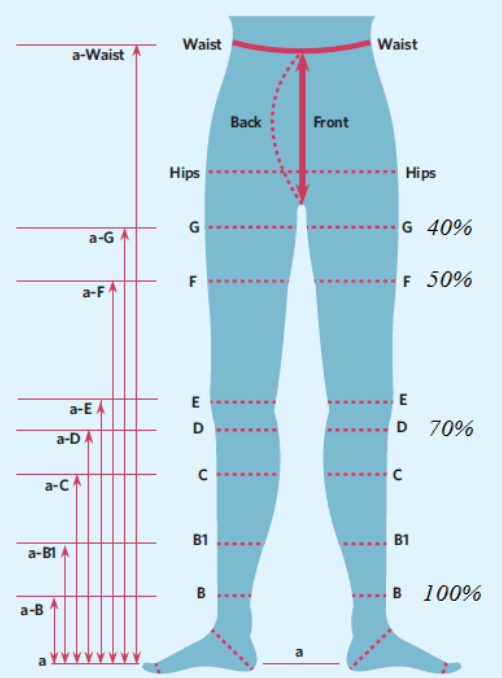
Measurement points. 9 B:ankle at the point of its minimum girth, B1: point at which the Achilles tendon changes into the calf muscles, C: calf at its maximum girth, D: just below the tibial tuberosity, E: centre of the patella and over the back of the knee, F: mid-thigh between patella and groin, G: 5 cm below the center point of the crotch, H: greatest lateral trochanteric projections of the buttock, K: centre point of the crotch.
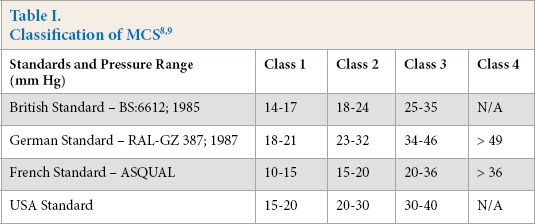
MCS are classified by different standards at four levels of compression using pressure values at the ankle (Table I). 8 , 9 In these standards, the test methods of the various test devices are explained.
Compression therapy is a potent treatment modality that depends on the amount of compression and the elastic properties of the material used. The level of compression is a complex interaction of the physical properties and construction of the stockings, as well as the size and shape of the leg.
Elastic or rubber fibers are used in compression stockings to help compress the limb, aiding in circulation. Owing to its elastic structure, these stockings stretch and take the shape of the leg. As a principle, the level of compression is directly proportional to the tension of the stocking.5,9,10
MCS development started with clinical studies at the end of 1940s. 11 Today's fiber, manufacturing methods, and customized sizing technologies provide important improvements for optimal compression treatment. Limited research regarding medical compression stockings is available, although extensive research is reported on compression therapy12 -24 However, few investigations involving pressure measurements of medical products are available. Maklewska, et al., designed a new measuring device, called Textilepress, to measure the pressure exerted by textile products used in healing therapy of hypertrophic scars. Using an indirect method, this device can be used for products such as compression bandages with cylindrical shape similar to the selected part of the human body 25
Stolk, et al., developed a new method to investigate the dynamic behavior of MSC during walking. Dynamic movement was simulated using an artificial leg-segment model. The dynamic stiffness index was defined by the dynamic pressure and circumference signals—a new characteristic of MSC. A large difference was found between the pressures of the MSC for a patient at rest versus an ambulatory patient. It was also noted that insertion of non-elastic materials into the MSC covering overlying the expanding muscles increased the dynamic stiffness index. 26
Nishimatsu, et al., studied comfort properties of men's socks. They reported that the comfortable feeling observed was closely related to the tight feeling at the top. A system was developed to measure the pressure at the top of the sock using an elastic optical fiber. In this device, the incident light into the core was transmitted from the end through the core by total reflection. For testing, a sock was placed around an acrylic tube, which had a diameter equal to the circumferences of subjects’ legs. When the elastic optical fiber, positioned between the sock and the tube, was deformed by an external force, the amount of transmitted light decreased. There fore, the external force on the optical fiber was obtained by measuring the amount of outgoing light. 27
Wang, et al., developed a new measuring system that provided useful information on both the dynamic pressure and the stiffness of various compression garments. This new system for monitoring the dynamic pressure behavior of compression fabric uses a direct measuring method. To quantify the dynamic behavior of the compression fabric, a new index, the dynamic pressure stiffness index, has been introduced. 28
The aim of this study is to develop a new pressure measuring device that can gather the pressure profile of MCS according to the related standard. The key factor of a successful compression treatment is the customized stocking according to patients’ leg sizes. Therefore, testing pressure properties before use is highly desirable for manufacturers producing stockings to achieve an ideal pressure profile. However, there are only a few test devices in the market for measuring MCS by different methods, including HOSY (Hohenstein Institute), Pressure Measuring Devices MST IV and Professional (Salzmann AG), and HATRA (Hosiery and Allied Trades Researches Association). Manufacturers need practical devices that provide rapid test results before and during production. This new device provides these features, as well as the advantages of technological and sensitive measurement, simulation of real wear conditions with 3-D leg shape, and flexible and customized adjustments of leg sizes.
Description of New Pressure Measuring Device
Specialists recommend that anatomical locations described in the related standards should be used to define the position on the leg, along with recording the exact position of measuring sensors (ventral, medial, dorsal, lateral). 10 The new device was constructed according to the related standards (such as RAL-GZ 387, 1987 and CEN/TR 15831, 2009), in which seven measuring points were defined for determination of MCS pressure profile characteristics (Fig. 1).
Use of a mechanical apparatus is thought to be advantageous, with minimum error compared to local sensors (used between body and stocking) since the variances of local sensors are high and significant variations can occur after several tests. Besides, analog load cells used on the mechanical apparatus provide sensible and stable results with high reliability. The schematic view and an image of the new measuring pressure device are shown in Figs. 2 and 3, respectively.
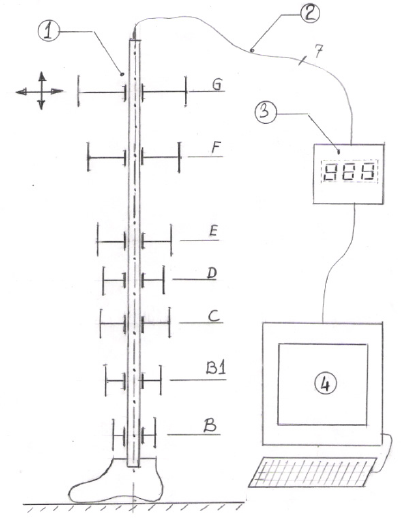
Schematic view of the new pressure measuring device. (1) load cell, (2) transmitter, (3) data logger, (4)computer.
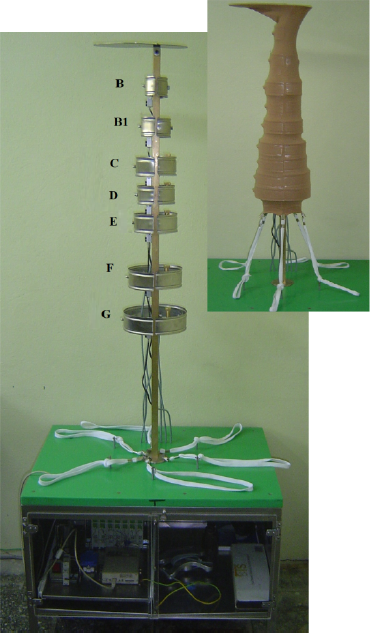
Image of new pressure measuring device.
Test Method
Pressure can be measured either by direct or indirect test methods. In the indirect method, the Laplace Law is used to define the pressure profile. This has been used to calculate the pressure delivered on a cylinder of known radius by a fabric under known tension. Here, the pressure is inversely proportional to the circumference (Eq. 1).
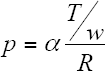
p is the pressure (mmHg or hPa), T/w is the tension (N) by width unit, R is the radius of the leg (m), and α is the proportionality coefficient.
In the direct method, the pressure is measured by pressure sensors. Measurement using this new device can be considered as a direct method, since pressure values are determined based on force measured directly by the load cells (Fig. 4). Pressure (p) is the force per unit area applied in a direction perpendicular to the surface of an object (Eq. 2).
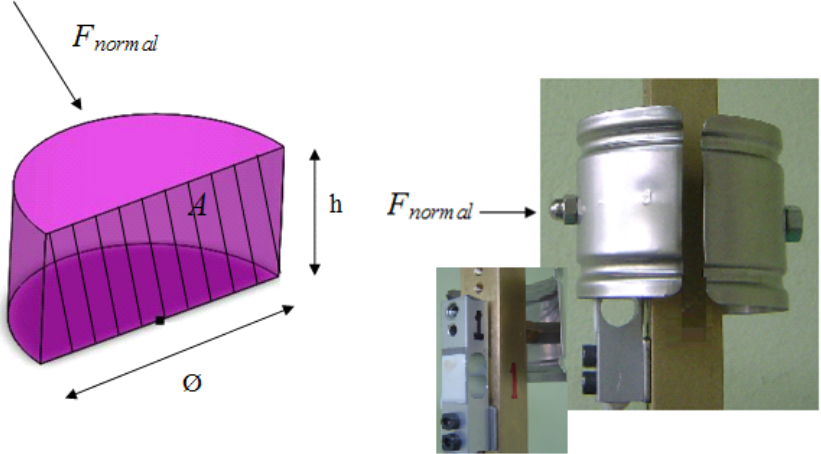
The surface area on which the force is applied.
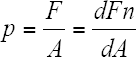
p is the pressure, F is the normal force, and A is the surface area on contact.
On this device, the heights of all measuring areas were kept constant (5 cm) and the areas of the perpendicular measuring surfaces were calculated by Eq. 3.

A is the perpendicular surface area on contact, Ø is the diameter of the measurement area, and h is the height of the measurement area.
The new device was designed in a 3-D leg shape to simulate the real leg form and, therefore, real wear condition. Measurement points were chosen as small as possible to minimize the faults that can arise from normal forces on surrounding parts. valus, the forces on surrounding parts were neglected and only pure normal forces were assumed to be present.
This new device consists of several components, as noted below.
Mechanical leg apparatus: this component simulated the leg in 3D with adjustable sizes for different circumferences and lengths (Fig. 3). As mentioned in CEN/TR 15831/2009, measurement points should be flexible to measure different sizes of compression stockings. For this reason, the device was designed with sensors that were adjustable on both vertical and horizontal sides depending on leg shape and, therefore, size of compression stocking. Load cell adjustments were achieved before testing and the measurement points were static during tests.
Load cells: these were placed on points B, B1, C, D, E, F, and G to measure the force applied on the leg by a compression stocking. Force values were converted into electrical signals (range of measurement: 0-5 kgf, sensitivity of load cells: 2% ± 10% mV/V) (Fig. 4).
Transmitters: used to set electrical signals in the range that was received by the computer and signal gain was adjusted at a desired range (e.g., 1 kgf to 10 V).
Data logger (multi-channeled, computer based): used to record the generated data by the load cells over time.
Computer program: used to save and evaluate data (Fig. 5).
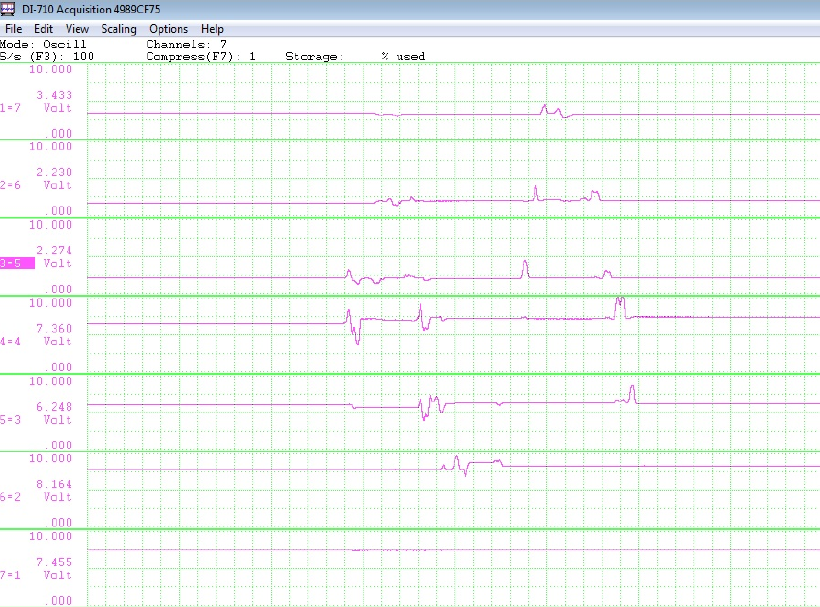
An example for the output of electronic signals for seven measurement points.
Pressure measurements were defined in the following steps:
Determination of the patients leg size: the circumferences and lengths of the measurement points.
Adjustment of the mechanical leg apparatus according to measurement points.
Adjustment and calibration of load cells.
Calibration of transmitters (offset/zero/gain).
Measurement.
Data (electronic signals in V) transfer to the computer via data logger (Fig. 5).
Calculation of pressure values (Eq. 2).
Test Results
To deduce whether the measurement on the new device was reliable, initial trials for some commercial medical compression stockings, produced by polyamide and covered elastane yarns, were performed both on some available devices in the market (the devices that worked by local sensor principle or according to the standard CEN/TR 15831) and the newly designed system. Table II shows the comparison of the pressure results obtained on these devices. The measurement areas (measurement circumferences and lengths) were adjusted to medium size, which is the most commonly used type according to the defined sizes in CEN/TR 15831. Samples were chosen from different compression classes (Class 1, 2, and 3) to ensure that reliable results were provided for any pressure range.
The new device test results given in Table II are average values of 3 tests (over 3 days) and each of these tests includes a data set of 100 different measurements (within a day). Coefficient of variation values of the results showed that new device had a high repeatability or test-retest reliability with low coefficient of variation values within a day (< 0.1%) and over different days (< 8%).
The Classes and the Pressure Results of MCS Samples
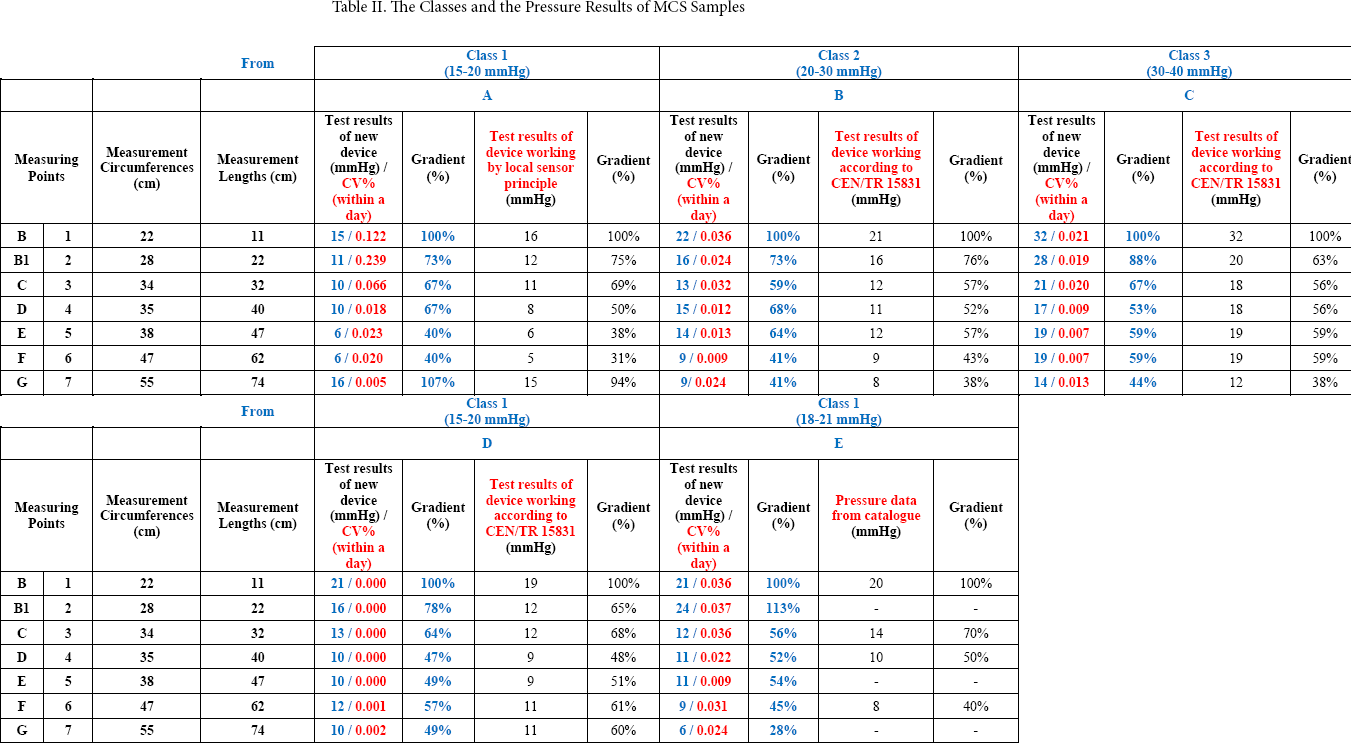
Test results were also evaluated according to related standards, whether the stockings were convenient to successful compression therapies.
The new device gave accurate and reliable pressure results comparable to other devices. The gradient trends of pressure results between the new and available devices tested were significantly close to each other—this trend was valid for all compression classes. This was also confirmed by the pressure profiles in Fig. 6.
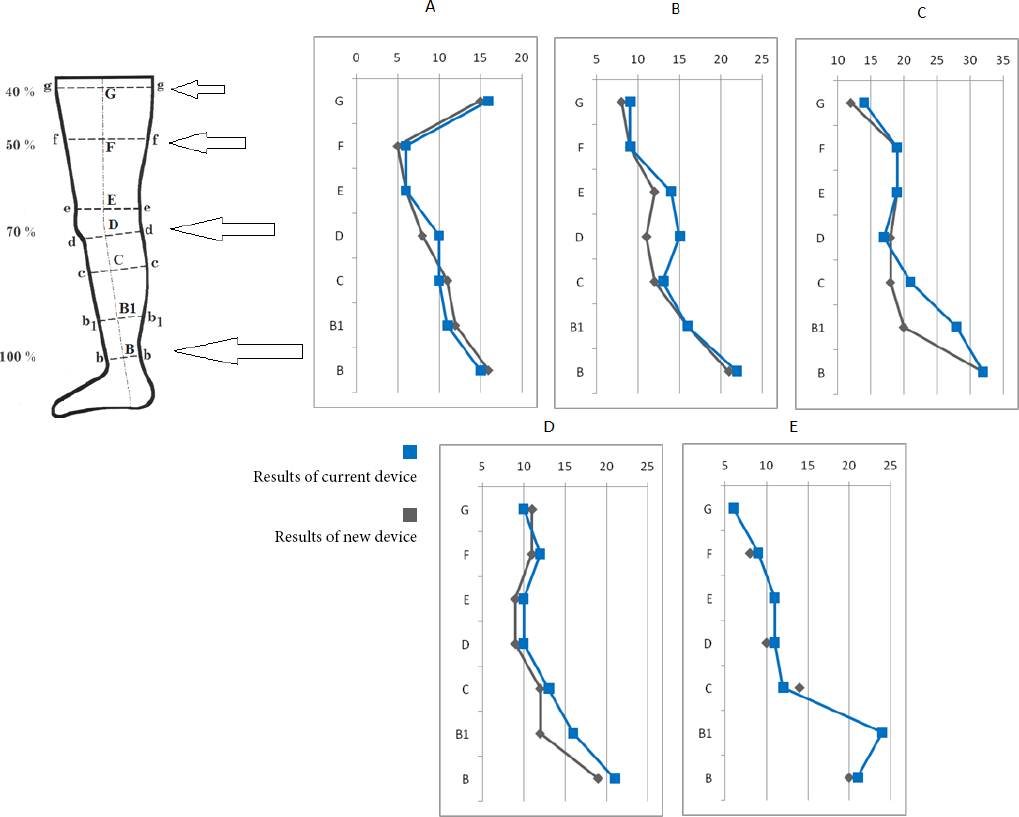
The pressure profiles of MCS: A-E, respectively.
Both test results performed on the new device and two other current devices confirm that the measured stockings were classified properly with regard to ankle pressure values. However, the results show that Sample A did not give the required pressure profile of 100% at the ankle and 40% at the thigh. The silicone bands that were used at the G area to cling to the leg and prevent slippage caused this result. These bands were not chosen attentively therefore, the pressure profile was deformed at this area. This result is known to cause crucial problems in compression therapy. On the other hand, Samples B-E were expected to achieve successful therapies with optimal pressure profiles that decreased gradually (Fig. 6).
Conclusion
The new MCS compression test device is unique in that it measures actual pressure values sensitively for a customized sizing before use. It is now possible to produce MCS with optimal pressure profiles according to the degree of disease progression and convenient to patient sizes. This can result in successful compression therapy.
Pretesting results and statistical evaluations using the new device within a day and over different days showed that the device had a high repeatability value with a low coefficient of variation. CV% of test results within a day was < 0.1%, while CV% over different days was < 8%.
The new device gave reliable pressure results compared to available devices that used different methods (like the local sensor principle or CEN/TR 15831 standard). This device offers unique and different functions when compared to current devices such as:
High technology: possibility of fast and sensitive measurements via analogue load cells, 3-D leg shape and simulation of real use conditions, and statistical evaluation.
Ease of use: flexibility of testing various types (different sizes and different compression classes) of stockings on one device using a horizontal and vertical adjustable mechanical leg apparatus.
Testing according to related standard: simultaneous measurement of pressure values on seven points and adjustment of different leg sizes as stated in the related standard.
Repeatability: Low coefficient of variation values (over different days < 8%, within a day < 0.1% and for low pressure values < 0.05%).
A “Utility Model Certificate” has been given to this pressure measuring device by Turkish Patent Institute (Application Number: 2010/01394).
Footnotes
Acknowledgements
The authors would like to express their sincere thanks to the Turkish Scientific and Technical Research Council for support of this research (1002-Short Term R&D Funding Program, Project No: 108M152).