




Abstract
This study proposes to make geotextiles from recycled materials. Polyester fibers, recycled polyester fibers, and low melting point polyester fibers are blended and needle punched to make the polyester fabrics, the mechanical properties of which are then evaluated to determine the optimal parameters. The polyester nonwoven fabrics are needle punched with various densities. Afterwards, the resulting polyester nonwoven fabrics, glass fiber woven fabrics, and polypropylene selvages are combined, needle punched, and hot pressed to form geotextiles, the properties of which are tested by tensile strength, tearing strength, burst strength, puncture strength, and water resistance tests. The test results show that polyester fabrics containing 50 wt% of polyester fibers have the optimal mechanical properties. Furthermore, needle punching at 90 needles/cm2 results in a greatest increase in mechanical properties of the polyester nonwoven fabrics. The tensile strength, tearing strength, and water resistance of the geotextiles increase as a result of hot pressing, and the bursting strength and puncture resistance are primarily associated with the needle punching densities. This study successfully creates composite geotextiles with reinforced mechanical properties by needle punching and hot pressing recycled polyester fabrics and polypropylene selvages.
Introduction
Taiwan is an island created by the subduction of the Philippine Sea Plate beneath the Eurasian Plate. As a result, earthquakes occur as a result of the energy released during plate movement. In addition, Taiwan has a subtropical zone climate, which makes it a possible target for frequent typhoons during the summer months. Due to the aforementioned reasons, the odds of earthquakes and typhoons occurring in Taiwan are high, and as a result, mudslides in mountainous regions are a frequent occurrence. Therefore, the use of geotextiles for the prevention, and afterward reinforcement, of mudslides is important [1].
According to ASTM D4439-11, geotextiles are a planar product made with polymers, and thus can be accommodated for use with relative materials in geotechnical engineering [2]. With the amount of geotextile applications increasing due to the improvement of combining synthetic materials and textile techniques, geotextiles have evolved from traditional textiles to many differing kinds. Geotextiles refer to all types of textiles used in geotechnical engineering, including geotextiles of woven and nonwoven fabrics, geogrids, geodrains, geopipes, geomembranes, geosynthetic clay liners, and geocomposites [3–5]. All of these geotextiles possess various functions due to their various designs, such as separation, filtration, drainage, reinforcement, protection, and acting as a barrier [6–8]. In sum, mechanical properties and water resistance are important features of geotextiles.
Rapid technological development has resulted in an industrial era that values high production and high consumption, thus increasing the amount of refuse and waste, which can harm the environment and affect people’s lives. For example, textile selvages account for the majority of the waste in the textile industry. Selvages do not have a valuable use, and as such are commonly sold cheaply or disposed of by outsourcing. They are mostly buried, incinerated, or crumbled into fibers to be used for nonwoven interlining, or packing materials with a low strength requirement. However, these waste selvages can be combined with geotextiles to add extra value, while also lessening the environmental burden and reducing the production cost [9]. Due to the fact that some sharp pieces of wood or stones are hard to remove, geotextiles are required to not only allow filtration and drainage, but also to have appropriate mechanical strength to extend their service life [10].
In this study, geotextiles are composed of recycled high strength polyester (PET) fibers and polypropylene (PP) selvages, which are used for their eco-friendly appeal and cost reduction. This study makes geotextiles via nonwoven fabric manufacturing, which blends and cards PET fibers and low melting point PET fibers to form recycled PET nonwoven fabrics. Next, these fabrics are combined with glass fiber (GF) woven fabrics, and PP selvages to provide greater mechanical properties to the geotextiles. Tests for tensile strength, tearing strength, burst strength, puncture strength, and water resistance are performed on the geotextiles in order to analyze their properties so as to determine the reinforcement of the recycled fibrous materials.
Experimental
Materials
Materials specification.

PET: polyester; RPET: recycled polyester; LPET: low melting point polyester.
Experimental procedures
PET fibers, LPET fibers, and RPET fibers are respectively blended with ratios of 80/0/20, 70/10/20, 60/20/20, and 50/30/20, and then needle punched to form PET nonwoven fabrics. The optimal parameter is determined by the tensile strength, tearing strength, puncture-resistant, and water resistance tests. The optimal PET nonwoven fabrics are then needle punched with 50, 70, and 90 needles/ cm2 for reinforcement. PET nonwoven fabrics with different needle punching densities, GF woven fabrics, and recycled PP selvages are combined, needle punched, and then hot pressed at 140℃ in order to form geotextiles (Figure 1), combining two layers of PET nonwoven fabrics as the top and bottom layers, which enclose two layers of GF woven fabrics with an interlayer of PP selvages that are arranged parallel to the machine direction of the PET nonwoven fabrics and along the warp direction of GF woven fabrics. Hot pressing causes the LPET fibers to melt so as to provide the geotextiles with a thermal bonding effect.
Scheme of the composite geotextiles composed of PET fabric, GF woven fabrics, and PP selvages.
Tests
Tensile strength
This test follows ASTM D 5035-12 (the maximum tensile strength test), measuring the tensile strength at break of the PET nonwoven fabrics and geotextiles with a universal testing instrument (Hung Ta Instrument Co., Ltd., Taiwan, R.O.C.). Ten samples measuring 180 mm× 25.4 mm are taken along the machine direction (MD, the direction that nonwoven fabrics are discharged from the needle punching machine), and along the cross machine direction (CD, a direction perpendicular to the MD), as in Figure 2. The tensile speed is 300 mm/min and the distance between clamps is 75 mm. The test results are for the mean and standard deviation.
Illustration of the CD and the MD of nonwoven fabrics.
Tearing strength
A tearing strength test is performed on PET nonwoven fabrics and geotextiles to measure the tearing strength at break with a universal testing instrument (Hung Ta Instrument Co., Ltd., Taiwan, R.O.C.) as specified in ASTM D4533-11. A trapezoidal scheme is used with ten samples of 75 mm× 150 mm taken along the CD and the MD, drawn with an equilateral trapezoid having a vertical 10-mm cut of the short base. The two legs of the trapezoid are held and damaged by the clamps, and the distance between clamps is 25 mm. The tearing speed is 300 mm/min.
Puncture strength
The puncture strength test of the samples is performed with an Instron 5566 (Instron, USA) as specified in F1342-05. The size of the samples is 100 mm× 100 mm. The puncture mold for the test punctures the samples with a specified speed of 508 mm/min, in order to yield the maximum puncture strength. Ten samples of each specification are taken and the test results are calculated for a mean [11,12].
Burst strength
Samples measuring 150 mm× 150 mm are tested for the burst strength with a universal testing instrument (HT-2402, Hung Ta Instrument Co., Ltd., Taiwan, R.O.C.) as specified in CNS 12915 (method of test for fabrics). Ten samples of each specification are taken and fixed with clamps to prevent goffering of the samples. The burst mold then measures the burst strength of the test samples.
Air permeability
The air permeability (cm3/cm2/s) of the PET nonwoven fabrics is measured with a tester (FX3300, TEXTEST, Taiwan, R.O.C.) under a pressure of 125 Pa, as specified in ASTM D737-04. Samples are not required to be trimmed, but should be no less than 255 mm× 255 mm, without having any damages and without being uneven. The sample is placed flat on the tester, and ten spots of the sample are measured for the mean of air permeability values.
Water resistance
The water resistance of PET nonwoven fabrics and geotextiles is measured using a custom-made tester indicated in Figure 3. Ten samples of each specification are taken, trimmed into 10 cm× 10 cm squares, and affixed between two pieces of wood (B) with screws. Water is then poured through an upper tube (A), and the volume of the water passing through the samples in 20 s and the lower tube (C) is recorded [13]
Image of water resistance tester.

Results and discussion
Mechanical properties of polyester fabrics
Mechanical properties of polyester fabrics.

PET: polyester; RPET: recycled polyester; LPET: low melting point polyester; CD: cross machine direction; MD: machine direction.
Tensile strength of geotextiles as related to hot pressing
Figure 4 shows that hot pressing provides the geotextiles with tensile strength above 600 N, which is better than that of geotextiles which are not hot pressed. Such a result is due to the LPET fibers in PET nonwoven fabrics, which melt as a result of hot pressing and cause bonding points that increase the tensile strength. In addition, hot pressing also causes the fabrics to shrink, which in turn increases the density of the fabrics and further causes a greater tensile strength of the overall geotextiles.
Tensile strength of geotextiles with or without hot pressing.
The variations in tensile strength along the CD and along the MD become smaller after the geotextiles are hot pressed. Moreover, one-way ANOVA analyses and Scheffe’s test results rank the influence of needle punching density on the tensile strength of geotextile as 50 > 70, 90 needles/cm2. Hot pressing decreases the influence of the fiber orientation (i.e. the direction most fibers are arranged) on the tensile strength, with the optimal tensile strength along the CD (994.4 N) and MD (1131.2 N) occurring when the consistent PET nonwoven fabrics are needle punched with a density of 50 needles/cm2. Increasing the needle punching density of the PET nonwoven fabrics means that each unit area of the fabric is needle punched more densely; thereby providing the fibrous net with a greater strength. When being needle punched with a certain density, the fibrous net becomes very compact, which greatly restricts the barbed needles from moving while carrying the fibers. This easily causes the breakage of barbed needles and damage of the fibers, eventually resulting in a decrease in the overall strength of the resulting fabrics [Figures 5 and 6].
SEM image (500×) of thermal bonding point. Illustration of the shrinkage of composite geotextiles.“UH” refers to untreated sample, and “H” refers to hot pressed sample.

Tearing strength of geotextiles as related to hot pressing
Figure 7 shows that the tearing strength of the geotextiles before and after hot pressing is significantly different. The influence of hot pressing on the tearing strength of geotextiles are ranked as 50 > 70, 90 needles/cm2 using one-way ANOVA and Scheffe’s test. Hot pressing chiefly makes the LPET fibers of the PET nonwoven fabrics melt, and as a result creates thermal bonding by forming bonding points where the fibers cross. The thermal bonding temperature is lower than that of PET fibers but greater than the glass transition temperature (Tg) of PET fibers. As a result, the PET nonwoven fabrics show shrinkage, which increases the density of the fabrics and thus the tearing strength of the resulting geotextiles. The tearing strength along the CD and MD of the geotextiles are 1167.07 N and 1135.59 N, respectively. In addition, needle punching densities significantly influence the tearing strength of the geotextiles [14,15].
Tearing strength of geotextiles with or without hot pressing.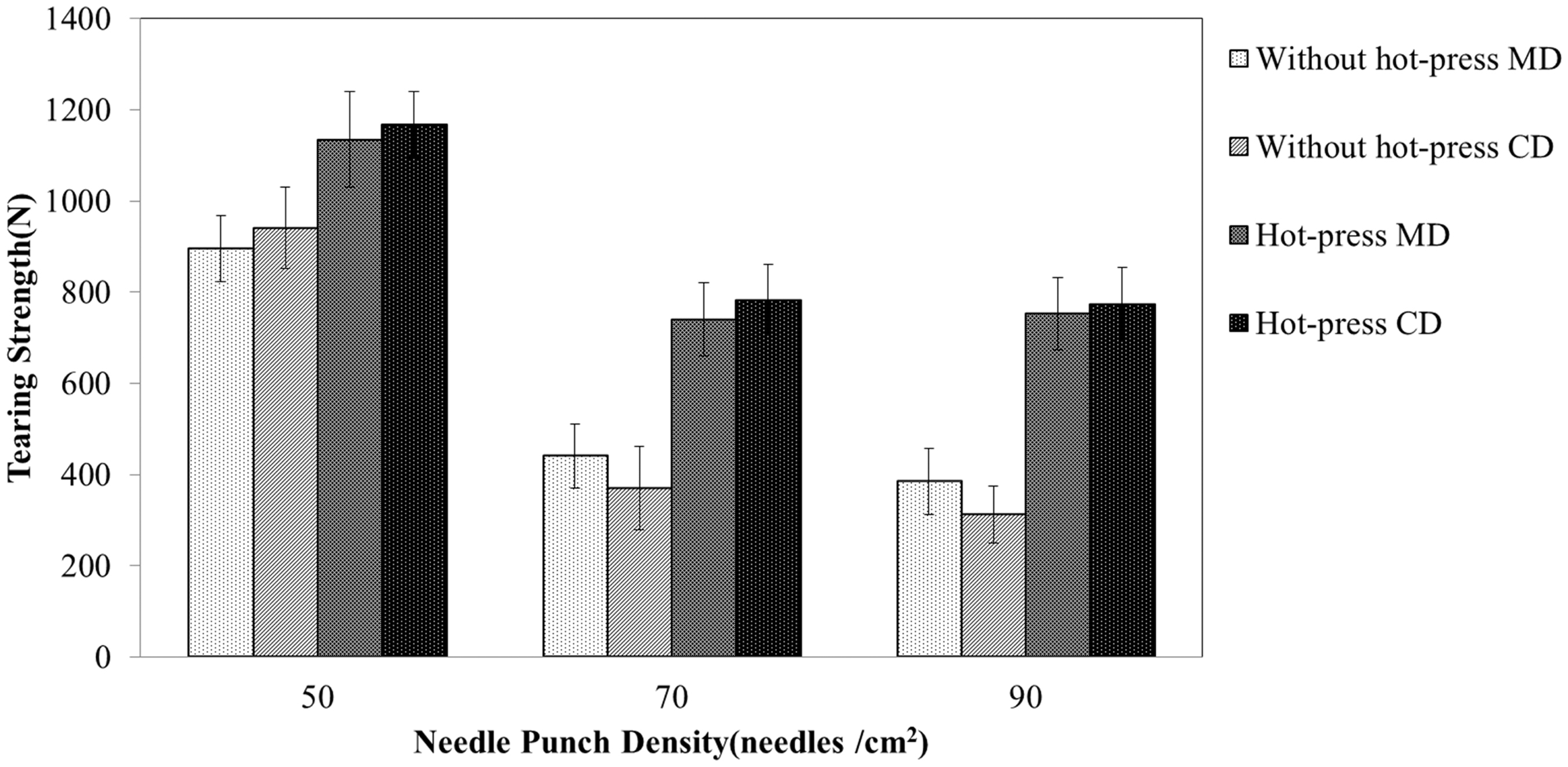
The direction that a tearing strength test damages the samples with its shear force is 45°, which is different from that of a tensile strength test. Fabrics are torn along the direction where the fibers cross one another.
Puncture resistance of geotextiles as related to hot pressing
Figure 8 shows that hot pressing results in a significant trend in puncture resistance. Moreover, one-way ANOVA analyses and Scheffe’s test results rank the influence of needle punching density from highest to lowest as 90 > 70 > 50 needles/cm2. LPET fibers form the bonding points as a result of thermal bonding caused by hot pressing. The PET nonwoven fabrics thus shrink, increasing the density and the overall strength of the nonwoven fabrics. A greater fabric density creates more friction between fibers and the puncture mold; therefore, the resulting geotextiles possess greater puncture strength. The optimal puncture resistance is 73.39 N.
Puncture resistance of geotextiles with or without hot pressing.
Burst strength of geotextiles as related to hot pressing
Without hot pressing, the geotextiles that are made with needle punching exhibit delamination during the burst strength test, which is absent in the burst strength test for the hot pressed geotextiles. Hot pressing causes the LPET fibers to melt and form thermal bonding points between the PET fibers and themselves. PET fibers also reach their Tg point during hot pressing, which causes a shrinkage of the nonwoven fabrics as well as a more compact arrangement of fibers. With a higher needle-punching density, there are more fibers from the surface pushed downward and pulled upward from horizontal to vertical by the barbed-needle plate in each unit area of nonwoven fabrics, entangling horizontal fibers and vertical fibers and heightening the fabric density. As a result, there are more fibers that are vertically arranged, and they cause friction against the test mold that leads to a higher resistance. Figure 8 shows that the burst strength of the geotextiles increases with the increasing needle punching density of the PET nonwoven fabrics. Figure 9 shows that the burst strength of the geotextiles increases with the increasing needle punching density of the PET nonwoven fabrics. Moreover, one-way ANOVA analyses and Scheffe’s test results rank the influence of needle punching density from highest to lowest as 90 > 70 > 50 needles/cm2. A high needle punching density causes a compact entanglement between fibers, while hot pressing causes thermal bonding points. Also, the burst strength test damages samples, which does not occur during the tensile and tearing strength tests. Therefore, the burst strength of geotextiles increases to a maximum of 3279.7 N with an increase in the needle punching density of PET nonwoven fabrics [16,17]
Burst strength of geotextiles with or without hot pressing.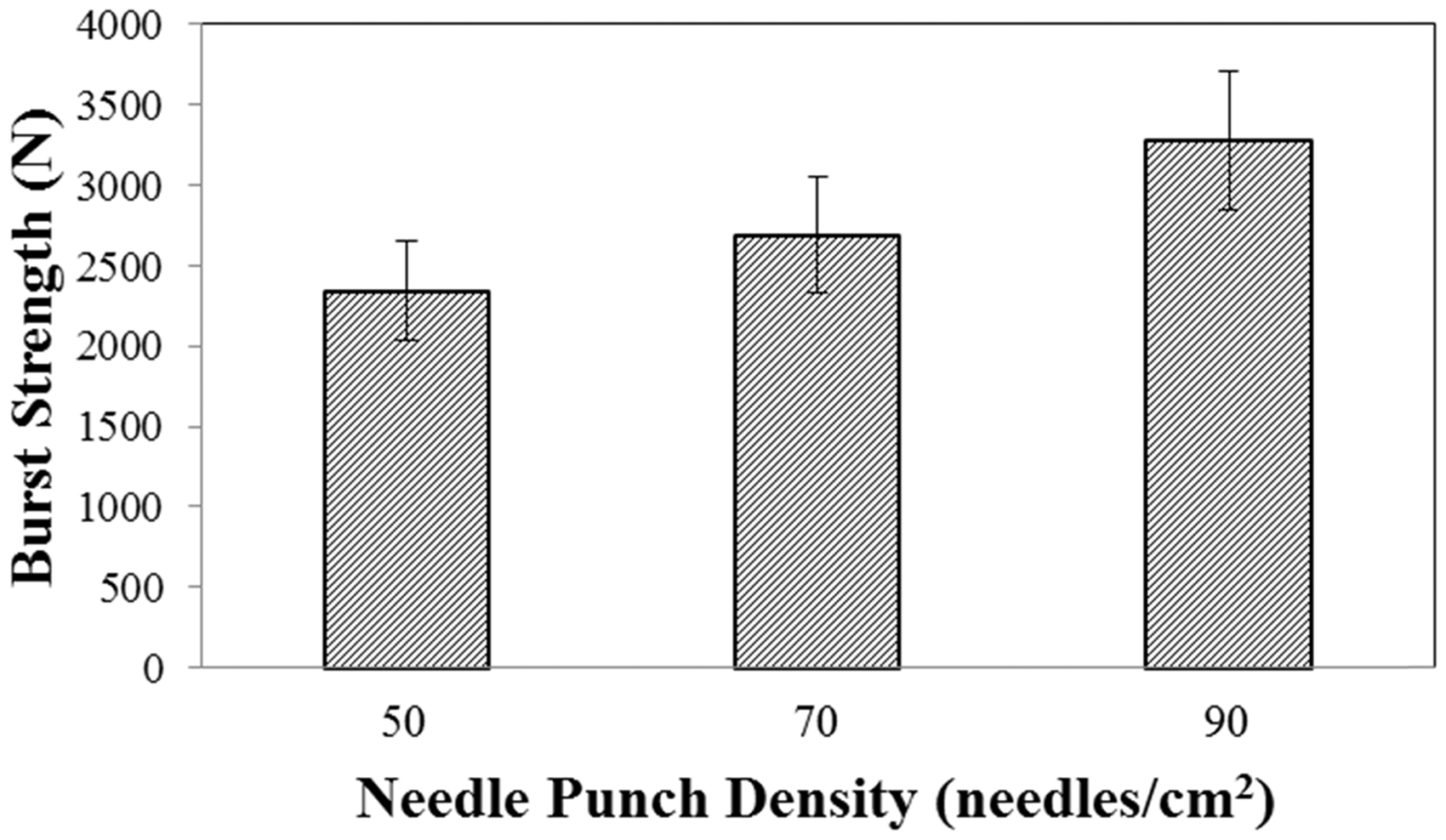
Water resistance of geotextiles as related to hot pressing
Figure 10 shows that hot pressing causes the water resistance of the geotextiles to increase by 10%. The pores of geotextiles are sealed by the thermal bonding points of the melted LPET fibers, thereby greatly increasing the water resistance. It takes approximately 5 s for the water to pass through the test sample types. Only the hot-pressed samples possess a distinct water resistance with all water passing through in 10 s, and yield an optimal water resistance of 86.4%. An increasing needle punching density fortifies the entanglement between fibers, thus augmenting the mechanical strength of the nonwoven fabrics, while also not causing any significant variations in the porosity [18,19]. The variations in porosities created by needle punching densities barely influence the water resistance of the geotextiles. This result is in conformity with the one-way ANOVA analyses and Scheffe’s test results that needle punching density does not pertain to water resistance.
Water resistance of geotextiles with or without hot pressing.
Conclusion
This study successfully combines recycled PET fibers, GF woven fabrics, and PP selvages to make composite geotextiles a better combination of which can be yielded by using hot pressing. Hot-pressed geotextiles yield a tensile strength along the MD and along the CD, which are 58.6% greater and 79.9% greater; and a tearing strength along the MD and along the CD, which are 26.8% greater and 25.6% greater. The needle punching density of the PET nonwoven fabrics demonstrates an influence on the burst strength and puncture resistance of the geotextiles. When the needle punching density increases from 50 to 90 needles/cm2, the burst strength and puncture resistance of the hot pressed geotextiles are 39.9% and 65.3% greater, respectively. Finally, water resistance of the geotextiles depends solely on hot pressing, which causes a water resistance that is 13.4% greater. The composite geotextiles are mechanically improved as a result of using thermal treatment, thereby determining the optimal needle punching density the optimum parameters. The resulting composite geotextiles have the high water resistance that is required in drainage and barrier selections, and are thus suitable for use in tunnels and road pavements to prevent excessive water penetration.
Footnotes
Declaration of Conflicting Interests
The author(s) declared no potential conflicts of interest with respect to the research, authorship, and/or publication of this article.
Funding
The author(s) disclosed receipt of the following financial support for the research, authorship, and/or publication of this article: This study was funded by the Ministry of Science and Technology of Taiwan (contract no. MOST-103-2622-E-035-025-CC2).