




Abstract
This paper presents an experiment-based, multi-medium heat transfer model to study thermal responses of multi-layer protective clothing with an air gap exposed to thermal radiation and hot contact surface. The model considers the dynamical changes of air gap, each layer’s fabric thickness, and air content contained in the fabric due to the pressure applied. The fabric heat transfer model developed from this study was incorporated into a human skin burn model in order to predict skin burn injuries. The predicted results from the model were well in agreement with the experimental results. A parametric study was conducted using various contact temperatures and applied pressures and design variables of firefighting protective clothing, such as physical properties of fabric layers and air gap sizes. It was concluded from the parametric study that resistance to transmission of injurious levels of heat decreases as the test temperature and contact pressure increase, and the contact heat transfer can weaken the importance of air gap under radiant heat flux(8.5 kW/m2) for 60 s and compression (pressure: 3 kPa, temperature: 316℃) for 60 s. The findings obtained in this study can be used to engineer fabric systems that provide better protection for contact heat exposure.
Introduction
Approximately 100 firefighters suffer from fatal injuries in the USA annually and over 30,000 firefighters are subject to injuries while firefighting [1, 2]. Although extensive efforts have been dedicated to improve the safety of firefighters, this profession continues to be one of the world’s most dangerous industries [3]. From 2007 to 2011, firefighters who suffered from skin burn injuries received them most frequently in the head area (38%), the arm or hand (30%), the neck or shoulder area (16%), and the leg or foot (8%) [2]. It is shown from the etiology of injuries to firefighters that scald burns were responsible for injury (65%) and flame burns caused injury to 20% of firefighters. However, other 15% patients received contact or compression burns [4]. Contact burns to the elbows, knees, and lower legs resulted from kneeling or crawling on excessively hot surfaces or hot liquid [5]. The self-contained breathing apparatus (SCBA) goes from the shoulders across the biceps, increasing the probability of compression burn [6]. Another common compression injury happens to the firefighters’ forearms when the arm holding a hose is extended toward a heat source [7].
Even though contact injuries comprise a relatively small fraction of the reported injuries sustained, these burns can have a significant effect on firefighters’ health, safety, and job performance. Firefighters are usually required to wear protective clothing to prevent skin burn injuries and ensure life safety. The thermal performance of compressed protective clothing systems and contact injuries has been addressed by ASTM F1060-08 [8]. The standards can be used to assess thermal protective performance under hot contact surface with a temperature of 316℃ and a pressure of 3 kPa. Based on the similar test method, Barker et al. [9] analyzed the effect of fabric properties and moisture content on thermal protective insulation of single-layer fabrics under different contact temperatures and applied pressures. But these procedures did not take into consideration wet conditions that firefighters can crawl through hot water. Lawson et al. [5] developed a dynamic compression test method to simulate knee crawling through hot water that can be used for evaluating the thermal protective performance of firefighters’ clothing exposure to hot water (75–100℃). However, the experimental data were not employed to predict skin burns due to the limitation of the sensor. A novel protocol introduced by Mandal et al. [10] was to simulate hot water immersion with a particular water temperature (85℃) and compression (55.16 kPa). A second-degree burn on human skin upon hot water exposure was measured using a skin simulant sensor. In addition, the method from ASTM F2731-11 [11] can be used to investigate the effect of the stored energy of fabrics transferring to the body due to subsequent compression (13.8 kPa). Generally speaking, the thermal protection of protective clothing exposed to hot surface or hot water with compression mainly depends on fabric thickness, applied pressure and hot contact temperature. Considering the complexity of fire ground conditions, an extensive parametric study should be conducted in a range of hot contact surface temperatures and compression pressures. Additionally, it is extremely important to explore compressive heat transfer mechanism after non-contact heat exposure.
Over the past decades, heat transfer models have been widely developed in thermal protective clothing as the numerical models have more flexibility and convenience compared to the laboratory simulation methods [12–20]. In the early 1970s, Morse et al. [12] modeled the thermal response of clothing covered skin subjected to a JP-4 fuel fire first considering the pyrolysis, ignition, and combustion of fabric. Since then, little progress was made in terms of rigorous theoretical modeling until Torvi and Dale [13] developed the classic heat transfer model for the single fabric system, which mainly accounted for the calculation methods of radiant heat transfer and proved that one-dimensional model effectively simulates heat transfer in protective clothing exposed to flash fire. In recent years, more precise one-dimensional models have been built by other researchers. For example, Zhu et al. [14] used a new numerical model to investigate the heat transfer in a cylinder sheathed by flame-resistant fabrics considering the effects of cylindrical geometry on heat transmission in fabrics. A clothing numerical model developed by Song et al. [15] was employed to explain heat transfer in a configuration that realistically simulates the shape of human body. Models for air gaps in the fabric system were further improved by Ghazy and Bergstrom [16, 17] and Ghazy [18] based on radiative transfer equation (RTE), including multiple air gaps model of multilayer fabric system [16] and dynamical air gap models owing to the body motion and thermal shrinkage of fabric [17, 18]. A three-dimensional transient heat transfer in the flame manikin test of thermal protective clothing was proposed to predict the distribution of skin burn exposed to flash fire based on computational fluid dynamics (CFD) techniques [19, 20].
Although a considerable amount of models have been conducted to predict the thermal protection of flame-retard fabrics to flames or to radiant heat, few studies have been made to evaluate thermal protective performance in high-intensity contact exposures with compression after radiant heat exposure. An empirical model of single-layer fabric that uses fabric thickness to predict insulation time has been developed by Baker et al. [9] in order to provide a convenient way of comparing different materials in hot surface exposures. However, contact heat transfer under compression can cause the changes of fabric thickness and air content within fabric, thus affecting the heat transfer in protective clothing. Therefore, the purpose of numerical simulation for heat transfer in the multilayer fabric system under hot surface exposure with compression is to predict skin contact burns, and explore the heat transfer mechanisms through compressed fabric systems and the influencing factors of thermal protection under compression conditions. The understanding of heat transfer with compression obtained from this work will contribute to provide proper guidance to reduce or prevent the contact burn injuries.
Model formulation
In order to comprehensively analyze heat transmission of multi-layer fabrics under compression, this study considers radiant heat exposure before compression, as is shown in Figure 1. The model consists of a clothing ensemble, including an outer shell, a moisture barrier and a thermal liner, an air gap and skin tissues. In forming the mathematical model, we assume that:
Heat transfer is one-dimensional along the thickness of the fabric layers, without mass transfer. The convection portion of the heat flux transfers energy to the fabric’s surface, while the radiative portion penetrates into the fabric system only during radiant heat exposure. It is assumption that the change of fabric thickness results from the discharge of air content without considering the effect of molecule force between air and fiber during compression. The thermal properties of the fabric are taken to be a function of temperature, but the optical properties of the fabric layers, such as absorptivity, reflectivity and transmissivity, are considered with constant values. Concerning the thin thickness of the fabrics layer and air gap between thermal liner and skin surface, the heat transfer within each fabric layer and air gap is considered as heat conduction and radiation, without convection.
Schematic diagram of radiant heat exposure and compression.

Heat transfer during radiant heat exposure
Heat transfer in the fabric layer
Based on the conservation of heat energy [13], at position x and time t, we have the heat transfer equation


The air content percentage (Vair%) can be calculated using the density of fibres and air [13], which can be expressed as

Heat transfer in the air gap
This model dealt with the air gap as a radiation participating medium that only absorbs thermal radiation [27] without considering the ability of the air gap to emit and scatter thermal radiation. Some studies used the Rayleigh number and flow visualization method to demonstrate that the natural convective heat transfer in the air gap is quite small comparing with conductive heat transfer when the air gap thickness is below 6.4 mm [13, 28]. Therefore, the energy equation inserting into conduction and radiation heat transfer within the air gap is as follow


Heat transfer with compression
Compared with the heat transfer during radiation heat exposure, thermal energy is transmitted in conductive heat in multilayer fabric system during compression. The energy conservation equation is given as below

In addition, the external compression can remove air gap between protective clothing and skin surface, and decrease fabric thickness and air volume fraction within fabric. The fabric thicknesses of different layers are measured under different pressures according to ISO 5084-1996 [29], as is described in Figure 2. To further understand the correlations between different pressures and fabric thicknesses, regression methods are employed respectively to build fitting curves for calculating fabric thicknesses under different pressures. All the curves present significantly high correlation coefficients (R2 > 0.92), which indicate good fits for the obtained data.
Different layers fabric thicknesses under various pressures.
The air content percentage contained in the fabric (Vair,com%) under different pressures can be obtained by using the change of fabric thickness as this model ignores the effect of molecule force between fibers, which is given as follows

Initial and boundary conditions
The initial temperatures of each layer fabric and air gap are considered equal to the ambient temperature (300 K). The skin tissue temperature is assumed to initially vary as a linear function of depth into the skin, from a surface temperature of 305.5 K to the subcutaneous base temperature of 306.5 K [11].
During radiant heat exposure, the thermal boundary conditions to differential equation (1) are specified by the radiation and convective or conductive heat transfer




In equation (13), hconv is the heat transfer coefficient of air due to natural convection from the outer shell to the ambient (W/m2 K), given by



During compression, the boundary conditions for differential equation (11) are


Heat transfer in the skin tissues
Heat transfer within the skin is represented as a transient one-dimensional heat diffusion problem, assuming heat conduction only within the skin and deeper layers. But the skin parameters considers the effect of blood flow in the dermis and subcutaneous layers on the heat transfer according to ASTM F2731-11 [11]. The energy equation of the human tissues is written as




Numerical solution
A finite difference scheme is applied to obtain the numerical solution. The time discretization scheme is Crank–Nicholson implicit scheme based on a grid spanning a 1D space coordinate and time coordinate, i.e., {x0, x1,…, xi} and {t0, t1,…, tj} [30]. The temperature values T(x, t) at the discrete points (xi, tj) are denoted by

Combining equation (5) with equations (6) and (7), we obtain

By using equations (26) and (27), the partial derivatives in equation (1) are replaced by finite differences (combined forward and backward schemes) yielding the following discrete version, associated with the position xi and the time tj
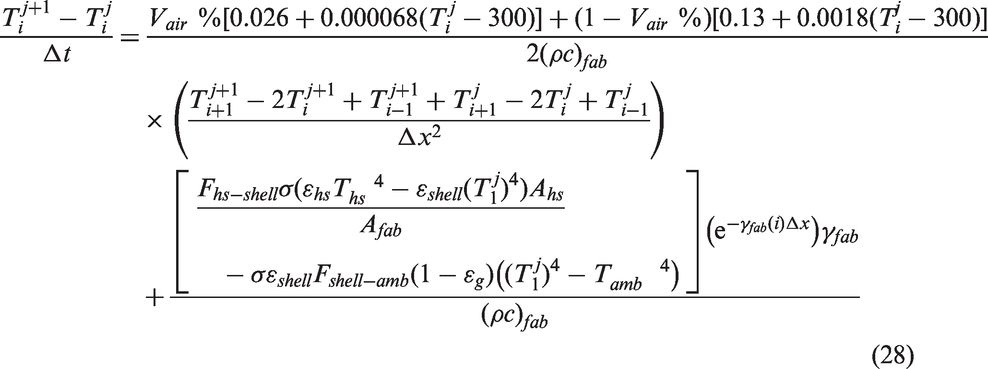
Defining

Similarly, defining

Defining

Then, the boundary conditions were discretized using same methods and we can obtain a non-linear tri-diagonal system. Due to the nonlinearity that comes from the radiation boundary condition, the coupling conduction–radiation and the variation in the fabric thermo-physical and convective heat transfer coefficient with temperature, the Gauss–Seidel point-by-point iterative scheme was employed to solve these discrete equations. In addition, the influences of grid size and time-step on model precision were studied in order to get the solution to an acceptable level. Finally, space-step and time-step were defined as 5 × 10⁻⁶ m and 0.1 s, respectively. The program was written in Matlab version 8.3.
Results and discussion
Experiment
Properties of the fabrics used in the numerical simulation.

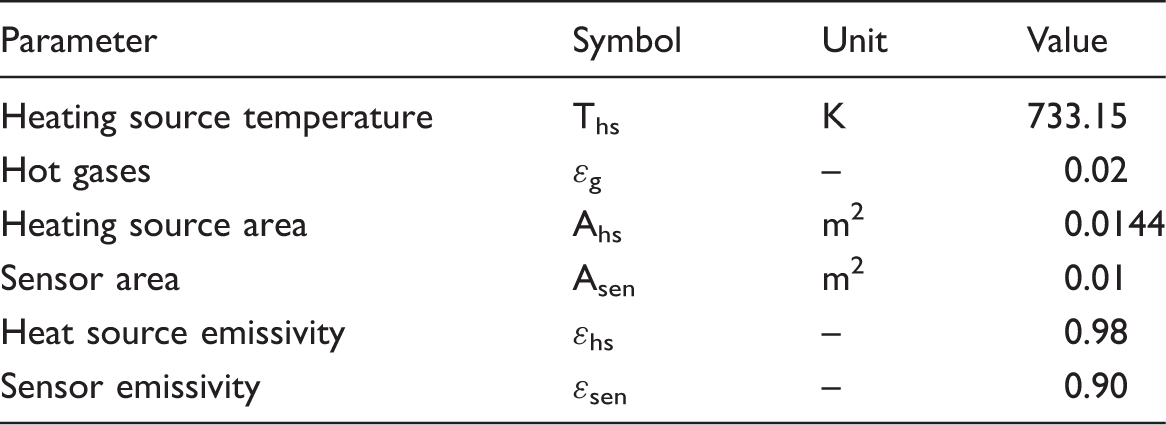
Basic parameters of the heating source and the sensor.
Thermo-physical/geometrical properties of the skin.

The compressor assembly consists of a compressor block, air cylinder, air regulator and a framework that rigidly holds the system in place. The compressor block is made from Marinite with thermal conductivity (0.12 W/m K). When activated, the regulated air can activate the piston and force the circular heat-resistant block against the sample and data collection sensor with a pressure of 13.8 ± 0.7 kPa.
The transfer tray connected with the sensor assembly and specimen holder can be moved between the compressor assembly and the heating source. As soon as the tray is moved over the heating source, the data acquisition system begins collecting data. At the end of 300 s exposure, the transfer tray is moved away from the heating source and over the compressor while the data acquisition system continues to collect data for 600 s.
Experimental results and errors of time to second degree burn and time to third degree burn.

Model validation
In order to verify the developed model in multilayer clothing system with an air gap, the prediction results of the time to skin burn and the thermal responses were compared with the experimental results. The predicted times to the second degree burns and third degree burns using the developed model and Henriques damage integral model [31] are 162.4 s and 288 s, respectively. Comparing the experimental results shown in Table 4, the corresponding predicted deviations are, respectively, 9.58% and 4.57%. The reason why the time to third degree burn is closer to the experimental value is that the compression to fabric system accelerates the thermal energy to transfer to the skin tissues.
Figure 3 shows the experimental measured temperatures of the epidermis/dermis interface for the multilayer fabric with an air gap, compared to the numerical results from the developed model. It can be seen that the temperature distributions of the epidermis/dermis interface during the exposure period can be divided in three different phases: (1) an initial rising phase during radiant heat, (2) a sharply rising phase in a moment of pressure applied and (3) a decreasing phase after compression. It is observed from Figure 3 that these numerical results in this study are in good agreement with the experimental results. However, the temperature rise predicted by the model during radiative heat exposure is marginally higher compared with the experimental measurement. It was reported by Sawcyn and Torvi [32] that the center temperature of fabric system is higher than the edge temperature of fabric system when the fabric system is exposed to heating source. Therefore, the thermal energy from the central portion of fabric system can be transferred to the surrounding portion due to the temperature difference. But the developed model ignored the multi-dimensional heat transfer in the multilayer fabric system. On the contrary, the rate of temperature decline in the model is quicker than the experimental data after compression. The main reason can be that the change of fabric thickness also depends on the molecule force in the air and the fiber during compression. So the fabric system actually contains more air content after compression. It follows that the thermal-physical properties of each layer fabric are relatively small in the developed model.
Comparison of experimental and numerical results of temperature histories on the epidermis/dermis interface for a multi-layer system with an air gap.
The surface temperature distributions of each layer fabric and skin tissues are compared as shown in Figure 4. From the outer shell to the skin tissues, there is an obvious decrease in the number of temperature from 600 K to about 330 K, showing that the multi-layer protective clothing system can effectively hinder heat transfer. It is also obvious that the outer shell, moisture barrier, and thermal linear quickly reach to a quasi-stable phase in nearly 100 s. However, the temperature of the skin tissues still experiences an increasing tendency during the whole radiant exposure because of the delayed effect of multi-layer media. The temperature in multi-layer fabric system and skin tissues witnesses a peak moment at about 300 s. For one thing, the applied compression can remove the air gap between thermal barrier and skin so that the thermal barrier with higher temperature is in direct contact with the skin surface. For another, multi-layer fabric system is compressed, thus increasing the heat transfer rates. But due to the lower temperature with compressor assembly, the temperatures of different layer fabrics quickly decrease to 307 K after compression. Figure 4 also shows that the temperature of the skin tissues initially continues to increase during compression, and then gradually declines to 307 K. The main reason is that the stored energy from multi-layer fabric can be discharged after compression.
Simulated temperatures in multi-layer fabric system and skin tissues.
Parametric study
Due to the complexity of fire ground conditions, an extensive parametric study should be conducted at a range of hot contact surface temperatures and applied pressures. In addition, the effect of different air gap sizes on skin contact burns should be investigated. According to ASTM F2731-11 and ASTM F1060-08, predictions from the established model were performed exposed to 8.5 kW/m2 radiant heat exposure for 60 s and compression with an applied pressure of 3 kPa and a temperature of 316℃ for 60 s, which can be treated as the baseline case.
Heat transfer under different pressures
The effects of different contact pressures are shown for the multi-layer clothing system in Figure 5. In our works, pressure was systematically varied from 0.25 to 133 kPa [5, 8, 10, 11], which contains the pressure range of Barker et al. [9], i.e. from 1.18 to 6.89 kPa. It is worth mentioning that the compression force with the firefighters kneeling on both knees is 133 kPa while they support the operating hoseline and nozzle with their right hand [5]. It is found from Figure 5 that the abrupt change of the epidermis–-dermis interface temperature after compression exists at an obvious difference under different applied pressures. Also, the applied pressure increases the rate of heat transfer by removing the air gap between the fabric and skin surface and by decreasing the effective thickness and air content of compressible fabrics. Additionally, this phenomenon shows that the abrupt change of the epidermis–dermis interface temperature is dependent not only on the back temperature of thermal barrier, but also on the applied pressure. During contact heat transfer of 316℃, the skin tissue temperature shows an increase tendency under different pressures when the time ranges from 60 s to 150 s due to the large temperature difference between contact block and skin. The heat transfer rate during compression is greater than that during radiation exposure. There is an increase in the rate of heat transfer in the skin tissues as the contact pressure increases from 0.25 kPa to 133 kPa. It is indicated from Figure 5 that the loss of the protective insulation is much greater from 0.25 to 3 kPa than that from 55.16 to 133 kPa, which has a good consistence with the experimental results of Baker et al. with single-layer fabrics [9].
Effect of contact pressure for a multilayer system with an air gap on temperature of the epidermis–dermis interface.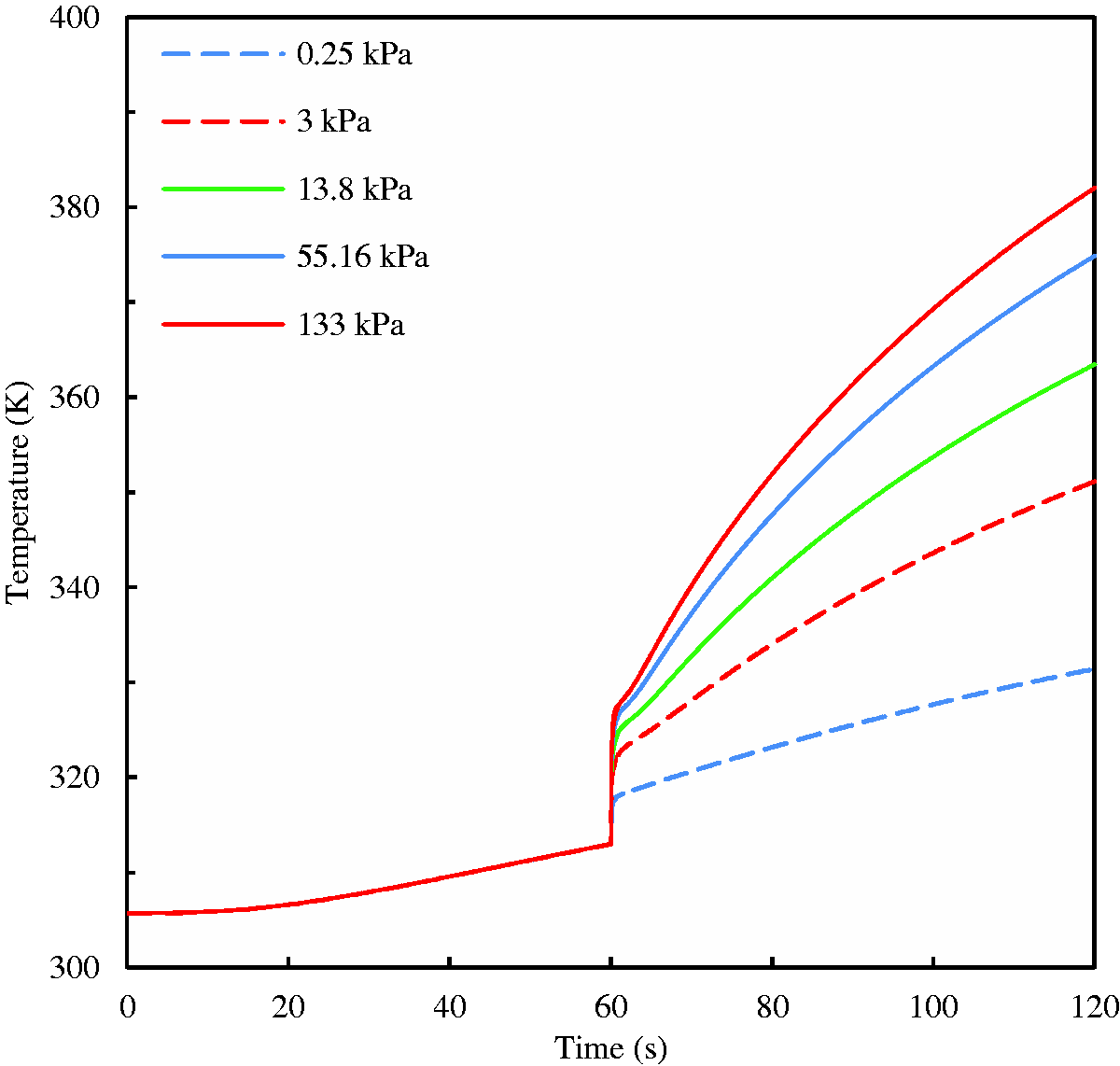
In order to explore the relationship between skin burn and contact pressure, Figure 6(a) shows the times to second degree and third degree skin burn under different applied pressures by using an iterative method. From 0 to 150 kPa, there is an obvious decrease in the number of second degree burn time from 89.85 s to 62.85 s and third degree burn time from 109.35 s to 74.35 s. But the decreasing zones mainly focus on the pressure of 20 kPa. Figure 6(a) also shows the variation of multi-layer fabric thickness under different pressures. It is observed from Figure 6(a) that there is a similar trend between multi-layer fabric thickness and burn times as the pressure applied increases, showing that the decrease of fabric thickness is one of the main reasons to increase heat transfer rate. To further analyze the influence factors of contact heat transfer, we compare the relations between the thermal conductivity of different fabric layers and skin burn under different pressures, as shown in Figure 6(b). Because thermal energy during compression is transmitted in conductive heat in multilayer fabric system, the heat transfer rate is mainly dependent on thermal conductivity. As the contact pressure increases, the thermal conductivities with different layers decrease, exacerbating skin burn injuries. Therefore, the fabric thickness and the thermal conductivity are both important factors that affect contact heat transfer under various applied pressures.
Relationship between burn time and fabric thickness (a) or thermal conductivity (b) under different pressures.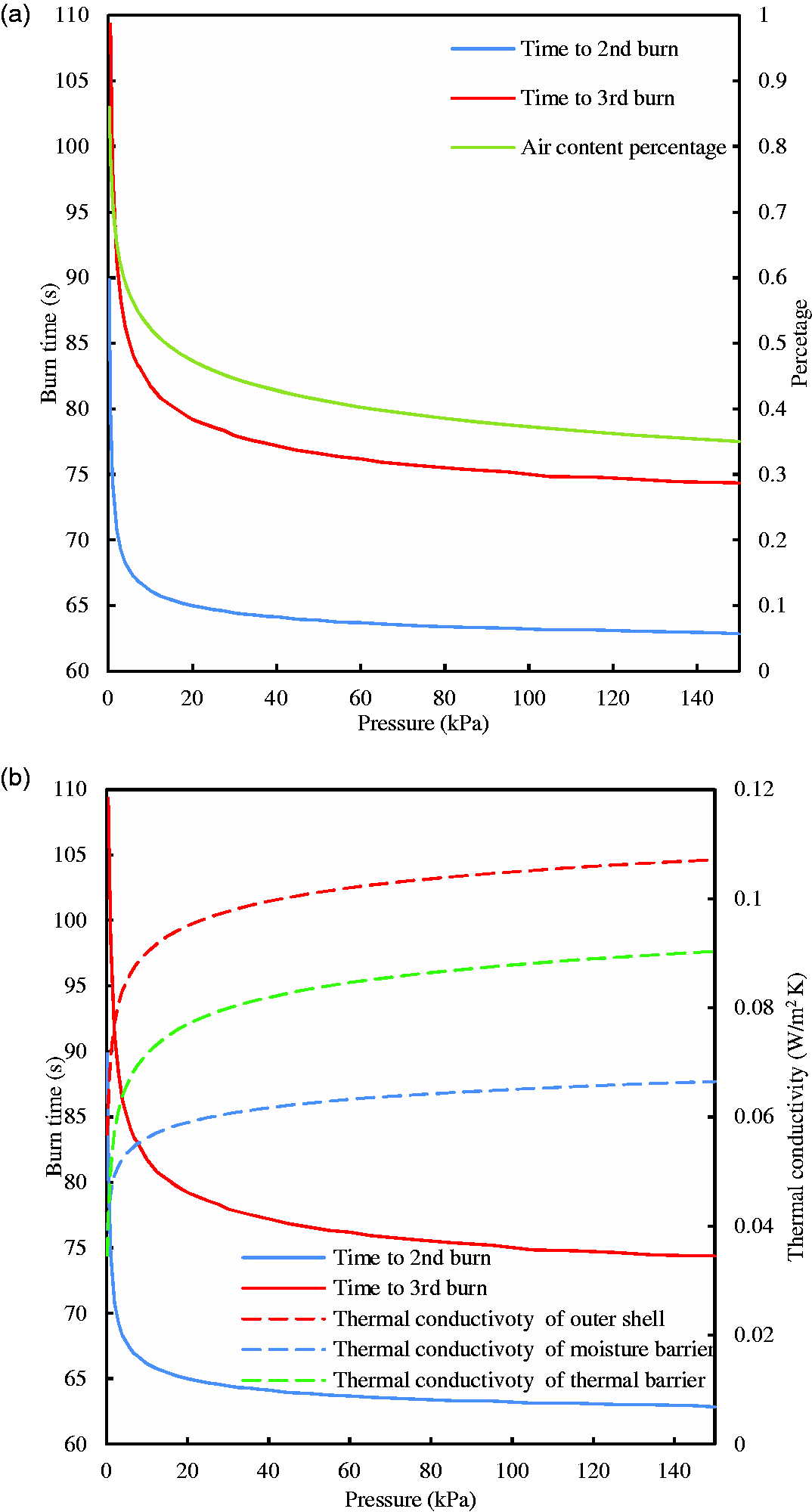
Heat transfer under different contact temperatures
In order to investigate the effect of the contact temperature on thermal protective performance of the multi-layer clothing system, the contact surface temperature ranges from 300 K to 700 K. The main reason is the high-temperature degradation of flame-retard fabrics, for example, Nomex fiber begins to degrade at 700 K [33]. The fabric system is exposed to a radiant heat flux of 8.5 kW/m2 for 60 s, and following a compression with an applied pressure of 3 kPa for 60 s. It is clear from Figure 7 that there are some discrepancies regarding to temperature of the epidermis–dermis interface with the increase of contact surface temperature during compression. But the temperature differences on the epidermis–dermis interface under different contact temperatures seem to be equal as the temperature difference is the only factor to determine conductive heat transfer for constant thermal conductivity. Different contact temperatures do not change the abrupt temperature of the epidermis–dermis interface because of the constant applied pressure, being in stark contrast to Figure 5.
Effect of contact temperature for multilayer fabric system with an air gap on temperature of the epidermis–dermis interface.
Times to second and third degree burns under various contact temperatures.

Heat transfer under different air gaps
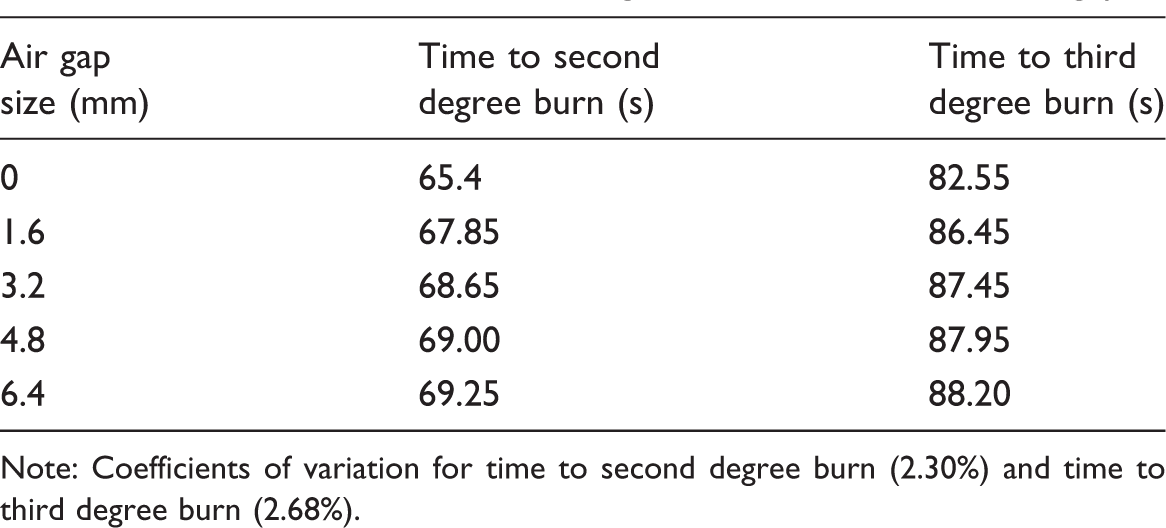
A large number of experimental and numerical results have been proved that the air gap size between the fabric and the skin surface has a significant impact on thermal protective performance of the clothing system under flash fire or radiant heat exposure [5, 16–18, 34]. It deserves to study the role of air gap exposed to radiation heat and hot contact exposure. Figure 8 shows the temperature responses of epidermis–dermis interface in various air gaps. It is clear that the air gap greatly affects the temperature tendency during radiant heat exposure, but the difference begins to decrease as the air gap size increases. After the pressure is applied, the temperature differences under different air gap sizes decline obviously. Table 6 describes the differences of times to second and third degree burns under various air gap sizes. According to the coefficients of variation for times to second degree burns (2.30%) and time to third degree burns (2.68%), the air gap size has an insignificant effect on the skin burn injuries. It was concluded from Figure 8 and Table 5 that the contact heat transfer can weaken the importance of air gap under 8.5 kW/m2 radiant heat exposure for 60 s and compression with an applied pressure of 3 kPa and a temperature of 316 ℃ for 60 s.
Effect of air gap size for multilayer fabric system on temperature of the epidermis–dermis interface. Times to second and third degree burns under various air gap. Note: Coefficients of variation for time to second degree burn (2.30%) and time to third degree burn (2.68%).
Conclusion
The experiment-based, multi-medium heat transfer model for thermal responses using three-layer protective clothing systems with an air gap was developed under thermal radiation and hot-contact exposure. The new model considered the changes of air gap between thermal barrier and skin surface, each layer fabric thickness and air content contained in the fabric due to the applied pressure. The developed heat transfer model in fabric system was incorporated into a human skin burn model in order to provide a convenient way of predicting the skin burn injuries under different contact temperatures and contact pressures. The results of the new model were compared and found in good agreement with the experimental ones.
This model was employed to analyze temperature distribution in a three-layer protective clothing assembly and skin tissues. It was concluded from the numerical analysis that the fabric thickness and the thermal conductivity are both the important factors to affect contact heat transfer under various applied pressures, and the thermal protective performance of multilayer clothing system decreases as the test temperature and contact pressure increase. The results also illustrated that the contact heat transfer can weaken the importance of air gap under radiant heat (8.5 kW/m2) for 60 s and compression (pressure: 3 kPa, temperature: 316℃) for 60 s. The developed model can be used to efficiently evaluate the thermal responses and protective performances of protective clothing systems and optimize various design parameters of clothing, such as type, physical properties of fabric layers, and air gap sizes under different contact temperatures and contact pressures.
Footnotes
Declaration of Conflicting Interests
The author(s) declared no potential conflicts of interest with respect to the research, authorship, and/or publication of this article.
Funding
The author(s) disclosed receipt of the following financial support for the research, authorship, and/or publication of this article: The authors would like to acknowledge the financial support from the National Nature Science Foundation (Grant No. 51576038), the Fundamental Research Funds for the Central Universities (Grant No. 15D110735/36), Donghua University PhD Thesis Innovation Funding (NO.16D310701), and the Open Funding Project of National Key Laboratory of Human Factors Engineering (Grant No. SYFD150051812K).