




Abstract
The goal of this research is to develop a mathematical model of heat transfer in protective garments exposed to routine fire environment (low level of radiant heat flux) in order to establish systematic basis for engineering materials and garments for optimum thermal protective performance and comfort. In the first stage, this paper focuses on the formulation of heat transfer model suitable for predicting temperature and heat flux in firefighter protective clothing, using COMSOL Multiphysics® package based on the finite element method. Computational results show the time variation of the temperature at the inner face of the protective clothing system during the exposure to a low-radiant heat flux as well as during the cooling-down period. Model predictions of the temperature agreed very well with the experimental temperature. In the second stage of this study, in order to predict the first and second-degree burns, the model of heat transfer through multilayer protective system was coupled with the heat transfer model in the skin. The Pennes model was used to model heat transfer in the living tissue. The duration of exposure during which the garment protects the firefighter from getting first and second-degree burns is numerically predicted using Henriques equation. The results demonstrated that even for a low-level thermal radiant heat flux, a typical three-layer thermal protective clothing system is required to protect the wearer from skin burn injury.
Introduction
Thermal comfort of the protective clothing is a topic of active research. According to generally accepted definition given by American Society of Heating, Refrigerating, and Air Conditioning Engineers, thermal comfort is “the condition of mind that expresses satisfaction with the thermal environment” [1]. Nonetheless, the concept of thermal comfort is not solely in a subjective domain since it depends on physiological processes in the body to a certain extent. It is in direct relation with a heat balance of the human body, i.e. the processes that lead to heat production and heat loss. The summary of the heat balance of the human body can be described using the following equation [1,2]:

The terms used in the heat balance depend on a number of factors that could be classified into environmental, physiological, and clothing factors. Therefore, the role of protective clothing in high-risk profession as firefighting is of crucial significance for the thermal comfort of a wearer and its performance.
When firefighters are exposed to a heat source, their body reacts by activating sweat glands, i.e. through evaporative cooling mechanism. The protective clothing protects the firefighters from environmental heat and moisture but simultaneously prevents their flow in opposite direction, away from the body to the environment. Consequently, risks of heat stress and steam burn injuries strongly increase. In hot environments, heat and moisture transfer properties of the protective clothing have a prevailing impact on firefighters’ performances and their safety. Optimization of these coupled transfer phenomena from the skin through the garment could improve comfort of the wearers and hence their performance. Effective protective clothing should minimize heat stress while providing protection [3].
The physical model of a firefighter in a firefighting environment consists of three parts that are linked by heat and mass transfer: the human body that produces heat (metabolic heat) and water (sweat), the heat source from the environment, and the protection system (Figure 1).
Processes involved in heat and mass transfer of firefighting protective clothing.
During the last decade, numerous studies have been carried out regarding the design and the mathematical modeling of different aspects of the physical behavior of the protective clothing [4–7]. Two types of mathematical models have been developed: those that only consider heat transfer [7–13] and those that consider heat and moisture transfer [4,5,14–18]. All these studies refer to emergency conditions, which, according to Mäkinen [19], imply extreme heat fluxes in the range from 8.37 to 125.6 kW/m2 and air temperatures in the range from 300 to 1000℃. Emergency conditions are quite rare, and firefighters are most frequently exposed to routine and hazardous conditions [3]. Routine corresponds to a common intervention environment for fire fighters with low-radiant heat flux from 0.42 to 1.26 kW/m2 and air temperatures in the range from 10 to 60℃. Hazardous represents an intervention environment with high-radiant heat flux from 1.26 to 8.37 kW/m2 and air temperatures in the range from 60 to 300℃ [19]. Data obtained over the years show that most burn injuries sustained by firefighters occurred in thermal environments with low-radiation level (classified as routine or hazardous conditions), as a result of prolonged exposure. Only a few studies have been conducted on thermal protective performance with prolonged exposure to these conditions. The goal of this research is to develop a mathematical model of heat transfer in protective garments exposed to routine fire environment, the most common conditions in the firefighters work. In such conditions, the most important phenomenon, which significantly affects the thermal comfort, is the heat transfer (often the phenomenon of sweating may be missing). In this study, only heat transfer is taken into account whereas the influence of moisture is not considered. The COMSOL Multiphysics® package that uses the finite element method (FEM) was used to simulate heat transfer in protective clothing during low-radiant flux exposure.
Approach and methodology
Materials
The fabrics selected for experiments are commonly used as high-performance fabrics in the thermal protective clothing field. The multilayer system consists of three fabric layers: outer shell, thermal liner, and moisture barrier.
Physical and thermal properties of monolayers.

Thickness of the monolayers was measured under the pressure of 1 ± 0.01 kPa, according to the standard ISO 5084:1996. Density was calculated from the values of fabric monolayer thickness and surface weight (determined using an analytical balance). The average of 10 measurements was calculated.
The thermal properties of the fabric samples were measured with the Hot Disk TPS 2500 S instrument in agreement with the standard ISO 22007-2:2008 [20]. For each monolayer, three measurements were performed, and then the average of the measured parameters was calculated.
To simplify the formulation, the textile layers were considered homogeneous.
Numerical model of heat transfer
The first part of this study focuses on the formulation of the heat transfer model suitable for predicting temperature and heat flux in firefighter protective clothing. In order to validate the model by comparing the predicted values with the experimental results, the experimental setup of ISO 6942-2002 was used (Figure 2).
Scheme of the experimental setup used for evaluation of the material assemblies when exposed to a source of low-radiant heat flux.
Due to the length scales of clothing thickness compared to their surface, a one-dimensional model is adopted as a valid assumption (the direction normal to the clothing surface).
For the development of the numerical model, it was supposed that the temperature depends only on time and position, T (t, x). Heat conduction and penetrating radiation through solid phase are considered for heat transfer within the fabric. Radiative heat transfer in the fabric is accounted for by introducing in the energy equation a source term similar to that in Torvi’s model [8]. It is assumed that radiation penetrates through the outer layer of the fabric only. The conductive and radiation heat transfer mechanisms are considered through the air gap. Heat conduction was considered through the copper plate and insulation board. No external air flow was considered in the model. The evaporative heat was not considered in the present model because the influence of sweating has been not taken into account. All textile structures used are aramid fabrics, so the amount of water regain in the fibers is small (maximum 3–4%), and consequently, the heat of evaporation can be neglected. The evaporation rate of water retained in the fiber was measured experimentally, and a value of 0.0025 g/m2s was obtained. This evaporation rate multiplied by the latent heat of evaporation of water gives the total energy used to evaporate this amount of water. The value obtained is 5.6 W/m2, a value which can be neglected in comparison with the value of the incident flux.
The energy balance in the infinitesimal element of the fabric, for one-dimensional heat transfer, can be described in the form of differential equation


The extinction coefficient that characterizes the decrease of thermal radiation as it penetrates into the fabric is given as
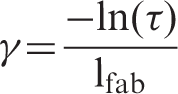
The boundary conditions
A constant inward heat flux, convective, and radiant heat transfers are assumed on the left external boundary and constant temperature (ambient temperature) on the right side.
The general inward heat flux Q (W/m2) represents a heat flux that enters into domain.
The emitted thermal radiate heat flow is defined as

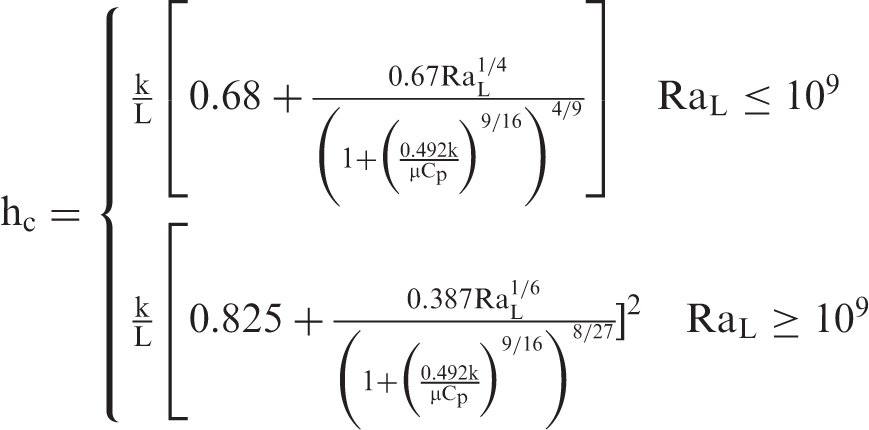
Natural convection heat transfer due to the temperature gradient between the surface and the environment occurs


According to the empirical correlation of free convection on a vertical plate [21]

The heat flux by radiation across the air gap is the radiation heat exchange between two gray parallel surfaces [22]

Initial conditions
The fabric initial temperature is considered equal to the ambient temperature

Based on data in the literature, an emissivity of 0.9 and a transmissivity of 0.01 were assumed for the fabric [6]. Emissivity of the inner surface of the calorimeter was considered 0.78 and the emissivity of the insulation board 0.96 [23].
In the second stage of this study, in order to predict time to the first and second-degree burns, the model of heat transfer through multilayer protective system was coupled with the heat transfer model in the skin. For this, the calorimeter and the insulation board were replaced by the skin that consists of three layers: epidermis, dermis, and subcutaneous (Figure 3). The Pennes model was used to model heat transfer in the living tissue.
Schematic cross section for one dimensional heat transfer models.
An air gap of 1 mm width is assumed between the fabric and the human skin, and the conductive and radiation heat transfer mechanisms through the air gap are considered according to [16,24].
The heat flux by radiation from the fabric to the skin across the air gap is
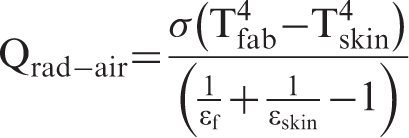
The skin initial condition is expressed as a linear temperature distribution between 33℃ at the epidermis surface and 37℃ at the subcutaneous base (core body temperature). The boundary condition at the base of subcutaneous layer is set at a constant temperature of 37℃. The ambient temperature was considered at 20℃. Metabolic heat was considered 4343 W/m3. The temperature at the interface between the epidermis and dermis in the human skin was denoted as “T” in Henriques equation (equation (13)). The equation was integrated in MATLAB® over the time interval that the temperature at the basal layer is above 44℃, in order to obtain the minimum exposure time for the first and second-degree skin burn.
Bioheat transfer model
In quantitatively estimating fabrics and garments thermal performance under heat conditions, the time to damage the skin beneath the fabric is applied using different skin bioheat transfer models [7,8,11,25].
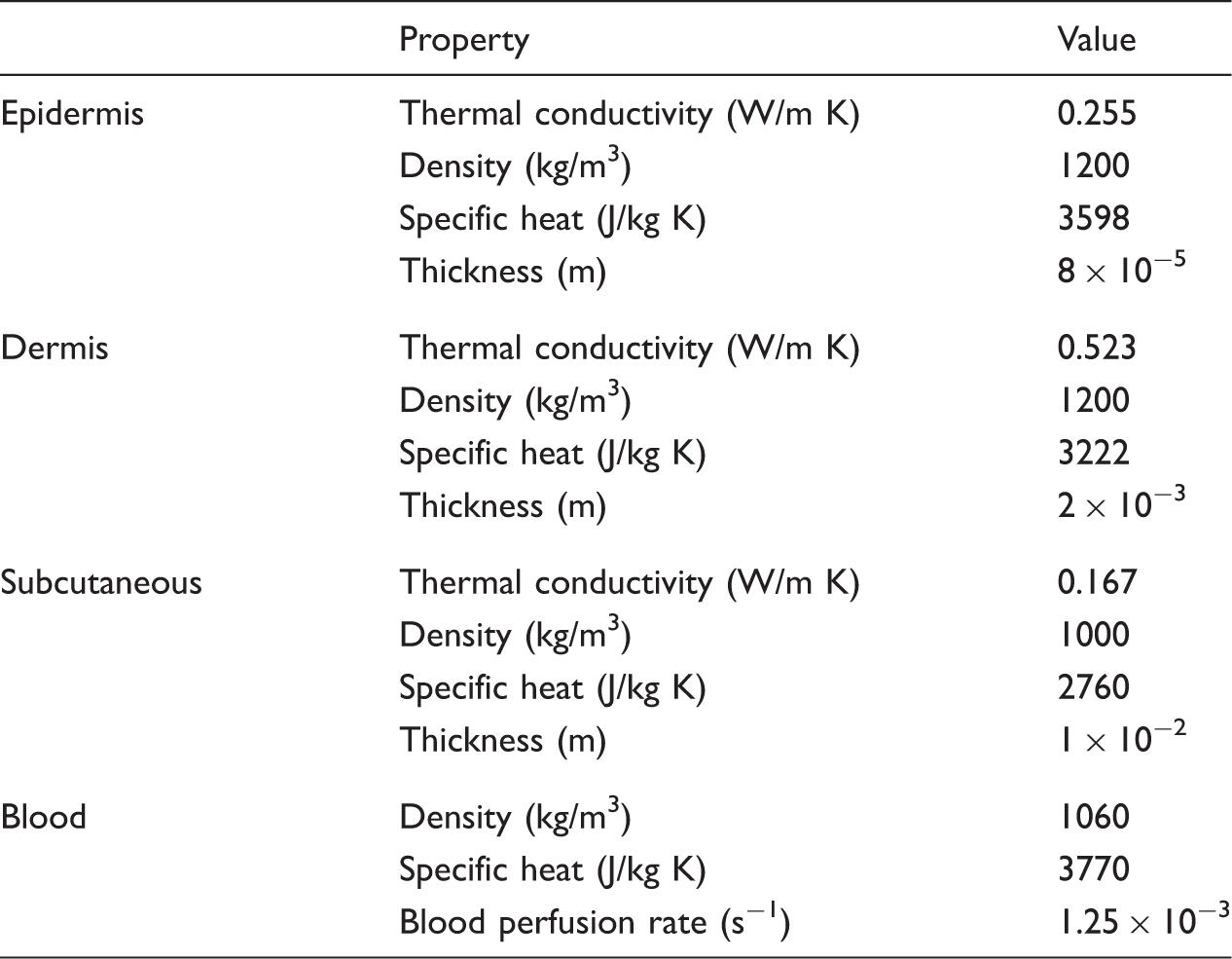
The Pennes model is used by many authors to model heat transfer in the living tissue [7,8,11]. According to this model, the skin is divided in three layers—epidermis, dermis, and subcutaneous—and the total heat transfer by the flowing blood is proportional to its volumetric flow rate and the temperature difference between the blood and the tissue.
Pennes proposed a transfer equation to describe heat transfer in human tissues. For one-dimensional heat transfer, the equation is

Pennes’ model assumes that skin tissue above an isothermal core is maintained at a constant body temperature. The resulting simplified bioheat equation is based on following specific assumptions: heat is linearly conducted within tissues; tissue thermal properties are constant in each layer, but may vary from layer to layer; blood temperature is constant and equal to body core temperature; negligible exchange between the large blood vessels (arteries and veins) and the tissue; the local blood flow rate is constant. In long duration, low-intensity heat exposure, the rate of metabolic energy production is included in the above equation [8].
Skin and blood properties used in a three-layer skin model.
Skin burn model
Henriques and Moritz [7,11,18] were among the first to publish a skin burn injury model. They claimed that skin burn damage can be represented as a chemical rate process, so that a first-order Arrhenius rate equation can be used to estimate the rate of tissue damage as

Integrating this equation yields

Integration is performed for a time when the temperature of basal layer (the interface between the epidermis and dermis in human skin), T, exceeds or equals to 44℃, because damage to the skin commences when the temperature in the basal layer rises above 44℃.
Henriques found that if Ω ≤ 0.5, no damage will occur at the basal layer.
First-degree burn occurs if Ω is 0.5–1.0, and a second-degree burn is indicated when Ω > 1.0.
These tissue burn damage criteria can be applied with providing the appropriate values of P and ΔE. These values were suggested by Weaver and Stoll [6] for the basal layer
for T < 50℃, P = 2.185 × 10124 s−1
ΔE/R = 93534.9 K
for T ≥ 50℃, P = 1.823 × 1051 s−1

The advantage of using the Henriques integral is that time to first and second-degree burn can be estimated.
Use of COMSOL Multiphysics®
The numerical model was programmed with Comsol Multiphysics® version 4.3 and the equations, together with the already described set of initial and boundary conditions have been solved by FEM. Heat transfer interface and heat transfer in solids module were used for modeling heat transfer. The biological tissue feature was used to provide the source terms that represent blood perfusion and metabolism for modeling heat transfer in biological tissue using the bioheat equation.
Experimental setup
To perform the laboratory simulation of low-level radiant thermal hazards, six silicon carbide heating roads were employed as the radiant heat source as specified in NF EN ISO 6942-2002, for measuring radiant heat resistance. According to this standard, the levels of incident heat flux density should be chosen from the following levels: low level 5 and 10 kW/m2, medium level 20 and 40 kW/m2 and high level 80 kW/m2. However, other levels of incident heat flux density may be chosen as well [26]. A copper plate calorimeter is used to record the temperature, and a data acquisition system connected to a computer with TESTPOINT software was used for registering the results. The copper plate calorimeter is constructed of a rectangle cooper sheet (50 mm × 50.3 mm), 1.6 mm thick, bent in the longer direction into an arc with a radius of 130 mm. The copper plate has a mass of 36 g. A cooper constantan thermocouple is mounted on the back of the cooper plate. An air gap with the width of 9 mm and an insulation board of 14-mm asbestos-free non-combustible are placed behind the calorimeter.
The specimens have the dimension (230 × 80) mm, and the composite specimen reproduces the arrangement in which the layers are used in practice. The specimen is fastened on the specimen holder using some clamps. The tensioning force of 2 N is applied to the assembly of all layers.
The radiation source was positioned to deliver 1000 W/m2 inward heat flux. The calibration followed the standard, and the heat flux value was confirmed by measurements conducted using an ultrathin heat flow meter 50 × 50 mm, from CAPTEC. For the experiments, the specimens were exposed to radiant heat flux for 40 min. A protective shutter positioned between the radiant energy source and the specimen was used to block the radiant energy prior to the exposure of the specimen and to control the exposure time. At the end of exposure period, the specimen was isolated from the heat source by closing the protective shutter and a cooling-down time followed.
Thus, we used only the apparatus and only the procedure described by the standard NF EN ISO 6942 for the source calibration. Furthermore, in our experiment, in order to validate the model, only the temperature recorded by the calorimeter was used. For the temperature record, the calorimeter does not introduce significant errors. The measurements were done for both transient conditions and equilibrium. Three specimens have been tested, and the average temperature registered by calorimeter was determined.
Results and discussion
Figure 4 shows the evolution of temperature over time according to measurements and numerical simulation, respectively. The temperature of the calorimeter starts rising sharply as the fabric system is exposed to the radiant flux at t = 0 and then gradually rises until the stabilization. After stopping the radiant flux (t ≥ 2400), the temperature decreases until it reaches again the initial value of the environment.
Comparison of computational and experimental results of calorimeter temperature for a three-layer system and 1000 W/m2 inward heat flux.
The numerically predicted profiles follow the experimental data. During the heating period, the difference between the experimental and the numerical values can be explained by the fact that the heat accumulates in front of the shutter and when the shutter opens this extra heat is added to the radiative flux. As result, there is a steeper temperature gradient compared with the predicted values. The differences between experimental and predicted values during cooling-down period are due the cooling system of the shutter that speeds up the cooling effect and was not considered in the numerical model.
In the second stage of this study, in order to predict time to the first and second-degree burns, the model of heat transfer through multilayer protective system was coupled with the heat transfer model in the skin. For this, the calorimeter and the insulation board were replaced by the skin that consists of three layers—epidermis, dermis, and subcutaneous—and the Pennes model was used to model heat transfer in the living tissue.
An air gap of 1 mm width is assumed between the fabric and the human skin, and the conductive and radiation heat transfer mechanisms through the air gap are considered according to [16,24].
Figure 5 shows the temperature of the basal layer versus time for the heat flux between 400 and 1200 W/m2. The temperature of the basal layer increases above 44℃ only for heat flux intensity of 1000 and 1200 W/m2.
Influence of the heat flux on the temperature of the basal layer for a three-layer system and 1-mm air gap between the fabric and the skin.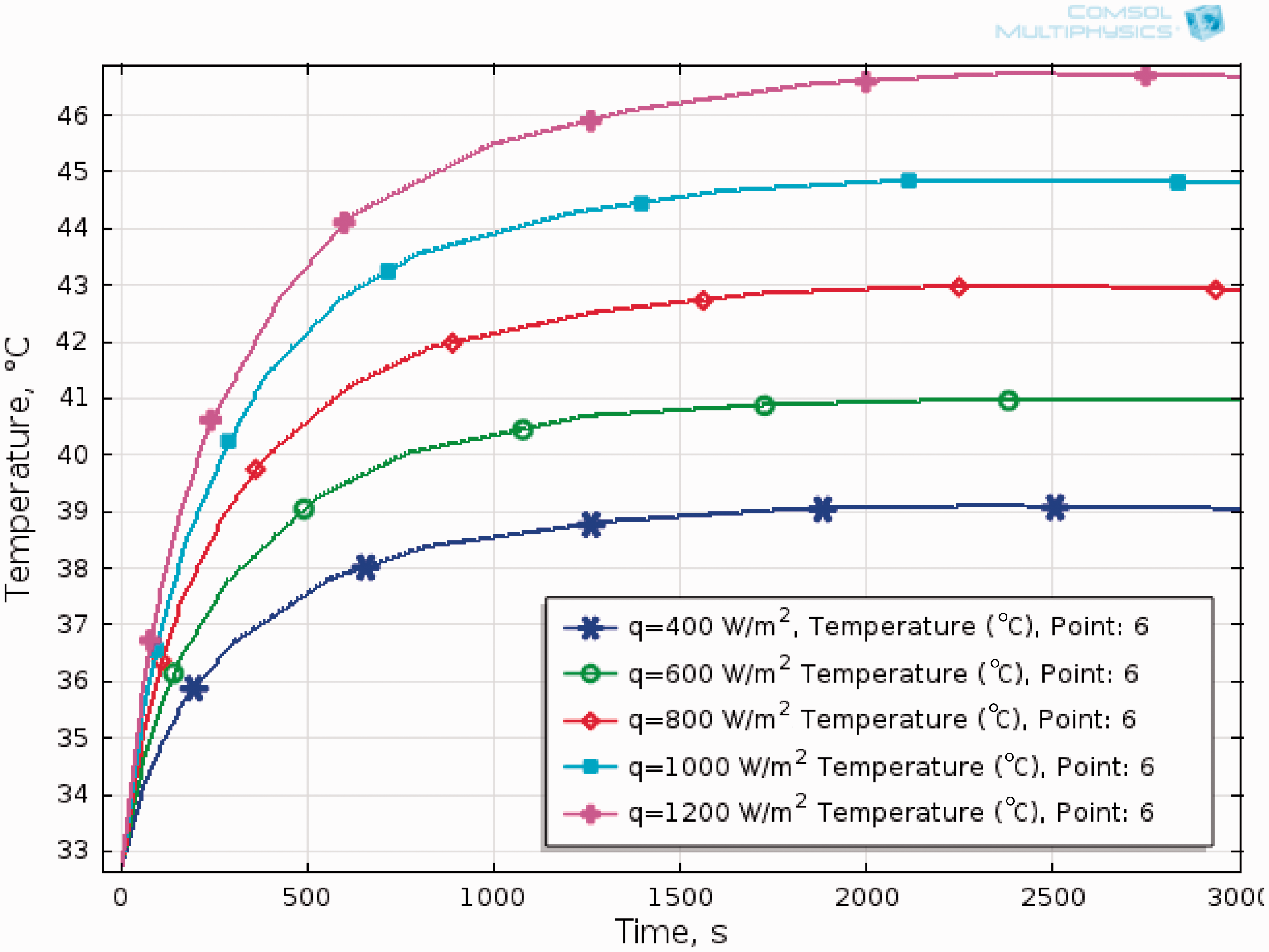
For a radiant heat flux of 1200 W/m2, the first-degree burn occurs after 32′20″, and the second-degree burn occurs after 38′10″ of exposure.
The thickness of the air gap between the garment and the body depends on the particular location on the human body. According to Song [7,27], the maximum air gaps occur for the leg (15–22 mm), and the minimum air gap occurs for the shoulders (1.6 mm).
Figure 6 shows the temperature of the basal layer versus time for the heat flux of 1200 W/m2 and air gap thickness between the garment and the skin from 1 to 6 mm.
Influence of the air gap width on the temperature of the basal layer for a three-layer system and 1200 W/m2 inward heat flux.
An increase by 5 mm of the air gap thickness causes a decrease of the basal layer temperature by 2.7℃. As air is a good insulator, increasing the size of the air gap will increase the degree of insulation and slow down heat transfer to the skin.
When the air gap between the fabric and the skin was increased to 3 mm for the heat flux of 1200 W/m2, the minimum exposure time for skin damage was doubled (65′40″ for the first-degree burn and 91′20″ for the second-degree burn) compared with the time obtained with 1-mm air gap.
The results obtained demonstrate that even for a low-level thermal radiant heat flux, a typical three-layer thermal protective clothing system is required to protect the wearer from skin burn injury. A remark should also be done: since the tests are carried out at room temperature (and for simulation, we also considered the ambient temperature of 20℃), the results do not necessarily correspond to the behavior of the materials at higher ambient temperature and therefore are only to a limited extent suitable for predicting the performance of the protective clothing made from the materials under test.
This model could be used as an aid in the design of candidate protective clothing systems, evaluating the performance of current protective clothing systems in various thermal environments. Also, the developed model can serve as a tool for study of potential issues related to the causes of fire fighter burn injuries. Thus, the model can be used to determine the effect of change of different parameters such as fabric thickness and density, thermal properties such as thermal conductivity and specific heat capacity, optical properties, and air gap width, or even environmental conditions such as radiant heat flux density and ambient temperature on the protective performance of clothing.
In addition to studying the physical characteristics of the fabrics utilized in protective clothing, the model can also be used to predict the performance of a thermal protective fabric system in terms of skin burn. In this respect, the minimum exposure time required to generate a second-degree burn can be predicted, using a three-layer skin model.
Conclusions
A numerical model of heat transfer in protective clothing during exposure to low-level radiant heat flux was investigated using the software Comsol Multiphysics®.
The goal of this study is to improve firefighter comfort through better understanding of heat transfer in the protective garments they wear. Both experimental and modeling approaches were used. The model results were compared to experimental case, typical of routine conditions with a commonly used three-layer protective clothing assembly. Model predictions of the temperature agreed very well with experimental temperature.
The numerical model incorporates separate layers of a composite fabric so as to evaluate the response of both the individual materials and the entire assembly.
The numerical model of heat transfer in protective clothing was coupled to the three-layer skin model to predict the performance of thermal protective system in terms of skin burn. The time to first and second-degree burn was estimated during exposure to low-level radiant heat flux. The influence of air gap width between the fabric and the skin was analyzed. Increasing the air gap width an extra insulation is provided, and the heat transfer to the skin is slow down.
At this stage, the model is restricted to dry fabrics but further developments should include moisture effects. Estimations of burn injury risk would then be more accurate.
Footnotes
Funding
The authors gratefully acknowledge the region Nord-Pas-de-Calais and the European Regional Development Fund for their financial support.