




Abstract
Textile products are considered as an acceptable alternative for commonly used composite reinforcement due to their lightweight as well as relatively high specific strength and stiffness. Among the variety of textile structures which could be employed in composite manufacturing, the role of weft-knitted fabrics is almost very limited. This is because employing the weft-knitting technology would provide such structures with inferior mechanical properties due to their highly looped construction as well as low fiber volume fraction. But on other hand, it is important to be noted that some advantages such as high energy absorption, good impact resistance, and formability of knitted structures made the researchers to focus on investigating different methods by which the inferior mechanical properties of ordinary weft-knitted fabrics could be improved. Inserting the reinforcing yarns through the warp and weft direction of the knitted fabrics is considered as one of the effective solution for improving their mechanical behavior which eventually leads to a high potential product called as biaxial weft-knitted fabrics. In this literature, it is aimed to review different aspects of novel designed biaxial weft-knitted fabrics which could be suitable for a broad area of technical application such as composite reinforcements.
Keywords
Introduction
Considering the composite applications, textiles due to their lightweight structures are more suitable to be used as composite reinforcements since they could provide required strength and stiffness properties for the resulted constructions. Employing textile products as composite reinforcements would obtain lower weight/strength ratio for the final composite materials compared with other commonly used reinforcements, such as steel. As it is widely accepted, reinforced textile composites usually possess such high drapability as well as good impact behavior and acceptable fatigue properties [1].
Textile composites in general are suitable for applications in which providing lightweight structures is of the main concern, since they could provide acceptable strength and stiffness properties. Growing advancements in numerous industrial constructions have attracted attention of engineers and designers toward the high-performance technical textiles which exhibit desirable mechanical behavior during their end uses. The proportion of using technical textiles in various fields of applications including transportation and automotive industries, building constructions, aerospace equipment, furniture, medical products, etc. has been increased spectacularly over a relatively short time. Using these stable structures as the composite reinforcements leads to provide more efficient and reliable constructions suitable for those applications in which different kinds of loads are expected to be sustained. Due to desirable mechanical properties of textile reinforcements, an increasing rate of 15% in the global market for textile reinforced composite materials is forecasted [1, 2].
Biaxial fabrics which could be considered as newly designed reinforcements for composite manufacturing, are generally comprised of reinforcing yarns which are in-laid into a 3D stitching yarn system and held tightly between the looped-form yarns of the fabric structure. Compared with the conventional metal design, biaxial fabrics as the composite reinforcements have numerous advantages such as fiber arrangement along the load directions, low thermal expansion, low manufacturing cost, high fracture toughness, easy recycling, various forming possibilities, as well as high resistance to the environmental conditions and corrosion. Due to relatively high mechanical performance of biaxial fabrics as a result of inserting the reinforcing yarns into the structure, the reinforced composite materials could be suitable for applications in which impact resistance is much considered, like as bulletproof performance in helmets. On the other hand, coated biaxial weft-knitted fabrics (BWKFs) have high potential to be used in a wide range of applications. As soft composites, they could be employed in such applications in which the tensile and tearing properties are of the main concerns especially in particular roofing membranes, air ship, inflatable boats, and rescue tents.
Among the various available fabricating methods (including weaving, nonwoven manufacturing, knitting, and braiding), knitting technology has allocated a significant contribution in biaxial fabric production, recently. From the first view, it might be considered that the knitted structures have inferior mechanical properties due to their highly looped construction as well as providing such low fiber volume fraction during the composite manufacturing [2]. But, more accurate investigations revealed that there are some unique properties such as high energy absorption, good impact resistance, structure formability even in complex shapes, and also the cost-effectiveness advantage, which make the knitted structures as an acceptable choice for technical applications [2].
One effective method for improving the mechanical behavior of the ordinary weft-knitted fabrics is reinforcement yarns integration into the structures both in warp and weft direction which eventually leads to biaxial warp and weft-knitted fabrics, respectively. Because of holding the warp and weft yarns by the stitching yarns system, the biaxial-knitted fabrics exhibit an extraordinarily high strength than the usual knitted structures [3, 4]. In the present paper, due to the simplicity of production process and higher functionality of the weft-knitted structures, detailed investigations have only been focused on the BWKFs which are completely described through the following sections.
Principles of knitting technology
Knitting is a flexible production method in which different fabrics of either simple or complex structures could be easily provided [5, 6]. Recent developments in knitting machinery would provide the possibility of making a wide range of high-performance knit-based configurations which are suitable for various technical applications [7].
The production flexibility of knitting technology is considered as the main reason affecting the advancement of using different knitted structures in technical applications [8]. Regardless of lacking suitable mechanical properties of an ordinary knitted fabric, the curved nature of looped yarns has its individual advantages. For a highly looped structure, significant amounts of deformation as a result of the applied load could be expected. This in turn provides the ability of forming 2D or 3D-shaped fabrics based on the weft-knitting technology. Good drapability of weft-knitting structures is responsible for providing the possibility of making cost-effective complex parts which could be suitable in composite manufacturing. [9]. According to De Haan et al. [10], the better notch strength of knitting structures also make them an acceptable choice for being used in manufacturing the perforated composites.
Composites reinforced by the conventional weft-knitted fabrics
The yarn-looped structure of a conventional knitted fabric results in obtaining some unique properties compared to other textile structures. Higher failure deformation as well as energy absorbency under different loadings make the knitted fabrics to be more competitive for composite manufacturing than other 3D textiles, especially when the energy absorb-ability is mainly considered as the main concern [11].
During tensile and impulsive loadings knitted-fabric constitutive loops are contributed to absorb the generated energy which is distributed through the whole fabric structure. According to Knapton [12], while applying the vertical forces, loops of a certain course would elongate in vertical position simultaneously and so the jamming phenomenon occurs in that position. Similarly, this matter is also resulted in horizontal direction while the forces are applied along the fabric’s wales. Due to the interlocking phenomenon caused between the constitutive loops, the knitted fabrics are considered to have remarkable work up to rupture resistance against both vertical and horizontal forces. He also claimed that double-jersey-knitted structures such as rib fabrics present better mechanical properties than the plain structures [12].
Mechanical behavior of a knitted structure is corresponded to its constitutive looped yarns affected by the jamming phenomenon through loading. In the jamming state, maximum tension would be sustained by each part of the knit elements which eventually leads to stitch deformation as well as the structural fracture [13]. There are lots of literatures in which the weft-knitted composites are investigated for their good impact resistance, stretch-ability, and compression behavior [11, 14–20]. Mechanical properties of knitted composites have been studied by Khondker et al. [21] in order to find the best solution for designing their structures which might be suitable for simulating their behaviors under real loading conditions. Despite the stretching ability of knitted structures, compression tension applied to the loop’s head during the jamming state causes the fibers' cross-section to be deformed which eventually results in structural fracture [14].
It is widely accepted that the knitted constructions due to their high formability/drapability could be used to form either simple or complex shapes for industrial and technical applications [22, 23]. Some researchers revealed that the knitted composites suffer from the lack of good mechanical performance compared with other conventional reinforced textile composites [24, 25]. Based on Leong et al. [7] and Semnani [14], the inferiority of knitted composite properties is contributed to the limited fibers stiffness and the reduction of yarn strength during the loop formation. Chou et al. [26] also believed that the fiber damages caused during the knitting process is an additional reason which could be participated in deterioration of the knitted fabrics mechanical properties.
Mechanical performance of the weft-knitted composites
Nonlinear mechanical behavior of weft-knitted fabrics
As it was previously stated, the limited use of weft-knitted fabrics as the composite reinforcements is due to their poor mechanical properties [27]. In general, the mechanical behaviors of weft-knitted fabrics not only follows the nonlinear models but also strongly affected by the fabric’s structural parameters, yarn parameters, and either the fabric direction [14, 27]. During tensile loading and stretching deformation, weft-knitted structures exhibit various behaviors before and after jamming phenomenon. Some researchers claimed that the isotropic mechanical properties of knitted fabrics reinforced composites are essentially due to differences of fibers orientation within the fabric structure [28–30]. They also described that the knit structure and its parameters (such as loop length and stitch density) have significant influences on mechanical behaviors of the knitted composites. In the case of fabrics made of carbon fibers, some researchers introduced different methods of carbon nanotube growing on carbon fibers in order to improve their mechanical performances in terms of tensile strength [31, 32].
Verpoest et al. [30] inferred that the strength and stiffness of knitted fabrics are relatively lower than that of the other textile structures (including woven, braided, and noncrimped materials) with equivalent fiber proportion. The main reason for this matter might be due to the limitation of fiber selection with low stiffness properties and good ability to form a loop [7].
The mechanical performance of knitted fabrics is strongly affected by the looped, curved architecture of the yarns. Structural complexity of the knitted fabrics with maximum strength generally results in similar performance in both wale and course directions but it should be noted that the properties of knitted preforms are greatly influenced by the fiber strength, modulus and type of yarn, knitting pattern, stitch density, number of knitted fabric plies, amount of pre-tension applied to the fed yarns, number of reinforcing in-laid yarns and knitting process parameters. Consequently, the mechanical performance of composite materials reinforced with knitted preforms mostly depends on the fabric properties. For this reason, having knowledge about tensile properties of the knitted fabrics is required in order to predict the corresponding properties of the knitted reinforced composites [33].
The nonlinear behavior of a knitted fabric under tensile loading could be divided into two-stage deformation process as typically illustrated in Figure 1 [27]. In the first stage of deformation, the increasing trend of load–extension curve up to a certain point (where the jamming state occurs) refers to the loop straightening phenomenon. Since determining the Young’s Modulus for a knitted structure is not possible due to its nonlinear behavior, the fabric stiffness in term of tensile rigidity can be calculated as follows in order to compare its mechanical behavior with the other textile structures
Typical load–extension behavior of a weft-knitted fabric under tensile loading [27].

De Araújo et al. [27] recognized the nonlinear behavior of a knitted structure under tensile loading as the main reason for its low stiffness and strength properties. By considering the load–extension curve precisely, they concluded that the knitting yarns are subjected to an excessively high extension under loading condition which makes the knitted fabrics to be inapplicable for composite manufacturing. In order to improve the mechanical behavior of conventional knitted structures, numerous researchers [5, 24, 34–39] proposed different suggestions which are explained as following.
Fiber damages during the loop formation
During the knitting process, yarns (and their constitutive fibers) are required to be bent over sharp radius and manicure sharp corners in order to form the knitted loop within the structure, so the fibers are subjected to different bending forces [40]. Since this loading condition must be sustained by the yarns, it would be preferable to use the more load-bearing fibers during the knitting process. Despite the suitability of these fibers for being used in production of engineering composites, their high elastic stiffness and dimensional stability are considered as negative aspects that eclipse the loop formation ability [41]. Thus, the fibers are inevitably exposed to significant damages while forming the knit (or tuck) stitches which eventually resulted in yarn strength reduction and structural weakness [42]. Some researchers believed that using a basic knitting pattern (plain knitted stature) or applying some modifications to the conventional knitting system would be effective in order to reduce fiber damages during the knitting process [26, 43–45].
Andersson et al. [46] stated that the fiber damages during knitting are not only due to the increased tension applied to the yarns but also might arise from the yarn abrasion with knitting elements. They suggested that the surface roughness and characteristics should be carefully considered in order to provide higher ability for the yarns during knitting. Employing high-performance yarns due to their high tenacity would result in applying better mechanical properties to the produced knitted fabrics, but considering some of their negative aspects such as lower surface strains, higher residual tension and low out-of-plane properties than the conventional yarns, made them unsuitable to be used in knitting process [41, 47]. Regarding the composite manufacturing, Chou and Wu [48] described the effect of fiber fraying on promoting the fiber bridging (as an essential matter considered in composite strength analysis) which has a significant role on improving the composite mechanical properties in terms of tensile strength and impact resistance.
Practical solutions for improving the mechanical behavior of knitted structures
Researchers pointed out various techniques in order to improve the mechanical behavior of weft-knitted structures to become suitable for composite manufacturing [49–52]. Pretensioning was proposed as a suitable strategy for eliminating the effects of loops deformation during the initial part of the load–extension behavior of knitted fabrics (the nonlinear behavior) on their mechanical performance [27]. De Araújo et al. [27] claimed that the pretensioning technique applied to the knitted fabrics before resin impregnation could significantly minimize the high extension behavior of knitted loops during tensile loading. According to their experiments, it was concluded that for a typical single jersey structure, a pretensioning of about 3750 N/m is able to reduce the fabric’s initial extension by 55%. Using this strategy, the stiffness and deformation resistance of the knitted structures would be improved [27, 52]. The results of De Araújo et al. [27] also reveal that the tensile strength, Young’s modulus, and the extension at break for the knitted structures are influenced mainly by the reinforcement pretension level and the testing direction. Similar to other researchers, they have also claimed that the weft-knitted composites comprised of float (not-knitted) yarns exhibit more desirable tensile performance.
Rudd et al. [24] pointed out to this fact that incorporating float yarns to a basic knitted structure would moderately improve its mechanical behavior. But the estimated values for the tensile properties revealed that the proposed suggestion could not significantly affect the stiffness and strength of the knitted fabrics because of the inevitable crimps formed along the constitutive yarns length during miss loops formation [7, 53]. Zănoagă and Tanasă [54] believed that the mechanical properties of the knitted fabrics could be controlled by their structure, yarn properties, and the process parameters. According to their findings, not only the application of miss loops in knitted fabric structure, but also varying the stitch density would dramatically affect the stiffness and tensile properties of the final product.
Shortly thereafter, inserting the straight uncrimped fibers into the fabric structure was proposed as anther effective way for improving tensile properties of knitted composites [34, 35]. These fibers could be involved into the knitted structure through either warp or weft direction. In this regard, Sarlin et al. [35] introduced a new type of knitted fabric which was reinforced unidirectionally by the help of at least two fiber types (primary fiber and secondary fiber), one to form the knitted structure and the other to act as the actual reinforcement.
Considering the combination of weaving and knitting technologies, some researchers proposed a new designed hybrid structure with improved mechanical behavior due to their constitutive straight fibers and yarns [6, 55]. Along with this suggestion, it was concluded that by inserting the reinforcement yarns into the knitted structure directly either in warp (wale-wise) or weft (course-wise) direction, the anisotropy characteristics of the resulted composite would become suitable for particular applications [7].
Involving the in-lay yarns into the conventional knitted fabrics can significantly increase their stiffness and strength against tensile loading [28, 56–58]. Also, incorporation of high-performance fibers and yarns as straight yarns in warp and weft directions of a knitted structure can effectively resolve the problem of fiber damaging during knitting process. There are lots of literatures in which the researchers focused on fabricating different kinds of reinforced knitted structures called as the warp-inserted weft-knitted fabrics, the warp-inserted warp-knitted fabrics, the weft-inserted weft-knitted fabrics, and the weft-inserted warp-knitted fabrics [54, 59–65]. Considering the end-use of knitted composites, the in-laid reinforcement yarns could be introduced to the structure in both warp and weft direction. Also, it is possible to insert the straight reinforcement yarns into the fabric construction through diagonal direction [66].
In this paper, it is aimed to study different aspects of the biaxial weft knitted fabrics (BWKFs) which have high potential to be used in numerous technical applications such as composite manufacturing. The following sections describe the characteristics of this kind of structure as the composite reinforcement and their mechanical behavior under tensile loading.
BWKFs
Since the use of conventional knitted fabrics in composite manufacturing would eventually provide materials with low fiber volume fraction, they could not be suited as the preforms of high-performance materials [1, 66]. Insertion of reinforcing yarns in warp and weft directions into the knitted structures would increase their mechanical properties in terms of strength and stiffness. Abounaim [33] categorized five different techniques for inserting the reinforcement yarns into the knitted structures in order to improve their mechanical behaviors under external loads. If the improved mechanical properties are only obtained in one direction, the structure is called “unidirectional” or “uniaxial” fabrics. Similarly, the fabrics which exhibit the same behavior in both wale and course directions are called “biaxial” fabrics. Accordingly, those knitted fabrics that behave the same in every directions are called “multiaxial” fabrics [67]. Among these various structures, BWKFs which were typically developed at the Institute of Textile and Clothing Technology at TU Dresden as well as Institute of Technology at RWTH Aachen University are also considered by numerous researchers due to their simple production process and the ability of forming complex-shaped structures.
A typical schematic of a basic biaxial weft-knitted structure is illustrated in Figure 2 [52, 68]. The yarns employed as the structural reinforcement are responsible for providing the composite stiffness and strength while the ground knitted structure allows the high drapability and formability as well as good impact resistance of the preforms [52]. According to the designed pattern, the introduced reinforcing yarns are locked by the ground-knitted loops in order to be fixed in their right positions. Figure 2(b) depicts the positions of weft and warp reinforcement yarns inserted into the knitted fabric structure.
Schematic view of a biaxial weft-knitted structure: (a) the constitutive components, and (b) the position of warp and weft reinforcing yarns [68].
BWKFs are mainly produced on modern flat knitting machines which have the ability for producing complex-shaped structures and possess individual technical features. Individual needle selection capability, presence of holding down sinkers, needle bed racking, loop transfer ability, adapted feeding devices combined with CAD system, and modern programming installations are considered as the flat knitting machines abilities which make them suitable for fabricating BWKFs. Furthermore, the flexibility of the knitting machinery in combination with their ability for integrating the reinforcement yarns into fabric structures have attracted lots of researchers' attention toward the production of engineered knitted fabrics [8, 33].
Yarn feeders in the knitting zone, could be employed as weft insertion elements during knitting. In order to inlay the straight reinforcement yarns into the ground-knitted structure in weft (course) direction, a certain yarn feeder is held by the carriage and pulled along the needle beds. Because of inactivating the knitting cam in this stage, the needles remain in their lowest position and don’t move upward to get the yarn. To be sure that the weft reinforcement yarns is inserted into the fabric structure accurately, it is suggested to adjust the yarn feeder as close as possible to the needle bed. According to Abounaim [33], for entrapping the reinforcement yarns by the ground-knitted structure, all needles of the front needle beds are participated to form knit loops while the rear needles form tuck stitches simultaneously using the same fed yarn. After the weft inlaying, tuck stitches from the rear needle bed are transferred to the front needles and eventually both weft and warp reinforcement yarns (as floating yarns) would be trapped into the structure. In some cases, introduction of the weft reinforcement yarns could also be carried out in both front and rear side of the integrated warp yarns which in turn would be resulted in different mechanical behavior for the structure.
Among different elements of the knitting zone participated in loop formation process, the machine carriage is known as the main operating system which introduces the knit pattern to the needles via its constitutive cam-box system [33]. Generally, the knitting machines might be equipped by either close-type or open-type carriages which are depicted in Figure 3. In order to produce BWKFs, a knitting machine equipped with open carriage (Figure 3(a)) is generally preferred in which the cam boxes of both rear and front needle beds are separated from each other and could be controlled individually. The space formed between both needle beds is sufficient for the warp yarns to be threaded in and involved into the knitted structure. In the case of flat-knitting machines equipped with close-type carriage, some modifications are required to make the warp yarns insertion possible. A new kind of yarn feeder which can be fixed on the machine guide rails must be designed for this condition (Figure 3(b)). In this case, the warp reinforcing yarns are threaded from both sides of the flat-knitting machine which eventually results in fabric width limitation. Since the knitting quality and ultimate mechanical behavior of the resulted biaxial-knitted structure are strongly affected by the yarn pretension, employing a yarn creel unit equipped with suitable tensioners would be essential for providing a constant tension to the yarns.
Carriage of the knitting machine: (a) open-type carriage, and (b) close-type carriage equipped with a modified warp yarns feeder [33].
Abounaim [33] stated that different arrangement of reinforcement yarns within the knitted structure is responsible for their different mechanical behavior during end-uses. He believed that integration of the reinforcement yarns as knit or tuck loops would result in the higher energy absorption under impact loading whereas by inserting the reinforcement yarns as the noncrimped in-lays, more extension resistance would be expected for the structure. Although such variations in mechanical behavior would eventually lead to variable breakage performance in composite applications, it was accepted that integration of weft and warp reinforcement yarns is the best solution for improving the mechanical behavior of conventional knitted fabrics.
Reinforced composites based on the BWKFs
Similar to any kind of textile reinforced composites, BWKFs could also be employed in combination with both thermoset and thermoplastic resins during the composite manufacturing. Selection of composite constitutive materials strongly depends on desired properties expected for the final product [69]. Generally, two widely used matrix materials for textile reinforced composites are thermoset and thermoplastic polymers. Since the thermoplastic composites show distinct advantages over the thermosets, researchers have much more focused on investigating the mechanical behavior of BWKFs reinforced thermoplastic composites [40, 55, 69–73]. This is the main reason that why the numbers of literatures focused on the properties of thermoset BWKFs reinforced composites are limited. In the following subsections, a brief description of both thermoset and thermoplastic weft-knitted composites and their mechanical properties are presented.
Thermoset biaxial weft-knitted composites
Thermoset composites are comprised of thermoset polymeric material as the matrix phase for which the curing reaction must be followed by additional heat and chemical reactivity with suitable organic peroxide additives. Prepreg which is known as the commonly used method for preparing the composite reinforcement contains only textile materials in forms of woven fabrics or unidirectional structures of high-performance yarns [33]. Another aspect regarding the thermoset resins is that they are initially in a liquid form; during combining with a catalyst, these liquid resins will change into a solid configuration via crosslinking formed between their molecular chains. From this aspect, it can simply be found out that thermoset polymeric materials are not recyclable. Also, thermoset composite manufacturing process due to its prolonged process cycle is not widely preferred [33, 69, 74].
Investigating the mechanical properties of thermoset composites reinforced with BWKFs has been focused by numerous researchers [25, 75, 76]. In the literatures presented by Qi, Liu, Li, and Geng [77–79], the bending properties of three-, four-, and five-layer biaxial weft-knitted composites impregnated with epoxy resin via resin transfer molding (RTM) method have been investigated. The results showed that increasing the number of weft-knitted fabrics layer could significantly increase the bending strength of resultant multilayered biaxial weft-knitted composites because of increasing the fiber volume fraction. They also concluded that these kinds of composite materials exhibit much better bending properties than the conventional reinforced composites. Additionally, an obvious linear behavior could be observed in their tensile stress–strain curves. Li and Bai [80] focused on the tensile properties of multilayered BWKFs impregnated with epoxy resin. They evaluated tensile modulus and Poisson’s ratio for their prepared samples using the classical lamination theory. Through their studies, they developed a prediction model to estimate the mechanical behavior of multilayered biaxial weft-knitted composites.
Through the research held by Haasemann et al. [81], the properties of BWKF reinforced composite were modeled and the results were compared to the experimental data. Thereafter, Böhm and Hufenbach [82] tried to develop a reliable model of failure behavior for multilayered weft-knitted glass/epoxy composites. For this aim, they proposed an experimental damage analysis strategy by the help of acoustic emission analysis and optical microscopy with the ability of recording the stiffness degradation. Demircan et al. [83] also reported tensile properties of biaxial weft-knitted thermoset composites. They concluded that three layers of biaxial weft-knitted aramid fabrics provide the highest tensile performance among other composite materials considered in their studies.
Thermoplastic biaxial weft-knitted composites
Nowadays, thermoplastic polymers find their application in composite productions much more than the thermosets which are due to their desirable properties and numerous advantages over thermoset resins. Recyclability, cost-effectiveness, high impact and damage resistance, simple consolidation process, and also the potential for rapid mass production are of the advantages considered for thermoplastic composites over the thermosets [33, 69, 71]. The possibility of using a wide range of textile structures as the reinforcement phase of the composite makes the thermoplastic resins to be more preferred in composite manufacturing. Applying high pressure and high temperature (above the melting point), in order to obtain a uniform structure and reduce the void content, is essential for thermoplastic composite production [33]. One negative point regarding the thermoplastic polymers is higher viscosity of their melts which could result in significant difficulties during the resin transfer molding [33]. Demircan et al. [71] proposed that using the commingled yarns would effectively overcome this problem. They claimed that commingled yarn technique could also be chosen to fabricate the BWKFs suitable for composite applications.
Contrary to the thermoset composite materials, research works have been mostly concentrated to the thermoplastics and their mechanical behavior during different loading conditions. Nasiri and Hasani [84] studied the mechanical behavior of PP/GF-knitted composite reinforced by course-wise in-laid glass yarns. They also investigated the effect of silica nano-particles on improving the mechanical behavior of unidirectional weft-knitted fabrics. As the commingled yarn technique is considered as a cost-effective method for making thermoplastic resins to be easily processed, some researchers applied this method for fabricating the biaxial weft-knitted preforms and then investigated the properties of the resulted structures [85–89]. Also, the mechanical and tensile properties of thermoplastic composites reinforced with commingled yarns have been taken under consideration [90–93].
More recently, Demircan et al. [3, 94] focused on investigating the mechanical behaviors of biaxial weft-knitted reinforced thermoplastic composites. In their studies, the mechanical behavior of multilayered biaxial weft-knitted structures impregnated with thermoplastic resins was investigated under different loading conditions (such as tensile, three-point bending, and bending impact). They also studied the effects of structural parameters (knitting techniques, stitch yarns, loop length) on the mechanical performance of biaxial-knitted composites in terms of tensile and bending properties.
Experimentally, Demircan et al. [71] investigated the mechanical performance of biaxial weft-knitted thermoplastic composites by changing the types of yarns used for ground loops formation. It was concluded that the types of yarns strongly affect the fiber volume fractions of composite samples which in turn would change their tensile behaviors. They also denoted that differences between the inherent tensile behaviors of each yarn types would eventually affect the mechanical performance of the whole composite structure. In other literature, Demircan et al. [95] also investigated the effects of reinforcing yarn types (both as warp and weft inlays) on mechanical performance of biaxial weft-knitted thermoplastic composites. They also concluded that similar to the stitch yarns, the types of reinforcing yarn both in warp and weft direction, significantly affect the mechanical performance of composite structures.
The effects of some structural parameters regarding biaxial weft-knitted composites (including the knitting technique and loop length) on their mechanical behavior have been studied in terms of tensile and bending properties [2, 68]. For investigating the effects of various knitting techniques, Demircan et al. produced different types of BWKFs varied in their structural geometry, using glass/polypropylene commingled yarns [68]. They found out that the stress–strain behavior of weft-knitted reinforced composites is significantly affected by the stitch types corresponded to knitting pattern. It was also demonstrated that the loop length has a significant effect on composite tensile strength and stiffness. This might be due to increasing the fibers volume fraction as the loop length increases. Similar results were also achieved for bending and impact properties of biaxial weft-knitted reinforced thermoplastic composites [94, 95].
Demircan et al. developed their investigations regarding the biaxial weft-knitted reinforced thermoplastic composites and focused on differences between these structures and the cross-ply composites in term of their mechanical performance under tensile and bending loads [96, 97]. They compared the mechanical performance of a single-layer biaxial weft-knitted reinforced composite with four different cross-ply composite samples which were varied in the numbers of reinforcing layers. The results revealed that the tensile strength and stiffness of cross-ply composites are much higher than that of the biaxial weft-knitted samples, both in warp and weft directions. The possible reason for this effect could also be justified by the highest fibers volume fraction of cross-ply composites than other samples. Similar results were also achieved for bending behavior of composite samples, although there were no significant differences between the structures in terms of bending strength and stiffness [96].
In the case of multilayered textile reinforced composites, considering the interlaminar shear strength is of the main concern; since, applying tensile and bending loads would be contributed by forming the shear forces between the constitutive components of the resultant composite material [95, 96]. It is claimed that the method of shear test could have a significant effect on determining the shear strength of multilayered composites. For better understanding, Li et al. [98] examined two different shear test methods including three-point bend of short beam and double-notched compression. Their findings revealed that interlaminar shear strength of carbon fiber reinforced carbon composites (CC composites) determined by the former method is larger than the other one. Since the basis of microfracture process and mechanism of shear failure are the same for both test methods, they suggested to employ three-point bending test for investigating the shear strength of any reinforced composite materials [98].
Biaxial weft-knitted composites reinforced by natural fibers
Lots of interests toward using the natural fibers (with lots of desirable characteristics such as cost-effectiveness and biodegradability) instead of synthetic fibers as the composite reinforcements are increasing [99]. However, the number of literatures regarding the biaxial weft-knitted composites reinforced by the natural fibers is very limited.
Among different natural fibers, the flax fibers are considered to be the best alternative option for the commonly used synthetic fibers (such as the glass fibers) [100]. One negative aspect regarding the natural composite materials refers to the short-length nature of fibers which is responsible for the low mechanical properties of the structure [101]. Also, the hydrophilicity of natural fibers makes numerous difficulties regarding the low compatibility with the hydrophobic polymeric resins [102]. In order to overcome these problems, some chemical treatments are required to enhance the interfacial bonding strength between the fibers and matrices [103]. Among the various treatment methods available for the natural fibers, the alkali treatment is mostly used due to its low cost, ease of use, and efficiency [104, 105].
Xue and Hu [103] used the low-cost flax continuous yarns in the form of noncrimp fabrics as the reinforcements of biaxial weft-knitted structures. Through their investigations, they examined the effect of alkali treatment on tensile and flexural properties of biaxial weft-knitted flax/polypropylene composites. It was concluded that during the composite manufacturing process by the natural fibers, the chemical treatment has an important role on changing the composites mechanical performance. Through another investigation, the mechanical properties of BWKFs reinforced bamboo/PLA composites were studied [106]. Considering the characteristics of composite’s reinforcement and matrix phases, methods of pretreatment preparation technology, and the biodegradable nature of bamboo fibers, Zhao et al. were able to achieve such a natural composite sample with excellent tensile and flexural performance [106].
Modeling the mechanical properties of BWKFs
In the case of composite materials reinforced by knitted fabrics, the mechanical performance of the final composite product is strongly affected by the fabric properties. So, before mentioning the previous investigations applied on the BWKFs reinforced thermoplastic composites, it is essential to get a through understanding about tensile behavior of these knitted structures [33].
The biaxial reinforced-knitted fabrics and the multilayered fabrics, in particular, are considered as the most effective knitted structures used for improving the mechanical behavior of final composite products both in wale and course directions. For better understanding about weft knitted fabrics mechanical performance under tensile loading as well as investigating their tensile properties, development of a simple model based on the structural unit cell is preferred [107–110]. Since the multilayered-knitted fabric is generally comprised of knit loops (formed by the finer yarns) and reinforcement yarns (of coarser and stronger yarns), some further modifications must be applied to the proposed models in order to do more accurate theoretical calculation of fabrics tensile strength [111]. For this reason, a multilayered biaxial weft-knitted structure must be divided into its constitutive components as depicted in Figure 4. It is clear that the tensile strength of the whole structure could be achieved by combination of tensile properties of each substructure element according to equations (2) and (3)
Simple model of substructure for a multilayered biaxial weft-knitted fabric: (a) biaxial weft-knitted structure, (b) plain weft-knitted fabric, (c) reinforcing yarns system, (d) the layer of weft reinforcing yarns, and (e) the layer of warp reinforcing yarns [33].


Prior to the composite manufacturing process, developing the analytical and numerical simulated models of composite structures corresponding to their mechanical performance under different loading conditions is considered as a key factor to achieve a desirable composite product [66]. Various researchers focused on modeling and simulating the mechanical performance of textile reinforced composites [112–117]. Among different textile structures, modeling the mechanical behavior of the reinforcements with weft-knitted structures has been widely involved in numerous literatures [9, 118–122], while the reports regarding the simulation of biaxial weft-knitted composites are almost limited.
Besides the experimental investigations, Demircan et al. developed a theoretical model in order to investigate the mechanical performance of biaxial weft-knitted composites [3, 123]. In general, textile fabrics with periodic structures are difficult to be investigated in terms of elastic properties of a unit cell. In order to simplify the investigation of textile structures, lots of methods including the analytical method (used for meso-mechanical parameters) and numerical method (mostly known as the finite element method) are available. The good agreement between the experimental and analytical results of the composites tensile and bending properties found by Demircan et al. is considered as the high ability of finite element method for simulating the mechanical behavior of biaxial weft-knitted composites [123].
Similarly, Haasemann et al. [124] focused on analyzing the mechanical properties of biaxial weft-knitted glass/epoxy composites using theoretical models. They believed that the in-plane stiffness and delamination resistance of BWKF reinforced composites is due to the presence of reinforcement yarns and the nature of looped structure, respectively. For computing the effective elastic material properties and mechanical performance, they suggested the asymptotic homogenization procedure based on the displacement method and finite element model. Because of difficulties faced during the generation of a 3D model for the unit cell of BWKFs, Haasemann et al. used a binary model to simplify their interior structural geometry [82, 113, 124]. Through other investigations, they have presented detailed description about the homogenization method employed for investigating the viscoelastic and viscoplastic composites parameters [125–128].
Finding the damage mechanism of composite materials as well as achieving real failure criteria for BWKF reinforced structures are considered to be essential aspects for composite designing and manufacturing. For determining damage mechanism and degradation behavior of textile reinforced composites, various models based mostly either on the principles of continuum damage mechanics or on the physically based failure criteria are available [1, 66, 126]. Due to the geometrical complexity of biaxial weft-knitted composites, conventional failure analysis would not be applicable. For this aim, models based on the continuum damage mechanics followed by some assumption which is presented by Matzenmiller et al. would be effective [66, 128].
Nowadays, the number of research works focused on investigating the failure mechanism and damage behavior of biaxial weft-knitted reinforced composites is limited. Hufenbach et al. [66] studied damage behavior of these textile reinforced composites based on experimental measurements. Failure modes of the glass/epoxy laminates and the resulted degradation of their mechanical performance were investigated by carrying out tensile tests in which the acoustic emission technique was employed. This proposed phenomenological method can detect damages and crack distribution by the effect of structural changes on mechanical performance, since a direct measurement of textile composite damages is not possible. A good agreement between the obtained results of the theoretical damage models and the experimental data showed the applicability of the proposed micromechanical models for designing the highly loaded structures from textile reinforced composites. Thereafter, a novel damage model for textile reinforced composites was presented by Böhm et al. [129] in which the biaxial reinforced weft-knitted glass-epoxy composites were concerned. They employed similar concepts of the failure criteria to describe the quasi-brittle fracture behavior of their samples. In this study, the failure modes in combination with a continuum damage mechanics model were adopted to investigate the nonlinear stiffness degradation of the composites.
Complex structures of biaxial-knitted fabrics used as composite reinforcements
Multilayer-connected biaxial weft-knitted (MBWK) composites
Recently, a particular importance has been assigned to the MBWK fabric as composite reinforcement, due to their excellent mechanical properties and good features [81, 130]. This fabric which is widely known as a competitive sample to other commonly used structures, is generally comprised of straight high-performance yarns (as the warp and weft inlays) and the flexible stitch yarns (as the connecting elements between the reinforcement yarns system) [81, 131]. The specific geometrical structure of MBWK fabrics provides them good in-plane and out-of-plane mechanical properties for composite application such as excellent shear deformation, good tensile properties (strength and stiffness), relatively high bending, and impact resistance [132, 133].
Multilayer flat-knitting technique is suitable for simple inserting the reinforcement straight yarns into the ground-knitted structures [55]. Cherif et al. [72] stated that flat-knitting technique allows integrating up to 11 biaxial reinforcement yarn layers into the knitted structure while in the case of multiaxial integration, only up to five reinforcement yarns could be kept between the stitches. Figure 5 schematically shows different multilayer biaxial and multiaxial weft-knitted structures.
Multilayer biaxial and multiaxial weft-knitted fabrics [72].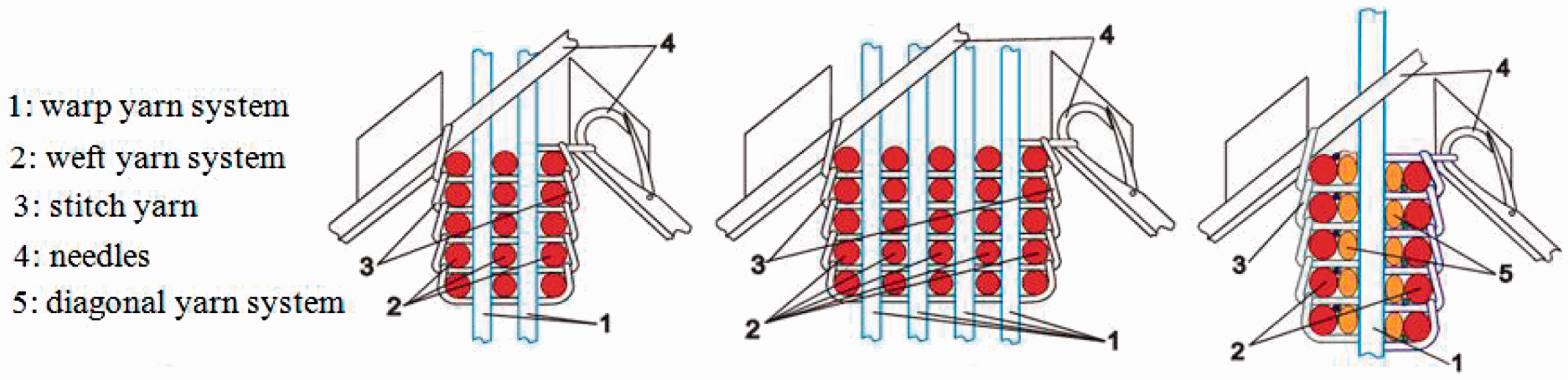
Numerous researchers focused on investigating the mechanical behavior of MBWK fabrics reinforced composites under different loading conditions including the tensile, compression, bending, and impact loads [78, 81, 134–136]. As an example, Qi et al. [131] investigated the mechanical behavior of carbon/epoxy composite samples reinforced with different multilayer-knitted structures varied in the number of connected layers as shown in Figure 6. They concluded that increasing the number of connected layers of MBWK fabrics leads to increase the fibers volume fraction of composite samples which could significantly affect their mechanical behaviors and tensile properties. It was also concluded that the stress–strain behavior of the MBWK fabrics reinforced composites shows a basic linear trend until the final structural rupture [138, 139]. The bending analysis of MBWK fabrics reinforced composites carried out by Qi et al. [140] also leads to the similar results.
Multilayer-connected biaxial weft-knitted fabrics: (a) three layer connected, (b) four layer connected, and (c) five layer connected [137].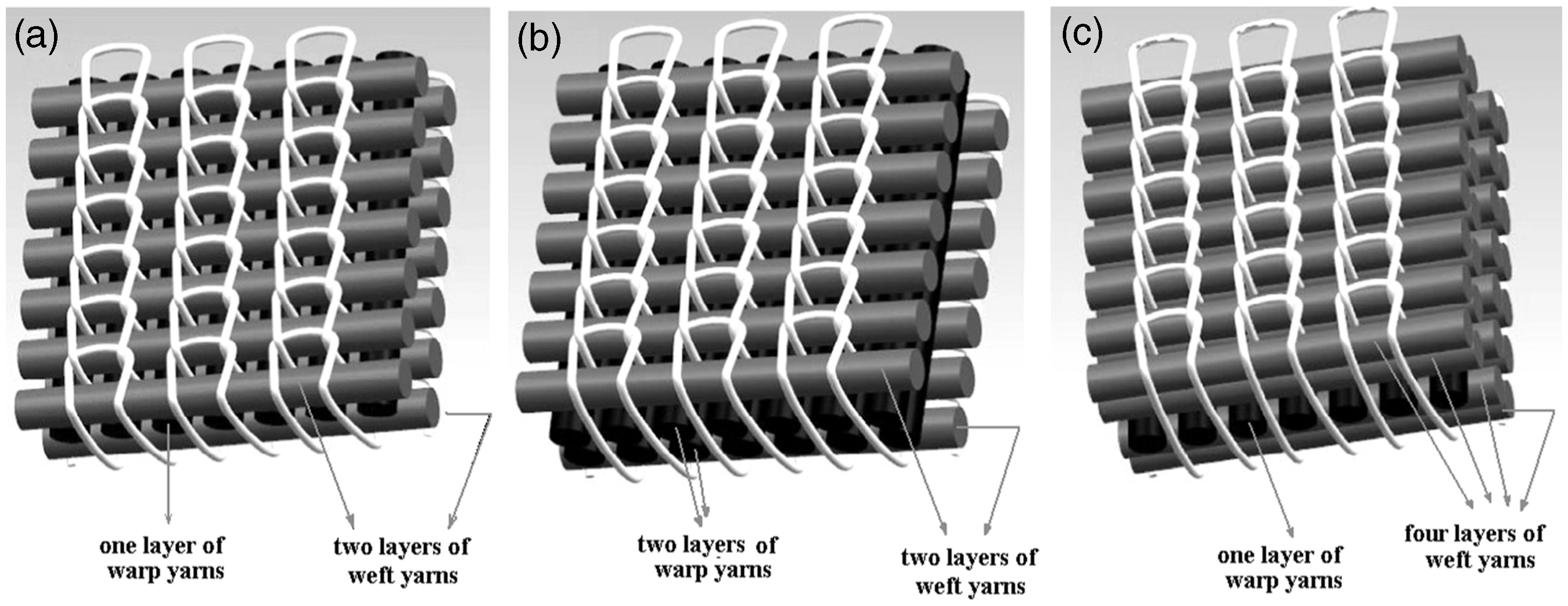
During molding process, the use of MBWK fabric as the composite reinforcement would cause different problems among which the low fitness to the highly curved corners of the mold is considered as the most important one. This might be due to the presence of not enough space for distorted fiber bundles within the structure. Also, the reorientation and redistribution of the composite constitutive fibers during the molding is not clear and controllable [141]. These two aspects would eventually affect the mechanical performance of MBWK fabric reinforced composites. In order to investigate the mechanical performance of MBWK fabrics reinforced composites, some theoretical models have also been developed by some researchers. Haasemann et al. [124] presented a new efficient modeling strategy based on combination of binary and finite element methods in order to simplify the internal architecture of MBWK fabrics with complex geometries. The proposed model by Haasemann et al. [124] is depicted in Figure 7(a). Similarly, Li and Bai [80] proposed their theoretical model for multilayer BWKFs according to Figure 7(b) in order to estimate their mechanical behaviors under tensile loading. According to proposed geometrical modeling, Li and Bai [80] investigated the forming ability of multilayered BWKFs on hemispherical surface. They established an element model based on fiber bundle which is composed of microscopic geometrical and numerical submodels in order to obtain the fabric architecture and its structural deformation mechanism. Comparing the theoretical and experimental results also revealed the suitability of MBWK fabrics to be used in composite manufacturing.

Co-woven-knitted (CWK) biaxial fabrics
Combining both weaving and knitting techniques, a novel structure called as CWK fabric would be achieved in which the inserted warp and weft yarns are involved within the fabric construction in an interwoven way [142, 143]. For this aim, an improved fabrication method and a modified flat-knitting machine is required [144–147]. Since the CWK fabrics are comprised of woven and knitted structures, they are expected to show the combined characteristics of both structures during any loading conditions [143]. In the case of CWK fabrics, their tensile properties (tensile stiffness and strength) and mechanical performance are mostly affected by the reinforcement yarns formed into the woven structure; while the stitching yarns participated in loop formation are responsible for fabrics formability and its morphological characteristics.
Recently, Zhu et al. [148] presented a new design of CWK structures with unique appearance which were produced on a modified flat-knitting machine combined with a weaving loom, as schematically shown in Figure 8. In this modified system, the needles (which are fed with stitch yarns) are placed as parallel as the bottom layer of warp yarns which are threaded into the waving loom elements in such position that their hooks are nearly closed to the fabric fell [148]. During the weaving, the needles must be remained in their initial position (Figure 8(a)), while in knitting operation, the needles are pushed by the cams in order to catch the stitch yarns which are fed between the formed shed (Figure 8(b)). In CWK fabric, the knitted structure appeared on its technical face while the woven structure could be observed on its technical back. Zhu et al. concluded that the thickness of CWK fabrics is higher than that of the woven or knitted constitutive structures individually, but less than them together (woven side-knitted side fabrics). Recently, Xu et al. compared the mechanical properties of CWK fabrics with the MBWKs under tensile and bending loads [142, 143]. They depicted the structural differences of the two kinds of fabrics according to Figure 9.
The modified system for producing CWK fabrics: (a) position of needles during the weaving stage, and (b) position of needles during the knitting stage [148]. Co-woven and multilayer biaxial weft-knitted fabrics: (a) structural geometry of CWK fabric, (b) CWK fabric, (c) structural geometry of MBWK fabric, (d) MBWK fabric [142].

The results of stress–strain behavior and failure mode revealed that the tensile strength and stiffness of both CWK and MBWK fabrics reinforced composites are significantly higher in course and wale directions when compared with the bias direction. It was also observed that all the composite samples exhibit a brittle damage mode during the fracture phenomenon. The results obtained from the bending stress–displacement curves shows an initial linear behavior for both reinforced composites. CWK fabric reinforced composites show a plastic failure mode while the MBWK fabric reinforced composites exhibit a fragile failure first and then behave like as the CWK structures [142, 143]. A photographical investigation regarding tension and tear behaviors of CWK fabrics was also carried out by Ma et al. [149].
Investigating damage mechanism of the CWK fabric reinforcement composites is also essential when they are decided to be employed as composite reinforcements. According to the observations reported by Zhu et al. [148], the yarns participated in forming the constitutive woven structure of a CWK fabric, cased to be break prior to the constitutive yarns failure of the knitted structure. Ma et al. [150] examined impact and tensile behaviors of the CWK composites by considering the Hilbert–Huang transform method. They found a frequency distribution for different tension failure modes of their samples by the help of stress–time curves. In order to be more precise, they combined all of their observed results regarding the damaged samples with the theoretical data obtained from their analysis. Through another investigation, they presented the Laplace transform and Z-transform theories [151] in order to analyze tensile stress–strain curves of CWK fabric reinforced composites. They stated that a digital signal processing method is also effective for investigating the mechanical behavior of knitted composite materials.
Based on the experimental investigations, Xu et al. [152] presented a unit cell geometrical model and a representative volume element for CWK fabrics as the composite reinforcements. They established a theoretical model for describing the relationships between the fabrics structural parameters and the process variables. The verification results of the proposed geometrical model by the help of experimental data revealed such high applicability of the model for simulating the mechanical behavior of CWK fabric reinforced composites before starting the manufacturing process. A finite element analysis was recently carried out by Ma et al. [153] for investigating tensile impact behavior of CWK fabric reinforced composites. Using the ABAQUS simulation environment, they established a unit cell model and calculated the tensile failure of the whole composite structure. The comparison made between theoretical results and experimental data proved the high capability of the finite element model for simulating the structural failure mechanism.
3D biaxial spacer weft-knitted composites
Beside of improving the fabrics strength by inserting the biaxial reinforcement yarns into their structures, using the spacer fabrics could also be considered as another effective method for improving the interlaminar strength of resultant composite materials due to the presence of reinforcement yarns along the fabric thickness [154]. The conventional structure of spacer fabrics is comprised of two individual surface layers joined together by connecting pile yarns which are formed along the fabric thickness [154, 155]. Composite structures reinforced by the spacer fabrics would have higher delamination resistance and fracture toughness under any kind of impulsive loading. If the biaxial yarns (in weft, warp, or bias directions) are inserted into the spacer fabrics' surface layers, both the in-plane mechanical performance and the interlaminar fracture resistance of the final composite material would be enhanced. These structures with their novel geometry are called as 3D biaxial spacer weft-knitted composites which are widely taken into account by numerous researchers [4, 154–162]. Construction of 3D biaxial weft-knitted spacer fabrics is typically shown in Figure 10.
Schematic drawings of biaxial weft-knitted spacer fabrics: (a) front view, and (b) side view [155].
High interlaminar shear strength of the spacer weft-knitted fabrics is mainly due to the interlaced two knitted layers which are connected by the paralleled interlacing yarns. Because of the yarn curvature within the fabric structure, tensile stiffness and strength of the spacer fabrics are relatively lower than those of woven samples [154]. Since the spacer weft-knitted fabrics are more considered due to their energy absorption capability, most of the researchers focused on improving their inferior mechanical performance under compression and impact loading, in order to make them suitable for being considered as a good alternative in composite manufacturing. Sun and Gu [158] investigated the effect of inserting biaxial reinforcement yarns into the surface layers of spacer fabrics in order to improve the shear behavior of 3D biaxial spacer weft-knitted fabric reinforced E-glass/vinyl-ester composites. The experimental results revealed that the shear stiffness as well as the failure stress and strain parameters could be highly improved as a results of reinforcement yarns, but they are severely affected by the strain rate during the test. It was also concluded that the biaxial weft-knitted spacer composites have high potential to be used as composite reinforcements with higher in-plane tension stiffness and strength. Similarly, Gowtham et al. [157] observed that the in-plane shear strength of composite structures reinforced with biaxial spacer-knitted fabrics would be increased at higher strain rate under compression and tensile loadings.
Regarding the impact properties of spacer biaxial weft-knitted composites, Liu [159] stated that increasing the strain rate would result in different out-of-plane and in-plane behaviors of the materials. They observed that the main failure mode at out-of-plane compression is the interlaminar shear failure while in the case of in-plane failure, delamination is predominant. Zhang [160] simulated the load–displacement curves, energy displacement curves, and damage modes of 3D biaxial spacer weft-knitted composites using the finite element method. They developed a unit cell model for fabric structure in order to simplify their investigations. The maximum stress failure theory as well as the critical damage area failure theory was utilized to control the yarn failure under impact. Sun et al. [154] and Lv et al. [155] developed different unit cell models of the 3D-knitted fabric reinforced composite in order to study their impact properties. They characterized the materials behavior using the elastic–plastic relationships between the constitutive component of the resultant composite structures.
Fully fashioned BWKFs
In the case of 3D-shaped weft -knitted preforms, strengthening of the structure via inserting the biaxial reinforcement yarns in various directions is more complex due to their geometrical and process characteristics. During thermoplastic composites manufacturing using fully-fashioned BWKFs, it is appropriate to use the thermo-molding method is appropriate to be employed instead of other commonly used molding methods. Because of BWKFs structural rigidity, some limitation would be faced during the composite manufacturing using 3D-sahped molds; so that efforts have been carried out to produce a 3D form of BWKFs on flat-knitting machine, directly [52] In order to produce near-net shape performs, the flat-knitting machine should be equipped with individual needle selection mechanism in association with stitch holding down sinkers. The selection of spatial geometry form for the knitted fabrics is based on their end-uses. Spatial fashioned knitting process would be done according to the knitting zones which are justified by participating either all working needles or partly selected needles for knitting (Figure 11) [38]. This method is called as needle parking method. For reinforcing these kinds of fully fashioned preforms, the required warp and weft yarns can also be incorporated during the knitting of planar design of the preform. Haller et al. [4] stated that fully fashioned BWKFs have high potential to be used as reinforcement in wood construction.
A disk preform with biaxial reinforcement in spatial and planar forms [38].
Comparing the mechanical behavior of different kinds of axial weft-knitted fabrics
Nowadays, the weft-knitted fabrics due to their individual looped structure as well as their good flexibility have gotten such high potential applications in different technical fields including the composite manufacturing, particularly. As previously stated, numerous researchers focused on different methods in order to improve the mechanical behavior of generally structured weft-knitted fabrics among which, inserting the reinforcement yarns through the weft or warp directions of the fabrics structure could be more effective.
According to the results obtained by Semnani [14] regarding the mechanical properties of some commonly used weft-knitted fabrics, it could be found out that the rib-structured fabrics have superior tenacity compared to other structures which are mostly comprised of miss and tuck loops. Based on this result, all other researchers did their investigations on reinforced axial weft-knitted fabrics with the rib structure. BWKFs considered as one of the best choice for reinforcing the composite materials have been analytically studied in various literatures. Not only inserting the reinforcement yarns into the knitted fabric structure could be effective for improving their mechanical performances [3] but also, preparing the MBWK fabrics as the composite reinforcements would provide such excellent tensile properties [131]. According to the results reported by Qi et al. [131] increasing the number of connected layers which is responsible for increasing the composite’s fibers volume fraction would significantly improve the mechanical behaviors of the final products. Figure 12 typically shows the variation trend of three different MBWK fabrics with three different levels of fibers volume fraction. It is obvious that increasing the number of layers can somehow improve the tensile strength of multilayer BWKFs.
Tensile strength variation of multilayered-connected biaxial weft-knitted fabrics [131].
CWK fabrics which are classified in biaxial fabrics group possess the mechanical properties of both woven and knitted structures. Compared with the traditional biaxial-knitted fabrics, the outstanding difference is that the constitutive warp and weft yarns are weaved together in the case of CWK fabrics. It is claimed that the mechanical behavior of these fabrics is between the behaviors of woven and knitted structures, individually. Comparing the results of different studies illustrate that CWK fabrics have higher initial modulus and strength than the ordinary knitted fabrics. Some reported results show that the axial performance of CWK fabric reinforced composites is basically similar to that of the MBWK fabrics.
It is noted that the buckling of warp and weft yarns in CWK fabrics plays an important role in their remarkable tensile strength. Moreover, the effect of yarns interweaving in the case of CWK fabrics could be responsible for their high delamination resistance in comparison with ordinary BWKFs or the multilayered-connected fabrics [163]
Conclusions
Although knitted composites are generally superior in terms of energy absorption, fatigue life, fracture toughness, formability, and low resistance to deformation, their in-plane strength and stiffness are inferior to composite materials reinforced by other textile structures. Various techniques such as pretensioning, using tuck and float stitches within the knit structure and introducing the reinforcement yarns in the warp, weft, and diagonal directions have been proposed to resolve this problem. Among the proposed techniques, incorporating the straight yarns in warp and weft directions of weft-knitted structures (called as BWKF) was subjected in this paper as an effective way to improve the mechanical behavior of these fabrics. BWKF can simply be produced on modern flat-knitting machines. These structures could be used widely in composite manufacturing as the reinforcements. Based on used matrix and material type, thermoset or thermoplastics composites can be produced. Most of the investigations have been focused on employing the BWKF as the reinforcement of thermoplastic composites than the thermosets. The findings revealed that different variables including the knitting technique, stitch length, and type of yarns used as stitch yarns or reinforcement in-lays can significantly affect the mechanical properties of the final products. Also, the mechanical properties of thermoset composites reinforced by BWKF have been modeled and investigated. Some limited attempts were also carried out to produced biaxial weft knitted reinforced composites using different natural fibers such as jute, flax and hemp. Improving the strength and stiffness of BWKFs compared with conventional weft-knitted fabrics illustrated their high potential for being used in numerous technical applications. Due to their structural features, BWKFs represent low deformation during molding process. Some successful efforts have been carried out to produce a 3D form of BWKFs on flat-knitting machine using needle parking technique. This ability makes the three-dimensional BWKFs an ideal preform for composite manufacturing.
Footnotes
Declaration of Conflicting Interests
The author(s) declared no potential conflicts of interest with respect to the research, authorship, and/or publication of this article.
Funding
The author(s) received no financial support for the research, authorship, and/or publication of this article.