




Abstract
The carbon weft-knitted biaxial fabrics stitched by polyester fibers and preoxidized polyacrylonitrile fibers were prepared respectively. Tensile and tearing tests of two types of carbon biaxial weft-knitted fabrics stitched by different fibers were carried out. Stress–strain and load–displacement curves were obtained according to the testing data. The high-speed camera was employed to observe the whole testing process and series of still images were picked up according to the time nodes to analyze the meso-scale mechanism of the extension and displacement of tows on oriented layers and stitching yarns. The properties of the two fabrics were compared based on the research of the stitching yarns mechanical performance. The researching results indicated that preoxidized polyacrylonitrile fiber exhibit higher mechanical behaviors, and its fabric bond displays excellent performance.
Keywords
Introduction
Carbon biaxial weft-knitted (CBWK) fabric is a novel and excellent oriented material with wonderful forming capability, drapability, elasticity, and energy absorption capacity. This kind of fabric is normally manufactured in the modified flat knitting machine, which have the opened head. It is constituted by laying yarn system and stitching yarn system. The laying carbon tows are arranged in a non-crimped manner and align along the orientation of 0°and 90° to form vertical yarn placements. Thus, carbon yarn capacity can be developed much higher than woven fabrics. Besides, the mechanical properties of the fabric along the two orientations of 0°and 90° can be fully expressed. The number of carbon placements can reach 2–5 to achieve the multilaminate fabric. Nowadays, CBWK fabric is becoming popular in textile and material fields.
All the layers in CBWK are stitched by weft loops from the thickness direction so that the layered fracture can be avoided effectively. However, since the special structure of weft knitting is unconsolidation, especially the 1 + 1 rib tissue, the loops do not have enough restriction to the carbon tows. Therefore, the tows can make slight displacement in the loops. That is why CBWK fabric has excellent elasticity and forming capability. Stitching yarns play a significant role in keeping the integrity of CBWK. The most commonly used traditional stitching yarns are always made from polyester yarns. Polyester yarns have excellent knitting property and are inexpensive. In this paper, the authors introduce a novel type of stitching yarn, i.e. preoxidized polyacrylonitrile (PAN) yarn. Preoxidized PAN yarn is the intermediate product during the manufacturing of carbon fiber, in which the PAN fibers are heated from 200°C to 400°C under air atmosphere. As a result, the heat-resistant and fire-resistant preoxidized PAN fibers are obtained. Though these fibers are similar to carbon fibers in appearance and the mechanical properties are more closely related to carbon fibers compared to other kinds of fibers, they are not as fragile as carbon fibers and are easy to be knitted and looped. Therefore, preoxidized PAN fibers are suitable materials for the stitching yarns, especially in stitching the heat-resistant oriented fabrics.
BWK fabric has aroused the attention of some scholars. The group of Abounaim and Cherif [1,2] transformed the flat knitting machine to produce flat-knitted three-dimensional spacer fabric with multilayer. They focused on the process development of the fabric and the preparation technology of thermoplastic composites. They researched the tensile, flexural and impact properties [3,4] and the lightweight [5] applications of flat-knitted three-dimensional spacer BWK fabric reinforced composites. Abundant of data analysis was involved in their work. The performance and the application of the perform were studies and all of these work set the stage for further research.
There are several papers focusing on the tensile and tearing properties of fabrics. Tessitore and Riccio [6] built a finite element model for biaxial non-crimp fabric composite materials under tension. In their study, the influence of the bundle waviness on the tension stiffness and the presence of the stitching yarns had been investigated. Luo et al. [7] investigated the tensile and tearing properties of PVC-coated biaxial warp-knitted fabrics under biaxial loads. The obtained load–extension curves were discussed and the influence of crack length and direction under biaxial tensile loads were analyzed. The results showed that the yarn linear density, the densities of insertion and stitching yarns were the mains aspects which impacted the tensile property of biaxial warp-knitted fabrics coated with PVC. Besides, the tearing strength decreased with the increase in initial crack length. Hu et al. [8] built up a uniaxial tensile model to predict the tensile properties of warp-knitted fabrics. The theoretical model was confirmed by the tests and a good agreement between theoretical and experimental results was obtained. Ramakrishna [9] analyzed the models for predicting tensile properties of weft-knitted glass fiber fabric reinforced composites. The fracture strength of bridging yarns was estimated by investing the strength of bridging yarns. The experimental results showed consistency with analytical procedures. Turl [10] tested 16 kinds of fabrics on INSTRON and SCOTT material testers by using tongue method and trapezoidal method. He found that the differences existing between different testers and tongue method should be the main criteria to evaluate the tear strength of woven fabric. Witkowska and Frydrych [11] discussed the analysis of tear strength methods. They described in detail the problem of tear strength, appropriate measurement methods, and the correlation relationships between the results obtained by different tear methods. Steele and Gruntfest [12] deduced general formulas to predict trapezoid tear strength of woven fabric and designed relevant experiments to confirm the effectiveness of the equations. The relationship among tear strength, dimension of the specimen, and fabric structural parameters were built up by the formulas. Taylor [13] discussed fabric structural parameters among tear strength, tensile strength, and mechanical properties of yarns of woven cotton separately. The results showed that tear strength was dominated by space between yarns, strength of yarns, and the force for extracting the yarns from fabrics. Hager et al. [14] focused on the analysis of tear strength of fabrics through trapezoid tear-strength test. The evaluation of the derived equation was obtained which gave the correlation between the calculated and measured tear-strength values of the fabrics.
In addition, stitching yarns in fabrics or composites are also widely studied. Demircan et al. [15,16] investigated effects of different kinds of stitching yarns on tensile, bending and impact properties of BWK fabrics composites. The results showed that the composites reinforced by fabrics with different stitching yarns had respective advantages in tensile strength, bending strength or three-point bending impact properties. And the research reveals the different performance characteristics and application advantages of aramid, glass and nylon stitching yarns [17]. Oudet and Bunsell [18] analyzed the behavior of two types of polyester fibers on the basis of tensile, creep, and fatigue properties. The results showed that the crack propagation and fatigue lifetime were closely related to molecular structure of the materials. Bilisik and Demiryurek [19] investigated the tensile characterization of air-entangled textured polyester woven fabrics depending on interlacement and yarn sets. The failure mechanism of two-dimensional dry fabric structure regarding yarn sets and interlacements was studied. The regression model was established and the testing and theory had good agreement. Galliot and Luchsinger [20] built up a simple model based on experimental observations of the yarn-parallel biaxial extension of PVC-coated polyester fabric cruciform specimens. The theoretical results revealed that only five biaxial tests were required to accurately describe the material response with the proposed material model. Hsiehl et al. [21] carried out research on five different types of polyester geogrids whose nominal tensile strengths varied from 100 to 400 kN/m. The long-term creep strain of these geogrids were tested based on series of conventional long-term and stepped isothermal method. Triki et al. [22] studied the tear behavior of polyester-based coated textiles after thermo-oxidative aging. The energy dissipated in tearing of thermally aged samples of polyester fabric, polyvinyl acetate rubber coating, and textile-coating composites was calculated and compared.
However, there are seldom researches focusing on the mechanical properties of preoxidized PAN yarns, especially for foundation of stitched yarns. The most typical papers researching the preoxidized PAN fibers were Luo and Bi [23] discussing the influence of preoxidation process on the mechanical properties of preoxidized fabrics and the yield of activated carbon fiber. They found that the best conditions for preparation of preoxidized fabrics were preoxidation temperature of 250°C, preoxidation time of 30 min, and the shrinkage rate of fabric of 15%. Wu et al. [24] prepared porous carbons (PCs) from PAN-based preoxidized cloth with potassium hydroxide as active reagent. PCs with high SBET between 2500 and 3000 m2/g can be produced from PAN-based preoxidized cloth by KOH activation.
This paper compares the two types of carbon weft-knitted fabrics which are stitched with preoxidized PAN yarns and polyester yarns separately based on the tensile testing of two kinds of yarns and mechanical behavior testing of fabrics. Moreover, the stress–strain curves and the load–displacement curves are obtained. Besides, the meso-scale deformation of the fabric structures is revealed by photography technology. All the failure modes and the forming reasons are systemically discussed. The authors aim to show the mechanical characteristics of both preoxidized PAN stitching yarns and polyester stitching yarns through series of data and photographic evidence.
Experimental
CBWK materials
The two fabrics have the same laying orientation (0°/ 90°), placement number, stitching tissue, fineness of layer yarns and weight, but different stitching materials. Specimen I is stitched by polyester fibers (Figure 1), while Specimen II is stitched by preoxidized PAN yarns (Figure 2). Two stitching materials have similar fineness in order to make them comparable with each other.
The structure of CBWK fabric stitched by polyester fiber (Type I). The structure of CBWK fabric stitched by preoxidized PAN fiber (Type II).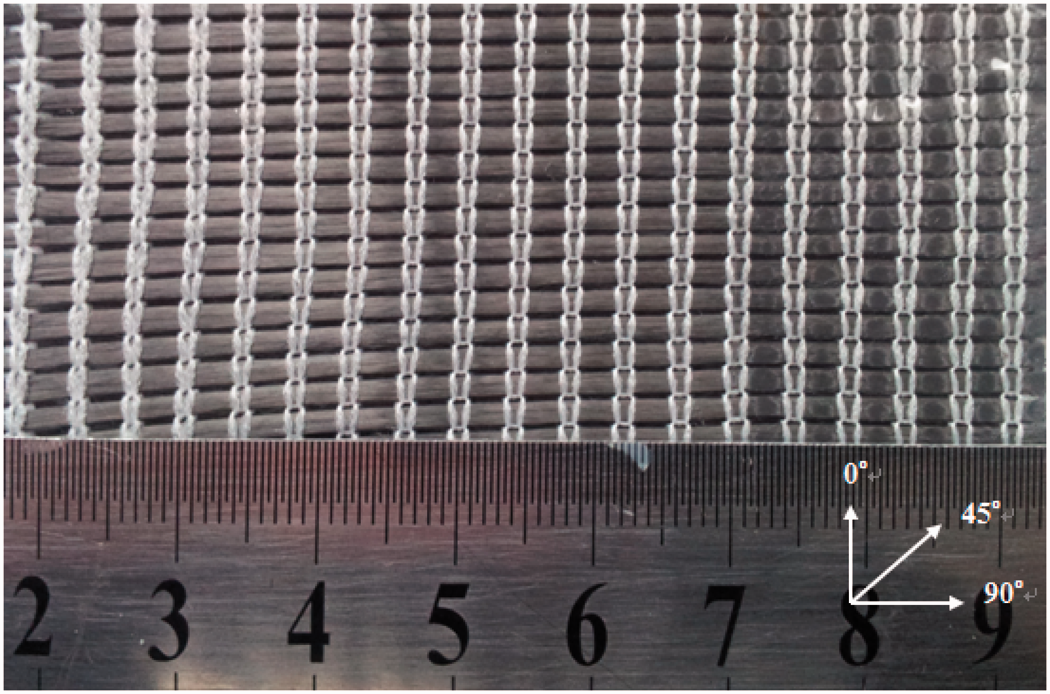

Tensile test
The tensile property tests were implemented under ASTM D5035-06. Figure 3 shows the dimension of tensile specimens. The valid tensile extension zone is within the area of 200 mm × 25 mm. The shadowed parts are gluing areas. The tests were carried out on the multipurpose material tester INSTRON 3385 H. The loading speed was 5 cm/min and the gage length was 200 mm. During the implement process, Keyence high-speed camera was employed to record the dynamic videos and take the static images and also survey the deformation procedure of fabric meticulously. Both of the two carbon weft-knitted fabrics were tested and the stress–strain curves were obtained.
Sketch map of specimen for tension test.
Tearing test
The tensile property tests were implemented under ASTM D5587-96. The dimension of the samples is displayed in Figure 4. The size of specimen is 37.5 mm × 100 mm. The shadowed parts are gluing areas. The trapezoid zone in which the upper base is 25 mm and lower base is 70 mm is the effective tear extension area. Besides, there is a split with the length of 15 mm provided in advance perpendicular to the upper base in the middle. The tear tests were implemented on multipurpose material tester INSTRON 3385 H. The loading speed was settled at 5 cm/min. The whole testing process was observed and recorded through Keyence high-speed camera. Series still pictures were picked up from the videos according to the time nodes to reveal the deformation of fabrics in detail. The ideal tear deformation appeared around the reserved little tear. Load–displacement curves were obtained according to the testing data.
Sketch map of specimen tearing test.
Results and discussion
Tensile results of testing on stitching yarns

Specification of fabrics.

PAN: polyacrylonitrile.
Tensile testing results of polyester fiber and preoxidized PAN fiber.

PAN: polyacrylonitrile.
Tension properties results
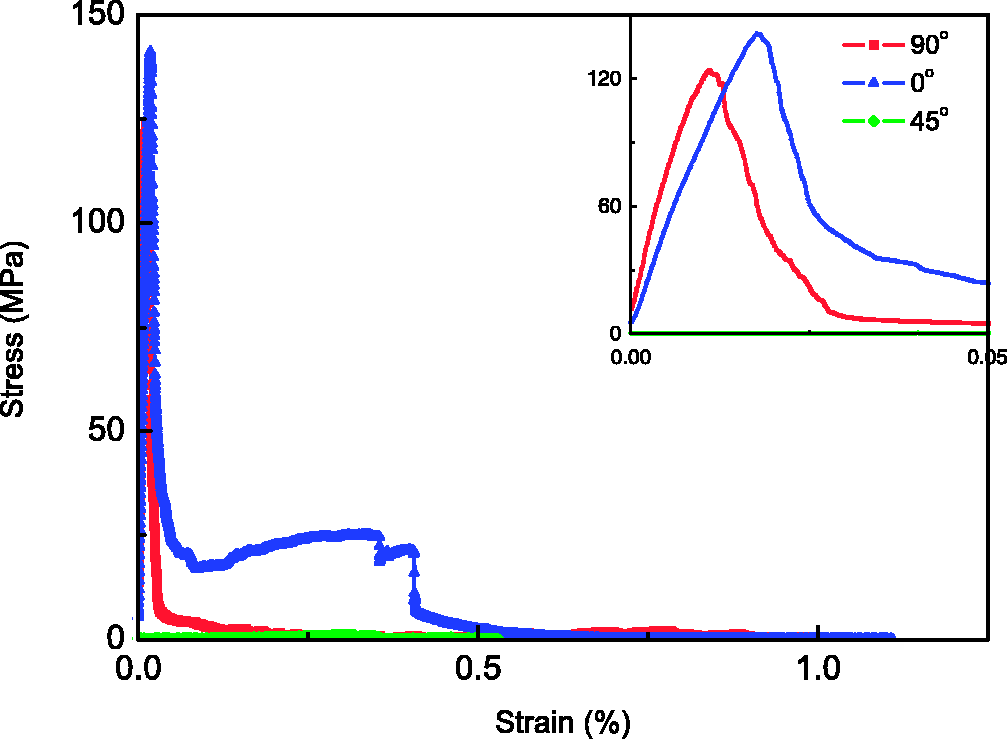
All the tensile tests were implemented by using the multipurpose material tester INSTRON 3385 H. The deformation of the specimens was uneven in the scope of gage length along the directions of 0°, 90°, and 45°, separately. The tensile curves obtained are shown in Figures 5 and 6.
Stress–strain curves of Type I. Stress–strain curves of Type II.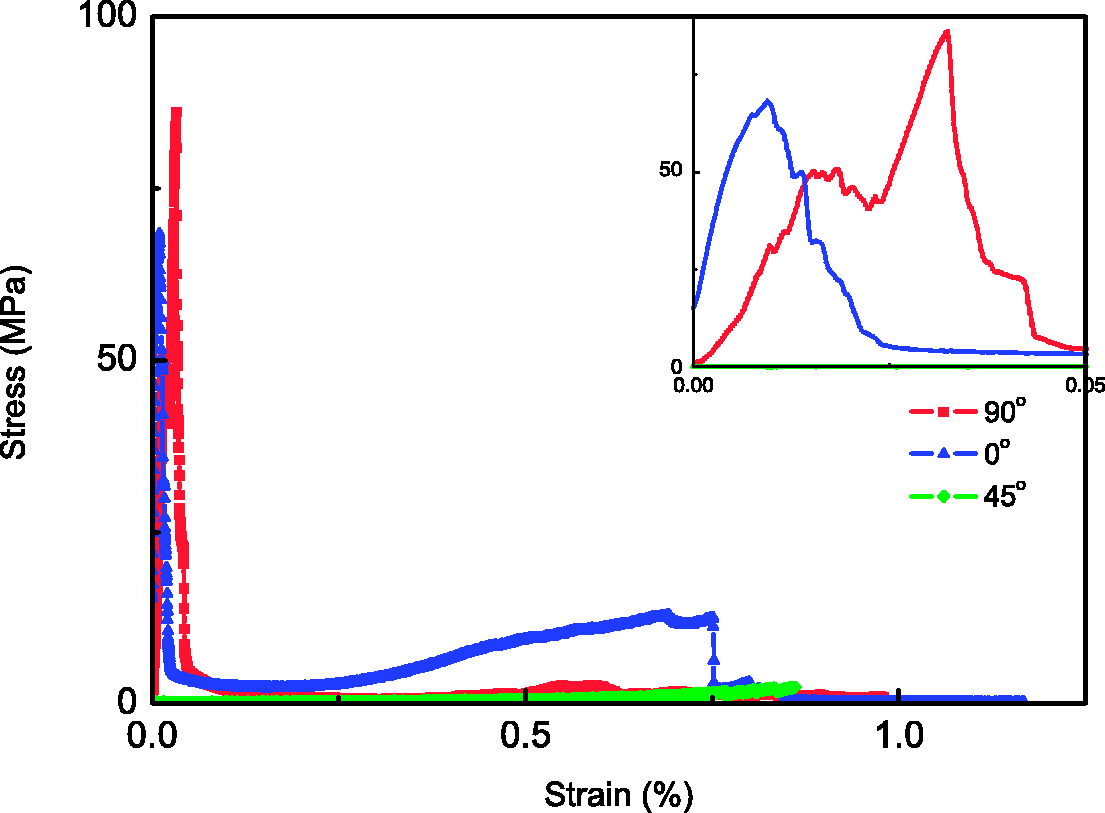
Stress–strain curves of carbon biaxial weft-knitted fabric stitched by polyester fibers (Type I) are shown in Figure 5, from which the curves along 0° and 90° rising rapidly within the small strain values and expressing gentle trend can be found. In the larger view of figure proportion, the variation tendency along the orientation of 0° and 90° is obvious. The stress along 90° direction presents remarkable fluctuations and reaches its peak at the value of 85 MPa. The stress value along the direction of 0° is nearly 70 MPa. The curve of the orientation of 45° is no different, which is too low to observe. The tensile test along bias direction expresses unsatisfactory Young’s modulus.
Stress–strain curves of carbon biaxial weft-knitted fabric stitched by preoxidized PAN fibers (Type II) are displayed in Figure 6. The specific value of stress and strain along the orientation of 45° is still low, and the situation is similar to that presented in Figure 5. On the other hand, it is worth mentioning that the peak stress values in the 0° and 90° directions increase. The two curves increases linearly and decrease gradually after reaching their peaks. The curves are smooth before and after the main peak. Furthermore, the stress along 0° being different from the case in the curves of Type I, performs best. The peak value is twice the corresponding data in the curves of Type I.
Figure 7 displays the comparison between stress and strain curves of Type I and Type II. It can be obviously observed that both 0°and 90℃urves of polyester stitched fabric are more badly behaved than that of preoxidized PAN stitched fabric. The latter presents higher modulus than the former. The peak values of the solid curves of 0°and 90° directions are nearly 20% and 15% higher than the crest values of hollow curves respectively. While the commonality of the two fabrics is that they show poor performance along the orientation of 45°.
Comparison between stress and strain curves of Type I and Type II.
Tear properties results
The tearing properties of the two types of fabrics were carried out, and the load–displacement curves are displayed in Figures 8 and 9.
Load–displacement curves of Type I. Load–displacement curves of Type II.

The load–displacement curves of carbon biaxial weft-knitted fabric stitched by polyester fibers (Type I) are expressed in Figures 8. The curve along 0° presents distinctly with the peak value at 400 N. This curve remains fluctuating, and it can be separated into three stages according to the relationship between load and displacement: firstly, the displacement from 0 mm to 20 mm – the load increases rapidly and glides sharply after the peak value; secondly, the displacement from 21 mm to 60 mm – the curve is in the situation of fluctuant gliding; finally, the displacement from 61 mm to 110 mm shows placid condition. The load decreases and displacement keeps extending. The performance of the curve along orientation of 90° is moderate, but the onset of displacement is deferred. Moreover, along the direction of 45°, the curve shows depressed state again. The maximal value of load is only 90 N, and the displacement distance is shorter than the curves along the other two directions, which is just about 80 mm.
On the other hand, load–displacement curves of carbon biaxial weft-knitted fabric stitched by preoxidized PAN fibers (Type II) is exhibited in Figure 9. The curve along 90° reaches maximum height at the load value of more than 1500 N when the displacement is 20 mm. The maximal value along the orientation of 0° is similar to the same direction in Type I and the displacement is more than 125 mm. The curve along 45° is quite weak with 125 N load and only 60 mm displacement.
Photography results
Every tensile and tearing testing procedure and every integrated deformation process were observed and recorded with employing Keyence high-speed camera. All the imaging materials provided by the device are valuable to give assistance in the research on meso-scale mechanism of the deformation. Meanwhile, series static pictures were picked up according to the typical fracture of the specimens and experimental time nodes (as labeled in the pictures, the unit is second), which are displayed in Figures 10 to 13.
Tensile property testing photographs of Type I: (a) testing along 0°; (b) testing along 90°; (c) testing along 45°.
Photography results of tensile property tests
Figure 10 shows the tensile property testing photographs of Type I along 0°, 90°, and 45°separately. In Figure 10(a), along the testing orientation of 0°, the specimen endured a long period of tension, which lasted for 132 s. At the beginning of 42 s, the sample keeps firm and no deformation is seen. From 43rd second, obvious deformation appears. The carbon weft tows (along 90°) start to be separated from each other, just like the incompact and broken ladder. The loops of polyester stitching yarns are pulled open and the stitching yarns become parallel with the tows along 0°, which fight together the warp tows. That really benefits for improving the tensile strength of the specimen. In Figure 10(b), along the testing orientation of 90°, the situation is quite different. The carbon tows perpendicular to the tension orientation do not play their positions in bearing the load. On the contrary, weft tows become the main force. It is worth mentioning that the polyester stitching yarns begin to ladder regularly from the central fracture area to two flanks. From the picture at the time node of 69 s, it can be found that some stitching yarns do not ladder totally, but tie knots. They bundle the weft carbon yarns resulting in larger tows and more tied the knots bundle, stronger the tows become. That is why the curve along 90° in Figure 5 endures the largest stress and gives the best presentation. In Figure 10(c), along the testing orientation of 45°, the tension time period is short and the specimen fractured very early at the 20th second.
Figure 11 exhibits the tensile property testing photographs of Type II along the testing orientation of 0°, 90°, and 45°. In Figure 11(a), it is different from the status of Type I in that the tows along 90° keep ordered and unbroken for a longer period of time, and the weft yarns begin to separate at the 76th second after the start of the test, which is later than 58 s in the corresponding test of Type I. Therefore, the tows bear larger load than the ones in Type I. From the picture, it can be noticed that laddered preoxidized PAN yarn loops evolves into warp yarns as the test proceeds, and give support to the carbon tows along 0°. In Figure 11 (b), along the testing orientation of 90°, similar to case of Type I, the laddering of preoxidized PAN stitching yarns spread from the central deformation zone to two sides of the specimen. Also, the knotted stitching yarns make bundling phenomenon to appear. In Figure 11(c), along the testing orientation of 45°, the specimen is elongated gently at a constant rate. Both the warp and weft carbon yarns cannot bring the strength into action completely because of the bias tensile direction. Moreover, the stitching yarns are destroyed during the diagonal cutting of the specimen, thus, all the components of the fabric are not qualified to endure the load.
Tensile property testing photographs of Type II: (a) testing along 0°; (b) testing along 90°; (c) testing along 45°.
Photography results of tearing property tests
Figure 12 shows the tearing property testing photographs of Type I along 0°, 90°, and 45°. In Figure 12(a), the test is implemented along the orientation of 0°. The specimen fractures follow the split given in advance. At the time of 25 s, all the stitching yarns begin to be broken, and then the warp tows without bounding of stitching yarns are fractured as well. In Figure 12(b), along the orientation of 90°, the split plays a guide role to the tearing direction. The polyester stitching yarns on both sides of the split are not influenced by the tearing, but the loops are widened from crosswise. In Figure 12(c), at the time of 25 s, the polyester stitching yarns start to be broken under the load and lead to the final fracture of the specimen.
Tearing property testing photographs of Type I: (a) testing along 0°; (b) testing along 90°; (c) testing along 45°. Tearing property testing photographs of Type II: (a) testing along 0°; (b) testing along 90°; (c) testing along 45°.

Figure 13 displaces the tearing property testing photographs of Type II along the testing orientation of 0°, 90°, and 45°. In Figure 13(a), the weft carbon tows in the test apparently have little contribution to enduring the load. The preoxidized PAN loops are elongated and begin to be broken at the time of 32 s, which is later than the broken time of Type I. In Figure 13(b), along the orientation of 90°, the preoxidized PAN yarns developed from the loops take part in the weft carbon tows at the time of 19 s, and strengthen the weft yarns. Combined with the curve in Figure 9, it can be seen that both preoxidized PAN yarns and tows along 90° together endure maximum load. However, in Figure 13(c), along the orientation of 45°, the specimen expresses unwound situation, since the preoxidized PAN stitching yarns are cut down from the bias direction. The bias tows give displacement without enough restrain.
Results analysis
Owing to the existence of 0° and 90° tows, both the two types of carbon weft-knitted fabrics which are stitched with polyester yarns and preoxidized PAN yarns showed excellent stress–strain and load–displacement curves. On the contrary, because of the deficiency of the tows along the orientation of 45°, the tensile and tearing properties tests along this bias direction were undistinguished, and even weak.
For the test along 0° or along 90° directions, the stitching yarns always took part in load enduring as the deformation of the specimens. This phenomenon indeed benefited the strength of the yarns on the stress direction. Sometimes, the bundling promoted by the stitching yarns greatly strengthens the tows in certain degree. Moreover, according to the previous tensile test of polyester yarns and preoxidized PAN yarns, the tension strength and Young’s modulus of the latter are obviously higher than the former, and it is easy to explain as to why the curves of CBWK fabric stitched by preoxidized PAN yarns are much better than the ones of CBWK fabric stitched by polyester yarns.
Conclusions
The tensile properties of polyester yarns and preoxidized PAN yarns are implemented. Both tensile and tearing behaviors of the carbon biaxial weft-knitted fabrics stitched by polyester yarns and carbon biaxial weft-knitted fabrics stitched by preoxidized PAN yarns are studied. The stress–strain and load–displacement curves are obtained based on the testing data. The tensile strength and Young’s modulus of preoxidized PAN yarns are apparently superior to the polyester yarns. Furthermore, the fabric stitched by preoxidized PAN yarns have more excellent comprehensive behaviors on tension property according to the data obtained in the tests. Meanwhile, there is such a huge advantage of preoxidized PAN yarns that they present restriction in the tearing test along 90° orientation, so that the specimen can endure load more than 1500 N.
Footnotes
Funding
The authors acknowledge the financial supports from the National Science Foundation of China (No. 11302085), the National Science and Technology Support Program of China (No. 2012BAF13B03) and the Fundamental Research Funds for the Central Universities (No. JUSRP1043).