




Abstract
A conductive poly(o-anisidine) (POA)/poly(ethylene terephthalate) (PET) nonwoven composite was prepared by chemical oxidative polymerization of o-anisidine in aqueous HCl solution. The effects of the oxidant type, oxidant/monomer mol ratio, and polymerization temperature and time were studied on POA content and surface resistivity of the composite. It was observed that the swelling of PET in 1,4-dioxane decreased the surface resistivity of the POA/PET composite by up to 18.5 kΩ/cm2, when compared to that of the unswollen PET nonwoven. According to the electromagnetic shielding effectiveness (EMSE), and the relative shielding efficiency of the absorbance (Ab) and reflectance (Re) values of the composite in the range 15–1500 MHz, 99.9% of the shielding was obtained with an attenuation of 33 dB at 15 MHz. The durability of the composite was determined by measuring its surface resistivity after domestic washing and commercial laundering.
Introduction
In the preparation of conductive polymer/fiber and fabric composites, many kinds of natural and synthetic textile materials have been used. These types of composites are of potential use in application areas such as temperature and humidity sensors [1,2] strain sensors [2,3] electrotheraphy [4], antibacterial agents [5], static charge dissipation [6,7] and thermal heating devices [8]. For example, Oh et al. [4] prepared a polypyrrole /nylon-spandex fabric composite and investigated its usability as a conductive electrode pad material for electrotherapy. The stretchable and conductive fabric composites of polyethylenedioxythiophene/nylon [2] and polypyrrole/lycra [3] were reported to have potential uses as strain sensors with high strain sensitivity over a period of time. Varesano et al. [5] used a polypyrrole/cotton fabric composite as an antibacterial agent against Escherichia coli. These composites were also used as electromagnetic interference (EMI) shielding materials. A conductive polypyrrole-coated PET fabric with the trade name of Contex® was commercialized by Milliken Co for camouflage netting due to the microwave absorbance characteristics of polypyrrole [9]. The polypyrrole/nylon-6 fabric composite prepared by multiple depositions of polypyrrole layers onto nylon-6 could effectively be used in EMI shielding with an attenuation of 40 dB in the 50 MHz–13.5 GHz frequency range [10]. The results of a very recent study including the preparation of poly(o-toluidine)/carbon fiber/novalac thin sheets showed that the material could have potential uses in durable enclosures for electronic equipment with an EMSE performance of 24 dB at 8–12 GHz [11]. Studies on the EMI shielding performances of polypyrrole/nylon-lycra [12], polythiophene/PET [13], polyaniline/carbon fiber [14] polyaniline/cotton [15,16], and polyethylenedioxythiophene/PET [17] were also examined under different frequencies.
In the literature, only one conductive textile material has been prepared from conductive polyaniline and its POA derivative with PET fabric by grafting [18]. In that study, the authors investigated the thermal and flame retardant properties of the grafted conductive PET fabrics [18]. Unlike from this study, to prepare a conductive composite, we used PET nonwoven and POA materials. In addition to the polymerization conditions, the swelling of the PET in various organic solvents was firstly investigated related to the POA content and the surface resistivity of the composite. The durability of the POA/PET nonwoven composite to domestic washing and commercial laundering processes was determined by measuring the surface resistivity of the composites after the suggested processes. The EMI shielding performance of the composite was also investigated in the frequency range of 15–1500 MHz, including radio waves (high frequency, HF) to microwaves (ultra high frequency, UHF).
Materials and method
PET nonwoven fabric (basis weight of 130 g/m2 and thickness of 0.45 mm) was obtained from KORDSA (Kocaeli, Turkey) and used in the experiments after cutting into pieces sized 2 × 2 cm. The monomer of o-anisidine (bp: 224 ℃/760 mmHg) (Merck) was purified by vacuum distillation at 92C/5 mmHg before use. While the chemicals including (NH4)2S2O8 , K2Cr2O7, CrO3, FeCl3.6H2O, Na2WO4.2H2O, acetonitrile, dichloromethane, ethyl acetate, and tetrachloroethylene were supplied by Merck with hydrochloride acid (37%), KIO3, NaOCl, 1,4-dioxane, ethylene glycol and methanol were being obtained from Sigma-Aldrich, and all were used without further purification. The commercial detergent used in the domestic washing process contained 15–30% carbonate, 5–15% anionic active and less than 5% nonionic active materials.
Preparation of POA/PET composite
PET nonwoven samples were swollen in organic swelling solvents under a reflux condenser for 2 h at the boiling point of each solvent before polymerization. After removing the excess solvent on the sample with filter paper, the nonwoven fabric was added to a 1.0 M HCl solution containing a certain amount of o-anisidine. The polymerization was started with the addition of a certain oxidant solution drop by drop. At the end of the polymerization time, the POA/PET composite was taken from the solution and washed 2–3 times with distilled water and rinsed well with methanol to remove the residual oxidant and monomer, respectively. Finally, the composite was redoped with 1.0 M HCl and dried at 50 ℃ under a vacuum. The percentage content of POA in the composite was calculated according to the following equation (1)

Characterization
The surface resistivity measurements were performed with the two probe method using a Thurlby 1503 digital multimeter and Keithley 6517A high resistance meter, for the composites showing low and high surface resistivities, respectively. The surface resistivity was taken as the average of 10 measurements taken from different regions of the samples. The ATR-FTIR spectra of the samples were recorded with a Perkin Elmer Spectrum 100 FTIR spectrometer. The TGA curves were measured with a Shimadzu DTA-60H Thermal Analyzer at a heating rate of 10 ℃/min under a nitrogen flow (flow rate = 100 ml/min). The surface morphology of the samples was analyzed with a Quanta 400F Field Emission SEM instrument after coating with Au-Pd. Contact angle measurements were performed by the sessile drop method with a SEO Phoenix-300 Automatic Contact Angle Analyzer at ambient temperature.
The EMSE measurements
The EMSE measurements were performed according to the ASTM D4935-89 standard for planar materials with an Electro-Metrics EM-2107A test fixture which was connected to an Agilent E5061B Vector Network Analyzer. Then 201 points were taken in the frequency range of 15–1500 MHz. The actual power level was adjusted to be 0 dBm during the measurement. First, an annular disk shaped reference sample was placed onto the conductors of the fixture, whose outside and inside diameters were in 133 mm and 33 mm, respectively. Then a 133 mm circular disk-shaped load sample, which was the same thickness as the reference sample, was put between the conductors. This process was repeated for each sample.
The EMSE was calculated in decibels (dB) according to equation (2) [19]


The Ab and the Re quantities show the contribution of the absorption and reflection losses to the EMSE, respectively. The sum of the Ab and Re values represents the relative shielding efficiency of the material.
To monitor the effect of the POA content and thickness of the POA coating, a second POA coating was added to the POA/PET composite and the same EMSE measurement and calculation steps given above were followed.
Washing and laundering processes
The domestic washing process was performed by stirring 0.2 g of the composite sample in 50 ml of aqueous solution containing 2 g of commercial detergent at 20 ℃ for 30 min. Then the sample was rinsed with distilled water for 10 min to remove residual detergent. The commercial laundering was also performed by stirring the composite sample in 25 ml of tetrachloroethylene under a reflux condenser at 20 ℃ for 30 min. After the washing and laundering processes, samples were dried in vacuum oven at 50 ℃ for 12 h. The surface resistivity of the composites was measured at the end of each washing and laundering processes.
Results and discussion
In the first experiment, the PET nonwoven fabric was directly used in the polymerization without any pretreatment processes. Although a homogenous POA coating on the surface of the composite was obtained, the surface resistivity of the composite was a remarkably high value (2320 kΩ/cm2). For this reason, the PET nonwoven sample was swollen in various organic solvents such as 1,4-dioxane and dichloromethane, which are known to be swelling agents for PET [20]. It was observed that the surface resistivity values of the POA/PET composites prepared from the swollen PET nonwoven in the examined solvents decreased when compared to that of unswollen PET. The decrease in the surface resistivity values of the composites prepared from the swollen PET nonwoven was in the descending order of ethylene glycol (79.7 kΩ/cm2) > ethyl acetate (61.4 kΩ/cm2) > dichloromethane (20.9 kΩ/cm2) > 1,4-dioxane (18.5 kΩ/cm2). Therefore, the PET nonwoven swollen in 1,4-dioxane was used in the following experiments.
Effect of oxidant type
The effect of oxidant types on POA content (%) and surface resistivity of the POA/PET composite.

Note: [o-anisidine]: 0.2 M, polymerization temperature: 20 ℃, time: 120 min.
The value of 1.63 V is the redox potential of HOCl which is formed by NaOCl in HCl medium.
Effect of (NH4)2S2O8/o-anisidine mol ratio
Figure 1 shows that the POA content (%) and the surface resistivity of the POA/PET composite were affected by the (NH4)2S2O8/o-anisidine mol ratios. The POA content (%) of the composite increased as the oxidant/monomer mol ratio increased up to 2, and then decreased. This could be explained by the removal of POA oligomers from the composite through washing [23] and the overoxidation [24] formed due to the usage of excess (NH4)2S2O8. The surface resistivity of the composite also decreased with increasing mol ratio and reached its lowest value (18.2 kΩ/cm2) at the mol ratio of 0.5, and then markedly increased. Due to the overoxidation at higher mol ratios causing the degradation of the backbone of the POA coat on the fabric, the formation of POA chains with shorter conjugation lengths could be observed, which lead to an increase in the surface resistivity of the composite [25].
The change in the POA content (%) (Δ) and surface resistivity of POA/PET composite (○) with (NH4)2S2O8/o-anisidine mol ratio (polymerization temperature: 20 ℃, time: 120 min).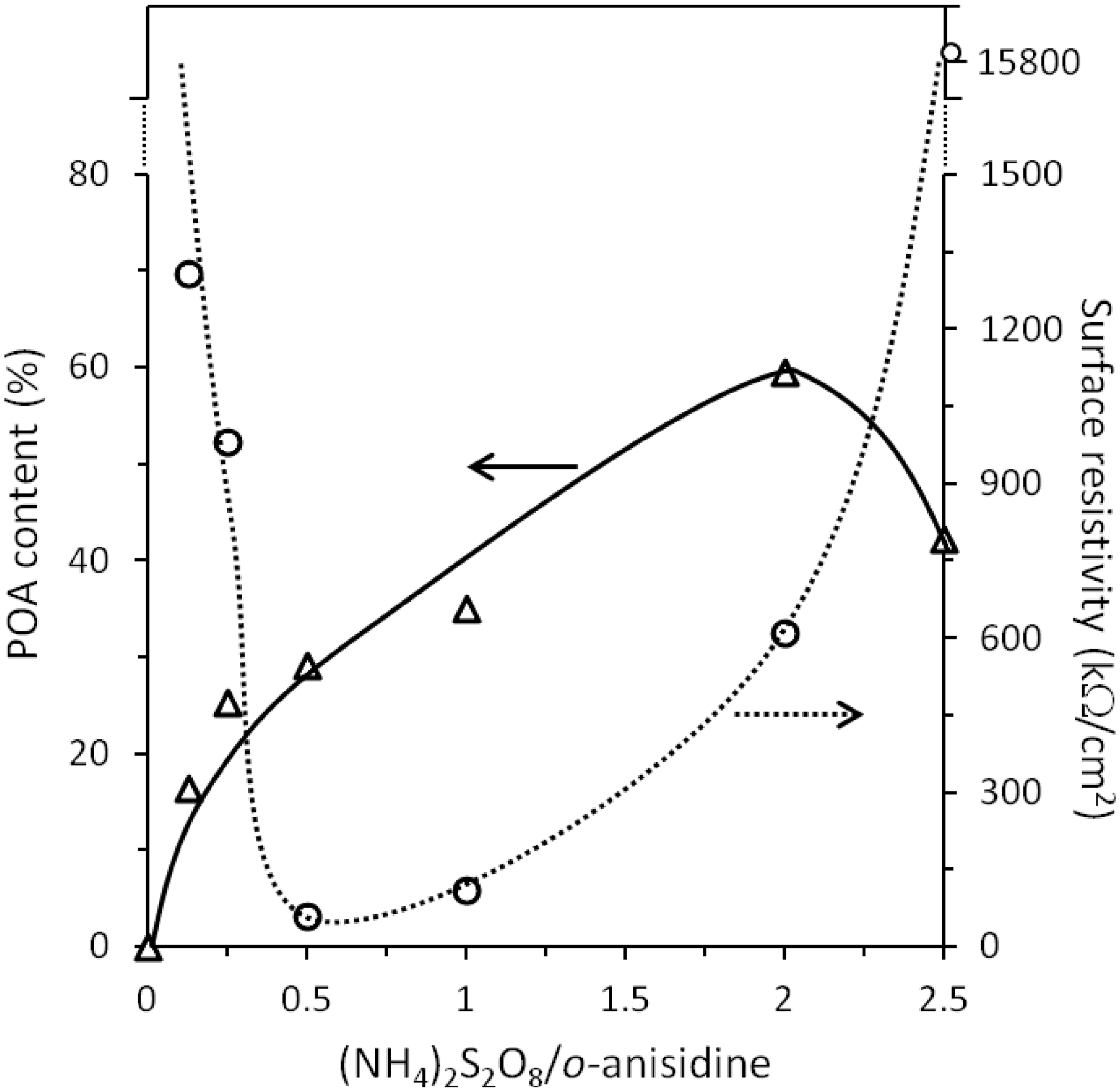
Effects of polymerization temperature and time
The changes in the POA content (%) and surface resistivity of the POA/PET composite with changes in the polymerization temperature and time are shown in Figure 2(a) and (b). It was observed that the POA content (%) of the composite decreased with an increase in the temperature from 0 ℃ to 40 ℃ within the time period of 0–120 min, and the highest POA content (%) was obtained with the polymerization carried out at 0 ℃ for 60 min. The decrease in the POA content (%) of the composite with an increase in the polymerization temperature was due to the exothermic nature of the polymerization [26,27]. Additionally, it could be stated that the sulfate radical anions formed with the thermal decomposition of (NH4)2S2O8 at higher temperatures might not polymerize by o-anisidine [28]. The change in the surface resistivity of the composite was also consistent with the change in the POA content (%) of the composite, and increased with an increase in the polymerization temperature. In the polymerizations carried out at high temperatures, the residual oxidant present in the solution could hydrolyze the newly formed polymer by attacking [29]. Moreover, the increase in the polymerization temperature could lead to side reactions of the radical cations [30], and these may have caused an increase in the surface resistivity of the composite.
The change in (a) the POA content (%) and (b) surface resistivity of the composite with polymerization temperature and time ([(NH4)2S2O8]: 0.1 M, [o-anisidine]: 0.2 M).
FTIR
Figure 3 shows the FTIR spectra of the PET nonwoven, POA and POA/PET composite. The bands observed at 2969 cm−1, 1712 cm−1, and 1094 cm−1 in the spectrum of the composite originate from aliphatic C–H stretching, C=O stretching and C–O stretching of PET, respectively. While the bands at 1572 cm−1 and 1485 cm−1 correspond to the C=C stretching mode of the quinoid and benzenoid rings of the POA coat on the composite [31], respectively, the band observed around 1460 cm−1 can be attributed to the C–H bending of the −OCH3 group of POA [32].
FTIR spectra of PET nonwoven, POA and POA/PET composite containing 59% of POA.
TGA
The thermograms of the PET nonwoven, POA, and POA/PET composites are given in Figure 4. As can be seen from the thermograms of the composite and POA, three weight loss steps were present, which can also be observed in the thermogram of polyaniline or its derivatives [33,34].
TGA curves of PET nonwoven, POA and POA/PET composite containing 59% of POA.
In the first step, the weight losses observed in the thermograms of POA/PET and POA was due to the removal of moisture within the temperature ranges of 20–85 ℃ and 20–110 ℃, and were 2.8% and 8.8%, respectively. In the second step, while the composite exhibited a weight loss of 5.9% between 124 and 276 ℃, a weight loss of 13.7% was observed between 113 and 330 ℃ in the POA, which can be attributed to the loss of the dopant from the POA chains [34]. In the last step, major weight losses occurred in the composite as a result of the structural decompositions of the POA and PET chains [35]. These weight losses (57.2%) were lower than that of PET nonwoven (78.1%) sample between 390 and 500 ℃. On the other hand, it was observed that the degradation temperature of PET (398 ℃) slightly decreased to 391 ℃ after the incorporation of POA to its structure. Although a slight decrease was observed in the degradation temperature of the composite, considering the lower weight loss value of the composite between 390 and 500 ℃, it can be assumed that the thermal stability of the composite increased to a certain degree when compared to the PET.
SEM
The surface morphology of the unswollen and 1,4-dioxane swollen PET nonwoven material, and the POA/PET composite with different POA contents were evaluated with SEM images, which are given in Figure 5. As can be seen from the micrographs, while a significant change was not observed in the fiber diameter and the surface of the fibers after swelling of PET in 1,4-dioxane (Figure 5(a) and (b)), it was noteworthy that the diameter and the morphology of the composite remarkably changed with an increase in the POA content from 20% to 59% (Figure 5(c) and (d)).
SEM micrographs of (a) PET fiber, (b) PET fiber swollen in 1,4-dioxane, (c) 20% and (d) 59% of POA containing POA/PET composites, and (e) POA.
The micrograph for the POA (Figure 5e) showed that it had a bulk form with a round granular structure. However, it can be seen that the POA formed a homogenous layer on the surface of the fiber and that the coating thickened with an increase in the POA content (Figure 5(c) and (d)). This observation could be proven by the formation of cracks in the coating. In addition, it can be clearly seen that the POA particles with nanometer sizes that were embedded in the POA layer showed a regular distribution.
Contact angle measurement
To determine the wettability characteristics of the unswollen and 1,4-dioxane swollen PET nonwoven, and POA/PET composites, the water contact angles of the surfaces were measured from images recorded at 250 ms time intervals of a water droplet, and the results were plotted in Figure 6. The average contact angle value of the PET nonwoven fabric was 102°, which was slightly higher than the values reported in the literature for PET [36]. This high contact angle value of the PET nonwoven could be the result of its high surface porosity [37]. It was observed that the average contact angle of the PET nonwoven (102°) reached 116° after swelling the PET in 1,4-dioxane. When the contact angle values of the POA/PET composite were examined, it was observed that the composite showed a sharp decrease starting from 80° to 0° at the end of 2000 ms (2 s). This could be attributed to the HCl doped POA, with a hydrophilic property, being coated on the nonwoven sample.
The water contact angle values of untreated PET nonweoven, PET swollen in 1,4-dioxane and POA/PET composite containing 59% of POA.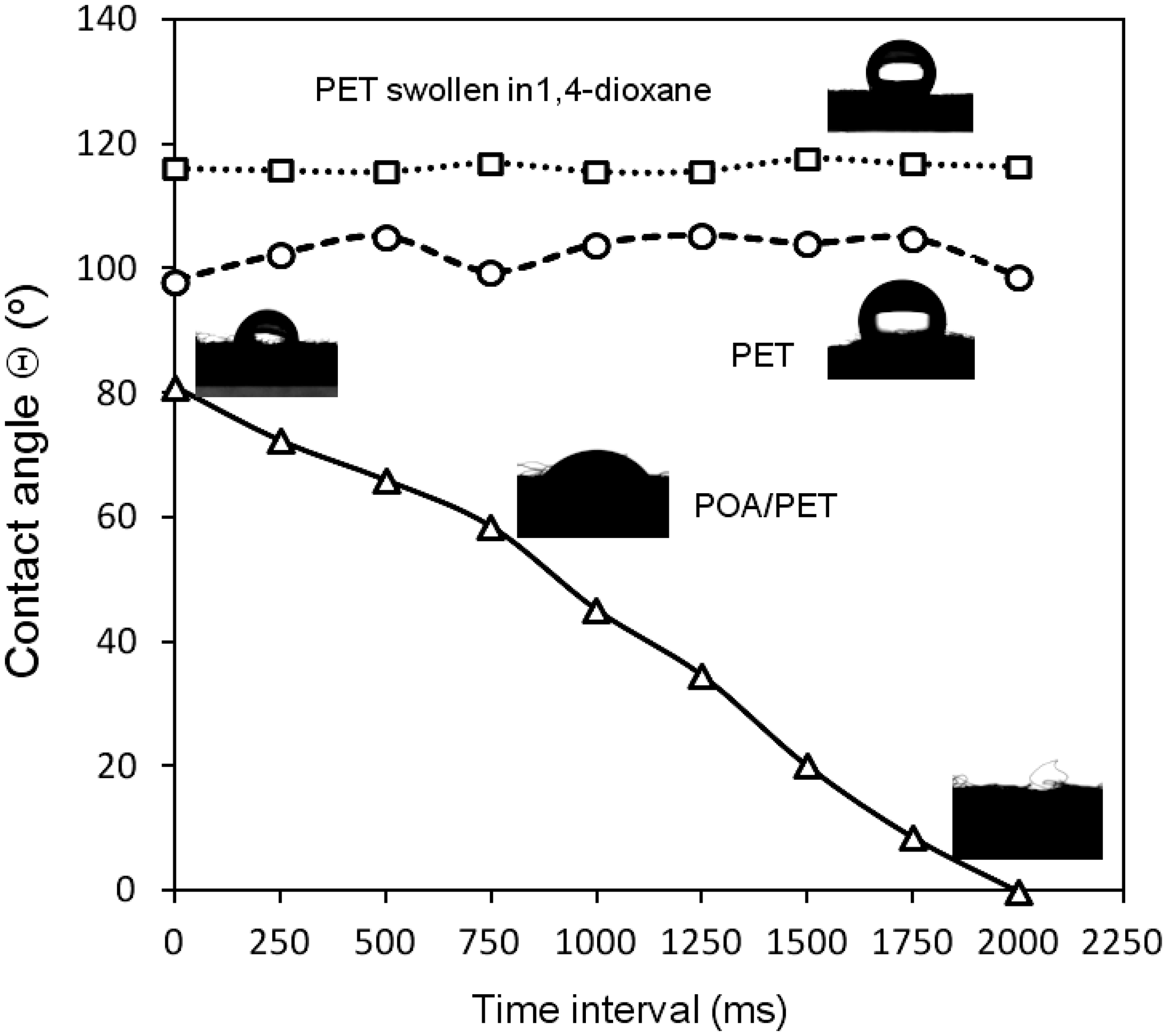
Effect of washing and laundering processes
The change in the surface resistivity of the conductive POA/PET composite was monitored after the processes of domestic washing with a commercial detergent solution and laundering with a dry cleaning liquid (tetrachloroethylene), separately. In the first domestic washing experiment, the surface resistivity of the composite (13.5 kΩ/cm2) showed an increase of around 103 fold and it was measured as 15 MΩ/cm2. Molina et al. [38] observed that this increase was in the range of 108 fold after the first domestic washing of the polyaniline/PET composite. In the second wash of the same sample, we observed that the dark green color of the composite turned to black, and the surface resistivity reached a high value of 50 GΩ/cm2 due to the removal of the dopant Cl- anions present in the composite [39]. However, it was observed that the surface resistivity of the composite could be recovered (345 kΩ/cm2) after the sample was redoped with 1.0 M HCl.
In contrast to the domestic washing, in the commercial laundering with tetrachloroethylene, the surface resistivity of the composite slowly increased and was measured as 180 kΩ/cm2 and 302 kΩ/cm2 after the third and fifth launderings of the composite, respectively. This showed that the surface resistivity of the composite was more resistive to the commercial laundering when compared to the domestic washing, due to the fewer dopant anions being removed from the composite.
At the end of both washing and laundering processes, no deformation, such as felting, was observed in the composite.
EMSE and relative shielding efficiency
On the EMSE performance of the POA/PET composite, the effect of the POA content and the number of POA coatings was monitored in the frequency range of 15–1500 MHz. For this purpose, a single coated composite containing POA of 59% and surface resistivity of 16.5 kΩ/cm2 (sample thickness of 0.67 mm) was prepared under the conditions of (NH4)2S2O8/o-anisidine mol ratio of 0.5 at 0 ℃ for 60 min and the EMSE performance was investigated. Then, with a second coating of POA, the POA content of the composite increased to 83% and the surface resistivity reached 1.3 kΩ/cm2 (sample thickness of 0.90 mm), and the EMSE results of both of coatings are given in Figure 7.
The EMSE values of PET, single-coated POA/PET composite (POA content of 59%) and double-coated POA/PET composite (POA content of 83%) in the range of 15–1500 MHz.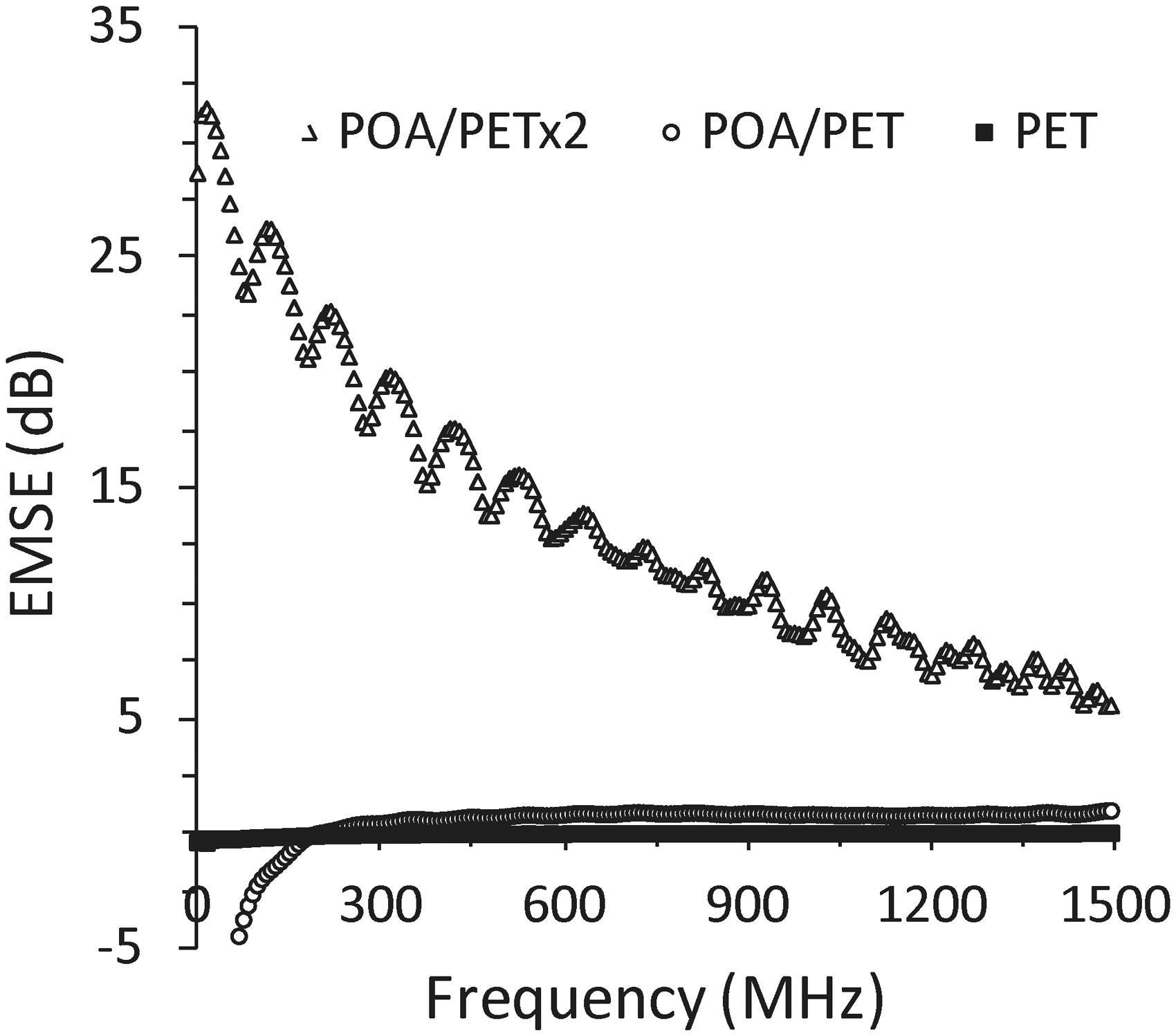
The EMSE of the single coated composite remained around 1 dB for the complete frequency range. However, with an increase in the POA content from 59 % to 83 %, it was observed that the EMSE value of the composite reached 33 dB at 15 MHz. This result showed that the composite could be effectively used in applications related to HF radio waves. This could be attributed to the decrease in the surface resistivity of the composite as a result of the double coating of POA. The high initial EMSE value of 33 dB decreased to 6 dB with an increase in the frequency from 15 MHz to 1500 MHz. The EMSE value of the uncoated PET nonwoven was 0 dB due to the transparency of the PET [19] in the studied frequency range.
The sum of the Ab and the Re values, showing the relative shielding efficiency of the POA/PET composite, was calculated and is shown in Figure 8. As seen from the figure, the relative shielding efficiency of the double coated composite was higher than that of the single coated for the whole frequency ranges, which was due to the decrease in the surface resistivity of the composite with an increase in the coating thickness from an increase in the POA content. This is because the EMI shielding property of a material depends on both the thickness and conductivity of the conductive coat [40,41]. The sum of the Ab and Re values was calculated as 0.20 for the single-coated composite, and this showed that only 20% of the waves could be shielded in the swept frequency range. In the low frequency region (15–150 MHz), the sum of the Ab and Re values of the double coated composite indicated that the contribution of the absorbance value of ca 0.999 to the total shielding was higher than that of the reflectance value. This value indicates that the composite could shield 99.9% of the waves by absorption in this region. With an increase in the frequency from 15 MHz to 1500 MHz, the Ab values of the composite decreased, but since the Re values increased, the average total shielding efficiency did not remarkably change and was calculated as 0.95. Although these values were slightly lower than the values reported for conductive polymer/fabric composites in the literature [10,42,43] since the EMI shielding performance of the double coated composite could be evaluated as good and/or fair according to the Specified Requirements of Electromagnetic Shielding Textiles: Class II-General Use [44], it might be used in EMI shielding applications depending on the applied frequency range.
The relative shielding efficiency values of single-coated POA/PET composite (POA content of 59%) and double-coated POA/PET composite (POA content of 83%) in the range of 15–1500 MHz.
Conclusion
It was shown by the present work that, a conductive POA/PET composite with a low surface resistivity could be prepared using PET nonwoven fabric swollen in 1,4-dioxane, due to changes the chemical polymerization conditions. It was proven from the TGA results that the thermal stability of the composite increased to a certain degree. SEM images revealed that the POA coating formed a homogenous layer on the surface of the fiber, while with an increase in the POA content, cracks formed in the thickened layer. The contact angle measurement showed that the hydrophobic nature of the PET nonwoven gained a hydrophilic property after the conductive POA coating was doped with HCl. In the washing and laundering processes, the surface resistivity of the POA/PET composite was affected less by the commercial laundering, with the obtained composite maintaining its electrical properties and fibrous structure, which may be important for the studies that should be carried out in organic media. One of the most remarkable results of this study was the satisfying EMI shielding performance of the double coated composite at high and very high radio wave frequency regions (15–300 MHz), which would enable the composite to have a potential of use as an electromagnetic wave absorber, and the poor performance under the limits of the ultra high frequency region (600–1500 MHz).
Footnotes
Declaration of Conflicting Interests
The author(s) declared no potential conflicts of interest with respect to the research, authorship, and/or publication of this article.
Funding
The author(s) disclosed receipt of the following financial support for the research, authorship, and/or publication of this article:
We would like to thank Ankara University Research Fund (BAP) for giving financial support to this study (Project number 12B4240018).