




Abstract
Pressure garments are used to heal different medical conditions such as hypertrophic scars, venous problems and orthopaedic disorders. The requirement of therapeutic pressure for different applications is different. So there is a need for engineering pressure garments according to the requirement. Pressure garments are made from elastic knitted fabric. The principle of pressure generation depicts that the tensile property of the elastic knitted fabric is an important factor which can be regulated by varying the property of elastic inlay yarn used in the fabric. Little information is available in this aspect. In the present study, elastic knitted fabric tubes were prepared by varying the linear density of the elastic inlay yarn. Pressure exerted by the fabric tubes was studied on 10 male and 10 female upper arm of left hands. The pressure generation behaviour was then compared in between male and female subjects. The results were also compared with pressure development on rigid body. Results showed that tensile property of elastic knitted fabric can be regulated by varying the linear density of elastic inlay yarn. Pressure exerted by the fabric tubes can be regulated by changing the linear density of elastic inlay yarn. Pressure generation was always higher on rigid body than human body.
Introduction
Pressure therapy is employed in healing of scars, in venous and lymphatic disorders and for relieving of muscular pain. Pressure garments, made from knitted elastic fabrics, are widely used for pressure therapy to overcome the above-mentioned problems [1]. Pressure garments generate positive pressure over human body parts. However, the requirement of pressure differs from application to application. 25 mmHg is the pressure recommended in scar management [2–7], 10–49 mmHg for venous and lymphatic disorders [8, 9] and 15–20 mmHg for muscle injuries [10].
Pressure garments are designed to be smaller than the size of the body part they enclose, so as to remain in a stretched state and apply transverse pressure on the body. The pressure exerted by pressure garments primarily depends upon factors such as: tension developed in the fabric, reduction factor or fit of the garment, curvature of the body and compliance of the body on which the garment is worn [11]. Reduction factor is defined by the percentage difference between the garment circumference and limb circumference.
The garments may be customised or readymade. Customised garments are costly but they fit the body properly. On the other hand, ready-made pressure garments cover a range of body size. So the fit of the garment and curvature of the body would obviously vary within a range. As a result, they produce different amount of pressure on different human bodies. Thus, the manufacturers of ready-made pressure garments always claim a range of pressure could be generated by the produced pressure garments. Fit of the garment and curvature of the body – these two factors cannot be controlled in case of ready-made garments. On the other hand, the tension developed in the elastic knitted fabric could be regulated by changing the linear density of yarns [12]. Customised elastic knitted fabrics, used in pressure garments, are either warp or weft knitted fabric with inlaid elastic yarns. The garments are stitched such a way that the elastic yarns remain around the circumference of the body. These elastic yarns are mainly responsible for development of tension in the fabric. The information regarding the effect of linear density of elastic inlay yarn on pressure development on human limb is very little. Thus, this issue could be addressed.
The last factor of pressure generation is the tissue compliance of the body which depends on the amount of soft tissue and bony part. In human body some portions have predominance of soft tissues whereas other parts are bony. In clinical trials, it was found that the pressure generated on soft body parts was always lower than that on bony parts [9]. The pressure exerted by pressure garments changes the shape of the body to some extent by redistributing the body mass. The net pressure exerted by the fabric is less where soft tissues are predominant due to dissipation of compression energy by displacement of tissues [13, 14]. In bony areas, the compressive energy does not get a chance to dissipate which leads to increase in pressure. Different levels of pressure could be generated by a given pressure garment on different human bodies as compressibility of the body might vary from a person to person. Again, the mechanical characteristics of body tissues (elastic constant and Poisson ratio) vary between male and female and so the pressure is also expected to vary accordingly [13, 15–16]. In another work, it was found that the pressure distribution profiles of a pressure stocking on a male and a female subject were different from each other as the contact area on the female leg seemed relatively larger than that on the male leg; therefore, the pressure distributed more evenly on the whole lower leg of the female subject [17]. Information regarding this aspect is little. It would be interesting to study the pressure generation by pressure garments on male and female body.
In this study, elastic knitted fabric tubes were prepared by varying the linear density of elastic inlay yarn. The pressure developed by the fabric tubes on upper arm (left hand) of female and male subjects was measured. Effect of linear density of elastic inlay yarn on pressure exertion was studied on both male and female body. These values were also compared with the pressure developed on rigid cylinders of similar radius of curvature for reference purpose.
Experimental
Materials
Fabric tube
Knitted fabric tubes were prepared in single jersey construction with elastic inlay yarn. Circular knitting machine Soosan (Model number SS604U) having cylinder diameter of 9.52 cm and needle gauge of 6.69 cm−1 was used for fabric tube production. The schematic diagram of the knitted structure is shown in Figure 1. The knitted structure was a combination of normal loop and tuck loop. Elastic inlay yarns were inserted between the loops in every course line at a constant pretension of 2gf to avoid the unwinding tension variation.
Knitted structure used in the present study.
Manipulated circumference of the fabric tubes.

Subjects
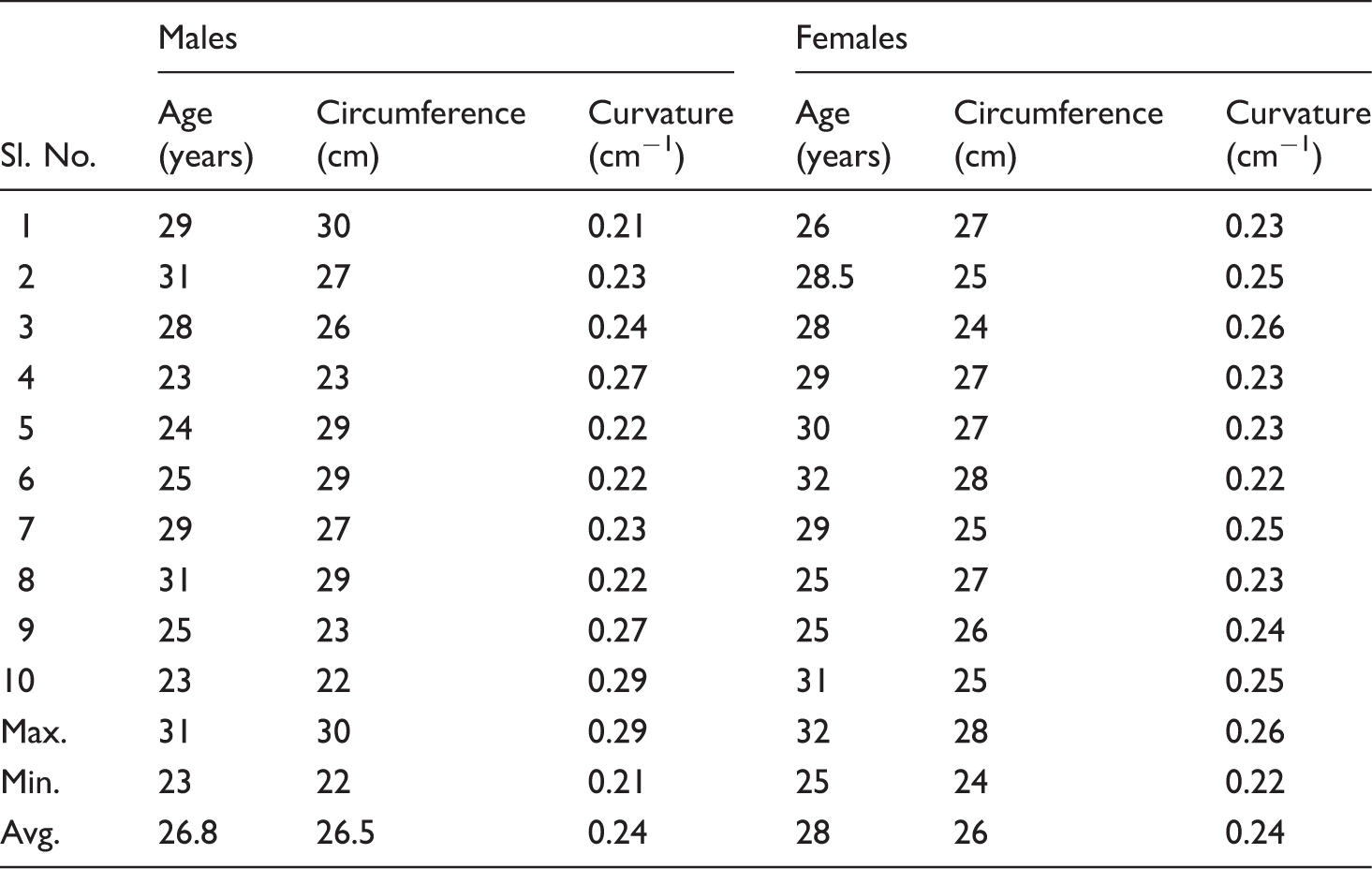
Ten female and 10 male subjects were chosen for the trials. The age of female and male subjects was varied between 25–32 years and 23–31 years, respectively. Pressure was measured on the middle of the upper arm of the left hand. Anatomically, it was the bicep muscle of the left hand (Figure 2). Demographic and other general information about the subjects such as age, weight, height and any history of venous or lymphatic disorders were also collected.
Anatomical landmarks on the upper arm.
To find out the middle position of the upper arm, two body landmarks were marked – acromion and elbow (Figure 2). Acromion is the most lateral point of the shoulder on the superior surface of the acromion process of the scapula. Pressure was measured on the front side of the middle position of acromion and elbow. As the heights of the subjects were different, the lengths of the upper arm were also different.
Details of the subjects used in the trials.
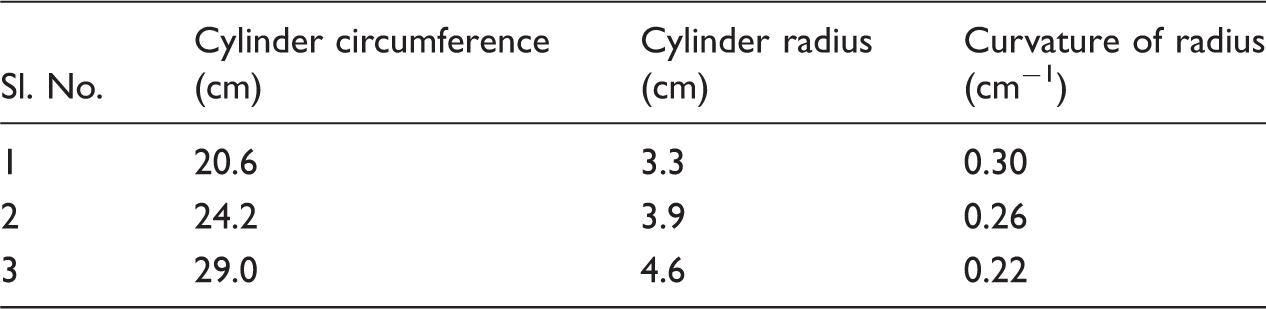
PVC rigid cylinders
Details of PVC cylinders used in the study.
Methods
Tensile properties of yarns
Properties of elastic yarns were measured on Instron testing machine model: 4301 (UK), according to ASTM D2256 at gauge length of 50 mm. Speed of jaw separation was kept at 300 mm/min. At least 10 specimens were tested for each sample.
Tensile properties of fabric
During wear and use, pressure garments never experience the breaking extension. The initial load extension behaviour of the fabric is very important to study the pressure generation behaviour by the fabric tubes [11, 14, 17]. Therefore, to study their properties under conditions of actual use, load extension behaviour of the test samples was studied up to 300% extension. As only the course wise elastic yarns are mainly responsible for exerting pressure compared to wale wise yarns, all tensile tests were carried out only in the course direction of the fabric. 150 × 50 mm2 samples were cut and tested on Instron tensile tester model 4202 at a gauge length of 75 mm. The upper jaw speed was maintained at 300 mm/min. At least five specimens per sample tested and an average result was recorded.
Method of pressure measurement on human subjects
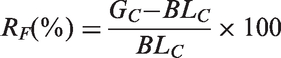
The pressure was measured on the human subject’s left arm. The subjects were instructed not to perform any heavy physical work or strong exercise, to ensure that they had enough sleep, and to maintain their regular routine for 24 h before the test. They were instructed to wear a loose fitting garment for the test. Subjects were first asked to relax fully before the experiment and were seated on a chair of fixed height. All measurements were taken in the sitting posture with the left hand hanging freely. The studies were carried out in a laboratory with a controlled temperature of 23 ± 2℃ and a relative humidity of 65 ± 5%. Participants were requested to sit straight with foot touching the ground. The middle position of acromion and elbow on left hand was located and marked. Circumference at this position was measured by a measuring tape. After donning the fabric tube, the located position was marked on the garment. The garment was taken off and laid flat on a table. The circumference of the garment at the marked position was again measured. Reduction factor (RF %) of the fabric tube at this body position was calculated by equation (1) and recorded.
The interfacial pressure was measured on the human body as well as rigid cylinder by Kikuhime pressure sensor (Denmark) (Figure 3). It was set to 0.0 mmHg before every test. The balloon of the pressure sensor was then fixed temporarily at the position of measurement with adhesive tape to ensure that it would not shift from its position after the fabric tube was mounted. Then the exerted pressure was recorded. Average of five readings was calculated and reported.
Pressure measurement on human subject.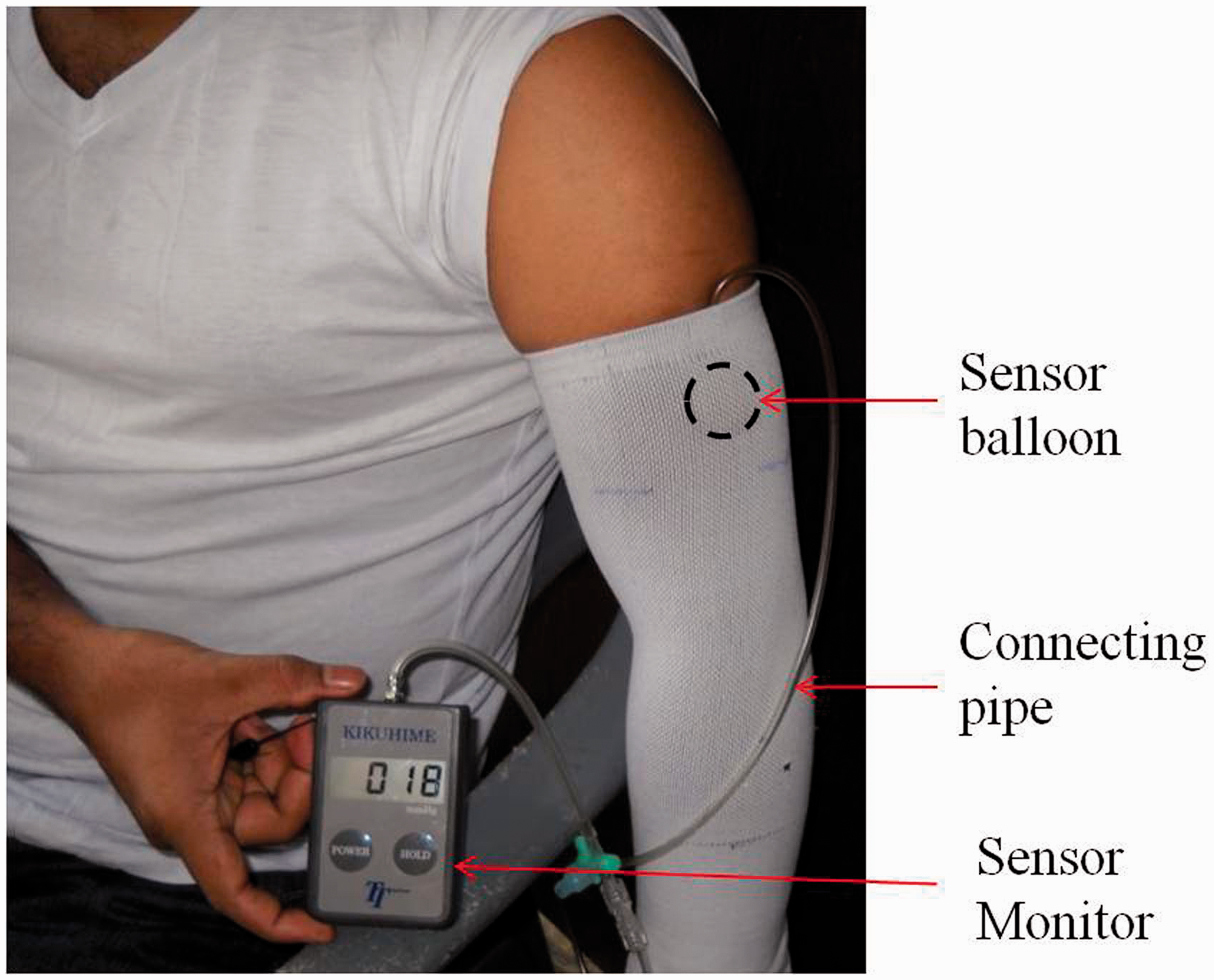
Results and discussion
Tensile properties of fabric
The relative load extension behaviour of fabrics, having different linear density of elastic inlay yarns, up to 300% extension is shown in Figure 4. From Figure 4, it can be seen that at any given extension the maximum tension generated in the fabric is highest in case of fabric made of elastic inlay yarn with highest linear density and vice versa. The phenomenon can be addressed as below.
Load extension curve of fabrics up to 300% extension.
The tensile property of the fabrics in the course wise direction is mainly dependent on the elastic inlay yarns, as elastic inlay yarns are the main load-bearing element. The load extension behaviour of the elastic inlay yarns is given in Figure 5. It can be seen that at any given extension the maximum tension is generated in the yarn having highest linear density and vice versa. Thus, the tension generation in the fabric can be regulated by varying the linear density of elastic inlay yarn. As the pressure generation behaviour directly depends on the tension development in the fabric, it is expected to get varying pressure exertion by using these fabrics.
Load extension curve of elastic inlay yarn.
Pressure exerted by fabric tubes
Female subjects
Interfacial pressures recorded by F750, F950 and F1200 fabric tubes on 10 females at different reduction factors are shown in Figure 6. At any given reduction factor, highest pressure is exerted by the fabric tube with highest linear density of inlay yarn and vice versa. Pressure exertion can be regulated from 6 to 17 mmHg by changing the reduction factor from 20 to 53% by F750 fabric tube. F950 fabric tube developed 5–19 mmHg pressure when reduction factor varies from 7 to 36%. Similarly, 6–26 mmHg is observed on female subjects by F1200 fabric tube when reduction factor varied from 5 to 38%.
Pressure generated on female subjects.
At any given reduction factor (for example 30%), pressure exerted by F750, F950 and F1200 fabric tubes are 10, 16 and 20 mmHg, respectively. It implies that pressure development by the fabric tubes can be regulated by varying the linear density of inlay yarn. Higher the linear density, higher is the exerted pressure.
Male subjects
Interfacial pressure measured on male subjects by F750, F950 and F1200 fabric tubes is shown in Figure 7. The same phenomenon can be seen in male subjects as it was observed in female subjects. Exerted pressure is maximum for fabric tube having maximum linear density of inlay yarn and vice versa.
Pressure generated on male subjects.
The pressure exertion was changed from 4 to 20 mmHg as reduction factor varied from 9 to 53% by F750 fabric tube. A total of 2–26 mmHg pressure was exerted by F950 fabric tube when reduction factor was varying from 2 to 40%. Similarly, F1200 fabric tube developed 3–30 mmHg pressure when reduction factor was varying from 2 to 40%.
At any given reduction factor, say 30%, pressure developed by F750, F950 and F1200 fabric tubes are 15, 18 and 21 mmHg, respectively. So, it can be inferred that exerted pressure can be regulated by choosing appropriate linear density of inlay yarn. However, some overlapping of exerted pressure is seen in Figure 7, which may be due to the difference in body characteristics among the subjects. But the general pressure exertion behaviour can be identified properly from the figure.
Rigid cylinders
Pressure development by F750, F950 and F1200 fabric tubes on rigid PVC cylinders is shown in Figure 8. It can be seen that pressure development increases as the linear density of inlay yarn increases which is also true for female and male subjects.
Pressure generated on rigid body.
A total of 3–51% reduction factor change results in 4–31 mmHg pressure change for F750 fabric tube. F950 fabric tube develops 10–40 mmHg pressure, when reduction factor changes from 6 to 38%. Similarly, 18–47 mmHg pressure can be generated on rigid cylinders when reduction factor is varying from 6 to 38%.
At any given reduction factor, say 30%, pressure exerted by F750, F950 and F1200 fabric tubes are 20, 28 and 37 mmHg. The same phenomenon can be seen in rigid cylinders also. It can be understood that pressure can be changed by changing the linear density of inlay yarn.
The maximum pressure recorded in the present study with F1200 fabric tube on the female subjects is 53 and 37% more than that of F750 and F950 fabrics, respectively. Similarly, maximum pressure exerted on the male subjects by F1200 fabric tube is 50 and 15% more than that of F750 and F950 fabrics, respectively. The maximum pressure exerted on rigid cylinders by F1200 fabric tube is 51 and 17% higher than the pressure exerted by F750 and F950 fabric tubes. The phenomenon can be explained as follows.
The measured maximum reduction factor on human subject was 53% in the tube made from F750 fabric. At 53% reduction factor (
The tension generated in the fabrics up to 300% extension is shown in Figure 4. It can be seen that the tension developed by F750 fabric tube is always less than the other two fabrics. F950 and F1200 fabrics show overlapping load extension curves at some portion. As pressure is directly proportional to the tension development in the fabric (Laplace’s Law, equation (3)), thus, higher is the linear density of the elastic inlay yarn, greater is the pressure

The results clearly depict that the exerted pressure by pressure garments can be regulated by changing the tensile property of the constituent fabric. The elastic inlay yarns are the main load-bearing element in the fabric. Thus, pressure development mainly depends on the tensile property of the elastic inlay yarn. It is well known that the load-bearing capacity of yarn increases with the increase in linear density. Thus, increase in linear density of inlay yarn increases the pressure development on different bodies.
The results also depict that at any given fabric tube and reduction factor, pressure development on rigid cylinder is highest followed by male subjects and female subjects. For example, at 30% reduction factor, the pressure developed by F750 fabric tube on female, male and rigid cylinder are 10, 15 and 20 mmHg, respectively. F950 fabric tube exerts 16, 18, 28 mmHg pressure on female, male and rigid cylinder, respectively, at 30% reduction factor. A total of 20, 21 and 37 mmHg pressure are developed by F1200 fabric tube at 30% reduction factor. It can be noticed that at any given reduction factor, pressure development is always highest on rigid cylinder followed by male body and female body.
The effect of body characteristics causes a difference in the extent of pressure developed. The soft tissues or collagen content is higher in the female body than that in the male body. So the external pressure can compress a female body more than a male body. As the compressibility of the body increases, the exerted energy can dissipate over a larger surface area, so the pressure recorded is always lower in females as compared to males. Pressure on rigid body is always highest.
Conclusions
Tensile behaviour in the transverse direction of an elastic knitted fabric can be regulated by changing the linear density of elastic inlay yarn.
Pressure exertion on a human subject can be regulated by changing the linear density of elastic inlay yarns used in the fabric – higher the linear density higher would be the pressure.
Pressure generation also depends on the body compressibility. Pressure development on female body is always lower than that of male body. Rigid body shows maximum pressure.
Footnotes
Declaration of Conflicting Interests
The author(s) declared no potential conflicts of interest with respect to the research, authorship, and/or publication of this article.
Funding
The author(s) received no financial support for the research, authorship, and/or publication of this article.