




Abstract
Spacer fabrics found vast applications as medical textile due to their intrinsic and unique properties such as good air permeability, breathability, compressibility and comfort. The aim of this study is to utilize weft knitted spacer fabric as pressure garment to apply more uniform interface pressure on limb than common commercial fabrics. Initially, different weft knitted spacer fabrics by varying the spacer fabric thickness (0.8, 1.2 and 1.8 mm) and elastane yarn content (25, 30, 35 and 40%) were produced. Then, mean interface pressure was obtained through conducting the Mannequin test. Based on the Mannequin test results, spacer fabrics with similar applied interface pressure to commercial one were selected to perform human limb test. According to the results, the spacer fabric with the thickness of 1.8
Keywords
Introduction
The walls of the veins lose their elasticity and become stretched due to various reasons. There are some factors which increase the likelihood of developing varicose veins including being female, older age, being overweight, having a job that involves long periods of standing, being pregnant and etc. The varicose veins result in accumulation of blood in vessels which increase the intraluminal pressure and also cause the blood serum to flow out of the vessels to the surrounding tissues. This results in symptoms and complications caused by varicose veins. One of the methods to cure varicose veins is through applying external pressure on these vessels using varicose socks. As a result, the pressure inside the tissue becomes greater than the pressure inside the vessels, so the blood serum flow back from the tissue to the vessels. The use of pressure garments with the aim of treating varicose veins dates back to 1440 in the form of the bandages [1]. Compression or pressure garments are a specific type of clothing which are made of elastic fabrics. These garments are produced relatively smaller than the usual size which cause exerting mechanical pressure on the body surface [2,3]. Providing compression, stabilization and support for underlying tissues are alternative aims of exploiting pressure garment [4]. These types of garments are made in various forms and designs, based on the application or geometry of the body, including bandages, stockings, sleeves or body suits [5]. These products could be utilized for different applications such as medical textile [6–8], beauty gen or sportswear [9,10].
Knitted fabrics are almost used as pressure garments. There are two different techniques in knitting technology known as weft knitting and warp knitting. Both mentioned techniques have their advantages and disadvantages; however, single jersey weft knitted fabrics with plain pattern containing elastane yarns are the most common as the base constituent of compression garments. Some of the features of the fabric such as extensibility [11], elastic recovery [12], hysteresis [13], dynamic elastic properties [14] and also stiffness [15] are more important when being used as pressure garment. Weft knitted fabrics outperform warp knitted ones in terms of the mentioned features. On the other hand, the capability of pressure garment on applying uniform pressure on body with low variance is also of great importance, since in some applications one must use these products for a long period. For medical purposes, for instance, to treat hypertrophic scar, sometimes the pressure garment must be worn 23 hours per day for a whole year to yield ideal results. Besides, the interface pressure must lie between the following ranges 20–30 mmHg [16–19]. Moreover, the lack of comfort, non-uniform pressure distribution and pressure drop after a period of usage are the main disadvantages of the pressure garments [20]. Furthermore, the distribution of applied interface pressure is influenced not only by the pressure garment properties, but also by the body parts which have non-identical mechanical properties. In this regard, for instance, it is reported that the fleshy parts are more capable of resisting the applied pressure than the bony parts [21]. On the other hand, the non-uniform distribution of interface pressure applied by the pressure garment may have destructive damage, since it could apply pressure higher than suggested values which might cause arterial occlusion [22]. For instance, in a pilot study conducted by Wiseman et al. [23] on compression garment therapy after burn, they noticed the applied interface pressure variations from what recommended during the use of pressure garment.
In other medical applications rather than pressure garments, spacer fabrics were proposed as a solution to provide wearing comfort, breathability and reducing the maximum applied pressure [24–26]. Spacer fabrics are three-dimensional weft or warp knitted fabrics that are composed of two separated knitted fabric layers which are connected to each other by yarns [27]. Numerous applications have been found for spacer fabrics due to their intrinsic and unique properties. Weft knitted spacer fabrics’ unique features are outstanding air breathability and compressibility which led to wearing comfort that could be utilized in medical care related garments [28]. For instance, Pereira et al. [24] concluded that knitted spacer fabrics could be employed for medical applications such as knee braces provided that they exhibit good elastic and recovery properties. In another study, the spacer fabrics were proposed to be used as bed sheets, underclothing or hospital shirts with the aim of reducing the risk of pressure ulcers formation [29]. The effect of hoist sling fabric construction on the interface pressure whilst sitting on wheelchair was studied by Webb et al. [25]. According to their findings, the use of spacer fabric could reduce the mean gluteal pressure more than parachute silk and plain polyester. In addition, the peak pressures at the left ischial tuberosity and coccyx were reduced through employing spacer fabrics in comparison to other fabrics. Yu et al. [26] assessed the potential of employing spacer fabrics as inserts in pressure therapy with the goal of treating the hypertrophic scars in comparison to common insert materials, for instance Plastazote. They reported that spacer fabrics not only could apply a comparable interface pressure to Plastazote, but also it provided wearing comfort, much lower air resistance and also higher rate of water vapor transmission. Their clinical study also exhibited the effective treatment of scars using inserts made of spacer fabric [26].
The application of pressure garments in medical fields in the form of clothes or bandages and etc. are growing with the development of sciences. Thus, a comprehensive study is required to be carried out experimentally to exploit pressure garments in an optimal way. Based on the literature review above, weft knitted spacer fabrics are proposed herein as the base constituent of pressure garments for limbs. It is expected to obtain more uniform applied interface pressure mapping on limb via pressure garments made of weft knitted spacer fabrics in comparison to pressure garments made of single jersey weft knitted fabrics. Therefore, to assess the potential use of weft knitted spacer fabric as pressure garment, various weft knitted spacer fabrics with different spacer thicknesses (
Material and methods
Material
In this research, the spacer fabrics were produced by OVJA ER model circular knitting machine with the gauge of 36, which had 96 cam boxes. Nylon 6 (linear density of 40 den), Polyester (linear density of 80 den) and Lycra (linear density of 30 den) yarns were used to produce spacer fabrics. To assess the effect of elastane yarn content and the spacer fabric thickness on the interface pressure applied by the pressure garment, various spacer fabric samples, as presented in Table 1, were produced. This should be noted that Nylon 6 yarns were utilized as spacer yarns, while skins were knitted using Polyester and Lycra yarns using plating technique. Thus, the presented elastane yarn contents in Table 1 are the summation of Lycra contents in both skins of the spacer fabrics. Moreover, interlock pattern was used to produce the spacer fabrics according to Figure 1 [30].
The essential parameters of spacer fabric samples.

The presented data in parentheses are CV%.

The arrangement of needles in interlock pattern.
In this research, four different levels of elastane yarn content (25, 30, 35 and 40%) and three different levels of spacer fabric thickness (0.8, 1.2 and 1.8
The course and wale densities of samples were measured using a fabric density magnifier from five different locations. The presented data for course and wale densities in Table 1 are the average of five data. The areal densities of samples were recorded from circularly cut samples with the diameter of 100
Besides the essential parameters, the tensile properties of samples along the course direction were obtained through performing uniaxial tensile test in accordance with ASTM D5034-09 [31]. In this regard, five specimens with appropriate dimensions (15 × 2.5 cm2) were cut from the sample and tensile loading was applied along the course direction using Zwick Universal Testing machine. The gauge length was set to 75 mm and the rate of displacement was adjusted in a way that the total time of tensile test last exactly 20 seconds. The average Young’s modulus from five repetitions for all samples is presented in Table 1. Average stress-strain diagrams of all samples are shown in Figure 2.
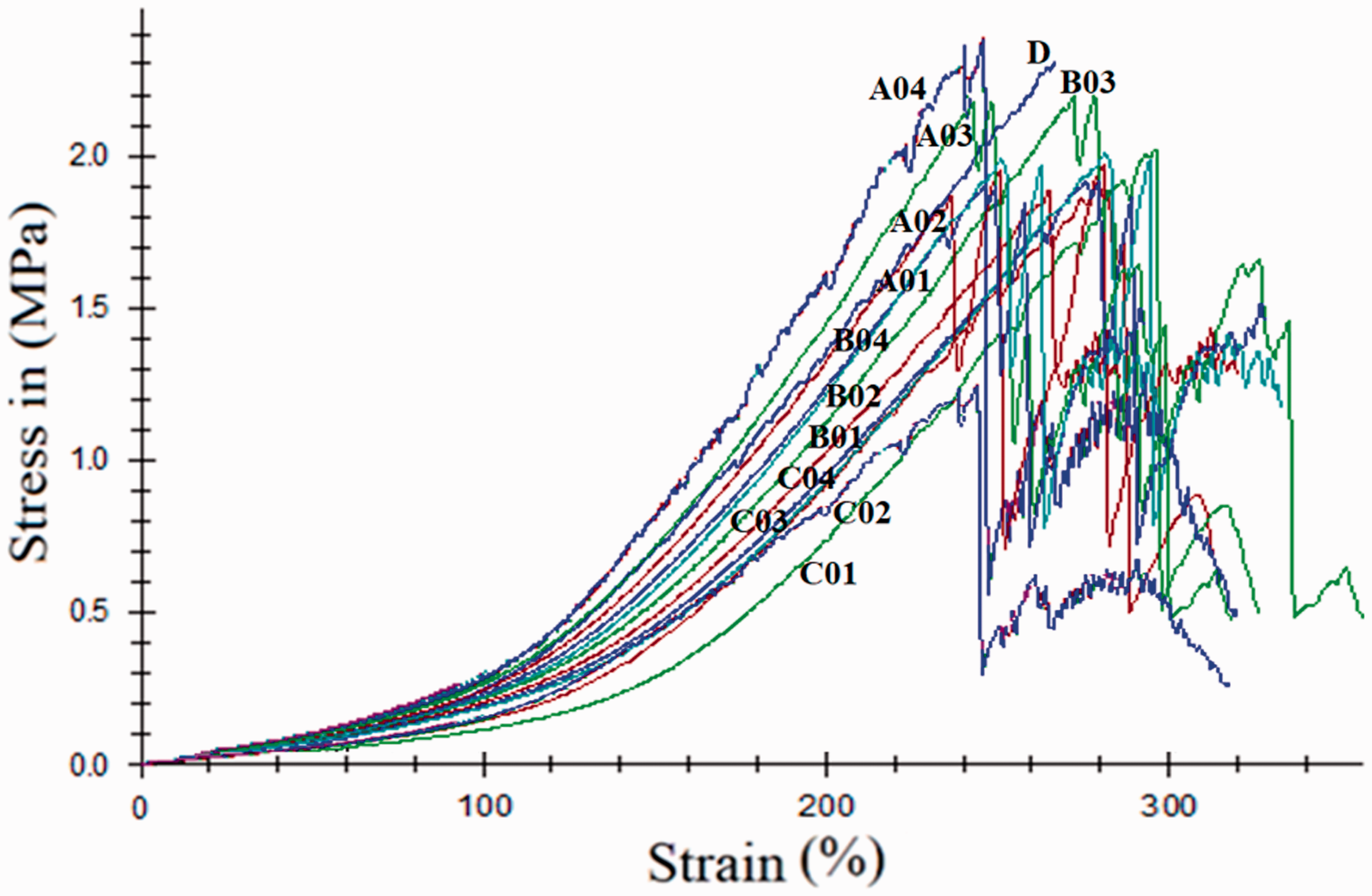
Stress–strain diagrams of all spacer fabric samples.
Interface pressure evaluation method
In this study, two test types were selected to measure the interface pressure: the Mannequin test and human limb test. In the following, the type of measurement device being used, the Mannequin and human limb tests are explained in detail in that order.
The Kikuhime pressure monitoring device was used to measure the interface pressure. This device, as shown graphically in Figure 3(a), is a common system to measure the interface pressure. This device is composed of a silicon tubing which one end is connected to a pressure transducer and other end is attached to a sensor. The sensor is capable of transmitting the pressure readings to the transducer online with the measurement error of 1

(a) The Kikuhime pressure monitoring device and (b) the Mannequin test set-up.
Prior to producing the pressure garments made of spacer fabric samples mentioned in Table 1, an attempt was made initially to get insight about the magnitude of interface pressure applied by each spacer fabric sample. In this regard, the interface pressure was measured using a Kikuhime pressure monitoring device considering the reduction factor of 50% through a Mannequin test. The Mannequin test was conducted using a polyethylene cylinder with the diameter of 15
Afterwards, based on the obtained results from the Mannequin test, the spacer fabric samples with the applied interface pressure similar to the commercial one were selected for the human limb test. To perform human limb test efficiently, an appropriate pressure garment must be designed and produced from the selected spacer fabrics. To this end, based on the examinations made on limb anatomy, a bi-sectional pressure garment was produced. That is, as schematically shown in Figure 4, two sections were considered to prepare the pressure garment. The first section was considered as a cylinder with the radius of (

(a) 2D and (b) 3D schematic of pressure garment design.
The essential specifications of the volunteered participant is presented in Table 2. The human limb test was performed on the left lower limb of the participant and the interface pressure was measured using Kikuhime device. Besides, in Figure 5, the selected positions on limb for measuring the interface pressure are shown schematically. According to Figure 5, the measuring region, which starts from above the ankle and ends below the knee, was divided into 6 sections and in each section four positions were determined (total of 24 positions) for measuring the interface pressure. The selected four positions in each section includes a position on the sheen (denoted by S), a position on the calf (denoted by C), a position on outer side of the limb (denoted by P) and a position on inner side of the limb (denoted by G). The letters “P” and “G” were chosen for outer and inner sides of the limb since these positions are almost located on peroneus longus and gastrocnemius muscles. Therefore, the interface pressure was recorded on the participant’s limb on the predetermined locations and five repetitions were made for each position. Consequently, for each pressure garment sample, a total of 120 interface pressure values were recorded.
The specifications of the volunteered participant’s limb.

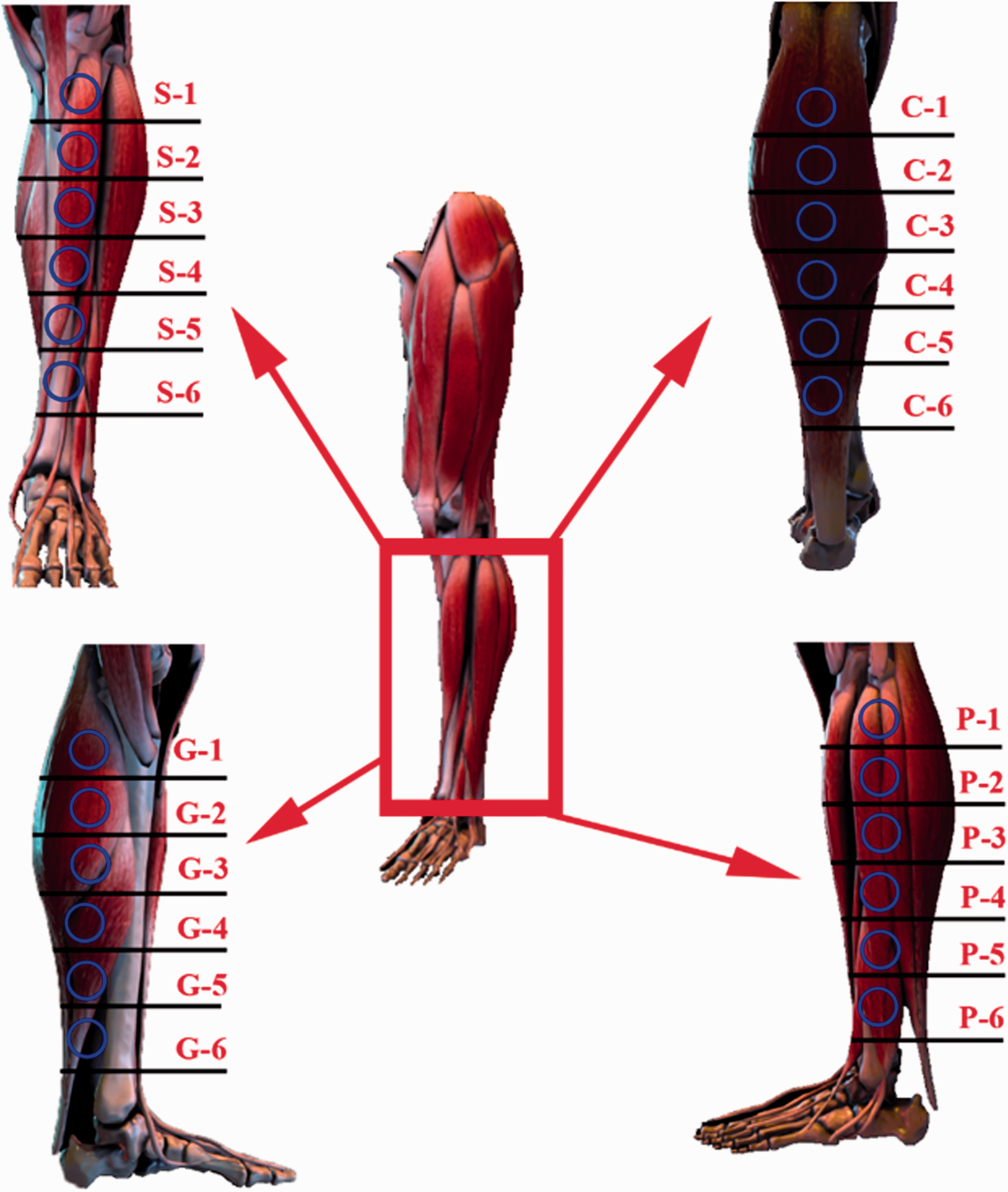
The selected positions on each section for measuring the applied interface pressure.
Results and discussion
Results and discussion of the Mannequin test
The Mannequin test results of all produced samples are presented in Table 3. For the ease of comparison, based on the applied interface pressure, five interface pressure ranges were defined and the samples were categorized based on the defined ranges, as presented in Table 4 and illustrated in Figure 6. According to the presented data, the C01 sample, which is the spacer fabric with the thickness of 1.8
Measured interface pressure from Mannequin test.
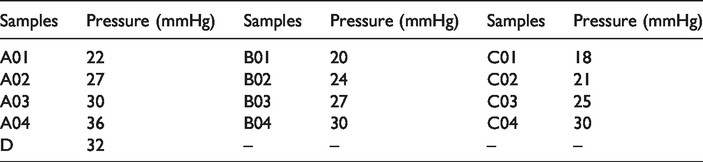
The category of Mannequin test results based on the applied surface pressure.


The Mannequin test results for all spacer fabrics and for commercial pressure garment “D”.
By comparing the Mannequin test results obtained on produced spacer fabrics with the commercial counterparts “D” (plain weft knitted fabric), as shown in Figure 6, one can observe the comparable applied interface pressure (30–33
Prior to dealing with the obtained results from the human limb test, the effect of elastane yarn content and spacer fabric thickness on the interface pressure could be analyzed from the Mannequin test data. To investigate the effect of elastane yarn content, the interface pressure is plotted against the elastane yarn content for various spacer fabric thickness in Figure 7. It is obviously shown that with increasing the content of elastane yarn, the measured interface pressure exhibited a reduction trend, for each considered thickness level (

Effects of elastane yarn content and spacer thickness on interface pressure.
Beside the effect of elastane yarn content, the effect of spacer fabric thickness on the interface pressure can be analyzed through Figure 7. According to Figure 7, the interface pressure reduced with increasing the thickness of spacer fabric. The length of interconnecting yarns between skins or “spacer yarn” increases as the thickness of spacer fabric increases. Therefore, the longer spacer yarn would rotate and undergo bending deformation (buckling) much easier in comparison to the shorter spacer yarns under compression loading. Consequently, with increasing the spacer fabric thickness, the contribution of upper layer in providing interface pressure would diminish due to the dissipation caused by the bending and rotation of spacer yarns between the layers, which results in lower interface pressure. The reduction trend of interface pressure through increasing the spacer fabric thickness can be justified by the proposed model by Patyk and Korlinski [35]. According to the proposed theoretical model by Patyk and Korlinski [35], the spacer yarn’s elastic energy (


According to equation (5), the critical force has an inverse relation with spacer fabric thickness. In other words, as spacer fabric thickness increases, the required critical force to buckle the spacer fabric along the thickness direction decreases. Thus, according to Laplace law (
Results and discussion of the human limb test
As explained in previous sections, three spacer fabric samples applied comparable interface pressure in comparison to the commercial pressure garment sample, according to Mannequin test results. Thus, three pressure garments were prepared from the selected spacer fabrics and their interface pressure mapping and performance were measured using Kikuhime device on a volunteered participant’s limb with the specifications presented in Table 3. The interface pressure was measured on six sections, four positions in each section, of the participant’s limb, as illustrated earlier in Figure 5. The measured interface pressure on participant’s limb is presented in Table 5 for A03 sample. The results for all pressure garment samples (three spacer fabric samples and one commercial sample), for ease of comparing, are illustrated in Figure 8. The presented data are the average of five repetitions.
Applied interface pressure by spacer fabric “A03” on various positions of limb.
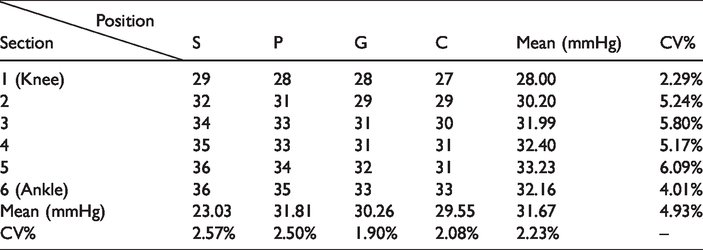

interface pressure map applied by various pressure garments on participant’s limb.
The minimum, maximum and mean value of applied interface pressure on participant’s limb by four samples are illustrated in Figure 9. As can be observed, similar to Mannequin test results, the mean value of applied interface pressure by four samples lies in the range of 30-33

Interface pressure variation of four pressure garment samples obtained from human limb test.
Figure 9 implies that the maximum applied interface pressure on participant’s limb by commercial sample is considerably higher than the measured maximum applied interface pressure by three spacer fabrics. Furthermore, similarly, the lowest applied interface pressure by commercial sample is significantly lower than the measured lowest values by spacer fabric counterparts. In overall, there are narrow variance in the measured interface pressure applied by the pressure garments made of spacer fabrics (A03, B04 and C04), while the counterpart made of weft knitted fabric exhibited wide variance. The more uniform applied interface pressure by spacer fabrics in comparison to commercial fabric is resulted by the presence of spacer yarns in the core of the spacer fabrics. In the other words, the presence of spacer yarns in the core of the spacer fabrics caused uniform distribution of applied interface pressure on limb and also diminished the applied interface pressure on various sections of limb. In addition, one can notice that the commercial pressure garment applied the interface pressure as high as 44
To assess the significant difference between the standard deviations of interface pressure obtained by four samples, the analysis of variance (ANOVA) test was conducted with the significance level of 0.05 on the calculated standard deviation data. The standard deviation results are plotted for four pressure garment samples (A03, B04, C04 and D) in Figure 10. Based on the ANOVA results, there is a significant difference between the standard deviation of pressure garment samples made of spacer fabric (A03, B04 and C04) and the commercial fabric “D”. As discussed earlier, this remarkable difference is due to the presence of piles in the core of the spacer fabric which cause the interface pressure to be applied more uniformly on the limb, especially on boney regions. Among the spacer fabric based pressure garments, the sample “C04”, which has the maximum thickness (1.8

Plot of standard deviation of interface pressure for four pressure garment samples.
Figure 11 depicts the interface pressure profile of the compression garment samples on different sections and positions of the volunteered participant’s limb. For each pressure garment sample, the variation of interface pressure on each section for various positions is illustrated. Based on the depicted interface pressure profiles for four samples, all four pressure garment samples exhibited similar applied interface pressure profile. Thus, the illustrated plot for one sample, for example A03, will only be discussed.
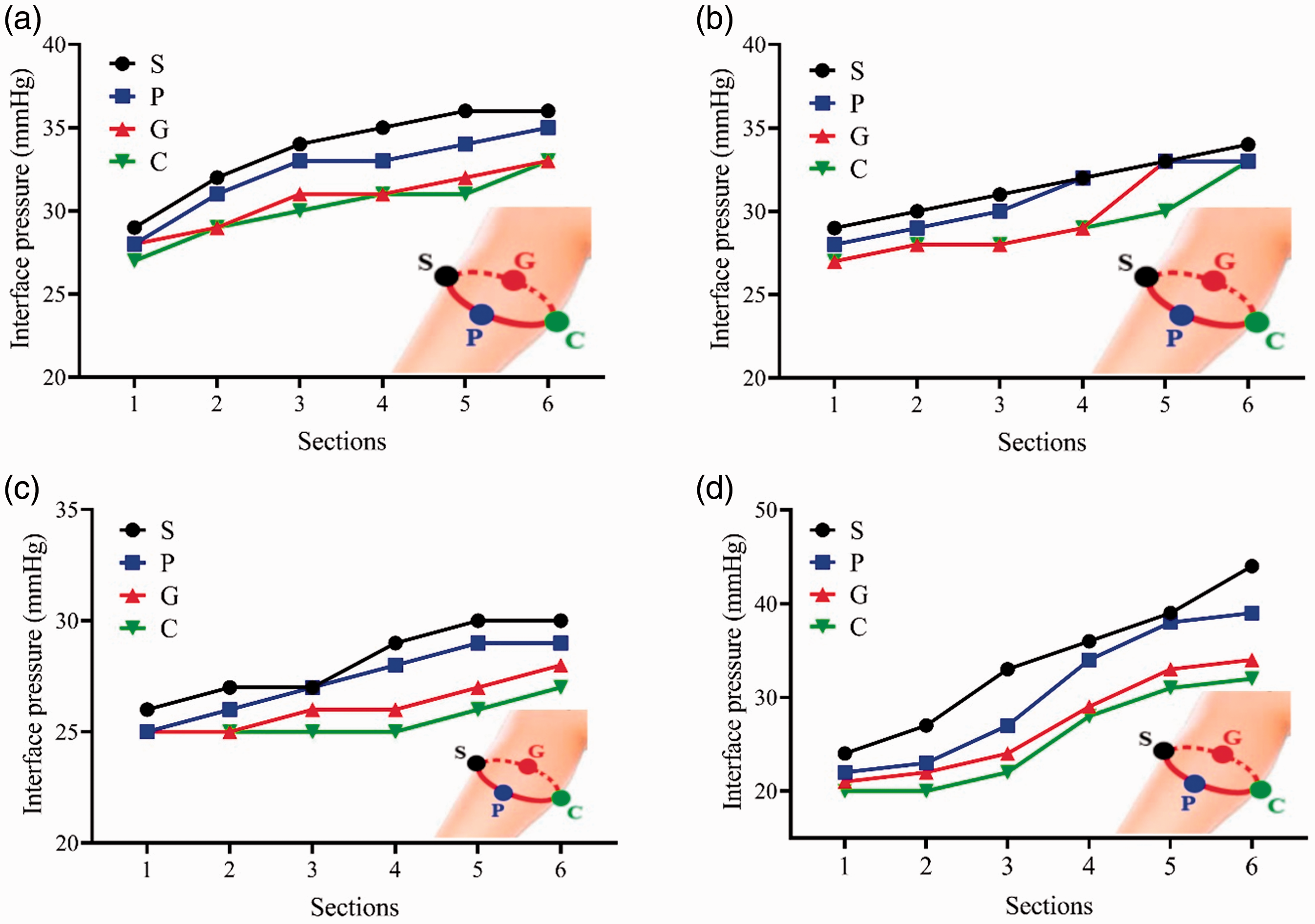
Applied interface pressure profile on participant’s limb by pressure garment sample: (a) A03, (b) B04, (c) C04 and (d) D.
According to Figure 11(a), it can be clearly seen that the applied interface pressure increases in each position (S, P, G or C) as section varies form 1 (below the knee) to 6 (above the ankle). Therefore, as radii of curvature decreases from section 1 to section 6, the applied interface pressure increases, which is well conformed to the Laplace law. On the other hand, from the plotted interface pressure profile, it can be inferred that with reducing the soft tissue from section 1 to section 6, broader variation of interface pressure can be observed and also the magnitude of applied interface pressure increases. The reason is that the soft tissue deform under applied pressure due to its unique flexibility property, thus lower pressure was felt by the participant and also measured in sections containing soft tissue. These findings are well conformed to the reported results by Gupta [21]. Consequently, for each position, the lowest magnitude of applied interface pressure was obtained on section 1 (below the knee).
In addition, according to Figure 11(a), one can observe that the highest interface pressure was applied on position ‘S’, which is located on the shin of the limb. The highest applied interface pressure on position “S” is due to the presence of tibia bone and also there are solely low amount of soft tissue. On the other hand, the lowest interface pressure was applied on spot “C”, which is located on the calf of the limb. Since calf region contains a high amount of soft tissue, the lowest applied interface pressure was measured. The applied interface pressure on position “P”, which is located on the outer side of the limb, is higher than positions “G” and “C”. The higher measured interface pressure on spot “P” is owing to the presence of fibula bone and lower contribution of soft tissue in this region. However, it is noteworthy that the variation of curvature in each section and also along the limb caused the non-uniform interface pressure distribution and subsequently the non-uniform induced stress. Unlike concave curvature, the smaller the radii of the convex curvature, the more interface pressure is applied and also more stress is induced on the pressure garment. However, according to interface pressure profiles depicted in Figure 11, one can conclude the superior performance of spacer fabrics as pressure garment in terms of uniform distribution of applied interface pressure on limb. On the contrary, the commercial sample, which was a single jersey weft knitted fabric with plain pattern, exhibited non-uniform distribution of interface pressure. On some positions, an interface pressure as high as 44 mmHg was applied on the participant’s limb while on other positions, an interface pressure as low as 20 mmHg was applied on the participant’s limb by the commercial pressure garment. These findings confirms the potential use of spacer fabric as pressure garment for medical applications in case of requiring a more uniform interface pressure accompanying with the wearer comfort and breathability.
Conclusion
Weft knitted spacer fabrics were proposed in this study as an alternative base materials for producing pressure garments with the aim of applying uniform interface pressure. In this regard, an experimental study was designed to investigate the effects of spacer thickness and elastane yarn content on the applied interface pressure mapping. Thus, four levels of elastane yarn content (25, 30, 35 and 40%) and three levels of weft knitted spacer thickness (0.8, 1.2 and 1.8
Footnotes
Declaration of conflicting interests
The author(s) declared no potential conflicts of interest with respect to the research, authorship, and/or publication of this article.
Funding
The author(s) received no financial support for the research, authorship, and/or publication of this article.
