




Abstract
Phase change nanofibers based on polyamide 6 and polyethylene glycol, in which polyethylene glycol acted as a model phase change material and polyamide 6 acted as a supporting material, were successfully prepared via electrospinning. Morphology, compatibility, thermal stability, thermo-regulated performance and physical properties of the polyamide 6/polyethylene glycol thermo-regulated nanofibers were studied. Morphology observation indicates that the addition of polyethylene glycol can improve the spinnability of the nanofibers, and polyamide 6 has a good compatibility with polyethylene glycol. Fourier transform infrared spectrometer characterization results show that polyethylene glycol is well added into polyamide 6 nanofibers, and hydrogen bonding interactions exist between polyamide 6 and polyethylene glycol. Differential scanning calorimetry and heating (cooling) experiment analyses show that the electrospinning polyamide 6/polyethylene glycol blended nanofiber has effective thermo-regulated properties. Mechanical properties experiments show that tensile strength of polyamide 6/polyethylene glycol composite nanofibers decreases with the increasing of polyethylene glycol content in the nanofibers.
Introduction
Thermal energy storage has gained more and more interest due to the impending shortage and increasing cost of energy resources nowadays [1]. Phase change material (PCM) is a significant and attractive material for latent heat storage because of its high-energy storage density and small temperature variation from storage to retrieval [2]. Thermal energy storage using PCM is one of the effective methods of conserving energy. In the past decades, PCM has been extensively investigated and applied successfully in various areas (such as solar energy storage, energy efficient buildings, space and water heating, waste heat utilization, cooling and air-conditioning, medical application, cooling of engines, thermo-regulating fibers and smart textiles, and so on) [3–5]. In general, the PCM has a lot of advantages including, but not limited to, high heat storage density, small temperature variation from reserve to release thermal energy, small heat storage container and much less insulation required [6]. Phase change fibers, also called thermo-regulated fibers, are prepared by adding PCM into fibers [7]. Generally, phase change fibers can regulate temperature through energy exchange with environment caused by PCM in the fibers during the phase transition process as the ambient temperature alters [8–10]. Electrospinning is a simple and feasible technique for fabricating nanofibers using a wide variety of natural polymers, synthetic polymers, polymer blends and polymers with inorganic nanometer particles. Electrospinning nanofibers have been applied in many fields, such as biomaterials, textile and clothing, filtration, energy storage materials and so on [11–15]. Polyamide 6 (PA6) fibers have good mechanical properties, non-toxicity and thermal stability [16]. Polyethylene glycol (PEG) can obtain a certain amount of enthalpy through its phase change from amorphous to crystal, which absorbs, stores and releases it in the form of latent heat under normal temperature [17]. Consequently, PEG can be used as phase change and energy storage materials. There are a few reports about the electrospinng nanofibers which are used as PCMs. Chen et al. [18] prepared the PEG/cellulose acetate blended nanofibers, and studied the morphology, structure and phase change behaviors of the nanofibers, the results showed that the PEG/cellulose acetate-blended nanofibers had enormous applicable potentials in thermal energy storage. Zhang et al. [19] fabricated the PVA/PEG nanofibers, and investigated the technological parameter of the electrospinning. Seifpoor et al. [20] prepared the nylon 6,6/PEG nanofibers, and differential scanning calorimetry (DSC) was used to characterize the thermo-regulated properties. However, the structure, thermo-regulated performance and physical properties affected by the blended ratio of the PCM have not been systematically investigated in the previous studies. Furthermore, few reports studied the compatibility of the PCM and polymers. In this research, PEG was selected as the PCM and PA6 was used as the polymer carrier. Thermo-regulated PA6/PEG-blended phase change nanofibers were prepared by means of electrospinning. Morphology, compatibility, thermo-regulated properties, thermal stability and physical properties of the PA6/PEG thermo-regulated nanofibers were studied by scanning electron microscopy (SEM), transmission electron microscope (TEM), Fourier transform infrared spectrometer (FTIR), electronic fabric strength tester and thermo-gravimetric analyzer (TGA). Furthermore, the thermo-regulated behavior of the PA6/PEG-blended nanofibers was characterized by means of DSC and heating (cooling) experiment. The aim of this research is to explore the feasibility of the electrospun PA6/PEG-blended nanofiber as thermo-regulated material.
Experimental section
Preparation of phase change nanofibers
A predetermined amount of PA6 pellets (Sigma Aldrich Co., Ltd) and PEG powder (with molecular weight of 4000, Sinopharm Chemical Reagent Co., Ltd, chemically pure) were mixed in the mass ratio (100:0, 90:10, 80:20, 70:30, 60:40 and 50:50) and dissolved in formic acid (98 wt%, Tianjin Organic Synthesis Factory, China, analytical reagent), then stirred for 60 min until a homogeneous spinning solution (13 wt%) was obtained. Electrospinning process was carried on self-assembled machine, as shown in Figure 1. Optimized parameters were set as follows: voltage was 30 kV, distance between needle and collector was 13 cm, solution feed rate was 0.1 ml/h and inside diameter of needle is 0.9 mm.
Schematic diagram of electrospinning.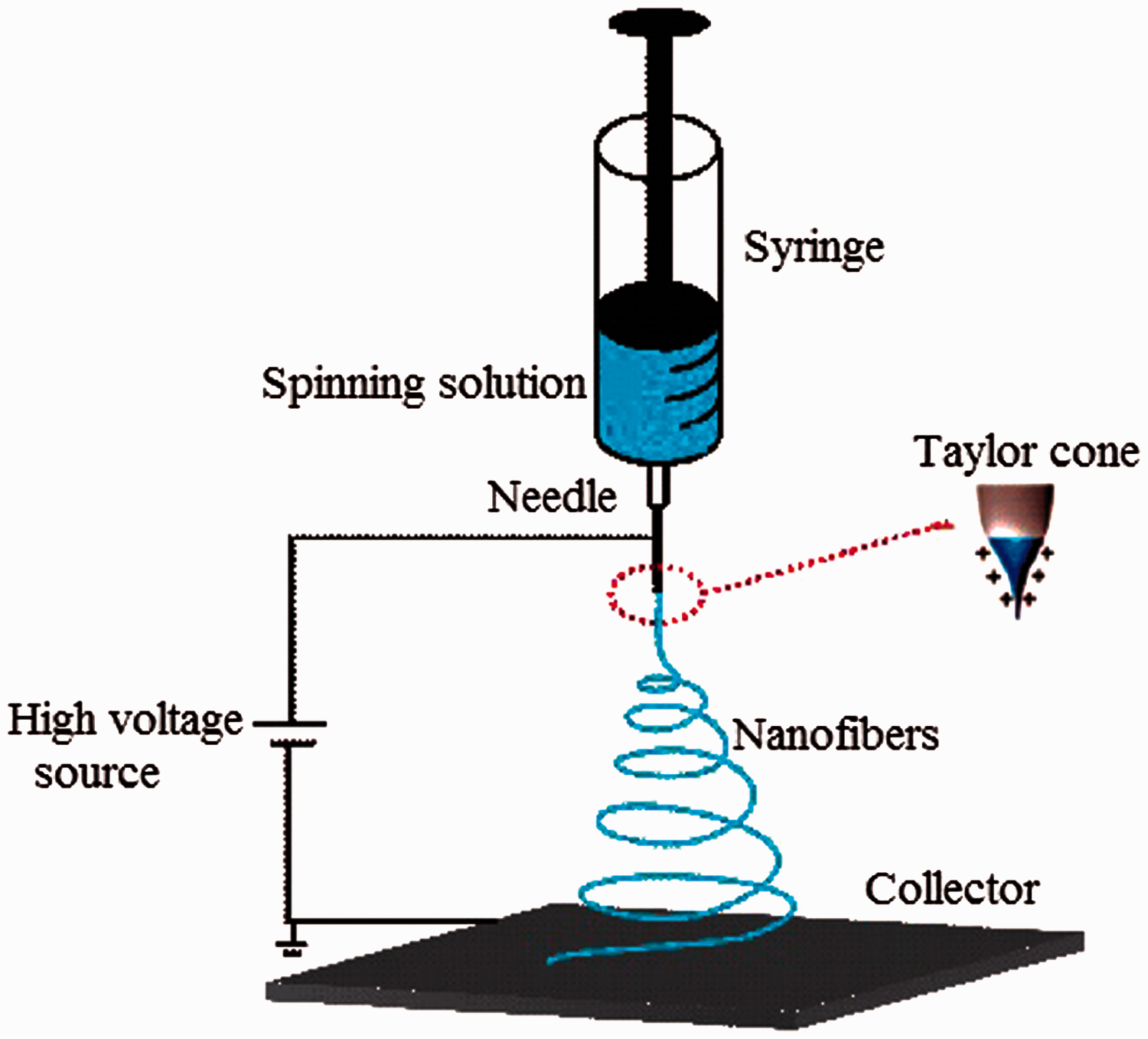
Viscosity of the spinning solution
Rheometer (HAAKE RheoStress 6000, Thermo Fisher Scientific Co., Ltd) was employed to measure the viscosity under different shear rates of the electrospinning solution. Frequency sweeps were collected continuously over a wide frequency range from 100 to 1 rad s−1 at 25℃. All samples were stabilized for 20 min before the measurement.
Morphology of the PA6/PEG nanofibers
Morphology of the electrospinning nanofibers were observed by SEM (S-4800, Hitachi) and TEM (Hitachi-600). Based on SEM images, fiber diameter and standard deviation were analyzed with an image analysis program (Adobe Photoshop 7.0).
FTIR characterization of the PA6/PEG nanofibers
Compatibility of the electrospun nanofibers is measured by FTIR spectra. FTIR spectrum was obtained by using a series spectrometer (Nicolet 5700, USA) in spectral region of 4000–400 cm−1, the powdered electrospinning scaffolds were pressed into potassium bromide (KBr) pellets prior to data collection.
Thermo-regulated properties and thermal stability of the PA6/PEG nanofibers
DSC and TG curves were determined by thermal analyzer (Diamond 5700, PE Co., Ltd, USA) at a heating rate of 10℃/min, scan range of 40–400℃ and nitrogen gas flow rate of 120 mL/min, which could characterize thermo-regulated performance and thermal stability of the nanofibers. Enthalpy value of the nanofibers could be obtained based on DSC. DTG curves were obtained from the TG curves by differential using the origin 8 soft.
In order to further investigate the thermo-regulated performance of the electrospun PA6/PEG-blended nanofibers, the heating and cooling experiments were carried out. Before heating and cooling experiment, all the samples were balanced under constant temperature and humidity (T = 23℃, RH = 60%). For heating experiment, the electrospun nanofibers were put in the flat plate heat preservation apparatus (Model XF814-YG606D). Before the electrospun nanofibers were put in the flat plate heat preservation apparatus, the parameter of the flat plate heat preservation apparatus was set for 60℃, during the heating experiment, the parameters were kept unchanged. Infrared radiation thermometer (Model HS-CW3000) was used to measure the surface temperature of the electrospun nanofibers from 1 min to 5 min, the frequency of the measurement was 30 s, and then the heating curve was obtained. For cooling experiment, the electrospun nanofibers were put in the oven (60℃) for 1 h, and then the electrospun nanofibers were taken out from the oven and put in the heat insulation pad. Infrared radiation thermometer was used to measure the surface temperature of the electrospun nanofibers from 1 min to 5 min, the frequency of the measurement was 30 s, and then the cooling curve was obtained.
Mechanical properties of the PA6/PEG nanofibers
We measured the mechanical properties according to the standard of ISO13934.1. Samples were balanced under constant temperature and humidity (T = 23℃, RH = 70%). After balanced for 24 h, the tensile testing was performed by using fabric electronic tensile strength tester (Model YG026PC). The length of samples was 50 mm and the width was 10 mm (Gauge length was 20 mm, load cell was 100 N). The cross-head speed was 10 mm/min, three samples in each group, each membrane was selected at five points to test the thickness by digital fabrics thickness instrument (Model YG(B)141D), and then calculated the average values. Mechanical properties were characterized according to the following formula


Results and discussion
Compatibility analysis between PA6 and PEG and morphology of the PA6/PEG nanofibers
Many techniques have been used to characterize the polymers’ compatibility, such as morphology, thermodynamics, dynamics, intermolecular forces and so on [21]. In this study, the compatibility of PA6 and PEG is characterized by means of morphology and intermolecular forces (see ‘FTIR characterization of the PA6/PEG nanofibers’ section). In order to investigate the compatibility between PA6 and PEG, the morphology of the PA6/PEG-blended nanofibers is observed by SEM and TEM, the results are shown in Figure 2. Morphology characterized the compatibility via observing the continuous phase and dispersed phase. As shown in Figure 2, both the SEM image (Figure 2b) and TEM image (Figure 2d) of the PA6/PEG-blended nanofibers did not show the dispersed phase when compared to Figure 2(a) and (c), which indicates a good compatibility between PA6 and PEG.
Compatibility analysis of PA6 and PEG: SEM images of (a) PA6 nanofibers and (b) PA6/PEG (70/30) blended nanofibers, TEM images of (c) PA6 nanofibers and (d) PA6/PEG (70/30) blended nanofibers and (e) viscosity of the electrospinning solution.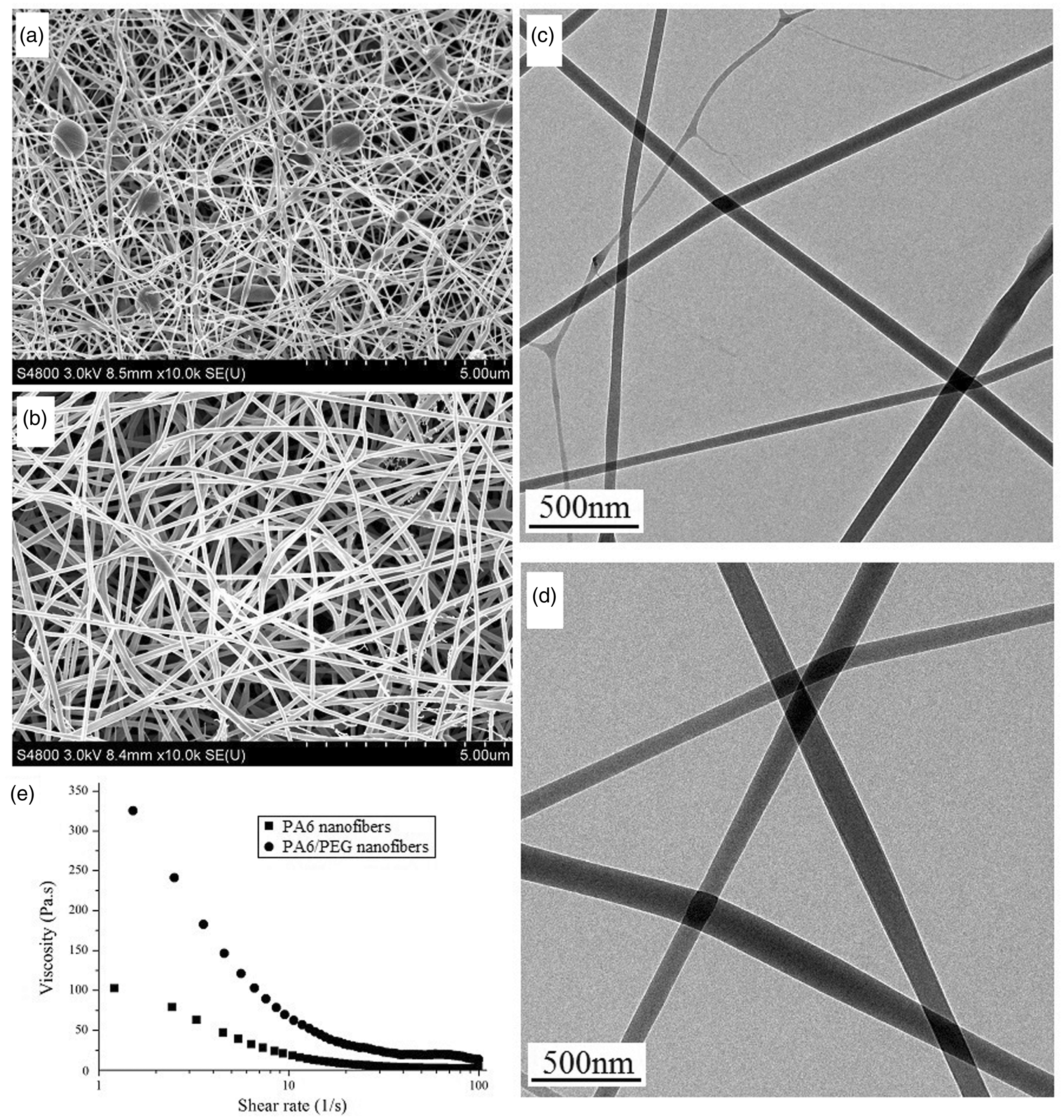
Furthermore, it could be seen from Figure 2(a) and (c) that the pure PA6 nanofibers are uneven with breakage and beads. However, as shown in Figure 2(b) and (d), with the addition of PEG, PA6/PEG-blended nanofibers (blended ration is 70:30) show excellent morphology with regular shape, uniform distribution and no breakage, which also indicates that PA6 has good compatibility with PEG. The above results demonstrate that the addition of PEG improves the spinnability of electrospinning, this may be because the addition of PEG increases the viscosity of the spinning solution, which can be proved by Figure 2(e).
Figures 3 and 4(a) show morphology and diameter of the PA6/PEG-blended nanofibers with different blended ratio of PEG. It can be seen from Figures 3 and 4(a) that with the addition of PEG, the spinnability of the solution is greatly improved, and the diameter of the nanofibers increases. When the PA6/PEG mass ratio reaches 70/30, as shown in Figure 3(d) and (d′), the PA6/PEG-blended nanofibers show regular shape, no beads and no adhesions with average diameter of (104 ± 14) nm. However, with the further increase of PEG concentration, distribution of the PA6/PEG-blended nanofibers becomes uneven. When the PA6/PEG mass ratio reaches 50/50, beads occur and the diameter of the nanofibers increases. Meanwhile, the spinnability of the solution becomes bad, which may be caused by the viscosity of the electrospinning solution. Figure 4(b) shows the viscosity of PA6/PEG solution with different PA6/PEG mass ratios. It can be seen from Figure 4 that with the increase of PEG content (lower than 30%) in the nanofibers, the viscosity of the solution increases, which induces the good spinnability of the solution. However, as the PEG content in blended nanofibers continues to increase, the viscosity of the solution decreases, which then leads to the bad spinnability of the solution. This is probably due to poor fluidity of PEG, and the addition of PEG hinders PA6’s flowing, which causes the increase of viscosity of the solution. When the addition of PEG exceeds a certain amount (higher than 30%), it reduces entanglement among macromolecules and intermolecular forces of PA6, which causes the decrease of viscosity of the solution [22].
Morphology of the PA6/PEG-blended nanofibers with different blended ratio: (a) 100:0, (b) 90:10, (c) 80:20, (d) 70:30, (e) 60:40 and (f) 50:50. Influence of the blended ratio on the average diameter of the nanofibers and viscosity of the spinning solution: (a) average diameter of the phase change nanofiber, (b) viscosity of the spinning solution.

FTIR characterization of the PA6/PEG nanofibers
In order to further investigate the compatibility and intermolecular forces between PA6 and PEG, FTIR spectra of pure PA6 nanofibers and PA6/PEG-blended nanofibers are measured, which are shown in Figure 5. As shown in Figure 5(a), characteristic absorption peak of pure PA6 nanofibers at 3439 cm−1 is assigned to the stretching vibration of N–H bond. Peaks at 1648 cm−1 and 1532 cm−1 are characteristic absorption peaks of amide I and amide II in PA6 [23]. As shown in Figure 5(g), peaks at 843 cm−1 is the characteristic absorption peak of -CH2- in PEG, and peaks at 962 cm−1 is the crystalline absorption peak, the characteristic absorption peak of PEG at 1110 cm−1 is attributed to the stretching vibration of C-O bond. Peaks at 2884 cm−1 is the characteristic absorption peak of C-H, and peaks at 3325 cm−1 is the characteristic absorption peak of O-H in PEG [24]. As shown in Figure 5(b)–(f), the electrospun PA6/PEG-blended nanofibers not only show absorption peaks at 3439 cm−1 but also show absorption peaks at 3325 cm−1. Furthermore, characteristic absorption peaks of amide I and amide II in PA6/PEG-blended nanofibers shift to 1641 cm−1 and 1528 cm−1, respectively. This may be due to the formation of hydrogen bonding between the N-H or C-O group in PA6 and the C-O or O-H in PEG. Another important factor that influences the compatibility between two polymers is intermolecular forces such as hydrogen bonds, ions, charge transfers and so on [21]. The result is consistent with that of the morphology analysis, which shows that the PCMs (PEG) are well introduced to the polymers (PA6), and there is an excellent compatibility between them. Moreover, it could also be seen from Figure 5(b) to (f) that the characteristic absorption peaks of PA6/PEG-blended nanofibers at 843 cm−1, 962 cm−1 and 1110 cm−1 become sharper with the increase of PEG content, which further demonstrates that PCMs (PEG) were well introduced into PA6.
FTIR spectra of the phase change nanofibers: (a) PA6/PEG100/0, (b) PA6/PEG90/10, (c) PA6/PEG80/20, (d) PA6/PEG70/30, (e) PA6/PEG60/40, (f) PA6/PEG50/50 and (g) PEG powder.
Thermo-regulated properties and thermal stability of the PA6/PEG nanofibers
DSC curves and enthalpy value of electrospinning PEG/PA6-blended nanofibers with different mass ratios are shown in Figures 6 and 7.
DSC curves of the electrospinning phase change nanofibers. Enthalpy value of the electrospinning phase change nanofibers.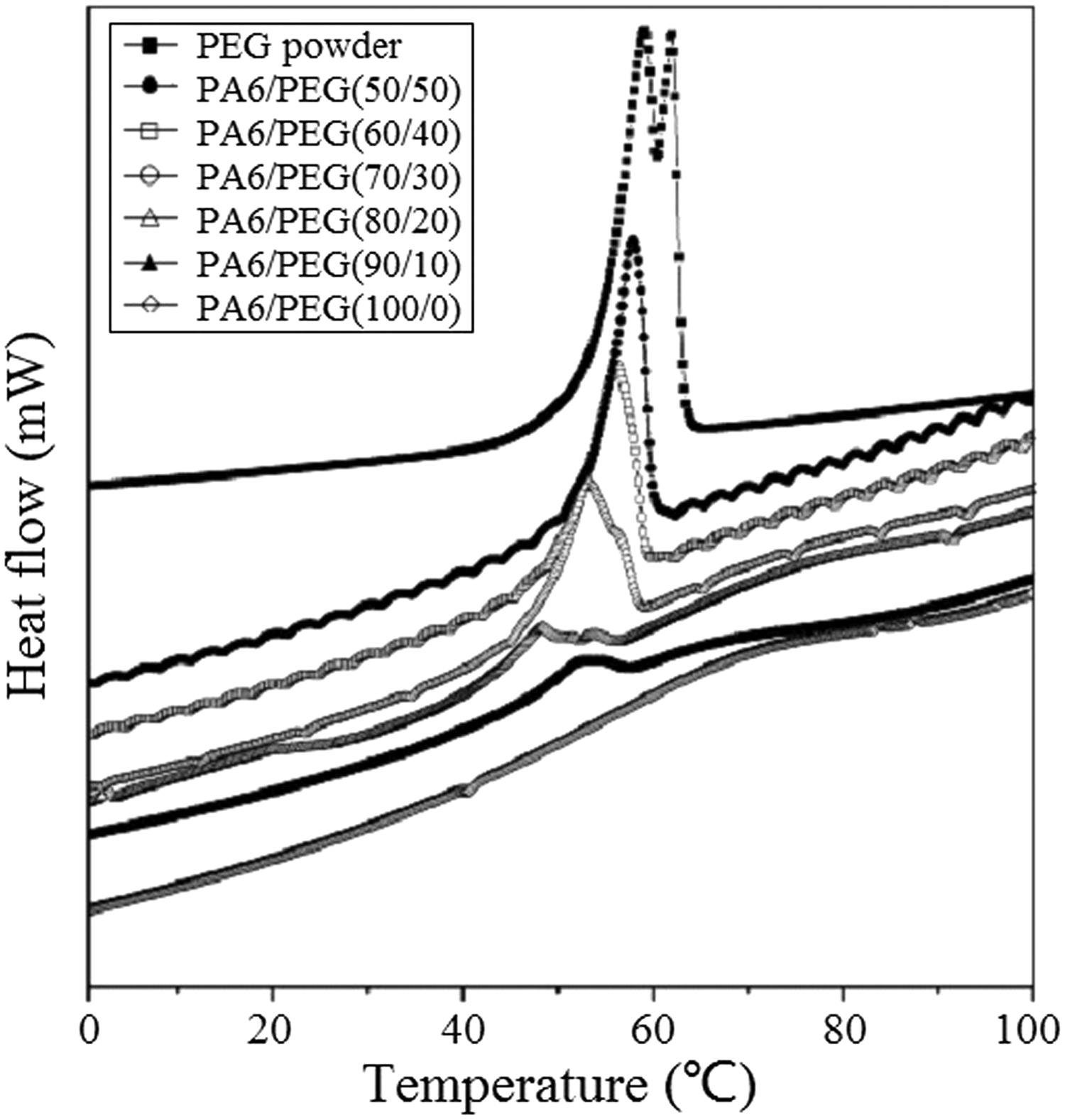
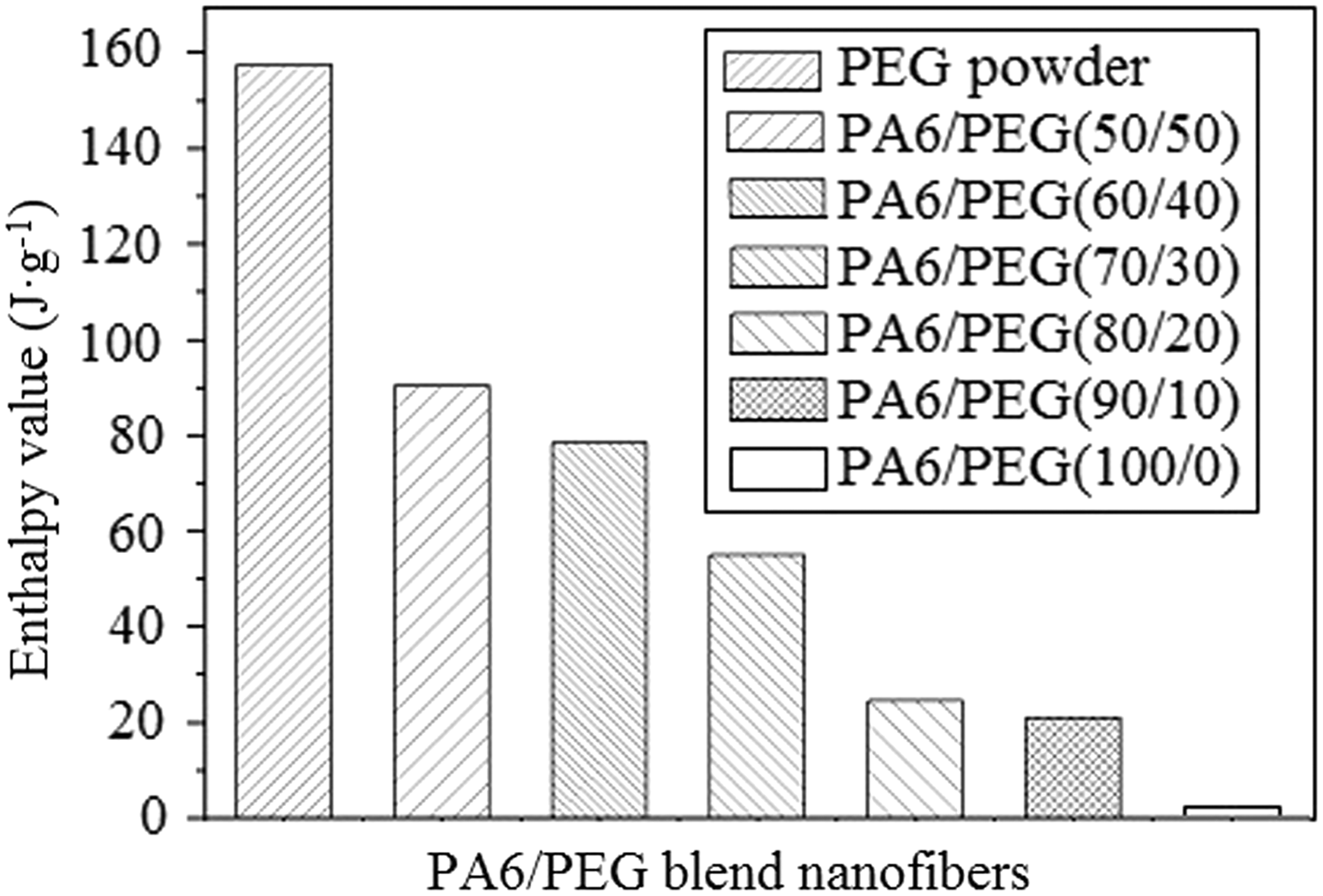
It could be seen that the phase-transition temperature and enthalpy value of PEG/PA6-blended nanofibers are higher than those of the pure PA6 nanofibers (have no phase-transition temperature), and they increase with increase of PEG content, which is because of the energy stored by PEG. It demonstrates that the energy of solid-liquid phase transition of the electrospinning PA6/PEG-blended nanofibers increase with the addition of PEG. The above results indicate that the electrospinning PA6/PEG-blended nanofibers have effective thermo-regulated properties, while the pure PA6 nanofibers do not have thermo-regulated properties. Furthermore, the thermo-regulated properties can be improved by increasing the mass ratio of PEG. It also can be found that both the phase-transition temperature and enthalpy value of PEG/PA6 nanofibers are lower than those of the PEG powder, which is because the melting temperature of PA6 are relatively high (about 220℃) [25], and it remains solid phase and does not supply enthalpy within the thermo-regulated range of PEG.
The thermo-regulated performance of the electrospun PA6/PEG-blended nanofibers is further investigated by means of the heating and cooling curves, which are shown in Figure 8(a) and (b), respectively. It can be seen from Figure 8(a) and (b), both the heating and cooling rate of the PA6/PEG-blended nanofibers are lower that those of the pure PA6 nanofibers, and the heating and cooling rate decrease with the increase of the blended ratio of PEG. Furthermore, it can be seen that the surface temperature of the PA6/PEG-blended nanofibers (with blended ratio of 50/50) is about 10℃ lower or higher than that of the pure PA6 nanofibers during the heating and cooling process. With the extension of heating or cooling time, the surface temperature of the PA6/PEG-blended nanofibers is close to that of the pure PA6 nanofibers. From the above results, the heating and cooling rate decreases when compared to the pure PA6 nanofibers obviously. The results further prove that the electrospun PA6/PEG-blended nanofibers have effective thermo-regulated properties.
Kinetic curves of the PA6 nanofibers and PA6/PEG-blended nanofibers in (a) heating process and (b) cooling process.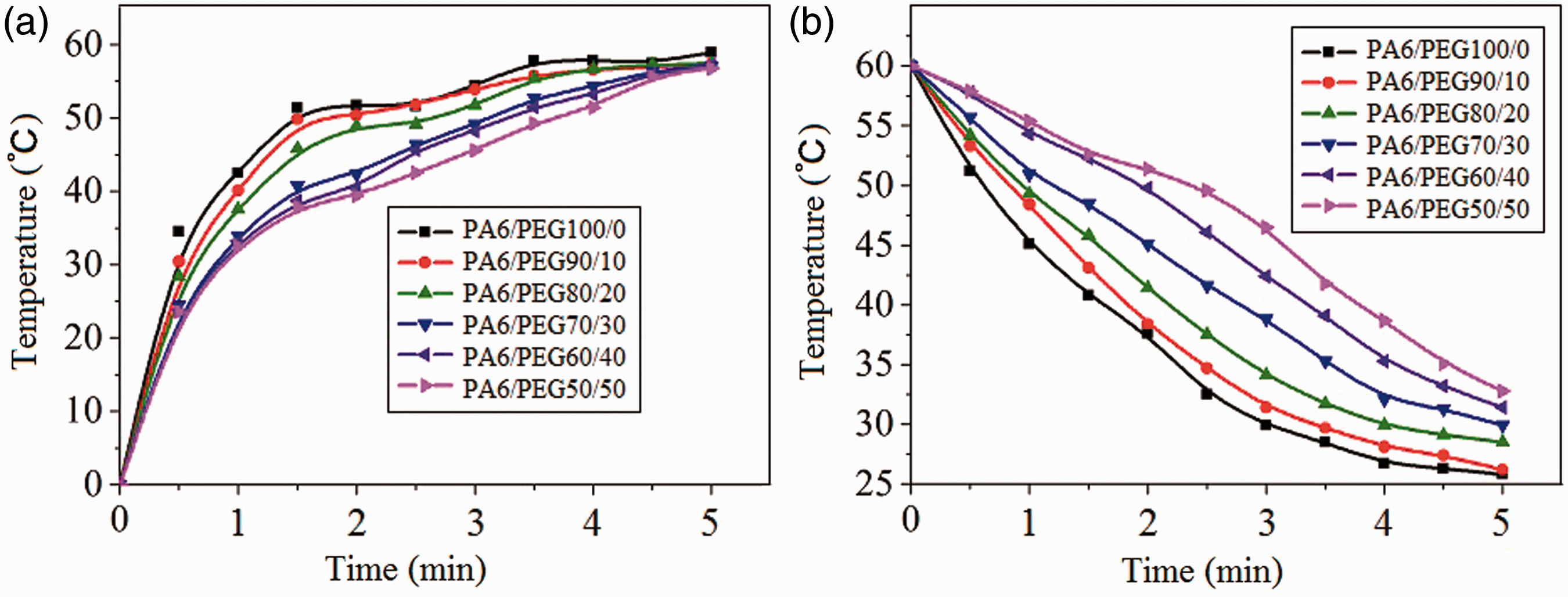
TG and TGA curves are used to investigate the thermal stability of pure PA6 nanofibers and PA6/PEG-blended nanofibers, the results are shown in Figure 9. It could be seen from Figure 9 that the decomposition temperature of pure PA6 nanofibers is higher than that of the PA6/PEG-blended nanofibers, and the decomposition rate is also lower than that of the PA6/PEG-blended nanofibers. Furthermore, it could also be seen that the decomposition temperature decreases and the decomposition rate accelerates with the increase of PEG content. This is because the molecular weight of PEG is less than that of the polymer (PA6), and PEG is easy to decompose under high temperature [26], which leads to the thermal stability of PA6/PEG-blended nanofibers being inferior to that of the pure PA6 nanofibers.
Thermal stability of the phase change nanofiber: (a) TG curves and (b) TGA curves.
Mechanical properties of the PA6/PEG nanofibers
Mechanical properties of the pure PA6 nanofibers and PA6/PEG-blended nanofibers are shown in Figure 10. As shown in Figure 10, the breaking strength of the pure PA6 nanofibers is higher than that of all blended nanofibers, and it decreases with the increase of PEG content. However, the elongation (which could characterize the elasticity of the nanofibers) of PA6/PEG-blended nanofibers increases with the increase of PEG content. This is because the molecular weight of PEG is lower than that of the polymer (PA6), as mechanical properties (especially for breaking strength) are affected by molecular weight of the polymers [27]. And it could also be known from the thermal stability of PA6/PEG-blended nanofibers that the structure stable of PA6/PEG-blended nanofibers is poor than that of the pure PA6 nanofibers.
Mechanical properties of the phase change nanofiber.
Conclusions
Thermo-regulated PA6/PEG-blended nanofibers can be prepared successfully via electrospinning. Addition of PEG improves the spinnability of the electrospinning nanofibers. SEM and TEM images show that PA6 has good compatibility with PEG. Morphologies indicate that the diameter of the nanofibers increase with the increase of PEG content. High quality of PA6/PEG-blended nanofibers with regular shape, no beads and no adhesions could be obtained with the PA6/PEG mass ratio of 70/30. However, the quality of the nanofibers will become bad if the mass ratio of PEG continue to increase. FTIR results show that PEG are well introduced into PA6 and has good compatibility with PA6, hydrogen bonding interactions form between PA6 and PEG as well. Melting temperature and enthalpy value of PEG/PA6-blended nanofibers are higher than those of the PA6 nanofibers. With the increase of PEG mass ratio, energy of solid-liquid phase transition of the electrospinning PA6/PEG-blended nanofibers increase. The electrospinning PA6/PEG-blended nanofibers have effective thermo-regulated properties. Breaking strength of the pure PA6 nanofibers is higher than that of the blended nanofibers. However, the elongation increases with the increase of PEG content. From the above results, the electrospun PA6/PEG nanofibers with reliable thermal properties are suitable and promising in serving as phase change fibers for thermal energy storage and temperature regulation.
Footnotes
Acknowledgement
The authors are grateful for the practice innovation training program projects for the Jiangsu college students (S2011861).
Declaration of Conflicting Interests
The author(s) declared no potential conflicts of interest with respect to the research, authorship, and/or publication of this article.
Funding
The author(s) disclosed receipt of the following financial support for the research, authorship, and/or publication of this article: This research is supported by a grant from the financial support by Qinglan Project of Educational Department of Jiangsu Province (2012) and Senior Visiting Engineers of Jiangsu Higher Vocational Education (2013FG104).