




Abstract
The use of cushioned insoles has been recommended as a method to reduce the impact forces on feet associated with running. This study is used to determine the influence of insole structure and thickness on the permeability and conductivity properties of air and temperature. The insoles are constructed with warp-knitted polyester spacer fabrics with 3D construction and have good cushioning, permeability, and conductivity properties. The middle layer is made up of polyester monofilament yarn which decides the thickness of fabric, and the two outer surfaces of the fabric were made from polyester multifilament yarns which is a closed and open structure. The comfort properties of spacer fabric have been studied by measuring air permeability, water vapor permeability, and thermal properties with respect to fabric porosity. One-way analysis of variance is used to analyze the significant of fabric thickness and surface structures. The experimental result shows that the vertical gap of the two outer surface layers and the horizontal pore size of the face surface decide the permeability and conductivity properties of spacer fabrics. The fabric with higher porosity show high permeability of air and water vapor. Depending on the fabric thickness and structure, the 4-mm thickness of spacer fabric with locknit structure resulted in low air and water vapor permeability. It is found that the 3.1-mm thickness spacer fabric with hexagonal net structure proves to have good air and water vapor permeability and comparatively lower thermal conductivity.
Introduction
Comfort is one of the required one in world’s sports textiles. Several scientists had focused their work on the foot wear. Shoes are evacuating the warmth generated in the foot while on foot or running. The main modes of heat transfer are encountered as conduction, convection, and radiation. The convection of heat happens through the aeration of the gap and also by evaporation, which are the principal mode of heat transfer between the foot and the ambient air [1]. The purpose of insole is to reduce the force transmission and customizing shoe to protect the foot and reduce the occurrence or recurrence of heat [2]. The cushioned or shock-absorbing insoles have been recommended as a material to diminish the impact forces connected with running and to reduce plantar pressures, thereby shielding against discomfort [3,4]. Some investigations had proved that the use of cushioned insoles reduces the risk of stress fractures and overuse injuries [5,6]. When the insole materials were introduced, the pressure at the painful area is reduced to less than 254.97 kN/m2 [7]. An earlier study established that insoles constructed only of polyurethane foam and neoprene undergone a major deterioration in shock-absorbing capacity after a few weeks of daily walking. This insole is constructed with 3-mm thick at the forefoot and at the center of the heel [8,9]. Even the shock-absorbing capacity of the insole is the main criteria; wearing comfort also plays a vital role. To achieve this breathable wearing comfort, the foams may not be suitable and the alternate material will be a textile material.
Construction of textile materials is very complex and wide ranging, while the structure and material composition are the main factors for determining the permeability and comfort properties. Warp-knitted spacer fabrics are an ideal group of energy absorbers for cushioning applications. Their energy absorption capacity can easily be customized to meet correct requirements by simply modifying their structural parameters [10,11]. The fundamental construction of 3D spacer fabrics is formed of two surface textile layers held by spacer threads in a defined spacing. This structure provides tortuous spaces that let heat and moisture to be transferred through the fabric with air easily [12,13]. The quantity of yarn contribution in a distinct unit area depends on the structure and thickness of fabric, which decides the loop length, stitch density, and areal density. In spacer fabrics manufacturing, the commonly used materials are polyester multifilament yarns on its two outer surface and monofilament yarns at the center [14,15]. This comfort property of the spacer fabric depends on the thickness and structure of the fabric. Fabric thickness and weight as a significant aspect, since it decides the distance through which moisture vapor and heat passes from one side of the fabric to the other [16]. Human generates heat continuously due to metabolic processes and the heat transfer occurs through the clothing. Thermophysiological comfort properties are mainly related to fabric transmission performance and to maintaining the heat balance among the body and the surroundings. The efficiency of heat dissipation is related to fabric permeability and conductivity properties. Normally, the spacer fabrics have good thermal conductivity, and it depends on the weight, structure, and thickness of the fabric. Thermal resistance corresponds to the fabric thickness and often has an inverse relationship with the thermal conductivity [17]. Permeability properties of fabrics are directly related to the number of pores on the fabric. The quantity of air entrapped within the fabric construction and the air pass through the fabric is decided by the porosity of fabric [18,19]. Air and water vapor permeability are also the most significant properties of textile materials that ensure their comfort. The lack of influence of surface porosity on water vapor permeability and air permeability is caused by the measurement conditions [20,21]. In general, the mechanical behaviors like tensile, tear, and peeling are the other attributes of spacer fabrics and it can be utilized in an innumerable applications varying from cushioning to automotive applications, active wear to extreme sporting apparel, intimate wear, medical, and wide range of industrial applications [22,23].
The purpose of this study is to investigate the effects of spacer fabrics for the application of shoe insole with supernatural properties of permeability and conductivity. Two different sets of warp-knitted polyester spacer fabrics were developed to examine the fabric porosity, air permeability, and water vapor permeability. First set was carefully designed by hexagonal net structure on face surface layer with three fabric thicknesses. Second set of spacer fabrics are constructed with thickness of 3 mm with varying three face surface layer of close and open structure since the face layer is having contact to the skin.
Experimental procedures
Materials
Properties of polyester multifilament and monofilament yarns.

Methods
Stitch notation of warp-knitted polyester spacer fabric.

The thickness of the samples was measured through fabric thickness gauge (ASTM D 1777 – 96) at pressure foot load of 100 g/cm2. Mass per unit area of the spacer fabrics is measured using weighing balance (ASTM D 3776 – 07). Fabric weight was calculated using the following formula, and it is very useful to estimate the theoretical weight of individual three layers of spacer fabric.

The porosity will influence the air permeability, moisture permeability, and thermal conductivity of a fabric. It was estimated by using following formula

The air permeability of warp-knitted spacer samples was experienced based on Bureau of Indian Standards (BIS) IS 11056:1984 at 10-cm water head. The unit of measurement is cc/cm2/s, accuracy 3% of Full Scale Range (FSR), and test area of 4 cm2. Thermal conductivity is a property of materials that articulates the heat flow through the material and it was calculated using Lee’s disk instrument (ASTM-D570). Thermal resistance and relative water vapor permeability were measured on permetest instrument working on similar skin model principle according to both BS 7209 and ISO Standard 11092. The relative water vapor permeability of the textile fabrics is calculated by the equation

Result and discussion
Fabric properties of warp-knitted spacer fabrics.

Effect of porosity
The porosity of a spacer fabric is a very important characteristic, which decides permeability, moisture, and thermal comfort of fabrics. Fabric porosity is mostly influenced by the loop length, stitch density, and the thickness [24].
With a constant linear density of polyester filament in the three layers of spacer fabric, the porosity depends on the fabric structure and thickness of fabrics that is shown in Figure 1. The gap between the two outer surface layers is decided by the middle layer of spacer fabric. Even with the same surface structure on the face, among the three samples, the minimum and maximum vertical gap of spacer fabric results in low porosity than the sample T2. The T1 does not contain enough space between the two surface layers and it shows poor porosity. T3 has more space that leads to more contribution of middle layer and increase in fabric density results in low porosity. The horizontal pore size is decided by the structure and stitch density of fabric. Filaments are interlooped very closely in a locknit structure than the other two open structures. The open structure on the surface will produce long loop, and removing of few filament causes a relative increase in its porosity. This is proved in Figure 1 and there is a steady improvement in the value of porosity between S1 and S3. The horizontal increase in porosity can result in a significant increase in air and water vapor permeability.
Porosity percentage of spacer fabrics.
Fabric air permeability
Air permeability is the rate of air flow passing vertically through a known area under a prearranged air pressure differential between the two surfaces of a material. Air permeability and porosity are directly related to each other. If a fabric has very high porosity, it can be assumed that it is permeable [18,25].
As it can be seen from Figure 2, the T2 and S3 fabrics have more open structure than the others and with the increment of porosity, the air permeability values have also increased. T3 has good space between two surface layers, because of more void space, the air get trapped and middle layer restricts the flow through the fabrics. As mentioned in porosity, T1 shows low space and all the three layers contribute the restriction of air flow. The S1, S2, and S3 results indicate that the air permeability values increase when the fabrics become looser. Locknit structure interloops the filament very closely and the surface of the fabric becomes tighter than the other two structures. If S3 produces open structure on its surface, it produces more gaps and it allows adequate air pass through the fabric.
Air permeability of spacer fabrics.
Fabric water vapor permeability
Water vapor permeability is one of the most important properties that determine the velocity of water vapor transmission through a textile material. This is a vital parameter in appraising comfort characteristics of a fabric, as it stands for the capability of transporting perspiration. On the whole, the water vapor permeability of polyester is superior and this is due to low tendency of retaining moisture within the filament [26].
Figure 3 shows the water vapor permeability of different type of warp-knitted polyester spacer fabrics. Moisture vapor transmission through largely open-knitted structure is predominately controlled by fabric variables that determine thickness and permeability. The thickness of fabric is a vital feature and it establishes the distance through which moisture vapor pass through from one side of the fabric to the other side. The less space in T1 and more space in T3 hold the moisture within it, which leads to low permeability. The fabric construction features also influence the moisture vapor performance. In this case, the open structure S3 has more water vapor diffusivity in between the surfaces and layers. More pores in the fabric structure, which results in high porosity, have good water vapor permeability. This quantity of permeability is defined as the property of a porous material and characterizes the passage of liquid which is forced to flow through the fabric under an applied force. The S1 compact structure factor affects the relative water vapor permeability of the fabric significantly. So the unfasten structure forms a transfer system that draws moisture from the skin to the outer layer of the fabric.
Water vapor permeability of spacer fabrics.
Fabric thermal properties
Thermal properties are explained as the amount of heat transmitted through the thickness of the fabric in a measured surface area. Thermal conductivity and resistance are immensely influenced by the fabric structure and thickness. The long float open loop structure with higher fabric thickness produces lowest thermal conductivity. The thermal resistance shows high response for thermal conductivity and thickness of fabric [27,28].
Figures 4 and 5 demonstrate the effect of thickness and structure on the thermal conductivity of the fabric. Comfort property is depending on the fabric thickness, and thermal conductivity was established as a significant aspect leading to the thermal insulation of textiles. These results give details in the way that comparatively higher fabric thickness of a spacer fabric entraps more air within the middle layer and therefore cause higher thermal resistance with lower thermal conductivity. Even though T3 has high middle layer density among the three samples, the higher sample thickness contributes more on thermal properties. When fabric design is considered, the results can be explained by the structure of the outer surface layers. The samples having open skin hexagonal net structure (S3) have comparatively lower thermal conductivity than the closed skin locknit structure (S1). The quantity of air entrapped within the hexagonal net structure is high and it restricts the effortless conduct of heat causing lower thermal conductivity and higher thermal resistance.
Thermal conductivity of spacer fabrics. Thermal resistance of spacer fabrics.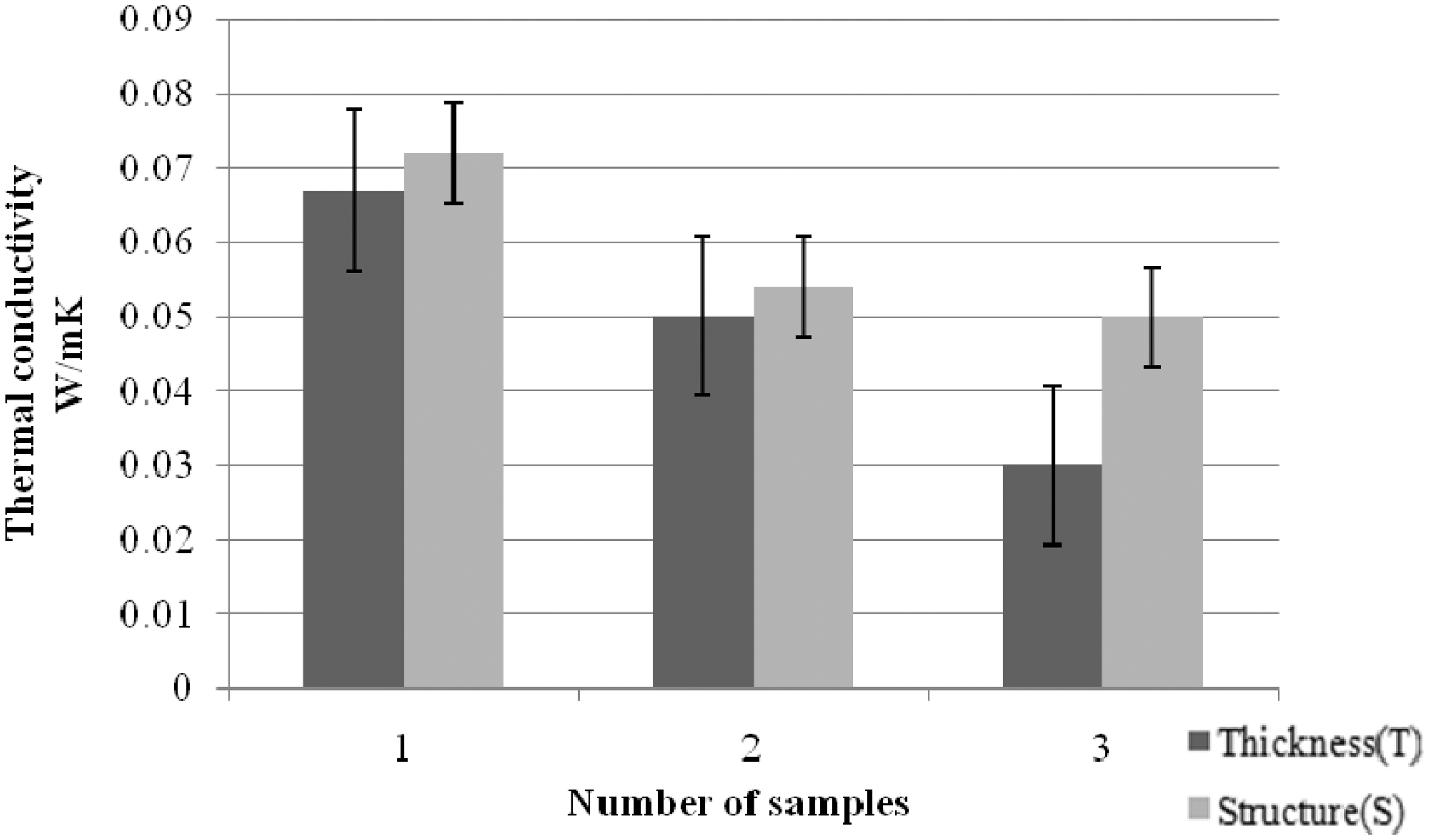
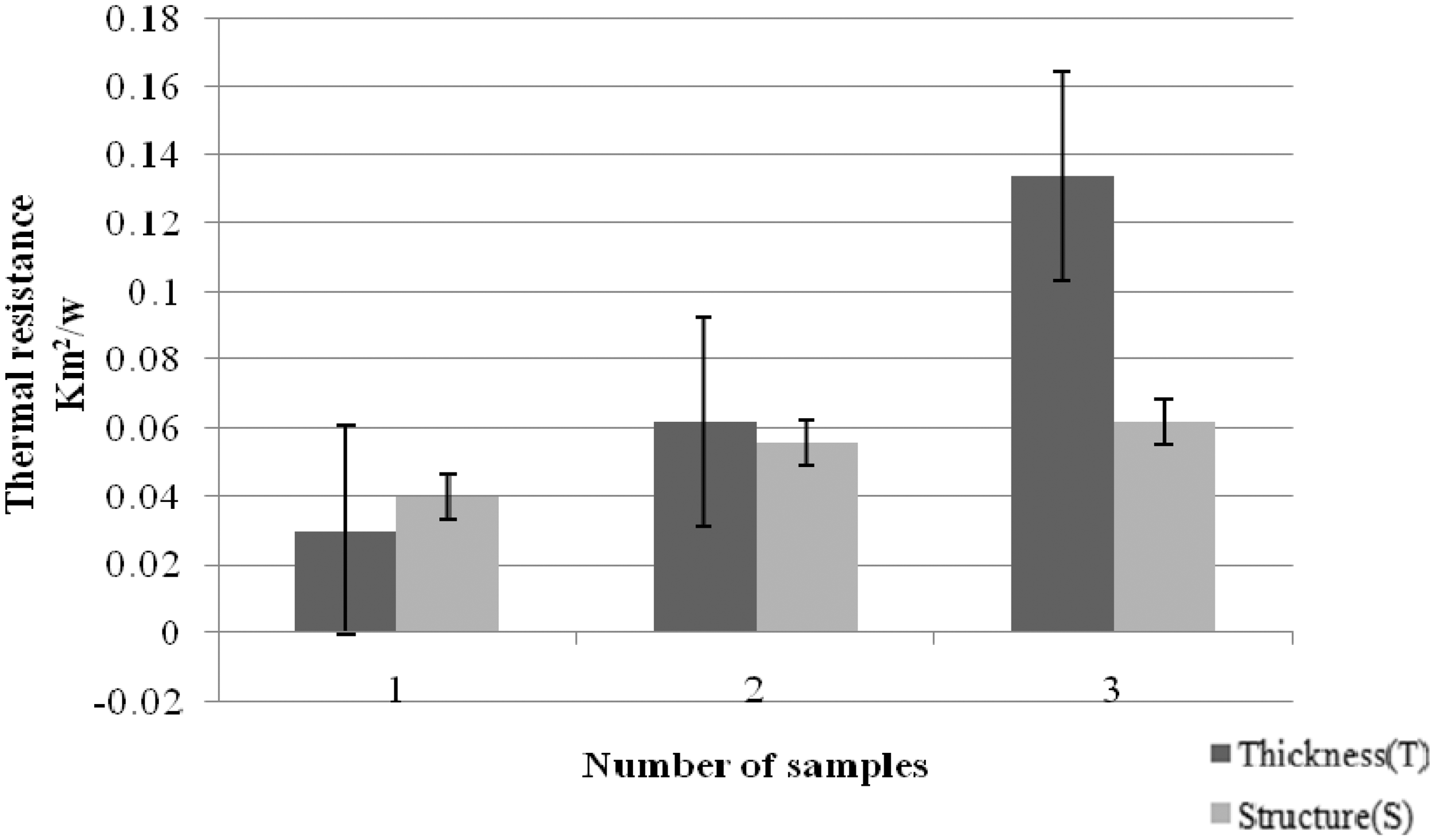
Statiscal evaluation
The above-mentioned results are confirmed by analysis of variance (ANOVA), and the result is significant influence of the structure and thicknes on fabric properties. In this section, one-way ANOVA is analyzed and the selected value of significance for all statistical tests in the study is 0.05 level. The degree of freedom is 2, 12, and the Fcritical is 3.89.
One-way ANOVA of spacer fabric properties.

Note: ANOVA: analysis of variance; HSD: honest significant difference.
Conclusion
Permeability and conductivity properties of warp-knitted spacer fabrics made from polyester filament were studied in this paper. The spacer fabric for the application of shoe insole is considered to create a comfortable fabric that normalizes the transfer of heat while on foot or running. These double-faced warp-knitted spacer fabrics were manufactured by varying the different thicknesses and face structures, thus resulted in a number of six spacer fabrics.
In order to compare the spacer fabrics, by keeping the hexagonal net structure in face surface layer and the thicknesses of the fabrics are altered to 2 mm, 3.10 mm, and 4 mm for the one set of samples. In the second set, the thickness of the spacer fabric is maintained as 3 mm and the face surface structure is varied in to locknit, rhombic mesh, and hexagonal net. The results revealed that the fabrics thickness and porosity influence the air and water vapor permeability. Fabric porosity is the key aspect for permeability and conductivity of spacer fabrics. The face and back layers are the two outer surface layers that decide the vertical gap of the spacer fabric. In these vertical gaps, the contribution of middle layer determines the amount of porosity of the fabrics. The low vertical gap shows poor void space, does not allow the air and moisture to penetrate to it, and this leads to good thermal conductivity. If there is more void space between the two outer surface layers, the air get trap and middle layer restricts the air and moisture flow through the fabrics. Spacer fabric thickness of 3.1 mm proves optimum level of thermal conductivity with good air and water vapor permeability. Regarding the fabrics face surface structure, more open or closed structures make a decision on the horizontal pore size of spacer fabrics. The open mesh hexagonal net structure shows good porosity than the other two structures. The results clearly demonstrate that the open structure having with long loop and moderate moving of number of filament proves good air and water vapor permeability.
The ANOVA confirmed that the thickness and face layer structure have significant impact on the fabric properties and the Tukey’s HSD test also proved the significant difference among all the groups. By considering all the above cases, the fabric with open structure with around 3-mm thickness is recommendable for shoe insole with high air and moisture permeability that can balance the thermal conductivity.
Footnotes
Declaration of Conflicting Interests
The author(s) declared no potential conflicts of interest with respect to the research, authorship, and/or publication of this article.
Funding
The author(s) received no financial support for the research, authorship, and/or publication of this article.