




Abstract
Clean room is an environment in which the concentration of ambient particles is controlled in order to keep the number of particles in the room at a minimum level. Clean room garments should be capable of preventing the transmission of particles from a person to the ambience. Filtration properties, along with favorable breathability and elasticity, provide a strong reason for using these structures for clothing purposes in the clean room environment. In the present study, the polyamide-66 nanofiber layer was electrospun on Spunbond–Meltblown–Spunbond nonwoven substrate as coating in several time intervals. Consequently, the filtration test was conducted on two groups of particles. Dioctyl phthalate as uniform particles and atmospheric particles as nonuniform particles were used to evaluate the filtration efficiency of the nanofibrous filter. The statistical analysis showed that the filtration efficiency for dioctyl phthalate particles was less than atmospheric particles. Also, at longer coating time, the difference between efficiencies was at the lowest level. Air permeability and water vapor permeability were studied as components of garment thermal comfort specifications. Results of this study show that air permeability decreased and overall filtration efficiency of the produced layer was improved by increasing of coating time.
Introduction
Clean room environment is used in many industrial applications. Garments worn within the clean room are recognized as one source of contamination for the semiconductor device and microelectronic component manufacturing. Microelectronic and semiconductor industry clean rooms are designed to reduce the generation and transportation of particle contamination in manufacturing of sensitive products [1–5].
The use of nonwovens for clean room clothing, especially, when nanotechnology meets it, brings a novel opportunity in this regard. Extensive use of disposable nonwoven products in protective clothing has been an alternative for synthetic woven clothing to provide maximum protection in the environment. Nonwovens are relatively inexpensive, lightweight materials with effective protection [6–11]. In recent decades, nanotechnology has opened a new class among the materials. Applications of nanotechnology are rapidly expanding in numerous fields and the textile industry is not an exception in this regard. Electrospinning is the most common and best known method in development of nonwoven consisting of nanofibers. Electrospun products are applied in different areas such as filter media, tissue engineering, personal protective clothing, and other medical and industrial applications [12–17]. Jaroszczyk et al. [18] reported that in the case of electrospun nanofibers, only a very low basis weight, approximately 0.02–0.07 g/m2 nanofibers with a diameter of 100–400 nm were applied to the cellulose or synthetic substrate to offer best in filter media performance [18]. The nanofiber layer possesses porosity with pores on a micro and nano scale. The thicker the nanofibrous layer, the more crisscrossed the nanofibers are. Crisscrossing reduces the micropore size and increases the filtration precision [19,20]. Unique characteristics of nanofibrous structures, such as high specific surface area and highly porous membrane surfaces with very fine pore size for moisture vapor transmission, have made this type of material very desirable in preparing garments for use in special environments such as the clean room. These structures are often light and have desirable breathability and elasticity. The high specific surfaces area of nanofibers significantly increases the probability of the aerosol particles deposition on the surface, which leads to improvement in the filtration efficiency [21]. Faccini et al. prepared polyamide-6 (PA-6) nanofibrous filter by electrospinning onto a nonwoven viscose substrate. Their results showed that penetration was increased by increasing the nanoparticles size from 40 to 100 nm, due to Brownian diffusion in classical filtration model [22]. Li et al. produced a thin layer of PLA nanofiber that was sandwiched between two layers of PP nonwoven fabric to filter the atmospheric aerosols. Filtration efficiency increased with the thickness of PLA nanofiber mats. It was higher for particles in the range of 0.3–10 µm (up to 75%) than for 14–660 nm particles (up to 55%) [23]. Qin and Wang produced poly(vinyl alcohol) nanofibers layers with different area weight were electrospun on the spunbonded or meltblown sublayers. They found optimum region for maximum filtration efficiency at minimum pressure drop and this point resulted at a lower add on weight for meltblown webs than for spunbonded webs [24]. Electrospinning is applicable to a wide range of polymers such as polyolefine, PAs, polyester, Polyacrylonitrile (PAN) as well as biopolymers [25]. Vitchuli et al. [26] found that depositing ultrathin Nylon 6 nanofiber mats on woven 50/50 nylon–cotton fabric can significantly improve the filtration efficiency to 99.5% without sacrificing air permeability. Marsano et al. showed that PA-6 nanofibers having a diameter ranging from 100 to 600 nm, has been successfully prepared. The electrospun PA-6 nanofiber mats show good mechanical properties, such as a high-tensile strength (12 ± 0.2 MPa) and elongation (300% ± 50%) [27]. Matulevicius et al. reported the comparative analysis of PA-6 and PA-66 nanofiber characteristics. It was revealed that the PA-66 had higher potential to be used in air filtration applications [28].
Filtration and comfort properties are the main streams of research on clean room clothing. The most common method of filtration is via fibrous nonwoven media. Fibrous filters are generally characterized by their collection efficiency and pressure drop. Air permeability and water vapor permeability were assessed as indications of thermal comfort performance in hot, humid environments [29].
The method for measuring filtration efficiency of protective clothing is similar with a typical industrial filter. In this regard, air velocity that is passing the garments is generally low and varies over a certain range, compared with industrial filters. All of the theoretical aspects for deposition of particles on the fiber assume that the particle is captured by the van der Waals forces, when the particle first encounters the fiber [6]. For nanofibers, the effect of slip flow at the fiber surface is of prime importance. Filtration theory generally relies on an assumption of continuous flow around the fiber, with a no-slip condition at the fiber surface [21]. The theory starts to break down when the scale of the fiber becomes small enough because when the fiber diameter is close to the mean free path of the gas molecules (e.g., 65 nm for air in normal temperatures and pressures), the flow field around the fiber can no longer be assumed to be in a continuum regime and the no-slip boundary condition at the fiber surface is invalid. For fibers with diameters smaller than 0.5 µm, slip flow must be considered [30]. Based on this theory [31–35], the influence of the particle shape on nanofibrous filter efficiency should be considered. The removal efficiency of fibrous filters may decrease dramatically due to particle bounce from the fibers. The possibility of the particle bouncing depends on its composition, its shape, velocity, and the type of impaction surface. The collision properties of the particle on the fiber surface, as well as particle/fiber area of contact depend on the particle shape. For perfectly spherical particles, the type of motion of the particle in contact with fiber is either sliding or rolling. A study by Mullins et al. [33] has analyzed the role of particle geometry on particle adhesion. Irregular aluminum particles, which presumably may have more than one point of contact with the surface, required the least acceleration to remove them from the surface. The reasons for this removal are unclear in that the adhesive force should increase with increased points of contact. Nevertheless, the mean force of detachment was approximately half of that for the spherical particles of similar dimensions (and presumably similar mass), but in the same acceleration, the percentage of particle removal efficiency for irregular particles is higher than regular particles. Not surprisingly, the aluminum flake material required the highest accelerations in order to remove it from the surface. This is due to the low mass of these particles relative to their area of surface contact [36].
In the present study, we aimed at manufacturing nanofibrous structures for use in clean room applications. PA-66 nanofiber layer was electrospun on Spunbond–Meltblown–Spunbond (SMS) nonwoven substrate as coating for application in microelectronic and semiconductor industry clean rooms. This structure increased the filtration efficiency up to 100% without using any nanoparticles in the nanofibrous layer. Also, the filtration performance for uniform and nonuniform particles of the nanofibrous filter media was evaluated. These data can be used to design protective clothing against certain infections. Air permeability and water vapor permeability were studied as influencing factors of garment thermal comfort specifications. Air permeability remained unchanged when the coating mass per unit area was increased from 0.87 g/m2 to 1.08 g/m2. Also, particulate air filtration efficiency increased with increasing the coating times, especially for smaller particle sizes. All findings support the influence of particle shapes on the filtration efficiency in nanofiltration.
Experimental
PA-66 was selected for electrospinning. It is a semicrystalline polymer having high strength, elasticity, toughness, and abrasion resistance mechanical properties, which are maintained in temperatures up to 150℃. It is soluble in formic acid at room temperature and can be electrospun to result in nanofibers.
Based on the reported works, among the various types of PA, PA-66 was chosen to yield small fiber diameter, narrow diameter distribution, high productivity, and good electrospinnability [12,37]. It was dissolved in formic acid as solvent for preparing electrospinning solution. The nylon 66 was in the form of chips and produced by Fluka factory. The molecular weight of this nylon is 262.3 g/mol. Formic acid 99%—product of Chemi Lab was used with a density of 1.22 g/cm3. The polypropylene substrate used for electrospinning operations was SMS with a mass per unit area of 34 g/m2. For the filtration test, two groups of particles were used, dioctyl phthalate (DOP) as uniform particles with spherical shape and atmospheric particles as nonuniform particles.
A scanning electron microscope was used for preparing images from produced samples. It was a model S4160 field emission scanning electron microscope (FESEM) from Hitachi Company. Particles were counted with a model 7.309 particle counter from GRIMM. This model is designed to fulfill US ASHREA 52.2 five-category/20 subgroup. It is also useful for many more standards for specific applications. Air flow was applied with suction pump (by Anderson Company) with a capacity of 100 L/min. Two different types of particles were used in the experimental part: spherical DOP particles and irregular atmospheric particles. DOP particles were produced with a particle generator (by Topas Company, model 7.8225).
Electrospinning parameters.

Samples code.

Measurement methods
The filtration test corridor of fibrous samples consisted of a cylindrical box for the passage of air. This box was initially designed for meeting the requirements of initiation of laminar flow (Re < 1500). Particles were carried by 4 L/min of air pressure produced by a suction pump. The airflow face velocity was 0.13 m/min. Two air lines were devised on both sides of the sample holder for counting of the concentration particle. The number of particles after passing through the filter represented the downstream concentration, while the number of particles before flowing through the filter, corresponded to the (initial) upstream concentration of aerosols. Filter samples were fixed between two cardboards, while the circle of the filter sample with 10.5-cm diameter among this cardboard was encountered with the air flow. Figure 1 shows the schematic diagram of filtration test apparatus.
Schematic of filtration test apparatus.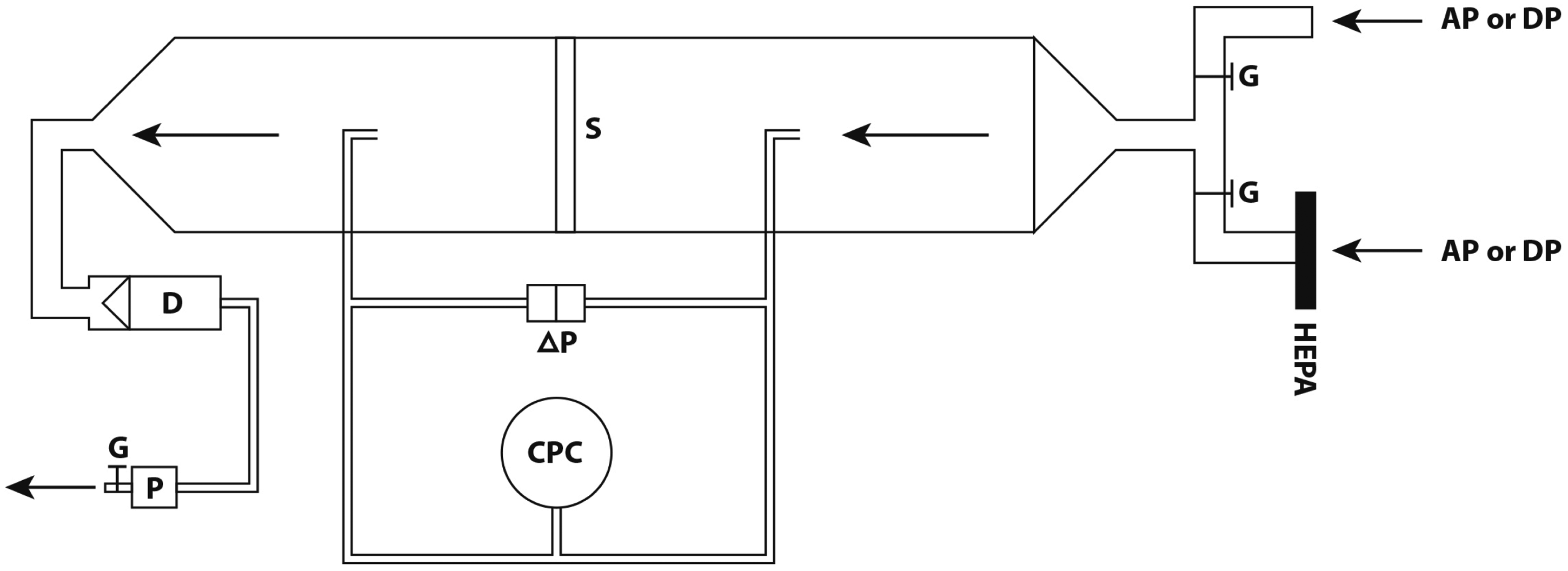
The filter efficiency E was then calculated according to the classic equation given by Brown (1993) [38]

The apparatus for measurement of water vapor permeability was constructed based on the standard of BS 7209 (specification for water vapor permeable apparel fabrics). The container for holding samples had a circular orifice with a diameter of 8.5 cm and 50 cc distilled water. The fabrics being tested, were initially cut, and placed on a three-blade sample holder over the container. Total weight of the sample and container was measured every other hour through an 8-h period. This test was performed four times for each sample. The rate of air permeability was measured 10 times for each sample at a pressure of 98 Pa.
Result and discussion
Field emission scanning electron microscope
Figure 2 shows the images of the sample by scanning electron microscope.
FESEM images (a) substrate, (b) coated in 30 min, (c) coated in 60 min, and (d) coated in 90 min.
Fibers diameters and distribution
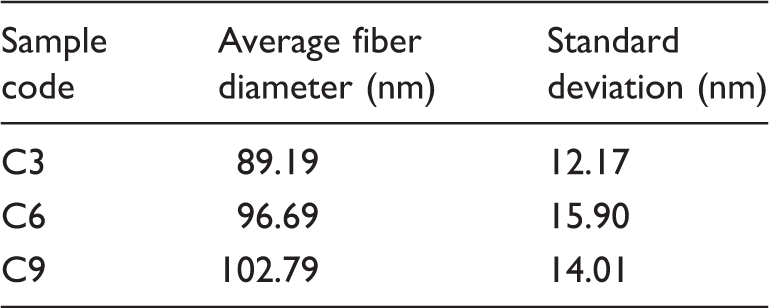
Based on FESEM images, the fibers were uniform without beads formation. The mean diameter of the fibers increases with increasing the coating time. The measurement of diameter was performed 100 times for each sample by Measurement software. These results are shown in Table 3 and Figure 3.
Fiber diameter distribution of electrospun PA-66 fibers at different coating time (a) coated in 30 min, (b) coated in 60 min, (c) coated in 90 min. Average fiber diameter.
Pressure drop and filtration efficiency for atmospheric particles
Deposited nylon 66 nanofibers had an average diameter of around 100 nm. Figure 3 shows the filtration efficiency of nylon 66 nanofiber mat deposited nonwovens. The filtration efficiency of the atmospheric particle with 300-nm diameter for the SMS fabric was only 31%, indicating that most of the atmospheric particles penetrate through the fabric. Depositing a small amount of electrospin nylon 66 nanofibers significantly increased the filtration efficiency. For example, when the coating time was 30 min, the filtration efficiency increased to 95%. One major trend in developing clean room garment is to maintain low pressure drop and high air permeability while increasing the filtration efficiency. Table 4 and Figure 4 show the pressure drop and filtration efficiency of SMS and electrospun nylon 66 nanofiber-coated nonwovens. The star mark in Table 4 shows that no significant difference was within the data. With a further increase in the mass per surface square of nanofibrous web, the filtration efficiency continued to increase and an efficiency greater than 99% was obtained when the mass per surface square increased about 3%.
Filtration efficiency of substrate and coated samples. Filtration efficiency and pressure drop for different samples (star mark for no significant difference).

Filtration efficiency for uniform and nonuniform particles
One of the aims of this research was to further deliberate the effect of particle shape on the filtration efficiency while coating time of nanofiber on the filter substrate increased. It was found in the previous researches that the filter efficiency was substantially different for removal of nanoparticles with cubic and spherical shape of the same aerodynamic size. Such a difference was explained by the dissimilar nature of the particle motion along the fiber’s immediately initial collision. It was suggested that in case of spherical shape, particles either slide or roll, in contrast with cubic particles, which are sliding or tumbling. In the case of tumbling, the geometry of a contact spot varies dramatically, thus affecting the bounce probability, while for the spheres, the area of contact remains the same for any point of particle trajectory. The difference between the various shapes of the particle in the study by Mullins et al. [33] was explained with changes of contact points. In our investigation, the DOP particle with spherical shape was compared with the atmospheric particle with irregular shape. Examination of the movement of the atmospheric particle with 300 nm of diameter along the nanofibers with 100 nm of median diameter might be complicated due to irregular shapes. Figure 5 shows the results of filtration efficiency for two types of particles.
Filtration efficiency of uniform and nonuniform particles.
Filtration efficiency of the atmospheric particle was higher than the DOP particle in all of the coating times. Based on the slip flow around the nanofiber, the spherical particle could be slipped with this flow while probability of this movement for the irregular particle was not too high.
We used analysis of variance single-factor analysis to determine if coating time is significantly effective on filtration efficiency for both the DOP and atmospheric particle. According to this analysis, with the 95% confidence level, there is a statistically significant difference between the efficiency of the samples C0, C3, C6, and C9 investigated in this work. Also, we used Student’s t-test to assess if filtration efficiency for DOP and the atmospheric particle are significantly different. These findings supported that the shape of particles is effective on the filtration efficiency for C0, C3, and C6 samples. Differences among the efficiency of two types of particles decreased with increasing the coating times.
Air permeability
Air permeability.
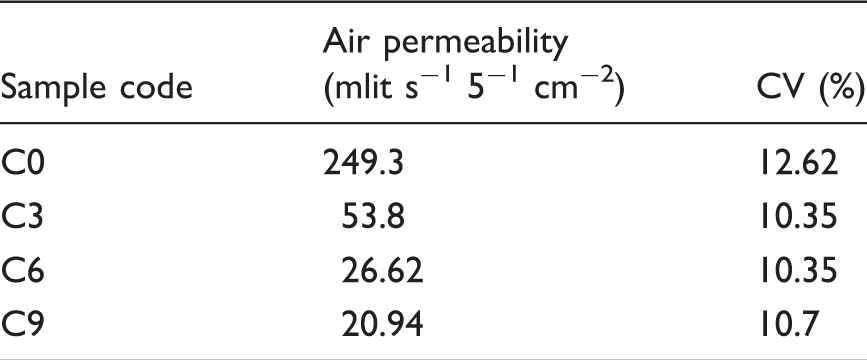
All covered layers had significantly lower air permeability than the substrate. This is the effect of electrospun nanofibers layer on the air permeability. Fineness of fibers and a decrease in pore size of the nanofibers layer causes an increase in resistance against permeability to air molecules. Results of variance analysis indicate significant differences in air permeability among layers in this study. Statistical test results show no significant difference between samples C6 and C9 in terms of air permeability. Air permeability remained unchanged when the coating time was increased from 60 min to 90 min.
Water vapor permeability

Water vapor permeability.
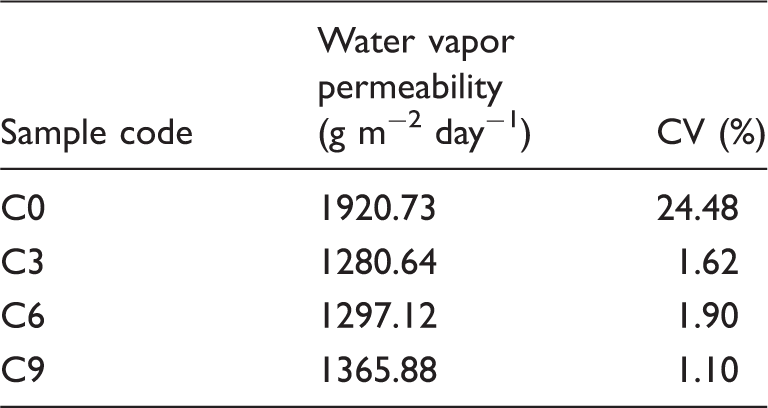
Statistical analysis revealed no significant differences in water vapor permeability among the coated samples. The only significant difference was between the substrate and coated samples. There is considerable water vapor permeability in the coated samples, indicating their suitable breathability.
Conclusion
This study showed that the filtration efficiency for DOP and atmospheric particles were similar to each other without a significant difference by increasing the coating times. This is in accordance with the classic filtration theory, in which diffusion is the main mechanism for collection of small particles at the lower face velocity. It was resulted that with 90-min coating time, thickness of the nanofibrous layer, and diameter of the surface fiber were higher than the lower coating time samples. All of the results showed that filtration efficiency increased with increasing the coating time, especially for smaller particle sizes. The structure of C9 increased the filtration efficiency up to 100% without using any nanoparticles in the nanofibrous layer. With increasing the coating times, filtration efficiency for DOP and atmospheric particles were similar to each other without significant difference (C9). The diameter of the fibers increased with an increase in coating time. The mean diameter of the fibers had a linear relation with the coating time. The percentage of fibers over 100 nm increased from 18% in sample C3 to 61% in sample C9. Air permeability decreased with increasing coating time but there was no significant difference between the samples of 60 min and 90 min coating times. Water vapor permeability decreased in the coated samples compared to the nonwoven substrate, but there was no significant difference among different coated samples. It appears that water vapor permeability does not drastically decrease with coating and remains within an acceptable range.
Footnotes
Declaration of Conflicting Interests
The author(s) declared no potential conflicts of interest with respect to the research, authorship, and/or publication of this article.
Funding
The author(s) disclosed receipt of the following financial support for the research, authorship, and/or publication of this article: The Research Affaires of Amirkabir University of Technology (AUT) provided financial supports for this work.