




Abstract
This study aims to achieve high comfort characteristics in medical corsets. For this aim, initially the expectations of users were determined by a survey and special yarns have been selected according to the survey responses. Then, different corset fabrics have been designed in a functional structure. Later, the most important body movement (stretchability), sensorial (bending rigidity) and thermophysiological comfort (air permeability, water vapour permeability, and thermal resistance) properties of these fabrics were tested and evaluated statistically. The results revealed that high levels of clothing comfort and performance properties can be established by different yarn types and fabric compositions and this will lead to achieve a successful medical therapy.
Keywords
Introduction
Nowadays, the use of corsets increases related to occurrence of diseases as a result of high tempo of daily life and heavy working conditions. They are commonly used in the medical treatments of postural deficiencies, scoliosis, slipped disk, back pain, etc. or sometimes used for aesthetic reasons. According to end use they need to achieve different characteristics such as support muscles, compression therapy or body recovery.
These products should be worn daylong, that’s why the most required characteristic is comfort for all types of corsets. Clothing comfort can be determined as satisfactory of physical and psychological harmony between body and environment. It includes four main topics: thermophysiological comfort, psychological comfort, sensorial comfort and body movement comfort. As the survey results of this study indicated that especially the parameters of thermophysiological and body movement comfort are important for corsets.
Thermophysiological comfort is strongly related to the thermal balance of the body. This balance is influenced by environmental, personal and clothing parameters. To achieve thermal balance, the thermal control function of the body should be maintained by heat, moisture and air transfer management. These parameters can be described as the most important thermophysiological comfort parameters and their processes are normally coupled under transient situations [1]. Besides thermal character of clothing, the parameters such as thickness, weight and stretchability have also great importance for providing free movement.
The heat loss from the body and feeling of comfort in a given environment is much affected by the clothing worn [1]. Various researches have been performed on clothing comfort, especially on thermophysiological comfort and it is determined that thermophysiological comfort properties of fabrics are mainly influenced by fibre, yarn and fabric properties [2]. The type of fibre [3–6], yarn parameters (spinning technology, yarn count, yarn twist, yarn hairiness) [7], fabric characteristics (e.g. thickness, weight, tightness and porosity) [8–13] and finishing processes [1, 14, 15] are some of the factors.
The current medical corsets on the market are commonly produced by cotton or wool yarns and they are presented as comfortable products since including natural yarns. However, as mentioned in previous researches, special yarns (regenerated, synthetic or engineered yarns) and using of different yarn types together increase performance characteristics in terms of clothing comfort. In this context, this study aims to design functional knitted structures for medical corsets. In terms of up to date studies, the most convenient fabric construction and yarn types such as cotton, bamboo, viscose, wool, engineered polyester were chosen that will provide high levels of clothing comfort. Also a double faced fabric structure was derived by using different yarns together in order to combine excellent properties of different yarn types.
Materials and methods
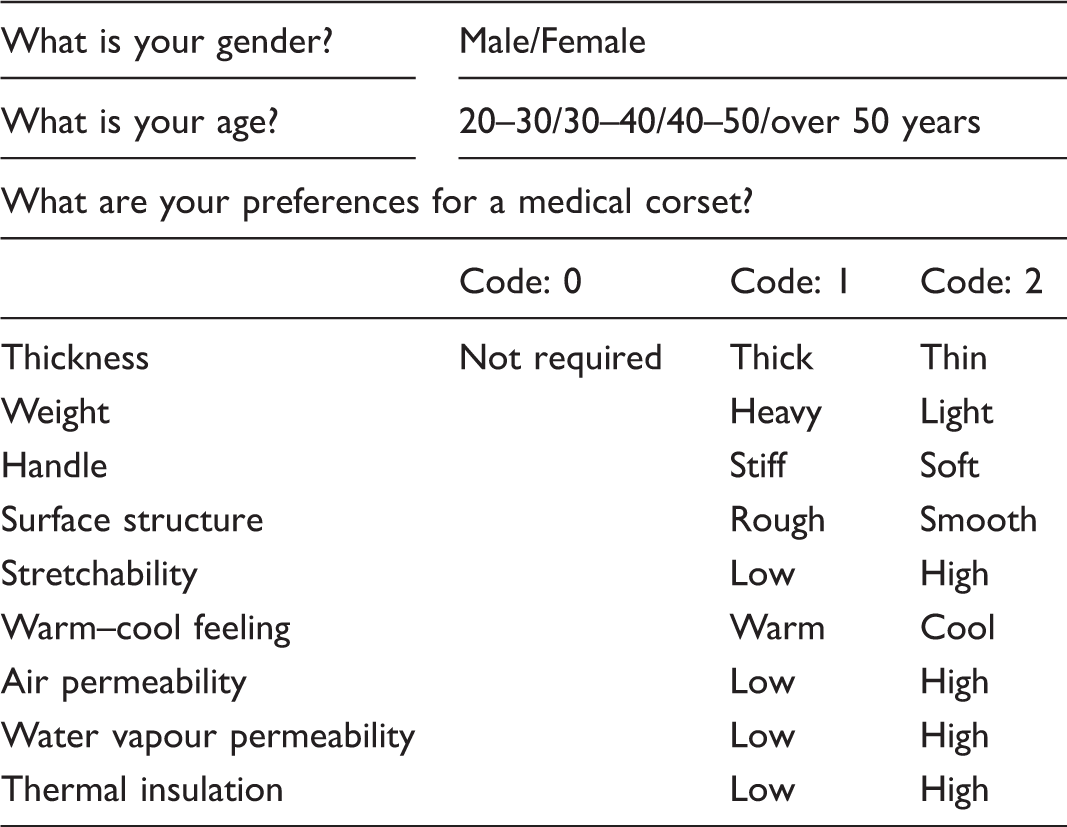
Survey questions.
Then, the following yarn types (Table 2) were selected according to this survey responses together with current products to use in the designed structure (as weft in-laid yarn that contacts to skin as seen in Figure 1) in order to meet the expectations and to develop clothing comfort characteristics of corsets. Also cotton, conventional polyester and wool were used as the most common yarn types in the market. In knitting process, yarns used as weft in-laid were doubled to achieve the same linear density.
Stitch diagram of designed structure. Y1: Ground yarn (conventional polyester yarn), chain notation: 0-1/0-1; Y2: Rubber, chain notation: 0-0/1-1; Y3: Weft in-laid yarn for front side (outer layer), chain notation: 0-0/78-78; Y4: Weft in-laid yarn for back side (inner layer), chain notation: 78-78/0-0. Yarn properties used as weft in-laid yarn.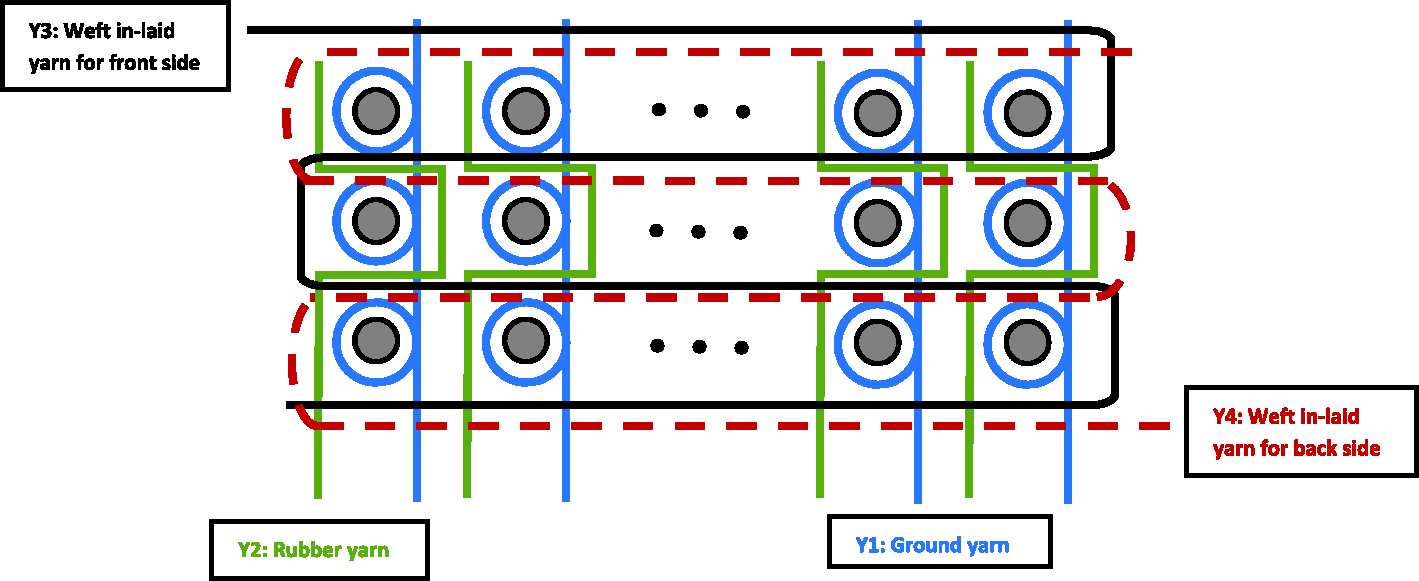

Fabric characteristics.

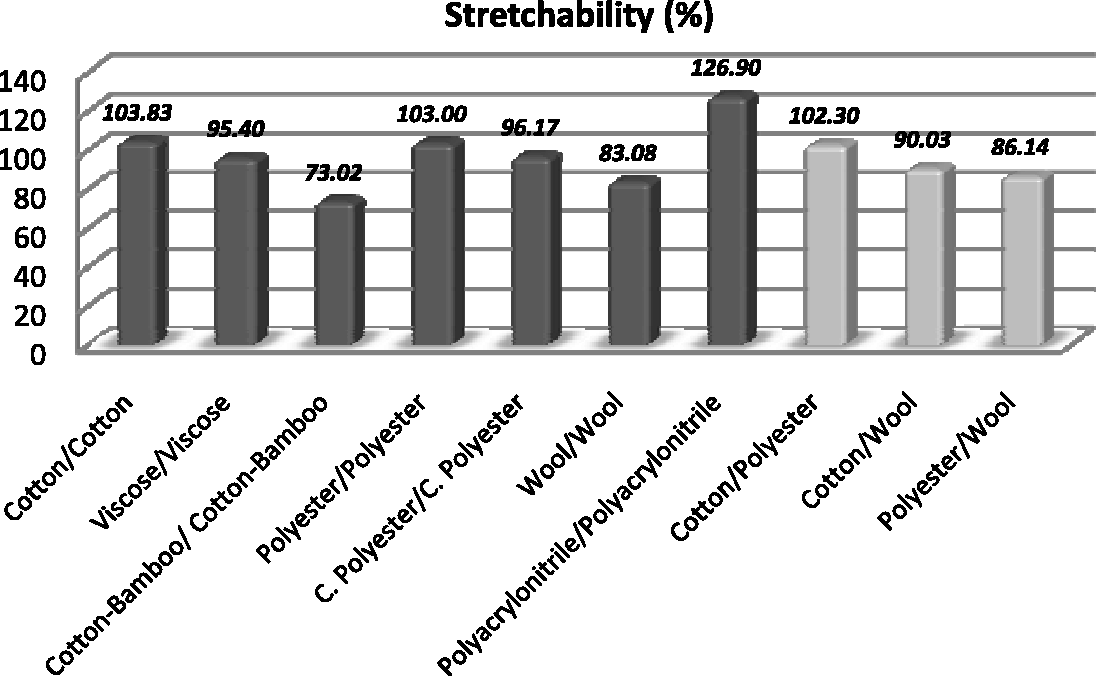
The fabrics were evaluated in two main groups which have different or same yarn combinations in outer (front side) and inner (back side) layers and these groups are illustrated in different colours in Figures 3, 4 and 6 to 8 (black or grey).
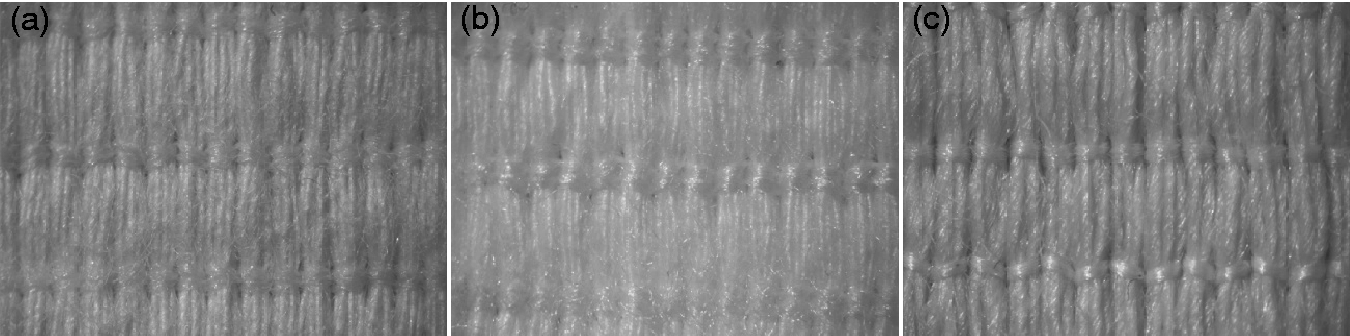
Survey results (percentage of responses). Stretchability results. Circular bending rigidity results. Air permeability results. Images of (a) cotton fabric, (b) polyester fabric and (c) wool fabric surfaces. Relative water vapour permeability results. Thermal resistance results.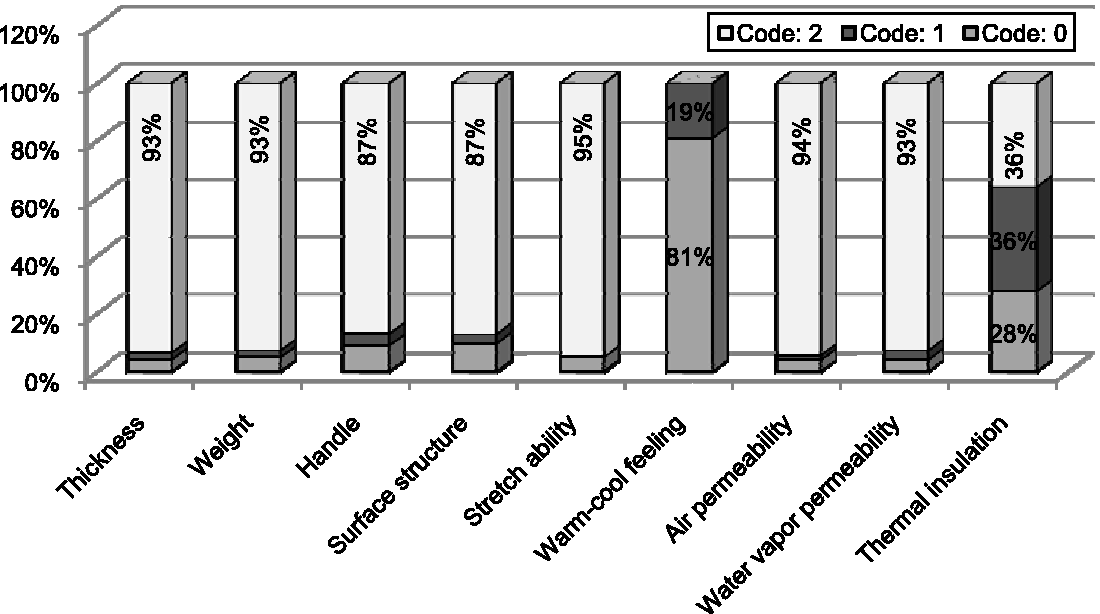




For the production, a warp knitted structure which is commonly used in corset manufacture was designed and knitted on a crochet knitting machine (Kuş Makina San. ve Tic. A.Ş., Model: KMK V800, the whole design system was further improved to produce higher fabric width) by using polyester yarn (150 denier) as ground and rubber thread for elasticity (rubber diameter = 0.552 mm). Figure 1 exhibits stitch diagram of designed structure, where Y1 is ground yarn, Y2 is rubber, Y3 and Y4 are weft in-laid yarns on front and back surfaces (outer and inner layers), respectively.
Tested parameters and test methods.

Coefficients of variation for test variables.

Results and discussion
Survey results
The survey was conducted to people to find out the expectations on medical corsets and 120 people were asked to evaluate the related parameter according to their subjective preferences (Table 1). A total of 62.5% of respondents are female and 77.5% of respondents aged between 20 and 30 years. However, this investigation could give general results, which are slightly different from these of people aged over 50, who usually wear the medical textiles.
Survey results displayed that all parameters except warm–cool feeling are required for medical corsets. These products are preferred as thin, light, soft, smooth and flexible; besides breathable with high air and water vapour permeability. Besides, there is not any certain expectation about thermal insulation property (Figure 2).
According to the survey results, the important comfort parameters were determined as handle, stretchability, air and water vapour permeability and these features were evaluated objectively. Although there is not any certain expectation about thermal resistance, it was also tested since it is accepted as one of the most effective mechanisms for thermoregulation for the products especially used next to skin.
Test results
Stretchability
Movement can be enhanced particularly by the garment fit and the quality of body fit is related to the stretch potential of fabric characteristics. The ability to predict how closely stretch fabric should conform to the body for optimum performance. Stretch garments will stretch automatically in the right places to give an acceptable fit, enhance comfort and provide freedom of movement. Easy movement can be achieved by greater fabric stretch than free body expansion.
Variance analysis of stretchability results.

Bending rigidity
Bending rigidity indicates the stiffness characteristics of the fabrics and it is one of the significant properties for determination of sensorial comfort behaviours like as drapeability and handle. In accordance to the definition of sensorial comfort, which was defined as the feelings resulting from contact between body and garment, handle property is so important for suitability especially for next to skin garments. A lower value of bending rigidity supports the positive impression of handle and so sensorial comfort [16].
Variance analysis of circular bending rigidity results.

According to these results, the softer structures including polyacrylonitrile, polyester and cotton inner layers can be suggested for garments that have direct contact with the skin such as medical corsets.
Air permeability
The clothes especially used in higher temperature conditions should be able to provide evaporation to the sweat by allowing dynamic air exchange. Here, air permeability parameter is accepted as one of the most important factors, which often used in evaluating and comparing the breathability characteristic. This parameter mainly depends on fabric structure and yarn properties and the most effective parameter is porosity for air permeability character [9].
Variance analysis of air permeability results.
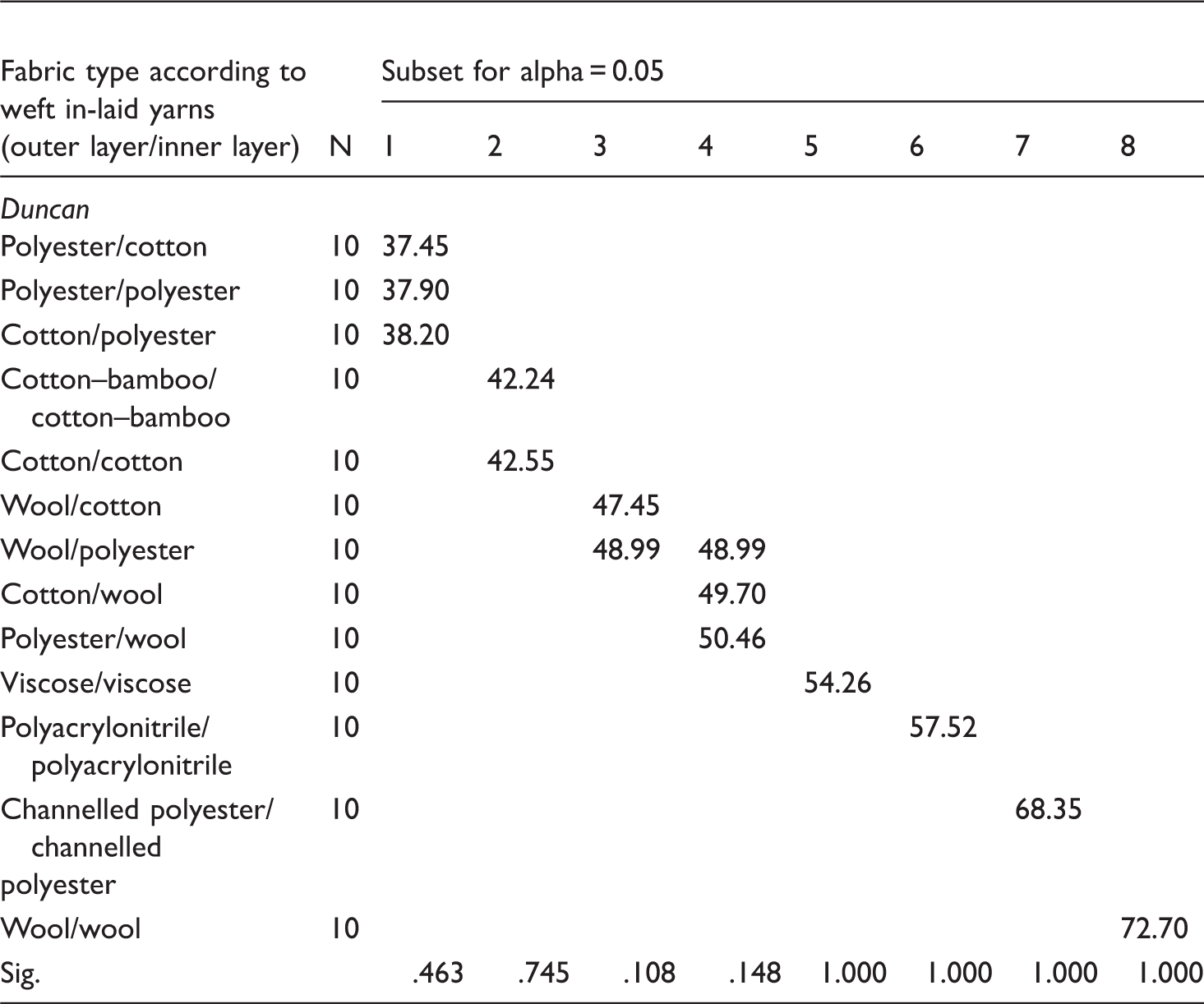
Besides, the air permeability characteristics of double faced structures represent mean values between the fabrics produced by individual yarns within the fabric structures and there is not any significant difference to use front or back side.
Air permeability is important as well as weight parameter for medical corsets since they should be worn all day long. The results pointed out that channelled polyester yarns will allow high permeable characteristic close to wool products and so this two corset types will be convenient for summer and winter use, respectively, if other comfort properties were also considered.
Water vapour permeability
The rate at which water vapour moves through a fabric plays an important role in determining the comfort as it influences the human perception and the cool/warmth feeling. The body produces moisture in the form of perspiration in to avoid clinging of fabric on to the skin and to keep skin surface dry. A fabric allows a faster water vapour transfer said to be a breathable fabric [18]. If a structure provides higher air exchange (permeability) combined with higher breathability, it would create an incredible comfort through a wide range of actives. Therefore, water vapour permeability and also air permeability have great importance for medical corsets for the purposes of thermal balance and air circulation of microclimate, since they are used next to skin.
Variance analysis of relative water vapour permeability results.

Thermal resistance
Thermal resistance is one of the main aspects for thermoregulation in order to keep body temperature within certain boundaries, even when the surrounding temperature is very different. The most effective mechanisms for thermoregulation (heat loss) especially during activities are heat transfer and sweating.
Thermal resistance is the reciprocal of thermal conductivity and is a material property indicating the resistance of the material to thermal conduction. The thermal resistance properties of textiles depend on thermal conductivity, fabric tightness or density, material thickness and thermal emission characteristics. It is a function of the actual thickness and thermal conductivity and is defined by the following relationship, where h is fabric thickness and λ is thermal conductivity

Variance analysis of thermal resistance results.

Conclusion
This study aims to design functional knitted structures for medical corsets. Within the study, the most convenient fabric construction and yarn types such as cotton, bamboo, viscose, wool and engineered polyester were chosen in order to achieve high levels of clothing comfort. Also a double faced fabric structure was derived by using different yarns together in order to combine excellent properties of different yarn types.
The comparison results can generally be listed as:
Medical corsets produced by cellulosic fibres (cotton, bamboo and viscose) are appropriate for hot climate and high physical activities with optimum air and water vapour permeability characteristics besides their naturally fineness, lightness and high thermal conductivity values. Especially viscose fibre stands out with higher water vapour permeability and better stretchability within cellulosic fibres. Channelled polyester fibres are more advantageous for summer corsets than other fibres in terms of thermophysiological comfort with higher air and water vapour permeability values. Also they support body movement comfort with good extensibility. So the corsets knitted using channelled polyester yarns will be convenient for use in hot climate or in high physical activities as well as cellulosic fibres. Moreover in terms of sensorial comfort, this fibre provides the softest feeling and it is the most convenient fibre type for corsets, which have direct contact to the skin. Wool and polyacrylonitrile fibres have high thermal insulation and good air permeability because of their thick and bulky structures, whereas they exhibit low water vapour permeability. These features make them preferable for the corsets that will be used in cold climate. However, the stretchability and bending rigidity values stated that wool fibre is not convenient for medical corsets because of lower extensibility and stiff fabric structure. Alternatively, medical corsets including polyacrylonitrile fibres will provide optimum thermophysiological comfort with better body movement and sensorial comfort by high extensibility, softness and lightness properties. The thermal insulation values of the fabrics produced by conventional polyester yarns are rather good than other fabric constructions due to their high thickness. However, their air permeability characteristics are weak. These features gain a high barrier characteristic to these corsets. Besides high moisture transfer capacity of synthetic fibres ensures better water vapour permeability. Therefore, the corsets produced by polyester yarns should be preferred for cold weather even if during sweating. But they are not appropriate for high physical activities because of their high thickness, high weight and low stretchability properties. The evaluations of the double faced corsets showed that significant changes have been occurred in thermophysiological (especially in water vapour permeability) and sensorial comfort values by the use of different fabric surfaces as outer and inner layers. Thus, it is important to decide the fabric layers perfectly according to aim of usage, as well as to choose fibre types that will be used in the structure. Besides, the values of stretchability, air permeability and thermal insulation of double faced structures, which constitute different types of inner and outer layers, represent approximately mean value of the fabrics produced solely by inner or outer yarns (i.e. Rcotton-cotton < Rcotton-wool < Rwool-wool).
If it is considered that medical corsets should be worn next to skin all day long and used frequently in long term, the most important fabric characteristics are thickness, weight, stretchability, handle, permeability and thermal resistance for comfortable clothing. The results revealed that high levels of clothing comfort and performance properties can be established by different yarn types and fabric compositions. As conclude, a successful medical therapy will be achieved using the corset designed by a special construction.
Footnotes
Acknowledgement
The author wish to thank Burak Sarı, Burcu Sakarya, Sedef Köse and Nedime Tanrıverdi for their help in laboratory testing.
Declaration of Conflicting Interests
The author(s) declared no potential conflicts of interest with respect to the research, authorship, and/or publication of this article.
Funding
The author(s) received no financial support for the research, authorship, and/or publication of this article.