




Abstract
e-Textiles are structures that have properties such as sensing, actuating, communicating, and generating/storing power. Since e-textile structures may be in contact with skin, it is essential to have low temperatures when they are functioning. In this article, temperatures obtained on the e-textile structures were analyzed by taking into account weave type, linear resistance of conductive yarns, base yarn type, and voltage values using full-factorial experimental design method. e-Textile structures were designed using different conductive yarns with different linear resistance values in different weave-type configurations. Thermal analysis was carried out under different voltage values to observe temperature variations over the conductive yarns positioned in the fabric structure. It was found that linear resistance of conductive yarns and its interaction with voltage values considerably affect the temperature of the e-textile structures, and the temperature observed over the conductive yarns is directly proportional to the linear resistance of conductive yarns. Additionally, it was observed that plain fabric samples reach lower temperatures than twill and sateen fabric samples.
Keywords
Introduction
Electronic textiles are becoming one of the major development topics in the current textile industry. They can be formed by the integration of sensing elements, functional fibers, flexible technologies, and microelectronics to textiles [1–3]. Recently, the interconnections between these components in an e-textile circuit are generally satisfied using conductive threads in which an electrical current passes through [4]. Conductive yarn has an electrical resistance proportional to its length and resistivity of the material and inversely proportional to its cross-sectional area [5, 6]. Metal, carbon, and optical fibers are the most well-known textile conductive yarns. Conductive yarns that have lower linear resistance values are used to transmit electrical signals in an e-textile configuration. They can be directly woven, knitted, embroidered, or sewn into the fabrics for designing e-textile transmission lines; however, during production or usage, these yarns are subjected to high level of stress, friction, moisture, perspiration impacts, etc., which can lead to failure of the line in terms of resistivity and signal transmission [7]. In the literature, there have been many studies dealing with the issue of conductive yarns’ usage. In one of these studies, Li et al. [8] used silver-coated yarn to produce conductive knitted fabric with specific stitches, which can be used for intelligent applications such as monitoring and heat generation. Hertleer et al. [9] used a thin copper-plated high-quality nylon ripstop fabric, a copper, and tin-plated woven nylon fabric to design wearable microstrip patch antennas working in 2.45 GHz frequency [9]. Bhattacharya et al. [10] created a polymeric textile battery by coating of poly(3,4-ethylenedioxythiophene): poly(styrene sulphonic acid) as a solid electrolytic layer placed between two woven silver-coated polyamide yarns. Senol et al. [5] used 100% stainless-steel filaments to design a fully integrated functional active T-shirt structure. Jayaraman et al. [11] built Georgia Tech Wearable Motherboard® with optical and conductive yarns to identify if a soldier get injured or not during war. These conductive threads were also used for data transmission to corresponding units of the electronic circuit in the structure [11]. Marculescu et al. [12] investigated the textile handle properties of the conductive yarns. Plain-woven fabrics-containing polyester yarns that were twisted together with a copper filament, which were insulated with a polyesterimide coating, were tested for handling. Bahadir et al. [13] used silver-plated nylon conductive yarns to develop a smart clothing prototype enabling detection of obstacles called “Wearable Obstacle Detection System” for visually impaired people. Li et al. [14] designed an intelligent wearable garment with transcutaneous electrical nerve stimulation (TENS) function for the treatment of various types of diseases and pains of the body by using silver-coated conductive yarns.
When the literature is examined, it is seen that most of the studies are related with constructing smart textile systems, and they just dealed with their simple functioning instead of monitoring performance, signal quality, and accuracy. In those studies, conductive yarns were generally used for electrical transmission function in an e-textile structure [15–17]. However, conductive yarns satisfying electrical transmissions carry a power on themselves; hence they are producing heat while transmitting signals, which may be uncomfortable for a user at high-voltage values and even be dangerous for human health. At this point, this study aimed to identify the thermo-electrical properties of conductive yarns designed as transmission lines of e-fabric. In the literature, only in one of the studies, this critical issue has been discussed. Hamdani et al. [4] studied the thermo-mechanical properties of knitted structures designed by using silver-coated Nylon 6,6 filaments. In their study, heating behavior of silver conductive thread having a resistance of 10 Ω/cm, under different voltage values, was investigated through knitted structures [4]. Apart from this study, in our study, the heating behavior of conductive threads having different linear resistance values was investigated through woven structures. Indeed, the purpose of this study is to observe the temperatures over the conductive yarns when e-textile transmission lines are subjected to different voltage values. The temperature along the conductive yarns used as transmission lines in a woven fabric was observed using thermal analysis, and the test results were analyzed taking into account the linear resistance of conductive yarns, weave types (plain, twill, sateen), base yarn types, and voltage values using full-factorial design.
Experimental work
Material
Characteristics of yarns.
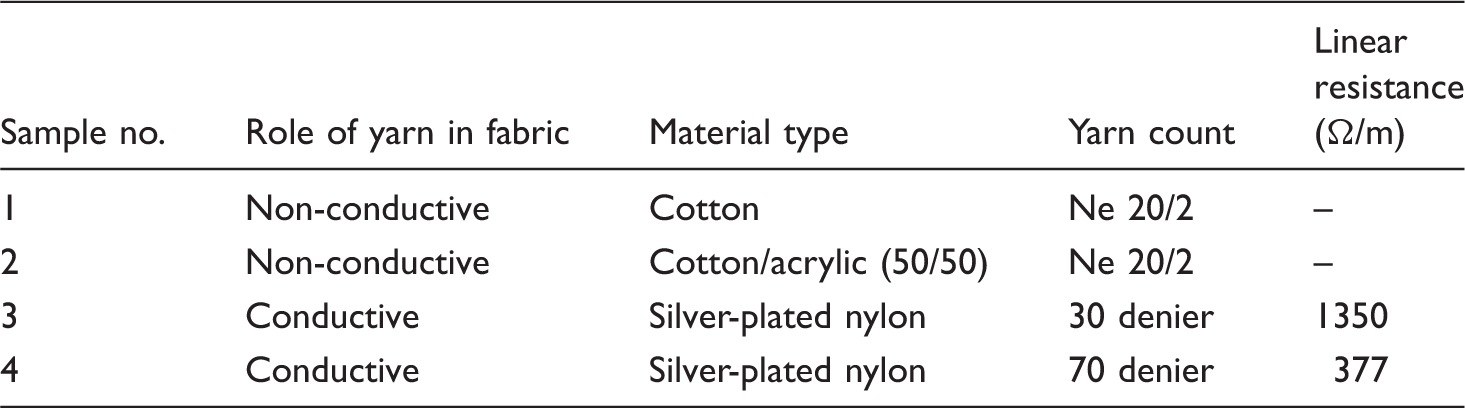
Plain, twill, and sateen, which are the basic weave types, were used to produce samples. Totally, 12 different fabric samples were produced using hand looms, and then the samples were tested for thermal analysis.
Method for thermal analysis
In order to test the thermal properties of samples, all the fabrics first were placed on a flat surface for at least 24 h prior to testing under standard atmospheric conditions (65% ± 2% RH, 20℃ ± 2℃). To carry out thermal analysis, thermal camera and DC power supply were used. The required energy to e-fabric samples was provided from DC power supply. Testo® 880 thermal camera and TestoIRSoft® software program were used to obtain and examine the thermal images of the e-fabrics.
At the beginning of the experiments, e-fabric samples were placed on a plate to satisfy stable measurement. After that, positive and negative poles of DC power supply were clamped to the ends of two parallel conductive yarns as shown in Figure 1.
Schematic diagram of experimental setup.
Voltage supplied from DC power supply was increased step by step starting from 1 V to the point where yarn started to break or fabric started to burn (with an interval of 1 V). The amount of current passing through the conductive yarns was recorded via DC power supply.
To stabilize the temperature, we waited at least 30 s after setting the voltage value. After stabilization, instant thermal images of fabric sample at each voltage value were recorded with the thermal camera. Three thermal images at each voltage value were taken, and from these images, the average temperature value was calculated to prevent the diversity that can be comprised due to experimental conditions. For instance, Figure 2 shows the original and thermal image of fabric 3 at 15 V.
Original (a) and thermal image (b) of fabric 3 at 15 V.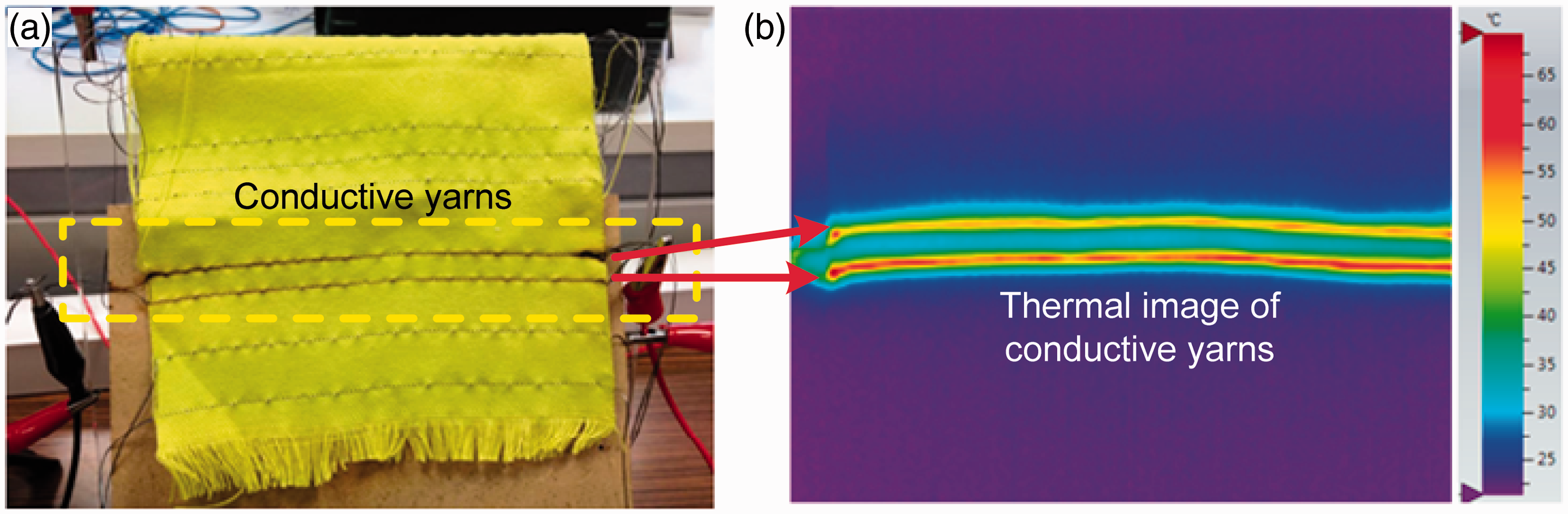
Experimental design
In order to examine the main factors and their interactions for the thermal properties of the e-textile fabrics, full-factorial design was used. Full-factorial experiments are the experiments in which the effects of more than one factor on response are investigated. Factorial designs are mostly used to examine the effects of experimental factors and the interactions between those factors, that is, how the effect of one factor varies with the level of the other factors in a response. Also, the number of experiments geometrically increases with the increasing number of factors and levels [18, 19].
Factors and levels used in full-factorial experimental design.

Experimental layout using a full-factorial experimental design.

Results and discussion
ANOVA response table for full-factorial experimental design.

As it is seen from table, F and P values could not be obtained because the df of the error is zero. Considering this result, SS values are secondly taken into account in order to find out the parameters that are least important and corresponding F and P values. In fact, SS value represents the effect of the parameter on the result, which means that if a parameter has a low-SS value, it has a low effect on the result [21]. When the SS values are taken into account (see Table 4), it is seen that C (base yarn type) is the least important parameter (SSc = 21.01) in the experimental layout; thus, it is eliminated. In this study, two types of base yarns, namely 100% cotton yarn and cotton/acrylic (50–50%), were used. The elimination of this parameter is probably due to the fact that the thermal conductivity values of cotton and cotton/acrylic composition yarns are close to each other (100% acrylic = 0.2 W/mK, 100% cotton = 0.461 W/mK) [22].
Correspondingly, interactions including parameter C, namely A * C, B * C, C * D, A * B * C, A * C * D, B * C * D, and A * B * C * D, were also eliminated. This result is also proved with Figure 3. In Figure 3, OX axis represents the levels of the factors A–D that are previously explained within Table 2. As it is clearly seen from Figure 3, the voltage (parameter D) and linear resistance (parameter B) of conductive yarns have high effect on the temperature obtained over the e-textile samples, whereas the type of basis yarn has very small effect. Based on this result, it can also be concluded that the temperature observed over the conductive yarns is directly proportional to the linear resistance of conductive yarns.
Main effects plot for temperature.
Moreover, according to the results, the effect of weave type (parameter A) is also considerable. Also, it is clearly seen from Figure 4 that plain fabric samples reach lower temperatures than twill and sateen fabric samples at each voltage value. Also, when the main effects plot for temperature (Figure 3) is examined, it is seen that plain (level 1), twill (level 2), and sateen (level 3) fabrics have a mean temperature value of approximately 35℃, 40℃, and 45℃, respectively.
Weave type versus temperature graph of fabric woven with (a) cotton/acrylic-1350 Ω/m silver yarn; (b) cotton-1350 Ω/m silver yarn.
Reduced ANOVA response table for full-factorial experimental design.

Due to the 95% confidence interval, the parameters with P < 0.05 values indicate that the effect of that parameter on the given experimental layout is statistically significant. Based on this fact, it is observed that except A * D (the interaction between weave type and voltage value), all the other parameters and interactions are statistically significant (see Table 5). With reference to Table 5, it is clearly seen that the interaction between parameters B and D (voltage, linear resistance of conductive yarns) is relatively higher than other interactions. Since voltage and linear resistance values affect each other correspondingly due to the well-known Ohm’s law, which states that the current through two points on a conductor is directly proportional to the potential difference across the two points and inversely proportional to the resistance between them [23], they together have considerable impact over the temperature values during the electrical transmission. This result is also supported by Figure 5, with a higher linear resistance value; the observed temperature change at higher voltage value is incredibly high.
Effect of linear resistance values of conductive yarns over temperature for (a) cotton/acrylic, (b) cotton samples.
Conclusion
In this study, e-textile fabric samples including different silver conductive yarns with different linear resistance values were produced using 100% cotton and 50% cotton/acrylic yarns in order to analyze temperatures over the conductive yarns of e-textile samples. To carry out thermal analysis, first DC power supply at various voltages (5 V–10 V–15 V) was applied on the e-textile structure. Then the amount of temperature at each point of conductive yarn and temperature distributions over the conductive yarns were measured using thermal camera. Then, full-factorial experimental design method was used to optimize the process parameters. Results show that the linear resistance of conductive yarns considerably affects the temperatures obtained on the e-textile structures. It was found that the temperature observed over the conductive yarns directly proportional to the linear resistance of conductive yarns. Correspondingly, it was indicated that the interaction of linear resistance and voltage values together have significant effect on the temperature of e-textile structures. Another result issuing from this study is that compared to sateen and twill weave types, plain fabric samples reach lower temperatures at the same voltage values; thus, it can be suggested that plain fabric weave type may be suitable for e-textile configurations that may be used in military and medical applications where human health and comfort issues are so significant.
As mentioned above, in this study, two different silver-coated yarns with different linear resistance values were preferred but it is intended to use different types of conductive yarns (e.g. steel and copper) with different fabric compositions and structures to investigate the effect of the type of the conductive yarn on the thermal behavior of e-textile fabrics in future works.
Footnotes
Declaration of Conflicting Interests
The author(s) declared no potential conflicts of interest with respect to the research, authorship, and/or publication of this article.
Funding
The author(s) disclosed receipt of the following financial support for the research, authorship, and/or publication of this article: This work was supported by the Istanbul Technical University Scientific Research Projects Fund under grant no. BAP 34395.