




Abstract
Nanofibrous filters made of electrospun nanofibers are used in different types of filtration. In this study, nanofibrous filters comprising of electrospun filter media between two nonwoven layers were placed in cigarette filter tip and the performance of the new filter was assessed. Electrospinning conditions were varied to achieve ultrafine cellulose acetate nanofibers for this purpose. Nanofibers of different diameters and different layer thickness (based on unit area weight) were used. Tar removal efficiency increased by increasing the unit area weight of filter media. Nanofibrous filter containing nanofibers with a mean diameter of 280 nm increased efficiency from 47.7 to 71.6% for filter tip and efficiency sharply decreased by increasing the diameter of nanofibers. Double layer electrospun filter media showed higher efficiency and lower pressure drop than those of single one with the same unit area weight. Tar removal efficiency increased significantly by using nanofibrous filters, whereas the pressure drop was not affected severely. On the other hand, tar/nicotine ratio reduced.
Keywords
Introduction
Tobacco smoke is an aerosol composed of more than 3800 individual compounds, volatile agents in vapor phase and semivolatiles and nonvolatiles in the particulate phase. The majority of toxic and carcinogenic compounds are in the tar (nicotine-free dry particulate matter). Over past six decades, filter tip has been the most common approach to reduce harmful compounds. Many additives and absorbents have been introduced into the filter tip to enhance removal efficiency of harmful compounds of cigarette mainstream smoke. Some manufacturers have made filter tips containing activated carbon; however, cellulose acetate (CA) filter tow has been the highly prevalent filter tip which is able to reduce nicotine and tar yields by 40–50% [1–3]. Despite the high absorbency of activated carbon, Shin et al. reported that CA filter tip made higher or equal removal efficiency for many of the cigarette smoke compounds than that of activated carbon [2]. Removal efficiency of filter tip used in the cigarette is not expected to be more than 50%, since it affects the filter’s pressure drop significantly [4]. Acceptable pressure drop of the filter must be lower than 1 kPa [1, 4].
In recent years, nanofibers mainly produced by electrospinning have been used commercially in filtration area [5]. Nanofibers with nanodimensional diameters have a high specific area and are capable of providing nanofibrous filter (NFF) with unique properties such as high porosity (upper than 70%), high permeability (especially for gases), and pore size of few nanometer to few micron [6, 7]. Hence, NFFs can provide high filtration efficiency without a significant increase in pressure drop [8]. Podgórski et al. demonstrated that reducing the fiber’s diameter from 10 µm to 100 nm caused a huge increase in filtration efficiency of submicron particles (especially for particles of 100–500 nm) [9].
Buika et al. showed that PVA nanofibers are capable of filtering many of the compounds from cigarette smoke while microfiber nonwoven does not have such a capability [10]. CA has been used to produce nanofibers for various applications such as antimicrobial [11], bactericidal [12], tissue engineering [13], affinity membrane [14], and ion adsorption [15], and this is because of special properties of CA [16]. Solvents used have an interesting effect on the diameter and morphology of the produced nanofibers. There are reports on using more than 25 different solvents or solvent systems to produce fine CA nanofibers, e.g. [17, 18]. Acetone/dimethylacetamide (Ac/DMAc) has been the highly efficient solvent for CA electrospinning throughout the previous studies [19]. Despite all the efforts, unlike other polymers such as nylon [20], no report of producing nanofibers with diameter of sub-100 nm is available for CA.
In this work, effects of applying electrospun CA nanofibers filter to the cigarette filter tip on tar removal efficiency, pressure drop, and tar/nicotine ratio are reported. Tar removal efficiency is defined as percentage of tar which has been eliminated from main stream smoke by the filter. Nanofibers of different diameters and various unit area weights (grams per square meter of electrospun filter media) in single layer and NFF made of double layer electrospun filter media (nanofilter) were used.
Materials and methods
Materials
CA (Mw = 37,000 Da, DS = 40%) was purchased from Fluka. Ac (>99.8%), DMAc (>99.0%), and 2-propanol (>99.8%) were purchased from Merck. Microfibrous layer in the form of spunbond polypropylene nonwoven with unit area weight of 34 g/m2 was used as substrate. Nicotine (>99.0%), heptadecane (>99.5%), and ethanol (99.5%) were purchased from Sigma-Aldrich Company (St. Louis, USA). Cigarettes used were standard king size from brand of “Bahman” (the length of filter tip: 21 mm, the diameter of filter tip: 7.8 mm, total length: 84 mm) made by Iran Tobacco Company.
Electrospinning
CA was dissolved in Ac/DMAc (3/2) under constant stirring at room temperature. Purpose-built electrospinning set up was used to produce nanofibers. Syringe pump (Daiwha, MS2200) was used to provide desirable solution flow rate (0.18 ml/h). Needle gauge was 22 (ID = 0.4 mm). A drum collector was used with fixed rotation speed of 60 r/min. Solution concentration varied from 17 to 25 wt%, tip to collector distance varied from 12 to 18 cm, and voltage varied from 20 to 26 kV to produce nanofibers with proper morphology. Morphology of electrospun CA nanofibers and surface of electrospun filter media were observed using scanning electron microscope (SEM) (Philips XL30, Netherlands). Mean diameters of nanofibers were calculated through 100 random measurements by image processing software (ImageJ, National institutes of Health, USA).
Design of new cigarette filter
After electrospinning of the filter media on nonwoven substrate, it was completely dried and then another layer of the substrate was placed on the other side of nanofilter in the form of sandwich and the NFF was formed. Each substrate had an area equal to 400 cm2. After optimizing the electrospinning process to get the finest nanofibers, the area weight of nanofilter obtained for 55, 110, and 165 min of electrospinning was 0.08, 1.3, and 1.8 g/m2, respectively. The NFF sandwich can be easily handled during cutting to filter disks and emplacing in filter tip without any damage to nanofilter media. Thickness of substrate and NFF of 1.3 g/m2 were approximately 250 and 60 µm, respectively. The NFFs were cut into disks with diameters equal to filter tip’s diameter, i.e. 7.8 mm using CMA 10080 laser cutting machine (Han's Yueming Laser Technology Co., Ltd, China). Disks of the NFF were placed in the cigarette filters in which the mainstream smoke was completely passed through the NFF. Figure 1 shows emplacement of NFF in cigarette filter.
Schematic of cigarette structure comprising NFF (a) filter wrap, (b) filter tip, (c) nanofilter media,(d) nonwoven layers, (e) tobacco rod, and (x) distance of NFF from tobacco rod.
Cigarette smoking and collecting the main stream smoke
Cigarettes were smoked under standard conditions of ISO 4387 [21] using home-made smoking machine made in accordance with ISO 3308 [22]. Two sets of five cigarettes were smoked for each test sample. After the main stream smoke had passed through the cigarette filter, smoke condensates were collected on a glass fiber filter pad. After complete smoking of five cigarettes for each set, the total particulate matter (TPM) was determined by weighing the glass fiber filter pad. Glass fiber filter pads were extracted by 2-propanol for further analysis. 2-propanol contains heptadacane and ethanol as internal standard for gas chromatographic measuring of nicotine and water, respectively.
Determination of filter properties
Determination of nicotine and water was performed under ISO 10315 and ISO 10362-1 standards [23, 24]. Briefly, nicotine and water in the smoke condensates were measured by gas chromatograph–mass spectroscope (Agilent 6890 N, Agilent Technologies, USA) and gas chromatograph (Sigma 3B, PerkinElmer, USA), respectively. The contents of nicotine (or water) were calculated through the linear regression equation derived from four known nicotine (or water) concentrations. Linear regression equations were obtained exactly as described in ISO 10315 and ISO 10362-1 standards. Tar filtration efficiency of all tested samples was calculated based on nonfilter cigarette. Pressure drop of the filters was measured according to ISO 6565 under air flow of 17.5 ml/s [25].
Results and discussion
Electrospun CA nanofibers
Various ratios of Ac/DMAc have been examined as solvent for electrospinning of CA. It was observed that when the ratio of Ac is high in the mixture solvent due to lower conductivity of solution, thicker CA nanofiber is obtained. On the other hand, more Ac content led to beadless nanofibers at lower concentrations of CA solution [17, 18]. The lower concentrations lead to lower viscosity and consequently finer nanofibers. Although 2/1 ratio of Ac/DMAc was frequently used as CA solution in previous studies, Ac/DMAc (3/2), the median ratio was selected to produce CA solution for electrospinning. In addition, our previous study showed that 3/2 ratio of Ac/DMAc produced finer CA nanofibers than those of the ratios of 7/3, 8/2, 9/1, and so on (Figure 2) [26].
SEM images of electrospun CA nanofibers from solutions of CA in Ac/DMAc of different ratios (a) 6/4, (b) 7/3, (c) 8/2, and (d) 9/1.
When solutions of lower concentration up to 17 wt% were used, beaded nanofibers were obtained (sample A in Table 1 and Figure 3(a)). As a common principle in electrospinning, increasing the concentration can eliminate beads from the resulting nanofibers [27], therefore concentration of CA solution was increased. CA solution of 19 wt% was electrospun under different conditions (samples B to F in Table 1). At the distance of 15 cm, increasing the voltage resulted in increasing the mean diameter of nanofibers due to the reduction of flight time of the jet and decrease in the jet stretching. When voltage increased to 23 kV, uniform beadless and fine nanofibers were obtained. However, changing distances from 15 to 12 and 18 cm resulted in an increase in the mean diameter of nanofibers due to the reduction of jet stretching as a result of shorter flight time of the jet in case of 12 cm and weaker electric field in case of 18 cm. Thus, conditions used for sample C were selected for electrospinning of higher concentrations of CA solution and producing NFFs. By increasing the concentration from 19 to 25 wt%, mean diameter of nanofibers sharply increased as a result of the increase in viscosity of the solution (samples G to I in Table 1 and Figure 3(g) to (i)). Figure 3 shows SEM images of all the samples.
SEM images of electrospun nanofibers produced under different conditions. Concentration of (a) 17 wt%, concentration of 19 wt% by distance and voltage of (b) 15 cm and 20 kV, (c) 15 cm and 23 kV, (d) 15 cm and 26 kV, (e) 12 cm and 23 kV, (f) 18 cm and 23 kV and concentration of (g) 21, (h) 23, and (i) 25 wt% by condition of sample c. Properties of electrospun CA nanofibers produced under different experimental conditions. CV: coefficient of variation.

Effects of substrates on filtration properties
Filtration properties of regular filter tip were examined. Effects of double layers of substrate on the filtration properties were assessed as well. Table 2 presents the details and the results of filtration experiments. Substrate layers have negligible effects on filter tip performance. When nonwovens were used as support in the NFF, produced efficiency and pressure drop can be totally accounted for electrospun nanofilter [28]. Optical image and SEM images of nonwoven layer after filtration show very few captured smoke particles (Figure 4(a), (c), and (d)).
Optical images of filters after filtration: (a) nonwoven and (b) nanofilter (sample W2D1 in Table 2) and SEM images: (c) and (d) nonwoven after filtration, (e) nanofilter before filtration and (f), (g), and (h) nanofilter after filtration. Filtration properties of all tested filters. W1, W2, and W3 represent the unit area weight of electrospun filter media produced for 55, 110, and 165 minutes of electrospinning, respectively, and D1, D2, and D3 represent diameter of nanofibers of 280, 370, and 610 nm, respectively.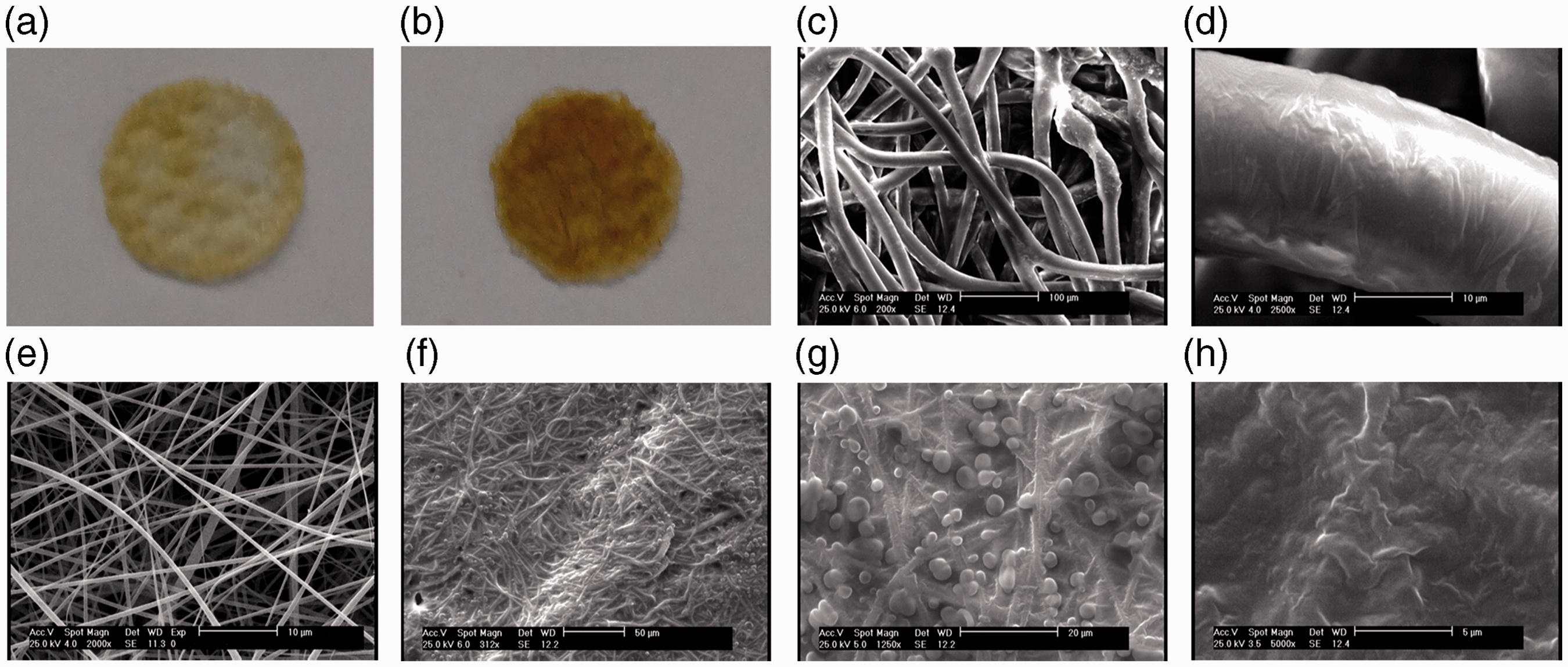

Effects of area weight of the nanofilter on filter tip properties
After doing a series of experiments, it was found that filtration efficiency of NFFs with different area weights of filter media was of similar value and relatively low when NFFs were placed at a distance of x = 0 mm from the tobacco rod. This was probably because of the high load of TPM which caused damage to filter media. Thus, NFFs were placed at x = 10 mm in the middle of the filter tip. The higher distance of NFFs from the tobacco rod results in higher efficiency of the filter tip, but NFFs could not be placed at further distance of 10 mm due to the technical problem of inserting cigarette filter tip in cigarette holder to a depth of 9 mm of the holder.
Filter media with an area weight of 0.8 g/m2 caused a significant increase in filtration efficiency and increment of efficiency was highly decreased by further increasing of the area weight. Similar trend was reported by Qin and Wang [6]. Generally, initial increase in the area weight of electrospun filter media caused a significant increase in filtration efficiency which was accompanied by a low pressure drop. By further increasing of the area weight, the slope of graph of efficiency versus pressure drop gradually decreased (see Figure 5). This was in consistent with a previous work reported by Leung et al. [28]. Although the filter media with area weight of 1.8 g/m2 had the highest efficiency, lowest tar/nicotine ratio was achieved in the case of 1.3 g/m2. The lower the tar/nicotine ratio, the lesser harmful compounds are inhaled. Optical image (Figure 4(a)) and SEM images (Figure 4(e) to (h)) of nanofibrous surface show that the nanofibers are covered by retained smoke after filtration procedure, whereas the substrate is kept intact.
Efficiency (Etar) versus pressure drop and trend of tar/nicotine ratio of filter. Left to right: general filter tip, electrospun nanofilter by area weight of 0.8, 1.3, and 1.8 g/m2.
Effects of diameter of nanofiber on the filter performance
Previous works have shown the important role of nanofibers diameter on the filtration efficiency [9, 10]. To assess the effects of the produced nanofiber diameter on filtration performance, NFFs containing CA nanofibers with different diameters were produced by electrospinning of various concentrations of the solution, i.e. 19, 21, and 23 wt% (see Table 2). Efficiency of the filter decreased considerably as the diameter of nanofibers increased, and the added efficiency to regular filter generally used in cigarettes by NFFs was 28% for nanofibers with a diameter of 280 nm. This value was 18 and 15% for nanofibers with diameters of 370 and 620 nm, respectively. This can be explained by the fact that the nanofibers of smaller diameter have a higher surface area and provide NFFs with smaller pore size rather than thicker nanofibers. Moreover, slip flow of smoke stream on the surface of nanofibers increases with decreasing the nanofibers’ diameter. Therefore, high filtration efficiency and relatively low pressure drop can be achieved by utilizing NFFs made of ultrafine CA nanofibers. Finer nanofibers resulted in a lower ratio of tar/nicotine. The finer the nanofibers, the more reachable absorbent agent on the nanofibers surface and subsequently lower the tar/nicotine ratio.
Comparing single and double layer filter media
Applying the multilayered filters made of multiple nanofibrous layers of low area weight is suggested instead of using a single one with a high area weight. Layering of thin nanofibrous layers could eliminate the inhomogeneity which occurred as the result of random nature of deposition in electrospinning and consequently higher quality can be achieved [28, 29]. NFF made of two similar thin layers resulted in higher efficiency at lower pressure drop in comparison with NFF of a single layer and the same area weight. Rotary collector system and transverse movement of syringe pump cause a lesser inhomogeneity of the electrospun layer than that of the flat collector. Nevertheless, the results showed that little inhomogeneity occurs in single layer electrospun filter media.
Comparing efficiency of nanofibers and other nanomaterials used in filter tip
Many nanomaterials could be applied in a filter tip. For example, Chen et al. reported that oxidized carbon nanotubes are able to remove tar and nicotine from main stream smoke of filtered cigarette by 81.3 and 50.9%, respectively [30]. These percentages are lower for current NFFs. Sample W2D1 resulted in 45.6 and 36.4% of tar and nicotine removal efficiency from mainstream smoke of filtered cigarette. Utilizing NFFs for such application also has benefits such as lower cost due to inexpensive technology. Furthermore, the risk of releasing of nanofibers is lower than that of carbon nanotubes due to cohesion, nonnanometrical length of nanofibers, and also adhesion of nanofibers in some cases. Other grainy nanomaterials that are used for this purpose also have the risk of releasing.
Conclusions
CA nanofibers with a mean diameter of 280 nm were electrospun. Application of NFFs increased tar removal efficiency from 47.7 to 71.6% for regular filter tip while pressure drop increased from 800 to 930 Pa. Moreover, to gain further benefits from NFFs by increasing number of nanofilter layer or its thickness, the structure of filter tip must be designed in such a way that the produced pressure drop gets counterbalanced and does not exceed the desirable value. This study showed that when a mean diameter of nanofibers increased from 280 to 370 nm, filtration efficiency affected inversely and it was considered that nanofibers’ diameter is a high influencing factor in filtering application. Decrease in tar/nicotine ratio by the NFFs shows that the lesser harmful compounds are inhaled as this new filter is used. Double electrospun nanofilter produced a higher efficiency and lower pressure drop than the single layer with the same area weight which indicates that utilized electrospun filter media have become more homogenous in this case.
Footnotes
Funding
This research received no specific grant from any funding agency in the public, commercial, or not-for-profit sectors.