




Abstract
This study investigates the thermal and viscoelastic properties of flax preform reinforced epoxy composites. Plain woven flax fabric and 1 × 1 weft rib knitted structures were used as reinforcements and flax preforms reinforced epoxy composites were produced using hand lay-up method. Thermogravimetric analysis (TGA) indicates a decrease in thermal stability of the matrix polymer with the incorporation of flax woven and knitted preforms. The dynamic mechanical analysis revealed a higher storage modulus for woven preform reinforced composite compared to knitted preform reinforced composites. The storage modulus was found to decrease with temperature in all cases. Loss modulus showed shifts in the (Tg) compared to virgin epoxy, with the addition of flax preforms as reinforcing phase, which indicate that preforms plays an important role with respect to Tg. Single tan δ peaks were observed for all the composite samples tested. The tan δ peak height was maximum for virgin epoxy matrix, indicating that there is a large degree of mobility, thus good damping behaviours. However, lower peaks were observed for both woven and knitted preform reinforced composites. With respect to the viscoelastic properties the rigidity and endurance of the fibres are highly affected by thermal treatment at temperatures above 70℃ and up to 100℃.
Introduction
Off late, the development of sustainable materials has received considerable attention from both industry and academia because of environmental issues pertaining to climate change, pollution, etc [1]. In this context, the natural fibre reinforced composite has been in considerable demand due to their high strength to weight ratio, renewability, biodegradability, lower energy requirements for processing, low cost and relatively less wear and tear in processing over traditional synthetic reinforcing fibres [2]. Bast fibres, like jute, hemp, kenaf and flax have been identified as most promising and potential candidates for replacing synthetic fibres because of their attractive properties such as good specific properties due to their low densities [3–6]. However, applications of natural fibre reinforced composite with all these advantages have been limited due to its low thermal stability during processing, hydrophilic nature and poor adhesion with synthetic matrix [7,8]. These characteristics are related to the chemical composition of the fibre. A number of studies have been carried out on surface modifications, for example Lu and Oza [9] investigated the effect of silane and NaOH treatments on hemp fibre, and have observed that the composite reinforced with treated fibres had higher thermal stability in comparison to untreated fibre. Sanjay et al. [10] studied the influence of maleated polypropylene (MAPP) coupling agent on short bamboo/glass fibre polypropylene hybrid composites and its effect on the thermal, dynamic mechanical and rheological properties, and confirmed an increase in thermal stability, crystallization temperature and magnitude of the storage modulus with addition of MAPP. However, the literature on thermal degradation of natural fibre reinforced composites is unfortunately poor. The viscoelastic behaviour of the composite depends on the nature of the matrix material and the distribution and orientation of the reinforcing fibres. Even a small change in the physical and chemical nature of the fibre for a given matrix may result in notable change in the viscoelastic properties of the composite [11]. Further, most studies are confined to unidirectional long or short fibres as the reinforcement. Reinforcements in the form of textiles such as woven, knitted are more advantageous than unidirectional reinforcements. Consequently, textile preform reinforced composites have found wide applications in aerospace, automobile and other structural applications [12,13]. Young Seok Song et al. [14] studied the thermal and viscoelastic behaviour of twill and plain woven hemp fabrics reinforced poly lactic acid (PLA) composites produced by film stacking method. The authors indicated that the thermal co-efficient of thermal expansion of the composites decreased sharply with increasing fibre volume fractions. Further, the composites embedded with twill woven hemp fabrics showed better mechanical, thermal and viscoelastic behaviour than those reinforced by plain woven hemp fabric. Jawaid et al. [15] studied the dynamic mechanical and thermal properties of oil palm empty fruit bunch (EFB)/woven jute fibre reinforced epoxy composite. The results indicated that pure woven jute composites showed better dynamic mechanical and thermal properties. Sergio et al. [16] in their review on the thermogravimetric behaviour of natural fibre reinforced polymer composites has comprehensively highlighted the general trends such as the water loss, onset of initial degradation and higher temperature degradation that occur in natural fibre reinforced composites. Placet [17] investigated the thermo-mechanical behaviour of hemp fibres with the view of manufacturing high performance fibre reinforced composites. The author has observed that polypropylene hemp composites clearly demonstrate the potential for obtaining high performance materials. Wielage et al. [18] studied the application specific properties of flax and hemp fibre reinforced polypropylene composites and observed that the elastic properties of the composite material are dependent on the type of coupling agent, specific surface and the content of added fibre. However, the multiple processing has only insignificant influence on the mechanical properties. Geethamma et al. [19] studied the dynamic mechanical behaviour of natural rubber and its composites reinforced with short coir fibres and have observed that as frequency increases, the values of damping factor (tan δ) and loss modulus (E′′) decrease, whereas the values of storage modulus (E′) increases in the case of both gum and the composites. In addition, Idicula et al. [20] studied the dynamical mechanical properties of randomly oriented short banana/sisal/polyester hybrid composites and concluded that higher compatibility was obtained hybridizing these fibres, leading to higher stress transfer ability. With the escalation in use of natural fibre reinforced composite in industrial components the strength and stiffness properties have to satisfy a wide range of temperatures. In this study, woven and knitted flax fabrics were used to fabricate composites. Dynamic mechanical analysis (DMA) and thermal properties of plain woven and 1 × 1 rib knitted fabric reinforced epoxy composites were studied. The effects of different preforms were studied as a function of fibre volume fraction.
Experimental details
Materials
Plain woven and rib-knitted preforms were manufactured using flax yarn of linear density Scanning electron micrographs of (a) plain weave fabric and (b) 1 × 1 rib knit structure.
Araldite LY 556 with a viscosity of 12,000 mPa.s at 25℃ and density 1.16 g cm−3 and hardener XY 54 with a viscosity of 1000 mPa.s and density 0.98 g cm−3 with a pot life of 135 min at 25℃ (according to manufacturers data) from Huntsman Advanced Materials India Private Limited were mixed in a ratio of 100:50 parts by weight at room temperature was used as matrix in this study.
Manufacturing of composite laminates
Composite stacking sequence and weight fraction.

Characterization of methods
Thermogravimetric analysis (TGA)
Thermal stability of samples was assessed by TGA using Q50 series (T. A. Instruments) apparatus. TGA measurements were carried out on 10–15 mg sample placed in a platinum pan, heated from 20 to 700℃ at a heating rate of 20℃/min in a nitrogen atmosphere with a flow rate of 60 ml/min to avoid unwanted oxidation.
Dynamic mechanical analysis
A dynamic mechanical analyzer (SEIKO, Model DMS 6100) was used to determine the viscoelastic behaviour of flax preform reinforced epoxy composites in bending mode over a temperature range of 0–300℃ according to ASTM D 5023. The flax preform epoxy composites were cut into samples having dimensions of 40 mm × 10 mm × 2.6 mm (length × width × thickness). The experiment was conducted at five different frequencies, namely 0.1, 0.5, 1, 2 and 5 Hz. The storage modulus, loss modulus and mechanical damping factor or loss tangent (tan δ) of the specimen were measured.
Results and discussion
Thermogravimetric analysis
Thermal properties of flax fibre, virgin epoxy, woven and knitted preform reinforced composites.

Figure 2 shows the thermogravimetric curves for flax fibre, virgin epoxy, flax/epoxy woven and knitted preform reinforced composites. Complete weight loss between 340 and 480℃ is observed in the case of virgin epoxy. Flax being natural and hydrophilic in nature has a lower thermal degradation temperature than virgin epoxy. The initial desorption peak observed around 100℃ indicates evaporation of absorbed moisture which occurs primarily in the amorphous regions. The first degradation temperature between 270 and 340℃ for the flax fibre corresponds to the thermal degradation of the glycosidic linkages of cellulose followed by a second step degradation of lignin at about 390–410℃. Decomposition of other flax fibre components, such as hemicelluloses, waxes and pectin, is also taking place at lower temperature of about 110–220℃ [7].
TGA curves of flax fibre, virgin epoxy, woven preform laminate (W1) and knitted preform laminate (K1).
In the case of both flax woven and knitted preform reinforced composites, decomposition starts at higher temperature than flax yarn but lower than that of virgin epoxy. The first weight loss of the woven preform reinforced epoxy composite was between 300 and 340℃, whereas for knitted preform reinforced epoxy composites it was between 340 and 365℃. This indicated that the presence of flax preforms does affect the degradation process. As the fibre volume fraction increased, there was a decrease in the thermal stability as was observed with flax woven preform reinforced epoxy composites. These results are logical since flax has much lower thermal stability compared to virgin epoxy. At around 700℃, woven preform reinforced composites possess highest char residue because of higher cellulose content. This result was consistent with results reported by other researchers [16].
Dynamic mechanical analysis
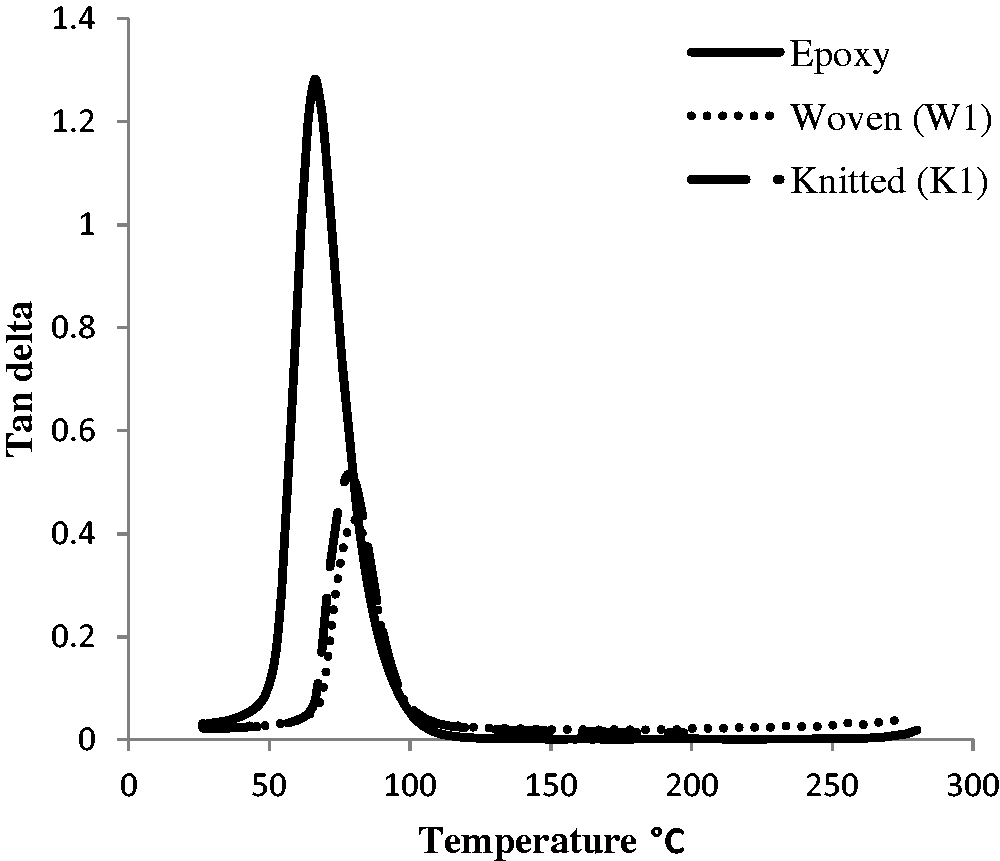
The properties of the composite materials can be determined by the characteristics of the polymer, together with reinforcements and the bonding strength at the fibre/matrix interface. The DMA, which monitors changes in the mechanical properties, serves as an important thermal analysis technique for characterising the fibre/matrix interface. Figures 3–5 show the variation in storage modulus, loss modulus and tan δ of the virgin epoxy, flax woven and knitted preform reinforced epoxy composites, as a function of temperature at a frequency of 1 Hz. The results show how the composite stiffness was affected at elevated temperatures.
Storage modulus of virgin epoxy, woven and knitted preform reinforced composites. Loss modulus of virgin epoxy, woven and knitted preform reinforced composites. Tan δ of virgin epoxy, woven and knitted preform reinforced composites.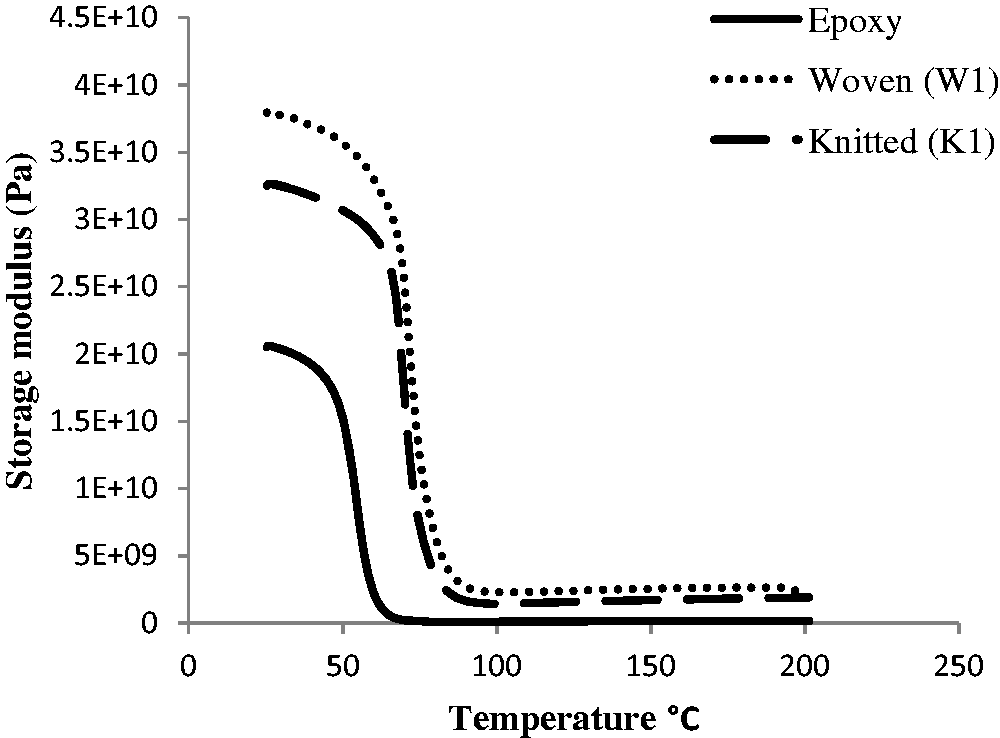

Dynamic mechanical properties of the composite.

Tg obtained from loss modulus curves.
Figure 4 shows the variation of the loss modulus of the flax preform composites and the virgin epoxy matrix with temperature. For the polymer system, the dynamic glass transition temperature (Tg) is defined as the peak of either loss modulus or tan δ. As seen in Figure 4 and Table 3 with the incorporation of flax preform reinforcements in the epoxy matrix the (Tg) values of both woven and knitted preform composites have shifted to higher values. This shifting of Tg can be associated with the decrease in mobility of the matrix. Furthermore, it can be seen that the loss modulus peak magnitude increases with increase in fibre volume fraction. This effect is more pronounced for woven fabrics, for it can be seen that the woven preform with a fibre volume fraction of 0.34 has a higher peak compared to the knitted preform composite with a fibre volume fraction of 0.23. However, the most pronounced effect of flax preform reinforcing has been the broadening of the transition region.
Figure 5 shows that the height of the tan δ peak decreases as expected with the incorporation of flax preforms. This behaviour of the composite is attributed to the decreased molecular mobility and the mechanical loss to overcome the inter friction between the molecular chains reduce after incorporation of the preforms and also due to the proportional decrease in the volume fraction of the matrix by the incorporation of fibres [19]. Further, the Tg values increases with increasing fibre content. At lower fibre volume fraction as in the case of knitted preform composites the knitted structure leads to lower packing and the fibres behave inefficiently, leading to easier failure of the bonding at the interfacial region. However, the closer packing of the plain weave structure prevents crack propagation. The woven composite with fibre volume fraction of 0.34 has the lowest peak. Implying effective stress transfer between the fibre and matrix at this fibre volume fraction. Further, the elevation of Tg is a measure of the interfacial interaction.
The addition of woven flax preforms in the volume fraction of 0.34 increased the storage modulus of flax woven epoxy composites due to the reinforcement imparted by the preforms that allows stress transfer from the matrix to the preform. The storage modulus of the flax preform epoxy composite decreases with the increase of temperature. The reduction of modulus is associated with softening of the matrix at higher temperature.
Conclusions
The study examined the properties of epoxy composites reinforced by two types of fabric preforms, i.e. plain weave woven and 1 × 1 weft rib knitted structures. The main focus was on thermal stability and viscoelastic properties of the flax woven and knitted preform reinforced epoxy composites. The thermal stability of the epoxy polymer matrix decreases with the incorporation of flax woven and knitted preforms. The composite embedded with a plain knitted preform shows better thermal properties than those reinforced with a woven preform. This is mainly due to the differences in the structural architecture of the two preforms.
In the present study, the loss moduli of the composites at all temperatures considered were found to be greater than that of virgin matrix polymer. In the composites, the peak magnitude varied with the fibre volume fraction. Single tan δ peaks were observed for all composites, and the values were a maximum for virgin epoxy matrix – an indication that there is a good damping behaviour in the polymer matrix and that the damping is reduced by the introduction of reinforcements, either woven or knitted.
A decrease in rigidity and endurance of the composites over the temperature range from 50 to 100℃ is attributed to the relaxation of hemicelluloses and lignin. Typical applications of both woven and knitted preform composite range from high performance components to structural parts such as automobile, sports, leisure, packaging, marine, construction, aerospace and defence industries. Woven fabric composites provide more balanced properties, whereas the knitted fabric provide for easy formability particularly for parts with complex shapes.
Footnotes
Funding
This research received no specific grant from any funding agency in the public, commercial, or not-for-profit sectors.