




Abstract
In this article, the effect of various yarn and fabric parameters on the electromagnetic shielding of metalized fabrics coated with polyaniline has been investigated. Copper wires with diameters of 0.06, 0.08 and 0.1 mm were chosen as conductive fillers for producing the metalized core-spun yarn. To investigate the effect of sheath material, cotton, viscose and polyester fibers supplied in a roving form were used to produce different core-spun yarn on a ring spinning frame. From the produced core yarn, woven fabrics were produced in three different pick densities: 12, 16 and 20 picks per cm. Polyaniline was synthesized in two chemical polymerization methods to achieve different surface conductivity. Taguchi’s experimental design was used to estimate the optimum process conditions and to examine the individual effects of each of the controllable factors on a particular response. The fabric parameters considered in this article were: copper wire thickness, sheath material type, fabric pick density and the coating compound chemical polymerization method. The electromagnetic effectiveness was measured at the frequency range of 1.7–2.7 GHz, using a waveguide. According to the level average analysis, fabric density factor shows the strongest effect on electromagnetic shielding, factor thickness of copper wire is the second and is followed by the factor coating compound chemical polymerization method and the sheath material type. The findings revealed that the samples at the frequency range 2.4–2.45 GHz show the highest shielding.
Introduction
Electromagnetic (EM) shielding reduces the EM field in a space by blocking the field with barriers made of conductive or magnetic materials. EM shielding is designed to limit the influence of EM fields and is a very popular method of protecting electronic and electrical equipment as well as human beings against radiated EM energy [1].Traditionally, sheet metal is considered to be the best material for EM shielding, but it is expensive, heavy, inflexible and undergoes thermal expansion. However, the use of textile products for protecting electronic and electrical devices is suitable, because they are lightweight, flexible and less expensive. To impart shielding properties to textiles, metalizing fabrics is an approach suitable for industrial scale processes, where textiles are covered with metal [1–3].
Few researchers have investigated the shielding effectiveness of textile materials. The effects of material type, yarn count, pick density, type of mordant and layers of fabrics on the EM shielding properties of textile material have been studied by Das et al. [4]. They concluded that the material type, yarn count, type of mordant and number of fabric layers have significant effects on the shielding effectiveness of fabrics. Perumalraj and Dasaradan [1] studied on the development of 2-ply and 3-ply of cotton copper yarns to produce woven fabrics for EM shielding applications. They discussed the effect of different parameters such as woven fabric structures, ends per cm, picks per cm, cover factor, yarn type and copper wire diameter on the variation in EM shielding effectiveness (EMSE).
In other investigation, Perumalraj et al. [5] measured the EMSE of metalized fabrics in the frequency range of 20–18,000 MHz. They reported that an increase in the number of conductive fabric layers, warp and weft density and cover factor causes to increase the shielding effectiveness. Also, with an increase in copper wire diameter, a decrease in shielding effectiveness was observed.
Roh et al. [6] developed a method for fabricating a multifunctional metal composite fabric with EM shielding characteristics. They also investigated the parameters influencing EM shielding properties of the metal composite fabrics. Su and Chern [7] investigated the effect of stainless steel containing fabrics on EMSE.
Çeken et al. [8] studied textile surfaces knitted with conductive copper and stainless steel wires wrapped with acrylic yarns produced on a flat knitting machine to measure the EM shielding properties of the fabrics. EMSE of some weft-knitted structures was investigated by Soyaslan et al. [9].
Metals or metal-coated materials generally show very high EMSE, as has been reported in the previous investigations. However, they cannot be used as EM wave absorber since high conductivity makes them shield by surface reflection [10]. Conducting polymers such as polypyrrole and polyaniline (Pani) are able to absorb as well as reflect EM waves, and then can exhibit certain advantages over metallic materials [10,11].
Avloni et al. [10] investigated the EM interference shielding effectiveness of polypyrrole-coated polyester textiles in the frequency range of 100–1000 MHz. Kumar et al. [11] studied the EMSE of polyaniline-coated polyester fabric. Neelakandan and Madhusoothanan [12] studied the effect of fabric parameters such as type of weave and pick density on electrical surface resistivity of polyaniline-coated fabric.
Fabrication with metal wires or coating with polyaniline are both well-known methods for manufacturing the EM shielding fabrics. But, applying two methods in one fabric is a novel attempt which is studied in this work. In this article, the effect of various yarn and fabric parameters on the EM shielding of metalized fabrics coated with polyaniline has been investigated. Taguchi’s experimental design was used to examine the individual effects of each of the controllable factors on a particular response and to estimate the optimum process conditions.
The fabric parameters considered in this article were: copper wire thickness, spun fiber type, fabric pick density and the coating compound chemical polymerization method.
A large number of experiments have to be carried out when the number of the process parameters increases. To solve this task, the Taguchi method uses a special design of orthogonal arrays to study the entire process parameter space with only a small number of experiments. Using an orthogonal array to design the experiment could help the designers to study the influence of multiple controllable factors on the average of quality characteristics and the variations in a fast and economic way, while using a signal-to-noise (S/N) ratio to analyze the experimental data could help the designers of the product or the manufacturer to easily find out the optimal parametric combinations.
Materials and methods
Production of copper core-spun yarn and woven fabric
A conventional ring spinning frame with a double apron drafting system was modified by an attachment to accommodate packages core yarns. Copper wires with diameters of 0.06, 0.08 and 0.1 mm were chosen as conductive fillers for producing the metalized core-spun weft yarns. Cotton, viscose and polyester fiber rovings were used to form the sheath part. The attachment consists of metal plate bent to a shape. One end of the device is fitted on the roving traverse guide bar such that the relative position of the roving and the core copper wire could be kept constant all the time. The other end of the plate is fitted with a guide that feeds the core copper wire behind the front drafting rollers. This devise is fitted with a pre-tensioner. Varying the number of tension discs varies the input tension of the core wire. The package containing core copper wire is suspended from a bar such that they could rotate easily, before it is fed to the tensioning device. A core spinning attachment in ring spinning is shown in Figure 1. Table 1 shows production parameters of metalized core-spun yarns.
Core spinning attachment in ring spinning. Spinning parameters of copper core-spun yarns.

Characteristics of woven fabrics.

Synthesis and coating of polyaniline
The chemical synthesis of polyaniline was carried out by the usual method as reported in the literature [13]. About 20 mL of distilled aniline was added to a balloon containing 600 mL 1 N HCL. The balloon was placed in a bath containing ice and salt. The temperature of the balloon was about 2℃. Then, 56.4 g of ammonium persulfate was dissolved in 200 mL 1 N HCL. Ammonium persulfate solution was added to the content of the balloon at 120 min by a burette. Pale yellow color of the solution changed to blue and then to green. Magnetic stirrer was used during the synthesis of polyaniline. The temperature was maintained for 24 h at 2℃ and was allowed to polyaniline settling. Two different acids have been employed to carry out the synthesis (HCl and H2SO4). An acid washing solution is needed to avoid deprotonation of polyaniline. Polyaniline was individually washed by 1 N hydrochloric acid and 1 N sulfuric acid, then was washed with distilled water and methanol, and then was dried at 50° C by an oven.
Before coating, the woven fabrics were degreased or washed in water at a temperature of 60℃, three times and then dried. Polyaniline powder and resin binder were used in an aqueous emulsion in the form of a thick paste, and was applied on the fabric. After the paste was coated onto the fabric, the fabric was subjected to 140℃ for 5 min to dry and fix the resin binder.
Experimental design
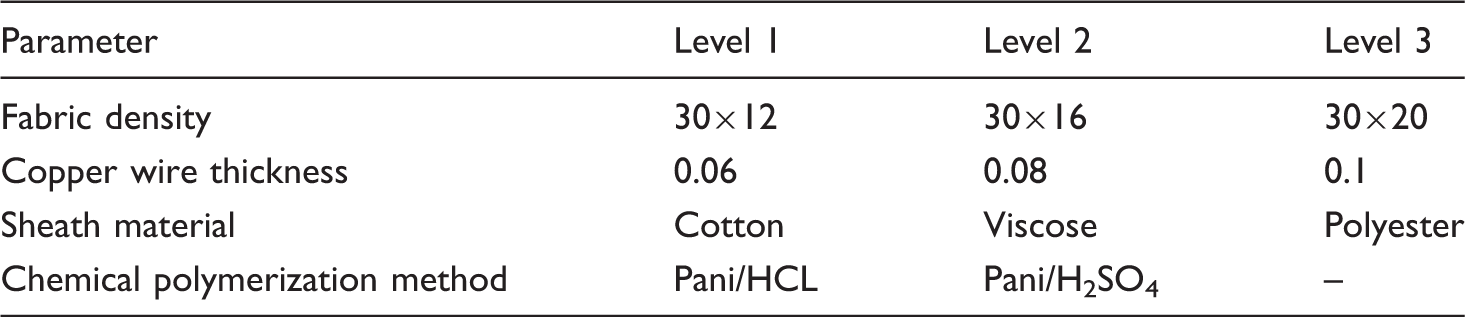
In order to estimate the optimum process conditions and examine the individual effects of each of the controllable factors on a particular response, Taguchi’s experimental design was used. This experimental design involves using orthogonal arrays to organize the factors affecting the process and the levels at which they should be varied [14].
Taguchi orthogonal array (L18).

Levels of controllable factors.
Response table for signal-to-noise ratios.

However, while conducting the experiments, the test runs have been randomly made to avoid the unidentified noise sources, which are not considered but could have an adverse impact on the response characteristic. Minitab software [15] (Minitab-14) was used to analyze the design of experiments results and analysis of Taguchi results. Three readings (corresponding to the three replications) are recorded for each experimental condition.
SEM observation and surface resistivity measurement
The morphology images of coated and uncoated fabric samples were taken by using scanning electron microscope (SEM) operated at 5 kV. All the samples were first coated with a thin layer of gold by sputtering and then exposed in SEM for taking images.
The surface resistivity of the conducting polymer-coated fabrics was measured according to AATCC 76-2002 by placing two copper strips on the fabric samples at a distance of 1 cm and measuring the resistance using a multimeter.
The EM shielding test
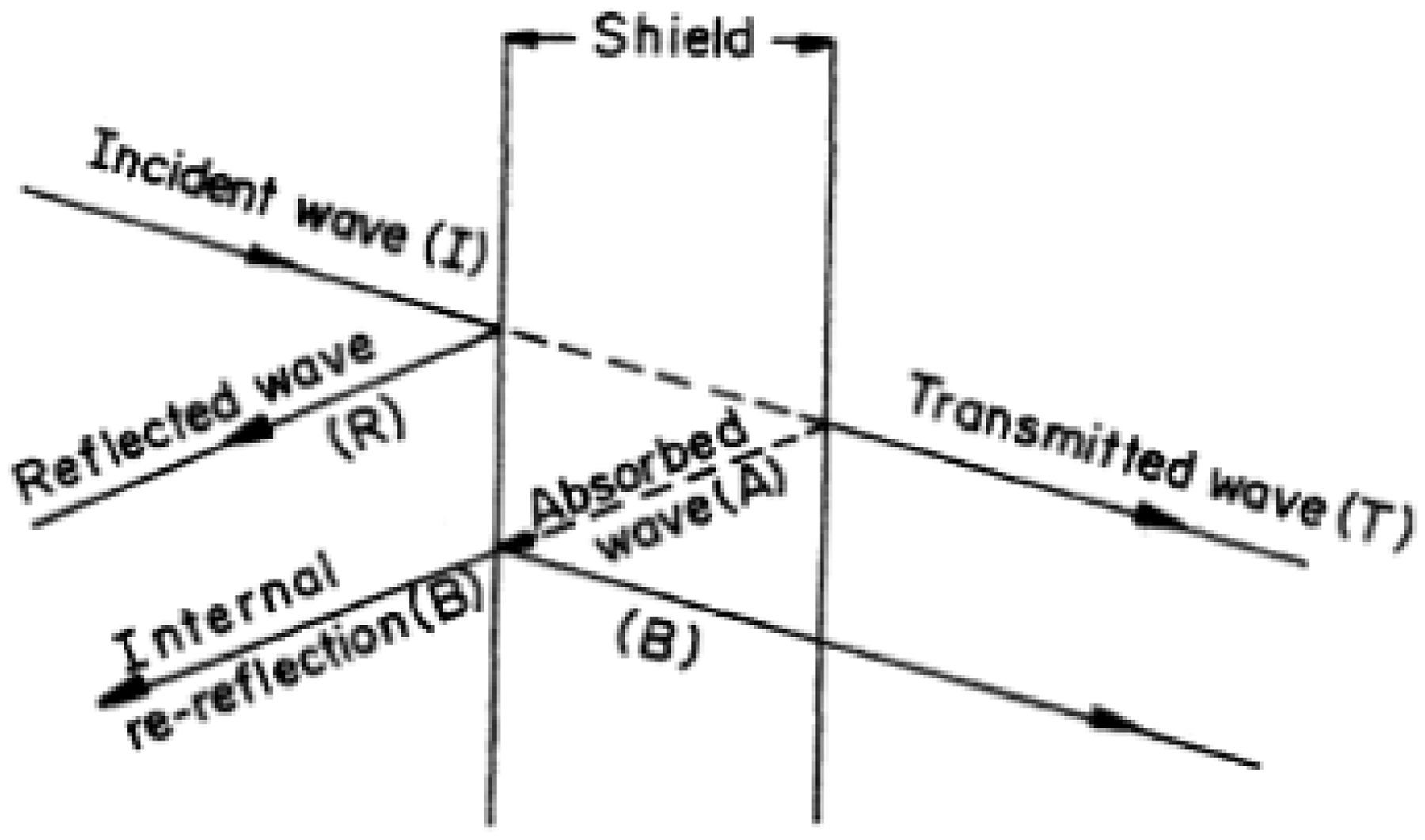
According to Figure 2, the EM wave upon incidence on the surface of the composite shielding material resolves into (i) direct reflected wave (R), (ii) an absorbed wave (A), (iii) an internally reflected wave (B), and (iv) a transmitted wave (T). The shielding effectiveness of the samples was calculated using the following equation:
Splitting the electromagnetic waves on passing through the shield [16].
According to ASTM D-4935, a spectrum analyzer, which had coaxial transmission equipment with a circle cross-section, was used to measure the EMSE of the samples. The frequencies of the EM waves transmitting in the waveguide tube ranged from 1700 to 2700 MHz. The waveguide was coupled and conjugated with a vector spectrum analyzer and a signal generator. The sample is cut in a dimension of 15 × 15 cm and placed in sample holder. Reflected and absorbed waves are measured by power meter as shown in Figure 3. Wave-parallellizer unit separates the reflected waves and these waves were measured by the spectrum analyzer. Shielding effectiveness was measured at 21 different frequencies. The distance between two consecutive frequencies was considered as 50 MHz.
Wave guide equipment (a) sample holder and (b) vector spectrum analyzer, signal generator and wave-parallellizer unit.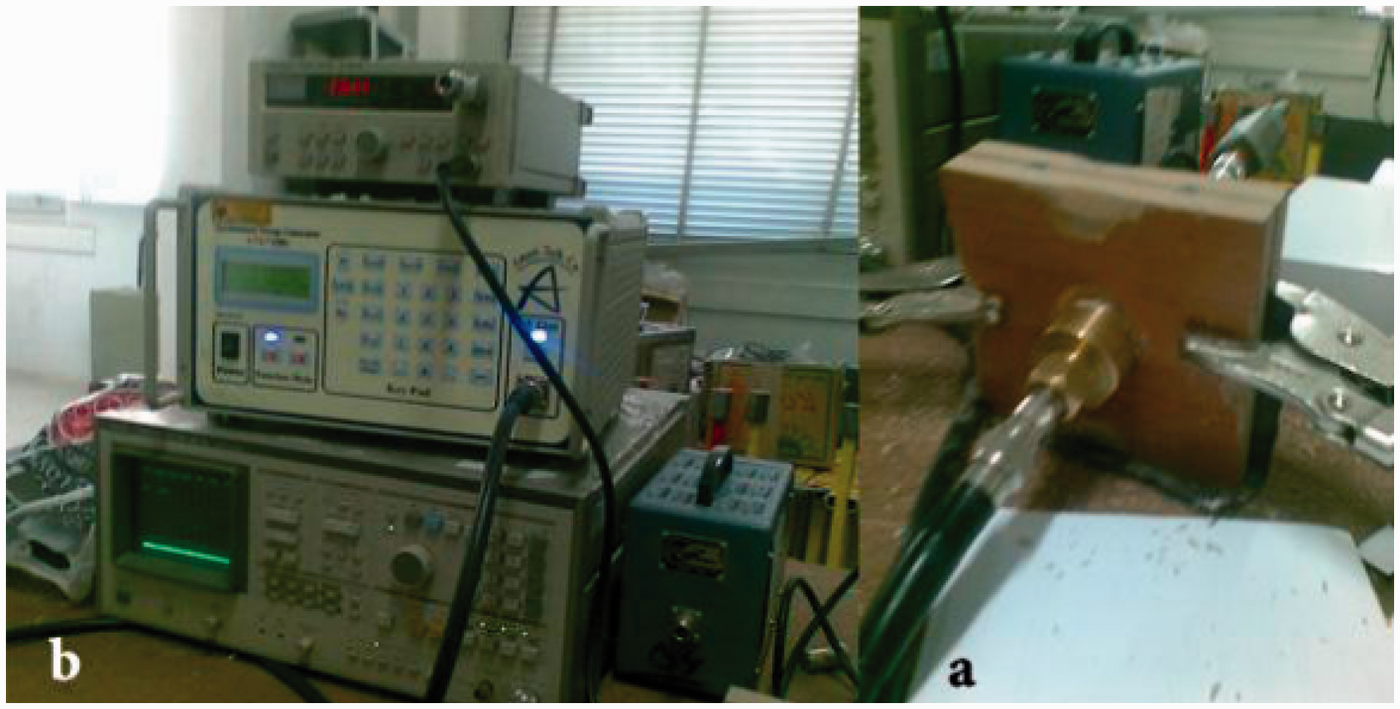
EM shielding of the fabric samples were measured in different frequencies and the shielding curve was drawn. A typical shielding curve is shown in Figure 4.
Typical shielding curve of fabric sample.
Results and discussions
Figure 5 shows micrographs of coated and uncoated fabrics. It can be seen that the morphology of the coating is completely different from the previous one.
Micrographs of coated (right) and uncoated (left) fabrics.
The response considered for the Taguchi method was shielding effectiveness of samples. Because, measuring the shielding effectiveness of the fabric samples was carried out in different frequencies, the analysis of the effect of the different yarn and fabric parameters was done for the frequency range in which the maximum shielding effectiveness is obtained. The samples show the maximum shielding effectiveness in a frequency range of 2400–2450 MHz.
Generally, three standard S/N equations are widely used to classify the objective function as: ‘larger the better’, ‘smaller the better’ or ‘nominal the best’. However, regardless of the type of effectiveness characteristics, a larger S/N ratio is always desirable. Shielding effectiveness belongs to the larger-the-better quality characteristics. The loss function of the larger-the-better quality characteristics can be expressed as [13]


In Minitab software, parameters are investigated based on the S/N ratio. This analysis is based on combining the data associated with each level for each factor. The difference between the highest and lowest S/N ratio measures the effect of that factor on maximum shielding effectiveness. The greatest value of this difference is related to the strongest effect of that particular factor. The results are given in Table 5. According to the S/N ratio analysis, the factor related to fabric density shows the strongest effect with a delta of 2.87 on maximum shielding effectiveness. Wire thickness is the second factor with a delta of 1.83 and is followed by factors coating compound chemical polymerization method and sheath material with delta of 1.10 and 1.20, respectively. The optimum level of each controllable factor shows the level in which the EM effectiveness is the highest.
The main effect plot for the S/N ratios is shown in Figure 6.
Effect of controllable factors on the: (a) surface resistivity of fabrics and (b) shielding effectiveness of fabrics.
As the surface resistance has a significant effect on the shielding effectiveness of the fabrics, the effect of the selected controllable factors on the surface resistivity of fabric was investigated. Surface resistivity belongs to the smaller-the-better quality characteristics.
Das et al. [4] reported that they did not observe any clear result in the case of shielding effectiveness to establish whether pick density plays a major role in shielding effectiveness. In spite of this, our results, which are shown in Figure 6(b), reveal that the fabric surface resistivity decreases as the pick density increases. This can be attributed to the fact that the increase in pick density makes more conduction path for the flow of electric charge. Consequently, the higher pick density leads to more shielding effectiveness. This result is in agreement with the results reported by Lai et al. [17].
Perumalraj et al. [5] studied the effect of wire thickness on the shielding effectiveness of metalized fabrics. But they did not observe any clear trend in the case of relationship between wire thickness and fabric shielding effectiveness. Our findings show that the higher wire thickness causes lower surface resistivity. It seems that higher wire thickness, in the same fabric density, increases the conduction path for the flow of electric charge. This means that the higher wire thickness provides more shielding effectiveness.
The second type of polymer (Pani/H2SO4) was found as the best polymer on shielding effectiveness, because of lower values of surface resistivity and consequently better conductivity. Molina et al. [18] also reported that the values of surface resistivity obtained for the sample coated with Pani/H2SO4 also showed lower value of surface resistivity. During the formation of conducting polymers such as polyaniline, positive charges which are responsible for its electronic conduction (polar ions and bipolar ions) are created in its structure. Shamil [19] demonstrated that the number and mobility of the charge carriers, which can be correlated with the chemical composition, are the main factors for conductivity of polyaniline. Doping polyaniline with protonic acids will produce a charge carrier formed between the polymer chains and the proton H+. Since the number and mobility of the charge carriers when the sulfuric acid is used is higher, surface resistivity of the Pani/H2SO4 is expected to be more.
The sheath material parameter has the least effect on the shielding effectiveness. In Figure 6 can be seen that viscose as a sheath material resulted the highest shielding effectiveness, compared with cotton and polyester fibers, respectively. But this difference is not statistically significant. Textile materials, including viscose, polyester, cotton and so on, are all poor conductors of electricity. As a consequence, they cannot shield the EM wave. Accordingly, a fabric woven with core-spun yarn produced from 0.1 mm copper wire as core part, 20 pick per cm and coated by Pani/H2SO4 resulted maximum shielding.
Conclusions
The effect of various yarn and fabric parameters on the EM shielding of metalized fabrics coated with polyaniline was investigated. Taguchi’s experimental design was used to analyze the effects of copper wire thickness, sheath material, fabric density and the coating compound chemical polymerization method on EM shielding. The optimum parameters of samples were determined through the experimental design. The response was the EM waves protection at the frequency range where the maximum shielding effectiveness is obtained. According to the level average analysis, fabric density factor shows the strongest effect on EM shielding. Thickness of copper wire factor is the second one and is followed by chemical polymerization method and sheath material factor. The findings show that the higher wire thickness causes lower surface resistivity and consequently more shielding effectiveness. Also, the fabric surface conductivity as well as shielding effectiveness increases as the fabric pick density increases. The polyaniline which is synthesized with sulfuric acid (Pani/H2SO4) represents the higher fabric conductivity and shielding effectiveness. The effect of sheath material on the shielding effectiveness is not statistically significant.
Accordingly, a fabric woven with core-spun yarn produced from 0.1 mm copper wire as core part, 20 pick per cm and coated by Pani/H2SO4 resulted maximum shielding.
Footnotes
Funding
The authors received no financial support for the research, authorship, and/or publication of this article.