




Abstract
Metallic wire based single jersey knitted fabrics were produced in different construction to study the electromagnetic shielding characteristics. In one construction, bare silver coated copper wire along with cotton yarn was used to knit fabric by ‘plating’ technique. In another construction, core spun metallic wire yarn produced by ring spinning was used to knit fabrics in two different loop lengths. Scattering (S) parameters for reflection (S11) and transmission (S21) obtained for the fabrics by ASTM D4935 standard using coaxial transmission fixture and network analyser were analysed in the frequency range of 30–1500 MHz. All fabrics exhibited shielding effectiveness of 40 dB and above in low frequency region, the minimum mark for safer application to solve electromagnetic interferences. Fabric produced by ‘plating’ technique showed better electromagnetic shielding than core spun yarn knitted fabrics whereas no marked difference in shielding was noticed between the core spun yarn fabrics produced in two different loop lengths. However, fabric with smaller loop length showed a marginal increase in shielding at low frequency. Core spun yarn knitted fabrics show resonance peaks of reflection at different frequencies which suggest the possibility of tailoring frequency selective surfaces for high pass/no pass filtering. Antibacterial activity of the fabrics as per AATCC 100 test method was moderate with 60–63% bacterial reduction against the bacterium Escherichia coli.
Introduction
Various electrical, electromechanical and electronics apparatus emit electromagnetic energy in their normal operation. Practical examples of systems that emit strong electromagnetic signals during their operation are the radars, communication equipments, television and radio broadcast transmitters and transmitters used for navigational aids [1].
The operation of man-made engineering devices makes an increasingly larger contribution to the electromagnetic environment. This may be regarded as a form of pollution and it is expected that increasingly closer attention will be paid to reducing and controlling electromagnetic emissions [2]. Electromagnetic interference (EMI) is a serious and increasing form of environmental pollution. Its effects range from minor annoyances due to crackles on broadcast reception to potentially fatal accidents due to corruption of safety–critical control systems. Various forms of EMI may cause electrical and electronic malfunctions, can prevent the proper use of the radio frequency spectrum, ignite flammable or other hazardous atmospheres and may even have a direct effect on human tissue [3]. There is a growing body of scientific evidence that links exposure to electro-pollution with a range of negative effects on our health. It has been compellingly linked to serious health problems such as leukaemia, brain tumours, Alzheimer’s disease, allergies, stress, sleep problems and depression [4].
Shielding an electromagnetic field is a complex and sometimes formidable task. The reasons are many, since the effectiveness of any strategy or technique aimed at the reduction of the electromagnetic field levels in a prescribed region depends largely upon the source(s) characteristics, the shield topology and materials. In electromagnetics, shielding effectiveness (SE) is a concise parameter generally applied to quantify shielding performance. However, a variety of standards are adopted for the measurement or the assessment of the performance of a given shielding structure [5]. Metallic enclosures with apertures are widely used for shielding applications. However these structures are heavy compared to the composites containing conductive fillers and polymeric materials. Flexible and light weight foils and metal coated thin films and fabrics are also in use. Conducting polymer composites are found to be effective absorbers of electromagnetic waves. A number of research studies dealing with application of textiles for electromagnetic shielding were reported. There are also published reports on the use of conducting textiles as frequency selective surfaces [6].
There are processing difficulties associated with weaving or knitting of bare metallic wires. Hence, various methods like core spinning, friction spinning or twisting are followed to produce composite yarn comprising metallic wires and textile fibres. Composite yarns are easy to process and the fabrics made out of these yarns show improved textile properties. Fabrics developed from friction spun core yarn containing steel wire, polyester and steel staple fibres showed electromagnetic shielding in the range of 25–70 dB over a frequency ranging from 300 kHz to 3 GHz [7]. Fabrics and mats containing electrically conductive fibres are effective for shielding from 300 kHz to 1.5 GHz, with fabrics superior to mats as a result of their continuous fibres and consequent electrical connectivity [8].
Metallic layers deposited on fabric surface by various methods offer low surface resistivity and hence high order of electromagnetic shielding. Metalized fabrics developed by electrolytic deposition of nickel showed sufficiently high level of electromagnetic field shielding in the metre and decimetre ranges of wavelength [9]. Electroless plating of copper on cotton fabrics resulted in higher shielding of above 90 dB with good wash durability [10]. Metallic layers of Zn and Bi deposited on polypropylene nonwoven by magnetron sputtering showed good adhesion and SE approaching 45 dB [11].
Coating of textiles with conducting polymers like polyaniline and polypyrrole has been widely studied for different application like anti-static, EMI shielding, sensing, etc. Metallic substrates shield electromagnetic waves mainly through surface reflection. On the other hand, electrically conducting polymers are capable of not only reflecting but also absorbing the electromagnetic waves. However, other factors like environmental stability, ease of application, etc. of conducting polymers need to be taken care. Conductive polypyrrole–nylon 6 composite fabrics were prepared by electrochemical and chemical oxidative polymerization which showed SE in the order of 40 dB with reflectance and absorbance dominant shielding of 20 dB each [12]. In situ polymerization of polyaniline on cotton fabric demonstrated shielding behaviour with flame retardancy [13]. The process of coating the surface of textile fabrics with layers of special properties (incorporating electromagnetic absorbers) can give way to products of new quality [14].
There is increasing interest in conducting fabrics and their uses at radio and microwave frequencies. The reflection and transmission measurements of bobbinet and knitted materials from around 8 GHz into the milli-metric frequency range 110 GHz demonstrated that bobbinet materials were found to behave like lossy dielectrics and may be useful in the construction of thin lightweight screening and absorption planes while the knitted materials, with very small mesh geometry, gave a reflection coefficient which was comparable to a metal foil [15].
The objective of this study is to study the effect of various construction parameters of single jersey knitted fabrics on electromagnetic shielding. The study includes production of metallic wire based core spun yarn for knitting, knitting of metallic wire and core spun yarn in different fabric configuration and finally evaluating all fabrics for physical, mechanical and electromagnetic shielding properties. Most of the EMI shielding studies of textiles covered only the shielding part and only few studies reported the S-parameters with reflection and transmission. In this study, knitted fabrics were produced by ‘plating’ technique using silver coated copper metallic wire as well as knitting of core spun yarn produced from metallic wire and the electromagnetic shielding was evaluated from S-parameters viz., reflection (S11) and transmission (S21).
Experimental
Metallic wire based core spun yarn production by ring spinning
Ring spun conductive core yarn was produced in a computerized miniature short staple ring spinning machine (Trytex) from commercially available silver coated copper metallic wire and cotton roving. Schematic core spinning is illustrated in Figure 1.
Schematic core spinning process.
Physical characteristics of ring spun conducting core yarn and its components.

Production of knitted fabric samples
Knitting by ‘plating’ of metallic wire
Metallic wire was incorporated in to the knitted fabric by a process known as ‘plating’. Metallic wire along with cotton yarn of 36 s Ne were fed to the knitting machine through two separate yarn guides positioned in such a way to feed to the same needle hook for producing single jersey plated (SJP) fabric. A lab model tubular knitting machine with cylinder diameter of 3.75 in having 294 needles was employed to knit samples.
Production of core spun yarn knitted fabric samples
Physical properties of knitted fabrics.

SJP: single jersey plated; SJC: single jersey close; and SJO: single jersey open.
Testing of physical and mechanical properties of knitted fabrics
Various physical and mechanical properties of knitted fabrics like loop length, weight and thickness, metal wire content by weight, air permeability and bursting strength were evaluated by standard test methods and procedures. Air permeability of the fabrics was tested as per ASTM D 737–04 test method. The bursting strength of fabric was evaluated as per ASTM D3786 test method using hydraulic diaphragm tester.
Measuring electromagnetic SE of fabrics
There are several systems for measuring the plane wave SE of materials, such as a shield room, a coaxial transmission line holder and time domain signals [16]. In this study, electromagnetic SE (EMSE) testing of fabrics due to plane wave (far field condition) was carried out as per ASTM D4935 standard using a network analyser (Agilent 5061A ENA Series RF Network Analyser) supported by Visual Basic for Application macro program connected to a coaxial transmission set up to hold specimen as shown in Figure 2.
EMSE test set up as per ASTM D4935 standard. EMSE: electromagnetic shielding effectiveness.
The range for frequency sweep was from 30 to 1500 MHz. The purpose of SE test is to determine the transmission due to introducing a material between the source and signal analyser. SE is determined by measuring the electric field strength levels with both load (EL) and reference (ER) specimens; this is with and without shielding material, respectively

Scattering (S) parameters of the two port measuring system, S11 (reflection) and S21 (transmission) were recorded in graph form to analyse the shielding behaviour of fabrics. S-parameters are used to evaluate how signals are reflected and transferred through the specimen. Two types of loss are encountered by an electromagnetic wave striking a metallic surface. The wave is partially reflected from the surface, and the transmitted (non-reflected) portion of the wave is attenuated as it passes through the shield. This latter effect, called absorption or penetration loss, is the same in either the near or the far field and for electric or magnetic fields. Reflection loss (RL), however, is dependent on the type of field and the wave impedance. Reflectance (S11) parameter otherwise known as reflection (return) loss is the ratio of reflected to incident signal and transmission (S21) parameter is the ratio of transmitted to incident signal. Both parameters are expressed in log magnitude giving negative values. With S21 in dB, its negative is insertion loss or SE and represents the loss suffered in the transmission. The total SE of a solid material with no apertures is equal to the sum of the absorption loss (A) plus the reflection loss (R) plus a correction factor (B) to account for multiple reflections in thin shields. Total SE therefore can be written as

All the terms in equation (2) must be expressed in decibels. The multiple reflection factor B can be neglected if the absorption loss A is greater than 9 dB. From a practical point of view, B can also be neglected for electric fields and plane waves [17]. In this study, the plots for S11 and S21 parameters were obtained for the frequency range of 30–1500 MHz.
Assessment of antibacterial activity
Electromagnetic shielding fabrics, especially when used in hospital environment to protect sensitive medical devices and the personnel are a source of cross infection. It is well documented that silver ions have the ability to kill many pathogenic microorganisms. Since knitted fabrics developed for this study comprise silver coated copper wire, an assessment of antibacterial activity as per AATCC 147 and AATCC 100 test method was carried out on fabrics. Metallic yarn plated fabric (SJP) and core spun close knit fabric (SJC, single jersey close) were evaluated for antibacterial activity.
AATCC 147 test method
As per the standard test procedure of AATCC 147 test method, two test strains, Escherichia coli: 2.7 × 10⁹ cfu/mL and Staphylococcus aureus: 2.4 × 10⁹ cfu/mL were used for the study. All the plates were observed for zone of bacteriostasis after 24 h of incubation.
AATCC 100 test method
With the same inoculum Broths used for AATCC 100 test method.
Results and discussion
Physical and mechanical properties of knitted fabrics
Some of the physical and mechanical properties of metallic wire plated and core spun yarn knitted fabric samples are presented in Table 2. In spite of the smaller loop length, plated fabric has lower values for thickness and weight/unit area because of the finer cotton yarn used for plating. The smaller loop length of the plated fabric (SJP) resulted in higher metal wire content in the fabric. Similarly, between the core spun yarn fabrics, a smaller loop length of closely knit fabric (SJC) has higher metal wire content than open knit fabric (SJO, single jersey open). The advantage of using conductive core spun yarn is its better knitting performance besides protecting the core component.
The surface morphology of plated fabric was studied by scanning electron microscopy (SEM) (Figure 4). The metallic wire mono filament (indicated by an arrow in Figure 4) is fully exposed on the surface of the fabric. The voids formed between the loops as seen from Figure 2 resulted in higher porosity of ‘plated’ fabric.
SEM image of fabric knitted by ‘plating’ metallic wire. SEM: scanning electron microscopy.
The SEM image of core spun yarn fabric knitted with a larger loop length is shown in Figure 5. In contrary to Figure 4, the metallic wire is not much exposed on the surface of core spun yarn knitted fabric due to the core spun yarn construction. The restricted spaces between the loops are also clearly seen.
SEM image of core spun yarn knitted fabric (with larger loop length). SEM: scanning electron microscopy.
It is evident from Figure 4 that porous structure of plated jersey fabric resulted in significantly higher air permeability (Table 2) when compared with core spun yarn knitted fabric with improved cover (Figure 5). The core spun yarn fabrics showed comparatively higher bursting strength values (Table 2) than plated fabric which could be attributed to the improved cover and the use of core spun yarn.
SE of knitted fabrics
Shielding behaviour of ‘plated’ knit fabric
The S11 and S21 parameters of fabrics knitted by ‘plating’ technique using silver coated copper wire along with cotton yarn are depicted in Figures 6 and 7. From Figure 6, the values of RL is close to 0 dB from 30 to 180 MHz and again from 240 to 912 MHz meaning RL is close to 100% where the maximum reflection occurs. In between there is a peak of −15 dB at 210 MHz which corresponds to reflected signal amplitude of approximately 18% of incident signal indicating the lowest reflection. The cause for this peak is attributed to the resonance due to fabric geometry. Then RL decreases from −3 to −8 dB in the frequency range of 912–1060 MHz which means reflected signal amplitude is reduced from 70% to 40% of incident signal. RL increases to −5 in the region of 1130–1350 MHz and finally touches −3 dB at 1500 MHz.
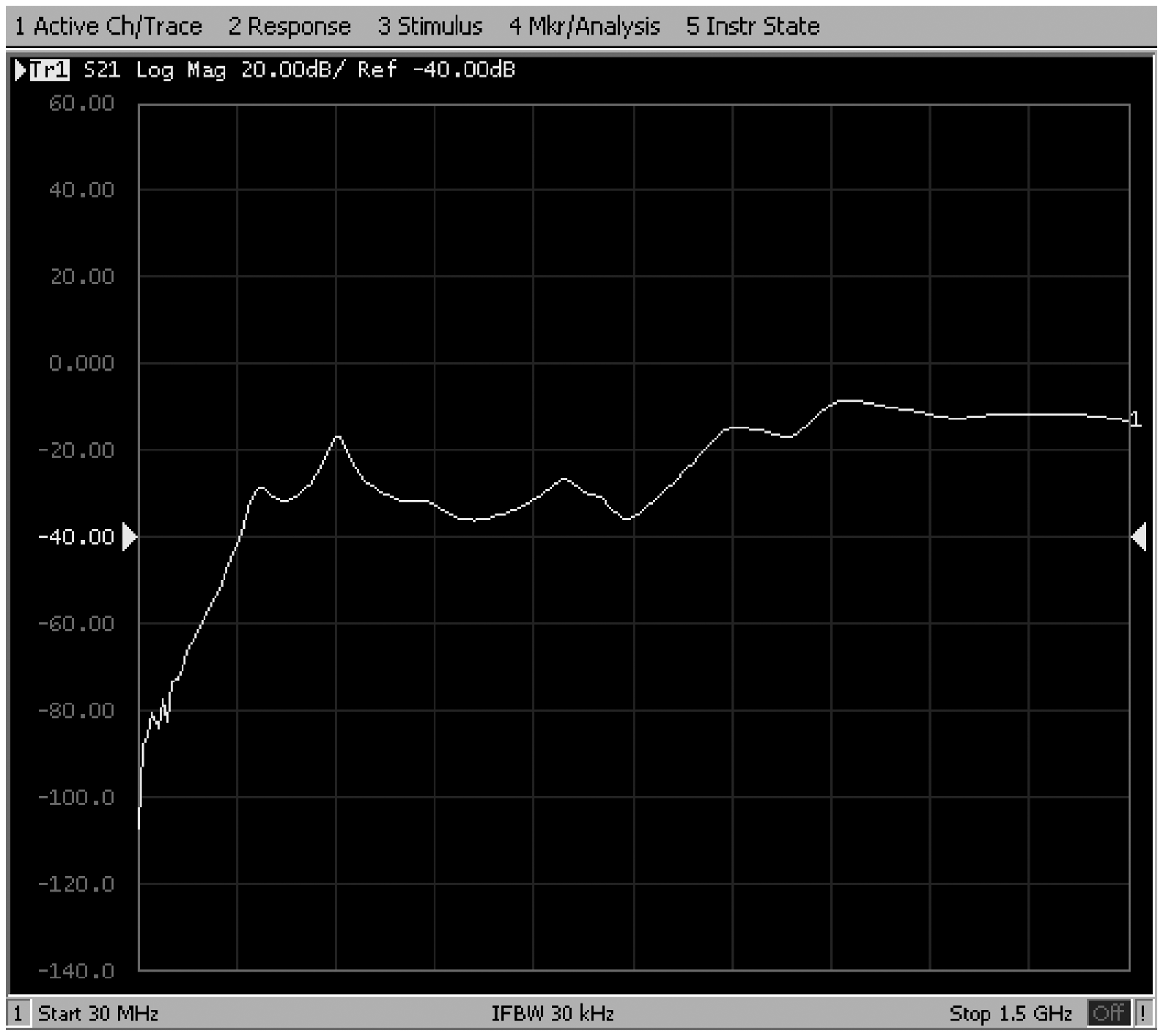
S11 (reflection) plot of SJP fabric. SJP: single jersey plated. S21 (transmission) plot of SJP fabric. SJP: single jersey plated.
The RL at the interface between two media is related to the difference in characteristic impedances between the media. S11 plot as shown in Figure 6 is in agreement with the fact that RL for plane waves are greater at low frequencies and for high conductivity material. Impedance mismatch between free space (air in the case of coaxial transmission) and shield decreases as the frequency increases resulting in lower RL.
S21 parameter of SJP fabric is shown in Figure 7. At lowest frequency of 30 MHz, transmission is −100 dB meaning SE or attenuation is very close to 100% or 99.99999%. A steep increase in transmission is noticed upto 210 MHz, however safer 99% shielding is obtained in the frequency range 30–177 MHz. The −40 dB SE mark is the preferred limit for solving many of EMI problems associated with radiated emission. S21 values between −40 and −20 dB is maintained in the frequency range of 177–870 MHz indicating shielding in the range of 90–99%. From 870 MHz frequency, transmission increases slowly from −20 dB to reach highest value of −9 dB at 1065 MHz. This suggests that the maximum electromagnetic wave transmission through fabric is 35% of incident signal resulting in the lowest SE obtained at 1065 MHz. From this point onwards, transmission is almost flat with very low rate of decrease and finally touches −13 dB at 1500 MHz indicating transmitted signal amplitude of 22% of the incident signal. In total, maximum amplitude of transmitted wave through SJP fabric is 35% of incident signal at 1065 MHz.
The drop in shielding at higher frequencies is mainly due to lower RL as seen from Figure 6
Shielding behaviour of close knit metal wire based core spun yarn fabrics
Figure 8 represents the reflectance behaviour of SJC fabric. RL is maximum and close to zero upto 250 MHz resulting in more than 99% of incident signal being reflected and a peak of −8 dB at 300 MHz indicates approximately 40% reflection of incident signal. Compared to SJP fabric, there is a shift in the peak towards higher frequency which may be attributed to the presence of dielectric (cotton) material in core spun metallic wire. From 330 to 765 MHz, the RL lies between 0 and −1 dB. RL starts declining 912 MHz and attains a minimum value of −19 dB at 1080 MHz resulting in approximately 89% of signal entering the fabric. From then onwards, the RL increases steadily and touches −3 dB at 1500 MHz which corresponds to reflected signal amplitude of 70% of the incident. Compared to SJP fabric, SJC fabric showed lower RL at high frequencies.
S11 plot of SJC fabric. SJC: single jersey close.
Figure 9 shows the shielding characteristics of SJC fabric. Transmission is −80 dB at 30 MHz and reaches the lowest value of −90 dB at 80 MHz resulting in maximum shielding of nearly 99.99%. From 80 MHz, transmission increases steeply to a high value of −7 dB at 290 MHz. Minimum electromagnetic shielding of 99% (−40 dB mark) is maintained in the region of 30−235 MHz. The trend reverses showing a decline in transmission from 330 MHz and touches −35 dB recording a second maximum shielding of approximately 98% at 545 MHz and then slowly increases to the highest transmission of −3 dB offering the lowest SE at 1060 MHz which corresponds to a shielding of 30% of incident signal. In the frequency region of 370–840 MHz and below −20 dB line, minimum of 90% shielding is maintained. From 1050 MHz, transmission slowly descends to −10 dB at 1500 MHz resulting in transmitted signal amplitude of 30% of incident signal. In the case of SJC fabric, maximum amplitude recorded for transmission is 70% of incident signal at 1060 MHz.
S21 plot of SJC fabric. SJC: single jersey close.
Shielding behaviour of open knit metal wire based core spun yarn fabrics
Figure 10 is the plot for S11 parameters of SJO fabric. RL of SJO fabric is close to zero mark almost similar to SJC fabric upto 250 MHz. The RL peak of −22 dB at 300 MHz a lower reflection compared to SJP and SJC fabric resulting in only 8% of incident signal amplitude got reflected. Higher RL is justified by the lower metal wire content of SJO fabric as presented in Table 2.
S11 plot of SJO fabric. SJO: single jersey open.
The frequency at which the resonance peak occurs is identical for both the core spun yarn fabrics. RL is almost flat between 0 and −2 dB in the frequency range of 350–765 MHz as like other fabrics. Reflected wave amplitude is 78% of the incident at −2 dB. RL declines from 765 MHz and attains the lowest value of −23 dB at 1065 MHz where reflected wave amplitude is only 7% of incident wave. From then onwards, there is a steady increase of RL to around −4 dB at 1500 MHz. Both core spun yarn knitted fabrics showed lower RL spread over a wider frequency range in the high frequency region compared to SJP fabric.
Figure 11 demonstrates the transmission characteristics of SJO fabric having largest loop length and lowest metal wire content. Lowest transmission is −83 dB at 30 MHz which is the highest attenuation obtained for the fabric. Out of three fabrics studied, the maximum attenuation is lower for SJO fabric which is caused by low metal wire content as presented in Table 2. Transmission moves up steeply and attains a value of −8 dB which is identical to SJC fabric. Maximum −40 dB mark is maintained in the frequency region of 30–235 MHz which is similar to SJC fabric. Transmission decreases from 330 MHz and reaches −34 dB at 545 MHz and then slowly increases to the highest value of −5 dB at 1060 MHz. A transmission of −20 dB and below is maintained in the frequency region of 360–795 MHz. From 1060 MHz, it decreases gradually to nearly −10 dB at 1500 MHz resulting in transmitted wave amplitude of 30% of incident signal which is similar to SJC fabric.
S21 plot of SJO fabric. SJO: single jersey open.
There is no marked difference observed in the shielding behaviour between SJC and SJO fabrics and only a marginal increase in maximum shielding and a little wider electromagnetic spectrum giving TL of −20 dB or low is observed in the case of SJC fabric which could be attributed to its higher metal wire content by weight (Table 2). SJP fabric exhibited better shielding because of the electrical inter-connectivity of loops formed by bare metallic wire used for ‘plating’. While comparing the plots of S11 and S21 it is observed that SE values are lower wherever the resonance in reflection (inverted peak) or lower RL occurs. Unlike the SJP fabric, SJC and SJO fabrics show resonance peaks in wider band width for reflection (Figures 8 and 10) in the higher frequency region which could be caused by the presence of core spun yarn. It was established [18] that the size, shape and thickness of conducting element and the dielectric thickness are responsible for resonance in a particular frequency. In this study, loop size, fabric thickness and the presence of dielectric (cotton) are responsible for resonance. It was reported [19] that capacitive coupling at higher frequencies creates a conductive mesh network. This is in good agreement with the comparable SE of core spun yarn fabrics and ‘plated’ fabrics at high frequencies.
Antibacterial activity
Zone of bacteriostasis as per AATCC 147 was not noticed on plates after 24 h of incubation against the two test strains, E. coli (ATCC 11229) and S. aureus (ATCC 6538). However, as per AATCC 100 test method, the bacterial reduction was 60% and 63% for plated and core spun yarn knitted fabrics, receptively against E. coli but the reduction was zero against S. aureus. It is inferred that silver coat on copper wire is not leaching out on plates in AATCC 147 test method resulting in no bacteriostasis but the silver is able to form enough ionic concentration in broth of AATCC 100 test method resulting in 60–63% reduction against E. coli which is Gram negative bacteria. However, the concentration of silver ions is not enough to act against S. aureus which is a Gram positive bacteria.
Conclusions
Single jersey knitted fabrics in different configuration were produced from plating technique of metallic wire as well as knitting of metallic wire based core spun yarn produced for the purpose. Air permeability of plated knit fabric was significantly higher by 200% than core spun yarn due to the porous structure as studied by SEM. Core spun yarn knitted fabrics demonstrated a 20% increase in bursting strength than plated knit fabric because of the improved cover resulting from core spun yarn. Smaller loop length of fabrics resulted in higher metal content by weight and hence higher electromagnetic shielding. Plated knit fabric exhibited better electromagnetic shielding than core spun yarn fabrics due to its higher metal wire content and improved electrical connectivity of loops formed by bare metallic wire. All knitted fabrics exhibited transmission of −40 dB or lower (equivalent SE of 40 dB or above) in the low frequency range of 30–250 MHz which solves many of the practical EMI related problems. Core spun yarn knitted fabrics showed lower RL in wider bandwidth at high frequencies. Larger loop size fabric (SJO) demonstrated the lowest RL because of lower metal wire content. Metal wire based fabrics showed a moderate antibacterial activity of 60–63% bacterial reduction against E. coli as per AATCC 100 test method due to the presence of silver coating. The knitted fabrics comprising metallic wire and textile fibre can be tailored to make curtains, tents, window screens and enclosures for electric/electronic devices to shield against EMIs.
Footnotes
Funding
This research received no specific grant from any funding agency in the public, commercial, or not-for-profit sectors.
Acknowledgements
Authors would like to thank Dr V.K. Kothari and Dr R. Alagirusamy, Faculty of Textile Technology, Indian Institute of Technology, New Delhi for providing EMI shielding test facility.