




Abstract
The efficiency of chemical biocides as anti-bacterial agents is well documented and there are various methods to incorporate these bactericidal agents onto commonly used substrates, such as textile materials. Silver is known for its excellent inhibitory properties due to its direct action on the morphology of the cellular membrane of the bacteria. The use of silver is, however, limited due to its cost and challenges to incorporate silver into relevant products and materials with minimal loss of efficiency. In this article, we present an ‘in situ’ (one-pot) process for the formation of silver nanoparticles onto cotton fabrics in an aqueous media. Silver nanoparticles are bonded onto the cotton fibers via a surface modification that involves the use of 3-aminopropyltriethoxysilane. This enables the improved bonding of silver nanoparticles onto the textiles, thus mitigating the challenges associated with the leaching of silver into eluents and wash-offs. Anti-bacterial efficiency testing was also carried out on the textiles with more than 99% reduction of bacterial growth within 1 h of contact. Additionally, the textiles have also demonstrated continued anti-bacterial efficiency after prolonged period of washing. Thus, our method can potentially be applied to large-scale manufacturing of anti-bacterial textiles with potential uses in biomedical and consumer clothing industries.
Introduction
Owing to the inherent demands placed on hygiene, a rapidly increasing anti-microbial textile market has emerged, which has stimulated the intensive research on anti-microbial technologies for textiles [1]. Cotton fabric is one of the most commonly used textiles with excellent properties, such as its biodegradability, hygroscopic properties and comfort on the human skin. Despite these properties, cotton fabrics also provide an ideal environment for the growth of microorganisms such as bacteria and fungi because of their hygroscopic properties, which contribute to their strong abilities to absorb moisture. To date, numerous antimicrobial agents and techniques such as quaternary ammonium [2,3], chitosan [4–6], photocatalysts [7,8], N-halamine materials [9–12] and metal nanoparticles [13–15] have been applied onto fabrics to impart anti-microbial properties onto the fabrics. Among the anti-bacterial agents used, silver nanoparticles (AgNPs) have garnered extensive attention both commercially and in research because of the large surface area it provides for microorganism contact that have enhanced its performance as an anti-bacterial agent [16]. Although there are potential health and environmental risks associated with the use of AgNPs in commercial products, such risks can be mitigated by product design measures such as limiting the loading of AgNPs within acceptable limits and strong immobilization of the silver nanoparticles to the material. Nonetheless, as each silver-based product is unique, a comprehensive study should be conducted to ascertain the health and environmental impact of the product before it can be launched onto the market.
Currently, one of the most common techniques to incorporate AgNPs onto natural cotton textiles is by post-treatment of the cotton fibers or the fabrics during the finishing stages of the manufacturing process. The post-treatment techniques will usually require the initial preparation of the AgNPs or sol-gels beforehand and then finally attaching them to the textiles by chemical bonding [17] or electric-static interactions [18]. Methods explored include the production of AgNPs by a fungal process [19] and this has been further incorporated onto cotton fabrics to impart anti-bacterial functionalities to the material. Zhang et al. [20] recently reported a method to impregnate cotton fabrics with an amino-terminated hyperbranched polymer (HBP-NH2). Advantages to their technique include sustained anti-bacterial efficiencies on the material even after 20 consecutive home launderings. The HBP-NH2 is known to play an important role in the reduction of the AgNPs and the subsequent stabilization of AgNPs. In another process, Kim et al. [17] employed the use of 3-mercaptopropyltrimethoxysilane (3-MPTMS) as a surface modifier for cellulose fibers for the immobilization of commercial AgNPs. However, all these methods require multiple preparative steps to incorporate the AgNPs onto the materials and are often time-consuming. Thus, ‘one-pot’ approaches for the incorporation of silver onto textiles have been explored and garnered attention from researchers.
Amongst techniques explored by various groups include an approach to load AgNPs onto cotton fibers by immersing the cotton fibers into a silver nitrate solution containing extracted Neelagiri and Marri leaves broth [21]. ‘Green’ in situ approaches have also been reported via a silver nitrate, glucose and cetyl trimethyl ammonium bromide (CTAB) solution to generate AgNPs onto cotton fibers [22]. Although often described as ‘green’, these methods do suffer from obvious limitations such as the leaching of silver from the materials as the bonding between the AgNPs and the hydroxyl groups in the cotton fibers are often weak. With our continuous effort on developing ‘green approaches’ to immobilize metal nanoparticles, we hereby report a novel one-pot ‘in situ’ approach to generate and load AgNPs onto cotton fibers. Our approach employs a unique one-step approach by employing 3-aminopropyltriethoxysilane (APTES) as a stabilizer and linker to immobilize the AgNPs onto cotton fibers with phenyl hydrazine (PhNHNH2) as the reducing agent. Of tremendous advantage is the ability to load and tune the amount of AgNPs onto cotton fabrics thus creating textiles with anti-bacterial functionalities.
Experimental work
Materials
Silver nitrate and APTES were purchased from Sigma-Aldrich. PhNHNH2 was purchased from Alfa Aesar. All reagents were used as received.
In situ formation of AgNPs on cotton fabric
Virgin cotton fabrics (300 mg) were stirred with silver nitrate and APTES (0.1 mL) at room temperature (20°C) for about 10 min in water (10 mL) and then at 60°C for another 10 min. To load a low concentration of silver onto the fabrics, 7 mg of silver nitrate was used and 29 mg of silver nitrate was added for a higher concentration of silver. After the completion of the reaction, the mixture was cooled and PhNHNH2 (0.1 mL) was added to the mixture. The cotton fabric will turn a dark gray color after 5 min indicating the successful immobilization of the AgNPs. The cotton fabrics loaded with AgNPs were then rinsed with deionized water for 5 min to remove any excess reactants. The wet samples were then left to dry at room temperature in a drying cabinet.
Characterization of the cotton fabrics loaded with AgNPs
Thermal gravimetric analysis (TGA) was carried out (TA Instrument TGA Q500) at a heating rate of 20°C/min in nitrogen atmosphere with a gas flow rate of 60 mL/min. X-ray photoelectron spectroscopy (XPS) measurements were performed on a Kratos Axis Ultra system with an aluminum filament operating at 10 mA and 15 kV, using the Kα line. The pass energy was 200 eV for the survey scans and 40 eV for the high-resolution scans, over a spot size of 400 µm. Scanning electron microscope (SEM) analysis was performed on a JEOL JSM-5600 scanning electron microscope. Time of flight secondary ion mass spectrometry (TOF-SIMS) was performed on ION TOF-SIMS IV.
To quantify the amount of silver on the fabrics, an acid digestion method [23] was carried out on the fabric. An air-dried sample of the fabric (100 mg) was submerged in a solution of 5 mL of ultrapure reagent grade nitric acid (6901-05, JT Baker, Phillipsburg, NJ) and 5 mL of deionized water. A watch glass was placed over the digestion beaker and the solution was heated to approximately 100°C and allowed to react. A further 2 mL of nitric acid was added until the bulk of the material was digested. The digested solution was then allowed to cool and then 3 mL of 30% hydrogen peroxide solution (HX0635-2, EMD Chemicals Inc., Gibb-stown, NJ, USA) was added to complete the digestion process. The digestion beaker was again heated to 100°C and hydrogen peroxide was further added in 1 mL aliquots until effervescence was minimal thus indicating the completion of the process. The digested solution was then cooled, filtered through a glass fiber filter (Qualitative #2, Whatman) and diluted to 100 mL. The amount of silver on the fabrics was then quantified by inductively coupled plasma optical emission spectroscopy (ICP-OES iCAP 6000, Thermo Scientific).
Modified tensile grab test
The breaking strength of the modified fabrics was characterized by modified grab test according to the standard test method, ASTM D5034-09. The tensile tests were performed on a single column tensile testing machine (Model 5543, Instron) and operated at a constant rate of extension of 300 mm/min. The samples were prepared according to the standards and a minimum of 10 samples were tested.
Leaching test for cotton fabrics loaded with AgNPs
The leaching test comprised 10 cycles of washing which simulated the action of a washing machine. In this test, a piece of cotton fabric loaded with AgNPs (2.5 cm × 2.5 cm) prepared by the described process was immersed in 50 mL of ultrapure water (Millipore) and placed on a temperature-controlled orbital shaker. In each cycle, the immersed fabric was subjected to a temperature of 37°C, dynamic conditions with shaking operating at 225 r/min, and a time period of 1 h. After each cycle, the same fabric was removed from the container and placed into a new container of fresh ultrapure water prior to the next subsequent cycle. The same fabric was then subjected to another cycle of washing and this process was repeated 10 times. The eluent left behind after the 10th cycle was collected and the amount of silver present in the eluent was quantified by inductively coupled plasma optical emission spectroscopy (ICP-OES iCAP 6000, Thermo Scientific).
Characterization of anti-bacterial activity
Escherichia coli ATCC® 25922™ (Gram-negative) and Staphylococcus epidermidis ATCC® 12228™ (Gram-positive) bacteria were used to ascertain the anti-bacterial activity of the cotton fabrics loaded with AgNPs.
Modified Kirby-Bauer disc diffusion tests
To investigate the susceptibility of bacteria to the cotton fabrics loaded with AgNPs, a modified Kirby-Bauer disc diffusion test was carried out. This was modified from the Kirby-Bauer antibiotic testing commonly used to test for the sensitivity of the bacteria to specific antibiotics. If the bacteria were susceptible to a particular antibiotic, an area of clearing or a zone of inhibition can be observed around the antibiotic disc where the bacteria are not capable of growth.
A hole-puncher was used to punch out 7-mm diameter cotton textile discs from the anti-bacterial cotton samples. The discs were subsequently sterilized by soaking them in 70% ethanol for 15 min and then air-dried overnight prior to the experiment. Overnight cultures of E. coli ATCC® 25922™ and S. epidermidis ATCC® 12228™ were grown in trypic soy broth (BD DIFCO™, USA) for ∼18 h. The culture was then smeared throughout the surface of the Mueller-Hinton agar (BD DIFCO™, USA) and the sterilized cotton disc samples were placed on the inoculated agar plates as indicated in Figure 6. In every test plate, a disc containing 10 mg of ampicillin (AM-10, BD, USA) was used as a positive control and an untreated but sterilized plain cotton fabric disc was used as a negative control. The assays were incubated for 24 h at 37°C and the diameter of the inhibition zone around each disc was measured after the required incubation period.
Bacterial reduction tests
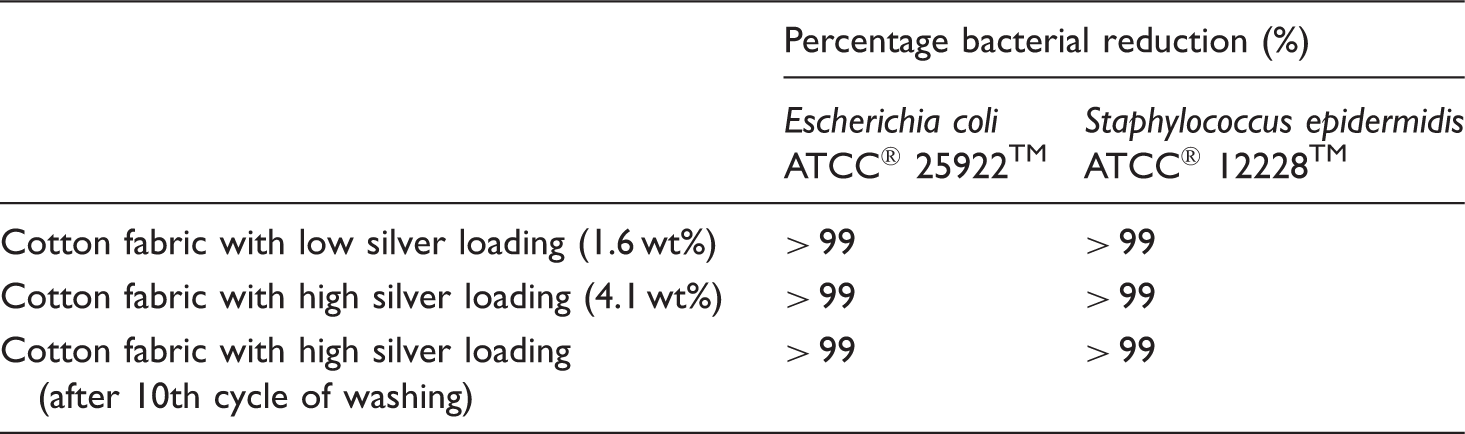
The anti-bacterial efficiencies of the cotton fabrics loaded with different quantities of AgNPs were probed using a procedure adopted from a standard testing method [24]. The cotton fabrics were cut into equal sizes of 1.5 cm squares. The cotton sample loaded with AgNPs was then placed in a flask (A) containing 50 mL of the bacteria culture (1.5 – 3.0 × 10⁵ colony forming units per milliliter). A flask of bacteria culture containing no cotton fabric (B) and another flask containing plain, as received but sterilized cotton fabric (C) were also prepared to serve as the controls. The assays were left to incubate at 35°C on a temperature-controlled orbital shaker running at 225 r/min for 1 h. After 1 h of incubation, the concentrations of the bacteria left in the various flasks were enumerated using a serial dilution and plate count method.
To calculate the percentage reduction, the difference in the resultant bacteria concentration between those in the flask containing the cotton sample loaded with AgNPs (A) and those in the control flask (B or C) was divided by the concentration of bacteria in the control flask (B or C), and multiplied by 100. If the difference in bacterial concentration between flasks (B) and (C) did not differ> 15%, the calculations were performed with reference to the concentration in flask (B). Thus, the equation is as follows:

Otherwise, if the difference in the bacterial concentrations between flasks (B) and (C) was> 15%, the bacterial concentration of flask (C) was used in the calculation instead.
Results and discussion
In situ preparation of AgNPs on cotton fabric and its characterization
As the major chemical composition of cotton fiber is cellulose with primary and secondary hydroxyl functional groups, APTES was selected as the surface modifier to introduce amine functional groups by a reaction of the cellulose hydroxyl groups in cotton fibers with the silyl ethers of APTES, as shown in Figure 1 (a). This forms a covalent linkage and anchors the APTES with the primary amine functionality free to act as stabilizing groups for the formation of AgNPs. A uniform coverage of AgNPs on the cellulose fibers can be achieved with this simple ‘one-pot’ process. The use of PhNHNH2 as the reductant was essential for the process. No color was observed on the fibers soaked in the reaction mixture at 60°C for an hour in the absence of PhNHNH2.
(a) Schematic diagram describing the formation of AgNPs on a cellulose (cotton) fiber in a one-step process and (b) schematic diagram representing non-dyed woven cotton fabric (left) and cotton samples loaded with AgNPs (right).
By controlling the amount of silver in the reaction mixture, the amount of silver loaded on the fabrics could also be tuned. As shown by the TGA data in Figure 2, the weight percentages of silver in the fabrics varied from 1.6% to a high of 4.1%. It is important to note that the decomposition pathway for the cotton fabrics loaded with AgNPs was slightly different from the untreated cotton. The cotton fabrics loaded with AgNPs showed lower heat stability as its initial decomposition temperature was lower than that of the untreated cotton fabrics. These observations were similar to other reported works [17, 25]. Figure 3 shows the SEM images of the untreated cotton fibers and cotton fibers loaded with AgNPs; the silver AgNPs were uniformly distributed onto the fibers with an average particle size of 100 nm.
Thermal gravimetric analysis of (a) untreated cotton fabric, (b) cotton samples with low loading of AgNPs and (c) cotton samples with high loading of AgNPs. Scanning electron micrographs of cotton fibers: (a) untreated cotton fabric, (b) untreated cotton fabric at higher magnification, (c) cotton fabric with high loading of AgNPs and (d) cotton fabric with high loading of AgNPs at higher magnification.

Concerns about silver include the limited color ranges imparted onto the textiles. Tang and co-workers, however, have shown that AgNPs can impart primary colors to fabrics due to surface plasmon resonance that occur when silver nanoparticles of specific shapes and sizes were immobilized onto the fabric [18]. The irregular shape and size of the AgNPs on the cotton fibers cause the characteristic dark gray or black color of this modified fabric. Theoretically, colors of this fabric can be changed accordingly by controlling the size and shape of the nanoparticles and the shade of the colors can be controlled by adjusting the loading of the AgNPs. Additionally, post-treatment of the modified cloth with color dyes can also be performed to modify the color of the fabric [26].
To further elucidate the nature of bonding between AgNPs and the cotton fibers, various surface analysis techniques were employed. The cotton samples loaded with AgNPs and untreated control samples were subjected to XPS analysis. An initial survey scan from 1200 eV to 0 eV for all the samples showed the expected carbon and oxygen groups on the fiber surface and also silver, nitrogen and silicon for cotton samples loaded with AgNPs. High-resolution scans were subsequently taken for the cotton samples loaded with AgNPs. The results showed that the binding energy of silver on the cotton samples were 384.1 eV and 390.1 eV, respectively (Figure 4). In the same fiber sample, we resolved a major N 1s peak in the –N–H bonds, which occurs at 415.4 eV (Figure 4) from the anchoring of the APTES group to the cellulose groups on the cotton fibers. TOF-SIMS analyses of the cotton samples have thus demonstrated that where there was a higher loading of silicon (as a result of APTES attachment), there was also a corresponding higher loading of silver, demonstrating that the silver nanoparticles were linked to the cotton surface by the amine groups of APTES (Figure 5). The XPS and TOF-SIMS results thus conclude that APTES was a prerequisite; essential for the formation, stabilization and anchoring of AgNPs onto the modified cellulose fibers.
XPS surface analysis for untreated cotton and cotton samples loaded with AgNPs. TOF-SIMS images for (a) silicon signals and (b) silver signals. Size of the sampling: 303.0 × 303.0 µm2. Images showing the zones of inhibition of cotton fabric with low loading of AgNPs (Sample A) and high loading of AgNPs (Sample B) on (a) Escherichia coli and (b) Staphylococcus epidermidis.


Breaking strengths of untreated cotton fabric and cotton fabric with high silver loading.

Loading and leaching abilities of cotton fabrics loaded with AgNPs
Two separate cotton samples with high AgNPs loading were prepared on two separate occasions to evaluate the consistency of the coating process. The acid digestion of both samples indicated that the loading of silver was 1981 ppm and 2200 ppm, separately. Within experimental errors, the concentration difference was 10% via the in situ method. In further experiments, the amount of silver leached out from the cotton samples loaded with AgNPs were investigated by washing the samples for 1 h at 37°C mimicking the action of a washing machine cycle. In the first eluent, only 41 ppb (weight) of silver was detected. This amount was reduced to 32 ppb (weight) in the 10th eluent. The low silver level in the eluents is an advantage extending the potential applications of the cotton textiles loaded with AgNPs.
Anti-bacterial activity
Modified Kirby-Bauer disc diffusion tests and bacterial reduction tests were carried out to ascertain the anti-bacterial effect and the killing efficiency of the cotton samples loaded with AgNPs on both E. coli ATCC® 25922™ and S. epidermidis ATCC® 12228™.
The results from the disc diffusion tests as shown in Figure 6 showed that small zones of inhibition (clearings) were observed for the fabric discs with AgNPs for both E. coli and S. epidermidis. This is in contrast to the large zones observed for the positive control ampicillin disc whereby the anti-bacterial agent (ampicillin) can freely diffuse from the disc to the surrounding agar and exert an extensive anti-bacterial effect. As the diameter of the zones of inhibition is indicative of the efficiency of the anti-bacterial agent against the test organism, intuitively one may deduce the lack of efficiency of the fabric against the bacteria tested. However, such deductions should not be made in this case as the silver nanoparticles are strongly bonded to the surface of the cotton fibers using the cross-linker described in the process. On the contrary, a smaller zone is indicative that a small amount of leaching only occurs for our samples. This was in fact evident when leaching tests were carried out on the material and the amount of silver ions that leached out into de-ionized water was < 0.1 ppm. The zones of inhibition tests had thus provided a qualitative measure of the anti-bacterial effectiveness of our modified cotton samples.
Percentage bacterial reduction against Escherichia coli and Staphylococcus epidermidis after 1 h of contact time with the modified cotton samples.
Conclusion
An in situ reduction of silver cations in a one-pot process for the fabrication of silver-containing cotton textiles has been demonstrated. Additionally, the fabric has demonstrated excellent anti-bacterial capabilities with minimal amounts of silver leaching into the eluents. The fabric has also been able to withstand mechanical washings potentially allowing its use as a household fabric. Anti-bacterial assays carried out on the fabrics show their anti-bacterial efficiencies thus potentially applying them as medical wound dressings.
Footnotes
Funding
The authors acknowledge the funding support from Institute of Materials Research and Engineering (A*STAR).