




Abstract
Nowadays, the advantages of staple fibers applied as reinforcement in cementitious composites are well known. The fiber to cement interfacial interactions influences mechanical properties of composites. Engineered cementitious composites are cement-based composites which are made of cement binder, small size sands, fillers, high modulus fibers, and supplementary cementing materials. They have improved tensile and flexural properties in comparison to normal concretes. To achieve these properties, high modulus fibers such as carbon, steel, and polyvinyl alcohol fibers have been used in engineered cementitious composites. In this research, low modulus polymeric fibers such as nylon 66, acrylic, and polypropylene were used as substitute of high modulus reinforcing fibers in engineered cementitious composite. The low modulus fibers were characterized carefully for physical–mechanical properties. The flexural behavior (flexural strength and flexural toughness) of the engineered cementitious composite specimens from this article was studied using a three-point bending test method. The results were compared to engineered cementitious composite containing polyvinyl alcohol. It was found that low modulus fibers caused considerable improvement in flexural behavior but results were lower than composites containing polyvinyl alcohol fiber. It was also found that these fibers are suitable choices for producing low price, acceptable performance engineered cementitious composites for usual applications in construction industry.
Introduction
Nowadays, the advantages of staple fibers applied as reinforcement in cementitious composites are well known. Cement-based materials are brittle under flexural and tension stresses in comparison to compression. This brittleness causes crack creation and propagation in the matrix and weakening of the product. This led to usage of fibers in short or long form and/or in the form of textiles as reinforcement in cement matrix. It has been found that the application of fibers in cementitious materials accompanied by desirable results such as decrease in crack creation and crack propagation, increase in toughness and ductility of matrix, increase in energy absorption capacity, and increase in tensile/flexural strengths [1–3].
Generally, fibers can act in two ways in cement-based composites [4]:
primary reinforcement: for improving the flexural/tensile properties of the composites and secondary reinforcement: for preventing crack creation and propagation in the cement matrix by bridging on the microcracks.
At first, the asbestos fibers were used to produce fiber-reinforced cement sheets [5]. In 1960s, the effectiveness of short steel fibers in reducing the brittleness of concrete was demonstrated [2,3]. This development has been continued with using variety of other fibers such as glass [6,7], carbon [8,9], synthetics (acrylic [7,10], nylon 66 [10,11], polyvinyl alcohol (PVA) [12], polypropylene [3,13–16], polyethylene [17], etc.), and natural fibers as concrete reinforcement [18–20]. In recent years, hybrid of different fibers have been used to improve performance of the cement-based composites [7,21–24].
In 1993, engineered cementitious composites (ECCs) were introduced by professor Li which were made of cement binder, small size sands, fillers, high modulus fibers, and supplementary cementing materials. It was a new type of high performance fiber-reinforced cementitious composites (HPFRCCs) which had been already presented by Naaman and Reinhardt [25]. ECC was a useful material with a moderate tensile strength of 4–6 MPa and higher ductilities (about 3–5%) than HPFRCCs [2,26].
ECCs had two exclusive characteristics; ability of multiple microcracking instead of macrocracking in the matrix and strain hardening behavior (i.e. a rise in tensile deformation accompanied by a rise in load after the first cracking) [2].
In many respects, this material has characteristics similar to medium to high strength concretes [27]. ECC is also ultra-ductile fiber reinforced cement based composite which has metal-like features when loaded in tension. ECC has also unique cracking behavior when loaded beyond the elastic range. ECCs exhibits cracks with the width below 100 µm, even at high deformations. ECC exhibits tough, strain-hardening behavior in tension, while containing low volumes of fibers (i.e. under 2 vol.%). The superiority of ECCs has been brought about by the engineering micromechanics approach and the development of fiber, matrix composite technology. The importance of the fiber matrix led to interface modification techniques that help to tailor desired properties [28].
ECCs are usually used as surface repair and retrofitting, surface repair of dam and irrigation channels, surface repair of retaining walls and viaducts, bridge decks, dampers for buildings, in shear elements subjected to cyclic loading, in mechanical fuse elements in beam–column connections, etc. [27,29–31]. In addition, it is found that ECCs are suitable materials for seismic applications, impact and blast resistant structures [32].
Regarding the importance of ECCs characteristics, a considerable amount of researches have been carried out on ECC behavior, including tensile characteristics [2,26,33], flexural properties [26,27,33–37], compressive strength [2,26,34,35], shear and shrinkage properties [27], water permeability [38], pullout behavior [35,39], etc.
Because of the importance of fiber types and their properties (as reinforcement), some researchers have studied the effect of fiber types on mechanical characteristics of concrete reinforced with fibers. Although various fibers such as steel, carbon, and various polymeric fibers have been used for producing ECC, PVA fibers with 12 mm in length and 39 µm in diameter seems to be of more common use in ECC [2,13].
Application of low modulus fibers as reinforcement in cement-based materials has been investigated by many researchers [40–43]. However, a few works has been performed on the evaluation of effects of low modulus fibers on ECC mix design.
In this research, effects of three different low modulus/low price polymeric fibers (acrylic, polypropylene, and nylon 66) on flexural behavior of ECCs were investigated. The results were compared to ECCs containing PVA fiber.
Experimental procedures
Materials
Fibers
Physical and mechanical properties of used fibers.

Cement
Chemical composition of used cement (%).

Methods
Determination of equivalent diameter of the fibers
The cross-sectional shapes of the fibers were determined by optical microscopy. Due to the importance of fibers diameter on mechanical behavior, equivalent diameter of the fibers were determined. Equivalent diameter is the diameter of a circle that its cross-sectional area is equal to the fiber cross-sectional area. Because of differences in fibers cross sections (Figure 1), a program was written by MATLAB software which was counted the number of existing pixels in each fiber’s image and then the equivalent diameter of each fiber was calculated by image processing [44].
Images of fibers cross-sectional shape obtained by optical microscopy (40×): (a) acrylic; (b) polypropylene; and (c) nylon 66.
Finally, three types of Iranian polymeric fibers (acrylic, polypropylene, and nylon 66) with equal equivalent diameter (approximately 30 µm) and length of 12 mm, were selected for the preparation of ECC mixture. As shown in Figure 1, the cross-sectional shapes of acrylic, polypropylene, and nylon 66 fibers were kidney shape, triangular, and circular, respectively. This factor (fiber cross section) is dependent on the conditions of fiber production.
Determination of tensile properties of the fibers
The single fiber tensile test was performed on each fiber using Instron 5566 machine. The span length was 30 mm according to ASTM D3822-07 [45] and 10 specimens were tested for each sample.
Fibers were clamed between two small clamps and 50 N load cell which was specific for fibers, used in this test. Results were obtained as load–extension curves. But for correct comparison, data of load were calculated as specific strength (tenacity). Afterward, percentage of fibers elongation was determined.
ECC mix design
ECC mix design proportions by weight for one sample.

ECC: engineered cementitious composite.
Characterization of fibers used in each sample.

Specimen preparation
In order to investigate the flexural behavior of ECC composite, some specimens were produced in the form of sheets. The dimension of the specimens was 230 × 100 × 9 mm3. Five specimens containing 2 vol.% of short staple fibers were produced and tested for flexural strength test. The average data were observed as mean value of test sample. To compare the effect of fibers, control sample (five specimens without fiber) was produced and tested.
The flexural strength specimens were prepared by a special mold which was designed and produced, as shown in Figure 2. The advantages of this mold compared to prior molds were increase in the production rate, reproducibility, and increase in smoothness of specimens surfaces.
Specimen production mold.
The specimens were cured at the temperature of 25 ± 2℃ and approximately 95 ± 5% relative humidity (Figure 3).
Prepared ECC specimens containing 2% volume fraction polymeric fibers.
Three-point bending test
After curing, the three-point bending tests were carried out using a Zwick-1494 machine based on EN 12 467 standard [46]. In this test, a 1000 kg load cell was used to measure the force and the span length was 200 mm. Figure 4 shows the three-point bending test setup.
Three-point bending test setup.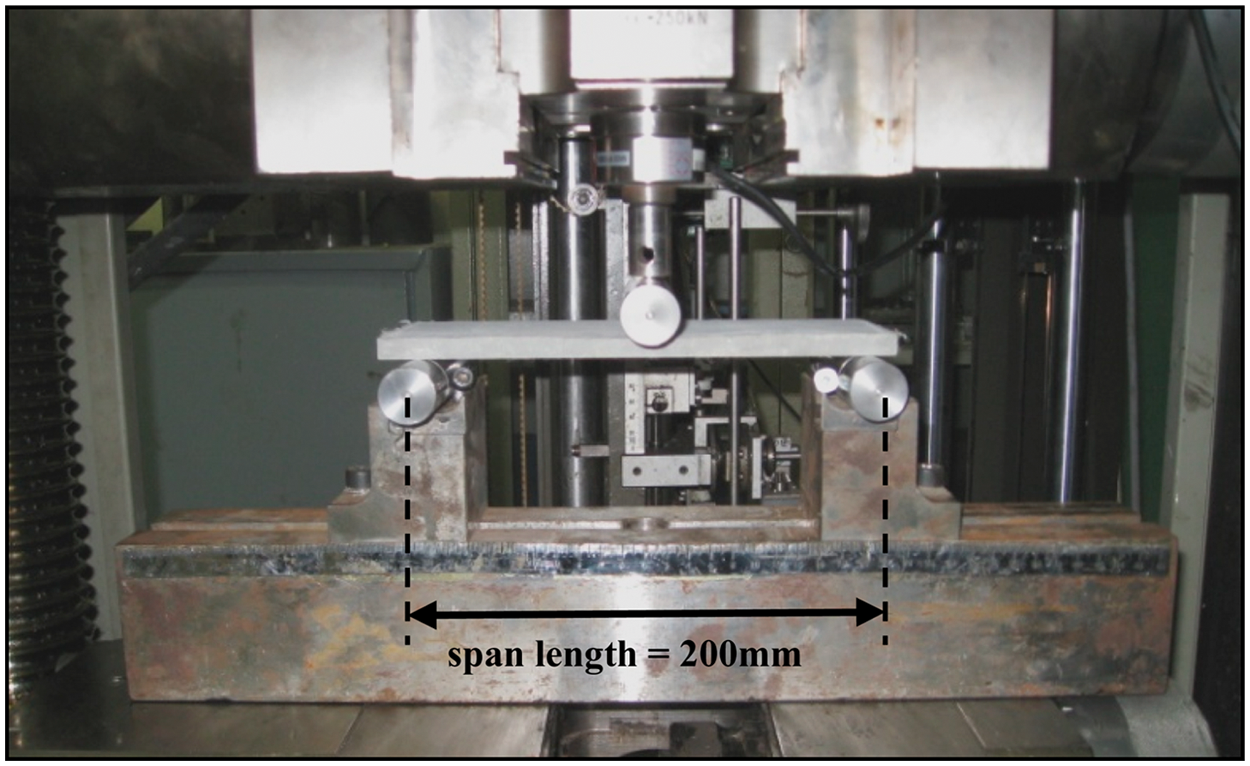
The results of this test were presented in the form of load–deflection curves, the flexural strength of specimens was determined as follows
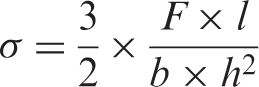
The flexural toughness of the samples was calculated from the surface area under the stress–deflection curve. It can be computed by integration or trapezoid method; the latter was used in this study.
The surface area under the curve was measured as toughness and the deflection capability of the composites (from horizontal axis of the flexural stress–deflection curves) was determined as ductility of the composite samples.
Results and discussions
Single fiber tensile test
The tensile strengths of all used fibers were characterized the results of which are shown as tenacity–elongation curves in Figure 5. The maximum tenacity and elasticity modulus was obtained by nylon 66 fibers, but the elongation of this fiber was less than other used fibers.
Tenacity–elongation curve of the used fibers.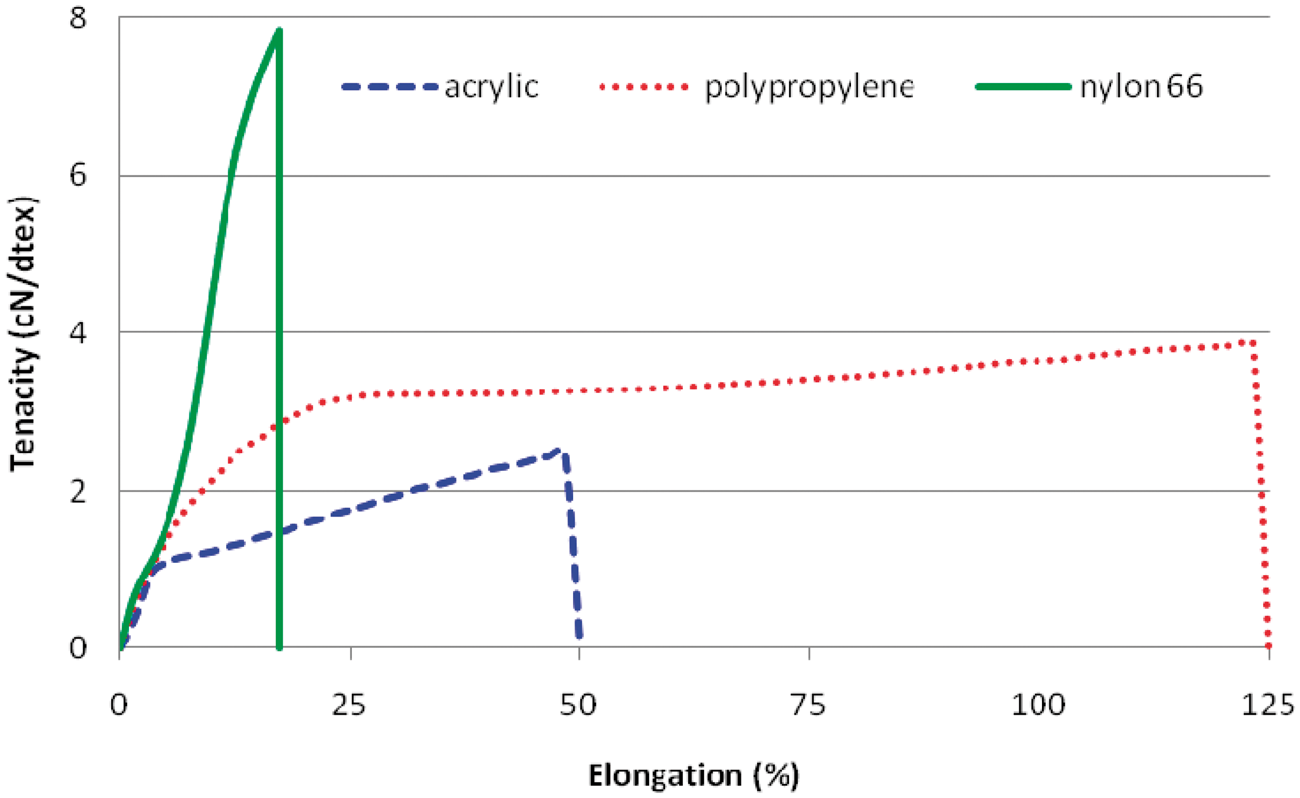
The acrylic fibers have the lowest tenacity (about 2.5 cN/dtex) among all the fibers used. It is evident that polypropylene fiber showed the highest elongation at tensile stress.
Three-point bending test
Results of three-point bending tests on ECC sheets are illustrated in Figures 6 and 7. Figure 6 shows that control sample has the flexural strength about 6 MPa, but its deflection is very low and it has fractured suddenly without deflection hardening behavior. As cement-based materials and concretes, this sample is quite brittle and its deflection is less than 0.45 mm.
Stress–deflection curve of control sample. Effect of the fibers type on the flexural behavior of the ECC samples: (a) stress–deflection curve and (b) magnification of the initial part of stress–deflection curve (dashed line zone).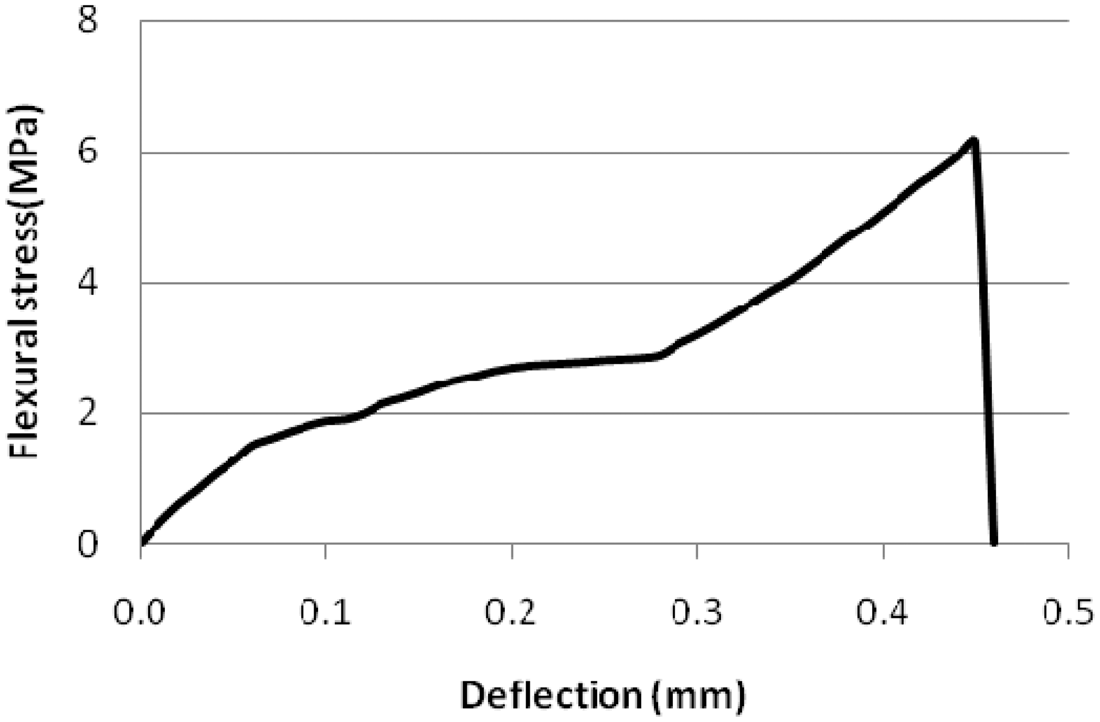

To compare the effect of fibers on the flexural performances of ECC, the flexural behaviors of all samples were evaluated and the results are shown in Figure 7. Five test specimens were tested and the mean value was reported as flexural strength of the sample.
As illustrated in Figure 7, addition of fibers in ECC samples increases the maximum flexural strength of the composites in comparison to control sample. This increase is accompanied by a high extent of deflection hardening zone. Deflection hardening is an intrinsic property of ECC and does not depend on specimen geometry (dimensions of ECC beams or sheets) [2].
In the ECCs containing polypropylene and nylon 66 fibers, increase in the flexural stress is accompanied by the creation of some microcracks. The first crack started inside the mid-span at the tensile side, and some cracks developed from the first cracking point. Now, these fibers influence the flexural behavior after the maximum load, via bridging on the cracks and decrease in the crack width.
Indeed, in the acrylic–ECC sample, the flexural stress is increased by increase in the deflection. However, after the first peak it is not seen a significant increase in the stress curve by deflection development (i.e. flexural softening behavior). In the ECC samples containing polypropylene and nylon 66 fibers, the flexural stress increased even after first peak in the stress–deflection curves up to second peak (i.e. deflection hardening behavior). The average deflections of these samples at the second peak stresses are about 5.48 and 5 mm, respectively. Thereafter, these samples show flexural softening behavior such as the ECC samples containing acrylic.
Three-point bending test results for different ECC sheets.

ECC: engineered cementitious composite.
Results of flexural toughness
As shown in Figure 8, presence of the fibers has changed the materials from brittle to tough form. It is clearly evident in the case of the composites containing polypropylene and nylon 66 fibers. It is found that employment of polypropylene and nylon 66 fibers increases the specimen’s toughness more than 130 times in comparison to the control sample. This improvement in flexural toughness is due to increase in deflection of ECC specimens containing polypropylene and nylon 66 fibers. It is also found that although addition of acrylic fibers in ECC matrix has increased the composite flexural toughness, but it is still less than two other samples. It seems that acrylic fibers are more effective in increasing the flexural strength of the composites.
Flexural toughness of the ECC samples.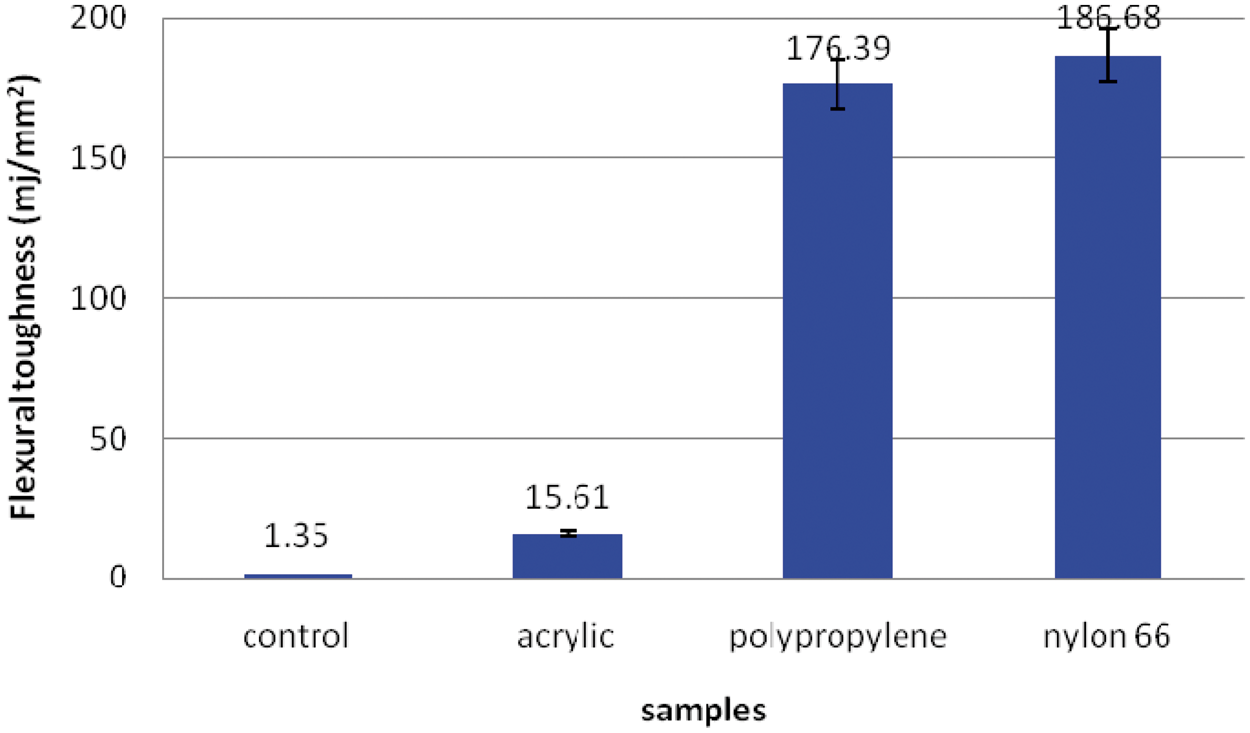
So it seems that acrylic fibers are more effective in increasing the flexural strength of the composites, while the polypropylene and nylon 66 fibers are effective in case of increasing the specimen’s deflection. So that the average of flexural deflection in the samples containing these two fibers is increased more than 175 times in relation to the control sample and it is about 80 mm.
Figure 9 shows that failure modes are different in various samples. In the ECC samples containing acrylic fiber, the sheets are fractured completely after three-point bending test. It is fractured after test similar to control specimens. In contrast, composites containing the polypropylene and nylon 66 fibers were not fracture even after higher deflections due to formation of microcracks instead of propagation of the first crack.
Image of the ECC’s after three-point bending test: (a) ECC containing acrylic fiber; (b) ECC containing nylon 66 fiber; and (c) crack bridging effect of nylon 66 fibers.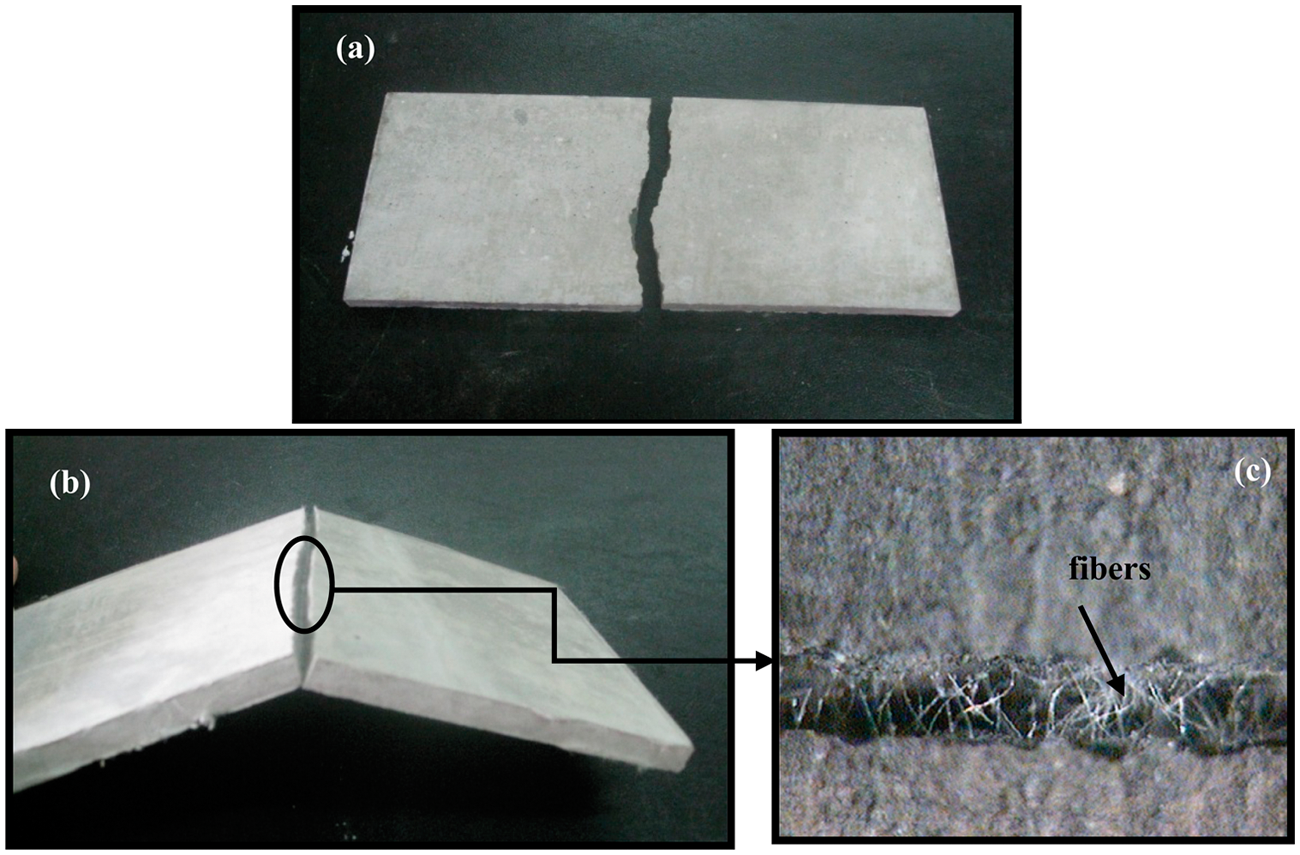
The finding was interesting because it was expected that the acrylic fiber perform better in the flexural strength test due to its better adhesion to cement matrix [7,10,41]. In contrast, it is expected that the polypropylene fiber show weaker performance in the cement matrix due to its hydrophobic nature and smooth surface which decrease fiber–matrix adhesion. Nylon 66 fiber has polar nature and should show more attraction to cement hydrated products, but in this study, the results show that there was no significant difference between the performance of the composites containing nylon 66 and polypropylene in the flexural strength and flexural toughness tests.
It should be noted that Li [2] has expressed that a flexural strength (modulus of rupture) of 10–15 MPa is easily achievable in PVA-ECC. So, although the flexural strength of ECC samples containing these polymeric fibers have increased, is still less than the flexural strength of PVA-ECC that is reported by other researchers.
Conclusions
In this study, three types of low modulus polymeric fibers were used as reinforcing fiber of ECCs. The following results were obtained:
The flexural test results showed significant decrease in flexural strength of composites in comparison to ECC samples prepared with PVA fiber [2,13]. However, a considerable increase in flexural strength and flexural toughness was observed in the produced ECCs in comparison to ECC control sample. It was found that it is feasible to produce low price ECCs with suitable flexural behavior, using low modulus polymeric fibers. Maximum flexural strength was obtained in ECCs prepared with the acrylic fibers. Addition of fibers in ECC samples increases the deflection of composites from 0.45 mm for control sample to about 80 mm for the composites containing polypropylene and nylon 66. The acrylic fibers are more effective in increasing the flexural strength of the composites, while the polypropylene and nylon 66 fibers are useful for toughness improvement.
Footnotes
Funding
This research received no specific grant from any funding agency in the public, commercial, or not-for-profit sectors.