




Abstract
Average number of fiber-to-fiber contacts in a fibrous structure is a prerequisite to investigate the mechanical, optical and transport properties of stochastic nano-microfibrous networks. In this research work, based on theoretical analysis presented for the estimation of the number of contacts between fibers in electrospun random multilayer nanofibrous assembles, experimental verification for theoretical dependence of fiber diameter and network porosity on the fiber to fiber contacts has been provided. The analytical model formulated is compared with the existing theories to predict the average number of fiber contacts of nanofiber structures. The effect of fiber diameters and network porosities on average number of fiber contacts of nano-microfiber mats has been investigated. A comparison is also made between the experimental and theoretical number of inter-fiber contacts of multilayer electrospun random nano-microfibrous networks. It has been found that both the fiber diameter and the network porosity have significant effects on the properties of fiber-to-fiber contacts.
Introduction
Electrospinning as an effective and promising technique for the production of nanofibers provides a mat of extremely fine fibers with small pore sizes. The small fiber diameter and porous structure of the nanofiber mats gives rise to a large specific surface area. This is advantageous in a wide variety of applications such as high-performance filters, scaffold in tissue engineering, separation membranes, reinforcement in composite materials, templates for the preparation of functional nanotubes and many others [1–5]. In all of these applications, it is crucial to have an estimation of the average number of fiber-to-fiber contacts within the assembly.
The estimation of the fiber-to-fiber contacts in a fibrous material is one of the most important parameters for investigation of many properties and applications of a fibrous assembly such as mechanical properties, porosity and pore size distribution, filtration performance, cell infiltration and so on. It is believed that when a fibrous assembly is deformed by an external force, the resisting and restoring forces thus produced within the structure are persisted and transmitted through the fiber contact points [6]. Also, one of the well-documented approaches for predicting the pore structure of fibrous material is based on knowing the number of fiber contacts in fiber assembly [7–13]. Thus, the number of fiber contacts plays an important role for study of different aspects of fibrous assembly.
The statistical geometry of different fibrous materials [6–9,11,12,14–17] and also paper and line networks [13,16,18] have been studied by many researchers up to now. In earlier studies of the fiber contact in fibrous materials, and more complete work in this regard, have been carried out by Komori and Makishima [6,19], Pan [7,13,14] and Sampson et al. [10–12,16,17,20]. Sampson and his co-workers in their works extended the work of Corte and Lloyd by incorporating the influence of fibre width and introduced a variable that characterizes the fibrous network, mean coverage (

During the application of the previous theories to the nano-microfiber assemblies, however, some problems have been revealed. First of all, all theories developed by Pan and Komori and Makishima are adjusted for general fiber assembles with definite fiber aspect ratio such as nonwoven materials. For these materials constituting staple fibers, one can easily determine average fiber length in the assembly and feed it to the geometrical model to determine the number of fiber contact in the fiber network. However, in the nanofiber assemblies like electrospun nanofiber mats, it is hard to determine the mean length of the fibers in the assemblies owing to unstable electrostatic forces during making of nanofiber layers in electrospinning process. Secondly, it can be proven, as we have theoretically shown elsewhere [21], that Sampson’s prediction of the number of crossing in the fiber assembly is too low, leading to a much lower average number of fiber contacts. Since these issues are critical to further studies, a modified theoretical analysis is developed by the authors which is reported in details elsewhere [21]. In that research work, they have developed a modified theoretical analysis for obtaining the number of fiber-to-fiber contacts in multilayer nanofibrous materials. In their approach, they first considered the statistical geometry of single-layer random nanofiber mats and then derived its average contact numbers. Since actual multilayer nanofiber mats have an appreciable structural component in the third dimension, they considered the superposition of single-layer mats to form a multilayer mat. They noted that in a nanofibrous network of a given mean fiber diameter ω and mean coverage

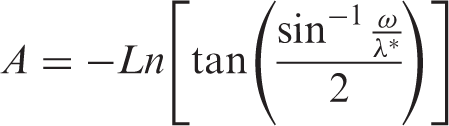
The average number of contacts on a random network,

To obtain the average number of fiber-to-fiber contacts per unit fiber length in the nanofiber assembly, they [21] simply divided equation (4) by λ, and therefore:

So, the expected average number of fiber-to-fiber contacts per unit fiber length of a single-layer random nanofiber network is dependent only on the porosity of the fibrous network, the fiber diameter and a function of aspect ratio of constituent fibers. As they assumed each single layer has a thickness twice the fiber diameter, by having the final thickness (t) of a multilayer nanofiber mats, the average number of contacts per unit length in a multilayered nanofibrous mats (


Therefore, by having the structural and morphological parameters of a nanofiber structure including mean fiber diameter (ω), porosity (ɛ) and thickness of multilayer mats (t), one can determine the expected average number of fiber contacts in a multilayer nanofiber structure composed of n layers for different applications and further analysis such as analyze mechanical properties, pore size and pore size distribution and so on, which is reported in detail elsewhere [21].
Equation (6) is not easily verified because the extent of fiber-to-fiber contacts is difficult to measure in multilayer networks. Experimental estimates of fractional contact area obtained from image analysis of cross-sections of paper embedded in resin is reported by Niskanen et al. [22] and Sampson et al. [23,24]. Because it is difficult to obtain a section along the full length of any fiber in a nanofibrous structure, these techniques are not readily applicable to the quantification of the number of fiber-to-fiber contacts per unit length. More recently, using Confocal Scanning Laser Microscopy (CLSM) to obtain three-dimensional (3D) stacks of images from fibrous [23] and nanofibrous assemblies [2] has been addressed by different authors and we extend their analysis here for our experimental study.
Therefore, the objective of this research work is to investigate the effect of theoretical dependence of fiber diameter and network porosity on average number of fiber contacts in nano-microfiber mats by using CLSM images.
Materials and methods
Preparation of nano-microfiber mats
Polycaprolactone (PCL, 80000 MW, Sigma-Aldrich, St. Louis, MO) was dissolved in Chloroform/Methanol (3:1) (Sigma-Aldrich, St. Louis, MO) at a concentration ranged from 10 to 16%wt polymer in solvent. CdSe-CdZnSZnSZnSZnS colloids quantum dot (QDs, Invitrogen Co., USA) with emission peak 578 nm and average particle diameter 5.72 nm were added to the polymer solution at 8%v/v to encapsulate them inside the fibers and make them visual through CLSM. Polymer solution was fed by syringe pump (KD Scientific, USA) at a rate of 0.55 ml/h through a 21 G blunt tipped needle. A voltage of 16–20 KV was applied to the needle tip with a high voltage power supply (Gamma High Voltage Research, Ormond Beach, FL, USA). A set of collectors was placed with needle-tip to collector distance 15 cm, as described elsewhere [1]. The fibrous scaffolds then were dried in a controlled atmosphere at ambient temperature for 1 day and in vacuum of less than 5 mmHg for at least 12 h and then were stored in a dessicator before testing.
To facilitate visualization of the fibers in the scaffolds, colloids QDs were blended with polymer solution for 2 h before electrospinning (Figure 1). After that, aqueous QD–PCL blend solutions were electrospun to make the fibrous scaffold, in which QDs were confined. After a pre-study of the best volume percent of QDs in the polymer solution, 8% v/v was chosen to make the fibers sufficiently bright and uniformly fluorescent.
A schematic mechanism for incorporating the quantum dots (QDs) into the nano-microfiber structure [2].
Surface morphology of nanofibrous scaffolds
The average diameter of the electrospun fibers was observed by a scanning electron microscope (SEM) (Zeiss, Supra550). Images were taken using a microscope operated at an accelerating voltage of 2–10 kV, after sputter coating with gold (BAL-TECSCD 050 Sputter coater, UK). Diameters of the electrospun nanofibers were analyzed from the SEM images using image analysis software (ImageJ, National Institutes of Health, USA). Typical SEM photographs of fibrous scaffolds with different polymer concentrations are shown in Figures (2–5).
Scanning electron microscope (SEM) micrograph of 16% wt/v polycaprolactone (PCL) in solvent. Scanning electron microscope (SEM) micrograph of 14% wt/v polycaprolactone (PCL) in solvent. Scanning electron microscope (SEM) micrograph of 12% wt/v polycaprolactone (PCL) in solvent. Scanning electron microscope (SEM) micrograph of 10% wt/v polycaprolactone (PCL) in solvent.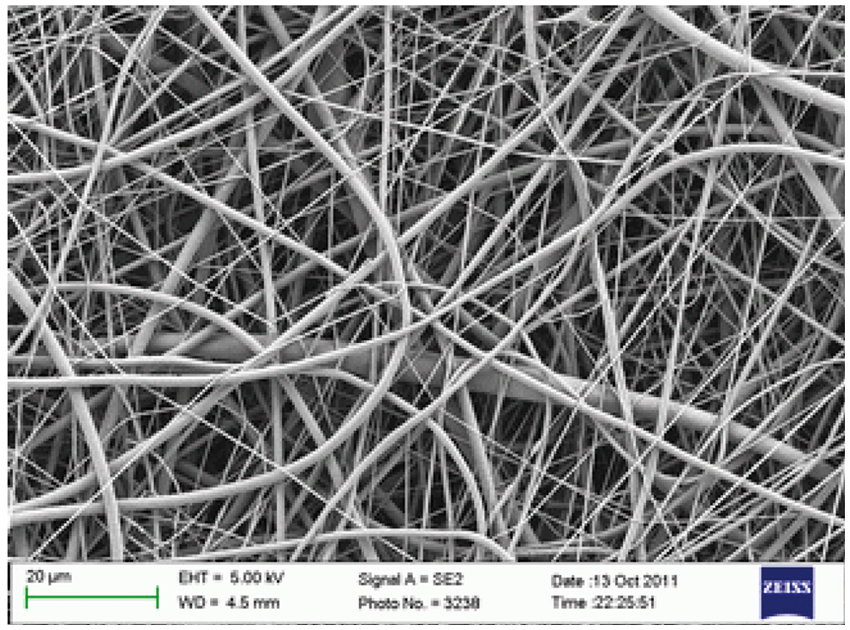


Nanofibrous network porosity
The porosity of the nano-microfiber mats was measured using gravimetry method. The thicknesses of the scaffolds were measured using CLSM reconstructed images, the details of which can be found elsewhere [2]. The volume of the structures could be determined using the measurement of the thickness and knowing the diameter of the mats. The mass of the scaffold was also measured for determination of the apparent density of the mats, ρ
mats
. The porosity, ɛ, was then calculated according to the equation (8) by having the density of PCL, 1.145 g/mL,

Microscopic measurement of fiber-to-fiber contacts
The measured parameters associated with the fiber-to-fiber contacts included the number of fiber-to-fiber contacts and the length of free fiber (ligament length). These parameters were measured directly in stacks of images of nano-microfiber mats obtained by using a Confocal laser scanning microscope and a × 60 oil-immersion lens. The inspection area of each image was 300 × 300 µm2. All the contacts in the images were counted and divided by the average fiber length of the fibers within the image to calculate the average number of fiber-to-fiber contacts per unit length of the fibers for each sample. Typical stacks of images of PCL 10%, 12%, 14% and 16% are shown in Figure 6. To measure the mean ligament length of the fibers in each image, a line was drawn between the centers of two neighboring contacts along each fiber axis in the image and the length of the line was measured as the ligament length. Thickness of each sample was also measured from the reconstructed images from the stacks of images by using ImageJ software.
Confocal scanning laser microscopy (CLSM) stacks of images for polycaprolactone (PCL) 10% (a), PCL 12% (b), PCL 14% (c), and PCL 16% (d).
Results and discussion
Average fiber diameter
To measure the average diameter of nano-microfiber mats, 100 fibers in the SEM micrograph were selected randomly and the average value of them was considered as the average fiber diameter. Figure 7 shows the histogram of fiber diameters for different samples. The average diameter of fibers for different samples based on the above procedure is also presented in Table 1.
Histogram of fiber diameters for different specimens. Average nano-microfiber diameters for different specimens.

It can be easily confirmed that with increasing concentration of polymer solution (keeping other parameters constant) the average fiber diameter increases. The larger fiber diameters at high concentrations are attributed to the viscosity of the solution that was high enough to lower the bending instability of the jet and consequently, decreasing the drawing forces in the spinning zone [1].
Average number of fiber to fiber contacts
To investigate the influence of different parameters affecting the average number of fiber-to-fiber contacts, as given by equation (5), the experimental data are summarized in Table 2. It can be seen from Table 2 that the total number of contacts falls linearly with nano-microfiber mats porosity; this could be due to the fact that increasing porosity effectively increases the number of fiber-to-fiber contacts within the nano-microfiber structures. The calculated and measured fiber contacts are also depicted in Figure 8. Clearly there is good agreement between theory and measurement for the results obtained by the presented model. Although the model presented by Sampson [20] can also predict the trend of the dependency of fiber diameters and porosities in the samples, their theoretical values fall far short of the experimental values.
Comparison of average number of fiber-to-fiber contacts per unit fiber length measured experimentally with that calculated using the model. Fiber and network properties.

The expected number of fiber contacts is an important property because the reciprocal of that gives the mean ligament length (mean length between contacts) [21]. Since ligament lengths in a fibrous structure forms the boundaries of pores within the constituent fibers, the characteristic pore size also depends only on fiber diameter and network porosity. Knowing these dependencies can be used for the estimation of the pore size and pore size distribution in experimental study for different application of the fibrous mats including tissue engineering, nano-filtration and so on.
Conclusions
In this research work, a new technique for measuring the properties of fiber-to-fiber contacts directly in nano-microfiber mats has been used successfully. Based on analytical approach presented for the estimation of the number of contacts between fibers in a random multilayer nanofibrous assembly with arbitrary fiber diameter and orientation, an experimental validation on the theoretical dependency of fiber diameter and network porosity was presented. Increasing the network porosity and fiber diameter effectively increases the number of fiber-to-fiber contacts within the nano-microfiber structures. Also, it is believed that the presented theory for fiber-to-fiber contacts is more realistic and useful for further studies of multilayer nanofibrous assemblies.
Footnotes
Acknowledgements
The authors kindly thank Centre for Material and Fibre Innovation, Institute for Frontier Materials (IFM), Deakin University, and Prof. Xungai Wang and Miss Helen Woodall, in particular, for their invaluable help and support.
Funding
This research received no specific grant from any funding agency in the public, commercial, or not-for-profit sectors.