




Abstract
Fabric stiffness is one of the most important parameters in estimating the wear and comfort properties of multilayered textile materials. The characteristics of bending stiffness may be determined using different test methods. The aim of this work was to apply the compress hanging loop method for the evaluation of stiffness of coated and laminated fabrics. In order to achieve this purpose an extension machine appropriately equipped with a special device for specimen fixing has been used in this work. The initial and ultimate geometrical characteristics of the loop, and also the forces that were necessary to compress the loops to a certain degree were determined in this work. The investigation reveals that the force, which is necessary to compress the loop to a stated degree, is different not only for specimens cut in various directions but also for those specimens that are of different size. Therefore, the deformation properties are dependent on the material structure and testing conditions. The results indicate that coated and laminated fabrics with larger surface weight were more resistant to compression force. Also for these fabrics the larger difference of compressing force values was determined when the polymer film had been in different loop sides. It should be noted that analysis of geometrical compressed loop characteristics showed that for all tested specimens the upper and lower ratios of formed semicircles were not equal. The investigation reveals that the hanging compressed loop method allows extending the range of tested materials, which include rigid and less rigid fabrics.
Introduction
Coated and laminated fabrics are made in a wide range of constructions to meet extensive range of applications. They are used for protective clothing, automotive and marine application, for household goods and in many other areas [1]. These fabrics are usually subjected to a wide range of deformation such as bending, folding, creasing, wrinkling and stretching in different directions and of different forces which are often acting at the same time. All these strains are essential for the wearer’s comfortability [2,3]. It means that clothing construction must be optimal and the deformation ability of fabrics should be taken into account. As a rule, the materials of two or more layers used for protective clothes are more rigid [1,4]. Fabrics lamination with polymer film may increase their bending stiffness about 13–20 times [5], coating up to 3 times [3,6]. Typical protective garments made from more stable and rigid coated and laminated fabrics can restrict the movement of the wearer. Clothing from materials of higher stability more often has deeper folds and wrinkles, which are not preferable especially for items which experience higher deformation during wearing. The higher resistance to bending forces appears in cylindrical parts of clothing such as sleeves and trouser-legs in the case of arms and legs maximal bending [2,7,8]. The fabric bulging caused by extension of these clothes parts is defined as bagging. More often for analysis of this phenomenon the device that has a motion, similar to the bending of an arm, is used [9]. The construction of artificial arm allows analysis not only on bagging but also on flexural rigidity of fabrics [10]. The repeated flexing fatigue of clothes made from laminated or coated fabrics may be the reason for small cracks that appear in bending lines [11]. The bending rigidity of fabrics also has an influence to the fabric's formability, buckling behaviour, wrinkle-resistance and crease-resistance and is the essential mechanical parameter in modelling of clothing from more stiff fabrics [12].
Many different methods are used for the estimation of fabrics bending rigidity. Those methods vary in the specimens’ shape, conditions of their testing and ways of fabrics rigidity evaluation. For the clothing fabrics rigidity analysis the researchers more often apply the well-known methods such as cantilever [6,13,14] or KAWABATA pure bending [15,16]. The coated and laminated fabrics as multilayered materials may be characterised by higher stiffness and stability, therefore the cantilever method is not suitable for the evaluation of their bending rigidity in some cases. Also it was determined that cantilever method is not suitable for some laminates that inclines to curl even in normal atmospheric conditions [17]. For stiffer fabrics and to purposefully eliminate the specimen’s curling during test the loop method is more suitable for fabrics bending rigidity determination. This method involves the formation of a loop by a specimen’s strip [18,19]. The testing conditions depend on the position of the loop, whether it is hanging, laying or standing and shape (pear, heart or ring). More often the rigidity of the fabric is evaluated using geometrical characteristics such as height and width of the loop. Four loop shapes are examined in the works of Zhou and Ghost [18] and Naiyue and Ghosh [20] and relationship between the height of the loop and bending rigidity is also analysed. The fabric mechanical behaviour and distribution of various inner stresses using loops of the heart shape has been analysed in Dai et al. [21]. The results of the work of Sacevičien ė and Masteikaitė [17] have shown that method using the loop of the pear shape allows testing the larger variety of coated and laminated fabrics but received results also confirm that this method is less sensitive due to insignificant differences between results of different fabrics. The bending rigidity characteristics of multilayered fabrics were different as result of bending them in face and in back sides in most cases [22,23]. In some cases this difference reached till 7 times. Review of literature and our earlier work indicates that for stiffer clothing fabrics’ bending rigidity analysis, compressed loop method is the more informative one [8,24,25]. This method better simulates the material deformation during the wearing of clothes and is more sensitive. During the loop compression the average stiffness of the material can be measured because the specimen is bent in both sides at the same time. According to vertical loop shape the specimen’s deformation is more complex: the top layers of loops are deformed into one, and the bottom to the other side.
The aim of this study is to analyse loop deformation peculiarities during its compression and estimate the suitability of compressed loop method for determination of bending rigidity of stiffer and non-stable coated and laminated fabrics used for protective clothes.
Materials and methods
Coated and laminated fabrics
Mechanical characteristics and structure of coated and laminated fabrics.

Three-layered fabric (polymer film between two plies of base fabrics); directions: M – lengthwise, A – crosswise.
Thickness
Chosen fabrics have polyvinylchloride or polyurethane coats. Their thickness varies from 0.01 to 0.44 mm. Taking into account the commercial fabrics used in this experiment, their polymer layer thickness was measured from the cross section of their photos using image analysis program Image J with accuracy of 0.01 mm. For scanning purposes, a scanning electron microscope (SEM), FEI Quanta 200 FEG, has been used. As evident from Figure 1(a) the thickness of laminated layer may be determined more easily because it is clearly seen. For coated layer measuring the thickness of polymer mass with caves has been chosen (Figure 1(b) and (c)). The six measurements were made and the averages were calculated. The coefficients of variation exceeded 2.8%. In spite of the fact that the thickness of polymer layer was determined only approximately, this characteristic was used only to compare the different behaviour of fabrics during their deformation. It is known that bending rigidity of multilayered fabric depends not only on the rigidity of separate layers but also on the type and contact area of their bonding [4,6,23]. Therefore the cross section of tested fabrics made with SEM was also used for the bonding between layers examination.
The cross section of laminate L2 (a) and coated fabrics L12 (b), L14 (c).
Cantilever test
At first, for the evaluation of tested fabrics bending rigidity we used the well-known FAST cantilever test [13]. Six repeats per specimen were carried out and the averages were calculated. The coefficient of data variation ranged from 1.7% to 4.2%. Unfortunately it was impossible to determine the bending rigidity for fabrics L11 and L12 because they were curling during test and for fabric L10 due to its very high stiffness. With reference to the fact that stiffness of multilayered fabrics, when it is bent on the outside and inside, is different, all specimens were tested deforming them in both sides, when the polymer film was inside (−) and outside (+). For three-layered laminate L1 the woven layer was accepted as outside (+) and the knitted layer as inside (−). To compare the tested fabrics the average results of bending rigidity were calculated

The results of tested fabrics bending rigidity in two principal directions are presented in Table 1. Using cantilever test it was found that range of bending rigidity Q for investigated specimens varied from 6.6 to 66.7 µNm. Taking into account the values of bending rigidity, FAST ‘Fingerprint’ recommends woven fabrics used for clothes to be divided into three groups [12]: limp fabrics Q < 5 µNm, average stiff fabrics 5 µNm ≤ Q ≤ 14 µNm and stiff fabrics Q > 14 µNm. Our test results have shown that laminated and coated fabrics chosen for this experiment may be characterised as stiff materials and only in lengthwise direction some of tested fabrics (L1, L3, L7 and L8) results may be characterised as results of average stiffness.
Compressed loop test
For the compressed loop method the strip shape specimens of 20 mm width and 120 mm length were cut in the lengthwise (M) and crosswise (A) directions. In order to examine specimen’s behaviour during its compression the different shape of loops were used. Choosing of the loop shape depends on the work aim. In the work of Stiuart et al. [24] authors used the circular loop that was loaded in compression up to loads, which can produce creases and unloads. An experimental technique had been used, which made possible the separation of loads supported by the bends from the load supported by the fabrics between the bends. The pear shape loop compression was used in the work Naujokaityt ė and Strazdien ė [25] on purpose to deeper analyse the buckling phenomenon appearing during specimen deformation. It is known that bending rigidity of material is very important in some parts of the worn clothes, where the deep wrinkles appear, for example, in the inner arm [8,26]. The structure of fabric’s deformation in the inner side of the sleeve may be divided into two parts: inner loops (G) and outer loops (H) (Figure 2). The same layer may be from outside and inside the loops during deformation of the clothes. Taking into account the stated facts – the loop shape, similar to the shape of deformed clothing parts, was used in this work. Tests were carried out with the fixed specimen in the hanging loop position using a Tinius Olsen HT10 tension machine with special clamps.
The type of sleeve deformation during arm bent (a) and schematic fabric deformation as loop shape from the inner side of elbow zone (b).
The shaped loop was attached by stretching out the ends of the strip by c = 20 mm and attaching them to the upper stable surface (j = 10 mm) (Figure 3).
The scheme of the specimen fixation in the special devise.
The initial height of the loop x was the distance from the outer side of the loop to the attaching surface while the initial width y was measured at its widest level. The loop-neck width d was determined at its narrowest point. The start-up distance between the specimen fixing plate B and compressing plate C was equal x0 = 45 mm. During the experiment the lower compressing platter C rose towards the upper stable fixing plate B using the cross-head speed at 25 mm/min. The two different degrees of specimen’s deformation were chosen in this work. They are analysed in the next section.
For the more rigid coated and laminated fabrics and for active wear clothes, which are produced from these fabrics, not only the characteristics of compressing force till some degree are important but also the geometrical characteristics of the compressed loop. Therefore, the process of the loop deformation was recorded with a digital camera every 5 mm and a ruler of the precision of 1 mm has been used. The pictures of initial and compressed loop shapes were transferred to the computer and the data has been analysed with the image analysis method [27].
Specimen preparation, pre-conditioning, and testing involved standard atmospheric conditions of 20℃ ± 2℃ temperature and 65% ± 2% relative humidity, extended on a horizontal surface for 24 h to decrease the inner tension of the fabric which could influence on the precision of this experiment.
Results and discussion
Initial loop characteristics
During the first stage of the experiment, the initial characteristics of the investigated fabrics shaped loops such as length x, width y and neck width d were determined (Figure 3). The results indicated that for the tested specimens the loop length x differed a little and ranged from 41 to 45 mm. The differences are about 9%. It should be noted that more considerable differences were determined between the values of the characteristic y. It ranged from 11 to 24 mm and differences exceeded till 54%. It was found also that loop’s neck width d varied from 0 to 11 mm. The maximum values of characteristics y and d were determined for three-layered fabric L1 in lengthwise direction when the knitted layer was inside (−) meanwhile the minimum values were fixed for the same fabric (L1) also in lengthwise direction, only in the case when woven layer has been outside (+).
Loop compression: Compression force
After loop’s compressing at xn = 5 mm the curves of loop-shaped specimen compressing force F changing was drawn (Figure 4). The results have shown that the received curves could be divided into two stages.
The specimen’s loop compression using special device (a) and curves of loop shaped specimen L10 compression (b) when the polymer layer is inside loop (+) or outside loop (−).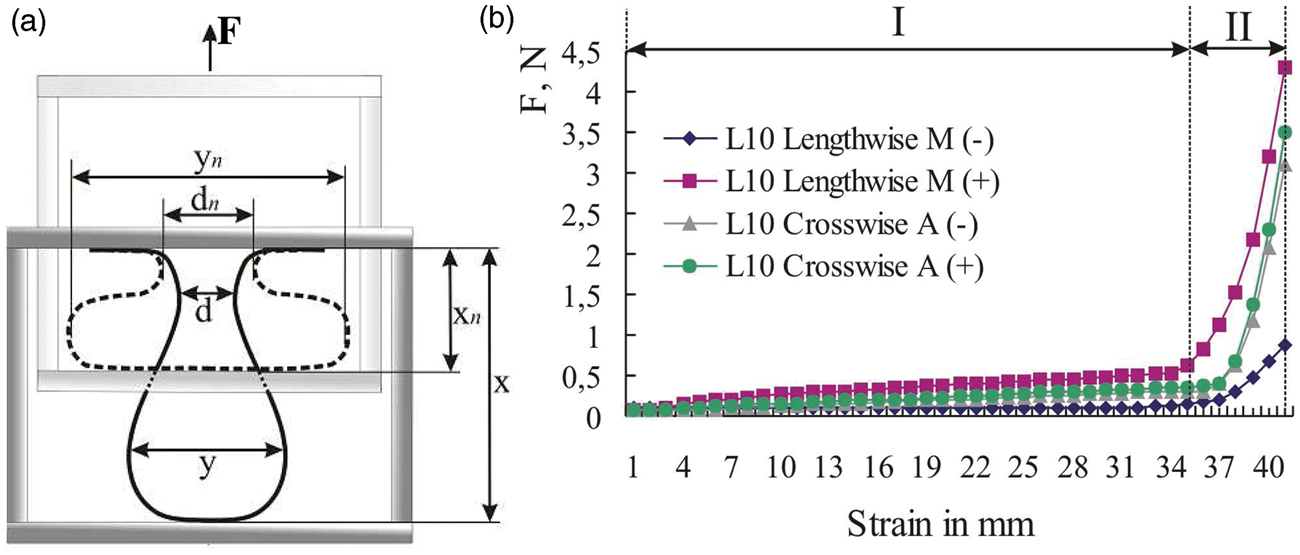
The compression curves slightly raised and remained linear at the stage I. It is evident that during this stage the compressing forces are relatively small and for all tested specimens it exceeds the maximum 0.5 N. More significant rise of the curves was noticed when the step of compressing plate C reached 34–37mm. Thus the sharper rise of the compression force was marked in the stage II. The end of the experiment was stated when the maximum step of compressing was reached (x1 = 5 mm) and compressing force Fmax was determined. As evident from Figure 4(b) the small forces and similar shape of curves in the stage I did not allow the analysis of the loop resistance to compression precisely. Therefore, for bending rigidity of tested fabric analysis the ultimate result of compressing force – Fmax was chosen. Around 3 to 5 measurements were carried out for every type of specimen and the averages were calculated. The maximum coefficient of data variation was determined from 4% to 17%.
After maximal fabrics loops compression till xn = 5 mm, the range of Fmax from 0.24 to 5.34 N was recorded (Figure 5). It can be seen that fabrics L10 and L12 are more resistant to compression force, which were distinguished by larger surface weight and, comparably, thick polymer layer (Figure 1(b)). The average values of characteristic Fmax was received during specimens from fabric L2 compression. It may be explained by the high thickness of base woven layer and the big surface weight. Also for this fabric, the larger difference of Fmax values was determined when the polymer film was in different loop sides. The difference exceeded about 2.1 times in lengthwise direction and about 2.2 times in crosswise direction. This effect may be related to the significant difference between thickness of fabric and polymer film layer (Figure 1(a)). For more stiff fabrics L10 and L12 this difference ranged from 9.4% to 29%. It should be noted that for fabrics L2 and L12 the higher Fmax values were received when polymer film was inside the loop, meanwhile for the fabric specimen L10, when outside. The reason of this phenomenon can be the thick PVC film layer of fabric L10. The other fabrics such as L2 and L12 are coated or laminated with more elastic PU film. It is also worth mentioning that higher resistance to compressing force mostly had specimens cut in lengthwise than in crosswise direction. As for the three layers fabric L1 (polymer film between two plies of base fabrics), the results of compressed force have shown that its bending rigidity is comparably low and similar to most tested fabrics bending rigidity. The lower values of compressing force have shown the thinnest laminate L5.
The compression forces Fmax of tested fabric in lengthwise (a) and crosswise (b) direction, when the polymer film is inside (−) and outside (+); for the three-layered fabric L1 the knitted layer is inside (−) and outside (+).
It is also worth mentioning that no satisfactory correlation between fabrics rigidity results received using cantilever test method (Table 1) and compressed loop method (Figure 5) was obtained. It may be explained by several reasons. Both used methods adopt different testing principles. According to these methods the bending rigidity is determined using own weight of the specimen [6,13,14] or its resistance to bending force [12,16,23,24]. Other reason may be the different structure of tested fabrics. Though the comparison of the results received using different types of testing methods often show good correlation, in some cases for example during heavy-weight fabrics testing there could be more discrepancy between compared results [28]. The characteristics of coated and laminated fabrics used in this work were different while the used methods did not have the same measure so they cannot be accepted as commensurable and interchangeable [12].
Loop compression: Geometrical characteristics
For the analysis of loop geometrical characteristics its compression till the profile of the loop breaks down into four semicircles has been used (Figure 6). The two of the semicircles were formed on the inner side of the loop and two on the outer side. The compression degree x1 was determined using formula
The compressed loop shapes of four semicircles; L1 laminates, lengthwise direction, when polymer film is: (a) inside: R1 < R2; (b) outside: R1 > R2.

Where δ is the thickness of coated or laminated fabric’s layer.
For the tested fabrics the characteristic x1 ranged from 17 to 19. Only for fabric C2 in crosswise direction during loop compression when the polymer layer was inside x1 = . 12 mm was used.
Naturally, during loop’s compression, its height x successively decreased and width y increased. The results indicate that loop-neck width decreases in most cases. After loops compressing till x1, the characteristic y1 ranged from 28.6 to 44.3 mm and characteristic d1 varied from 0 to 15.5 mm.
After compressing at x1, the radii R1 and R2 of the upper and lower semicircles were measured. The coefficients of variation of all fabric specimens’ characteristics ranged from 4.0% to 15%. Due to fabrics uneven rigidity, the radius R1 may be longer, equal or less than R2 (Figure 6). The uneven fabrics rigidity has an influence on the characteristic d1 values which can be 0 in some cases (Figure 5(b)). The results have shown that maximal d1 values were received during compressing of lengthwise cut specimens from fabrics L1, L10 and C2 with the inside position of polymer film. The minimal characteristic d1 have shown specimens L7 in crosswise and L1 in lengthwise cut directions when polymer film is outside and specimen L2 in crosswise direction when polymer film is inside. The difference between the radius R1 and R2 indicates how the rigidity of fabric differs when it is bent on different sides. For comfortability of clothes and wearer’s movements’ release, the less bending rigidity of loops G is preferable (Figure 2(b)).
The compressed loops semicircles’ radii R1 and R2 (mm) after compression till x1.
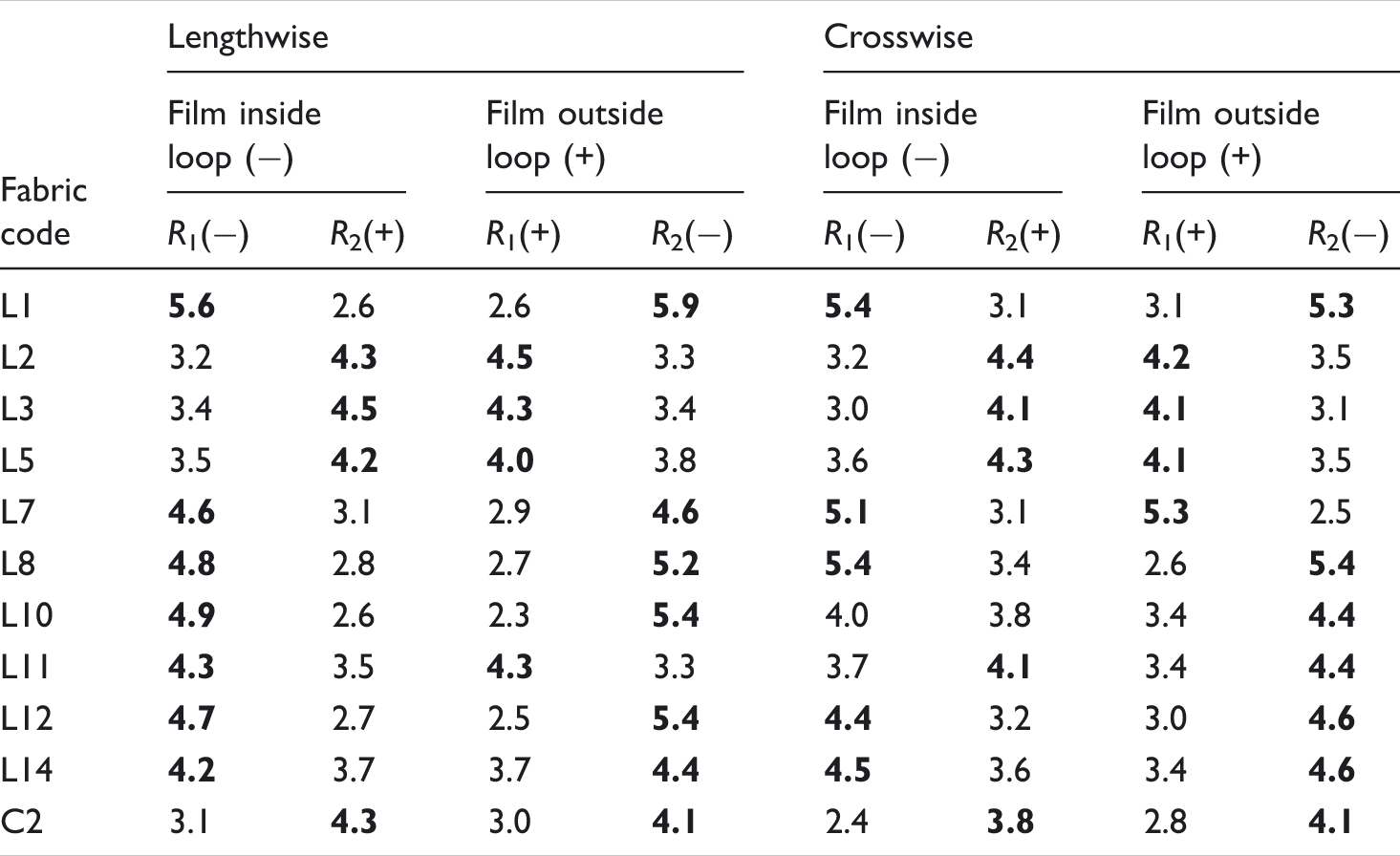
It has been discovered that the proportion between radius R1 and R2 depended in large part upon the situation of the polymeric layer. The investigation reveals that in most cases, when the polymeric layer is outside the initial loop, it is to be noted that R1 > R2 and when inside it is vice versa. It means that more comfortable clothing is one that is made using materials with polymeric film from inside. Since the clothes made from coated and laminated fabrics have inner lining layer the polymeric surface of the main fabrics has no contact with the skin of wearer and does not reduce the hygienic properties of clothing. The differences between the radii R1 and R2 in times (k = Rmax/Rmin) are presented in Figure 7. It should be noted that for all specimens the upper and lower radii were not equal and characteristic k ranged from 1.05 to 2.35. The test has shown that more uniform results of semicircles’ radii received for thinnest fabric L5.
The differences between the radius R1 and R2 in times after loop compression till x1 in lengthwise (a) and crosswise (b) directions when the polymer film is inside loop (−) and outside loop (+); for the three-layered fabric L1 the knitted layer is inside (−) and outside (+).
Although the loop compression deforms the same specimen into both sides at the same time, the experiment has shown that there are some differences between characteristics k received for fabrics with different situation of polymeric layer in shaped loop. The investigation reveals that during loop compression the more uneven bending rigidity of separate parts of loop (radii of semicircles) has shown fabrics L1, L8, L10 and L12 in lengthwise direction and fabrics L1, L7 and L8 in crosswise direction wherein k exceeded till 1.5. Because of the loop shape when specimen is compressed it deforms gradually and its surface contact with the plate C changes [30]. After loop’s compressing till x1 the contact area between straightened lower part of specimens and plate C is not equal for all tested specimens and depends on the loop-neck width d1 and differences between radii R1 and R2. The results have shown that contact area of tested specimens ranged from 41.0 to 66.0 mm2. It should be noted that loop’s bottom part contact area with plate C after its compression at x1 depend on the differences between radii of upper and lower semicircles. It was found that bigger contact area appears in the case R1 < R2 and vice versa.
Conclusions
The suitability of compressed hanging loop method for coated and laminated fabrics bending rigidity evaluation was analysed in this work. This experimental work has shown that using compressed loop method the stiffer and non-stable fabrics bending rigidity may be determined using numerical and graphical results. The compression force shows the fabrics resistance to the complicated deformation, which appears in the clothes during wearers movements while the geometrical loop characteristics have an influence on the comfortability of clothes parts after their deformation. Based on the received results the following conclusions were obtained:
The investigation reveals that due to compressed loop method the fabrics bending properties may be characterised using numeral characteristics such as compression force and geometrical characteristics such as loop-neck width, radii of shaped four semicircles and their differences, and loop contact area with compressing plate. The analysis of force variation has shown that during initial loop compression minimal changes can be observed and only when compression distance exceeds about 75–85% of initial height of loop, more considerable increase of the compression force was noticed. Therefore, for the estimation of fabrics bending rigidity the loop’s compression till 5 mm of its height may be used. In case of loop bending in different sides, the evaluation of the uneven bending rigidity was analysed using the geometrical characteristics of four semicircles shaped when loop was compressed till degree of 17–19 mm, which depends on fabric thickness and unevenness of rigidity when it is bent on different sides. The information about different rigidity of fabrics may be received from the relation between radii of upper and lower semicircles, if deformation of fabric is similar to the deformation which appears in clothes during wearing. The hanging compressed loop method allows extending the range of tested materials, including rigid and less rigid materials and especially multilayered with layers of different structure and properties. Though the loop shape of specimen allows compressing the specimen in both sides simultaneously, the experiment has shown that there are some differences between results received when the loop was shaped in fabric’s face and back. The investigation of some coated and laminated fabrics has shown that fabrics with larger surface weight are more resistant to compression force. Also, the larger difference of compressing force values was determined for these fabrics when the polymer film was in different loop sides.
This work extended the analysis of methods for estimation of fabrics behaviour in the various parts of clothing during wearer’s movements. It is important to note that the aim of this work was only to analyse the opportunities of compressed loop method used for multilayered fabrics bending rigidity estimation. Therefore the fabrics of different structural characteristics were used for this work. The results of this experiment have shown that to explain more deeply the behaviour of multilayered fabrics during their complicated bending it is necessary to carry out a more detailed analysis of fabrics structure and properties and for this purpose we plan to investigate separate fabric groups with more similar properties in the future. It should be noted that specimen’s deformation using the compressed loop method is more similar to the fabrics’ deformation in some parts of clothing during wear. Therefore this method may be used for more stiff fabrics bending rigidity evaluation during protective clothes design.
Footnotes
Funding
This research received no specific grant from any funding agency in the public, commercial, or not-for-profit sectors.