




Abstract
Acoustic is currently one of the most important fields of study. Recently, many studies have been carried out in this field and new findings have uncovered the potential use of new materials for sound absorption applications. This paper investigated the sound absorption properties for recycled fibrous materials including natural fibers, synthetic fibers and agricultural lignocellulosic fibers. Nonwovens produced from recycled natural fibers blended with synthetic fibers have been tested acoustically. Also, biocomposites from agriculture wastes such as rice straw and sawdust have been investigated. The results indicated that nonwoven samples have high sound absorption coefficients at high frequencies (2000–6300 Hz), low sound absorption coefficients at low frequencies (100–400 Hz) and better sound absorption coefficients at mid (500–1600 Hz) frequencies. The sound absorption coefficients at all frequency ranges improved by increasing the thickness of nonwovens. Also, adding air space behind the sample improved the sound absorption at low and mid frequencies. The tested rice straw and sawdust composite samples achieved low sound absorption at low and mid frequencies. However, they have slightly high sound absorption at high frequencies. A significant improvement in sound absorbing performance at low, mid and high frequencies was achieved by adding perforation of 6% for the tested sample and increasing the thickness of nonwoven samples. Adding air spaces behind the tested composite systems could improve the sound absorption at low and mid frequencies. Generally, the results indicated that recycled fibrous materials hold promise for use as raw material for sound absorbing, being low cost, lightweight and biodegradability.
Introduction
Due to noise pollution in many places in Egypt, there is a great need to find new sound-absorbing materials that are capable of reducing the noise level at various frequency ranges. Acoustical material plays a number of roles that are important in acoustic engineering such as control of room acoustics, industrial noise control, studio acoustics and automotive acoustics. Sound absorptive materials are generally used to counteract the undesirable effects of sound reflection by hard, rigid and interior surfaces and thus help to reduce the reverberant noise levels [1,2]. Also, they are used as interior lining for apartments, automotives, aircrafts, ducts and enclosures for noise equipments and insulations for appliances [2,3]. Also, sound-absorbing materials should always be used in conjunction with barriers and inside enclosures to improve their effectiveness [4].
The common sound-absorptive materials are made from synthetic fibers that are hazardous to human health and environment and quite expensive for small need. Therefore, some researchers showed their great interest in trying to make an alternative sound absorber from recycled materials [5].
Many studies focused in developing natural fibers, such as palm, kenaf, coconut, coir and many others fibers that have potential to be used as raw or waste material for sound absorption and sound insulation applications [6–9]. Zulkifli et al. had studied the effect of perforated size and air gap thickness on acoustic properties of coir fiber on sound absorption [10]. Paddy straw was investigated and reported suitable for acoustic panel because of its high elasticity and hollow space [11,12].
Porous materials used for sound absorption may be fibrous or cellular. Fibrous materials may be in the form of mats, board or preformed elements manufactured of glass, mineral or organic fiber (natural or man made) and include felts and felted textile [1]. The kinetic energy of the sound is converted to heat energy when the sound strikes the fibers. Hence, the sound disappears after striking the material due to its conversion into heat. The main reasons for the acoustic energy loss when sound passes through sound-absorbing materials are due to frictional losses, momentum losses and temperature fluctuations. Various parameters influence the sound losses of sound energy in fibrous materials. Number, size and type of pores are the important factors that affect the sound absorption. To allow sound dissipation by friction, the sound wave has to enter the porous material. This means, there should be enough pores on the surface of the material for the sound to pass through and get dampened [13]. One of the most important qualities that influence the sound-absorbing characteristics of a nonwoven fabric is the air flow resistance of the material. Fibers interlacement in nonwovens are the frictional elements that provide resistance to acoustic wave motion. In general, when sound enters these materials, its amplitude is decreased by friction as the waves try to move through the tortuous passages. Thus, the acoustic energy is converted into heat [14].
Using biofibers can address the ecological and economical concerns of the industrial materials [15]. Cotton and jute are very important fibers in Egypt, also wool is one of the most widely used textile fibers that is often blended with less-expensive fibers to reduce the cost of the fabric or to extend its use. Synthetic fibers such as polyester and polypropylene have great uses in the industry. Their staple forms can be blended with many other fibers contributing desirable properties to the blend without destroying those of the other fibers [16].
Lignocellulosic fibers from agriculture wastes such as rice straw and wood fibers have also great uses in the industry which help in reducing the negative impacts on the environment. In Egypt, after harvest of the rice crops, the fields must be cleaned and prepared for the next winter cultivation. The rice straw is usually burned soon after threshing. The uncontrolled burning of huge amounts of rice straw causes severe air pollution and leads to the formation of the “Black Cloud” [17,18]. Wood fiber wastes such as sawdust are mostly used in the thermoplastics industry. The scrap wood is sourced for species purity and then ground to specific particle size distributions. The specific but broad particle size distribution in commercial sawdust varies among manufacturers [19].
Nonwoven fabric technology is the most modern branch of the textile industry and it embodies both old and very new processing techniques and materials [20,21]. Since 1970, the nonwoven industry has observed a phenomenal growth mainly because of a close alliance among nonwoven producers, fiber producers, binder producers and machinery manufacturers. There are many nonwoven manufacturing processes and products that have been developed and commercialized in recent years [22]. Nonwovens are used in variety of purposes due to their advantages: lightweight, sound efficiency, flexibility, versatility and easily tailored properties, recyclability, low process and materials costs [23]. Needle punching is by far the most versatile and commonly used method of bonding fibers accounting for 20–25% of nonwovens. It is carried out through passing a number of needles with barbs, mounted in a board, through the batt at a high reciprocating speed. The needles are usually triangular in cross-section with barbs at the three edges. The extent of fiber bonding depends upon punch density, depth of needle penetration, needle type, shape, size and angle, barb shape and fiber characteristics [24].
The aim of the present work is to investigate the sound-absorption properties of various nonwovens produced from recycled fibers and biocomposites to benefit from these wastes which have a negative effect on the environment.
Experimental methods and materials
Nonwoven samples
Physical properties of the tested nonwoven samples.

Lignocellulosic fibers composite samples
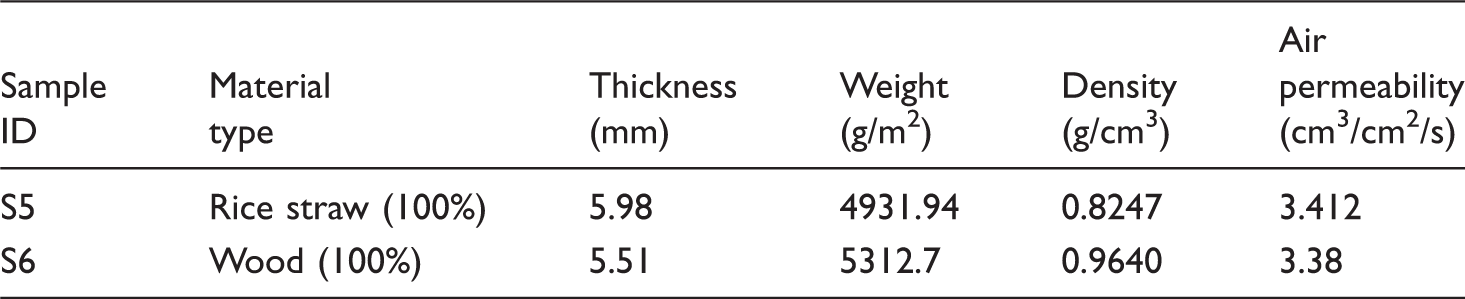
Physical properties of the biocomposites samples.
Sound absorption measurement apparatus
PULSE acoustic material testing tube, type 4206 [28], was used for sound absorption measurements with the needed software for analyzing and determining the acoustical properties of noise control materials. The measurements have been carried out according to ASTM E1050 [29] in acoustic laboratory of Building and Housing Research Center. Sound source (loudspeaker) is mounted at one end of the impedance tube and a sample of the material is placed at the other end as shown in Figure 1. The loudspeaker generates broadband, stationary random sound waves, which propagate as plane waves in the tube, hit the sample and reflect. The propagation, contact and reflection result in a standing-wave interference pattern due to the superposition of forward and backward traveling waves inside the tube. By measuring the sound pressure at two fixed locations and calculating the complex transfer function using a two-channel digital frequency analyzer, it is possible to determine the sound absorption and complex reflection coefficients and the normal acoustic impedance of the material. The usable frequency range depends on the diameter of the tube and the spacing between the microphone positions.
Schematic diagram of the impedance tube for the two-microphone transfer-function method.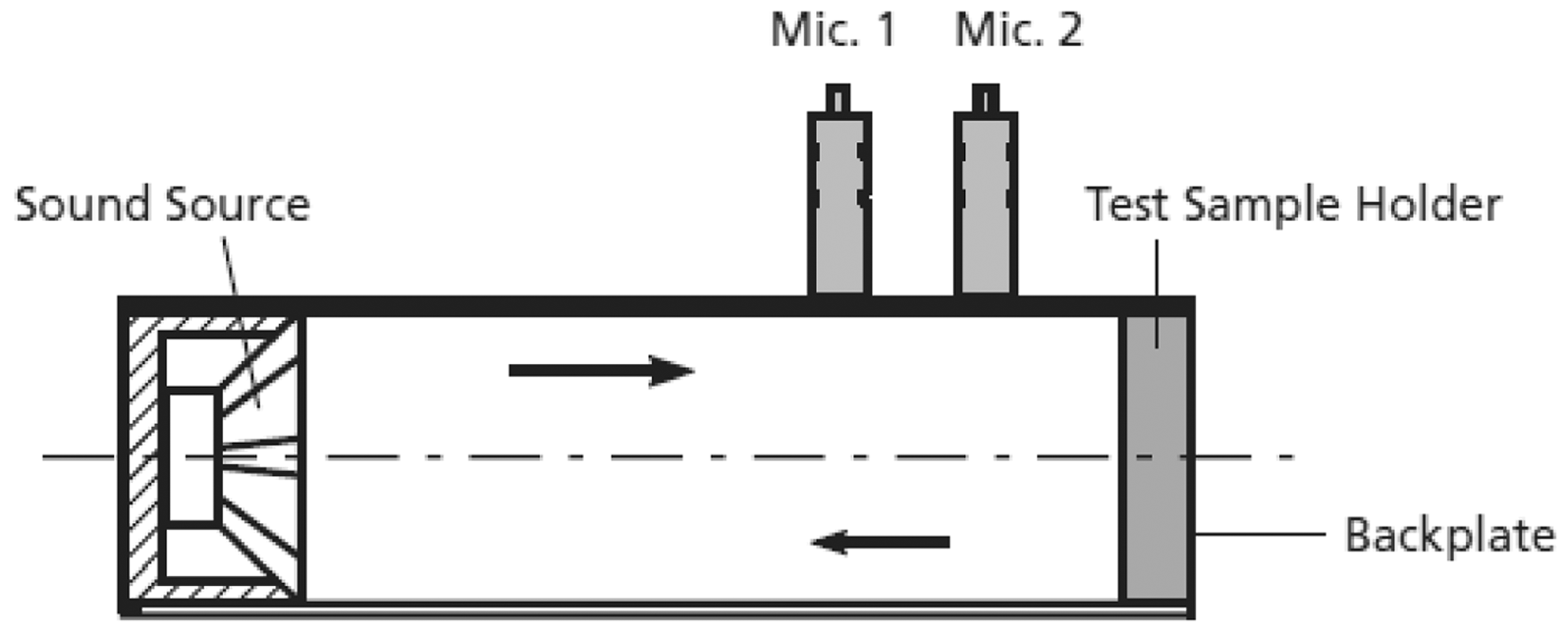
Impedance tube system (50 Hz–6.4 kHz) type 4206 consists of:
100-mm diameter tube (large tube) and 29-mm diameter tube (small tube). Sample holders and extension tubes (29 and 100 mm). Two condenser microphones 1/4 inch.
Figure 2 shows the complete system for measuring the sound absorption coefficient from 50 Hz to 6.4 kHz.
Complete system for measuring the sound absorption coefficient.
Measurement procedure
The sound absorption coefficients have been measured for four different nonwoven samples S1, S2, S3 and S4 as follows:
Testing the four different nonwoven samples with different thicknesses (adding layers). Testing sample S1 with perforated wooden plate (2 mm) of 6% perforation in front of the tested samples with and without adding air spaces (1, 2, 3 and 4 cm) behind it. Testing different thicknesses of S1 with the perforated wooden plate in front of it and adding different air spaces (1, 2, 3 and 4 cm) behind the sample.
The average sound absorption coefficients (arithmetic mean) have been calculated for low (100–400 Hz), mid (500–1600 Hz) and high (2000–6300 Hz) frequencies.
Then the sound absorption coefficients have been measured for different systems including the two lignocellulosic composite fiber samples S5 and S6. These samples were perforated of 6% open area and sample S4 was chosen to be added behind it for testing the acoustic performance of these systems assembly as follows:
1.With and without air spaces (5 and 10 cm) behind the samples. 2.With perforated samples S5 or S6 and adding different air spaces (5, 10 and 15 cm) behind the systems. 3.With perforated samples S5 or S6 and adding different thicknesses of S4 and different air spaces (5, 10 and 15 cm) behind the systems.
Results and discussion
Results for nonwoven samples
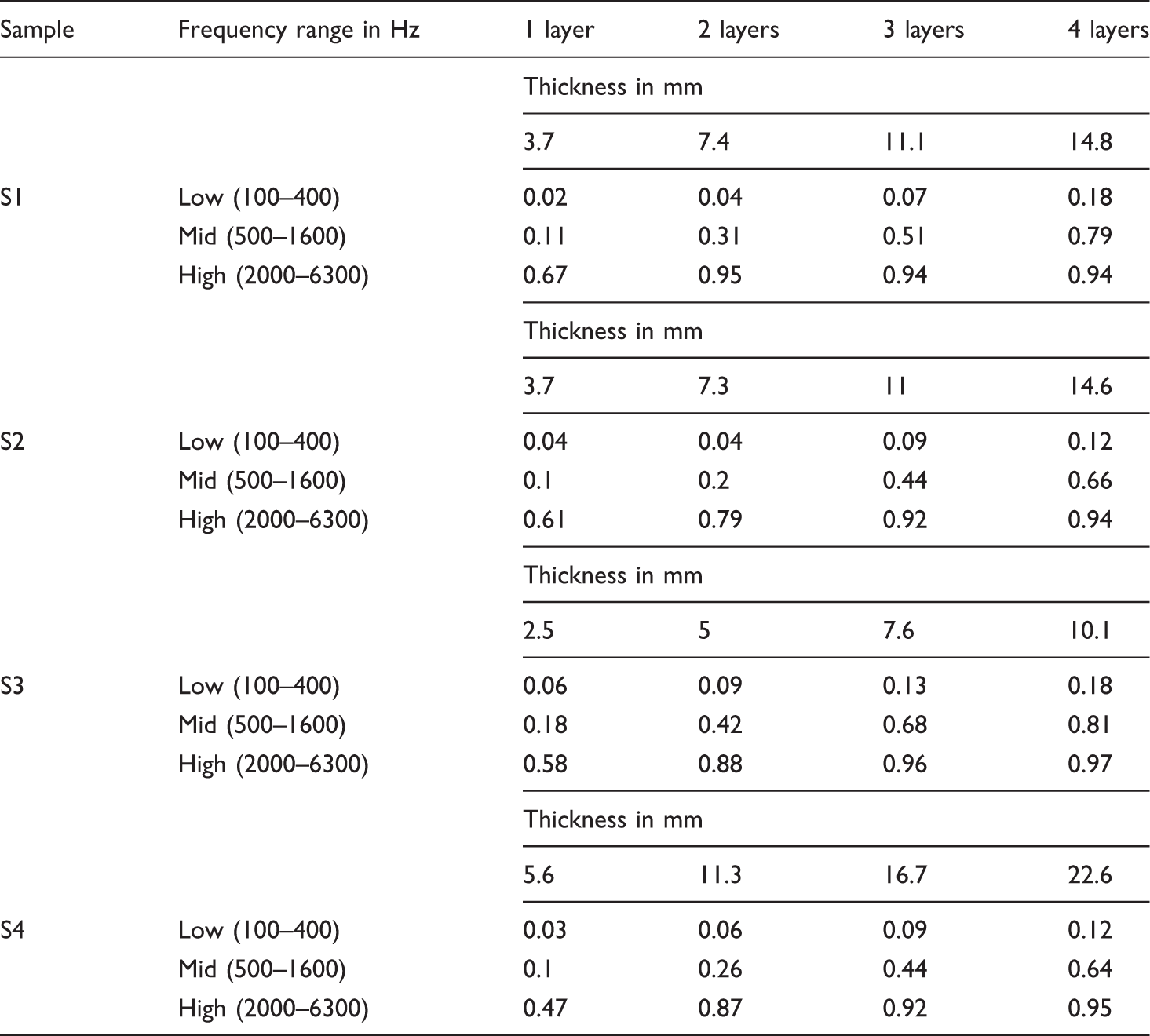
Average sound absorption coefficient at low, mid and high frequencies for nonwoven fabric samples.

Sound absorption coefficients for different thicknesses of sample S1.

Sound absorption coefficients for different thicknesses of sample S4.
Effect of air space
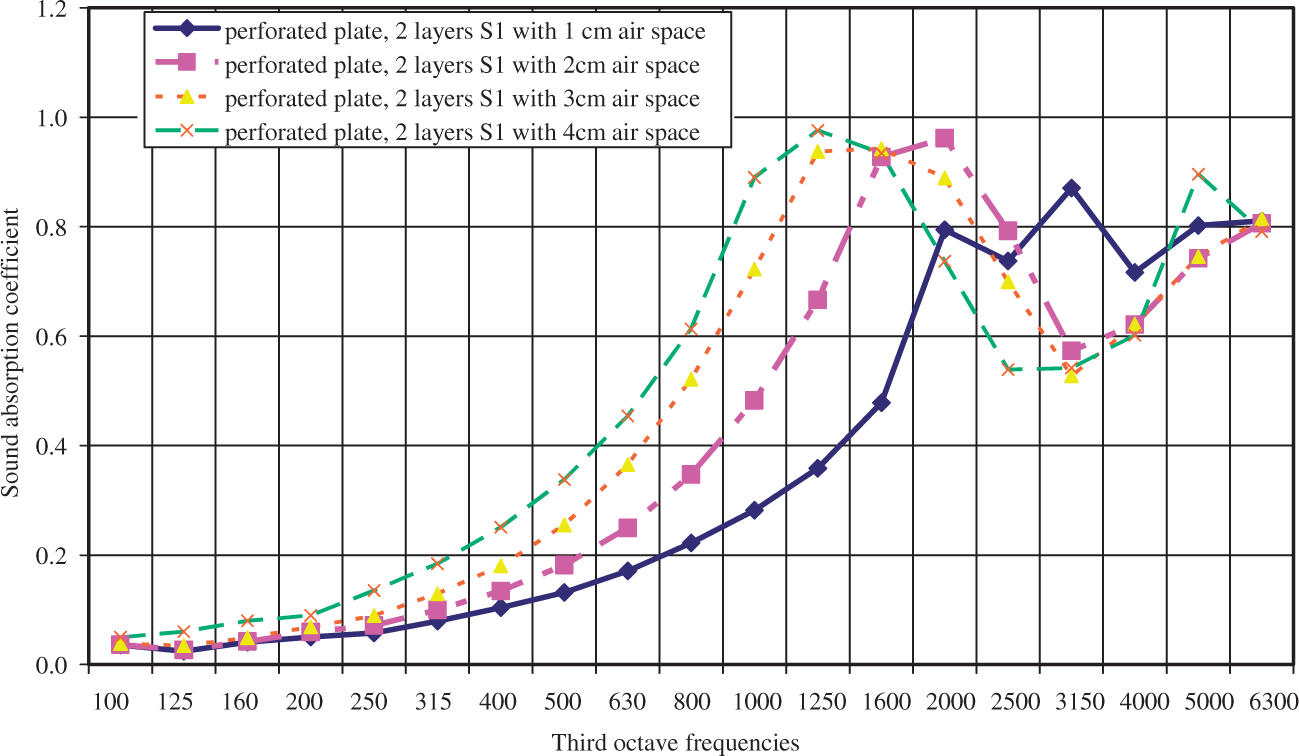
Some applications of fibrous materials such as barriers inside enclosures silencers require some forms of protective covering and at the same time permitting the sound to enter into the fibrous materials. The most common covers consist of perforated metal or wooden panel with a fibrous material behind. So sample S1 was chosen as an example for testing the use of perforated plate and air spaces behind the sample on sound absorption coefficients since it gathered the most common textile fibers in the textile industry. Figures 5–7 show the sound absorption coefficients for sample S1 with 6% perforated wooden plate that was added in front of the tested sample with different thicknesses and different air spaces behind the sample.
Sound absorption coefficients for S1 with perforated plate and air spaces behind. Sound absorption coefficients for two layers of S1 with perforated plate and air spaces behind. Sound absorption coefficients for three layers of S1 with perforated wooden plate and different air spaces behind.
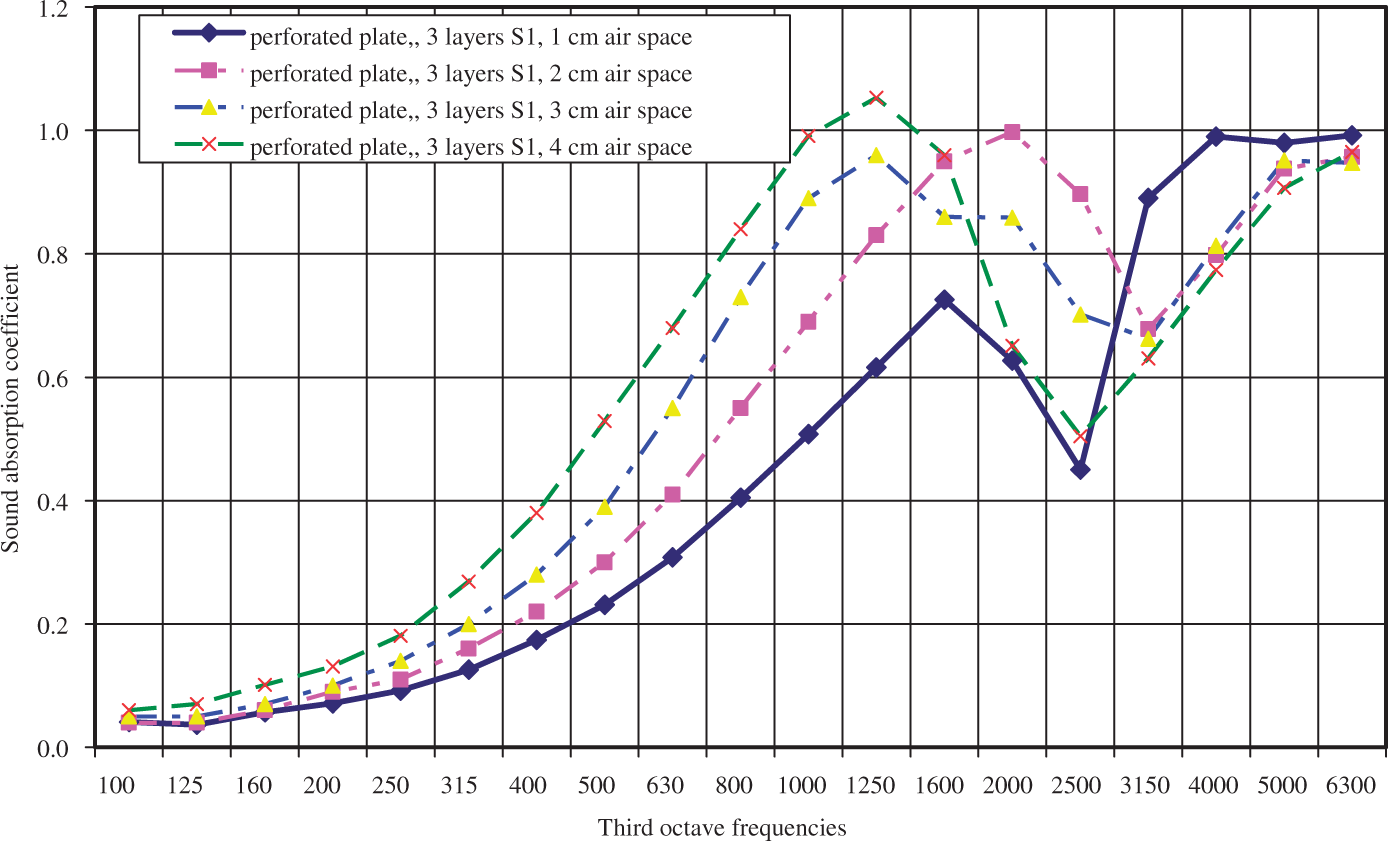
Average sound absorption coefficients for different thicknesses of S1 with perforated wooden plate and air spaces behind.

For testing sample S1 with thickness greater than 7.4 mm and adding air spaces behind, the sound absorption coefficients improved at low and mid frequencies and may be decreased at high frequencies. The increase of sample thickness can improve the sound absorption coefficients at low, mid and high frequencies due to the increase of sound energy losses. On the other hand the increase of air space behind the sample moves the resonance frequencies (peaks absorption) to lower frequency range and results in a decrease of the sound absorption at higher frequencies [31]. Also the air space distance can absorb the sound energy of long wavelength at mid and low frequencies.
Results for lignocellulosic fiber composite samples
Sound absorption coefficients for different systems of composite samples with and without perforation and air spaces behind.


Sound absorption coefficients for S5 with different air spaces behind.
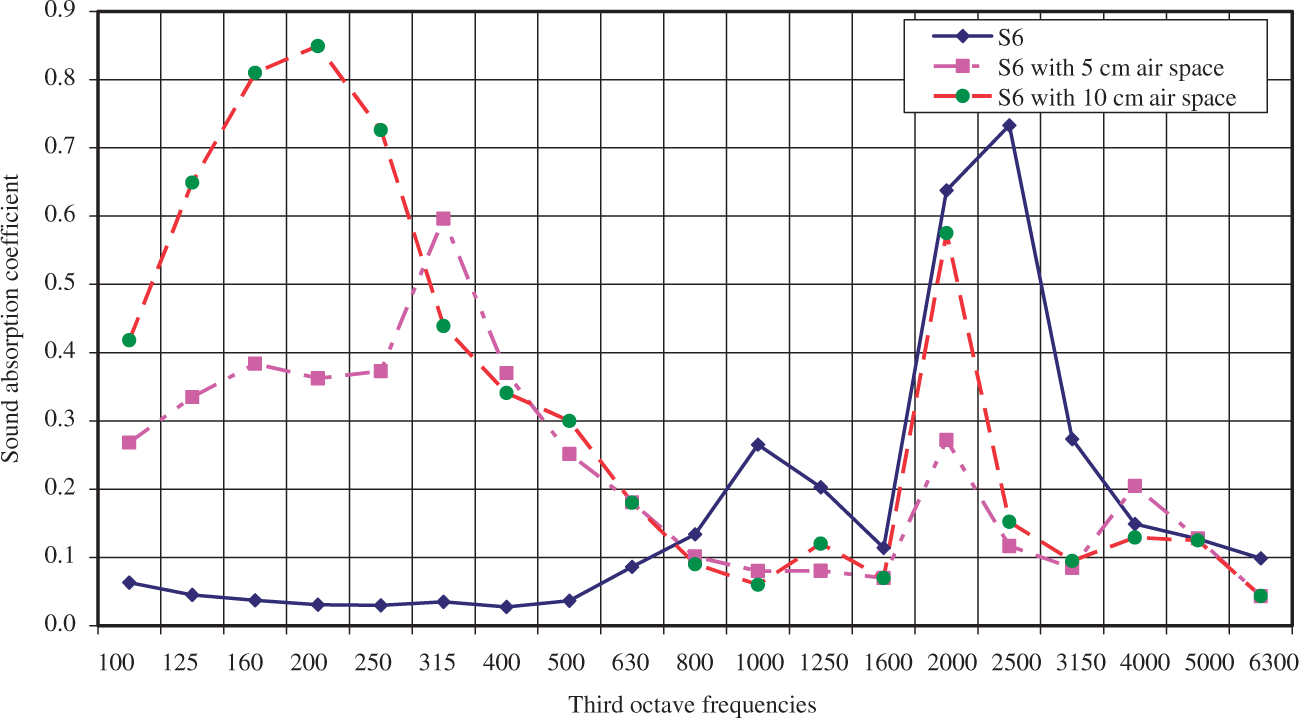
Sound absorption coefficients for S6 with different air spaces behind.
Sound absorption coefficients for different systems of perforated composite samples S5, S6 and S4 with different air spaces behind.


Sound absorption coefficients for perforated S6 and 1 layer of S4 with different air spaces behind.

Sound absorption coefficients for perforated S5 and 2 layers of S4 with different air spaces behind.

Sound absorption coefficients for perforated S6 and 4 layers of S4 with different air spaces behind.
Conclusion
The sound absorption coefficients for different nonwoven samples including natural fibers such as jute, wool and cotton blended with synthetic fibers such as polyester and polypropylene have been tested to define the sound absorption coefficients at frequencies from 100 to 6300 Hz. Also, the average for low (100–400 Hz), mid (500–1600 Hz) and high (2000–6300 Hz) have been determined. The acoustic tests have been carried out for different samples with different thicknesses (adding layers) and adding a perforated wooden plate (2 mm) of 6% perforation in front of the tested sample. The acoustic test has been carried out with and without different air spaces behind the tested samples. The results show that all tested nonwovens have low sound absorption coefficients at low frequencies (100–400 Hz) equal or lower than 0.06 and high sound absorption coefficients at high frequencies (2000–6300 Hz) up to 0.67 for S1 (polyester, wool and cotton), 0.61 for S2 (polypropylene, cotton and wool), 0.58 for S3 (cotton/polyester) and 0.47 for S4 (jute).
The sound absorption coefficients of nonwoven samples improved by increasing the thickness of the tested samples at low, mid and high frequencies due to the increase of friction losses that increases the energy losses. The results also showed that the sound absorption coefficients for 3.7 mm of S1 improved with adding 1, 2, 3 and 4 cm air spaces behind the sample at mid and high frequencies. For testing sample S1 with thickness greater than 7.4 mm and air spaces behind, the sound absorption coefficients improved at low and mid frequencies and may be decreased at high frequencies. On the other hand, the resonance frequencies (Peaks absorption) move to lower frequency range and results in decreasing sound absorption at higher frequencies.
Different composite systems contained rice straw (S5) and sawdust (S6) samples with and without perforation and different air spaces (5 and 10 cm) have been tested acoustically. The results showed that the composite samples have low sound absorption coefficient at low and mid frequencies and better sound absorption at high frequencies. In general, they have low sound absorption coefficients for all frequency ranges from 100 to 6300 Hz because they have lower porosity than nonwoven samples. When adding perforation and air spaces behind these systems, the sound absorption improved at low and mid frequencies and slightly decreased at high frequencies. The sound absorption coefficients for the tested composite systems with perforation and nonwoven Jute (S4) improved with the increasing thickness at low, mid and high frequencies. The sound absorption coefficients at low and mid frequencies improved by adding airspaces (5, 10 and 15 cm) behind these composite systems but slightly decreased at high frequencies. Generally, the results indicated that recycled fibrous materials hold promise for use as raw materials for sound absorbing, being low cost, lightweight and biodegradable.
Footnotes
Funding
This research received no specific grant from any funding agency in the public, commercial, or not-for-profit sectors.