




Abstract
Textile electrodes are a new and potential choice for long term and continuous monitoring of electrocardiogram measurements. In this research, textile electrodes have been designed and developed by embroidering conductive yarn on the polyester fabric to measure electrocardiogram biosignals of patients. Silver-coated nylon thread is embroidered on 100% polyester fabric in square form 11 mm × 11 mm with satin stitches in order to form three heart vectors (V3, V4, and V5). These electrodes are characterized based on electrode impedance and electrocardiogram measurement and the results are compared with the commercially available disposable Ag/AgCl electrodes. Further, additional tests have been performed using an electrode designed with 50% of the conductive thread used in the original sample. Real-time electrocardiogram signals, QRS-complex, P-wave, and T-wave were obtained for 10 subjects using existing hospital electrocardiogram equipment. The performance and repeatability of the electrode designed with 50% less conductive thread and effect of laundering were also studied. The results showed that the impedance of electrode has an acceptable value of 1.45 MΩ/cm2. Ageing tests showed that there is only a negligible deviation in the performance of the electrode. The results after laundering showed that the performance of the electrode is not affected by the laundering process.
Introduction
Over the past few years, a number of wearable physiological monitoring systems have been developed for health monitoring of patients in hospitals and real-life situations [1]. The wearable sensing systems aid the daily acquisition and processing of multi-parametric health data, providing an early detection of pathological signs and improving the curative rate of disease without intervening in the patient’s daily life [2].
The electrocardiogram (ECG) is a widely studied biosignal and it describes the electric action of the heart. The ECG consists of three main parts: QRS-complex, P-wave, and T-wave that are used to measure biopotential. Biopotentials are electrical potentials in the human body, where Cl−, Ca+, and Na+ ions transport charges in an organic system, in contrast to electrons in the leads of a sensing device. In order to measure these biopotentials, the ion currents in the body have to be changed to electron currents in the electrode.
Today disposable Ag/AgCl electrodes are most commonly used in ECG measurements. As the outer layer of the skin has a dry dielectric layer, called the stratum corneum, this will cause reduction of the transfer mechanism from ions to electrons, the Ag/AgCl electrode cannot be used directly, and hence is used as a wet electrode with the help of a conduction gel that moisturizes the skin outer layer and makes it highly ion conductive. However, this procedure is very cumbersome and also presents difficulty for the patient. Also, there is a possibility that the gel may leave a residue on the skin. Further, there is a possibility of short circuit of the electrodes when excess gel is applied. Another disadvantage is the short operating time and one time use of the electrode [3]. In addition, these aforementioned preparation procedures are time consuming, uncomfortable, and even painful for patients, as the skin preparation usually involves the abrasion of the outer skin layer. Repeated skin preparations and gel applications may also cause allergic reactions or infections. In addition, the ECG signal quality may degrade over an extended time period as the skin regenerates and/or the conduction gel dries.
These inherent weaknesses of the present Ag/AgCl electrode can be overcome with the help of textile electrodes. This paper details the design and development of a embroidered textile electrode for continuous measurement of ECG signals. Also a comparison of the developed electrode with conventional electrode is presented.
Recently, integrated electronics of textile electrodes in clothing have been developed for monitoring physiological signals in healthcare services. These intelligent textile electrodes make use of conductive yarn, integrated into the fabric to sense biosignal [4]. In contrast to the conventional wet electrode, the conductive yarn embroidered electrode exhibits both polarization and conductivity due to the partly polarizable electric characteristic of electrically conductive yarn and provides a strong capacitive behavior at the sensor–skin interface. Moreover, sweat and skin humidity may also aid the conductive path.
Long-term ECG recording is a standard procedure in monitoring cardiac patients. In case of ECG recording during life activity, washable and comfortable textile electrodes can be woven at precise target location in the wearable garments and hence make the ECG recording less hectic concerning electrode handling and adjustments on the body unlike conventional gelled electrodes [5,6].
Song et al. designed textile electrodes woven with conductive yarn in the jacquard woven structure and studied the biosignal of the ECG measurement [7]. They have designed electrodes with double-faced weave and woven with a silver covering yarn in the weft direction. Their findings demonstrate that the woven structure has less strain properties and is more uniform than knit structure. Pola et al. reported that the textile electrodes are well suited for measuring ECG and the best results were achieved with the embroidered electrodes, which have a large contact area with the skin [8]. Mankodiya et al. studied the comparison of textile electrode with the conventional electrode in terms of their ability to perform long-term recording and reported that the textile electrode shows a promising outcome as it exhibited low skin electrode impedance and a high signal to noise ratio (SNR) for long-term monitoring [5]. Beak et al. produced a polydimethylsiloxane (PDMS)-based surface electrode for the long-term measurement of ECG signals and reported that in special applications such as long-term unsupervised monitoring dry electrodes offer benefits over wet electrode [9]. All of the sensors above are fabric-based sensors, that is, the sensors are in a two-dimensional (2D) textile. The fabric sensors are popularly used in biomonitor applications due to its wearable and comfortable properties. However, the repeatability of the electrode, electrode performance after washing, and effect of conductive thread consumption are not studied in the previous work.
In this paper, the textile electrodes designed by embroidering the conductive yarn on polyester fabric was used for ECG biosignal measurement. The electrode was made with silver-coated nylon thread using satin 2/1 stitch type. Wilcom embroidery software was used to design the embroidery stitches. The performance of the developed electrode based on reduction of conductive thread by 50%, laundering and repeatability was evaluated and compared with commercially available Ag/AgCl electrode. The purpose of this work was to design a conductive yarn embroidered textile electrode to evaluate its feasibility as a biosignal electrode in ECG measurements for continuous physiological monitoring and for mass production.
Materials and methods
The textile electrodes were fabricated by embroidering conductive yarns on polyester fabric. 100% polyester woven fabric with 75D warp and 150D weft was used as base fabric for embroidering the electrode. This polyester fabric acts as an insulator, endures abrasion very well, absorbs very little moisture, and dries fast. Multifilament silver-coated nylon yarn of 110D/24f was purchased for the construction of electrodes. These yarns are highly conductive, more flexible, soft, and pliable. Metal snap fasteners made up of stainless steel having thickness of 0.6 mm and size No. 3 were used in the textile electrodes, for making connection with lead wires during ECG measurement.
Electrode design
The electrode was designed in the form of 11 mm × 11 mm square using the silver-coated nylon yarn as shown in Figure 1(a) and filled with under layered satin stitches. The design was carried out with the help of Wilcom embroidery software. Three sensing electrodes were designed on the base fabric using hand embroidery technique. Hand stitching was used for fixing the snap fastener on the surface of the electrode. The electrode embroidered polyester fabric was attached to two chest belts joined using Velcro. This facilitates adjustment and removal of the electrodes from the belt. The photographs of the designed electrode and elastic Velcro attachment are shown in Figure 1(b).
(a) Design of silver yarn embroidered textile electrode. (b) Images of the fabricated electrode.
Electrical characteristics of the embroidered textile electrode
In order to measure the skin–electrode impedance of the proposed textile electrodes, the skin-textile electrode equivalent circuit model was used as shown in Figure 2. The commercial Ag/AgCl ECG electrode was used as a reference electrode [10].
Textile electrode impedance measurement set up (top) and skin-textile electrode model (bottom).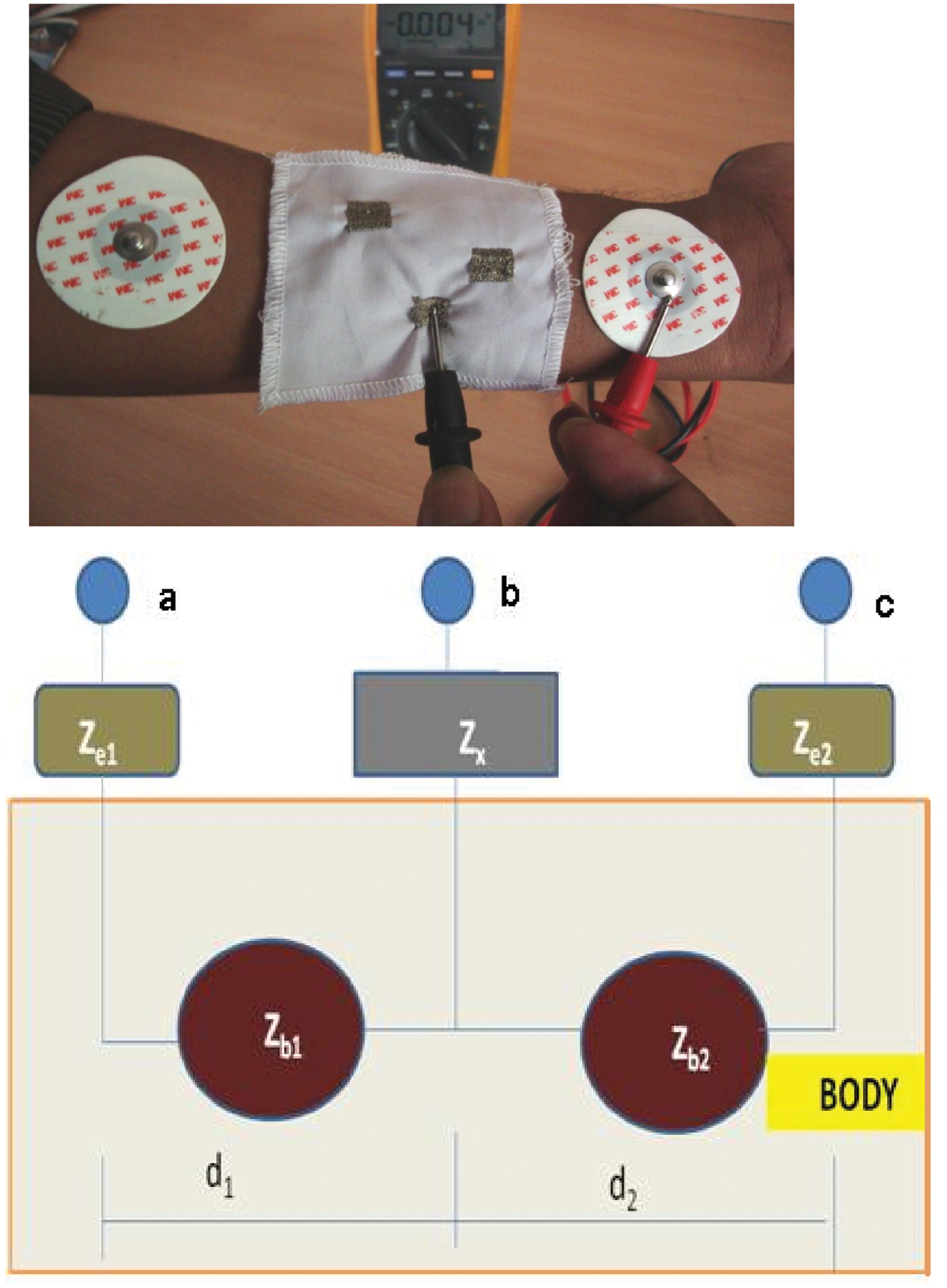
The proposed textile electrode, in this case an unknown electrode (ZX), is located at the center between two reference electrodes (Ze1 and Ze2) such that d1 ≡ d2. The endodermic impedance components between a reference and an unknown electrode were assumed to be Zb1 and Zb2, respectively [7]. If the impedances of the test points (a, b, and c) are measured, the following impedances are obtained:

Since the same reference electrode was used, it is assumed that Zb1 ≡ Zb2 = Zb and Ze1 ≡ Ze2 = Ze and a more simplified impedance of unknown electrode can be obtained:

Digital multimeter with 20 Hz frequency range was used to measure the impedance between the test points a and b, b and c, and a and c and electrode impedance Zx was calculated using the equations (1) and (2). When measuring the impedance of a textile electrode, the impedance tends to decrease because of the increasing contact area and the compression of the silver yarn under a certain level of pressure. Thus, elastic Velcro attachment was used to apply constant level of clothing pressure of 1000 N/m2.
The ECG was measured using Philips ECG monitoring equipment with a recording speed of 25 mm/s. The SNR value of the ECG signal was calculated from the root mean square (RMS) measurement of the isoelectric region.
ECG measurement
The standard 12-lead system is universally used for performing ECG measurement in the hospitals, of which 6 are used for chest leads and 4 for limb or peripheral leads. The chest electrodes are numbered V1 to V6 as shown in Figure 3. Of the six chest leads, V3, V4, and V5 are considered to be the most important. Hence, these three leads were taken for the study with the help of the developed conductive yarn embroidered electrode.
Position of the silver yarn embroidered electrode by the elastic Velcro band.
Physical characteristic of subjects.

BMI: body mass index.
Placement of the silver yarn embroidered electrode on the body surface
The electrode positioning methodology was derived from the previous research [7], as it takes into account the modified limb electrode positions considering the relationship between the heart vector and the body surface points. This relationship indicates that as the distance between two electrodes increases, a larger potential difference can be obtained. However, even if the distance between the electrodes is reduced, the body surface potential originating from the heart dipole could be theoretically obtained.
Based on the above statements the chest leads V3, V4, and V5 were taken as the test electrode configuration. The distance of the electrode configuration was reduced by decreasing the distance between the two bipolar electrodes. The above lead configuration was found to be less sensitive to the motion artifacts due to the shortest distance between the electrodes. Another reason for the selection of the leads V3, V4, and V5 was the lead points V3 and V4 face the heart in the same direction and it monitors the heart’s electrical activity from the vantage point of the anterior surface of the heart.
Evaluation of electrode quality
Evaluation basis for analysis of designed electrodes performance.

The baseline level describes how well the signal baseline settled at the level of 1.6 V, which is determined in the software. The stabilization time was measured from 0 s until the baseline settled to the level of 1.6 V. If time was under 10 s, 2 points, between 11 and 60 s 1 point, and over 60 s 0 points were given. The R-spike peak amplitude refers to the signal strength. If it was over 0.35 V, 2 points were allotted and if it was under 0.01 V, 0 points [8].
Impact of thread consumption
The study was performed to find out the optimum value of thread consumed for a single electrode in order to reduce the cost of the textile electrodes. Initially, 2.6 m of yarn was utilized for a single electrode. The signal offered from this electrode was taken as the base value. From the base value, longer and shorter lengths of yarn were used to make textile electrodes and the corresponding signal strength was measured. It was found that 1.31 m yarn itself was suitable and provided the required signal quality without any loss in performance as compared to the original 2.6 m yarn. Hence a 50% savings in yarn was achieved.
Impact of laundering
The electrode should have washability character in order to perform over extended periods and also for long-term monitoring. The developed electrode was washed using the method ISO105-C06:1994 (color fastness to domestic and commercial laundering) to analyze whether the electrodes have the required washability character and whether the laundering process affects the performance of the electrode [11]. The impact of laundering is discussed in results and discussion section.
Study of repeatability
Repeatability refers to measure of the number of times the electrode provides same results without any deterioration in the performance with respect to ageing. This repeatability character was used as a base for the long-term monitoring. For this study, six subjects were tested using the developed electrode for the period of 2-week intervals. In between 2nd and 4th week, the electrode was washed once.
Results and discussions
Electrode characterization
The electrical resistance of the silver-coated multifilament nylon yarn of 110D/24f was measured. Figure 4 shows the resistance values of the silver-coated nylon yarn with respect to its length. The test was carried out between the lengths of 0.25 m to 1.5 m. The change in resistance was found to be directly proportional to the length.
Effect of yarn length on its resistance value.
Impedance value of the silver yarn embroidered electrode.

SNR value of silver yarn embroidered electrodes.
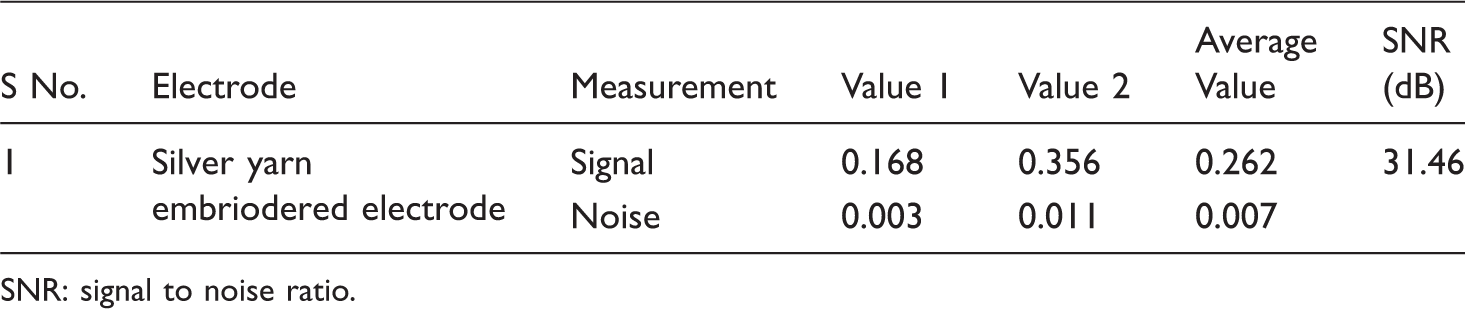
SNR: signal to noise ratio.
Comparison of ECG signals characteristics
Comparison of ECG signal characteristics of Ag/AgCl electrode and textile electrodes.
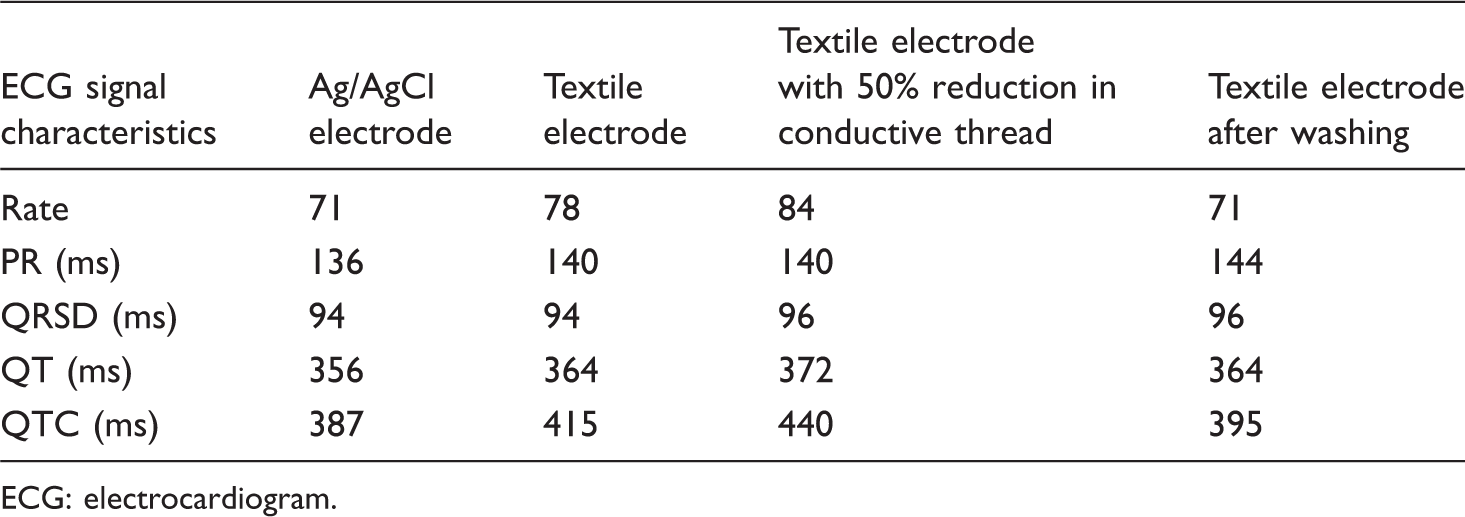
ECG: electrocardiogram.

Comparison of ECG signal characteristics (a to d).
Comparison of ECG results of embroidered textile electrode with commercial electrode
Measurement and result analysis of electrode performance.
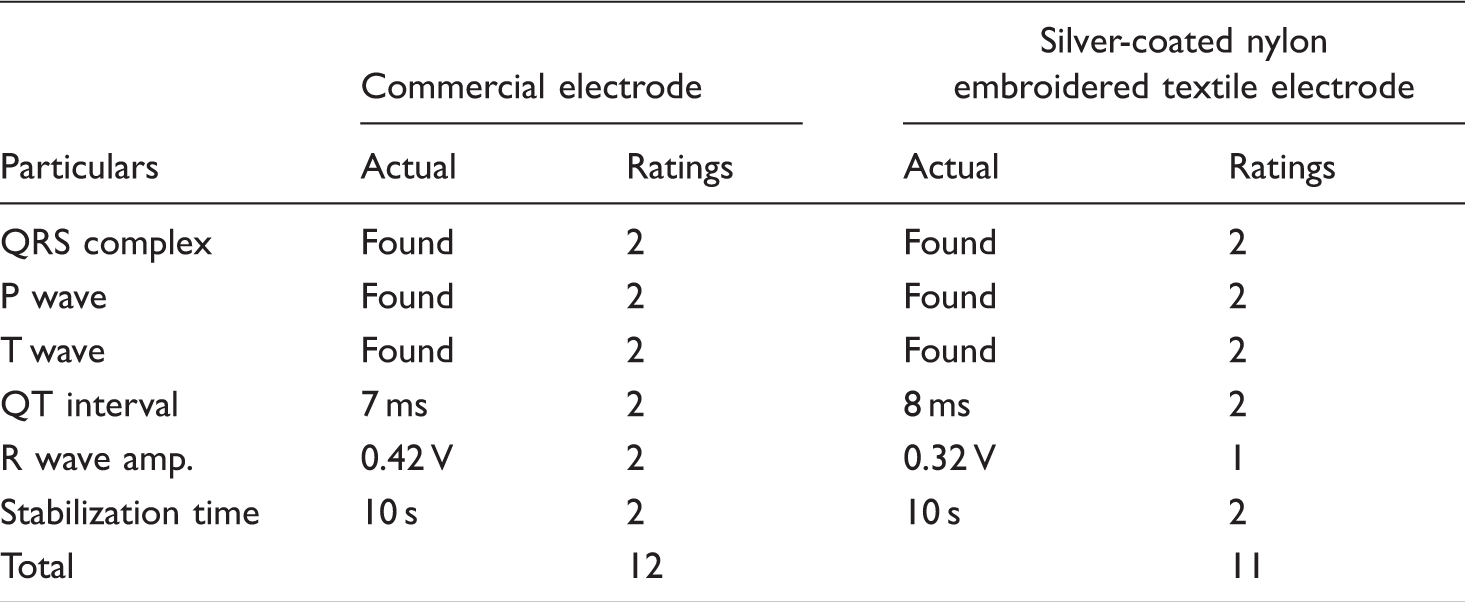
Effect of reduction in conductive thread consumption
Initially 2.6 m of yarn was used for a single electrode of 11 mm × 11 mm size. A 50% reduction in conductive thread consumption was done in the electrode fabrication in order to study the performance of the electrode. Comparison of performance ratings of the original electrode, electrode with 50% less conductive yarn, and commercial electrode (Ag/AgCl) at the V3, V4, and V5 leads are shown in Figure 6.
Effect of thread consumption on textile electrode performance.
From Figure 6, it is observed that the textile electrode made with 50% reduction in the conductive thread (1.31 m) and the textile electrode with 100% thread consumption (2.6 m) show an equivalent rating of 34. The overall performance rating percentage of the electrode with 50% and 100% thread consumption are the same and is 94%, whereas the commercial disposable electrode has 91.6%. It shows that there is no change in the electrode performance due to the reduction in the conductive thread.
Effect of laundering
The developed electrode was washed 15 times to study the effect of laundering on the electrode performance [11]. Figure 7 shows the effect of laundering on the performance of the developed textile electrode. The performance rating percentage for the developed electrodes after and before laundering is 97.22% and 94.4%, respectively. From the results, it is confirmed that laundering process does not affect the performance but only enhances the performance. It is in line with the findings of Pola et al. [8]. However, the enhancement in the performance may be due to the closing of threads in the embroidery structure due to washing and also some structural changes in the base fabric. Because of this, the contact area of the conducting surface might have increased, which resulted in better performance. Hence, the electrode can be reused and also can be used for long-term monitoring.
Effect of laundering on the textile electrode performance.
Study of repeatability
Repeatability of the textile electrode for six subjects.

It is observed from Table 7 that the performance of the developed textile electrode with respect to ageing is negligible. So, the developed electrode can be used for long-term monitoring.
Conclusions
A textile electrode using conductive yarn embroidered on polyester textile fabric was designed and developed for ECG measurement, and the results were compared with commercial disposable electrode in terms of their performance. The impedance of the developed electrode has an acceptable value of 1.45 MΩ. The ECG signals of the developed electrode were similar to Ag/AgCl electrode.
Performance ratings evaluation analysis shows similar results between the developed electrodes and commercially available electrodes. Based on the results of the repeatability study and the electrode performance with respect to 50% less conductive thread consumption and laundering, we conclude that the conductive yarn embroidered textile electrodes are well suited for continuous measurement of ECG signals.
The next step of this research is to develop a wearable monitoring garment that can work in continuous real-time monitoring of heart activity during daily activities with wireless transmission to computers for remote diagnosis of the wearer.
Footnotes
Funding
This research received no specific grant from any funding agency in the public, commercial, or not-for-profit sectors.